O R I G I N A L R E S E A R C H
Dispositional Mindfulness and Past-Negative Time
Perspective: The Differential Mediation Effects of
Resilience and Inner Peace in Meditators and
Non-Meditators
This article was published in the following Dove Press journal: Psychology Research and Behavior Management
Jingjing Ge 1,2
Jingjing Yang 3
Jingjing Song1
Guangyu Jiang 1,2
Yong Zheng 1
1Faculty of Psychology, Southwest
University, Chongqing, People’s Republic
of China;2Department of Humanities and
Management, Guizhou University of Traditional Chinese Medicine, Guiyang,
Guizhou, People’s Republic of China;
3Department of Public Health and
Management, Chongqing Medical
University, Chongqing, People’s Republic
of China
Purpose: Past-negative time perspective (PNTP) can affect our everyday lives and is associated with negative emotions, unhealthy behaviors, rumination, anxiety, depression, and post-traumatic stress disorder (PTSD). Dispositional mindfulness may be able to reduce the negative effects of PNTP; however, few studies have investigated their relationship. Thus, the purpose of this study was to explore the effect dispositional mindfulness has on PNTP, as well as the mediating role of resilience and inner peace in this regard.
Methods: This study investigated the cross-sectional relationship between self-reported mindfulness, resilience, inner peace, and PNTP. In order to further explore the relationship between mindfulness and PNTP, this study specially selected and analyzed the samples of 185 meditators and 181 non-meditators.
Results:Correlation analysis revealed that mindfulness is significantly positively correlated with resilience and inner peace. Conversely, PNTP is significantly negatively correlated with mindfulness, resilience, and inner peace. Structural equation model analysis revealed that resilience and inner peace partially mediated the relationship between mindfulness and PNTP. Furthermore, a multi-group analysis showed that the mediating effects are different between meditators and non-meditators. For meditators, the effect of mindfulness on PNTP was fully mediated by resilience and inner peace. For non-meditators, the effect of mind-fulness on PNTP was only partially mediated by resilience and inner peace.
Conclusion: Based on the significant differences between the mediational models of meditators and non-meditators, we believe that dispositional mindfulness can negatively predict PNTP, and practicing meditation consistently improves dispositional mindfulness, resilience and inner peace and effectively reduces PNTP. Our findings indicate that a combination of mindfulness and PNTP could be used to design new psychological interventions to reduce the symptoms of mental health concerns such as negative bias, rumination, depression, anxiety, and PTSD.
Keywords: psychological intervention, resilience, meditation, past-negative time perspective, unhealthy behaviors, inner peace
Introduction
Past-negative time perspective (PNTP) describes a generally pessimistic, negative, or aversive view and attitude toward the past.1Due to the reconstructive nature of past experiences, these negative views and attitudes may be due to actual experi-ences of unpleasant or traumatic past events, negative reconstruction of benign past Correspondence: Yong Zheng
Faculty of Psychology, Southwest
University, Chongqing, People’s Republic
of China
Tel +86 13667636167 Fax + 86 23 68254139 Email [email protected]
Psychology Research and Behavior Management
Dove
press
open access to scientific and medical research
Open Access Full Text Article
Psychology Research and Behavior Management downloaded from https://www.dovepress.com/ by 118.70.13.36 on 26-Aug-2020
events, or a mix of both. Several studies have shown that PNTP is positively associated with neuroticism,2 and anxiety,1 but is negatively associated with emotional stability,1self-esteem,3and subjective wellbeing.3,4
Although PNTP can affect routine cognitive and beha-vioral decisions, in general, the negative impact PNTP can have on one’s life is controllable. However, some people with high PNTP are prone to engage in unhealthy beha-viors that have a negative impact on their lives, such as excessive drinking or Internet addiction.5,6 Furthermore, some people who experienced negative or traumatic events may even“get stuck in the past,”increasing the likelihood they will develop symptoms of post-traumatic stress dis-order (PTSD),7,8and depression.9,10
Several recent studies have identified a negative associa-tion between disposiassocia-tional mindfulness and PNTP.3,4,11 People with high dispositional mindfulness generally display less PNTP.12Generally speaking, mindfulness is considered to be nonjudgmental acceptance of and nonreactive aware-ness to internal and external stimuli, including emotions, cognitions, and sensory input, as experienced in the present moment.13,14 Dispositional mindfulness is considered to be a psychological trait, and describes one’s tendency to be mindful in everyday life.14–16In recent decades, mindfulness meditation has received a great deal of application and research, these studies have shown that for clinical patients and healthy people alike, mindfulness training can signifi -cantly improve both physical and mental health, as well as promote overall psychological wellbeing. We posit that dis-positional mindfulness may not only be negatively correlated with PNTP, but may also negatively predict PNTP. While PNTP reflects an orientation of attention toward the past with a pessimistic and negative attitude,1mindfulness reflects an orientation of attention toward the present with a neutral and compassionate attitude.12,17Mindfulness involves maintain-ing a conscious awareness of the present moment, which can adjust one’s attention to time, improve one’s attitude toward time, and make one’s perspective of time moreflexible. Thus, we propose hypothesis one: dispositional mindfulness can affect PNTP.
We posit that mindfulness can not only negatively affect PNTP directly, but also may negatively affect PNTP indirectly through resilience. Resilience is a psychological trait that helps individuals who have experienced adversity and trauma adjust and develop during trying circumstances,15thus encouraging successful coping through“self-righting”.18,19It is a protective factor and developmental asset that can help people improve their subjective wellbeing.18 Studies have shown that
dispositional mindfulness can be a significant predictor of resilience.15,20 Some previous studies have found that both dispositional mindfulness and resilience can effectively reduce the symptoms of mental health concerns such as negative bias,21,22rumination,14,23depression,13,24,25 anxiety,13,26 and PTSD.19,25 The IAA model of mindfulness suggests that mindfulness can enhance self-regulation and increase cogni-tive, emotional and behavioral flexibility,25,27 which may increase resilience and enhance adaptive coping to stressful events.20Mindfulness and resilience can reduces these nega-tive symptoms, thereby also reducing PNTP. Thus, we propose hypothesis two: resilience plays a mediating role in the rela-tionship between dispositional mindfulness and PNTP.
In addition to resilience, we also believe that inner peace can play a mediating role in the relationship between dis-positional mindfulness and PNTP. First of all, Xu et al28 consider inner peace, a relatively mild positive emotion, to represent calmness and harmony in the mind. Inner peace was found to significantly decrease symptoms of depression and anxiety; therefore, psychology researchers usually regard inner peace as an important indicator of mental health.29 Lee et al29 further found that compared to Americans, Chinese individuals scored higher on scales used to measure inner peace. This indicates that in Chinese culture, individuals are more focused on inner peace as a core principle in the pursuit of emotional well-being. Xu et al28also identified“peace of mind,”as under-stood in Chinese culture, to be a main component of the Eastern cultural concept of subjective wellbeing. Secondly, in ancient Buddhism, achieving inner peace is the core goal of meditation.30 Empirical studies have shown that inner peace remains an important goal in contemporary medita-tion as well.31,32 Recent studies have demonstrated that dispositional mindfulness is also a significant predictor of experiencing inner peace.28Meditation’s fourfold model of well-being suggests that mindfulness can improve an indi-vidual’s ability to regulate emotions.33 Mindfulness encourages facing one’s own experiences with acceptance and a non-judgmental attitude in the moment. When a person non-judgmentally accepts him/herself instead of blaming or criticizing his/her feelings, emotions, and thoughts, it becomes easier to maintain and enhance emo-tional balance and inner peace.28,31 According to the broaden-and-build theory of positive emotions,34 positive emotions can broaden the scope of cognition, enhance cog-nitiveflexibility, and promote effective problem solving. It is speculated that inner peace could help people reduce negative cognition and increase positive emotions, which
Psychology Research and Behavior Management downloaded from https://www.dovepress.com/ by 118.70.13.36 on 26-Aug-2020
could consequently encourage individuals to develop a more flexible view of life and time, thereby reducing PNTP. Thus, we propose hypotheses three: inner peace plays a mediating role in the relationship between disposi-tional mindfulness and PNTP.
In addition, recent research has found that dispositional mindfulness not only directly affects inner peace but also indirectly affects inner peace through self-acceptance.28 Recent studies have provided evidence that individuals with high resilience also experience more equanimity and peacefulness when facing stressful events.20 We believe that mindfulness can also cultivate and improve inner peace through resilience. Mindfulness can improve resili-ence, and resilience may improve inner peace by improving emotional regulation and cognitiveflexibility.20,25Thus, we propose hypotheses four: resilience and inner peace plays a serial mediating role in the relationship between mind-fulness and PNTP.
At last, Pepping et al35found that experienced medita-tors have significantly higher levels of dispositional mind-fulness than inexperienced meditators. Wittmann et al36 found that the PNTP scores in a long-term meditator group was significantly lower than in the control group (non-meditators). In addition, Liu et al31 found that eight weeks of mindfulness training led to a significant increase in scores for mindfulness and inner peace in the meditation group, compared with the control group (non-mindfulness intervention). After a brief mindfulness training, the mind-fulness and resilience of the participants were significantly improved.37Since these variables may be different between meditators and non-meditators in the present study. Thus, we propose hypothesis five: the serial mediating role of resilience and inner peace affecting dispositional mindful-ness and PNTP may be different in meditators and non-meditators.
Materials and Methods
Participants
In total, questionnaires were distributed to 416 participants in the meditator group and the working population through an Internet platform; however, due to incomplete informa-tion about meditainforma-tion practice, data of 50 participants were excluded from analysis. Thus, a total of 366 individuals (152 female; 214 male) completed the questionnaire and were included in thefinal study sample. Thefinal analysis sample had an overall age range of 18 to 55 years with a mean age of 33.71 years (SD = 7.81). The education level of the
sample was generally high, with 81.15% of the participants having completed university studies. Of the participants, 185 (75 female; 110 male) regularly engaged in meditation and had an overall age range of 18 to 55 years, with a mean age of 34.41 years (SD = 8.07). The other participants were 181 individuals (77 female; 104 male) who had never regularly meditated (although they may have tried it once or on a few occasions) and had an overall age range of 19 to 54 years, with a mean age of 32.99 years (SD = 7.49).
Procedure
The present study was approved by the ethics committee of the Faculty of Psychology at Southwest University, China. All participants gave online informed consent before completing the questionnaire. Respondents were told that the questionnaire was entirely anonymous, and that they would receive feedback regarding their results.
Measures
Meditation Experience Information
Meditation experience was assessed with a brief question-naire designed by Baer et al.38Among the regular medita-tors, mean lifetime duration of meditation practice was 616.51 hours (SD = 845.294), and ranged among partici-pants from 20 hours to 3000 hours. More than half (55.68%) reported meditating more than three times per week. Meditation practice was defined broadly, and included Vipassana meditation, loving kindness meditation, walking meditation, and yoga.
Measurement of Dispositional Mindfulness
Dispositional mindfulness was measured using the Chinese version of the Mindful Attention Awareness Scale (MAAS).39 The MAAS consists of one dimension and 15 items rated on a 6-point scale ranging from 1 (“almost always”) to 6 (“almost never”). Previous research found that the MAAS has good reliability and validity.39In the present study, the reliability coefficient of the whole scale was 0.88.
Measurement of Resilience
Resilience was assessed using the Chinese version of the Connor-Davidson Resilience Scale (CD-RISC), as trans-lated and revised by Yu and Zhang.40The CD-RISC con-tains 25 items and divides resilience into three dimensions: fortitude, self-improvement, and optimism. The CD-RISC rates each item on a 5-point scale ranging from 0 (“not true at all”) to 5 (“true nearly all of the time”), with higher scores reflecting greater resilience. The Chinese version of
Psychology Research and Behavior Management downloaded from https://www.dovepress.com/ by 118.70.13.36 on 26-Aug-2020
the CD-RISC has been shown to have good reliability and validity.40In the present study, the reliability coefficient of the whole scale was 0.90, and the reliability coefficients for the subscales were 0.84 for fortitude, 0.70 for self-improvement, and 0.63 for optimism.
Measurement of Inner Peace
The Peace of Mind Scale (PoM) was used to measure peace of mind.29It comprises a total of 7 items rated on a 5-point scale ranging from 1 (“not at all”) to 5 (“all of the time”). Previous research found that the PoM has good reliability and validity.29Cronbach’s alpha in the present study was 0.89.
Measurement of Past-Negative Time Perspective PNTP was measured using the past-negative dimension of the Zimbardo Time Perspective Inventory (ZTPI).1 The ZTPI has shown good cross-cultural reliability and validity.41The past-negative dimension of the ZTPI com-prises 10 items rated on a 5-point Likert scale. In the present study, the reliability coefficient of the PNTP scale was 0.83.
Statistical Analyses
All analyses in this study were made using the SPSS 23.0 and AMOS 23.0 software programs. First, we examined the descriptive statistics and correlations of the study vari-ables using SPSS 23.0. Second, AMOS 23.0 was used to establish structural equation models and examine the med-iating effects and differences in the totality of the medita-tor and non-meditamedita-tor groups.
Results
Common Method Bias Test
After the data collection was completed, a Harman single factor test was used to test common method bias. The results showed that the first factor only accounted for 21.99% of variance, which was below the critical standard of 40%, indicating that common method bias was not significant.
Descriptive Statistics and Correlation
Analysis of Each Variable
The results, as shown in Table 1, demonstrate that mind-fulness is significantly positively correlated with resilience and inner peace. Conversely, PNTP is negatively corre-lated with mindfulness, resilience, and inner peace.
t
-Test for Differences Between Meditator
and Non-Meditator Groups
After independent sample t-test and chi-square test, the results are shown inTable 2, no significant differences in gender, age, educational background or economic income between The two groups.
As shown inTable 3, results of thet-test indicated that meditators and non-meditators show significant differ-ences in mindfulness, inner peace, and PNTP.
Testing the Multiple Mediation Model of
Dispositional Mindfulness In
fl
uencing
Past-Negative Time Perspective
Wu and Wen42 suggest that a single dimensional scale should be parceled. In the present study, these parcels
Table 1 Correlations Between Mindfulness, Resilience, Inner Peace, and PNTP
Mean SD 1 2 3 4
1. Mindfulness 3.82 0.75 –
2. Resilience 2.45 0.51 0.37** –
3. Inner peace 3.33 0.69 0.38** 0.56** –
4. PNTP 2.84 0.70 −0.41** −0.41** −0.49** –
Notes:n = 366, **p< 0.01.
Abbreviation:PNTP, past-negative time perspective.
Table 2 t-Test and Chi-Square Test of Major Demographic Variables Between the Meditation Group and the Non-Meditation Group
Meditator
Group
(n = 185)
Non-Meditator
Group (n=181)
t/F-value P
Age (years) (Mean±SD)
34.41±8.069 32.99±7.491 1.739 0.083
Gender 0.151 0.698
Male 110 104
Female 75 77
Educational situation
4.828 0.089
Junior college and below
38 31
University 78 97
Postgraduate 69 53
Monthly income (RMB)
4.455 0.108
<3000 21 16
3000~6000 106 123
>6000 58 42
Psychology Research and Behavior Management downloaded from https://www.dovepress.com/ by 118.70.13.36 on 26-Aug-2020
were formed to control for inflated measurement errors caused by multiple items for the latent factor. Three item parcels each were created for mindfulness and PNTP and two item parcels were created for inner peace. A random algorithm was used to combine the items into parcels. In addition, the variables of gender and age were controlled in the subsequent structural equation model analysis. Next, we created a multiple mediation model to examine whether resilience and inner peace mediate the impact of dispositional mindfulness on PNTP, and, if so, how this is done. Finally, AMOS 23.0 was used to perform bootstrap-ping procedures to test the significance of the mediation effects of resilience and inner peace. We generated 2000 bootstrapping samples from the original dataset (N = 366) through random sampling. Empirical 95% confidence intervals did not contain zero, indicating that the indirect effect was statistically significant.
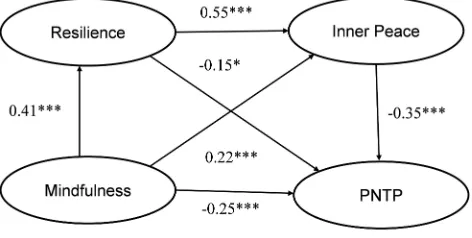
As shown inFigure 1andTable 4, the bootstrap method revealed that both resilience and inner peace mediate the association between dispositional mindfulness and PNTP. The significant mediating roles were: (a) that of resilience for PNTP, accounting for 12.95% of the total effect (95% CI [−0.096, −0.001]); (b) that of inner peace for PNTP,
accounting for 16.35% of the total effect (95% CI [−0.102,
−0.023]); and (c) the serial mediating role of resilience via inner peace for PNTP, which accounted for 16.99% of the total effect (95% CI [−0.102,−0.031]). Therefore, ourfi nd-ings also support hypotheses 1, 2, 3, and 4.
Testing Group Differences Between
Meditators and Non-Meditators in the
Multiple Mediation Model
First, the mediation effect model was tested on the medi-tator and non-medimedi-tator groups, respectively. The fit indices of the obtained models are shown in Table 5. Both the meditator model (Mm) and the non-meditator model (Mn) were acceptable and can be compared across groups.
Next, using the multi-group comparison method of structural equation modeling, the unconstrained model (M1) and the structural covariances model (M2) were set. Thefitting results of the two models are shown inTable 5 wherein a significant difference between M1and M2(Δχ
2
=52.18,Δdf =19, p< 0.001) is indicated. These findings support hypothesis 5.
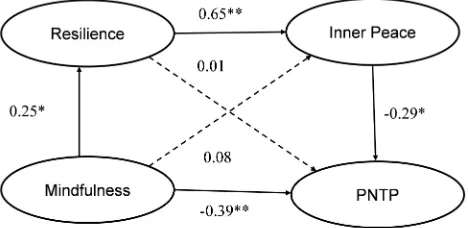
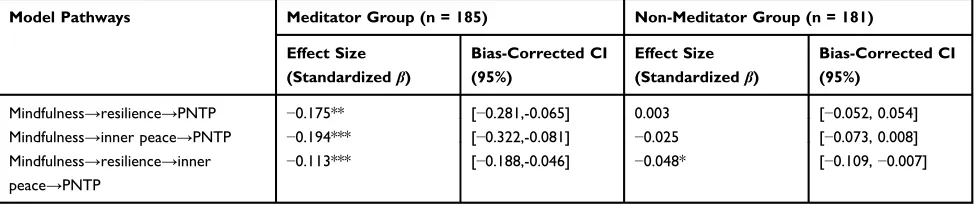
As shown inFigures 2and3andTable 6, the bootstrap method was used to test the mediation effects of the meditator and non-meditator models. In the meditator group, the serial mediating role of resilience and inner peace between mindfulness and PNTP accounted for 23.44% of the total effect (95% CI [−0.188, −0.046]), and the serial mediating effects in the non-meditator group accounted for 10.98% of the total effect (95% CI [−0.109,−0.007]).
In the meditator group, resilience and inner peace had significant intermediation between mindfulness and PNTP, respectively. Resilience for PNTP accounted for 36.31% of the total effect (95% CI [−0.281, −0.065]), and inner
Table 3 Group Differences Between Meditators and Non-Meditators in Mindfulness, Resilience, Inner Peace, and PNTP
Meditator Group Mean±SD (n = 185)
Non-Meditator Group Mean±SD (n = 181)
t P
Mindfulness 4.11±0.73 3.52±0.66 8.12*** 0.000
Resilience 2.49±0.51 2.40±0.50 1.57 0.116
Inner peace 3.42±0.69 3.24±0.68 2.50* 0.013
PNTP 2.73±0.75 2.95±0.63 −2.99** 0.003
Notes:n = 366, *p< 0.05, **p< 0.01, ***p< 0.001. Abbreviation:PNTP, past-negative time perspective.
Figure 1The multiple mediator model of mindfulness on PNTP. Notes:*p< 0.05, ***p< 0.001.
Abbreviation:PNTP, past-negative time perspective.
Table 4 Bootstrapping Indirect Effects and 95% Confidence Intervals (CI) for the Mediation Model
Model Pathways Effect Size Bias-Corrected CI
(95%) Standardized
β
Mindfulness→resilience→PNTP −0.06* [−0.096,−0.001] Mindfulness→inner peace→PNTP −0.08** [−0.102,−0.023] Mindfulness→resilience→inner
peace→PNTP
−0.08*** [−0.102,−0.031]
Notes:n = 366, *p< 0.05, **p< 0.01, ***p< 0.001. Abbreviation:PNTP, past-negative time perspective.
Psychology Research and Behavior Management downloaded from https://www.dovepress.com/ by 118.70.13.36 on 26-Aug-2020
peace for PNTP accounted for 40.25% of the total effect (95% CI [−0.322,−0.081]). The non-meditator group did not display these two effects.
Discussion
The Multiple Mediation Model of
Dispositional Mindfulness In
fl
uencing
Past-Negative Time Perspective in the
Whole Group
Our findings show that dispositional mindfulness nega-tively affects PNTP. On the one hand, dispositional
mindfulness can negatively predict PNTP, and previous studies have found a negative correlation between disposi-tional mindfulness and PNTP.4,11However, our research is a step forward from these studies as they have not further explored the relationship between dispositional mindful-ness and PNTP. Mindfulmindful-ness may be able to directly affect PNTP because mindfulness is a way of balancing aware-ness, encouraging one to observe thoughts and feelings without avoiding or attempting to change them or applying exaggeration or bias.33 This style of awareness can help reduce self-criticism, avoid overthinking negative events, and protect individuals from the harmful effects of depres-sion, anxiety, and other negative emotional states.13,14,39 Furthermore, as a result of the influences of culture, educa-tion, religion, social class, and family, humans can rely too much on a particular time perspective, and this behavior becomes automatic.1 Mindfulness has a de-automating effect that can reduce tendencies towards cognitive beha-vioral habituation,43helping to reduce automatic or habitual overuse of a particular time perspective.
On the other hand, dispositional mindfulness can also indirectly affect PNTP through resilience or inner peace. This is consistent with the IAA model of mindfulness which indicates that mindfulness involves a nonjudgmental aware-ness and acceptance of the present experience.21,27 This enhances individuals’cognitive functioning and emotional regulation, thereby improving resilience and enhancing inner peace, and may, therefore provide a more balanced andflexible time perspective.
The Differences in Multiple Mediation
Models of Dispositional Mindfulness
In
fl
uencing PNTP in the Meditator and
Non-Meditator Groups
The present study found that for the meditator group, the influence of dispositional mindfulness on PNTP was com-pletely mediated by resilience and inner peace. For the non-meditator group, only a small part of the influence of dispositiona mindfulness on PNTP was mediated by
Table 5Comparison of the Difference Between Meditator and Non-Meditator Groups in the Serial Mediation Models
Model χ2
df RMSEΑ GFI NFI TLI CFI
Mm 98.936 58 0.062 0.927 0.927 0.957 0.968
Mn 111.915 58 0.072 0.918 0.884 0.918 0.939
M1 210.852 116 0.047 0.923 0.909 0.941 0.956
M2 263.033 135 0.051 0.905 0.886 0.931 0.941
Abbreviations:Mm, the meditator model; Mn, the non-meditator model; M1, the unconstrained model; M2, the structural covariances model.
Figure 2The multiple mediator model of mindfulness on PNTP (meditator group). Notes:The dashed lines in thefigure indicate that the path coefficient was not significant; ***p< 0.001.
Abbreviation:PNTP, past-negative time perspective.
Figure 3The multiple mediator model of mindfulness on PNTP (non-meditator group).
Notes:The dashed lines in thefigure indicate that the path coefficient was not significant; *p< 0.05, **p< 0.01.
Abbreviation:PNTP, past-negative time perspective.
Psychology Research and Behavior Management downloaded from https://www.dovepress.com/ by 118.70.13.36 on 26-Aug-2020
resilience and inner peace. This may be because in the meditator group, due to the regular and continuous practice of meditation, resilience and inner peace have gradually become internalized as relatively stable psychological qua-lities. This is consistent with previous studies showing that mindfulness meditation can cultivate qualities such as lov-ing-kindness, compassion, inner peace, and resilience.20,33 Additionally, Buddhism has a system of meditative prac-tices for cultivating similar qualities, further illustrating the importance of meditation practice. Mindfulness meditation has always emphasized that only by the consistent practi-cing of mindfulness skills can these qualities be cultivated, maintained, and improved.
Additionally, the present study found that for the med-itator group, the effect of inner peace was greater than that of resilience, suggesting that inner peace may be an impor-tant predictor of and a good representation of Chinese emotional wellbeing. This finding is consistent with pre-vious research.28,31 According to Lee et al,29 traditional Chinese culture is greatly influenced by the three main religions or philosophies of Taoism, Confucianism, and Buddhism, which all value and emphasize inner peace. Additionally, mindfulness can promote inner peace, which is both consistent with previous research and with Buddhist thought.28,31 The ultimate goal of meditation is inner peace, and in Buddhism, inner peace is considered to be the most important thing in life.30,31
Finally, the present study found that for non-meditators, the direct effect of mindfulness on PNTP accounted for 89.04% of the total effect. Arguably, the direct effect of mindfulness on PNTP is relatively large, while the indirect effect of resilience and inner peace only provide a relatively small part of the total effect. This shows that mindfulness can promote psychological func-tioning and mental health, allowing individuals to better understand, manage, and solve problems in daily life,
thereby reducing PNTP. However, the direct effect of mindfulness on PNTP also suggests that mindfulness may reduce PNTP in other ways as well. In addition to resilience and inner peace, there may be other mediating variables, which future research should work to identify.
Conclusion and Limitations
This study has a few limitations. Firstly, the results relied completely upon self-report data, which may have potential problems, such as recall bias or response bias. Also, mind-fulness is a complex and abstract construct that involves an advanced level of meta-cognition,44so self-report methods may not be a reliable source of information.45 Future research can add direct and objective assessment measures (e.g., the Triangle task) or qualitative analysis to supple-ment the assesssupple-ment of mindfulness.45Secondly, since this study adopted a cross-sectional design, it was not appro-priate to make causal inferences. In addition, we took mind-fulness as the independent variable and PNTP as the mediating variable, and took inner peace or resilience as the dependent variables to make structural equation models. Although the models are weak, they remain significant, thus, the interpretation proposed here should be treated with proper caution. Future studies should design experi-ments or longitudinal studies that could complement and validate ourfindings.
Additionally, a multi-group analysis showed that, for meditators, the effect of dispositional mindfulness on PNTP was fully mediated by resilience and inner peace; however, for non-meditators, the effect of mindfulness on PNTP was partially mediated by resilience and inner peace. Thus, the mediational model was significantly different between meditators and non-meditators. On the basis of thesefindings, we conclude that dispositional mindfulness, resilience, and inner peace all negatively predict PNTP. Finally, some studies have found that the psychological
Table 6Bootstrapping Indirect Effects and 95% Confidence Intervals (CI) for the Mediation Model in Meditators and Non-Meditators
Model Pathways Meditator Group (n = 185) Non-Meditator Group (n = 181)
Effect Size (Standardizedβ)
Bias-Corrected CI (95%)
Effect Size (Standardizedβ)
Bias-Corrected CI (95%)
Mindfulness→resilience→PNTP −0.175** [−0.281,-0.065] 0.003 [−0.052, 0.054]
Mindfulness→inner peace→PNTP −0.194*** [−0.322,-0.081] −0.025 [−0.073, 0.008]
Mindfulness→resilience→inner
peace→PNTP
−0.113*** [−0.188,-0.046] −0.048* [−0.109,−0.007]
Notes:*p< 0.05, **p< 0.01, ***p< 0.001. Abbreviation:PNTP, past-negative time perspective.
Psychology Research and Behavior Management downloaded from https://www.dovepress.com/ by 118.70.13.36 on 26-Aug-2020
problems, such as emotional regulation, addiction, procras-tination, anxiety, depression, can be relieved or reduced by regulating the individual’s PNTP or by jointly regulating other dimensions of time perspectives.46,47 In the future, a combination of mindfulness and time perspective could be used to design new psychological interventions to regulate moods, manage addiction, reduce unhealthy behaviors, relieve stress and PTSD, and promote positive individual mental health outcomes.
Acknowledgments
The authors would like to thank the research assistants who undertook data collection and the participants for their selfless support of the study.
Author Contributions
All authors contributed to data analysis, drafting and revis-ing the article, gave final approval of the version to be published, and agree to be accountable for all aspects of the work.
Funding
This research was supported by the MOE Project of Key Research Institute of Humanities and Social Sciences at Universities (15JJDZONGHE022), China.
Disclosure
The authors report no conflicts of interest in this work.
References
1. Zimbardo PG, Boyd JN. Putting time in perspective: a valid, reliable
individual-differences metric. J Pers Soc Psychol. 1999;77
(6):1271–1288. doi:10.1037/0022-3514.77.6.1271
2. Sobol-Kwapinska M. Calm down—It’s only neuroticism. Time per-spectives as moderators and mediators of the relationship between neuroticism and well-being. Pers Indiv Differ. 2016;94:64–71. doi:10.1016/j.paid.2016.01.004
3. Seema R, Sircova A. Mindfulness–a time perspective? Estonian study.
Baltic J Psychol.2013;14:4–21.
4. Ge J, Wu J, Li K, Zheng Y. Self-compassion and subjective well-being mediate the impact of mindfulness on balanced time perspective in Chinese college students. Front Psychol. 2019;10:367. doi:10.3389/ fpsyg.2019.00367
5. Chavarria J, Allan NP, Moltisanti A, Taylor J. The effects of present hedonistic time perspective and past negative time perspective on substance use consequences.Drug Alcohol Depend.2015;152:39–46. doi:10.1016/j.drugalcdep.2015.04.027
6. Przepiorka A, Blachnio A. Time perspective in internet and Facebook addiction. Comput Human Behav. 2016;60:13–18. doi:10.1016/j. chb.2016.02.045
7. Kazak AE, Boeving CA, Alderfer MA, Hwang WT, Reilly A. Posttraumatic stress symptoms during treatment in parents of children with cancer. J Clin Oncol. 2005;23(30):7405–7410. doi:10.1200/ JCO.2005.09.110
8. Stolarski M, Cyniak-Cieciura M. Balanced and less traumatized: balanced time perspective mediates the relationship between tem-perament and severity of PTSD syndrome in motor vehicle accident survivor sample.Pers Indiv Differ.2016;101:456–461. doi:10.1016/j. paid.2016.06.055
9. Bitsko MJ, Stern M, Dillon R, Russell EC, Laver J. Happiness and time perspective as potential mediators of quality of life and
depres-sion in adolescent cancer. Pediatr Blood Cancer. 2008;50
(3):613–619. doi:10.1002/pbc.21337
10. Habermas T, Ott L, Schubert M, Schneider B, Pate A. Stuck in the past: negative bias, explanatory style, temporal order, and evaluative perspectives in life narratives of clinically depressed individuals.
Depress Anxiety.2008;25(11):121–132. doi:10.1002/da.20389 11. Drake L, Duncan E, Sutherland F, Abernethy C, Henry C. Time
perspective and correlates of wellbeing. Time Soc. 2008;17
(1):47–61. doi:10.1177/0961463X07086304
12. Wittmann M, Peter J, Gutina O, Otten S, Kohls N, Meissner K. Individual differences in self-attributed mindfulness levels are related to the experience of time and cognitive self-control.Pers Indiv Differ.
2014;64:41–45. doi:10.1016/j.paid.2014.02.011
13. Brown KW, Ryan RM. The benefits of being present: mindfulness and its role in psychological well-being.J Pers Soc Psychol.2003;84 (4):822–848. doi:10.1037/0022-3514.84.4.822
14. Josefsson T, Ivarsson A, Lindwall M, et al. Mindfulness mechanisms in sports: mediating effects of rumination and emotion regulation on sport-specific coping. Mindfulness. 2017;8(5):1354–1363. doi:10.10 07/s12671-017-0711-4
15. Bajaj B, Pande N. Mediating role of resilience in the impact of mindfulness on life satisfaction and affect as indices of subjective well-being. Pers Indiv Differ. 2016;93:63–67. doi:10.1016/j.paid. 2015.09.005
16. Short MM, Mazmanian D, Oinonen K, Mushquash CJ. Executive function and self-regulation mediate dispositional mindfulness and well-being. Pers Indiv Differ. 2016;93:97–103. doi:10.1016/j. paid.2015.08.007
17. Stolarski M, Vowinckel J, Jankowski KS, Zajenkowski M. Mind the balance, be contented: balanced time perspective mediates the rela-tionship between mindfulness and life satisfaction.Pers Indiv Differ.
2016;93:27–31. doi:10.1016/j.paid.2015.09.039
18. Richardson GE. The metatheory of resilience and resiliency.J Clin Psychol.2002;58(3):307–321. doi:10.1002/jclp.10020
19. Zheng Y, Fan F, Yu C, Luo T.Relationship between gratitude and symptoms of post-traumatic stress disorder among adolescents: med-iation of social support and resilience.Psychol Dev Educ.2011;27 (05):522–528.
20. Epstein RM, Krasner MS. Physician resilience: what it means, why it matters, and how to promote it. Acad Med. 2013;88(3):301–303. doi:10.1097/ACM.0b013e318280cff0
21. Garland EL, Farb NA, Goldin P, Fredrickson BL. Mindfulness broadens awareness and builds eudaimonic meaning: a process model of mindful positive emotion regulation.Psychol Inq.2015;26(4):293–314. doi:10. 1080/1047840X.2015.1064294
22. Kiken LG, Shook NJ. Looking up: mindfulness increases positive judgments and reduces negativity bias.Soc Psychol Pers Sci.2010;2 (4):425–431. doi:10.1177/1948550610396585
23. Wolkin JR. Cultivating multiple aspects of attention through mind-fulness meditation accounts for psychological well-being through decreased rumination. Psychol Res Behav Ma. 2015;8:171–180. doi:10.2147/PRBM.S31458
24. Edenfield TM, Saeed SA. An update on mindfulness meditation as a self-help treatment for anxiety and depression.Psychol Res Behav Ma.2012;5:131–141. doi:10.2147/PRBM.S34937
25. Thompson RW, Arnkoff DB, Glass CR. Conceptualizing mindfulness and acceptance as components of psychological resilience to trauma.
Trauma Violence Abuse. 2011;12(4):220–235. doi:10.1177/152483 8011416375
Psychology Research and Behavior Management downloaded from https://www.dovepress.com/ by 118.70.13.36 on 26-Aug-2020
26. Chen JH, Tsai PH, Lin YC, Chen CK, Chen CY. Mindfulness training enhancesflow state and mental health among baseball players in Taiwan.Psychol Res Behav Manage.2019;12:15–21. doi:10.2147/ PRBM.S188734
27. Shapiro SL, Carlson LE, Astin JA, Freedman B. Mechanisms of mindfulness. J Clin Psychol. 2006;62(3):373–386. doi:10.1002/ jclp.20237
28. Xu W, Rodriguez MA, Zhang Q, Liu X. The mediating effect of self-acceptance in the relationship between mindfulness and peace of mind.Mindfulness.2015;6(4):797–802. doi:10.1007/s12671-014-0319-x 29. Lee Y, Lin Y, Huang C, Fredrickson BL. The construct and measure-ment of peace of mind. J Happiness Stud. 2013;14(2):571–590. doi:10.1007/s10902-012-9343-5
30. Desbordes G, Gard T, Hoge EA, et al. Moving beyond mindfulness: defining equanimity as an outcome measure in meditation and con-templative research.Mindfulness. 2015;6(2):356–372. doi:10.1007/ s12671-013-0269-8
31. Liu X, Xu W, Wang Y, et al. Can inner peace be improved by mindfulness training: a randomized controlled trial.Stress Health.
2015;31(3):245–254. doi:10.1002/smi.2551
32. Ren J, Huang L, Zhang Z. Meditation makes a peaceful state of mind: people’s positive and negative emotional response can be reduced by meditation training. Acta Psychol Sin. 2012;44(10):1339–1348. doi:10.3724/SP.J.1041.2012.01339
33. Wallace BA, Shapiro SL. Mental balance and well-being: building
bridges between buddhism and western psychology. Am Psycho.
2006;7(61):690–701. doi:10.1037/0003-066X.61.7.690
34. Fredrickson BL, Branigan C. Positive emotions broaden the scope of attention and thought-action repertoires. Cogn Emot. 2005;19 (3):313–332. doi:10.1080/02699930441000238
35. Pepping CA, O’Donovan A, Davis PJ. The differential relationship between mindfulness and attachment in experienced and inexper-ienced meditators. Mindfulness. 2014;5(4):392–399. doi:10.1007/ s12671-012-0193-3
36. Wittmann M, Otten S, Schã Tz E, et al. Subjective expansion of
extended time-spans in experienced meditators. Front Psychol.
2015;5:1586. doi:10.3389/fpsyg.2014.01586
37. Kemper KJ, Khirallah M. Acute effects of online mind–body skills training on resilience, mindfulness, and empathy. J Evid Based Complementary Altern Med. 2015;20(4):247–253. doi:10.1177/ 2156587215575816
38. Baer RA, Smith GT, Lykins E, et al. Construct validity of thefive facet mindfulness questionnaire in meditating and nonmeditating samples.
Assessment.2008;15(3):329–342. doi:10.1177/1073191107313003 39. Deng YQ, Li S, Tang YY, Zhu LH, Ryan R, Brown K. Psychometric
properties of the Chinese translation of the Mindful Attention Awareness Scale (MAAS). Mindfulness. 2012;3(1):10–14. doi:10.1007/s12671-011-0074-1
40. Yu X, Zhang J. A comparison between the Chinese version of ego-resiliency scale and connor-davidson resilience scale. Psychol Sci.2007;30:1169–1171.
41. Sircova A, van de Vijver FJ, Osin E, et al. A global look at time: a 24-country study of the equivalence of the zimbardo time perspective inventory.SAGE Open.2014;1(4):1–12.
42. Wu Y, Wen Z.Item parceling strategies in structural equation modeling.Adv Psychol Sci.2011;19(12):1859–1867.
43. Wang Y, Xin TT, Liu XH, Zhang Y, Lu HH, Zhai YB. Mindfulness can reduce automatic responding: evidences from Stroop task and prospective memory task.Acta Psychol Sin.2012;44(9):1180–1188. doi:10.3724/SP.J.1041.2012.01180
44. Bishop SR. Mindfulness: a proposed operational definition. Clin Psychol Sci Pract.2004;11(3):230–241.
45. Bercovitz K, Pagnini F, Phillips D, Langer E. Utilizing a creative task to assess langerian mindfulness.Creat Res J.2017;29(2):194–199. doi:10.1080/10400419.2017.1304080
46. Sword RM, Sword RKM, Brunskill SR, Zimbardo PG. Time perspec-tive therapy: a new time-based metaphor therapy for PTSD.J Loss Trauma.2014;19(3):197–201. doi:10.1080/15325024.2013.763632 47. Zimbardo PG, Sword R, Sword R. The time cure: overcoming PTSD
with the new psychology of time perspective therapy.J Fam Ther.
2012;41(5):452–454.
Psychology Research and Behavior Management
Dove
press
Publish your work in this journal
Psychology Research and Behavior Management is an international, peer-reviewed, open access journal focusing on the science of psychol-ogy and its application in behavior management to develop improved outcomes in the clinical, educational, sports and business arenas. Specific topics covered in the journal include: Neuroscience, memory and decision making; Behavior modification and management; Clinical
applications; Business and sports performance management; Social and developmental studies; Animal studies. The manuscript manage-ment system is completely online and includes a very quick and fair peer-review system, which is all easy to use. Visit http://www. dovepress.com/testimonials.php to read real quotes from published authors.
Submit your manuscript here:https://www.dovepress.com/psychology-research-and-behavior-management-journal
Psychology Research and Behavior Management downloaded from https://www.dovepress.com/ by 118.70.13.36 on 26-Aug-2020