R E S E A R C H A R T I C L E
Open Access
Development and evaluation of a
standardized peer-training in the context of
peer review for quality assurance in work
capacity evaluation
André Strahl
1,2*, Christian Gerlich
1, Georg W. Alpers
3, Katja Ehrmann
1, Jörg Gehrke
4, Annette Müller-Garnn
4and Heiner Vogel
1Abstract
Background:The German quality assurance programme for evaluating work capacity is based on peer review that evaluates the quality of medical experts’reports. Low reliability is thought to be due to systematic differences among peers. For this purpose, we developed a curriculum for a standardized peer-training (SPT). This study investigates, whether the SPT increases the inter-rater reliability of social medical physicians participating in a cross-institutional peer review.
Methods:Forty physicians from 16 regional German Pension Insurances were subjected to SPT. The three-day training course consist of nine educational objectives recorded in a training manual. The SPT is split into a basic module providing basic information about the peer review and an advanced module for small groups of up to 12 peers training peer review using medical reports. Feasibility was tested by assessing selection, comprehensibility and subjective use of contents delivered, the trainers’delivery and design of training materials. The effectiveness of SPT was determined by evaluating peer concordance using three anonymised medical reports assessed by each peer. Percentage agreement and Fleiss’kappa (κm) were calculated. Concordance was compared with review results from a previous
unstructured, non-standardized peer-training programme (control condition) performed by 19 peers from 12 German Pension Insurances departments. The control condition focused exclusively on the application of peer review in small groups. No specifically training materials, methods and trainer instructions were used.
Results:Peer-training was shown to be feasible. The level of subjective confidence in handling the peer review instrument varied between 70 and 90%. Average percentage agreement for the main outcome criterion was 60.2%, resulting in aκmof 0.39. By comparison, the average percentage concordance was 40.2% and theκmwas 0.12 for the
control condition.
Conclusion:Concordance with the main criterion was relevant but not significant (p= 0.2) higher for SPT than for the control condition. Fleiss’kappa coefficient showed that peer concordance was higher for SPT than randomly expected. Nevertheless, a score of 0.39 for the main criterion indicated only fair inter-rater reliability, considerably lower than the conventional standard of 0.7 for adequate reliability.
Keywords:Training curriculum, Peer review, Quality assurance, Work capacity evaluation, Inter-rater reliability
* Correspondence:[email protected];[email protected] 1
Department of Medical Psychology, Medical Sociology, and Rehabilitation Sciences, University of Würzburg, Klinikstraße 3, 97070 Würzburg, Germany 2Department of Orthopaedics, University Medical Center
Hamburg-Eppendorf, Martinistraße 52, 20246 Hamburg, Germany Full list of author information is available at the end of the article
Background
Peer review
Assessing medical records in the context of a peer-review procedure is a widely used quality assurance method [1,2]. Peer review procedures have been shown to be empirically effective, when used together with systematic feedback of results [3, 4]. The central quality criterion for uni-formity of peer judgements is inter-rater reliability. Fair quality comparisons require highly independent reviews conducted by individual peers. If an individual assessment is highly reliable, there is no need for evaluation by more than one peer [5–7].
There is no generally accepted standard for interpret-ing inter-rater reliability; often, reliability coefficients
≥0.7 are interpreted as good [6,8,9]. However, reliability coefficient in peer review procedures are often lower than 0.7 [2,7,10–13]. Implementation of peer review of-fers the chance to use and process quality assurance re-sults in internal quality management procedures [3,14].
Peer review in work capacity evaluation
The German Statutory Pension Insurance has developed a peer review procedure to evaluate the quality of med-ical experts’ reports assessing work capacity. This med-ical evaluation is a basic prerequisite for determining eligibility for disability benefits. Results are anchored in a medical report. The concept of peer review is based on six subsidiary quality domains and one superordinate criterion, summarized in a catalogue of 23 items. The six quality domains include significant aspects covering the quality of evaluation of work capacity, specifically: for-mal structure, clarity, transparency, completeness, medical-scientific principles, and the efficiency of the medical report. Each of these 22 items is reported using a four-point ordinal rating scale. The twenty-third item, the superordinate criterion, refers to the plausibility of assessment using a coherent line of reasoning (confirm-ability of the medical report). This item constitutes a meaningful link between individual assessment steps, from adequate diagnosis to a reasonable determination of work capacity and is rated on a three-point ordinal rating scale, represented in the three traffic light colours. If there are no interruptions in the chain of reasoning, then assessment is generally plausible (first degree of evaluation,“green”). If there are gaps in the chain of rea-soning that can be filled by a physician qualified in social medicine based on the information in the report, then assessment is plausible in principle despite its limitations (second degree of evaluation, “yellow”). If there are too many gaps in reasoning that cannot be filled by a peer, then assessment is not plausible (third degree of evalu-ation,“red”) [15]. Peer review aims to use feedback from systematic quality evaluation to increase the transparency of reports and to generate sustainable improvements in
assessments [16]. In routine application, a random sample of 140 reports from medical experts at each of the 16 re-gional German Pension Insurances is selected annually. The number of reports is sufficient to guarantee the required precision for quality feedback [15]. Peer review includes all written reports of personal medical examina-tions following an application for a disability pension. Re-ports are obtained from both internal and external medical experts. Reports from each regional German Pen-sion Insurance are assessed anonymously by peers at other pension insurers based on the catalogue of 23 items. The number of participating peers per pension insurance var-ies and is up to the leading physician at each regional pen-sion insurance.
During the evaluation of this item catalogue, the reli-ability of peer review for quality assurance was evalu-ated. This investigation was based on 260 medical reports from 12 participating pension insurance depart-ments reviewed by 19 peers. Twenty reports were reviewed by all peers, while two peers reviewed 240 medical reports each. Reliability for the main target cri-terion (confirmability) was found to be 0.37 [9, 17]. The generally applicable standard of evaluation, 0.7, was not met. Inadequacies in peer review procedures, particularly when developing test questions and evaluation schemes (system bias), have been observed, with systematic differ-ences among peers (individual peer bias) as a reason for low reliability. Systematic development of a review tool has been recommended to counteract system bias. To control for individual peer bias, regular training on how to use the review tool has been recommended for indi-viduals involved in peer review [14,18,19].
The catalogue of peer review items was developed in a multi-level process and was pilot tested by 12 experi-enced physicians from 11 German Pension Insurance departments. The 12 experts were specialists in internal medicine (n= 3), general medicine (n = 3) and neur-ology/psychiatry (n= 3), surgery (n= 2) and orthopaedics (n= 1). A peer review manual was formulated using socio-medical expertise and was repeatedly revised. Add-itionally, social medical physicians involved in develop-ing and pilot testdevelop-ing the peer review tool directed a two-day workshop on how discrepancies in assessing the quality criteria could be reduced, by amending the de-scription of the criteria and/or the explanations in the manual. Discussions among peers resulted in a conver-gence of assessments of the superordinate criteria, indi-cating that the availability of a regular peer-training could reduce individual peer bias.
peer review. The success of training was evaluated by measuring inter-rater reliability (dependent variable) as a function of type of training (independent variable).
Methods
Developmental concept
Preliminary studies [17] and experience in peer-review procedure [20] indicate that an interactive training ap-proach seems to be most appropriate to produce the skills required for peer review. The literature describes that learning in interactive small groups, as part of an active, collaborative, problem-based learning process, promotes an intense information processing, a deeper understanding of learning content and the possibility to check and clarify the accuracy of the understanding of learning content [21–23]. Therefore, development of training was based on the standards used when developing standardized patient education training in medical re-habilitation. This orientation towards patient training was accepted since it has been shown that patient education results in compliance, self-management and empower-ment, and modifying attitudes [24]. A peer must acquire skills and competencies to perform peer review; i. e., cor-rect application of the review criteria. These behavioural patterns are routinely required when a peer individually assesses medical experts’reports. Furthermore, this devel-opmental approach was chosen because published quality criteria could inform the development and implementa-tion of the training programme [25].
Essential quality criteria include the central aspects of peer-training, as defined in a training manual, also known as a “curriculum”. The curriculum contains information on how to implement the training and defines educational objectives, target groups, teaching methodologies and re-quirements for the instructors. The curriculum provides guidance on how to implement the training and ensures that different instructors perform peer-training the same way [25, 26]. Based on this formal framework, an initial draft for a training programme was formulated in cooper-ation with a group of four social medical experts from the German Statutory Pension Insurance. These experts then also served as instructors for the SPT.
Structure and content of the SPT
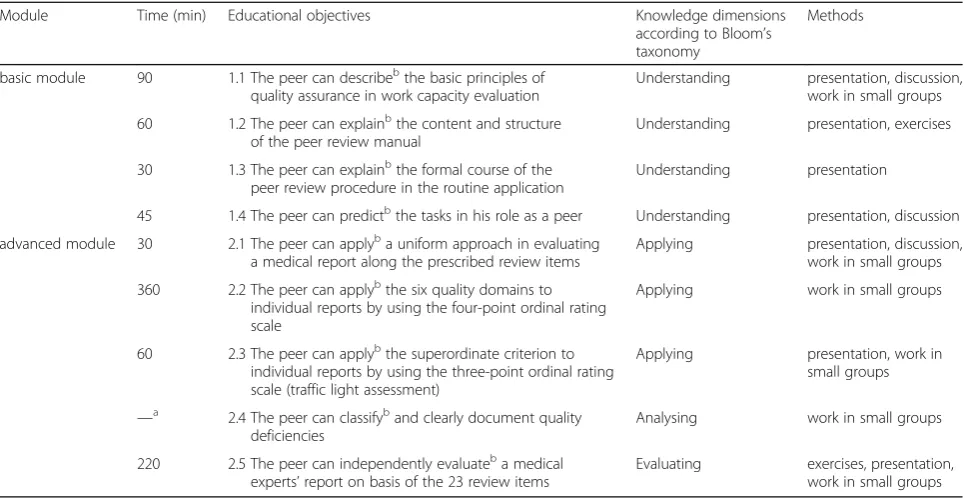
For peer-training, a curriculum consisting of two mod-ules (basic and advanced modmod-ules) was developed and set out in a detailed training manual. The sequence of modules and their learning objectives were determined. Each module starts with an overview of basic conditions. An overview of the structure, educational objectives and methods of this training can be found in Table1.
The overall three-day training course was split into nine educational objectives and included eight units
lasting between 30 and 360 min. The curriculum de-scribes the background, contents, and implementation instructions for each of these units. The curriculum also includes information on the methodical implementation of the contents of the training as well as standardized training materials. This is particularly important, as each defined educational objective is supported by an appro-priate methodological and didactical approach [27, 28]. The SPT uses slides for knowledge transfer, posters for illustrations, and table templates for constructing the catalogue of 23 review items. Additionally, the SPT, uses worksheets to record problems when dealing with these items. Altogether, this results in an interactive procedure with considerable peer involvement. The following teaching modules were included:
Brief presentation (learning objective 1.1: becoming familiar with the background of peer review)
Discussion (learning objective 1.4: identification as a peer in a quality assurance setting)
Work in small groups (learning objective 1.2: understanding the evaluation system)
Exercises (learning objectives 2.1 to 2.5: use of the review items)
Homework (learning objective 2.5: stabilisation and consistency of review outcomes)
Instructors were required to be individuals with broad expertise and experience in social medical assessment of the German Statutory Pension Insurance, excellent knowledge of peer review for quality assurance in evalu-ating work capacity and sufficient experience in man-aging (learning) groups. Prior to training, a one-day instructor workshop was conducted. There, the modera-tors discussed the learning objectives and overviewed the general training course. In addition, all medical ex-perts’ reports processed in the SPT were evaluated by the instructors using the 23 peer review items.
The basic and advanced modules were formulated for two groups of trainees: the basic module was designed for social medicine practitioners assuming a peer role for the first time. Its main purpose is to impart know-ledge about the content and structure of the peer review manual. Accordingly, learning objectives 1.1 to 1.4 are primarily presented as face-to-face lectures, supported by presentations. The advanced module was designed for social medicine practitioners who have already re-ceived training on the basic module and have acted or are acting as a peer reviewer. This module consists mostly of exercises for application of the peer review manual, using anonymised medical reports. More specif-ically, the evaluation system for all test questions is ap-plied concretely and the respective assessments options are discussed.
The advanced module was designed for small groups of up to 12 peers training together using three medical
reports. Each group is moderated by an experienced practitioner from the German Statutory Pension Insur-ance trained in social medicine. During this training, the participants practice and perform a peer review under supervision. Quality evaluations of each peer are dis-cussed in a group to reach a group consensus when an-swering test questions (calibrating assessments). After training, all participating peers were sent three reports as “homework”. Using the knowledge they have gained during training, the homework involves assessing these reports based on the quality assurance manual for evalu-ating work capacity.
Formative evaluation
The feasibility of the training using the manual, along with acceptance from peers, is tested as part of a forma-tive evaluation. A total of 40 social medicine physicians from all 16 regional German Pension Insurances under-went the SPT in accordance with the peer-training cur-riculum. The assessment tool used for formative evaluation was based on established evaluation forms [31] and was adapted to the training curriculum. The se-lection, comprehensibility and subjective use of contents delivered, the trainers’delivery and the design of training materials were assessed. A further key consideration was the subjectively estimated confidence when working with the manual. Additionally, open answer format comments on the training were gathered. The instructors (n= 4) evaluated integrity of treatment by assessing whether
Table 1Structure and learning objectives of peer-training
Module Time (min) Educational objectives Knowledge dimensions
according to Bloom’s taxonomy
Methods
basic module 90 1.1 The peer can describebthe basic principles of quality assurance in work capacity evaluation
Understanding presentation, discussion, work in small groups
60 1.2 The peer can explainbthe content and structure of the peer review manual
Understanding presentation, exercises
30 1.3 The peer can explainbthe formal course of the peer review procedure in the routine application
Understanding presentation
45 1.4 The peer can predictbthe tasks in his role as a peer Understanding presentation, discussion
advanced module 30 2.1 The peer can applyba uniform approach in evaluating a medical report along the prescribed review items
Applying presentation, discussion, work in small groups
360 2.2 The peer can applybthe six quality domains to individual reports by using the four-point ordinal rating scale
Applying work in small groups
60 2.3 The peer can applybthe superordinate criterion to individual reports by using the three-point ordinal rating scale (traffic light assessment)
Applying presentation, work in small groups
—a
2.4 The peer can classifyband clearly document quality deficiencies
Analysing work in small groups
220 2.5 The peer can independently evaluateba medical experts’report on basis of the 23 review items
Evaluating exercises, presentation, work in small groups
a
Educational objective 2.4 is not associated with a specified processing time. This objective has been integrated into the educational objectives 2.2 and 2.3. While working on these two objectives, the training instructor displays adequate documentation of quality deficiencies and discusses them with the peers
b
learning objectives could be established completely, par-tially, or not at all. A total of 36 trainees provided feed-back for formative evaluation; the remaining four trainees did not return their assessment questionnaires.
Summative evaluation
The effectiveness of the SPT was evaluated by determin-ing the peer concordance of the superordinate criterion. Evaluation was performed using the three anonymised medical reports assessed by each peer following training. The central hypothesis was that concordance and inter-rater reliability of the superordinate criterion, the main target criterion of peer review, would be higher in the SPT than in an unstructured, non-standardized peer-training. Concordance was evaluated by measuring the percentage agreement of the peer review rating scales among peers. A two-sample t-test between pro-portions was performed to determine whether there was a significant difference between Intervention and control condition with respect to the cases of percentage agree-ment. Inter-rater reliability was calculated using Fleiss’ kappa coefficient (κm) [32]. This measure of agreement
considers that a certain number of opinions that agree may be coincidental and statistically random. Concord-ance in quality assessments was therefore tested by adjusting for chance agreement [33].
Intervention and control condition
SPT served as the intervention group (IG), whereas un-structured, non-standardized peer-training was defined as the control group (CG). The two training conditions were implemented separately. Data from the IG were collected prospectively during this study. The IG com-prised 40 social medical physicians who volunteered fol-lowing an internal study announcement by the German Statutory Pension Insurance. None of these physicians was involved in developing the SPT curriculum. The par-ticipating peers had an average of 12 (SD 7.2) years of experience in the social medical service. They were spe-cialized in surgery (n= 4), orthopaedics (n= 3), internal medicine (n= 20), general medicine (n= 3), dermatology (n= 1), anaesthesia (n= 1) and neurology/psychiatry (n = 8). Approximately two-thirds of these peers had long-term clinical experience in acute hospitals, rehabili-tation clinics and/or outpatient care. The three-day training course was conducted according to the stan-dardized training curriculum. During training, the peers learned basic principles of quality assurance via peer re-view. Only reviews from peers who had no experience with the peer review procedure and were initially trained for the first time (n= 26) will be included exclusively in the analysis of concordance in the IG. In order to avoid analytical bias, 14 peers who participated in the SPT were excluded, as they were already involved in the
evaluation of the peer review procedure. A total of 78 re-views were included in the analysis (100% return rate).
The non-standardized peer-training (CG) took place earlier, during evaluation of the item catalogue of the peer review programme (see [17]). Nineteen social med-ical physicians from 12 German Pension Insurances de-partments were part of the CG. These peers had a similarly long experience in social medical services as the IG. They were specialized in surgery (n= 3), ortho-paedics (n= 3), internal medicine (n= 9) and neurology/ psychiatry (n= 4). They received a two-day training course which was one day shorter than the training for the IG. In contrast to the IG, peers were not trained in detail, nor was training constructed according to the basic structure of the peer review items. Thus, each item was provided with detailed instructions describing the rateable quality deficiencies with examples. Conse-quently, the non-standardized training focused exclu-sively on the application of the review items to small groups. In addition, no specifically prepared training ma-terials (PowerPoint, worksheets), methods and trainer instructions were used. The reliability of the CG was de-termined using 56 of the 57 expected reviews (98.2%) drawn up by the peers.
The study was authorized by the German Statutory Pen-sion Insurance based on a data protection protocol ap-proved by the respective Department for Data Protection. Each peer participating in this project was informed of the study aims and received written information on the study procedure. All participants provided written consent be-fore enrolment. Study participants evaluated only anon-ymised and declassified medical experts’ reports. Furthermore, only completely anonymised review data, with no reference to a particular medical experts’report, were transferred to the researchers. Because this study analysed anonymous data from declassified reports no fur-ther approval was necessary.
Results
Feasibility and acceptance of standardized training (formative evaluation)
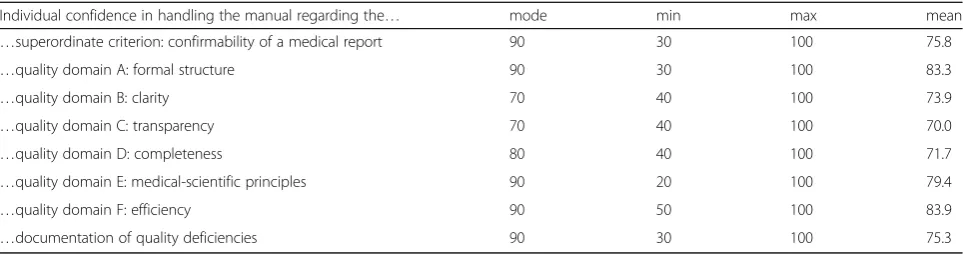
subsidiary quality domains ranged from 70 to 84%. The participating peers regarded working with quality do-main transparency as most uncertain; by contrast, they felt most certain when assessing the criterion efficiency. Overall, training implementation was regarded as suc-cessful. On a grading scale from 1 (very good) to 6 (un-satisfactory), working in small groups was particularly well regarded (average score 1.4). By contrast, the choice of medical reports for training was less well evaluated (average score 2.5). Over 90% of participating peers re-ported that having the chance to work on the test ques-tion catalogue in small group was fairly helpful or very helpful. Similarly, group-focused exchange of experience was rated as fairly helpful or very helpful. This point was also mentioned in the free comments section. The peers emphasized the opportunity to discuss with other peers (n= 11) and to work in small groups (n= 10). They also liked the way the groups were moderated (n= 5) and the inclusion of experienced social medical experts as mod-erators (n= 4). Of the participants, 94% described the training as useful and 89% would recommend it. Only two subjects mentioned that two of the three experts’ re-ports assessed during the SPT should be tested again for their suitability as training reports.
Concordance and inter-rater reliability (summative evaluation)
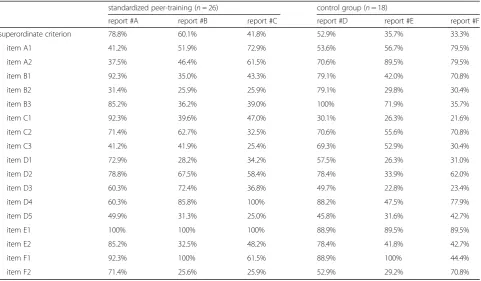
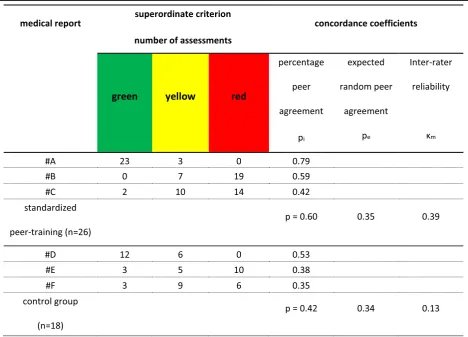
The percentage agreement on the superordinate criter-ion of the three reports, which were evaluated by peers as “homework” following the SPT were 78.8% (report #A), 60.1% (report #B) and 41.8% (report #C), respect-ively, with an average of 60.2%. By comparison, the CG, which did not include curricular standardized training, reported percentage concordance of 52.9% (report #D), 35.7% (report #E) and 33.3% (report #F), with an average of 40.2% (Table 3). This difference of 20% between IG and CG was not significant at the .05 critical alpha level (t(42)= 1.306, df = 42,p= 0.2). The inter-rater reliability of
the SPT reached aκmvalue of 0.39, compared with aκm
value of 0.12 for the CG. In addition, Fleiss’kappa analysis showed that agreement between pairs of assessors (pi) was
higher under both conditions than expected by chance (pe). The observed-chance concordance interval was three
times higher in the IG than in the CG (Table4).
Discussion
Peer review requires well-trained peers to establish uni-form standards for assessing reports as part of a cross-institutional quality assurance concept. This re-quires a thorough introduction to the methodologies used in the procedure. Accordingly, a curricular SPT provides knowledge not only on the review procedure to evaluate the quality of medical experts’reports, but also on the skills used when engaging in peer activities. The review of reports assessing work capacity is a particularly challenging, as the necessary standardisation of these re-ports itself is limited. These rere-ports draw on knowledge and experience from all medical fields and are therefore used to assess work capacity for specific individuals with a variety of medical conditions.
The training curriculum includes a structured manual with differentiated implementation instructions, ensur-ing a high level of standardisation, even across different training instructors. Having separate basic and advanced modules means the curriculum is conceptually open, allowing training on the basic module to be followed im-mediately or at a later time with training on the ad-vanced module. Peer-training appears fundamental for approximation of peer judgements by social medical practitioners with experience in peer review activities. Having separate modules also means that advanced module can be offered as a stand-alone continuous pro-fessional development (CPD) course for participating healthcare professionals.
The primary activity consists of working in small group on actual reports, as adjusting peer assessments (calibration) is one of the primary aims of training. Par-ticipants were particularly positive about sharing know-ledge and working jointly in groups. Furthermore, the training curriculum showed a high level of acceptance and feasibility. On average, the confidence in working with the manual was as high as 76.7%. This suggest that
Table 2Assessment of confidence in handling the components of the manual (n= 36)
Individual confidence in handling the manual regarding the… mode min max mean
…superordinate criterion: confirmability of a medical report 90 30 100 75.8
…quality domain A: formal structure 90 30 100 83.3
…quality domain B: clarity 70 40 100 73.9
…quality domain C: transparency 70 40 100 70.0
…quality domain D: completeness 80 40 100 71.7
…quality domain E: medical-scientific principles 90 20 100 79.4
…quality domain F: efficiency 90 50 100 83.9
if levels of confidence in working with the manual were assessed immediately following training, even higher confidence might be observed, especially after working through the“homework”and regular peer activities.
Formative evaluation showed no significant needs to im-prove the contents of the peer-training curriculum. Care should be taken during implementation, however, to en-sure that training is closely organised in accordance with the curriculum and, if necessary, to limit lengthy discus-sions so that all quality criteria can be discussed in detail. Accordingly, training instructors should have the soft skills required for group leadership and for implementing inter-active teaching methods, and also strong expertise in so-cial medicine and knowledge of the peer review process for quality assurance in evaluating work capacity. For im-plementation in routine practice two moderators per working group are recommended when teaching the ad-vanced module, to lead the group and consensus processes and to provide substantive input from their medical ex-pertise. Guided moderation was shown to be particularly useful when teaching the advanced module. Moderators were generally able to reconcile different review evalua-tions of single items among peers during discussions.
The German social security system is complex. Indi-viduals who apply for insurance benefits due to reduced work capacity must undergo an individual personal examination lasting about 1.5 h. The medical examiner must gather all information concerning the patient’s
previous job and the method by which the patient’s health problem is affected by job-related disability [34]. Although the German Statutory Pension Insurance fol-lows common“social medicine”guidelines, the evaluation process does not have an evidence-based gold standard. As a result of the complex mix of information, different experts can come to different conclusions during the per-sonal examination [35–39]. This can ultimately lead to disagreement between assessments of work capacity and, in some cases, to the erroneous refection of an application for disability benefits. A systematic review confirmed that physicians’assessments of work capacity show high vari-ability and low relivari-ability [40]. Moderate reliability in peer review for quality assurance [17] reflects the complexity of this process. Future peer-training requires that the experts’ reports evaluated during the training course to be checked for suitability in the moderator workshop. Both good (un-ambiguous) reports and negative (e.g., controversial or ambiguous) examples should be used.
The superordinate criterion is defined as the main quality outcome. Meeting this criterion is considered crucial and fundamental for the validity of medical re-ports [17]. This criterion was therefore the main focus of this study. The six quality domains may assess rele-vant aspects of the quality of the reports, but not their overall usability. Although the items of the subsidiary quality domains varied widely, concordance with the superordinate criterion was nearly 20% higher under
Table 3Percentage peer agreement of the standardized (SPT) and non-standardized (CG) peer-training
standardized peer-training (n= 26) control group (n= 18)
report #A report #B report #C report #D report #E report #F
superordinate criterion 78.8% 60.1% 41.8% 52.9% 35.7% 33.3%
item A1 41.2% 51.9% 72.9% 53.6% 56.7% 79.5%
item A2 37.5% 46.4% 61.5% 70.6% 89.5% 79.5%
item B1 92.3% 35.0% 43.3% 79.1% 42.0% 70.8%
item B2 31.4% 25.9% 25.9% 79.1% 29.8% 30.4%
item B3 85.2% 36.2% 39.0% 100% 71.9% 35.7%
item C1 92.3% 39.6% 47.0% 30.1% 26.3% 21.6%
item C2 71.4% 62.7% 32.5% 70.6% 55.6% 70.8%
item C3 41.2% 41.9% 25.4% 69.3% 52.9% 30.4%
item D1 72.9% 28.2% 34.2% 57.5% 26.3% 31.0%
item D2 78.8% 67.5% 58.4% 78.4% 33.9% 62.0%
item D3 60.3% 72.4% 36.8% 49.7% 22.8% 23.4%
item D4 60.3% 85.8% 100% 88.2% 47.5% 77.9%
item D5 49.9% 31.3% 25.0% 45.8% 31.6% 42.7%
item E1 100% 100% 100% 88.9% 89.5% 89.5%
item E2 85.2% 32.5% 48.2% 78.4% 41.8% 42.7%
item F1 92.3% 100% 61.5% 88.9% 100% 44.4%
SPT (60.2%) than the control condition (40.2%). This difference is not statistically significant. According to Kirk [41] does a non-significant statistical test merely mean that we cannot exclude chance or sampling vari-ability as an explanation for the observed differences, al-though a meaningful difference was found that support our initial hypothesis. Perhaps a larger sample size might have yielded to more significant results. Therefore, the best estimate of the difference of percentage agreement is 20% ± 21.3% considering a 95% confidence interval. Fleiss’ kappa coefficient also showed that peer concord-ance was 25% higher than the random expectation of 35%. Although medical assessments did not agree com-pletely, concordance was descriptively higher than chance would predict, even though this difference was not significantly higher due to the small number of reports. For all three reports, the concordance of the superordinate cri-terion was higher in the IG than in the CG (see Table3). The superordinate criterion during SPT showed only fair inter-rater reliability (κm= 0.39) and was substantially lower
than the conventional standard of 0.7 for adequate reliabil-ity. However, other studies showed similar or even lower
inter-rater reliability [11,13,18,42–46]. A meta-analysis re-ported an average weighted Kappa of 0.31 [47], whereas a systematic review found inter-rater agreements in evalu-ation of disability that ranged from 0.10 to 0.86 [40]. During the initial evaluation of the catalogue of peer review items, reliability values of 0.37 were calculated [17], indicating that a single training session cannot immediately increase inter-rater reliability.
Limitations
This study provided evidence of the effectiveness of peer-training in a realistic setting rather than proving ef-ficacy. The CG differed from the IG in that they received non-standardized peer-training and evaluated different anonymized medical reports. To ensure comparability, both groups would need to use the same reports. For or-ganisational reasons, however, all participants were trained using the standardized training course. Immedi-ately after evaluation, routine implementation of the peer review process was started. Retraining of a potential CG was not possible. Therefore, the IG that was trained at a different time without a standardized training
manual uses different reports. Differences in reviewed reports can lead to a different correspondence among peers. Because each report involves an individual case history, medical reports cannot be directly compared with each other. Experts determine work capacity on a case-by-case basis. Accordingly, inter-rater reliability of the training courses can only be compared and inter-preted indirectly, because variability may be due to the reports themselves. A bias due to the use of different medical reports in the two training sessions (IG and CG) cannot be finally ruled out. Further, the practical con-straints of the peer review programme for quality assur-ance did not allow for allocation of individual reviewers or for anonymised medical reports chosen at random. The developed training does not include tests on learn-ing objectives. Rather, trainlearn-ing is based on the common application of quality criteria for reports under the super-vision of an instructor. Assessments of learning objectives after basic training may improve the ability to use and in-terpret the review items. The advanced training module is based on the evaluated medical reports. The learning ob-jectives of this module are based exclusively on the prac-tical application of the 23 review items in small groups and cannot be tested in a standardized way. Further oper-ationalisation of the learning objectives and the subordin-ate teaching content is reasonable for the future development of SPT. This would allow success monitor-ing at several points in the trainmonitor-ing, which might be asso-ciated with an improvement of peer agreement.
A further fundamental limitation of the training success, however, was the reviewed reports themselves. In Germany, work capacity is directly assessed by medical ex-perts. However, there may be discrepancies between the formal definition of work ability being evaluated and the actual criteria of the evaluating experts. The formal criter-ion for work ability in Germany is based on the number of hours per day a person could work (> 6 h, 3–6 h or < 3 h). In practice, this strict classification cannot always be quantified on the basis of functional limitations. Accord-ingly, it is possible that during personal examination, the medical expert decide on work capacity according the in-dividual case and to a rule of thumb [34,48]. If the assess-ment of work capacity is not objectively comprehensible, peers can only make difficult uniform assessments during peer review or peer-training. This may also result in low post-training reliability.
Conclusion
Peer-training prepares participating social medical prac-titioners for their role as peers and creates common evaluation standards. Because the German Statutory Pension Insurance desires nationwide cross-institutional application of peer reviews, the advanced module should be offered regularly (e.g. annually) as a stand-alone CPD
measure for healthcare professionals active in quality as-surance procedures. Annual review will maintain the ef-fects of training and minimise peer bias. As peers usually remain the same, their experience will increase with each training session and peer review. This will have positive effects on inter-rater reliability. Evidence of this assumed effect is only verifiable with continuous evaluation. If reliability does not improve after re-peated training, the review instrument itself should be redesigned. Following evaluation of the peer review manual [17], the German Statutory Pension Insurance considered the development of a standardized peer cur-riculum as a further component in implementing a qual-ity assurance system in evaluating work capacqual-ity based on social medical experts’reports.
Abbreviations
CG:Control group; CPD: Continuous professional development;
IG: Intervention group; max: Maximum; min: Minimum; pe: Expected random peer agreement; pi: Agreement among assessors; SD: Standard deviation; SPT: Standardized peer-training;κm: Fleiss’kappa
Acknowledgements
This publication was supported by the German Research Foundation (DFG) and the University of Wuerzburg in the funding programme Open Access Publishing.
Funding
The study was funded by the German Statutory Pension Insurance, Department of Social Medicine. The German Statutory Pension Insurance recruited the medical experts involved in the peer peer-training and monitored the collection of peer review-data. The funding body had no influence on study design, data collection, data analysis, data interpretation, decision to publish, or preparation of the manuscript. This publication was funded by the German Research Foundation (DFG) and the University of Wuerzburg in the funding programme Open Access Publishing.
Availability of data and materials
The datasets analysed during the current study are available from the corresponding author on reasonable request.
Authors’contributions
AS performed the statistical analysis and interpretation, participated in the peer training and was the major contributor in writing the manuscript. CG conceived of the study and participated in its design, participated in the data interpretation and the peer training. GWA participated in the data interpretation and helped to draft the manuscript. KE participated in the data analysis and interpretation and helped to draft the manuscript. AMG participated in the peer training and helped to draft the manuscript. JG conceived of the study, and participated in its design and coordination and performed the peer review data extraction. HV conceived of the study, and participated in its design and coordination, participated in the peer training and helped to draft the manuscript. All authors read and approved the final manuscript.
Ethics approval and consent to participate
Competing interests
The authors declare that they have no competing interests.
Publisher’s Note
Springer Nature remains neutral with regard to jurisdictional claims in published maps and institutional affiliations.
Author details
1Department of Medical Psychology, Medical Sociology, and Rehabilitation
Sciences, University of Würzburg, Klinikstraße 3, 97070 Würzburg, Germany. 2Department of Orthopaedics, University Medical Center
Hamburg-Eppendorf, Martinistraße 52, 20246 Hamburg, Germany. 3Department of Psychology, School of Social Sciences, University of
Mannheim, L13,15-17, 68131 Mannheim, Germany.4Department of Social Medicine, German Statutory Pension Insurance, Ruhrstr, 2, 10709 Berlin, Germany.
Received: 3 July 2017 Accepted: 21 May 2018
References
1. Shaw C. External assessment of health care. BMJ. 2001;322:851–4. 2. Lilford R, Edwards A, Girling A, Hofer T, Di Tanna GL, Petty J, et al. Inter-rater
reliability of case-note audit: a systematic review. J Health Serv Res Policy. 2007;12:173–80.
3. Edwards MT. The objective impact of clinical peer review on hospital quality and safety. Am J Med Qual. 2011;26:110–9.
4. Glattacker M, Jäckel W. Evaluation of quality assurance - current data and consequences for research. Gesundheitswesen. 2007;69:277–83.
5. Wirtz M, Kutschmann M. Analyzing interrater agreement for categorical data using Cohen’s kappa and alternative coefficients. Rehabilitation. 2007;46: 370–7.
6. Wirtz M, Casper F. Beurteilerübereinstimmung und Beurteilerreliabilität. Göttingen: Hogrefe; 2002.
7. Goldman RL. The reliability of peer assessments of quality of care. JAMA. 1992;267:958–60.
8. Altman DG. Practical statistics for medical research: Chapman and Hall; 1991. 9. Landis JR, Koch GG. The measurement of observer agreement for categorical
data. Biometrics. 1977;33:159.
10. Hofer TP, Asch SM, Hayward RA, Rubenstein LV, Hogan MM, Adams J, et al. Profiling quality of care: is there a role for peer review? BMC Health Serv Res. 2004;4:9.
11. Neuderth S. Externe Qualitätssicherung durch Peer-Review. Verlag Empirische Pädagogik: Landau; 2004.
12. Farin E, Carl C, Lichtenberg S, Jäckel WH, Maier-Riehle B, Rütten-Köppel E. Evaluating the rehabilitation process by means of peer review: examination of the methods used and findings of the 2000/2001 data collection in the somatic indications. Rehabilitation. 2003;42:323–34.
13. Kadar N. Systemic bias in peer review: suggested causes, potential remedies. J Laparoendosc Adv Surg Tech A. 2010;20:123–8.
14. Smith MA, Atherly AJ, Kane RL, Pacala JT. Peer review of the quality of care. Reliability and sources of variability for outcome and process assessments. JAMA. 1997;278:1573–8.
15. Deutsche Rentenversicherung Bund. Qualitätssicherung der
sozialmedizinischen Begutachtung: Manual zum Peer Review-Verfahren. Berlin: Deutsche Rentenversicherung Bund; 2013. Available from: http:// www.deutsche-rentenversicherung.de/Allgemein/de/Inhalt/3_Infos_fuer_ Experten/01_sozialmedizin_forschung/downloads/sozmed/begutachtung/ manual_peer_review.pdf?__blob=publicationFile&v=5.
16. Legner R, Cibis W. Quality Assurance in Sociomedical Evaluation. Rehabilitation. 2007;46:57–61.
17. Strahl A, Gerlich C, Wolf H-D, Gehrke J, Müller-Garnn A, Vogel H. Quality Assurance in Sociomedical Evaluation by peer review: a pilot project of the German statutory pension insurance. Gesundheitswesen. 2016;78:156–60. 18. Harris CD, Bratzler DW. Evaluating quality of care: the role of peer review.
J Okla State Med Assoc. 2013;106(279):281–4.
19. Tuijn S, Janssens F, Robben P, van den Bergh H. Reducing interrater variability and improving health care: a meta-analytical review. J Eval Clin Pract. 2012;18:887–95.
20. Klosterhuis H. Rehabilitation quality assurance of the German pension insurance - a critical review. RVaktuell. 2010;8:260–8.
21. Jones RW. Learning and teaching in small groups: characteristics, benefits. problems and approaches Anaesth Intensive Care. 2007;35:587–92. 22. Springer L, Stanne ME, Donovan SS. Effects of small-group learning on
undergraduates in science, mathematics, engineering, and technology: a meta-analysis. Rev Educ Res. 1999;69:21–51.
23. Prince M. Does active learning work? A Review of the Research. J Eng Educ. 2004;93:223–31.
24. Faller H, Reusch A, Ströbl V, Vogel H. Patient education as a constituent of a patient-oriented approach in rehabilitation. Rehabilitation. 2008;47:77–83. 25. Ströbl V, Küffner R, Müller J, Reusch A, Vogel H, Faller H. Patient education:
quality criteria in ist implementation. Rehabilitation. 2009;48:166–73. 26. Ströbl V, Friedl-Huber A, Küffner R. Beschreibungs- und Bewertungskriterien
für Patientenschulungen. Prax Klin Verhal und Rehabil. 2007;75:11–4. 27. Möller C. Technik der Lernplanung: Methoden und Probleme der
Lernzielerstellung. Beltz; 1973.
28. Faller H, Reusch A, Meng K. DGRW-update: patient education. Rehabilitation. 2011;50:284–91.
29. Bloom BS. Taxonomy of educational objectives: The classification of educational goals. In: Engelhart MD, Furst EJ, Hill WH, Krathwohl DR, editors. Handbook 1: Cognitive domain. New York: David McKay; 1956.
30. Krathwohl DR. A revision of Bloom’s taxonomy: an overview. Theory Pract. 2002;41:212–8.
31. Meng K, Seekatz B, Roßband H, Worringen U, Faller H, Vogel H. Development of a standardized back School for in-Patient Orthopaedic Rehabilitation. Rehabilitation. 2009;48:335–44.
32. Fleiss J. Measuring nominal scale agreement among many raters. Psychol Bull. 1971;76:378–82.
33. Bortz J, Lienert GA. Kurzgefasste Statistik für die klinische Forschung: Leitfaden für die verteilungsfreie Analyse kleiner Stichproben; mit 97 Tabellen sowie zahlreichen Formeln. Springer; 2008.
34. Aurich-Beerheide P, Brussig M. Assessment of work ability in competing strands of social insurance: the German case. J Poverty Soc Justice. 2017;25: 163–76.
35. Tait RC, Chibnall JT, Miller L, Werner CA. Judging pain and disability: effects of pain severity and physician specialty. J Behav Med. 2011;34:218–24. 36. Chibnall JT, Dabney A, Tait RC, Cedraschi C, Nordin M, Nachemson A, et al.
Internist judgments of chronic low back pain. Pain Med. 2000;1:231–7. 37. Tait RC, Chibnall JT. Physician judgments of chronic pain patients. Soc Sci
Med. 1997;45:1199–205.
38. Merten T, Friedel E, Mehren G, Stevens A. Negative response bias and the validity of personality profiles in neuropsychiatric assessment. Nervenarzt. 2007;78:511–20.
39. Stevens A, Friedel E, Mehren G, Merten T. Malingering and
uncooperativeness in psychiatric and psychological assessment: prevalence and effects in a German sample of claimants. Psychiatry Res. 2008;157:191–200. 40. Barth J, de Boer WEL, Busse JW, Hoving JL, Kedzia S, Couban R, et al.
Inter-rater agreement in evaluation of disability: systematic review of reproducibility studies. BMJ. 2017;356:j14.
41. Kirk RE. Practical significance: a concept whose time has come. Educ Psychol Meas. 1996;56:746–59.
42. Abragam A, Lincke H-O, Lux A, Wallesch CW. Peer review of routine clinical case reports - an instrument of quality management? Results of a pilot investigation. Nervenarzt. 2002;73:956–66.
43. Dharmar M, Marcin JP, Kuppermann N, Andrada ER, Cole S, Harvey DJ, et al. A new implicit review instrument for measuring quality of care delivered to pediatric patients in the emergency department. BMC Emerg Med. 2007;7:13. 44. Hayward RA, Bernard AM, Rosevear JS, Anderson JE, McMahon LF. An
evaluation of generic screens for poor quality of hospital care on a general medicine service. Med Care. 1993;31:394–402.
45. Kameoka J, Okubo T, Koguma E, Takahashi F, Ishii S, Kanatsuka H. Development of a peer review system using patient records for outcome evaluation of medical education: reliability analysis. Tohoku J Exp Med. 2014;233:189–95. 46. Smith MA, Atherly AJ, Kane RL, Pacala JT, Dans PEWJOS, RL G, et al. Peer
review of the quality of care. JAMA. 1997;278:1573.
47. Goldman RL. The reliability of peer assessments. A meta-analysis. Eval Health Prof. 1994;17:3–21.