HELGOL~NDER MEERESUNTERSUCHUNGEN Helgol~nder Meeresunters. 52, 103-109 (1998)
Internal current generation in respiration chambers
R. S a b o r o w s k i & F.
B u c h h o l z
Biologische Anstalt Helgoland, Meeresstation, D-27483 Helgoland, Germany
ABSTRACT. A technical device generating a constant and directed current within a sealed respira- tion chamber is described. It does not involve any external pumps or tubing. This system is easy to handle, and improved the maintenance of rheotactic pelagic species like the Northern krill (Me-
ganyctiphanes norvegica,
Crustacea) or small fishes(Gasterosteus aculeatus)
under experimental conditions.Key words: Respiration chamber, current, rheotactic animals, krill, fish
I N T R O D U C T I O N
The accurate d e t e r m i n a t i o n of o x y g e n c o n s u m p t i o n rates in aquatic a n i m a l s d e p e n d s on a p p r o p r i a t e systems which allow the o r g a n i s m u n d e r study to be m a i n t a i n e d u n d e r c l o s e - t o - n a t u r a l conditions. Besides the choice of the m e a s u r e m e n t m e t h o d (i.e. elec- trodes, optrodes, chemical) a n d control or m a n i p u l a t i o n of the e x p e r i m e n t a l c o n d i t i o n s (light, t e m p e r a t u r e , addition of chemicals), the construction of the respiration c h a m b e r has a significant i n f l u e n c e on the course of the e x p e r i m e n t . B u l n h e i m (1974) e q u i p p e d a respiration c h a m b e r with a piece of g a u z e to m e e t the thigmotactic b e h a v i o u r of the e x a m i n e d isopods a n d to r e d u c e their activity. C h a p e l l e & Peck (1995) s h o w e d that the p r e s e n c e of a s u b s t r a t u m to w h i c h species could attach allowed a more n a t u r a l b e h a v i o u r of Antarctic a m p h i p o d s a n d d e c r e a s e d the respiration rates. Respiration m e a s u r e m e n t s are c o m m o n l y carried out in relatively small closed systems (bottle method). C e r t a i n applications, however, d e m a n d more sophisticated technical solutions. For e x a m p l e , the effect of hydrostatic pressure on the r e s p i r a t i o n rate of m a r i n e a n i m a l s a n d tissues were s t u d i e d by G o r d o n & T h o m a s (1974) as well as B e l m a n & G o r d o n (1979). Systems for l o n g - t e r m m o n i t o r i n g of r e s p i r a t i o n rates w e r e d e s i g n e d b y Sutcliffe et al. (1975) a n d Q u e t i n (1983). E r i k s e n & F e l d m e t h (1967) i n t r o d u c e d a w a t e r - c u r r e n t r e s p i r o m e t e r to simulate the conditions to w h i c h a n i m a l s are e x p o s e d in r u n n i n g w a t e r (e.g. insect larvae).
104 R. S a b o r o w s k i & E Buchholz
comm.). T h e krill o r i e n t a t e d t h e m s e l v e s a g a i n s t the c u r r e n t a n d s w a m p e r m a n e n t l y in the w a t e r column.
Large c h a m b e r s , however, are a w k w a r d to h a n d l e in routine l a b o r a t o r y work and, particularly, w h e n u s e d on board research vessels. E x t e r n a l t u b i n g i n c r e a s e s the suscep- tibility to the f o r m a t i o n of air b u b b l e s in the system a n d electric p u m p s m a y w a r m u p the water. Accordingly, the a i m of the p r e s e n t s t u d y was to d e v e l o p a s y s t e m which applies a c o n t i n u o u s c u r r e n t inside a respiration c h a m b e r u s i n g the simplest m e t h o d s . We also tried to avoid u n n e c e s s a r y external e q u i p m e n t to r e d u c e the risk of t e c h n i c a l p r o b l e m s d u r i n g operation. As a result we i n t r o d u c e a respiration c h a m b e r c o n t a i n i n g a n inte- g r a t e d c u r r e n t g e n e r a t o r for the m e a s u r e m e n t of respiration rates in N o r t h e r n krill a n d other p e l a g i c species.
In a d d i t i o n to the c u r r e n t g e n e r a t o r w h i c h is i n t e g r a t e d in the r e s p i r a t i o n chamber, a s e l f - c o n t a i n e d t u r b u l e n c e g e n e r a t o r is d e s c r i b e d which uses the same m e c h a n i c a l prin- ciple as the i n t e r n a l generator. It c a n b e a p p l i e d to i n d u c e a g e n t l e w a t e r m o v e m e n t with- in small c o n v e n t i o n a l c o n t a i n e r s used for respiration m e a s u r e m e n t s .
D e s c r i p t i o n of t h e r e s p i r a t i o n c h a m b e r
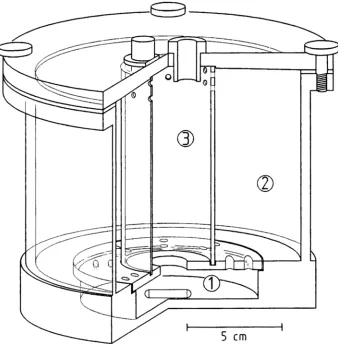
T h e Perspex c h a m b e r (Fig. 1) h a d a total v o l u m e of 1.65 1 a n d c o n s i s t e d of three func- tional units. T h e b o t t o m was s e p a r a t e d by a p u n c t u r e d plate a n d h o s t e d a stir bar. This stir b a r was d r i v e n by a n e l e c t r o m a g n e t i c stirrer on which the c h a m b e r was p l a c e d d u r i n g operation. This c o m p a r t m e n t a c t e d as the g e n e r a t o r for the w a t e r m o v e m e n t . As a result of the rotation of the stirrer, the w a t e r was p u s h e d by c e n t r i f u g a l force to the walls of this c o m p a r t m e n t a n d was directed t h r o u g h six pairs of o b l i q u e l y o r i e n t a t e d holes into the outer cylindrical c o m p a r t m e n t of the chamber. This c o m p a r t m e n t s e r v e d as the m a i n - t e n a n c e c o m p a r t m e n t for the o r g a n i s m s u n d e r study. T h e species w e r e a l l o w e d to m o v e freely in the w a t e r c o l u m n a n d could m a k e u s e of the circular and, therefore, p o t e n t i a l l y ' e n d l e s s ' s w i m m i n g a r e n a . At the top, the m a i n t e n a n c e c o m p a r t m e n t w a s c o n n e c t e d via small holes with a t u b u l a r f u n n e l . This f u n n e l w a s a g a i n a cylindrical u n i t which, how- ever, was m u c h s m a l l e r in d i a m e t e r t h a n the m a i n t e n a n c e c o m p a r t m e n t . It directed the w a t e r flow d o w n w a r d s b a c k into the generator.
T h e i n t e g r a t i v e action of these three c o m p a r t m e n t s g e n e r a t e d a d i r e c t e d s t r e a m of w a t e r w i t h i n the r e s p i r a t i o n c h a m b e r a n d s u p p l i e d the m a i n t e n a n c e c o m p a r t m e n t with a c o n s t a n t current. We u s e d a waterproof e l e c t r o m a g n e t i c stirrer (Variomag| T e l e m o d u l 40S a n d no. 40151 c o m p a c t stirring drive units, H+P L a b o r t e c h n i k G m b H , M u n i c h , Ger- many). It allowed the r u n n i n g of all stirring drives (up to 8) with exactly the s a m e rota- tion
speed.
I n t e n s i t y of t h e i n d u c e d c u r r e n t
I n t e r n a l c u r r e n t g e n e r a t i o n in r e s p i r a t i o n c h a m b e r s 105
Fig. 1. Respiration chamber with an integrated, self-generating current system. The chamber consists of a generator unit (1), a maintenance compartment (2) and a funnel (3). The lid is fixed by screws and sealed by a rubber ring. The lid also hosts an electrode fitting and an extra opening for flow-through measurements or the application of test substances. Further explanations are given in
the text
p a r t m e n t of 6.75 c m ( c i r c u m f e r e n c e 42.4 cm) a n d a n a n g u l a r v e l o c i t y of 0.5 s -1, t h e o r b i t a l v e l o c i t y v is 3.38 c m s -1.
106 R, S a b o r o w s k i & F, Buchhotz
Fig. 2. Relation between stirring speed and current speed (angular velocity) within the chamber. The relation follows significantly the Boltzmann sigmoid equation y = Ymm + ([Ym~ - Yminl/[ 1 + etvS~176
as calculated with the computer program Prism, Graph Pad Software Inc., San Diego
T u r b u l e n c e g e n e r a t o r
T h e t u r b u l e n c e g e n e r a t o r (Fig. 3) is similar to that in the system d e s c r i b e d above. T h e c u r r e n t g e n e r a t i n g u n i t is simplified a n d r e d u c e d i n size for use in vials w i t h o u t i n t e r n a l stirring device. T h e system consists of a flat cylindrical h o u s i n g (pill box shape) which c o n t a i n s a small m a g n e t i c stir bar. As a result of centrifugal forces a n o u t w a r d d i r e c t e d w a t e r c u r r e n t is i n d u c e d t h r o u g h the lateral jets. T h e b a c k s t r e a m of w a t e r is a l l o w e d t h r o u g h the w i d e o p e n i n g o n top of the box. This o p e n i n g is c o v e r e d w i t h n y l o n g a u z e (100 l~m) to p r e v e n t s p e c i m e n s from e n t e r i n g the stirring c o m p a r t m e n t . This g e n e r a t o r does n o t p r o v i d e a directed s t r e a m of w a t e r w i t h i n the respiration c h a m b e r . However, it g e n e r a t e s a t u r b u l e n c e w h i c h e n s u r e s a g e n t l e t u r n o v e r of t h e i n c u b a t i o n m e d i u m .
A p p l i c a t i o n
I n t e r n a l c u r r e n t g e n e r a t i o n in r e s p i r a t i o n c h a m b e r s 107
Fig. 3. Turbulence generator for use in commercial vials or bottles that are not provided with an adequate stirring device. The arrows indicate the flow of water
p r e l i m i n a r y i n v e s t i g a t i o n s w e r e c a r r i e d out on krill a n d fishes. In a c c o r d a n c e w i t h the d i m e n s i o n s of t h e c h a m b e r , w e u s e d a n i m a l s in the s i z e - r a n g e of 30-60 rnm.
T h e N o r t h e r n krill,
Meganyctiphanes norvegica,
is a p e l a g i c e u p h a u s i i d of u p to 35 m m b o d y l e n g t h . Since krlll is not e a s y to m a i n t a i n in the l a b o r a t o r y for l o n g p e r i o d s w e carried out this study on b o a r d a r e s e a r c h v e s s e l w i t h freshly c a u g h t animals. We i n t r o d u c e d s i n g l e a n i m a l s or g r o u p s of t h r e e s p e c i m e n s into t h e c h a m b e r a n d o b s e r v e d t h e i r b e h a v i o u r w i t h a v i d e o s y s t e m u n d e r i n f r a r e d illumination. T h e a n i m a l s e x h i b i t e d a m o r e active b e h a v i o u r a n d s p e n t m o r e t i m e s w i m m i n g in the w a t e r c o l u m n d u r i n g p e r i o d s of stirring. A slow a n d g e n t l e c u r r e n t close to t h e l o w e s t stirring s p e e d w a s m o s t favourable. At i n c r e a s e d w a t e r m o v e m e n t the a n i m a l s t e n d e d to s w i m m o r e erratically a n d o c c a s i o n a l l y s h o w e d e s c a p e b e h a v i o u r .As an e x a m p l e for small fishes w e s t u d i e d t h r e e - s p i n e d s t i c k l e b a c k s
(Gasterosteus
108 R. S a b o r o w s k i & F. Buchholz
m e a s u r e m e n t of the m e t a b o l i c d e m a n d of fish larvae a n d j u v e n i l e fishes for studies on the e x p e n d i t u r e of e n e r g y n e e d e d for s w i m m i n g a g a i n s t currents.
O t h e r features of the system are a d v a n t a g e o u s i n r o u t i n e a p p l i c a t i o n . O n e is the spatial s e p a r a t i o n of the electrode from the a n i m a l s in the m a i n t e n a n c e c h a m b e r . This protects the electrodes from b e i n g d a m a g e d by a g g r e s s i v e species. For e x a m p l e , some isopods a n d a m p h i p o d s as well as g r a p s i d d e c a p o d s t e n d to hold on to s u c h objects. Fish m a y s n a p at or hit the electrode. This b e h a v i o u r i n c r e a s e s the risk of d a m a g e partic- ularly to the sensitive m e m b r a n e s of the electrodes. Furthermore, the c u r r e n t i n d u c e d in the c h a m b e r causes a p e r m a n e n t a n d c o m p l e t e m i x i n g of the water. This is i m p o r t a n t in a v o i d i n g partial o x y g e n d e p l e t i o n w i t h i n the system. This feature of the c h a m b e r also e n a b l e s the study of species which prefer shelters (e.g. j u v e n i l e lobster). T h e p e r m a n e n t c u r r e n t t h r o u g h the system supplies the electrode with a c o n s t a n t s t r e a m of water. This is p a r t i c u l a r l y i m p o r t a n t for electrodes w h i c h c o n s u m e a c o n s i d e r a b l e a m o u n t of o x y g e n t h e m s e l v e s .
It m a y be r e g a r d e d as a d i s a d v a n t a g e that the c h a m b e r consists of s e v e r a l parts that m a y i n c r e a s e the susceptibility of c a t c h i n g air b u b b l e s d u r i n g filling a n d c l o s i n g of the chamber. However, in practice we h a d no p r o b l e m s with air bubbles, p a r t i c u l a r l y w h e n the c h a m b e r s were filled a n d closed u n d e r w a t e r (e.g. in a b u c k e t of a p p r o p r i a t e size).
T h e t u r b u l e n c e g e n e r a t o r c a n be a p p l i e d w i t h i n commercial vials or bottles which are not p r o v i d e d with a n a d e q u a t e stirring device (see also Q u e t i n & Mickel, 1983). It is particularly useful for e x p e r i m e n t s with small a n d fragile a n i m a l s of a few m m , e.g. deca- pod larvae or small isopods. T h e s e a n i m a l s w o u l d be i n j u r e d or d a m a g e d w h e n hit by a stirrer. In our system, the stirring bar is s h e l t e r e d w i t h i n a h o u s i n g that p r e v e n t s contact with the o r g a n i s m b u t allows the flow of w a t e r t h r o u g h the p u n c t u r e d walls. G e n t l e tur- b u l e n c e is also n e c e s s a r y w h e n the a n i m a l s u n d e r study are too small or too inactive to p r o d u c e sufficient w a t e r m o v e m e n t t h e m s e l v e s for c o n t i n u o u s l y e x c h a n g i n g the w a t e r at the tip of the electrode and, thus, e n s u r i n g a uniform o x y g e n d i s t r i b u t i o n w i t h i n the chamber. T h e g e n e r a t o r c a n be easily d r i v e n by a m a g n e t i c stirrer w h i c h is p l a c e d b e l o w the c h a m b e r . However, w h e n the g e n e r a t o r is not fixed at the bottom of t h e chamber, a critical rotation s p e e d of the stir b a r s h o u l d not be e x c e e d e d in case the e n t i r e g e n e r a t o r starts w o b b l i n g a n d m o v i n g b y itself.
T h e t e c h n i c a l principle of the s y s t e m i n t r o d u c e d here c a n be easily a d a p t e d to suit various a p p l i c a t i o n s a n d is a c o n t r i b u t i o n to studies on ecophysiological processes in a q u a t i c a n i m a l s u n d e r c l o s e - t o - n a t u r a l conditions.
A c k n o w l e d g e m e n t s . We are indebted to Mr. Manfred Pieper from our institute's workshop in Ham- burg for the realization of the chamber, and the crew of FS Heincke for excellent support in the field. This work was funded by the European Union within the MAST lII-programme under MAS3-CT- 0013 (PEP).
LITERATURE CITED
Belman, B. W. N Gordon, M. S., 1979. Comparative studies on the metabolism of shallow-water and deep-sea marine fishes. V. Effect of temperature and hydrostatic pressure on oxygen consump- tion in the mesopeiagic zoarcid M e l a n o s U g m a p a m m e l a s . - Mar. Biol. 50, 275-281.
I n t e r n a l c u r r e n t g e n e r a t i o n i n r e s p i r a t i o n c h a m b e r s 109
Chapelle, G. & Peck, L.S., 1995. The influence of acclimation and substratum on the metabolism of the Antarctic a m p h i p o d s Waldeckia obesa {Chevreux 1905) and Bovallia gigantea (Pfeffer 1888). - Polar Biol. I5, 225-232.
Eriksen, C. H. & Feldmeth, C. R., 1967. A water-current respirometer. - Hydrobiologia 29, 495-504. Gordon, M. S. & Thomas, T. J., 1974. Comparative studies on the metabolism of shallow-water and d e e p - s e a marine fishes. IIL Apparatus for studies of tissue preparations under high hydrostatic pressures. - Mar. Biol. 28, 73-77.
Kils, U., 1981. The swimming behavior, s w i m m i n g performance a n d energy balance of Antarctic krill, Euphausia superba. - BIOMASS Sci. Ser. 3, 1-122.
Quetin, L. B., 1983. An automated, intermittent flow respirometer for monitoring o x y g e n consump- tion a n d long-term activity of pelagic crustaceans. In: Polarographic oxygen sensors. Ed. by E. Gnaiger & H. Forster. Springer, Berlin, 176-183.
Quetin, L. B. & Mickel, T. J., 1983. Sealed respirometers for small invertebrates. In: Polarographic oxygen sensors. Ed. by E. Gnaiger & H. Forster. Springer, Berlin, 184-189.