
R E S E A R C H
Open Access
Genetic and functional analysis of HIV-1 Rev
Responsive Element (RRE) sequences from
North-India
Yogeshwar Sharma
1, Ujjwal Neogi
1, Vikas Sood
1, Snigdha Banerjee
1, Subodh Samrat
1, Ajay Wanchu
2,
Surjit Singh
3, Akhil C Banerjea
1*Abstract
HIV-1 Rev protein regulates the expression of HIV-1 transcripts by binding to a highly structured stem loop structure called the Rev Responsive Element (RRE) present in the genomic and partially spliced RNAs. Genetic variation in this structure is likely to affect binding of Rev protein and ultimately overall gene expression and replication. We characterized RRE sequences from 13 HIV-1 infected individuals from North India which also included two mother-child pairs following vertical transmission. We observed high degree of conservation of sequences, including the 9-nt (CACUAUGGG) long sequence in stem-loop B, required for efficient binding of Rev protein. All of our 13 RRE sequences possessed G to A (position 66) mutation located in the critical branched-stem-loop B which is not present in consensus C or B sequence. We derived a consensus RRE structure which showed interesting changes in the stem-loop structures including the stem-loop B. Mother-Child RRE sequences showed conservation of unique polymorphisms as well as some new mutations in child RRE sequences. Despite these changes, the ability to form multiple essential stem-loop structures required for Rev binding was con-served. RRE RNA derived from one of the samples, VT5, retained the ability to bind Rev protein under in vitro conditions although it showed alternate secondary structure. This is the first study from India describing the structural and possible functional implications due to very unique RRE sequence heterogeneity and its possible role in vertical transmission and gene expression.
Introduction
HIV-1 displays very high genetic diversity and has been classified into various subtypes and recombinant forms. While subtype B predominates in US and UK, it is sub-type C that is predominant in India, China and South Africa. Most of the changes are observed in the Envel-ope region but other region like p24-Gag is relatively conserved among subtypes and has been exploited to develop ELISA for diagnostic purposes. HIV-1 exploits the splicing machinery very efficiently by using the Rev protein which binds with high affinity and specificity to highly structured cis-acting RNA element present within the coding region of HIV-1 Envelope gene [1] called Rev Responsive Element (RRE). This RRE element folds into 4 well defined stem-loop structures (A to D) and
stem-loop B (stem-bulge-stem structure) is critically important for efficient binding with Rev Protein [2]. Natural variations in the RRE sequences can potentially impact on the secondary structure which might modu-late the efficiency of Rev binding. Several studies have earlier suggested that the major Rev protein binding site resides in the predicted second branched stem-loop region [1,3] and other regions of the full-length RRE may influence the binding of Rev protein [4]. Rev - RRE interaction is crucial for efficient late gene expression and replication and efforts are being made to develop novel antiviral approaches that interfere with this inter-action. RevM10, a transdominant negative Rev protein, was earlier shown to interfere with HIV-1 replication in T-cell lines and also in primary T-cells [5]. RRE element has been exploited as decoy for specific targeting of HIV-1 gene expression and replication [6].
* Correspondence: [email protected]
1Division of Virology, National Institute of Immunology, JNU Campus, Aruna Asaf Ali Marg, New Delhi-110067, India
RRE variants are produced when cells are treated with this protein [7]. Very recently resistant mutants were identified due to altered RRE structures in presence of RevM10 protein [8]. These two studies strongly suggest that sequences in RRE can change under pressure that can have great functional implications. Earlier, Ramak-rishnan & Ahmad, 2007 [9] carried out genetic and structural studies of the RRE sequences among mother-child pairs from USA where subtype-B is predominant. The extent and nature of genetic variation and its impli-cation on the secondary structures on its known func-tions in India is lacking where the epidemic is largely driven by subtype C. Studying sequence variation in the mother-infant pairs will provide insights into the evolu-tion and selecevolu-tion pressures exerted.
The interaction of HIV-1 Rev with RRE is critical for viral gene expression and replication of the virus. Data from various geographic location and subtypes would help us to develop strategies in combating HIV infec-tion. As per our knowledge there is no data available on HIV-1 subtype C RRE genetic and functional character-istics. In the present study, we present in-depth genetic and functional analysis of RRE sequences from a cohort of 13 HIV-1 infected individuals from North-India. The sequences were compared with the Indian consensus C and consensus B along with earlier published subtype C RRE sequences from India. A unique region specific conservation along with Subtype C and B specific muta-tions were observed in all of the stem-loop structures. We further show that RRE sequences derived from one of the samples (VT5) retained the ability to bind to Rev protein under in vitro conditions, though the in silico
analysis detects an alternate secondary structure. This
study is first of its kind to characterize HIV-1 subtype C RRE sequences both genetically and functionally.
Methods
Patient description
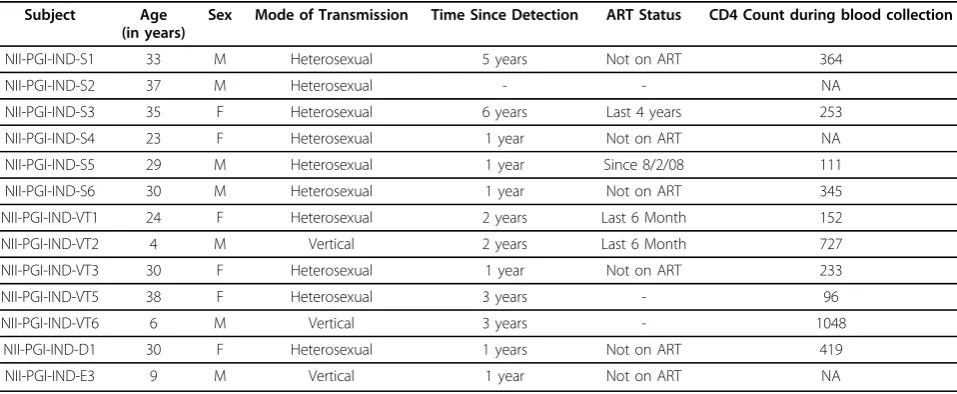
Detailed sequence analysis was carried out from HIV-1 infected individuals from Chandigarh-Punjab region as described in our recent HIV-1 LTR related paper [10]. They were monitored at Post Graduate Institute of Medi-cal Education and Research (PGIMER), Chandigarh by Dr A Wanchu (Clinician and one of the authors) after obtain-ing all requisite ethical clearances. The clinical features of all the 13 HIV-1 infected individuals are shown in table 1.
Genomic DNA isolation and analysis of RRE secondary structures
The genomic DNA was isolated from peripheral blood lymphocytes as described by us earlier [11] and sub-jected to polymerase chain reaction with RRE specific primers. 247 nt long RRE genes were amplified using specific primers common for both subtypes B and C and placed them under CMV/T7 promoter of the expression vector pCDNA3.1 (Promega Biotech.) that
was digested withHind III andBamH1. Following
pri-mers were used:
1. Forward: 5′- GGC aagctt GAGCAGTGGGAATA
GGAGCTTTG
2. Reverse: 5′- GGC ggatcc AGGAGCTGTTGATC
CTTTAGGTATCT
The sequence information was generated using T7-specific primers. Indian T7-specific Consensus C sequences
Table 1 Demographic, clinical parameters of HIV-1 infected individuals.
Subject Age
(in years)
Sex Mode of Transmission Time Since Detection ART Status CD4 Count during blood collection
NII-PGI-IND-S1 33 M Heterosexual 5 years Not on ART 364
NII-PGI-IND-S2 37 M Heterosexual - - NA
NII-PGI-IND-S3 35 F Heterosexual 6 years Last 4 years 253
NII-PGI-IND-S4 23 F Heterosexual 1 year Not on ART NA
NII-PGI-IND-S5 29 M Heterosexual 1 year Since 8/2/08 111
NII-PGI-IND-S6 30 M Heterosexual 1 year Not on ART 345
NII-PGI-IND-VT1 24 F Heterosexual 2 years Last 6 Month 152
NII-PGI-IND-VT2 4 M Vertical 2 years Last 6 Month 727
NII-PGI-IND-VT3 30 F Heterosexual 1 year Not on ART 233
NII-PGI-IND-VT5 38 F Heterosexual 3 years - 96
NII-PGI-IND-VT6 6 M Vertical 3 years - 1048
NII-PGI-IND-D1 30 F Heterosexual 1 years Not on ART 419
NII-PGI-IND-E3 9 M Vertical 1 year Not on ART NA
were created as describes previously [12]. Sequences were compared with Indian Consensus C and consensus B and Indian RRE subtype C sequences downloaded from Los Alamos Database http://www.hiv.lanl.gov/. The secondary structures were obtained using RNAali-fold program of Vienna RNA package that uses the Zuker algorithm as recently reported [13]. At least 4 independent clones were analyzed for each sample to
rule outTaqpolymerase mediated mis-incorporation of
nucleotides. A consensus RRE secondary structure was created by using the program described by Gruber
et. al., 2008 (website http://rna.tbi.univie.ac.at) [13]. All the 4 clones derived from a single individual showed complete similarity among them. Mother-child samples were processed separately to avoid potential cross contamination.
Rev cloning, purification, in vitro synthesis of RRE RNA and EMSA
Towards this end, we amplified Rev B using pNL4-3 [14] and Rev C using 93IN905 [15] genetic clones, as described above and purified it to homogeneity as GST-fusion proteins after placing them in bacterial expression vector (pGEX4T-2, Amersham Bioscience) following the earlier described protocol [16]. Prior to cloning in the bacterial expression vector, both the exons of the Rev genes were precisely fused using the fusion technology described by us recently [17]. We also amplified 247 nt long RRE fragment using specific pri-mers and placed it under CMV/T7 promoter of the expression vector pCDNA3.1 (Promega Biotech.) that
was digested with HindIII and BamH1. Hind III and
BamH1 restriction sites were engineered at the
begin-ning of forward and reverse primers respectively (small case) to facilitate cloning in the expression vector as
described above. 32P labeled RRE RNA was generated
using T7 RNA polymerase and fixed amounts of it was incubated with varying amounts of Rev protein and sub-jected to EMSA as described earlier [18].
Results and discussion
Analysis of RRE nucleotide sequences
83 sequences of subtype B (from USA, Japan, Mayan-mar, France and Brazil) and 83 sequences of Indian sub-type C, were downloaded from Los Almos data base
(Accessed on 13th May 2010). The mean intra-species
identity of Subtype B RRE sequences was 95.3% (range 90 -100) and Indian subtype C strains was 95.03% (Range 89-100). The identity between consensus B and C (downloaded from Los Alamos Database) was 94%. Thus RRE region is one of the most conserved regions in the genomic RNA between HIV-1 subtypes B and C and with probably other subtypes as well. The analysis of intra-subtype divergence (genetic distance from
Indian consensus sequence) and diversity (intra-subtype genetic variability of North Indian isolates) of these strains showed significant difference (0.105 vs. 0.011, p < 0.00011), thus it is tempting to speculate that North Indian HIV-1 subtype C RRE sequences are highly con-served and the phylogenetic analysis showed a mono-phyletic clade indicating epidemiological linkage of these samples (data not shown).
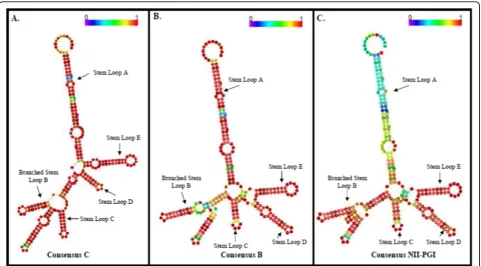
When the sequences were compared with the consen-sus Indian subtype C and consenconsen-sus B RRE sequences, all the four stem loops (C, D, E and A) showed nucleo-tide changes that were common with the latter with some unique region specific mutations. In stem loop A, G21A. A208G unique mutation observed in our cohort sequences. It is noteworthy that all of our 13 RRE sequences possessed G66A substitution located in the critical branched-stem-loop B which is neither present in the consensus C nor in Consensus B (Figure 1). In the same region, a unique G110A mutation was observed in North Indian strains. This region is critically involved with the binding of Rev protein. A120G muta-tion was observed in stem loop C and G192A substitu-tion was in stem loop E.
Mother- Child transmission of RRE sequences
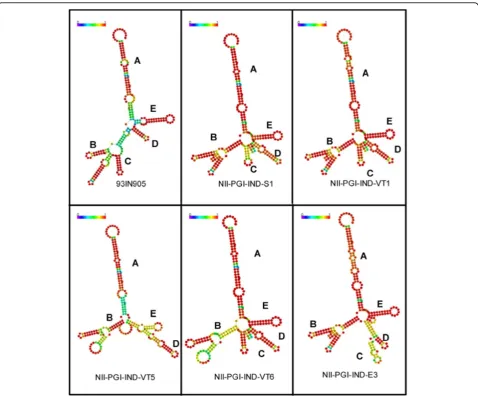
Two mother child pair samples namely, VT1 (mother) and VT2 (child) and VT5 (mother) and VT6 (child) were analyzed for the evolution or conservation of sequences. All of the stem-loop structures were retained with minor genetic changes that were different in the pair. For example, G123C mutation was observed only in stem-loop C of the mother. On the other hand, G94A unique mutation in stem-loop B was conserved both in mother and child (VT5 & VT6). The critically important 9 nt sequence involved in high affinity bind-ing with Rev protein, was however, completely con-served (figure 1).
Secondary structure prediction of RRE sequences
Stem Loop-A Branched Stem Loop-B
....|....| ....|....| ....|....| ....|....| ....|....| ....|....| ....|....| ....|....| 10 20 30 40 50 60 70 80
CONSENSUS_C GAGCAGTGGG AATAGGAGCT GTGTTCCTTG GGTTCTTGGG AGCAGCAGG- AAGCACTATG GGCGCGGCGT CAATAACGCT RRE-S1 ... ... T... ... ...- ... ...A.... ....G... RRE-S2 ... ... T... ... ...- ... ...A.... ....G... RRE-S3 ... ... T... ... ...- ... ...A.... ....G... RRE-S4 ... ... T... ... ...- ... ...A.... ....G... RRE-S5 ... ... T... ... ...- ... ...A.... ....G... RRE-S6 ... ... T... ... ...- ... ...A.... ....G... RRE-VT1 ... ...C T... ... ...- ... ...A.... ....G... RRE-VT2 ... ... T... ... ...- ... ...A.... ....G... RRE-VT3 ... ... T... ... ...- ... ...A.... ....G...
RRE-VT5 T - - A G
RRE-VT5 ... ... T... ... ....-....- ... ...A.... ....G... RRE-VT6 ...- -... T... ... ...- ... ...AC... ....G... RRE-D1 ... ... T... ... ...G ... ...A.... ....G... RRE-E3 ... ... T... ... ...- ... ...A.... ....G... CONSENSUS_B ... ... A... ... ...- ... ... ....G... Clustal Co ********* ******** ********* ********** **** **** ********** ***** *** **** *****
Stem Loop-C Stem Loop-D
....|....| ....|....| ....|....| ....|....| ....|....| ....|....| ....|....| ....|....| 90 100 110 120 130 140 150 160
CONSENSUS_C GACGGTACAG GCCAGACAAT TGTTGTCTGG TATAGTGCAA CAGCAAAGCA ATTTGCTGAG GGCTATAGAG GCGCAACAGC RRE-S1 ... ... .A...A ...G ...G.A.. .C... ...T... ... RRE-S2 ... ... .A...A ...G ...G.A.. .C... ...T... ... RRE-S3 ... ... .A...A ...G ...G.A.. ... ...T... ... RRE-S4 ... ... .A...A ...G ...G.A.. ... ...T... ... RRE-S5 ... ... .A...A ...G ...G.A.. ... ...T... ... RRE-S6 ... ... .A...A ...G ...G.A.. ... ...T... ...
RRE VT1 A A G G A T
RRE-VT1 ... ... .A...A ...G ...G.A.. ... ...T... ... RRE-VT2 ... ... .A...A ...G ...G.A.. ... ...T... ..A... RRE-VT3 ... ... .A...A ...G ...G.A.. ... ...T... ... RRE-VT5 ... ....A... .A...A ...C ..C....A.. ... ...T... ...C. RRE-VT6 ... ....A... .A...A ...G ...G.A.. ... ...T... ... RRE-D1 ... ... .A...A ...G ...G.A.. ... ...T... ... RRE-E3 ... ... .A...A ...G ...G.A.. ... ...T... ...C.. CONSENSUS_B ... ... .A... ... ...G.A.. ... ...T... ... Clustal Co ********** **** ***** * ******* ********* ** ** * ** * ******** ****** *** ** **** *
Stem Loop-E Stem Loop-A
....|....| ....|....| ....|....| ....|....| ....|....| ....|....| ....|....| ....|....| 170 180 190 200 210 220 230 240
CONSENSUS_C ATATGTTGCA ACTCACGGTC TGGGGCATTA AGCAGCTCCA GACAAGAGTC CTGGCTATAG AAAGATACCT AAAGGATCAA RRE-S1 ..C... ...A... ...C. .A... .G...A.. ...G.G. ... ... RRE-S2 ..C... ...A... ...C. .A... .G...A.. ...G.G. ... ... RRE-S3 ..C... ...A... ...C. .A... .G...A.. ...G.G. ... ... RRE-S4 ..C... ...A... ...C. .A... .G...A.. ...G.G. ... ... RRE-S5 ..C... ...A... ...C. .A... .G...A.. ...G.G. ... ... RRE-S6 ..C... ...A... ...C. .A... .G...A.. ...G.G. ... ... RRE-VT1 ..C... ...A... ...C. .A....C... .G...A.. ...G.G. ... ... RRE-VT2 ..C... ...A... ...C. .A... .G...A.. ...G.G. ... ... RRE-VT3 ..C... ...A... ...C. .A... .G...A.. ...G.G. ... ... RRE-VT5 ..C... ...A... G...C. .A... .G...A.. ...C..G.G. ... ... RRE-VT6 ..C... ...A... ...C. .A... .G...A.. ...G.G. ... ... RRE-D1 ..C... ...A... ...C. .A... .G...A.. ...G.G. ... ...
RRE E3 C C A C A G A G G T A
RRE-E3 C.C... ...A... ...C. .A... .G...A.. ...G.G. ...T- -..A... CONSENSUS_B ..C... ...A... ...C. ... .G... ...G.G. ... ... Clustal Co * ******* ****** *** ******* * * **** *** * ***** ** *** ** * * ******** ** ******
E stem loop structures) in the secondary structures were observed between VT5 (mother) and child VT6 (child) (figure 3).
Our RRE sequence analysis of HIV-1 infected indivi-duals (including mother -child pair samples) suggest that despite heterogeneity, four major stem-loop structures were conserved. This is important for Rev-RRE interac-tion which governs HIV-1 splicing and replicainterac-tion. Nine nucleotide long sequence (CACUAUGGG) present in stem-loop B was totally conserved in all our 12 samples and also among the early isolates from India (Data not shown). The most important observation was the pre-sence of G to A (66thposition) mutation present in the
2ndstem-loop region which was unique to our samples
(not observed in Consensus B or C sequences) and argues strongly in favor of selective forces responsible for selection of this mutation. Mutations were observed in other stem-loop regions (A, C, D & E) also. Most of these nucleotide changes are also observed in consensus sub-type B RRE sequence. Thus, most of our RRE sequences show similarity with either consensus B or C but the polymorphisms observed show similarity with consensus RRE B sequences. It is tempting to speculate that struc-tural constraints may allow the generation of RRE sequences that are either subtype B or C-specific in this
region. It must be pointed out that consensus RRE B and C sequences used here for comparison showed about 94% similarity between each other. Although we have carried out sequence analysis from 4 independent clones, it may still be argued that these mutations are due to mis-incorporation of nucleotides by the Taq polymerase. It is noteworthy that we used high fidelity Taq polymer-ase (Platinum Taq, Invitrogen). To further rule out this possibility, we isolated HIV-1 genomic RNA from the plasma of HIV-1 infected individuals from two samples (VT5 & VT6) and sequence information generated after PCR matched perfectly with the sequence generated from the DNA clones.
VT5 RRE binds to Rev B protein efficiently
alternate secondary structure. This also suggests that G to A transition (position 66) observed in VT5 RNA did not affect its binding ability to Rev protein. When RRE from VT5 was incubated with Rev C protein (derived from 93IN905), similar observation was made (data not shown).
Majority of HIV-1 infections among infants is due to vertical transmission from mother. It is, therefore, important to characterize various HIV-1 genes with respect to sequence variation or conservation. Our sequence & predicted structural analysis of mother (VT5) and child (VT6) pair indicate that stem-loop D and E have undergone some changes. These kinds of changes in the total number or the length of stem-loop structures in the RRE were reported earlier also [9], in a vertical transmission study carried out between mother and infant pairs. It must be pointed out that the nature
of polymorphisms observed in our studies is significantly different than what was observed by Ramakrishnan and Ahmad [9] for subtype-B-specific genes. Despite this kind of heterogeneity, the domains required for Rev pro-tein binding or host propro-tein interaction with RRE was conserved which is crucially important for viral gene expression and replication.
known to interact with RRE structures and modulate the splicing ability of Rev protein.
In summary, we genetically characterized the nature of heterogeneity in the RRE sequences from HIV-1 infected individuals from North India along with its impact on the formation of multiple stem-loop struc-tures. These structures show significant differences with respect to either the length or number of stem-loop structures when compared with prototype B and C RRE sequences. Transmission studies with mother-child pair revealed some conserved and new mutations but the ability to form stem-loop structures was retained. RRE derived from one of our samples (VT5) was fully cap-able of binding the Rev protein with equal efficiency as that of RRE B derived from subtype B (pNL4-3).
How these changes in the secondary structures of RRE RNA affect Rev protein binding in mammalian cells (or host factors), splicing and virus replication may be important for the virus replication.
Acknowledgements
Grant received from Department of Biotechnology, Government of India, is gratefully acknowledged. Support received from our Director Avadesha Surolia (NII, ND) and PGIMER Chandigarh is gratefully acknowledged.
Author details
1Division of Virology, National Institute of Immunology, JNU Campus, Aruna Asaf Ali Marg, New Delhi-110067, India.2Department of Internal Medicine, Post Graduate Institute of Medical Education & Research, Chandigarh, India.
3Department of Pediatrics, Post Graduate Institute of Medical Education & Research, Chandigarh, India.
Authors’contributions
YS, UN, VS, SB and SS carried out the experiments. Dr A. Wanchu and Dr S. Singh helped with clinical characterization of the infected samples. ACB is the principal investigator responsible for designing the work and writing the manuscript. All authors read and approved the final manuscript.
Competing interests
The authors declare that they have no competing interests.
Received: 22 December 2009 Accepted: 3 August 2010 Published: 3 August 2010
References
1. Malim MH, Cullen BR:HIV-1 structural gene expression requires the binding of multiple Rev monomers to the viral RRE: Implications for HIV-1 latency.Cell1991,65:241-248.
2. Holland SM, Ahmad N, Maitra RK, Wingfield P:Human immunodeficiency virus rev protein recognizes a target sequence in rev-responsive element RNA within the context of RNA secondary structure.J Virol1990,
64:5966-5975.
3. Pollard VW, Malim MH:The HIV-1 Rev protein.Annu Rev Microbiol1998,
52:491-532.
4. Battiste JL, Mao H, Rao NS, Tan R, Muhandiram DR, Kay LE, Frankel AD, Williamson JR:Alpha helix RNA major groove recognition in an HIV-1 rev peptide-RRE RNA complex.Science1996,273:1547-1551.
5. Plavec I, Agarwal M, Ho KE, Pineda M, Auten J, Baker J, Matsuzaki H, Escaich S, Bonyhadi M, Bohnlein E:High transdominant RevM10 protein levels are required to inhibit HIV-1 replication in cell lines and primary T cells: implication for gene therapy of AIDS.Gene Ther1997,4:128-139. 6. Akkina R, Banerjea A, Bai J, Anderson J, Li M, Rossi JJ:Si-RNAs, ribozymes,
and RNA decoys in modeling stem cell based gene therapy for HIV/ AIDS.Anticancer Res2003,23:1997-2006.
7. Hamm TE, Rekosh D, Hammarskjold M-L:Selection and characterization of human immunodeficiency virus type 1 mutants that are resistant to Figure 432P labeled RNA was made using T7 RNA polymerase after linearizing the vector as described by the manufacturer
inhibition by the transdominant negative RevM10 protein.J Virol1999,
73:5741-5747.
8. Legiewicz M, Badorrek CS, Turner KB, Fabris D, Hamm TE, Rekosh D, Hammarskjold ML, Le Grice SF:Resistance to RevM10 inhibition reflects a conformational switch in the HIV-1 Rev response element.Proc Natl Acad Sci USA2008,105:14365-14370.
9. Ramakrishnan R, Ahmad N:Derivation of primary sequences and secondary structures of rev responsive element from HIV-1 infected mothers and infants following vertical transmission.Virology2007,
359:201-211.
10. Neogi N, Sood V, Goel N, Wanchu A, Banerjea AC:Novel HIV-1 long terminal repeat (LTR) sequences of subtype B and mosaic intersubtype B/C recombinants in North India.Arch Virol2008,153:1961-1966. 11. Husain S, Goila R, Shahi S, Banerjea AC:First report of a healthy Indian
heterozygous forΔ32 mutant of HIV-1 coreceptor-CCR5 gene.Gene1998,
207:141-147.
12. Novitsky V, Smith UR, Gilbert P,et al:HIV-1 subtype C molecular phylogeny: consensus sequence for an AIDS vaccine design?J Virol2002,
76:5435-5451.
13. Gruber AR, Lorenz R, Bernhart SH, Neubock R, Hofacker IL:The Vienna RNA websuite.Nucleic Acids Res,36 Web Server:W70-4, Epub 2008 Apr 19. 14. Lole KS, Bollinger RC, Paranjape RS, Gadkari D, Kulkarni SS, Novak NG,et al:
Full-length human immunodeficiency virus type 1 genomes from subtype C-infected seroconverters in India, with evidence of intersubtype recombination.J Virol1999,73:152-160.
15. Adachi A, Glendelman HE, Koenig S, Folks T, Wiley R, Rabsom A,et al:
Production of acquired immunodeficiency syndrome associated retrovirus in human and nonhuman cells transfected with an infectious molecular clone.J Virol1986,59:284-291.
16. Malim MH, Cullen BR:HIV-1 structural gene expression requires the binding of multiple Rev monomers to the viral RRE: Implications for HIV-1 latency.Cell1991,65:241-248.
17. Sood V, Ranjan R, Banerjea AC:Functional analysis of HIV-1 subtypes B and C HIV-1 Tat exons and RGD/QGD motifs with respect to Tat mediated transactivation and apoptosis.AIDS2008,22:1683-1685. 18. Churchill MJ, Chiavaroli L, Wesselingh SL, Gorry PR:Persistence of
attenuated HIV-1 rev alleles in an epidemiologically linked cohort of long term-survivors infected with nef-deleted virus.Retrovirology2007,
4:43.
19. Banerjea AC, Joklik WK:Reovirus protein s1 translated in vitro as well as truncated derivatives of that lack up to two-thirds of its C-terminal portion, exists as two major tetramolecular species that differ in electrophoretic mobility.Virology1990,179:460-462.
doi:10.1186/1742-6405-7-28
Cite this article as:Sharmaet al.:Genetic and functional analysis of HIV-1 Rev Responsive Element (RRE) sequences from North-India.AIDS Research and Therapy20107:28.
Submit your next manuscript to BioMed Central and take full advantage of:
• Convenient online submission
• Thorough peer review
• No space constraints or color figure charges
• Immediate publication on acceptance
• Inclusion in PubMed, CAS, Scopus and Google Scholar
• Research which is freely available for redistribution
![Figure 1 HIV-1 RRE variants in North Indiaand subtype B (pNL4-3) [14]. Five stem loop regions are shown at the top of the sequence](https://thumb-us.123doks.com/thumbv2/123dok_us/446018.1538597/4.595.58.537.88.659/figure-variants-north-indiaand-subtype-regions-shown-sequence.webp)
![Figure 4 μ(Promega) and as described earlierlabeled RRE in 1032P labeled RNA was made using T7 RNA polymerase after linearizing the vector as described by the manufacturer [19]](https://thumb-us.123doks.com/thumbv2/123dok_us/446018.1538597/7.595.58.545.88.332/figure-promega-described-earlierlabeled-polymerase-linearizing-described-manufacturer.webp)
