Abstract In the mud- and sandflat region of the outer Königshafen off List on Sylt, the effects of the outflow from a sewage treatment plant on the benthic diatom flora were investigated. The spectrum of shapes, biomass, and diversity was determined in relation to the concentrations of phosphate, silicate, and nitrogen compounds in the overlying and pore water. The biomass increased with the available quantities of nutrients, while the diversity reached a maximum at the intermediate concentrations. Every different set of nutrient concentrations is character-ized by a different diatom community. Slight inputs of nu-trients led to changes in the relative abundances of forms typical of the habitat. Moderate concentrations permitted the species that are normally present in winter to occur in summer as well. In the strongly eutrophic region, nutrient-loving species that are not locally present under normal conditions formed nearly monospecific populations. A rel-atively constant input of nutrients almost eliminated the seasonal variations. Navicula gregaria, Nitzschia sigma, and Nitzschia tryblionella proved to be tolerant of pollu-tion, while the genera Achnanthes and Amphora were typ-ical in the nutrient-poor regions. The nutrient budget, par-ticularly that of the nitrogen compounds, was found to be predominant among the physical and chemical factors.
Key words Benthic diatom community · Structural changes · Nutrient concenration · Eutrophication gradient
Introduction
In the past, the benthic diatom flora was investigated mainly in relation to physical factors, such as character-istics of the sediment, light, and temperature, and more
recently in relation to hydrodynamics (Round 1971; Amspoker and McIntire 1978; van den Hoek et al. 1979; Colijn and Dijkema 1981; de Jonge 1992). The depen-dence of benthic diatoms upon nutrients has been widely neglected because it was assumed that they were suffi-ciently supplied from an inexhaustible nutrient pool in the pore water (van den Hoek et al. 1979). Only when the eutrophication problem became acute did the influ-ence of the increased nutrient concentration on the bent-hic diatoms become the subject of scientific investiga-tions (Van Raalte et al. 1976; Admiraal 1984; Granéli and Sundbäck 1985; de Jonge and Essink 1991; Nilsson et al. 1991; Sundbäck and Snoeijs 1991; Underwood et al. 1998). It became evident that benthic microalgae ex-erted a strong influence on the nutrient flux between sed-iment and overlying water (Asmus 1986; Rizzo 1990).
In the freshwater zone, the dependence of benthic dia-toms on nutrients has been so unequivocally clarified that the microalgae have been classified according to trophic and saprobity classes and are thus used as sensitive indi-cators of water quality (Lange-Bertalot 1979; Sládecek 1986). For marine regions, the available knowledge is still far from this level. While benthic marine diatoms as a group show much tolerance to fluctuations in environ-mental conditions, there is still little knowledge about the physiology and ecology of the individual species (Ad-miraal 1984). This work is meant to make a small contri-bution to the knowledge by investigating the effects of the outflow from a sewage treatment plant on the diatom flora. Difficulties in the precise identification of the dia-tom species due to the considerable methodological diffi-culties and the need for extensive taxonomic knowledge are certainly an impediment to an extensive investigation of the eutrophication phenomena. Therefore, this work is meant to show from a methodological aspect whether general identifications of the genus, shape, and size spec-tra combined with simultaneous recording of the morpho-logically and ecomorpho-logically outstandig species are suffi-cient to demonstrate possible variations in the community structure related to the nutrients. Is there a characteristic diatom association for certain degrees of eutrophication? M. Agatz · R.M. Asmus (
✉
)Wadden Sea Station Sylt, Alfred Wegener Institute for Polar and Marine Research, Hafenstrasse 43, D-25992 List, Germany e-mail: [email protected]
M. Agatz · B. Deventer
Fachhochschule Bingen, Department of Environmental Protection, Berlinstrasse 109, D-55411 Bingen, Germany
O R I G I N A L A R T I C L E
M. Agatz · R. M. Asmus · B. Deventer
Structural changes in the benthic diatom community
along a eutrophication gradient on a tidal flat
was determined using a gamma analysis technique salinometer. A WTW pH 191 electrode was used to record the pH.
Studies of the diatoms
The day after each of the water samples was taken for analysis, twelve random sediment samples were taken at low tide to a depth of 1 cm using a syringe with an open end 1 cm in diameter from within an area of 25 m2at each site. Six of these samples served
for identification, counting, and measuring cells under a light mi-croscope at a maximum magnification of 100×. For this purpose, 4 ml of filtered seawater was added to the samples, and they were shaken. Epipsammic diatoms were loosened from the sediment particles by exposure to ultrasonic vibrations for 2 min, which proved to be sufficient to remove the cells from the sand grains and to suspend the cells in the water as well.
On the days they were taken, two subsamples of each of the three parallel samples were examined under a dark field fluorescent microscope to determine the proportions of living diatoms belong-ing to each of the shape classes. The other three parallel samples were fixed in formalin. The small diatoms and those appearing in massive numbers were counted in a Thoma chamber. The large and rarer diatoms were counted under an inverted microscope. The specimens were identified using the following literature: van der Werff and Huls (1976), Hendey (1964), Lange-Bertalot and Kram-mer (1986), Cleve-Euler (1953), and Bertrand (1995).
The diatoms that were counted were measured, and their con-tent of organic carbon was calculated using the factors determined by Asmus (1984) with the formulae of Edler (1979). The second set of six sediment samples was used for photometrical determina-tion of chlorophyll a and pheopigment content after extracdetermina-tion overnight with 10 ml of acetone at 7°C, employing the formulae of Jeffrey and Humphrey (1975) and Lorenzen (1967).
Statistical evaluation
Because the diatom flora requires a certain period of time to react to changes in the nutrient supplies, the dataset for the diatoms was compared with that of the abiotic factors determined 14 days earli-er to evaluate their relationship. This time pearli-eriod corresponds ap-proximately to the displacement of the nutrient and biomass curves. Furthermore, Sundbäck and Snoeijs (1991) detected sig-nificant changes in the diatom flora in nutrient enrichment experi-ments only after 14 days.
The statistical analyses were conducted using the relative abundances of the diatoms belonging to the various shape classes so that the temporal variations of the absolute number of individu-als could not mask the effects. Discriminant analysis was used to quantify the differences between the sampling sites with regard to nutrient concentrations and diatom flora. Canonical analysis was employed in an attempt to elucidate the relationship between the nutrient supply and the diatom association. In addition, individual correlations were made between all of the diatom shapes and each of the nutrients. Cluster analysis was used to group the diatom forms with similar distribution patterns. The calculations were completed using the computer program Statistica.
Results
Nutrient conditions
Average concentrations over the whole study period showed nearly exponential gradients from the sewage outflow at station A to the sandflat at station D (Fig. 2). If the values at site D are considered to be reference val-ues typical of the region, then site A has to be consid-ered the one subjected to the strongest eutrophication,
Materials and methods
Area of investigation
On the intertidal flats of the “Oddewatt” of Königshafen off the northern part of the island of Sylt, the outflow of a community sewage treatment plant produces a distinct nutrient gradient, which was investigated at sampling sites designated by letters A to D (Fig. 1). Site A is located in the immediate vicinity of the out-flow point and is continually washed with the outout-flowing water, even during low tide. The continual flow there produces sandy sediment. The sites B to D are located at intervals of 150 m. Site D serves as an only slightly influenced reference point on an
Are-nicola sandflat, typical of Königshafen. Along the line formed by
sites, the sediment changes from silt at B to mixed sand and silt at C, and to sand at D. Benthic macrofauna (Hydrobia ulvae) was present, but it has been shown that the biomass of benthic microal-gae was not strongly influenced by grazing on the study sites. All sites were flooded within 30 min and the maximum difference be-tween them in the depth of the flooding was 25 cm.
Water analyses
The sites were sampled five times at 14-day intervals during the period from 25 June to 22 August 1997. The pore water was sucked through ceramic probes into evacuated glass jars and kept in a deep freezer until analysis. The samples of the overlying wa-ter were taken directly above the sediment surface during flood tide in polyethylene jars as well as in Winkler bottles for determi-nation of pH. They were analyzed subsequently in the laboratory. Determinations of phosphate, silicate, nitrite, nitrate, and ammoni-um were conducted according to the methods of Grasshoff et al. (1983), which required that the pore water samples be diluted up to 20 times their volume with doubly distilled water. The salinity
Fig. 1 Königshafen research area at the northern tip of the island
of Sylt. Low water line is indicated (grey line). Sampling sites A to
D extend on the tidal flat through the nutrient gradient produced
especially with regard to the nitrogen compounds. The values at site B also tended to be elevated. The large fluctuations in the values result from changes during the study period from June to August in the concentrations in the water flowing out of the sewage treatment plant,
the phase of the tide and the water currents, as well as natural processes. The changes in the mean concentra-tions of the overlying water along the gradient were dif-ferent for each of the nutrient substances. While the phosphate value at site A was only 2.5 times the value at site D, the nitrate concentration increased by a factor of 21 over the distance from site D to A. The mean sa-linity and pH values of 20 PSU and 7.9, respectively, were clearly reduced relative to the other stations (30.5 PSU, pH 8.3) only in the immediate vicinity of the out-flow point at site A.
The high mean pore water concentrations at sites A and B were indicative of eutrophication. The mudflat (site B) showed a special affinity for the accumulation of nutrient substances, as shown by observation that the phosphate and silicate concentrations in the pore water were greater at site B than at site A. There was a gradient for nitrogen compounds in the pore water from sites A to D.
In the discriminant analysis, the differences in the nu-trient concentrations in the pore water at all sites were significant at P<0.001. Only the distance between C and D was not significant. Because of the great degrees of fluctuation in the surface water concentrations, only the differences between site A and the other sites were sig-nificant at P<0.01.
The diatom flora
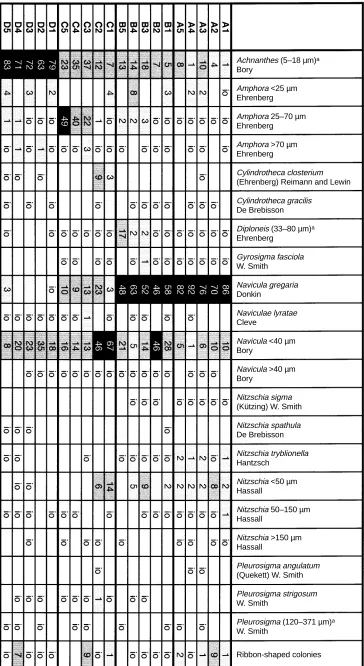
The composition of the diatom flora was characteristic at each of the sites (Table 1). At site A, Navicula gregaria was predominant with an average abundance of 81%, compared to its abundance of 53% at site B. At sites C and D, this species played only a minor role. Species of the genus Achnanthes showed the opposite tendencies. Their total abundance rose continually from 4% at site A to 74% at site D. Nitzschia tryblionella made a steady contribution to the total number of cells at sites A and B,
Fig. 2 Average nutrient concentrations (µmol l–1with standard
de-viations) at sites A to D for the study period June to August 1997.
Above Overlying water; below pore water
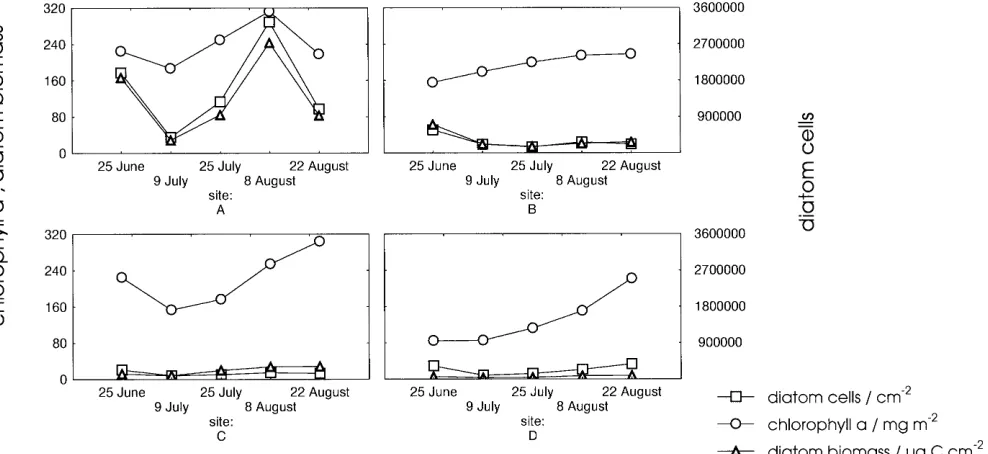
Fig. 3 Biomass of benthic microalgae at sites A to D during the
Table 1 Composition of
dia-tom flora at sites A to D on sampling dates 1 to 5. Relative abundances are illustrated.
Numbers represent percentages
of total number of cells: solid
shading massive numbers
(>45%); medium shading abun-dant (5–45%); light shading present (1–5%); io, isolated oc-currence (<1%)
Achnanthes (5–18 µm)a
Bory
Amphora <25 µm Ehrenberg
Amphora 25–70 µm Ehrenberg
Amphora >70 µm Ehrenberg
Cylindrotheca closterium (Ehrenberg) Reimann and Lewin
Cylindrotheca gracilis De Brebisson
Diploneis (33–80 µm)a
Ehrenberg
Gyrosigma fasciola W. Smith
Navicula gregaria Donkin
Naviculae lyratae Cleve
Navicula <40 µm Bory
Navicula >40 µm Bory
Nitzschia sigma (Kützing) W. Smith
Nitzschia spathula De Brebisson
Nitzschia tryblionella Hantzsch
Nitzschia <50 µm Hassall
Nitzschia 50–150 µm Hassall
Nitzschia >150 µm Hassall
Pleurosigma angulatum (Quekett) W. Smith
Pleurosigma strigosum W. Smith
Pleurosigma (120–371 µm)a
W. Smith
Ribbon-shaped colonies
but the species was difficult to find at C and D. The form group Navicula <40 µm reached an abundance maximum (31%) at site C. It amounted to 21% at sites B and D, while it was only 6% at A. The curve of its seasonal oc-currence showed a distinct downward dip in the middle of July.
The average proportion of the Amphora species re-mained below 1‰ and 1% at sites A and B. In contrast, they were important components of the flora at sites C and D, where they also displayed distinct seasonal changes. Before the beginning of sampling in spring, a massive development of these species was observed, but in June and July they were only sparcely represented. In August, they seemed to increase in numbers again.
In general, sites C and D were characterized by more distinct seasonal fluctuations than A and B. At site A, the seasonal changes were largely eliminated by the out-flow from the sewage treatment plant. For the species that occurred at low abundances, few tendencies could be detected. Nitzschia sigma was found only at sites A and B. Nitzschia spathula was generally observed only at site D. Most form classes of diatoms could be observed almost everywhere, at least as isolated individuals. At the nutrient-poor sites C and D, the number of cells of the cyanobacterium Merismopedia glauca (Ehr.) Naeg. greatly exceeded that of the diatoms.
A summary of the parameters and the indices of the diatom flora are provided in Table 2. The chlorophyll a content was at times influenced by the occurrence of Merismopedia glauca and is therefore unsuitable for a differential evaluation of the diatom flora. The biomass of the diatoms increased with the increase in nutrient in-put (Fig. 3), while the diversity was maximal at the inter-mediate concentration level. The differences in diversity resulted mainly from the relative levels of dominance and not from changes in the number of the forms.
Distribution patterns and dependences
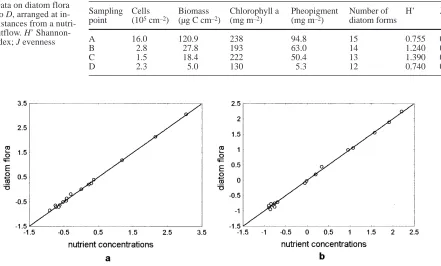
The diatom associations at the individual sites were sig-nificantly different from one another, as determined at the P<0.001 level by discriminant analysis. The greatest distance, calculated as the squared Mahalanobis distance, was between B and C, which signifies the transition from the “polluted” region to the “unpolluted” one. The ca-nonical analysis (Fig. 4) encompassed 73% of the vari-ance of the diatom forms, which could be explained by the nutrient conditions in the overlying water to a degree of 48%, equivalent to the total redundancy (canonical R=0.99, P=0.001). The canonical correlation of diatoms with pore water was similar to that of diatoms and the surface water: canonical R=0.99, P<0.001, total redun-dancy of the diatom set of 46%.
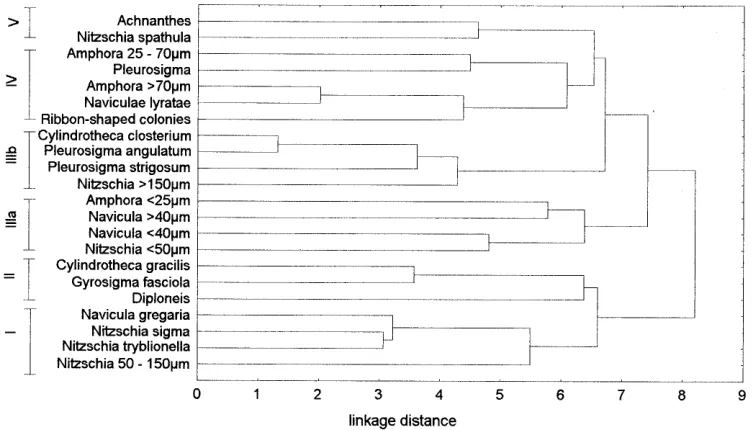
The cluster analysis of the distribution pattern of the diatom forms also reflects the nutrient gradient (Fig. 5). In this case, a main distribution can also be recognized, which corresponds to the categories “unpolluted” and “polluted”. Classes I and II are clearly distinct, and their species have their centers of abundance at the more eu-trophic sites A and B. In addition, the forms of class I
Table 2 Data on diatom flora
at sites A to D, arranged at in-creasing distances from a nutri-ent-rich outflow. H’ Shannon-Weaver index; J evenness
Sampling Cells Biomass Chlorophyll a Pheopigment Number of H’ J point (105cm–2) (µg C cm–2) (mg m–2) (mg m–2) diatom forms
A 16.0 120.9 238 94.8 15 0.755 0.279
B 2.8 27.8 193 63.0 14 1.240 0.473
C 1.5 18.4 222 50.4 13 1.390 0.538
D 2.3 5.0 130 5.3 12 0.740 0.292
Fig. 4 Canonical correlation between composition of diatom flora
are correlated positively with the nutrients and their abundances increase gradually as the nutrient concentra-tions increase. They can therefore be characterized as nutrient-loving. Class III includes the species that reach their abundance maxima at site C. Its subgroup (a) shows a seasonal minimum at the end of July and beginning of August. In contrast, the fluctuations of subgroup (b) are of an undetermined nature. If one form in this class ap-pears in one place during a particular time of year, how-ever, there is a high probability that the other forms will also be found. Class IV is characterized as a transition between sites C and D. Finally, class V encompasses the forms typical of the unpolluted site D, the abundances of which increase gradually along the gradient with de-creasing concentrations. Their correlation with the nutri-ents can therefore be classified as strongly negative. Achnanthes, Nitzschia spathula, and, based on the indi-vidual correlations, Amphora can therefore be assigned to the nutrient-poor region.
Discussion
Sources of nutrients and nutrient limitation
Stefánsson and Richards (1964) reported an optimal Si:N:P ratio of 22:16:1 for diatoms. At site A the corre-sponding nutrient ratio was almost optimal at 31:20:1 in July (Fig. 6), probably leading to a rapid increase in the diatom biomass. Phosphate seemed to be the limiting factor at site A, as also determined in a region exposed to nitrogen eutrophication by Granéli and Sundbäck (1985). Generally, however, nitrogen is the component lacking in the marine environment (Granéli and Sund-bäck 1985), as it was at sites B, C, and D, where the N:P ratio sank to 2:1 in August. Similarly, the relative amount of silicate never reached optimal values. The low Si:P ratio together with the shortage of nitrogen could
have promoted the growth of the cyanobacteria at sites C and D (Patrick 1977). With the increase in the relative amount of silicate in late summer, the diatom biomass increased. This biomass development in spite of a nitro-gen shortage suggests that the rich nutrient pool in the pore water was being utilized.
The degree of availability of the pore water and sedi-ment as nutrient sources is still generally unknown (Ad-miraal 1984). Sundbäck and Granéli (1988) estimated that the microphytobenthos covers between 5 and 30% of its nitrogen requirements by using the pore water. Ad-ditionally, the silicate pool of the sediment can be impor-tant for benthic diatoms (Nilsson et al. 1991; Sundbäck and Snoeijs 1991). In the present investigation, the math-ematical correlations between the diatom forms and the pore water are generally similar to those for the same forms and the overlying water. Species that live mainly at nutrient-poor locations, however, show a stronger de-pendence upon the pore water. There might be a physio-logical characteristic that allows certain forms to live at locations poor in nutrients. However, the close relation-ship may also result from the conditions at the location, which force the diatoms in nutrient-poor environments to rely on the pore water, while those at nutrient-rich sites do not need to do this. Furthermore, from the develop-ment of the biomass, it can be inferred that the nitrogen limitation can be reduced by the pore water. However, the utilization of nutrients in the pore water is greatly limited. Simon (1988) made it clear that the nitrate con-centrations in the immediate vicinity of the border be-tween the water column and sediment are often lower than those in both the overlying and pore water. Because benthic diatoms inhabit this interface, they are dependent upon nutrient fluxes from both the overlying and pore water into their environment.
Fig. 5 Cluster analysis
Changes in the diatom flora
An increase in the microbenthic biomass with elevations in the amounts of available nutrients has been demon-strated (Cadée 1984; Sundbäck and Snoeijs 1991; Pele-tier 1996). However, increases as great as those shown in this study, up to 24 times the reference value, have sel-dom been found. The significant positive correlation, P<0.01, between the biomass and the nutrient quantities further demonstrates the promotional effects.
In this study the association of benthic diatoms changed along the nutrient gradient so that different levels of nu-trient loadings could be distinctly separated by statistical analysis. For this purpose it was sufficient to identify the most abundant diatoms. Rare species gave only little fur-ther information on the eutrophication level. It is still un-der discussion on which taxonomic level a system of dif-ferent diatom associations in relation to the eutrophica-tion level should be based. While Kelly et al. (1995) did not find a significant difference between a system based at either the genus or the species level, Lange-Bertalot (1979) prefers definitely the species level. Within a ge-nus, species may vary in their sensitivity to eutrophica-tion. A study on diatom associations is only possible on the basis of a sound taxonomic knowledge and it is an important target to gain more information on the reac-tions of specific diatoms on nutrients. However, in this study the identification of the diatoms at the genus level in general and only for very abundant diatoms at the spe-cies level seemed to be a feasible compromise in order to gain information on the affect of the eutrophication in a very short time.
Nutrient-poor regions are inhabited mainly by small forms, in this case, species of the genus Achnanthes.
Their great surface to volume ratio permits an intensive nutrient absorption (Baillie 1987), making them especial-ly competitive at nutrient-poor locations (Carrick et al. 1988). In the eutrophic regions, the highly mobile species are predominant: in this case, Navicula gregaria. These are able to react to rapid changes in the conditions at their locations, such as a coating of macroalgae, which spread at nutrient-rich locations (Hudon and Legendre 1987).
The diversity variables observed are greater than the comparable values of Asmus (1984) for Königshafen; the actual low H’ and J values, however, indicate associ-ations that are influenced by a predominance of few spe-cies. Although there is a weak negative correlation be-tween diversity and the concentrations of nitrogen com-pounds, the species richness does not increase continu-ously along with the nutrient decrease. The maximal di-versity at sites B and C can be explained by the promo-tional effects of the moderate nutrient enrichment, but the kind of sediment is also an important factor since the diversity of diatom associations is lower on sand than on silt (Round 1971). Therefore, the conclusions of Dam (1982) must be preferred, since he denies that there is a uniform relationship between the diversity indices and water pollution. However, a reducton in diversity (Van Raalte et al. 1976) and number of diatom species has been found in enrichment studies in saltmarsh sediments (Sullivan 1976).
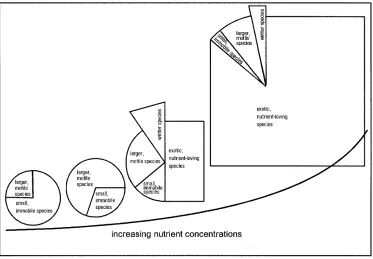
The number of forms scarcely varied along the nutri-ent gradinutri-ent because isolated individuals of almost all forms could be discovered at all of the sites. Transport processes and the broad ecological amplitude of the dia-toms have already been proposed to explain this phe-nomenon by Lange-Bertalot (1979). However, from the relative abundances of the diatoms, a clear modification due to the nutrient inputs can be recognized (Fig. 7).
The diatom associations at site D conform to the de-scriptions of those on the sandflats at Königshafen provid-ed by Asmus and Bauerfeind (1994), where the main gen-era were Achnanthes, Amphora, Navicula, and Pleurosig-ma, while Cylindrotheca gracilis, Diploneis, Gyrosigma
Fig. 6 Nutrient ratios at sites A to D. Silicate and nitrogen are
fasciola, and Nitzschia are largely lacking during the sum-mer. The development of Merismopedia glauca completes the comparison. The diatom associations described seem to form a characteristic flora of the relatively nutrient-poor Arenicola sandflats. Comparable associations of species have also been found in the Dutch Wadden Sea (Colijn and Dijkema 1981). At site C, mainly the same forms are en-countered. However, the relative abundances there begin to change, with Achnanthes losing its predominance to the small Navicula species. Amphora and Pleurosigma strigo-sum also begin to become more numerous. This slight shifting in dominance corresponds to the slight increases in the nutrient concentrations.
A more evident change in the diatom community was first observed at site B. Cylindrotheca gracilis, Diplon-eis, Gyrosigma fasciola, and Nitzschia, which Asmus and Bauerfeind (1994) had found only during the winter period of nutrient richness, could be found at this site in summer as well. The nutrient input first promoted the forms that are typical of the habitat but not those typical of the season. This can be explained by the equalizing effect of the wastewater inflow on the nutrient supplies, which become adequate to provide the winter species with their needs for survival even in summer. The natural seasonal fluctuations in the diatom community were re-duced in this way.
The influence of the nutrient input at site B leads to even more drastic changes in the diatom flora. Navicula gregaria, Nitzschia sigma, and Nitzschia tryblionella, which do not rank among the spectrum of species typical for the location, appear in great abundance. At the strongly eutrophic site A, the changes are so great that the original diatom community has almost been dis-placed by a monoculture of Navicula gregaria.
Wilkin-son et al. (1986) determined that the dense diatom mats occurring in eutrophic regions are formed almost exclu-sively of species that normally occur at insignificant abundances.
The principal changes are also apparent from the da-taset for the Ems-Dollard estuary obtained during the years from 1977 to 1993 (Peletier 1996). During this pe-riod, the amount of the nutrient-rich outflow greatly de-creased. First, the predominant nutrient-loving species that had been present during the summer or throughout the entire year were limited to an occurrence in winter, and then they disappeared completely. Among this group are species of Nitzschia and Navicula, which are similar in form to Navicula gregaria. Simultaneously, other cies of Navicula increased in importance, and new spe-cies appeared. Gyrosigma fasciola began to appear again in winter instead of summer. Underwood et al. (1998) found that epipelic species do have different trophic preferences and ammonium may be a factor in determin-ing estuarine species composition of epipelic diatoms.
This comparison suggests that the principal processes of change in the various regions show no basic differ-ences.
Factors with influence
The relationship between the nutrient supplies and the structure of the diatom flora seems to be so close that other factors are overshadowed. The diatom association at the strongly eutrophic sandy site A has a considerably different structure from that at the unpolluted reference site D on sand. It resembles, however, the diatom flora at moderately polluted site B on silt. In the literature,
char-Fig. 7 Schematized changes in
acteristic diatom associations have been described for the different kinds of sediments and the various mud-and smud-andflat areas (Brockmann 1950; Sundbäck 1983; Asmus and Bauerfeind 1994). According to the results reported here, the influence of the nutrient supplies is so strong, however, that the typical associations can be completely replaced. The dependence of the diatoms on the grain size of the sediment is therefore less strong than their dependence upon the nutrient concentrations. This conclusion is supported by the fact that Nitzschia sigma and Nitzschia tryblionella reached their maximal abundance at the eutrophic but sandy location, even though Brockmann (1950) and Hendey (1964) reported that they seldom appear on purely sand flats.
In a comparison with the salinity, the nutrient supply was found to be a predominant factor, as well. The forms that occurred in massive numbers at the site at which the water was most eutrophic and diluted by freshwater be-long to typical brackish-water species. However, they also characterized the diatom flora of the saltwater region with high concentrations of nutrient substances. Navicula gregaria and Nitzschia sigma are exemplary of these nu-trient-loving species. Their preferred salinity normally lies between 30 and 32 PSU (van den Hoek et al. 1979). In this investigation, however, they were most abundant at the eutrophic site that was influenced by freshwater.
The effect of the individual nutrients cannot be consid-ered alone. Because the N:P ratio at the unpolluted refer-ence site was lower than optimal and because it is mainly the amounts of nitrogen compounds that are greatly ele-vated by the wastewater, it is suspected that the nitrogen supply is the main cause of the observed changes. The in-dividual correlations between the different compounds of nitrogen and the diatom forms were very often and very highly significant. This conforms to the observations in the Ems-Dollard estuary, where similar changes in the di-atom flora were observed when there was a strong eu-trophication by nitrogen compounds (Admiraal 1980).
In general, it can be confirmed that while the nutrient supply, salinity, and nature of the sediment exert a com-plex influence on the diatom flora, it is the influence of the nutrient concentrations that is predominant.
Acknowledgement Special thanks are due to Charles Hackman
for the translation of the German manuscript. This is publication no. 1556 of the Alfred Wegener Institute for Polar and Marine Re-search.
References
Admiraal W (1980) Experiments on the ecology of benthic dia-toms in the Ems-Dollard estuary. PhD Thesis, University of Groningen
Admiraal W (1984) The ecology of estuarine sediment-inhabiting diatoms. In: Round FE, Chapman G (eds) Progress in phyco-logical research 3. Biopress, Bristol, pp 269–322
Amspoker MC, McIntire CD (1978) Distribution of intertidal dia-toms associated with sediments in Yaquina estuary, Oregon. J Phycol 14:387–395
Asmus R (1984) Benthische und pelagische Primärproduktion und Nährsalzbilanz. Ber Inst Meereskunde, Univ Kiel 131
Asmus R (1986) Nutrient flux in short-term enclosures of intertid-al sand communities. Ophelia 26:1–18
Asmus R, Bauerfeind E (1994) The microphytobenthos of Königs-hafen – spatial and seasonal distribution on a sandy tidal flat. Helgol Meeresunters 48:257–276
Baillie PW (1987) Diatom size distributions and community strati-fication in estuarine intertidal sediments. Estuar Coast Shelf Sci 25:193–209
Bertrand J (1995) Contribution à l’étude taxonomique des diatom-ées; reconnaissance du vivant. Vie Milieu 45:283–293 Brockmann C (1950) Die Watt-Diatomeen der
schleswig-holstein-ischen Westküste. Abh Senckenberg Naturf Ges 478:5–26 Cadée GC (1984) Has input of organic matter in the western part
of the Dutch Wadden Sea increased during the last decades ? Neth J Sea Res 10:71–82
Carrick HJ, Lowe RL, Rotenberry JT (1988) Guilds of benthic al-gae along nutrient gradients: relationships to alal-gae community. J N Am Benthol Soc 7:117–128
Cleve-Euler A (1953) Die Diatomeen von Schweden und Finn-land: Teil III. Kongl Svenska Vetenskapsakademiens Handlin-gar, Stockholm
Colijn F, Dijkema KS (1981) Species composition of benthic dia-toms and distribution of chlorophyll a on an intertidal flat in the Dutch Wadden Sea. Mar Ecol Prog Ser 4:9–21
Dam H van (1982) On the use of measures of structure and diver-sity in applied diatom ecology. Nova Hedwigia Beih 73: 87–115
Edler L (1979) Recommendations on methods for marine biologi-cal studies in the Baltic Sea. Baltic Mar Biol Publ 5:25–31 Granéli E, Sundbäck K (1985) The response of planktonic and
mi-crobenthic algal assemblages to nutrient enrichment in shallow coastal waters, southwest Sweden. J Exp Mar Biol Ecol 85: 253–268
Grasshoff K, Ehrhardt M, Kremling K (1983) Methods of seawa-ter analysis. Verlag Chemie, Basel
Hendey NI (1964) An introductory account of the smaller algae of British coastal waters, part V: Bacillariophyceae. Ministry of Agriculture, Fisheries and Food, Fishery Investigations Series, HMSO, London
Hoek C van den, Admiraal W, Colijn F, Jonge VN de (1979) The role of algae and seagrasses in the ecosystem of the Wadden Sea: a review. In: Wolff WJ (ed) Flora and vegetation of the Wadden Sea. Stichting Veth tot Steun aan Waddenonderzoek, Leiden
Hudon C, Legendre P (1987) The ecological implications of growth forms in epibenthic diatoms. J Phycol 23:434–441 Jeffrey SW, Humphrey GF (1975) New spectrophotometric
equa-tions for determining chlorophylls a, b, c1 and c2 in higher plants, algae and natural phytoplankton. Biochem Physiol Pflanzen 167:191–194
Jonge VN de (1992) Physical processes and dynamics of micro-phytobenthos in the Ems estuary (The Netherlands). PhD The-sis, University of Groningen
Jonge VN de, Essink K (1991) Long-term changes in nutrient loads and primary and secondary producers in the Dutch Wadden Sea. In: Elliott M, Ducrotoy JP (eds) Estuaries and coasts: spatial and temporal intercomparisons. Olsen and Olsen, Fredensberg, pp 307–316
Kelly MG, Penny CJ, Whitton BA (1995) Comparative perfor-mance of benthic diatom used to assess river water quality. Hydrobiologia 302:179–188
Lange-Bertalot H (1979) Toleranzgrenzen und Populationsdy-namik benthischer Diatomeen bei unterschiedlich starker Ab-wasserbelastung. Arch Hydrobiol Algol Studies 23:184–219 Lange-Bertalot H, Krammer K (1986) Bacillariophyceae. Teil 1:
Naviculaceae. Gustav Fischer, Stuttgart
Lorenzen C (1967) Determination of chlorophyll and pheopig-ments: spectrophotometric equations. Limnol Oceanogr 12: 343–346
Sundbäck K (1983) Microphytobenthos on sand in shallow brack-ish water, Öresund, Sweden. PhD Thesis, University of Lund Sundbäck K, Granéli W (1988) Influence of microphytobenthos
on the nutrient flux between sediment and water: a laboratory study. Mar Ecol Prog Ser 43:63–69
Sundbäck K, Snoeijs P (1991) Effects of nutrient enrichment on microalgal community composition in a coastal shallow-water sediment system: an experimental study. Bot Mar 34:341–358 Underwood GJC, Phillips J, Saunders K (1998) Distribution of
es-tuarine species along salinity and nutrient gradients. Eur J Phycol 33:173–183
Van Raalte CD, Valiela I, Teal JM (1976) The effect of fertiliza-tion on the species composifertiliza-tion of salt marsh diatoms. Water Res 10:1–4
Werff A van der, Huls H (1976) Diatomeeënflora van Nederland. Otto Koeltz Science Publishers, Koenigstein
Wilkinson M, Fuller I, Rendall D (1986) The attached algae of the Clyde and Garnock estuaries. Proc R Soc Edinburgh 90B: 143–150
Communicated by K. Lüning Patrick R (1977) Ecology of freshwater diatoms. In: Werner D
(ed) The biology of diatoms. Blackwell, Oxford, pp 333–371 Peletier H (1996) Long-term changes in intertidal estuarine diatom
assemblages related to reduced input of organic waste. Mar Ecol Prog Ser 137:265–271
Rizzo WM (1990) Nutrient exchanges between the water column and a subtidal benthic microalgal community. Estuaries 13: 219–226
Round FE (1971) Benthic marine diatoms. Oceanogr Mar Biol Ann Rev 9:83–139
Simon NS (1988) Nitrogen cycling between sediment and the shallow-water column in the transition zone of the Potomac River Estuary. I. Nitrate and ammonium fluxes. Estuar Coast Shelf Sci 26:483–498
Sládecek V (1986) Diatoms as indicators of organic pollution. Acta Hydrochim Hydrobiol 14:555–566
Stefánsson U, Richards FA (1964) Distributions of dissolved oxy-gen, density and nutrients off the Washington and Oregon coasts. In: Parsons TR (ed) (1984) Biological oceanographic processes, 3rd edn. Pergamon Press, Oxford