F o o d quality and the h e t e r o g e n e o u s spatial d i s t r i b u t i o n
of m e i o f a u n a
J. J. Lv.v. 1, J. H.
TIETJEN 1,
C. MASTROPAOLO 1 & H. RUBIN 2
1 Department of Biology,City College of City University of New York; New York, and
Department of Mathematics,
Hunter College of City University of New York; New York, USA
ABSTRACT: Several different experimental approaches were used to examine recruitment of benthic meiofauna to patches of selected species of algae. In one approach algal-coated, baited slides were incubated in a salt marsh littoral benthos. The second approach employed patches of algae arrayed equidistantly around art inoculum of meiofauna in a petri dish. Meiofauna were shown to be selectively recruited to patches of some species of algae but not to others. The evidence obtained supports a hypothesis that selective recruitment of meiofauna can be one mechanism which establishes the spatial heterogeneity so often observed in natural collections of meiofauna.
I N T R O D U C T I O N
Spatial and temporal heterogeneity of abiotic resources and organisms, at various hierarchies of scale, are commonplace in the natural world. We must presume that interacting species and the communities in which they co-evolved function effectively in this environmental mosaic or else they would not persist today. Quite some time has passed since Hutchinson & MacArthur (1959) concluded that there was a con- tinuous functional relationship between the size of the animal and the size of the mosaic elements of their environment. Though it would seem that the high species diversity of protozoa and small metazoa, their generally high reproductive rates and the mosaic nature of the environment at scales meaningful to them would have at- tracted many ecologists to use them to study mechanisms of community organization or structure, the specialized skills required for observation and manipulation and the proportionally greater time required in the identification of small organisms have not encouraged too many.
Food quality and spatial distribution of meiofauna 273 have been studied most intensively competition and predation seem to be the mecha- nisms which organize community structure (e.g. Connell, 1975). Through there is less documentation on this point, asexual reproduction and functionally similar phenomena (i.e. iteropary) seem to provide an additional major mechanism which operates in weaving communities from diverse assemblages of large numbers of small organisms with high reproductive rates.
Current ecological thinking suggests that resource partitioning by food type is more important for animals feeding on food that is large in relation to their own size than it is for animals feeding on relatively small food items (Schoener, 1974). Experimental evidence for protozoa (e.g. Fenchel, 1968; Lee, 1974; Rubin & Lee,
1976) and meiofauna (e.g. Provasoli et al., 1959; Tietjen et al., 1970; Lee et al., 1976) indicates that this ccncept is particularly applicable to the smallest animals. A conceptual framework for micro and meiofaunal resource optimization within an environmental mosaic could be based on successive responses of the animals to asexual blooms of different species of microflora. Species of littoral foraminifera, for instance, are known to feed, grow and reproduce quite rapidly in response to particular algal blooms (Lee et al., 1966; Lee & Muller, 1973). The explosive bursts of reproduction could lead to the extremely heterogeneous distribution of these animals which have been found in nature (Buzas, 1965, 1969; Lee et al., 1969; Matera & Lee, 1972).
Is it equally plausible that heterogeneity could develop in the small animal com- munity as a consequence of selective recruitment of these animals to specific blooms of algae? At the onset of our experiments, we were unaware of any specific experi- ments which demonstrated that selective recruitment to algal patches could be a mechanism for structuring communities populated by very small animals.
MATERIALS AND METHODS
holders in turn were inserted into a set of in situ incubators which we fabricated from lucite cylinders and flat sheets of the same plastic. The incubators were designed to hold 4 slide holders (Peel-a-Way Sci Div., W. Glen Wunderly Co., South el Monte, California) (with each 3 slides) in immediate contact with the benthic substratum. The walls of the incubators were perforated with small holes (0.5 cm) to permit free exchange of sea water without exposing the slides to macrofauna, and the bottom of the incubators were surrounded with a wide flange which prevented them from sinking into the substratum. There were 4 incubators to a set which were tied by means of nylon ropes to each other and staked so that each incubator was in a quadrant of m 2. In order to study both recruitment and reproduction, incubation times were varied from 2 days to several weeks. Control slides (sea water-agar controls) were randomiz- ed with experimental slides and were present in all subsets. At harvest the slide holders were gently removed from the incubators and individual slides were inserted into plastic cytological slide mailing tubes filled with a sodium bicarbonate buffered Rose Bengal-formalin mixture. The organisms on the surface of the slides and in the mailing tubes were examined under a dissecting microscope and when necessary under a com- pound microscope. The organisms were enumerated only to major group.
The second approach ("cafeteria") to the problem was basically a laboratory one. Large petri dishes (150 m m • 15 mm) were the experimental vessels. They were very carefully filled on a perfectly level surface with 40 ml of sea water agar. Stock cultures of the same experimental algae were grown on similarly prepared plates except that the medium was richer ("S" agar; Lee et al., 1970). An alcohol sterilized @ 10 cork borer was used to remove a central and 8 equidistant peripheral plugs of agar from the experimental plates. A template placed under the plates aided the processes. Number 10 plugs of algae from the stock plates were aseptically placed in four alter- nate peripheral holes in the experimental plates. The alternate spaces between algal patches were filled with plugs of "S" medium agar. Control plates were filled with plugs of "S" agar in all 8 positions. Two series of experiments were conducted in the petri dishes. In the first series synxenic cultures of individual meiofaunal species.
Chrornadorina gerrnanica (nematode), Nitocra typica (harpacticoid copepod), Lepto- caris brevicornis (harpacticoid copepod), Allogrornia laticollaris (foraminifera) and
Food quality and spatial distribution of meio{auna 275
8
0O I 0
U%
l l [ l l [ I J f l l l l l l ]
[ l [ l l l ] l l l l l l f l l
~ 0 0 ~ 0 ~
o ~ ~ o ~ o ~ o ~
I I i ] I ] I ] [ I I I I [ I I
] f l l l l [ r ] l l ] l l l l
I I [ I I I I I I I l I I I I
I I I I I ] 11 I I I I I I f
~ 0 ~ o ~
~ o ~
Those experiments involving field work were done in 2 successive summers whiie in residence at the Marine Biological Laboratory, Woods Hole, Mass., USA.
Some additional laboratory experiments were performed with the foraminifer
AlIogrornia laticollaris and 2 species of algae, Nitzschia acicularis and DunalieIla
parva. Plates were either uniformly inoculated with either organism, divided into
uniformly inoculated algal alternating quadrants, or 4 or 8 algal patches of one species in a uniform background of the other species. Uninoculated discs of media were used as controls.
Analysis of variance was performed with the aid of the UCLA Health Sciences Computer Program BMDOLV.
RESULTS AND DISCUSSION
Food quality and spatial distribution of meiofauna 277 more meiofauna than those baited with other species but when we compared the slides from different subsets and those incubated at different times we found no signifi- cant differences. We interpret these results again as a reflection of the match between the meiofauna available at the experimental site for recruitment and the algal species being tested at the time. This could be checked in future experiments by identifying the individual meiofaunal species recovered on each baited and control slide. We also noted that on several occasions small polychaetes and haustoriid amphipods had established burrows on our slides. Although not numerous enough to test statistically, we generally recovered many more nematodes and forams from the walls of the polychaete burrows than on other areas of the slides. There were fewer meiofauna recovered on slides with amphipod burrows.
Table 2
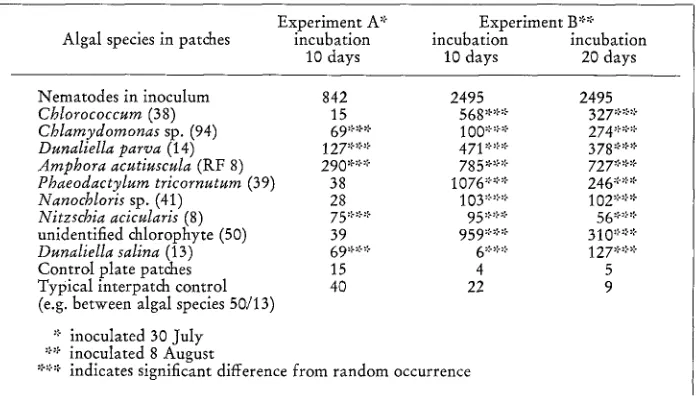
Selective recruitment of nematodes to patches of algae in petri dishes
Algal species in patches
Experiment A* Experiment B** incubation incubation incubation
10 days 10 days 20 days
Nematodes in inoculum 842 2495 2495
Chlorococcum (38) 15 568**:: 327*** Chlamydomonas sp. (94) 69*** 100":-* 274*** Dunaliella parva (14) 127"** 471"** 378':'** Amphora acutiuscula (RF 8) 290*** 785*** 727*** Phaeodactylum tricornutum (39) 38 1076"** 246*** Nanochloris sp. (41) 28 10Y:'** 102":'* Nitzschia acicularis (8) 75*** 95*** 56*** unidentified chlorophyte (50) 39 959*** 310"::* Dunaliella salina (13) 69*** 6*** 127"**
Control plate patches 15 4 5
Typical interpatch control 40 22 9
(e.g. between algal species 50/13) * inoculated 30 July
** inoculated 8 August
**:~ indicates significant difference from random occurrence
in the same experiments (F ratio 2.02, F.99 5.3). There were very significant differences between the animal populations on experimental algal patches and control areas (nematodes F.99 = 2.64; forams F.gs = 2.01; copepods F.95 = 1.97; nauplii F.95 = 2.12; large ciliates F.95 = 2.16; other groups insufficient data). As in the baited slide experi- ments, there were significant differences in the fauna recruited by patches of various species of algae (overall F ratio 25.3; significant at the 5 ~ level) but the attractiveness of a particular algal species varied in successive experiments presumably as a function of the specific animals available in the community for recruitment at the time of each experiment (Table 2). We observed microscopically that there were o~en changes in the animal populations of patches over a period of several days (Table 2). In some cases populations gradually built up by recruitment and then declined. In other cases reproduction was noted temporarily bt~ilding up the populations an.d was followed by dispersal of the offspring.
The "cafeteria" experiments with gnotobiotic laboratory cultures were quite re- producible and in general they gave results consistent with previous tracer feeding and ,gnotobiotic grown experiments (Lee et al., 1966, 1969; Tietjen et al., 1970; Tietjen & Lee, 1973, 1977). Since the experiments were relatively short (less than the generation times of the meiofauna tested) recruitment to algal patches was the main source of the heterogeneous distribution of the animals. The 4 algal eating species of meiofauna each favored particular algal patches over others (Table 3). Leptocaris brevicornis was the most selective of the meiofauna tested; ~0 % of the inoculum was found in patches of Nanochloris sp. while few were found in patches of Chlarnydo- rnonas subcordiformis, Phaeodactylum tricornutum, Cylindrotheca closteriurn or
Dunaliella parva. Chlamydomonas subcordiformis, on the other hand, attracted more
Allogromia Iaticollaris than did the other species of algae tested. When the algal patches were expanded, or when the plates were sectored, A. laticollaris showed even stronger tendencies for attraction to particular patches and heterogeneous distribution.
Chromadorina germanica was most strongly attracted to Phaeodactylum tricornuturn
and Cylindrotheca closterium. The distribution of Rhabditis marina, a bactivorous species, was very interesting. It seemed to strongly avoid patches of 3 species of algae,
Cylindrotheca closterium, DunaIiella parva and Nanochloris sp., but otherwise is was randomly distributed on both control and experimental patches.
Because of the economic and medical importance of nematodes, their behavioral responses to various types of stimuli have received significant attention (recently re- viewed by Croll, 1970; Nicholas, 1976). There is considerable evidence that plant parasitic nematodes are attracted tO the roots of particular species of plants. In an experiment similar to our first approach, but without controls, Meyers & Hopper (1967) found that mats of 2 species of marine fungi, Dendryphiella arenaria and
Food quality and spatial distribution of meio~auna 279
to 0 . , ~
g ~
~
~ . ~
"'2 ~ ~
<
~ ~ ~ 1 7 6
t ~ l o o , ~ - o o
~ ~ ' = ~ ~ o ~ o
o x
was insensitive tO concentrations up to 10-2M of L-tryptophan. Though Dusenbery (1976) wondered about the adaptive value of this response to the organism in its natural environment there are some possible explanations. Since many bacteria in- corporate D-amlno acids into their cell walls and capsules we suggest that C.
elegans
may have an adaptation to avoid microhabitats especially heavily colonized by parti- cular species of bacteria containing or releasing large quantities of D-tryptophan. This type of problem might be more easily studied using
Rhabditis marina
since we have already identified patches of 3 species of algae which the worm avoids. Release of various metabolites including amino acids and carbohydrates by the algae is quite well known and much of the methodology required is now quite routine (Hellebust, 1974). While we feel we have obtained strong evidence to suggest that algal colonies or blooms can selectively attract meiofauna and can be a factor causing the non-random distribution of these animals, with obvious cost-benefit advantages for the growth and reproduction of these animals, we cannot yet assess the importance of this phenomenon relative to other community organizing factors. We have found, for instance that many species of littoral foraminifera are more fecund on mixed diets of particular species of algae than on monalgal ones (Muller & Lee, 1969). Evidence indicates that this may be the case for at least some copepod species as well. Forams can have feeding nets up to several cm which could be feeding in several algal patches at the same time. Many species of littoral benthic foraminifera are algal patch makers themselves. They gather and transport captured algae from the edges of their feeding webs to their tests and oecen build huge balls or clumps of algae around themselves. Only a small fraction of the algae is used immediately as food. A part of the algal mass is used from time to time by the forams as surface on which to construct, new tes,t chambers or reproductive chambers (Grell, 1973).Compared to other physical environments (i.e. rocky shore) the salt marsh lit- toral is relatively benign. In common with many benign environments (i.e. forest floors) the biota of the littoral is seasonal, relatively transient, but predictable. Many selective forces are operating in time and space as the assemblages in the littoral go through their annual successional trajectories. Because so many questions remain, there is not yet sufficient evidence to build a conceptual framework which would clarify the tradeoffs of the various selective factors which shape the biotic assemblages of the lower and intermediate steps in the salt marsh detrital food webs. Those rneiofanna and microfauna which have been carefully studied seem to segregate by partitioning the available microflora (Fenchel, 1968; Lee et al., 1966, 1975; Muller, 1975). How o~en do they encounter blooms of "ideal" food organisms in nature? How do con- sumption rates and efficiencies vary with abundance and time? What are the relative replacement or turnover rates of these small plants and animals in time and in space? What role does competition among the various organisms play in the 4-dimensional spacing of the organisms in the community successional trajectory? What role do the macrofauna play in structuring the assemblages of smaller organisms? Do the macro- fauna selectively harvest the smaller animals? Are the initial colonizations of
Spartina,
Zostera,
and macrophytes selective or stochastic? How readily acceptable are newF o o d quality and spatial distribution of meiofauna 281 northern temperate forests) seem to be known, we must for the moment, content ourselves b y asking and answering m a n y more questions.
Acknowledgements. This work was supported by National Science Foundation Grant.
The authors wish to acknowledge the technical assistance of Monica J. Lee in some of the field and laboratory work.
L I T E R A T U R E C I T E D
Buzas, M. A., 1965. The distribution and abundance of foraminifera in Long Island Sound. Smithson. misc. Collns 149, 1-89.
-- 1969. Foraminiferal species densities and environmental variables in an estuary. Limnol.
Oceanogr. 14, 411-422.
Connell, J. H., 1975. Some mechanisms producing structure in natural communities. In: Eco- logy and evolution of communities. Ed. by M. L. Cody & J. M. Diamond. Belknap Press, Cambridge, 460-490.
Croll, N. A., 1970. The behaviour of nematodes. Arnold, London, 118 pp.
Dusenbery, D. B., 1973. Countercurrent separation: a new method for studying behavior in small aquatic organisms. Proc. natn Acad. Sci. U.S.A. 70, 1349-1352.
-- 1974. Analysis of chemotaxis in the nematode Caenorhabditis elegans by countercurrent
separation. J. exp. Zool. 188, 41-48.
- - 1975. The avoidance of D-tryptophan by the nematode Caenorhabditis elegans. J. exp. Zool. 193, 413-418.
Fenchel, T., 1968. The ecology of marine microbenthos. II. The food of marine benthic ciliates. Ophelia 5, 73-121.
Grell, K., 1973. Protozoology. Springer, Berlin, 552 pp.
Hellebust, J. A., 1974. Extracellular products. In: Algal physiology and biochemistry. Ed. by W. D. P. Stewart. Univ. of California Press, Berkeley, 838-863.
Hutchinson, G. E. & MacArthur, R. H., 1959. A theoretical ecological model of size distri- butions among species of animals. Am. Nat. 93, 117-125.
Lee, J. J., 1974. Toward understanding the niche of foraminifera. In: Foraminifera. Ed. by R. H. Hedley & G. Adams. Acad. Press, New York, I, 201-260.
- - & Muller, W. A., 1973. Trophic dynamics and niches of salt marsh foraminifera. Am. Zool. 13, '215-225.
Tietjen, J. H. & Garrison, J., 1976. Seasonal switching in the nutritional requirements of
Nitocra typica Boeck, a harpacticoid copepod from salt marsh aufwuchs communities.
Trans. Amer. microsc. Soc. 95, 628-637.
-- Tenore, K. R., Tietjen, J. t-I. & Mastropaolo, C., 1976. An experimental approach toward
understanding the role of meiofauna in a detritus based marine food web. Spec. PubI. Ecol. Soc. Amer. 1, 140-147.
- - McEnery, M., Pierce, S., Freudenthal, H. & Muller, W. A., 1966. Tracer feeding experi- ments in feeding littoral foraminifera. J. Protozool. 13, 659-670.
- - Muller, W. A., Stone, R. J., McEnery, M. E. & Zucker, W., 1969. Standing crop of fora- minifera in sublittoral epiphytic communities of a Long Island salt marsh. Mar. Biol. 4, 44-61.
- - Tietjen, J. H., Stone, R. J., Muller, W. A., Rullman, J. & McEnery, J. 1970. The cultiva- tion and physiological ecology of members of salt marsh epiphytic communities. Helgo- liinder wiss. Meeresunters. 20, 136-156.
Matera, N. J. & Lee, J. J., 1972. Environmental factors affecting the standing crop of fora- minifera in sublittoral and psammolittoral communities of a Long Island salt marsh. Mar. Biol. 14, 89-103.
Muller, W. A., 1975. Competition for food and other niche-related studies of 3 species of salt marsh foraminifera. Mar. Biol. 31,339-351.
-- & Lee, J. J., 1969. Apparent indispensability of bacteria in fo~aminiferan nutrition. J. Pro-
tozool. 16, 471-478.
Nicholas, W. L., 1976. The biology of free living nematodes. Oxford Univ. Press, London, 219 pp.
Pielou, E. C., 1975. Ecological diversity. Wiley, New York, 165 pp.
Provasoli, L., Shiraishi, K. & Lance, J. R., 1959. Nutritional idiosyncrasies of Artemia and
Tigriopus in monoxenic culture. Ann. N.Y. Acad. Sci. 77, 250-261.
Rubin, H. A. & Lee, J. J., 1976. Informational energy flow as an aspect of the ecological efficiency of marine ciliates..1, theor. Biol. 62, 69-91.
Schoener, T. W., 1974. Resource partitioning in ecological communities. Science, N.Y. 185, 27-39.
Steele, J. H. (Ed.), 1973. Theoretical problems. Part VI" Introduction, Recycling of organic matter. Oliver & Boyd, Edinburgh, 415-418.
Tietjen, J. H. & Lee, J. J., 1973. Life history and feeding habits of the marine nematode
Chromadora macrolairnoides Steiner. Oecolgia 12, 303-314.
- - - - 1977. Feeding behaviour of marine nematodes. In: Ecology of marine benthos. Ed. by B. C. Coull. Univ. South Carolina 'Press, Columbia. 22-36.
-- - - Rullman, J., Greengart, A. & Trompeter, J., 1970. Gnotobiotic culture and physiolo-
gical ecology of the marine nematode Rhabditis marina Bastian. Limnol. Oceanogr. 15, 535-543.
Ward, S., Thomson, N., White, H. G. & Brenner, S., 1975. Electron microscopical reconstruc- tion of the anterior sensory anatomy of the nematode Caenorhabditis elegans. J. comp. Neurol. 160, 313-338.
Ware, R. W., Clark, D., Crossland, K. & Russell, R. L., 1975. The nerve ring of the nematode
Caenorhabditis elegans: sensory input and motor output. J. comp. Neurol. (In press).
First author's address: Prof. J. J. Lee Department of Biology The City College