Clinical evaluation tools: a survey of doctors of
chiropractic and students at one chiropractic college
Barbara A. Mansholt, DC, MS
1Robert D. Vining, DC
21 Associate Professor, Clinic, Palmer College of Chiropractic
2 Associate Professor, Senior Research Clinician, Palmer Center for Chiropractic Research, Palmer College of Chiropractic
Corresponding author: Barbara A. Mansholt
Palmer College of Chiropractic, 1000 Brady St., Davenport, IA 52803 Email: [email protected]
© JCCA 2016 Disclaimers:
No conflicts of interest and no disclaimers to declare Funding:
Palmer College of Chiropractic supported this research. No specific funding was received or requested to support this study.
Introduction: The reliability and validity of many
evaluation tools leading to clinical decision-making for spinal manipulation are varied. We surveyed senior students and DC employees at one chiropractic college regarding 1) which analysis tools should be used and 2) factors that influence their choices.
Methods: The survey queried which tools should be used on a routine patient encounter. Clinical evaluation tools included palpation, skin temperature analysis, leg length analysis, and radiographs.
Results: Surveys were collected from 58 doctors of chiropractic (DCs) and 74 students. Respondents from both groups reported to most commonly use static palpation, followed by motion palpation and leg length analysis. DC respondents ranked evidence and personal experience high for rationale; student respondents frequently chose patient preference.
Introduction : La fiabilité et la validité de nombreux
outils d’évaluation menant à la prise de décision clinique pour la manipulation vertébrale sont variées. Nous avons interrogé les étudiants de cycle supérieur et les employés chiropraticiens d’un collège de chiropratique concernant 1) les outils d’analyse à utiliser et 2) les facteurs qui influencent leurs choix.
Méthodologie : Le sondage interrogeait sur les outils
qui devraient être utilisés lors d’une rencontre ordinaire avec un patient. Les outils d’évaluation clinique
comprenaient la palpation, l’analyse de la température de la peau, l’analyse de la longueur des membres inférieurs et les radiographies.
Résultats : 58 chiropraticiens et 74 étudiants ont
Introduction
Doctors of chiropractic (DCs) use information from mul-tiple sources to render clinical decisions regarding where, when, and how to perform spinal manipulative proced-ures.1,2 Information is obtained from static and motion
palpatory findings, skin temperature analysis, postural and leg length analysis, radiographic assessment, symp-toms, the primary diagnosis of the condition being treat-ed, and other physical examination findings.3 Additional
information derived from the patient interview includes prior response(s) to care, patient preferences, co-morbid conditions, and goals. Incorporating multi-faceted infor-mation into clinical decision-making is therefore, a com-plex process.4,5
Evidence-based practice suggests skillfully incorpor-ating research evidence, patient values, and practitioner experience when determining which clinical evaluation tools to use and how to appropriately weigh the clinical information gleaned from them when rendering clinical decisions.6 However, the reliability and validity of many
evaluation tools leading to clinical decision-making for spinal manipulation (SM) have not been robustly estab-lished,7–17 leaving evidence-based practitioners to depend
more on clinical experience, patient values, and other aspects of the clinical presentation. Despite limited reli-ability and the lack of research studying the validity of some analysis procedures, patients with a range of
mus-culoskeletal conditions often improve following SM per-formed by doctors of chiropractic using a variety of an-alysis tools and technique methods.18 Evaluation tools are
learned in educational settings, where students are chal-lenged to develop appropriate patient assessment habits and decision-making skills.
The purpose of this study is to survey chiropractic stu-dents and DC employees at a United States chiropractic college regarding 1) which clinical analysis tools should be used during routine patient encounters when evaluat-ing patients for SM, and 2) what factors most influence respondent choices.
Methods
The Human Protections Administrator determined this study exempt from full IRB review, IRB Assurance # X2013-7-12-M. The study was conducted in 2013.
Participants
The survey was administered both to chiropractic stu-dents in the ninth term (final year) and all DC employees (faculty, staff and administrators) at the Davenport cam-pus of Palmer College of Chiropractic. Respondents were not compensated in any way for participating.
Students in ninth term were surveyed as a convenience
sample of interns who had previously completed course-work covering spinal analysis protocols, taught in 2nd Conclusion: DC and student respondents reported
use of clinical evaluation tools consistently. However, some variations in rationale were noted. It is important for educators to provide a balanced presentation of the strengths and limitations of clinical analysis procedures to support the development of well-justified evidence-based clinical decision-making skills.
(JCCA. 2016;60(1):26-35)
k e y w o r d s: chiropractic, spinal manipulation,
palpation, decision making
les étudiants interrogés ont choisi souvent la préférence du patient.
Conclusion : Les chiropraticiens et les étudiants
interrogés ont signalé l’utilisation régulière des outils d’évaluation clinique. Cependant, quelques variations dans la justification ont été notées. Il est important que les éducateurs fournissent une présentation
équilibrée des points forts et des limites des procédures d’analyses cliniques afin de soutenir le développement de compétences décisionnelles cliniques bien justifiées et fondées sur des preuves.
(JCCA. 2016;60(1):26-35)
m o t s c l é s : chiropratique, manipulation vertébrale,
through 7th terms.19 Students surveyed were engaged in
outpatient care under the direct supervision of licensed college faculty members. The paper-based survey was implemented during a clinical instruction classin 2013, in which 111 students were registered. We chose the
stu-dents from ninth term (of 10) as the convenience sample because they 1) completed prior training regarding chiro-practic analysis tools, 2) participated in some supervised patient care activities, and 3) were in the final term of re-quired classroom attendance.
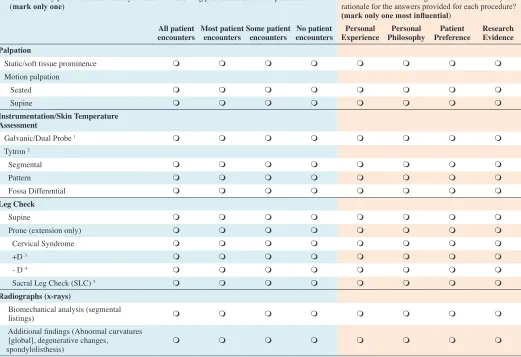
Figure 1.
Survey instrument inquiring of DC employees and senior students regarding use of chiropractic evaluation tools
Consider a routine patient encounter and the evaluation prior to performing a chiropractic adjustment. 1a. On how many patient encounters do you think the following procedures should be performed?
(mark only one) 1b. Which of the following reasons best describe your rationale for the answers provided for each procedure?
(mark only one most influential) All patient
encounters Most patient encounters Some patient encounters encountersNo patient ExperiencePersonal PhilosophyPersonal PreferencePatient Research Evidence
Palpation
Static/soft tissue prominence m m m m m m m m
Motion palpation
Seated m m m m m m m m
Supine m m m m m m m m
Instrumentation/Skin Temperature
Assessment
Galvanic/Dual Probe 1 m m m m m m m m
Tytron 2
Segmental m m m m m m m m
Pattern m m m m m m m m
Fossa Differential m m m m m m m m
Leg Check
Supine m m m m m m m m
Prone (extension only) m m m m m m m m
Cervical Syndrome m m m m m m m m
+D 3 m m m m m m m m
- D 4 m m m m m m m m
Sacral Leg Check (SLC) 5 m m m m m m m m
Radiographs (x-rays)
Biomechanical analysis (segmental
listings) m m m m m m m m
Additional findings (Abnormal curvatures [global], degenerative changes,
spondylolisthesis) m m m m m m m m
1 Galvanic/dual probe instruments measure skin temperature conductance and are used to determine sharp differences in bilateral skin temperature from one vertebra to another.
2 Tytron® infrared skin temperature analysis used to compare bilateral spinal temperature either from one vertebral level to another (segmentally) or as changes from sacrum to occiput (pattern). This infrared instrument can also be used to show bilateral difference between the region superficial to the atlas transverse processes (fossa differential).
For +D and –D, leg length is viewed in extension (position 1) and then flexed to 90o (position 2) while the patient is prone. 3 +D implicated when an observed short leg in position 1 appears to be longer when viewed in position 2.
4 –D implicated when an observed short leg in position 1 appears to stay short when viewed in position 2.
Table 1.
Respondent demographics (n=132) n(%)
Group one (students) 74(67)
Anticipated graduation
February 2014 (following term) 74(100)
Group two (DC employees) 58(61)
Licensed 55(95)
Currently seeing patients 29(50) Seeing patients off campus 9(16)
Primary Department
Academic Health Center 8(14)
Administration 11(19)
Campus Health Center 4(7)
Diagnosis & Radiology 5(9)
Life Sciences 2(3)
Philosophy & Practice Mgmt 1(2) Rehab & Sports Injury 2(3)
Research 9(16)
Technique 11(19)
Other 4(7)
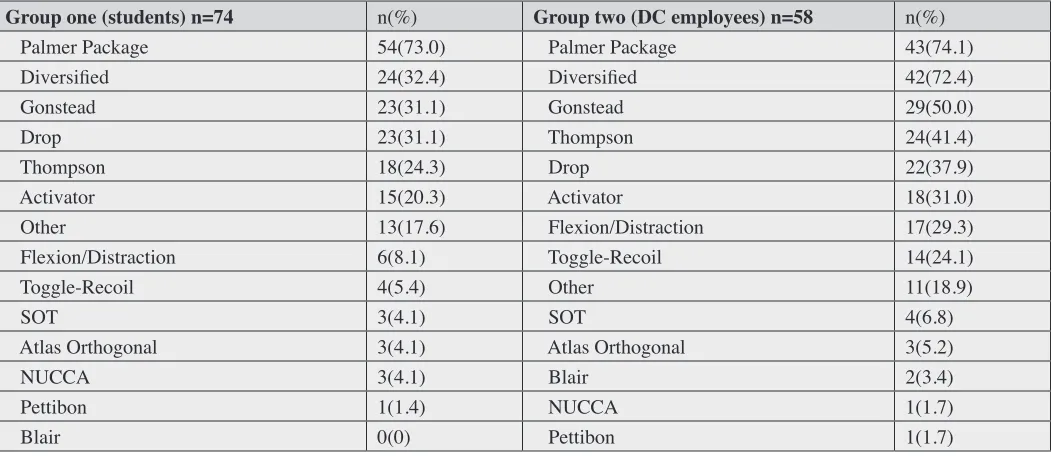
Table 2.
Respondent reported technique use
Group one (students) n=74 n(%) Group two (DC employees) n=58 n(%)
Palmer Package 54(73.0) Palmer Package 43(74.1)
Diversified 24(32.4) Diversified 42(72.4)
Gonstead 23(31.1) Gonstead 29(50.0)
Drop 23(31.1) Thompson 24(41.4)
Thompson 18(24.3) Drop 22(37.9)
Activator 15(20.3) Activator 18(31.0)
Other 13(17.6) Flexion/Distraction 17(29.3)
Flexion/Distraction 6(8.1) Toggle-Recoil 14(24.1)
Toggle-Recoil 4(5.4) Other 11(18.9)
SOT 3(4.1) SOT 4(6.8)
Atlas Orthogonal 3(4.1) Atlas Orthogonal 3(5.2)
NUCCA 3(4.1) Blair 2(3.4)
Pettibon 1(1.4) NUCCA 1(1.7)
Table 3.
Responses from senior students regarding a routine patient encounter and the evaluation prior to performing a chiropractic adjustment (n=74).
On how many encounters should this procedure be performed? Which best describe your rationale for this frequency?
Procedure n(%)All Most n(%) Some n(%) Never n(%) Missing n(%)
Personal Experience
n(%)
Personal Philosophy
n(%)
Patient Preference
n(%)
Research Evidence
n(%) Missing n(%) Palpation-static/soft tissue prominence 62(83.4) 11(14.9) 1(1.4) 0(0) 0(0.0) 8(18.6) 12(27.9) 21(48.8) 2(4.7) 2(2.8) Leg checks (prone, extension only) 41(55.4) 18(24.3) 10(13.5) 5(6.8) 0(0.0) 28(38.9) 3(4.2) 31(43.1) 10(13.9) 2(2.8)
Palpation-motion supine 40(54.8) 22(30.1) 8(11.0) 3(4.1) 1(1.4) 26(36.6) 9(12.7) 27(38.0) 9(12.7) 3(4.2)
Leg checks (+D) 34(46.0) 19(25.7) 16(21.6) 5(6.8) 0(0.0) 26(36.1) 3(4.2) 34(47.2) 9(12.5) 7(13.7)
Leg checks (cervical syndrome) 33(45.2) 20(27.4) 14(19.2) 6(8.2) 1(1.4) 29(40.3) 2(2.8) 31(43.1) 10(13.9) 2(2.8)
Leg checks (-D) 32(43.2) 19(25.7) 18(24.3) 5(6.8) 0(0.0) 26(36.1) 3(4.2) 34(47.2) 9(12.5) 2(2.8)
Leg checks (sacral leg check) 28(37.8) 23(31.1) 18(24.3) 5(6.8) 0(0.0) 31(43.1) 3(4.2) 29(40.3) 9(12.5) 2(2.8)
Palpation-motion seated 20(27.4) 21(28.8) 29(39.7) 3(4.1) 1(1.4) 28(40.0) 8(11.4) 23(32.9) 11(15.7) 4(5.7)
Radiographs (abnormal curvatures, degenerative changes,
spondylolisthesis) 20(27.8) 24(33.3) 27(37.5) 1(1.4) 2(2.8) 24(34.8) 2(2.9) 14(20.3) 29(42.0) 5(7.3)
Leg checks (supine) 14(19.2) 8(10.1) 27(50.1) 26(35.6) 1(1.4) 22(31.9) 4(5.8) 33(47.8) 10(14.5) 5(7.3)
Instrumentation (galvanic/dual probe) 12(16.4) 1(1.4) 33(45.2) 27(37.0) 1(1.4) 6(10.0) 8(13.3) 29(39.2) 17(28.3) 14(23.3) Radiographs (biomechanical segmental analysis) 11(15.1) 16(21.9) 33(45.2) 13(17.8) 1(1.4) 19(29.2) 2(3.1) 22(33.9) 22(33.9) 9(13.9)
Radiographs (other) 8(18.6) 12(27.9) 21(48.8) 2(4.7) 31(72.1) 15(20.3) 2(4.8) 11(26.2) 14(33.3) 32(76.2)
Instrumentation (Tytron fossa differential) 7(9.6) 3(4.1) 28(38.4) 35(48.0) 1(1.4) 8(14.8) 4(7.4) 29(53.7) 13(24.1) 20(37.0) Instrumentation (Tytron segmental) 4(5.5) 2(2.7) 30(41.1) 37(50.7) 1(1.4) 7(12.5) 4(7.1) 32(57.1) 13(23.2) 18(32.1) Instrumentation (Tytron pattern) 4(5.5) 4(5.5) 28(38.4) 37(50.7) 1(1.4) 7(12.5) 4(7.1) 32(57.1) 13(23.2) 18(32.1)
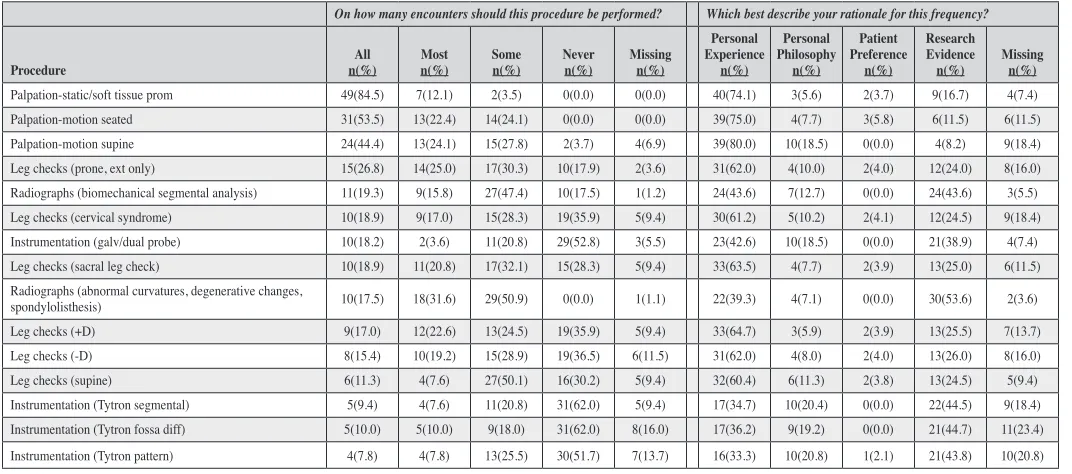
Table 4.
Responses from DC faculty regarding a routine patient encounter and the evaluation prior to performing a chiropractic adjustment (n=58).
On how many encounters should this procedure be performed? Which best describe your rationale for this frequency?
Procedure n(%)All Most n(%) Some n(%) Never n(%) Missing n(%)
Personal Experience
n(%)
Personal Philosophy
n(%)
Patient Preference
n(%)
Research Evidence
n(%) Missing n(%) Palpation-static/soft tissue prom 49(84.5) 7(12.1) 2(3.5) 0(0.0) 0(0.0) 40(74.1) 3(5.6) 2(3.7) 9(16.7) 4(7.4)
Palpation-motion seated 31(53.5) 13(22.4) 14(24.1) 0(0.0) 0(0.0) 39(75.0) 4(7.7) 3(5.8) 6(11.5) 6(11.5)
Palpation-motion supine 24(44.4) 13(24.1) 15(27.8) 2(3.7) 4(6.9) 39(80.0) 10(18.5) 0(0.0) 4(8.2) 9(18.4)
Leg checks (prone, ext only) 15(26.8) 14(25.0) 17(30.3) 10(17.9) 2(3.6) 31(62.0) 4(10.0) 2(4.0) 12(24.0) 8(16.0) Radiographs (biomechanical segmental analysis) 11(19.3) 9(15.8) 27(47.4) 10(17.5) 1(1.2) 24(43.6) 7(12.7) 0(0.0) 24(43.6) 3(5.5) Leg checks (cervical syndrome) 10(18.9) 9(17.0) 15(28.3) 19(35.9) 5(9.4) 30(61.2) 5(10.2) 2(4.1) 12(24.5) 9(18.4) Instrumentation (galv/dual probe) 10(18.2) 2(3.6) 11(20.8) 29(52.8) 3(5.5) 23(42.6) 10(18.5) 0(0.0) 21(38.9) 4(7.4) Leg checks (sacral leg check) 10(18.9) 11(20.8) 17(32.1) 15(28.3) 5(9.4) 33(63.5) 4(7.7) 2(3.9) 13(25.0) 6(11.5) Radiographs (abnormal curvatures, degenerative changes,
spondylolisthesis) 10(17.5) 18(31.6) 29(50.9) 0(0.0) 1(1.1) 22(39.3) 4(7.1) 0(0.0) 30(53.6) 2(3.6)
Leg checks (+D) 9(17.0) 12(22.6) 13(24.5) 19(35.9) 5(9.4) 33(64.7) 3(5.9) 2(3.9) 13(25.5) 7(13.7)
Leg checks (-D) 8(15.4) 10(19.2) 15(28.9) 19(36.5) 6(11.5) 31(62.0) 4(8.0) 2(4.0) 13(26.0) 8(16.0)
Leg checks (supine) 6(11.3) 4(7.6) 27(50.1) 16(30.2) 5(9.4) 32(60.4) 6(11.3) 2(3.8) 13(24.5) 5(9.4)
DC employees (93 faculty, staff, and administrators)
were sent a paper survey (11” x 17”) via campus mail in a hand-addressed envelope one month following the student survey in 2013, which included a signed descrip-tive cover letter from the principal investigator and an informed consent disclaimer. Respondents were asked to return the completed survey (re-folded as an anonymous self-mailer) to the principal investigator (BM), thus main-taining confidentiality and blinding investigators. All DC employees received follow-up e-mail reminders during three consecutive weeks including a reminder that they could request an electronic copy for anonymous submis-sion directly to the data manager.
Survey Instrument
This survey queried respondents on which clinical evalu-ation tools (including palpevalu-ation, paraspinal skin temper-ature measurement, leg length inequality, and/or radio-graphic analysis) should be used during patient encounters when evaluating a patient prior to delivering chiropractic SM. The survey instrument was designed in consultation with chiropractic college faculty with expertise in teach-ing SM techniques. Clinical evaluation tools queried are taught in the core curriculum. Response choices includ-ed “all,” “most,” “some,” or “no” patient encounters and were not further defined. Respondents were asked to rate which of the following reasons best describes the ration-ale for the rating: “personal experience,” “personal phil-osophy,” “patient preference,” or “research evidence.” See Figure 1.
Data Analysis and confidentiality
The Data Manager collected and secured hardcopy data collection forms. The Data Manager prepared form keys and data entry formats with validation schemes. Data entry clerks entered and verified data through a Win-dows-based application for double key-entry verification. Data entry formats and electronic data files in a secured server environment. Hardcopy data form packets were stored in a locked cabinet during key-entry process. Final project datasets were assembled by transferring data from flat data entry files to SAS System for Windows (Release 9.2). The Data Manager wrote and tested SAS programs to create datasets as requested by the Principal Investiga-tor. The analyzable dataset was imported into SPSS
(Ver-sion 17.0.0, SPSS, Inc. Somers, NY). Survey results are reported with descriptive statistics.
Results
Response rate
Surveys were completed for 74 of 111 students for a re-sponse rate of 67%. All students anticipated graduating by the end of the following (10th) term. Fifty-eight of 93 DC
employees returned surveys for a response rate of 61%, representing 10 department affiliations; 55(95%) held a current license to practice chiropractic, and 29(50%) re-ported actively rendering care to patients. See Table 1.
Chiropractic analysis tools favored by ninth term student respondents
Eighty-three percent reported that static palpation should be performed on all routine patient encounters. Prone leg length inequality (LLI) assessment ranked next, ranging from 38-55% depending upon type and variation of leg length analysis. Supine LLI assessment faired much low-er at 20%. Nearly 55% of respondents rated motion pal-pation should be performed on all patient encounters for supine cervical assessment while only 27% for seated pa-tient positioning. While 28% of respondents reported that radiographic assessment for general biomechanical align-ment and patterns should be used on all routine encounters; approximately 15% responded that radiographic vertebral segment analysis should be used on all encounters. Only 16% reported that a paraspinal dual temperature analysis should be used on all routine encounters, while 5-10% reported Tytron® infrared thermography (for paraspinal skin temperature readings, as a skin temperature pattern assessment, or for bilateral mastoid fossa temperature measurements) should be used on all encounters.
50%. While 28-45% of student respondents reported vari-ous forms of paraspinal thermographic instrumentation should be performed on some patient encounters, only 3-6% reported some form of this measure should be used on most routine encounters.
Fifty percent of student respondents reported that Ty-tron® infrared thermography should never be used dur-ing patient encounters, and 37% reported that galvanic/ dual probe should never be used. Less than 10% reported prone LLI should never be used while 36% reported su-pine LLI should never be used. Eighteen percent con-veyed that segmental radiographic analysis should never be used. Zero percent of student respondents reported that static palpation should never be used.
Chiropractic analysis tools used by DC employee respondents
Eighty five percent of DC employee respondents reported that static palpation should be performed on all encoun-ters. Next frequent, they reported motion palpation (seat-ed) 54% and motion palpation (supine) 44%. While 27% reported prone LLI should be performed on all encoun-ters, other LLI analyses responses ranged from 11-19%. Less than 20% of DC employee respondents indicated radiographic biomechanical segmental analysis or other radiographic findings should be used on all patient en-counters. Eighteen percent reported that paraspinal dual probe temperature analysis should be used on all patient encounters, while 4-5% reported Tytron® or paraspinal infrared thermographic measurements should be used all of the time.
Fifty percent of DC employee respondents stated that radiographs should be performed on some encoun-ters; 32% reported most encounters. Ten to 17% of re-spondents considered some component of prone LLI as-sessment as an evaluation that should be performed on some/most encounters; 4% rated supine LLI for most en-counters, while 50% related supine for LLI some encoun-ters. Respondents reported 4/26% for most/some patient encounters regarding all types of paraspinal temperature measurement. Motion palpation was chosen by about ¼ of respondents for most/some, while static palpation was chosen most by 12% and some by 4%.
Sixty-two percent of respondents reported that Ty-tron® infrared thermography should never be performed, while 53% reported that galvanic or dual probe paraspinal
temperature analysis should never be performed. LLI was reported as should never be performed by 28-36% of re-spondents, except for LLI prone, extension only, which was reported “never” by 18% of respondents. Eighteen percent reported that biomechanical segmental analysis of radiographs should never be performed.
Rationale for use of chiropractic analysis tools by ninth term students
Thirty-six to 43% of student respondents reported per-sonal experience as their rationale for their use of LLI and motion palpation. Nearly 35% used personal experi-ence as their rationale for responses to using radiographic analysis. Less than 15% of student respondents reported personal experience as rationale for use of paraspinal temperature measurements.
The use of static palpation originated from personal philosophy for 28% of student respondents. Student re-spondents chose personal philosophy less than 15% of the time for all other categories. Ranking close with personal experience, nearly one half of student respondents chose patient preference at their rationale for reporting various analysis tools.
Forty-two percent of student respondents chose re-search evidence as their rationale for their use of radio-graphs to assess abnormal curvatures and degenerative changes, which most responded should be used or ref-erenced on most or some encounters. This rationale was chosen by less than 15% for static and motion palpation as well as LLI assessments. Further, between 23-28% of respondents chose research evidence as rationale for their use of various thermographic assessment methods, con-sidered by most respondents to be used some or never during patient encounters.
Rationale for use of chiropractic analysis tools by DC employees
Thirty-three to 80% of DC employee respondents chose personal experience as their rationale when recom-mending frequency of use of chiropractic analysis tools. Personal experience was also chosen as a frequent ration-ale (60-80%) regarding palpation and LLI assessment. Personal experience was chosen infrequently as rationale for instrumentation use (33%).
categor-ies. The highest percentage of DC employee respondents chose patient preference (only 6%) for seated motion pal-pation.
Forty-three and 53% of respondents chose research evi-dence for use of radiographs (biomechanical segmental analysis) and (abnormal curvatures), both recommended by nearly half of respondents for use on some patient en-counters. Research evidence was ranked as rationale for thermography, chosen by 39-45% of responders, most of which ranked thermographic measurements to be used “never” for patient encounters.
Technique systems used by senior students
Seventy-three percent of students responded with “Palmer Package” as a technique used. Palmer Package is com-prised of components from Diversified, Gonstead, and Thompson or drop table SM techniques. Closely follow-ing is Activator, chosen by 20% of respondents.
Technique systems used by DC employees
Over 70% of DC employees responded with Palmer Package or Diversified for technique used, with Gon-stead, Thompson, Drop, following. Activator was ranked by 32% of respondents, flexion/distraction by 30%, Tog-gle-Recoil by 25%. See Table 2.
Discussion
This survey quantifies perceptions of DC employees and senior students at a single chiropractic college regard-ing the use of clinical analysis procedures used prior to performing SM. Static palpation was rated most con-sistently as a necessary procedure. This result may not be surprising given a manually delivered treatment often requires some palpation component to identify anatomic-al landmarks, locanatomic-al tissue characteristics and tenderness. Segmental motion palpation was not rated as highly by survey respondents in both groups. In a recent compre-hensive review of methods that can inform providers about treatment localization for SM, static palpation, motion palpation, and LLI assessment (pelvic only) were favorably recommended with limitations; radiographic imaging, paraspinal skin temperature, and galvanic skin response were unfavorably recommended.3 While this
re-view was published in the same year that the current was performed, it is unlikely that survey respondents were in-timately familiar with its recommendations due to a lag
in dissemination. Further, a challenge to change practice behavior may occur if “new” recommendations are differ-ent from an individual’s clinical experience.
Over half of DCs rated research evidence as a ration-ale for their opinion regarding radiographic analysis, al-though the preponderance of rationale reported for other procedures is personal experience. Note that most DC employees reported the use of radiographic interpretation on some, but not most or all, patient encounters. DC re-spondents more commonly reported personal experience as rationale for clinical decision-making than students. It is logical to expect practitioners with a larger reservoir of clinical experience to use personal experience as a ration-ale more often than students.
Research evidence was rated slightly higher than per-sonal experience among DC respondents for their ration-ale regarding the use of thermography; most (over half) recommended it never be used and over 20% suggested only on some encounters. Over 80% of students reported that paraspinal temperature measurements should never be used or only on some encounters. These responses are likely influenced by the lack of available evidence dem-onstrating validity as an assessment measure, a lack of personal experience with this type of assessment tool, or both. Similarly, research evidence ranked slightly above personal experience in rationale for recommending the frequency of use of radiographic analysis, even though research evidence is unfavorable for using radiography to determining the site of routine spinal manipulative care.3
However, it is unclear whether respondents who indicated radiographic analysis was important on routine encoun-ters considered it as necessary for determining the site of care or as additional clinical information that should be reviewed at each encounter when available. It appears that the research evidence rationale increases as the fre-quency and specificity of the recommendation decreas-es, e.g., research evidence rationale increases by 10% from segmental analysis to overall curvature and degen-erative changes. A similar trend may be observed when advancing from a simple prone LLI evaluation to more elaborate (and less reliable) leg length procedures. This could suggest that respondents used research evidence in a negative rather than a supportive manner.
re-spondents answered this question in 2 ways, 1) to justify use of a clinical evaluation tool; and 2) to justify why they rarely or never use it because they believe research evi-dence does not support regular use. Students rarely chose research evidence as rationale, which may represent a lack of awareness of, experience with, or confidence terpreting scientific evidence regarding procedures in-cluded in the survey. It may also represent the general lack of high-quality research evidence available for many diagnostic procedures, an area noted by Haas et al. as a research priority for the chiropractic profession.20
Technique systems reported were similar between fac-ulty and students, which may be expected when most re-spondents were educated at the same institution, although DCs did report greater use of Activator® and Flexion/dis-traction techniques. It could be surmised that attitudes of students will similarly follow faculty attitudes. This phe-nomenon does seem to exist, with some exceptions. The lack of research evidence informing the appropri-ate use of some clinical analysis procedures included in this survey may have led respondents to rely more on per-sonal experience and patient preference to influence their clinical decision-making. Survey responses indicating the use of clinical assessments unsupported by research evidence or considered to be fair, poor, or unknown sug-gests the following question. What is the most appropri-ate way to incorporappropri-ate the practitioners’ art and experi-ence into an educational curriculum dedicated to teaching evidence-based principles, skills, and decision-making? For procedures that have demonstrated poor reliability or validity, it seems clear that further use in educational settings is not well justified. Because evidence-based care includes what has been learned from experience, we do not suggest that chiropractic educators refrain from shar-ing their unique beliefs, as long as those unsupported by research are clearly stipulated as such. We suggest that it is vital for educators to provide balanced presentations of available literature describing both strengths and limita-tions of existing clinical analysis procedures and to con-sider the negative ramifications of directly or indirectly supporting the use of procedures no longer considered valid.
Limitations
This was the initial application of this survey, which has not been validated. The questionnaire asked respondents
to consider a routine patient encounter, which was not fur-ther defined. Also, the terms “most” and “some” were not defined for participants. Therefore individual respondents likely defined this differently. While the entire faculty was surveyed, only one term of current students were surveyed. It cannot be generalizable to the entire student body during that period.
Respondents cited research evidence as the reason for and against using certain procedures, and the survey was conducted using a convenience sample at a single chiro-practic college campus. This survey gathered data regard-ing the use of clinical tools and reasons that primarily in-fluenced their use.
Future Recommendations
It is beyond the scope of this survey to speculate how stu-dents and faculty are using assessment procedures includ-ed in this survey to make decisions basinclud-ed on evidence-in-formed principles. Major categories could be consolidat-ed and the more definconsolidat-ed rationale collectconsolidat-ed to identify how research evidence (or other motivation) is driving respondent’s decisions for or against clinical use. De-scriptions of specific clinical scenarios could also be more clearly defined. We suggest that it is important to assess faculty and students opinions regarding applicability and interpretation of research in daily clinical decision-mak-ing. Subsequent research seeking to further understand how diagnostic information informs care decisions is ne-cessary to inform both the teaching of and the practice of skilled evidence-based clinical decision-making.
Conclusions
References:
1. Van de Veen EA, de Vet HCW, Pool JJM, Schuller W, de Zoete A, Bouter LM. Variance in manual treatment of nonspecific low back pain between orthomanual physicians, manual therapists, and chiropractors. J Manipulative Physiol Ther. 2005;28(2):108-116. 2. Gleberzon B, Stuber K. Frequency of use of diagnostic
and manual therapeutic procedures of the spine
currently taught at the Canadian Memorial Chiropractic College: A preliminary survey of Ontario chiropractors. Part 2 - procedure usage rates. J Can Chiropr Assoc. 2013;57(2):165-175.
3. Triano JJ, Budgell B, Bagnulo A, et al. Review of methods used by chiropractors to determine the site for applying manipulation. Chiropr Man Therap. 2013;21(1):36. 4. Goertz CM, Pohlman KA, Vining RD, Brantingham
JW, Long CR. Patient-centered outcomes of high-velocity, low-amplitude spinal manipulation for low back pain: a systematic review. J Electromyogr Kinesiol. 2012;22(5):670-691.
5. Vining R, Potocki E, Seidman M, Morgenthal A P. An evidence-based diagnostic classification system for low back pain. J Can Chiropr Assoc. 2013;57(3):189-204. 6. Sackett DL, Rosenberg WMC, Gray JAM, Haynes RB,
Richardson WS. Evidence based medicine: what it is and what it isn’t. 1996. Clin Orthop Relat Res. 2007;455:3-5. 7. Cooperstein R, Young M, Haneline M. Interexaminer
reliability of cervical motion palpation using continuous measures and rater confidence levels. J Can Chiropr Assoc. 2013;57(2):156-164.
8. Cooperstein R. Heuristic exploration of how leg checking procedures may lead to inappropriate sacroiliac clinical interventions. J Chiropr Med. 2010;9(3):146-153. 9. Cooperstein R, Haneline M, Young M. Interexaminer
reliability of thoracic motion palpation using confidence ratings and continuous analysis. J Chiropr Med.
2010;9(3):99-106.
10. Haneline M, Cooperstein R, Young M, Birkeland K. An annotated bibliography of spinal motion palpation reliability studies. J Can Chiropr Assoc. 2009;53(1):40-58.
11. Haneline MT, Young M. A review of intraexaminer and interexaminer reliability of static spinal palpation: a literature synthesis. J Manipulative Physiol Ther. 2009;32(5):379-386.
12. Harrison DE, Harrison DD, Troyanovich SJ. Reliability of spinal displacement analysis of plain X-rays: a review of commonly accepted facts and fallacies with implications for chiropractic education and technique. J Manipulative Physiol Ther. 1998;21(4):252-266.
13. Harrison DE, Harrison DD, Colloca CJ, Betz J, Janik TJ, Holland B. Repeatability over time of posture, radiograph positioning, and radiograph line drawing: an analysis of six control groups. J Manipulative Physiol Ther. 2003;26(2):87-98.
14. Hart J, Neely C. Allowing a possible margin of error when assessing student skills in spinous process location. J Chiropr Educ. 2011;25(2):182-185.
15. Hestbaek L, Leboeuf-Yde C. Are chiropractic tests for the lumbo-pelvic spine reliable and valid? A systematic critical literature review. J Manipulative Physiol Ther. 2000;23(4):258-275.
16. Hubbard TA, Vowles BM, Forest T. Inter- and intraexaminer reliability of the Blair protractoview method: examination of a chiropractic radiographic technique. J Chiropr Med. 2010;9(2):60-68.
17. Kilby J, Heneghan NR, Maybury M. Manual palpation of lumbo-pelvic landmarks: a validity study. Man Ther. 2012;17(3):259-262.
18. Goertz CM, Long CR, Hondras MA, et al. Adding chiropractic manipulative therapy to standard medical care for patients with acute low back pain: results of a pragmatic randomized comparative effectiveness study. Spine (Phila Pa 1976). 2013;38(8):627-634.
19. Curriculum - D.C. Palmer College of Chiropractic. http:// www.palmer.edu/CurriculumDC/. Accessed February 23, 2015.