R E S E A R C H
Open Access
Segmentation of moving objects in image
sequence based on perceptual similarity of
local texture and photometric features
K. L. Chan
Abstract
The segmentation of moving objects in image sequence can be formulated as a background subtraction problem—the separation of objects from the background in each image frame. The background scene is learned and modeled. A pixelwise process is employed to classify each pixel as an object or background based on its similarity with the background model. The segmentation is challenging due to the occurrence of dynamic elements such as illumination change and background motions. We propose a framework for object segmentation with a novel feature for background representation and new mechanisms for updating the background model. A ternary pattern is employed to characterize the local texture. The pattern and photometric features are used for background modeling. The classification of pixel is performed based on the perceptual similarity between the current pixel and the background model. The segmented object is refined by taking into account the spatial consistency of the image feature. For the background model update, we propose two mechanisms that are able to adapt to abrupt background change and also merge new background elements into the model. We compare our framework with various background subtraction algorithms on video datasets.
Keywords: Moving object segmentation, Background subtraction, Local ternary pattern, Video surveillance, Dynamic background
1 Introduction
Moving objects such as humans or vehicles are often the focus of image sequence analysis. The segmentation of moving objects is the first key problem which can be for-mulated as a background subtraction. In that sense, the background scene is modeled. Object pixels are seg-mented when they are found to be different from the background model. A common background subtraction framework contains background modeling, joint back-ground/foreground classification, and background model updating. Survey on background subtraction techniques can be found in [1]. Sobral and Vacavant [2] presented a recent review and evaluation of 29 background subtrac-tion methods. Background subtracsubtrac-tion techniques can be categorized based on the ways to model the background scene. For instance, the background scene can be charac-terized in terms of statistical parameters. Bouwmans [3]
presented a survey on statistical background modeling. Alternatively, the background model is represented as a bag of visual words—intensities or colors sampled over a short image sequence. Texture-based methods model the background scene by analyzing the relationship between the neighboring pixels.
1.1 Parametric methods
In [4], pixelwise background colors are modeled by a sin-gle Gaussian distribution. Stauffer and Grimson [5] pro-posed a modeling of background colors using a mixture of Gaussian (MoG) distributions that can tackle repetitive background motions and illumination changes. The back-ground model is initialized usingK-means which approxi-mate an EM algorithm. Pixel value that does not match any of the most probable background distributions is regarded as foreground. Parameters of the MoG model are updated after background/foreground classification. Since its introduction, MoG has gained widespread popu-larity and inspired many improvements. For instance, in
Correspondence:[email protected]
Department of Electronic Engineering, City University of Hong Kong, 83 Tat Chee Avenue, Kowloon, Hong Kong
contrast with a fixed number of Gaussians in the original
MoG model, Zivkovic [6] proposed an algorithm for
selecting the number of Gaussian distributions using the Dirichlet prior. A comprehensive survey on the improve-ments of the MoG model can be found in [7].
1.2 Non-parametric methods
This category of background subtraction methods does not assume the pdf of the scene follows a known paramet-ric form. Elgammal et al. [8] proposed an algorithm for es-timating the pdf directly from the previous pixels using kernel estimator. Kim et al. [9] proposed to represent the background by codebooks which contain quantized
back-ground colors. Barnich and Van Droogenbroeck [10]
pro-posed a sample-based background subtraction algorithm called ViBe. The background model is initialized by ran-domly sampling the pixels on the first image frame. The pixel of the new image frame is classified as background when there is a sufficient number of background samples similar to the new pixel. It defines a fixed sphere centered at the current pixel value and searches for similar back-ground samples. If the sphere is too large, a foreback-ground pixel may be wrongly labeled as background. If the sphere is too small, a background pixel may not find matched
samples. Hofmann et al. [11] proposed a similar
non-parametric sample-based background subtraction method with nine tunable parameters. Van
Droogen-broeck and Paquot [12] introduced some modifications
for improving ViBe. Haines and Xiang [13] presented a
non-parametric background modeling method based on Dirichlet process Gaussian mixture models. Gao et al. [14] and Liu et al. [15] regarded the observed video frames as a matrix, which can be decomposed into a low-rank matrix of background and a structured sparse matrix of the
fore-ground. Monnet et al. [16] proposed an online
auto-regressive model to predict the new image frame. Change is detected as a difference between the prediction
and actual observation. Mahadevan and Vasconcelos [17]
proposed to model the background by dynamic texture (DT) features obtained in the center and surrounding win-dows. Background subtraction is performed by calculating the mutual information between DT features and classes (background, foreground). Sheikh and Shah [18] presented a non-parametric density estimation method to model the background. In [19], dynamic background is modeled by a local dependency histogram which characterizes the spatial dependencies between a pixel and its neighbors.
1.3 Texture-based methods
Recent research showed that modeling background by local patterns can achieve higher accuracy. Heikkilä and Pietikäi-nen [20] proposed to model the background of a pixel by local binary pattern (LBP) histograms estimated around that pixel. Their method can segment moving objects
correctly in indoor image sequence even though the colors of the foreground and the static background are similar. It also can segment moving objects in outdoor image se-quence with dynamic elements because the pattern exploits information over a larger area than a single pixel. Liao et al. [21] proposed the scale invariant local ternary pattern (SILTP) which can tackle illumination variations. It can per-form poorly in flat regions and produces holes in the seg-mented objects. St-Charles et al. [22] proposed a pixelwise background modeling method using local binary similarity pattern (LBSP) estimated in the spatio-temporal domain.
Ma and Sang [23] proposed the multi-channel SILTP
(MC-SILTP), which is an improvement of SILTP, with a pattern computed from RGB color channels. As shown in our experimentation in Section 6, it still results in many misclassifications. Background modeling by analyzing the neighboring pixels using neural networks and Markov ran-dom fields is also proposed. Spatiotemporal background modeling has gained more attention recently, e.g., [24,25], because it also contains motion information—the variation of the local pattern over time.
1.4 Background model update and object refinement
Object segmentation can be improved via background model updating or foreground model. Many background subtraction methods like [5] update parameters of matched background model with a fixed learning factor. In [11], the foreground de-cision threshold and model update rate can be adaptively ad-justed along the video sequence. In [10], a random policy is employed for updating the background model at the pixel lo-cation and its neighbor. Van Droogenbroeck and Paquot [12] inhibited the update of neighboring background model across the background-foreground border. In [22], a pixel-level feed-back scheme can adjust some parameters to respond to the background changes. That makes the modeling method cap-able of tackling both static and dynamic background. Kim et al. [26] proposed a PID tracking control system for the fore-ground segmentation refinement. In [27], MoGs are used to model the color distribution of swimmer pixels. Sheikh and Shah [18] also used a non-parametric density estimation method to model the foreground.
In [28], we proposed a novel perception-based local
characterize various dynamic circumstances in the scene. In our second contribution, we propose a new background model update and object refinement processes. Many back-ground subtraction methods have very simple backback-ground model updating. For instance, [10] updates the background model at the pixel location and its neighbor randomly. The sensitivity to background change may be slow. Our back-ground model update can tackle abrupt backback-ground change and also merge new elements (e.g., non-moving objects) into the background model. Many background subtraction methods, e.g., [22], devise complex feedback scheme for background model update. However, they lack any object refinement process. In our method, the segmented object can be refined by taking into account the spatial consistency of the image feature. This step can result in a more accurate segmented shape of the object.
2 Method
Many background subtraction methods assume that the scene is stationary or changes slowly. Background subtrac-tion becomes harder under various complex
circum-stances—camouflage, illumination changes, background
motions, intermittent object motion, shadows, camera jitter, etc. It is a challenging task to achieve accurate background/
foreground segregation in videos containing those dynamic scenes and over a long duration. The features for modeling the background scene, which are also used in the background-foreground classification, are very important. A pattern, with multiple pixels, can characterize the local texture more effectively than an individual pixel. Also, the refinement process is needed for improving the segmented object. To detect a moving object in a long image sequence, background model updating is necessary.
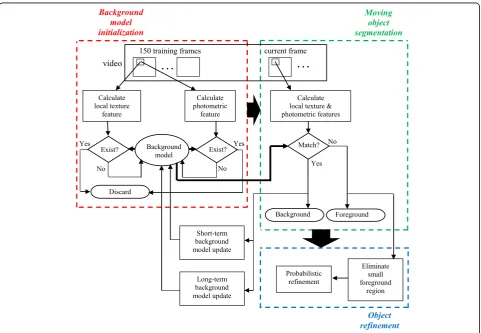
Our method, as shown in Fig. 1, contains three
se-quential parts (background model initialization, moving object segmentation, object refinement) and a feedback scheme (background model update). The background model is generated by analyzing the initial frames of the image sequence. The background model contains local texture and photometric features per pixel. The principle of perception-based local ternary pattern and the estima-tion of texture features are explained in the following section. The computation of the photometric feature and the generation of the initial background model are
presented in Section 4. The background model is then
used to segment moving objects in each frame of the image sequence. The object segmentation framework is
described in Section 5. The moving objects just
segmented can be refined by the probabilistic scheme. Finally, the background model is updated based on the segmentation result. Object refinement and background
model update are explained in Section 6. We test and
compare our method with various background subtrac-tion algorithms using common video datasets. The nu-meric and visual results are demonstrated and discussed in Section7. Finally, we draw a conclusion in Section8.
3 Perception-based local ternary pattern
We propose a novel perception-based local ternary pat-tern (P-LTP) which can be used effectively to characterize
various dynamic circumstances in the scene. Figure 2
shows a block of 3 × 3 pixels. Each pixel of the block,n1to n8(except the center pixel), is compared with the
confi-dence interval (CI) of the center pixelb. CI(b) is defined by (CIl, CIu) where CIland CIuare the lower bound and upper bound of CI, respectively. The pattern valuepis set according to the following equation:
pk¼
0; 1;
−1;
8 < :
CIl≤nk≤CIu
nk>CIu
nk<CIl
;1≤k≤8 ð1Þ
The confidence interval CI(b) can be defined as (b−d1,b
+d2). According to Weber’s law [29],d1andd2depend on
the perceptual characteristics of b. That is, they should be small for darker color and large for brighter color. Haque and Murshed [30] derived the linear relationshipd1=d2= c×b, wherecis a constant. The background model is repre-sented by the confidence interval centered at the mean value or the intensity of a recently observed background pixel. A new pixel is identified as a background if its intensity falls within the confidence interval. We adopt the human visual perception characteristics in transforming pixel colors into a local ternary pattern. In P-LTP, CI(b) is defined as (b−c1b,b
+c2b). Using peak signal-to-noise ratio (PSNR) measure,b
andb−c1bare just perceptually different from each other if:
20 log10 Imax
b−c1b−
20 log10Imax
b ¼Tp ð2Þ
whereImaxis the maximum intensity, andTpis the per-ceptual threshold. Similarly, b and b+c2b are just per-ceptually different from each other if:
20 log10Imax
b −20 log10 Imax bþc2b
¼Tp ð3Þ
To determinec1andc2, the equations are simplified.
c1¼
10T p20−1
10T p20
ð4Þ
c2¼10
T p
20−1 ð5Þ
Assume thatTpis 1.0 dB,c1= 0.1087, andc2= 0.1220.
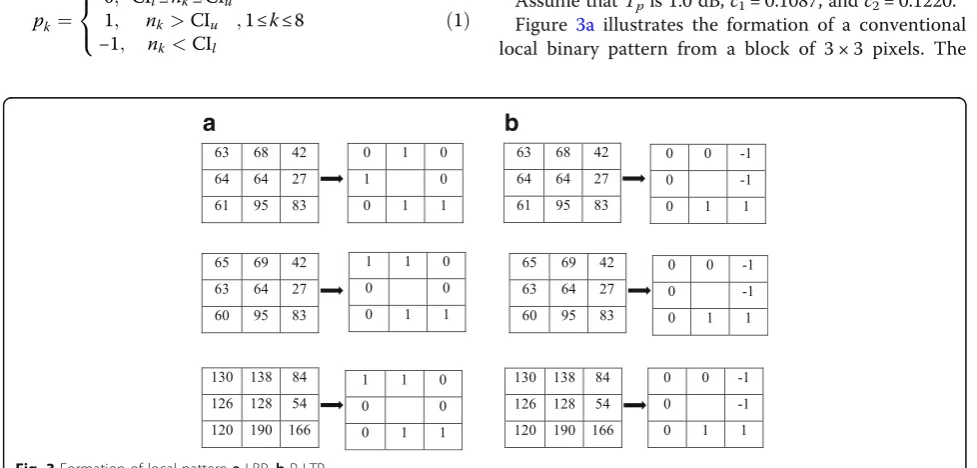
Figure 3a illustrates the formation of a conventional
local binary pattern from a block of 3 × 3 pixels. The
Fig. 2A block of pixels with center pixelband neighborsn1ton8is
transformed into a ternary pattern
a
b
first row shows the formation of LBP for a noise-free image. The second row indicates that LBP is not ro-bust to additive random noise in the image. The third row also shows that LBP cannot keep its invariance against random noise plus scale transform of
inten-sity. Figure 3b illustrates the formation of P-LTP
using Eq. (1) and the estimated c1 and c2 just
men-tioned under the same circumstances as in Fig. 3a.
The confidence intervals for the patterns in the first and second rows are 57 and 72. The confidence inter-vals for the pattern in the third row are 114 and 144. It can be seen that P-LTP is always the same which means it is robust against random noise and scale transform.
For each color component, pixel values are trans-formed into ternary pattern codes as mentioned previ-ously. The pattern is concisely represented by the cardinalities of individual pattern codes.
Pc;t ¼jpk¼tj;1≤k≤8;t¼f−1;0;1g;c¼fR;G;Bg
ð6Þ
Finally, a nine-dimension P-LTP feature vector is formed. The advantage of the P-LTP feature over the
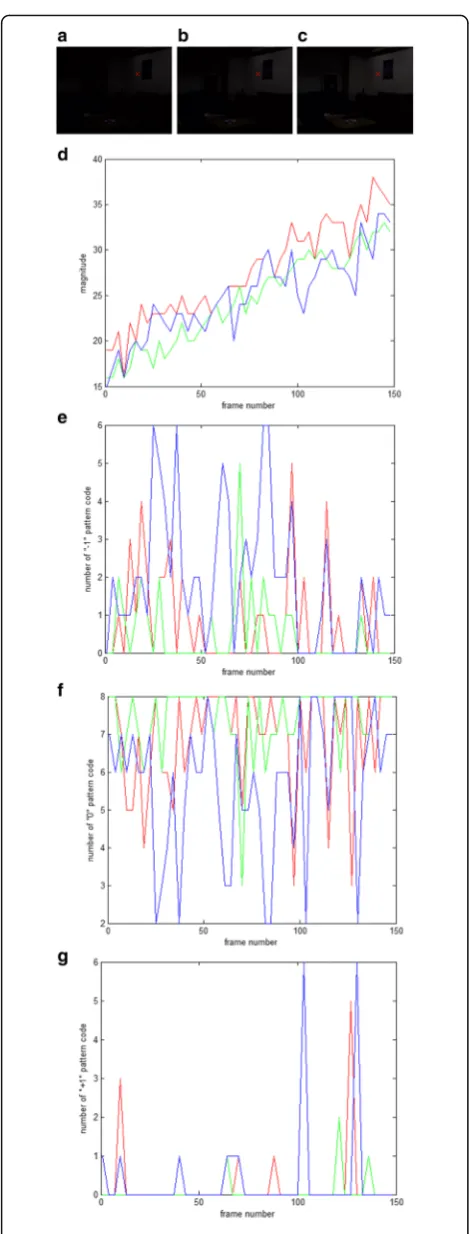
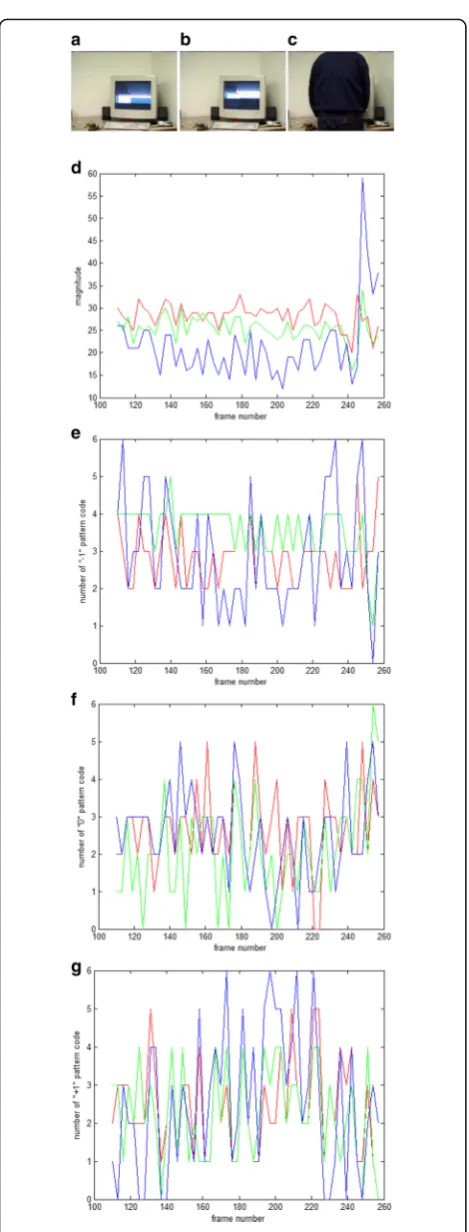
original pixel value can be seen in Fig. 4. Figure 4a–
c shows some image frames, and the selected point
is indicated by the “x” mark. The illumination of the
scene is gradually increasing. Figure 4d shows the
plots in red, green, and blue for the R, G, and B
pixel values, respectively, of the selected point. It is clear that magnitudes of the color components are increasing along the image sequence due to lighting
up of the scene. Figure 4e–g shows the plots of
car-dinalities of pattern codes “−1,” “0,” and “+ 1,” re-spectively, along with the image sequence. Each figure shows the plots in red, green, and blue for the
cardinalities of a pattern code estimated from the R,
G, and B pixel values, respectively. In contrary to
the magnitudes of color components, the nine P-LTP features are quite stable along the image sequence due to their invariance to intensity change. The se-lected point is on a smooth texture region.
Cardinal-ity of “0” pattern code is higher than that of “−1”
and “+ 1” pattern codes. Liao et al. [21] proposed a
scale invariant local ternary pattern (SILTP) to
Fig. 4Frames of an image sequence and plots of pixel values and P-LTP features for three color components (in red, green, and blue lines).aFrame 0.bFrame 74. cFrame 149.d
Magnitudes ofR,G, andBversus frame number.e Cardinality of“−1” pattern code. fCardinality of“0” pattern code.g
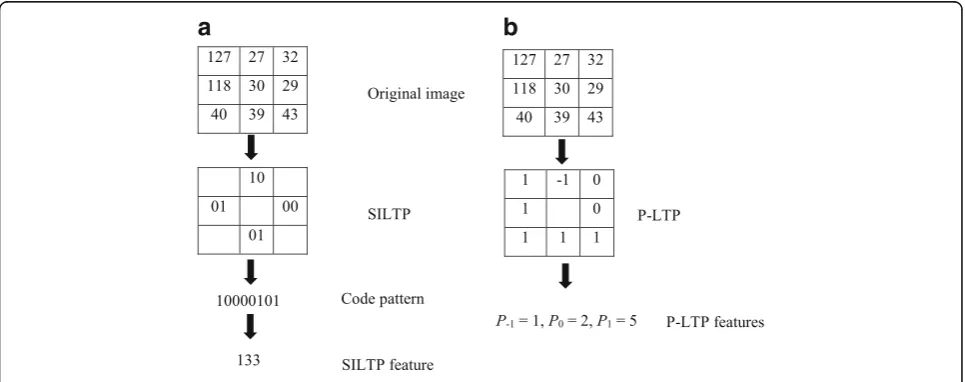
represent the gray levels of the pixels. However, as
shown in Fig. 5a, SILTP feature is not rotation
invari-ant. For instance, if the image is rotated 90° clock-wise, the feature value becomes 97. The P-LTP feature, as shown in Fig. 5b, is rotation invariant. The range of P-LTP feature for one color component is 9!, which is much larger than that of SILTP feature with 256-bin histogram representation.
4 Background model initialization
Many computer vision systems demand accurate seg-mentation of moving objects in the video. It is common that the method involves a learning process, and the background model is generated from the video. The background model must be versatile since simple or complex scenes may be encountered. The features repre-senting the background scene are very important. In our framework, the background is modeled using textural and photometric features.
We observed various challenges in real scenes. Dynamic background elements such as tree and water produce many false-positive errors. Camera jitter also
produces false-positive errors. It is because the
background model does not contain sufficient and
representative samples. Same as [21], we use 150
image frames in the background model initialization. At each pixel, the P-LTP features are computed with a fixed block size of 3 × 3 pixels. Only distinctive P-LTP features are entered into the background model. If a similar P-LTP feature already exists in the
background model, it will be discarded. Let B be the
background model and b is the number of P-LTP
fea-tures in the background model. Let N be the number
of initialization image frames and n is the frame
index. The algorithm for P-LTP feature selection is given below.
The similarity between the current P-LTP feature and the existing P-LTP feature in the background model is calculated by:
pdist Pnc;t;Pic;t
¼ X
t¼f−1;0;1g
Pnc;t−Pic;t
ð7Þ
If the cardinality of a pattern code differs by one, there is also another discrepancy of one in the cardinality of
a
b
another pattern code. We assume that if two sets of P-LTP features are similar, the discrepancy of pattern code cardin-ality should not occur more than twice. Therefore, we fixed
εpas 4. Also, we count the number of occurrences oi for each distinctive P-LTP feature. In case the initialization se-quence contains a moving object, its P-LTP feature should not be included in the background model. Assume that the moving object P-LTP feature occurs less often than the background P-LTP feature. We fixed the filter thresholdεo
as 10% of the length of the initialization sequence.
Besides P-LTP features, we also enter photometric fea-tures into the background model. We observed that for homogeneous textures, the P-LTP feature is not suffi-cient to differentiate the background and object even
though they are of different color. Figure 6 shows two
homogeneous textures, their colors and P-LTP features. The first row shows some image frames, and the
se-lected point is indicated by the “x” mark. Figure 6d
shows the color values of the selected point. Colors of the human are different from the background colors.
The P-LTP features (Fig. 6e–g) are more or less the
same for the two textures. The photometric features used for background modeling are the color components
C= {R,G,B} and intensityIwhich is calculated by:
I¼pffiffiffiffiffiffiffiffiffiffiffiffiffiffiffiffiffiffiffiffiffiffiffiffiffiffiffiR2þG2þB2 ð8Þ
Only distinctive photometric features are entered into the background model. The algorithm for photometric feature selection is given below.
We adopted [9] to measure the similarity between the
current pixel color and the existing photometric feature in the background model:
cdistCn;Ci¼
ffiffiffiffiffiffiffiffiffiffiffiffiffiffiffiffiffiffiffiffiffiffiffiffiffiffiffiffiffiffiffiffiffiffi
Cn
k k2− Cn∙Ci
2
Ci 2
v u u
t ð9Þ
We fixedεcas 10.
5 Moving object segmentation
Moving objects in the image sequence are segmented by comparing each pixel of the image frame with the back-ground model. It is a backback-ground/foreback-ground segregation process. If features of the pixel match with the background model, it is classified as background. Otherwise, it is a fore-ground (object) pixel. The algorithm for moving object seg-mentation is shown below.
Under the default condition (segment_cond= 1), all
the scene changes drastically, photometric features are not invariant and will not be used in the
classifica-tion. Control of segment_cond will be explained in the
next section. The similarity of the intensity is mea-sured with respect to the confidence interval of the
current pixel’s intensity. The lower and upper bounds
are computed based on the constants c1 and c2 as
ex-plained in Section 3. If the current pixel is classified as background, its features are saved temporarily. If it is classified as foreground, we save and count the number of occurrences for each distinctive feature.
This foreground model F will be analyzed in the
background model update process as explained in the following section.
6 Object refinement and background model update
The background/foreground segregation result may contain false-positive and false-negative errors. For in-stance, isolated scene pixels may have features deviate from the background model due to illumination change or background motion. As they are not con-nected to form a region, they can be discarded with-out affecting the detection of real moving objects. Therefore, foreground regions less than 15 pixels are eliminated. The remaining foreground regions may
have holes. The object’s silhouette may be distorted.
These false-negative errors are usually caused by the
similarity of the object’s feature to the background
model. We analyze the spatial consistency of the image feature and refine the object probabilistically.
Let x be a foreground (FG) pixel. Its neighboring
background (BG) pixels y are defined by:
y j distðx;yÞ<D;x¼FG;y¼BG ð10Þ
where dist() is the city block distance and D is fixed as
1. y is changed to FG when they have image features
more similar to neighboring FG pixels than neighboring BG pixels. If segment_condis 1, the image feature to be analyzed is P-LTP.
yi¼FG if logP yð i¼FGÞ
P yð i¼BGÞ>Tf ð11Þ
Fig. 6Two homogeneous textures and the corresponding colors and P-LTP features (in red, green, and blue lines).aFrame 110.b
P yð i¼FGÞ ¼exp −X
j
Pyj
c;t−P yi
c;t
!
;distyi;yj
<D;yj¼FG
ð12Þ
P yð i¼BGÞ ¼exp −X
j μ Pyj
c;t
−Pyi
c;t
!
;dist yi;yj
<D;yj¼FG
ð13Þ
whereμ() is the mean of the P-LTP features in the
back-ground model. If segment_cond is 2, the consistency of
the color component is checked.
P yð i¼FGÞ ¼exp −X
j
Cyj−Cyi
j j
!
;dist yi;yj
<D;yj¼FG
ð14Þ
P yð i¼BGÞ ¼exp −X
j
μðCyjÞ−Cyi
j j
!
;dist yi;yj
<D;yj¼FG
ð15Þ
Tf is fixed as 2. Figure 7 shows the original image
frame and the segmented human with and without prob-abilistic refinement. Many holes inside the human region are filled up. The silhouette is also improved.
We devise two mechanisms to adapt the back-ground model to complications such as a sudden global change in the scene and appearance of new background features. They are important to ensure accurate object segmentation over a long image se-quence. In the short-term background model update, an abrupt and extensive scene change is identified
by analyzing the current segmented result St and a
previous segmented result St-k, where t is the current
time instant and k is fixed as 15. Normally, the
background model will allow all stored features (P-LTP, color, and intensity) being used in the
mov-ing object segmentation (segment_cond= 1). It will
be changed (segment_cond= 2) such that only P-LTP
features are used when the following two conditions are met:
X
XORðSt;St−kÞ>TS ð16Þ
μð ÞIt −μðIt−kÞ
j j
μð ÞIt >
TI ð17Þ
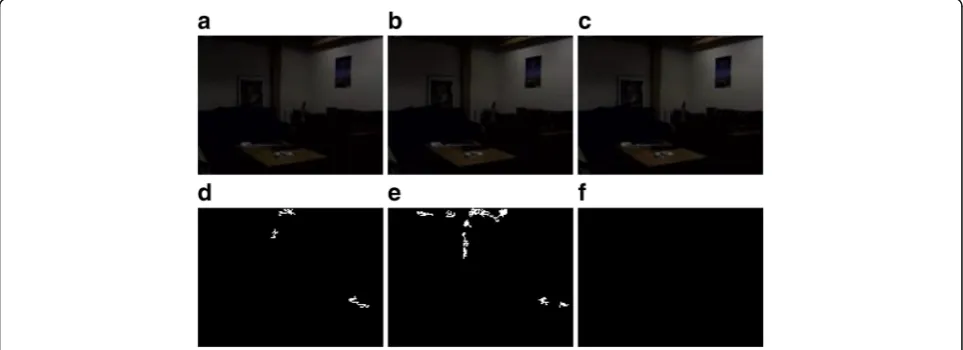
whereTS is fixed as 0.3 times the image frame size, μ(I) is the mean intensity, and TI is fixed as 0.2. Figure 8 shows the original image frames and the segmented re-sults before and after the sudden scene change. Initially, all the background pixels are identified correctly. When some lights are turned off, many pixels are wrongly clas-sified as foreground. With short-time background updat-ing, many pixels are correctly identified as background immediately.
In the long-term background model update, we accu-mulate the outcomes of background/foreground classifi-cation over a period of time. We choose the same duration for background initialization which is 150 frames. During this period, if the current pixel is classi-fied as background, its features are considered as reliable background features and will be stored temporarily. If it is classified as foreground, there are two possibilities. It may be a true object pixel or a new background pixel. Each distinctive foreground pixel will have its features
saved into the foreground model F. We also count the
number of occurrences for each distinctive foreground feature. By the end of the period, if the number of occur-rences is large enough (we fixed the threshold as 0.8 times the update period), those foreground features, to-gether with all the temporary background features, are
saved as the updated background model. Figure9 shows
the original image frames and the segmented results
before and after the long-term background update. The illumination of the scene is increasing and causes more false-positive errors. At time instant 450, the long-term background update is carried out. All the background pixels are correctly identified.
7 Results and discussion
We evaluated the performance quantitatively in terms of Recall, Precision, and F-Measure (F1). Recall gives the ratio of detected true-positive pixels to a total number of foreground pixels present in the ground truth which is the sum of true-positive and false-negative pixels. Preci-sion gives the ratio of detected true-positive pixels to a total number of foreground pixels detected by the
method which is the sum of true-positive and
false-positive pixels. F1 is the weighted harmonic mean of Precision and Recall. It can be used to rank different
methods. The higher the value of F1, the better is the accuracy.
We compared our method with other background subtraction algorithms on three publicly available data-sets. The Wallflower dataset [31] contains six videos. Each video comes with one manually labeled ground truth. They have the same image frame size of 160 × 120 pixels. The Star dataset [32] contains nine videos. Each video comes with 20 manually labeled frames as ground truths. The videos have a different image frame size, from 160 × 120 pixels to 320 × 256 pixels. Finally, we tested our method and compared with other algorithms
on ChangeDetection.net dataset [33]. Each video comes
with large amount of labeled ground truths. They have larger image frame size, from 320 × 240 pixels to 720 × 576 pixels.
As for our method, the first 150 image frames of the video are used for background model initialization which
Fig. 8Short-term background model update.a–cOriginal image frames 124, 126, and 128.d–fSegmented results
is the same as the best setting in [21]. Other parameters are: Tp= 1.0, εp= 4, εo= 15, εc= 10, Tf= 2, TS= 0.3 × image frame size, and TI= 0.2. The perceptual threshold of 1.0 dB corresponds to just visually observable differ-ence between neighboring pixels. If a pattern is a back-ground, we assume that any one pattern code cardinality should not differ from the existing background pattern by more than 2. Therefore, the total difference between the pattern features should not be more than 4. Through experimentation, we observed that moving object pat-tern occurs less than 10% of the length of the initialization sequence. The photometric feature similar-ity threshold is set the same as [9]. False-negative error is rectified when its features are more likely to be fore-ground than backfore-ground. Through experimentation, we found that the threshold for the log-likelihood ratio can be set as 2 properly. To detect a global change in the
Table 1F1 results on the Wallflower dataset
Sequence Our method ViBe SILTP MC-SILTP
Bootstrap 0.867 0.478 0.766 0.740
Camouflage 0.975 0.931 0.927 0.896
ForegroundAperture 0.693 0.644 0.849 0.665
LightSwitch 0.700 0.159 0.730 0.745
TimeOfDay 0.832 0.394 0.175 0.181
WavingTrees 0.952 0.933 0.712 0.946
Average 0.836 0.590 0.693 0.695
Variance 0.015 0.095 0.071 0.075
The best results are shown in italics
scene and appearance of new background features, we found that the conditions of 30% change in the segmen-tation result and fractional change of mean intensity of 0.2 are suitable for all testing image sequences.
7.1 Wallflower dataset
We selected non-parametric method ViBe [10],
texture-based method SILTP [21], and MC-SILTP
[23] for comparison. Based on sample consensus,
ViBe can achieve very good results with very few tunable parameters. It was showed that ViBe per-forms better than many state-of-the-art parametric
and non-parametric algorithms such as [6, 9]. ViBe
uses RGB color model and a fixed spherical distance of 30 in matching new pixel with background sam-ples. It keeps 20 background samples, and the new pixel is identified as background with two matches. SILTP employs scale invariant local patterns. It was
showed [21] that it performs better than other
LBP-based methods [20]. MC-SILTP is one latest
texture-based method and can perform even better with pattern obtained by cross-computation on RGB color channels. We implemented SILTP with the
same set of parameters as reported in [21]. The only
parameter value which was not mentioned is the number of training frames. Through experimenta-tion, we find that the number of training frames is best fixed as 150. Similarly, we implemented
MC-SILTP with the same setting as reported in [23]. The
Wallflower dataset contains videos exhibiting gradual illumination change (TimeOfDay), sudden illumin-ation change (LightSwitch), similar background and object color (Camouflage), moving background ele-ments (Waving Trees), etc.
Table 1 shows the F1 results of our method, ViBe,
SILTP, and MC-SILTP. The best result in a given row is highlighted. No method can achieve the highest F1 on
all videos. Our method can achieve the highest F1 on four videos. Overall, texture-based methods perform bet-ter than ViBe. MC-SILTP performs slightly betbet-ter than SILTP. Our method achieves the highest average F1 which is 14% higher than the second best method MC-SILTP. Also, our method can achieve consistently high F1 as indicated by the lowest variance.
Figure 10 shows the visual results. In “Bootstrap,”
humans already exist in the initialization image sequence. ViBe produces more false-negative errors. Our method and SILTP relatively have lesser false-negative errors. Our
method also has lesser false-positive errors than
MC-SILTP. In “Camouflage,” the difficulty is that the
monitor and the clothing have a similar color. Therefore, ViBe, SILTP, and MC-SILTP produce many false-negative errors. With probabilistic refinement, our method can drastically reduce false-negative error. In “
ForegroundA-perture,” the human remains stationary and stooped over
the desk for some time. Features of the human are in-cluded in the background model. When the human rises, all methods produce false-negative errors. In“LightSwitch,” ViBe cannot adapt to the sudden change of light. Other
methods can quickly respond. In“TimeOfDay,”the room
is very dark in the beginning. The light is turned on grad-ually, and a human enters the room. SILTP and MC-SILTP cannot adapt to the change and result in a large amount of false-positive errors. ViBe performs better, but the seg-mented human is small. Benefit by the P-LTP feature, our method can segment a larger human with a minimal
false-positive error. In “WavingTrees,” ViBe and SILTP
produce many false-positive errors in the trees behind the human. MC-SILTP still produces a moderate amount of false-positive error. As the P-LTP feature is rotational in-variant, our method is quite effective in identifying the waving trees as background. In summary, our method can achieve a consistent and accurate performance under vari-ous kinds of complication in the background scene.
Table 2F1 results on the Star dataset
Sequence Our method ViBe SILTP MC-SILTP MoG LBP-B LBP-P
AirportHall 0.728 0.496 0.681 0.659 0.579 0.477 0.503
Bootstrap 0.790 0.514 0.754 0.649 0.541 0.528 0.520
Curtain 0.885 0.775 0.912 0.707 0.505 0.661 0.714
Escalator 0.569 0.445 0.639 0.439 0.366 0.591 0.539
Fountain 0.809 0.425 0.835 0.504 0.779 0.705 0.753
ShoppingMall 0.813 0.522 0.796 0.513 0.670 0.547 0.629
Lobby 0.765 0.029 0.788 0.690 0.684 0.503 0.523
Trees 0.727 0.345 0.425 0.222 0.554 0.629 0.606
WaterSurface 0.934 0.801 0.743 0.570 0.635 0.768 0.822
Average 0.780 0.483 0.730 0.550 0.590 0.601 0.623
Variance 0.011 0.052 0.019 0.024 0.014 0.010 0.013
7.2 Star dataset
We selected ViBe [10], SILTP [21], MC-SILTP [23],
parametric method MoG [5], texture-based methods
blockwise LBP (LBP-B) [34], and pixelwise LBP (LBP-P)
[20] for comparison. Table 2 shows the F1 results. The numeric results of SILTP, MoG, LBP-B, and LBP-P are
from [21]. Our method can achieve the highest F1 on
five videos and second best on three videos. Overall, our method achieves the highest average F1 than all compar-ing methods which is 5% higher than the second best method SILTP. Our method has the second lowest vari-ance which is very near to LBP-B.
Figure11shows the visual results of our method, ViBe, SILTP, and MC-SILTP. Some videos contain busy human flows (AirportHall, Bootstrap, Escalator, ShoppingMall).
“Curtain” has a slowly moving curtain in the
back-ground. “Fountain” and“WaterSurface” contain moving
water. In “Lobby,” the light is dimmed and turned on
later. “Trees” has waving trees and banner in the
back-ground. In “AirportHall,” ViBe and MC-SILTP produce
more false-negative errors. The results of our method and SILTP are close, only that the latter method has more false-positive and negative errors. A similar com-parison can be observed in “Bootstrap.” In “Curtain,”
other methods produce many false-negative errors. MC-SILTP also produces many false-positive errors.“
Es-calator” is a difficult video. ViBe, MC-SILTP, and our
method can model the background. In “Fountain,” our
method takes advantage of the rotational invariant P-LTP feature and accurately identifying the fountain as background. Our method can segment all humans in “ShoppingMall” with low false-positive and negative
er-rors. In “Lobby,” ViBe cannot adapt to the change of
light while the results of our method are close to SILTP and MC-SILTP. ViBe, SILTP, and MC-SILTP produce a
large amount of false-positive errors in “Trees.” Our
method has no problem in tackling the waving trees as well as the window of the bus. Similarly, the P-LTP
fea-ture can model the moving water in “WaterSurface.” In
ViBe, the legs are almost missing completely, and MC-SILTP also produces many false-negative errors. Our method can segment the whole figure of the hu-man. In this experiment, it can be seen that our method can achieve a stable performance in all videos.
7.3 ChangeDetection.net dataset
We compared our method with ViBe, SILTP, and MC-SILTP on image sequences of the dynamic back-ground category. Due to larger frame size, backback-ground scene changes are more vigorous than the videos of pre-vious datasets. The testing image sequences contain complex backgrounds such as swaying trees, camouflage,
fountain, and water surface. Table 3 shows the F1
re-sults. Fountain01 is a very difficult image sequence with small foreground object and large regions of changing background. All methods achieve very low F1 results. Overall, our method can achieve the highest F1 on all image sequences, and the average F1 is 14% higher than the second best method ViBe.
Table 3F1 results on the ChangeDetection.net dataset dynamic background image sequences
Sequence Our method ViBe SILTP MC-SILTP
boats 0.566 0.178 0.015 0.127
canoe 0.850 0.783 0.107 0.695
fountain01 0.196 0.061 0.008 0.050
fountain02 0.632 0.563 0.024 0.098
overpass 0.704 0.685 0.066 0.209
Average 0.590 0.454 0.044 0.236
Variance 0.059 0.101 0.002 0.069
The best results are shown in italics
Figure12shows the visual results of our method, ViBe, SILTP, and MC-SILTP.“Boats”has water surface, people,
and cars in the background. “Canoe” has water surface
and trees in the background. SILTP cannot model the background well. MC-SILTP performs much better than SILTP, but like ViBe, produce many false-positive errors in the water surface. Our method can effectively model the whole background and segment the boat and canoe.
“Fountain01” and “fountain02” have flowing water in
front and moving cars behind the fountain. Again, SILTP cannot model the fountain well. MC-SILTP still pro-duces many false-positive errors in the fountain. ViBe results in a smaller foreground region. Our method can model the flowing water and segment the foreground in sufficient large size and good shape.“Overpass”contains a human walk along the bridge with swaying trees in the background. The legs and bridge have a similar color. SILTP cannot model the trees well. MC-SILTP and ViBe produce many holes (false-negative errors). Our method can effectively model the swaying trees and segment the human.
8 Conclusions
We propose a method for the segmentation of moving objects in the video. The background model is repre-sented by perception-based local ternary pattern and photometric features. The local ternary pattern is robust to random noise and invariant to scale transform. The feature derived from the local pattern is also rotational invariant. Each pixel of the image frame is classified as either background or object by matching the image fea-ture with the background model. The segmented object can be refined by taking into account the spatial consistency of the image feature. The background model is updated periodically along the image sequence for adapting to the changes of the scene. We devise two
mechanisms—short-term update to respond to a sudden
global change in the scene and long-term update for in-corporating new background features. We compare our method with various background subtraction algorithms. Testing is performed on three common video datasets, containing many types of complication. The quantitative and visual results show the consistency and accuracy of our method over others.
Abbreviations
BG:Background; CI: Confidence interval; DT: Dynamic texture; FG: Foreground; LBP: Local binary pattern; B: Blockwise LBP; LBP-P: Pixelwise LBP; LBSLBP-P: Local binary similarity pattern; MC-SILTLBP-P: Multi-channel SILTP; MoG: Mixture of Gaussian; P-LTP: Perception-based local ternary pattern; PSNR: Peak signal-to-noise ratio; SILTP: Scale invariant local ternary pattern; ViBe: Visual background extractor
Availability of data and materials
The video datasets used are publicly available and cited in the list of references.
Authors’contributions
The research was performed solely by the author. The author read and approved the final manuscript.
Authors’information
KL Chan received the M.Sc. Degree in Electronics from the University of Wales Institute of Science and Technology, UK. He received the Ph.D. degree from the University of Wales College of Medicine, UK. He is currently an Assistant Professor of the Department of Electronic Engineering, the City University of Hong Kong. His research interests include image processing and computer vision.
Competing interests
The author declares that he has no competing interests.
Publisher’s Note
Springer Nature remains neutral with regard to jurisdictional claims in published maps and institutional affiliations.
Received: 26 January 2018 Accepted: 16 July 2018
References
1. SY Elhabian, KM El-Sayed, SH Ahmed, Moving object detection in spatial domain using background removal techniques–state-of-art. Recent Pat. Comput. Sci. 1, 32–54 (2008).
2. A Sobral, A Vacavant, A comprehensive review of background subtraction algorithms evaluated with synthetic and real videos. Comput. Vis. Image Underst. 122, 4–21 (2014).
3. T Bouwmans, Recent advanced statistical background modeling for foreground detection: a systematic survey. Recent Pat. Comput. Sci. 4(3), 147–176 (2011).
4. CR Wren, A Azarbayejani, T Darrell, A Pentland, Pfinder: real-time tracking of the human body. IEEE Trans. Pattern Anal. Mach. Intell. 19(7), 780–785 (1997).
5. C Stauffer, WEL Grimson, Learning patterns of activity using real-time tracking. IEEE Trans. Pattern Anal. Mach. Intell. 22(8), 747–757 (2000). 6. Z Zivkovic, inProceedings of International Conference on Pattern Recognition.
Improved adaptive Gaussian mixture model for background subtraction (2004), pp. 28–31.
7. T Bouwmans, F El Baf, B Vachon, Background modeling using mixture of Gaussians for foreground detection–a survey. Recent Pat. Comput. Sci. 1, 219–237 (2008).
8. A Elgammal, R Duraiswami, D Harwood, LS Davis, Background and foreground modeling using nonparametric kernel density estimation for visual surveillance. Proc. IEEE 90(7), 1151–1163 (2002).
9. K Kim, TH Chalidabhongse, D Harwood, LS Davis, Real-time foreground-background segmentation using codebook model. Real-Time Imaging 11, 172–185 (2005).
10. O Barnich, M Van Droogenbroeck, inProceedings of International Conference on Acoustics, Speech and Signal Processing. ViBe: a powerful random technique to estimate the background in video sequences (2009), pp. 945–948. 11. M Hofmann, P Tiefenbacher, G Rigoll, inProceedings of IEEE Workshop on
Change Detection at IEEE Conference on Computer Vision and Pattern Recognition. Background segmentation with feedback: the pixel-based adaptive segmenter (2012), pp. 38–43.
12. M Van Droogenbroeck, O Paquot, inProceedings of IEEE Workshop on Change Detection at IEEE Conference on Computer Vision and Pattern Recognition. Background subtraction: experiments and improvements for ViBe (2012), pp. 32–37.
13. TSF Haines, T Xiang, Background subtraction with Dirichlet process mixture models. IEEE Trans. Pattern Anal. Mach. Intell. 36(4), 670–683 (2014). 14. Z Gao, L-F Cheong, Y-X Wang, Block-sparse RPCA for salient motion
detection. IEEE Trans. Pattern Anal. Mach. Intell. 36(10), 1975–1987 (2014). 15. X Liu, G Zhao, J Yao, C Qi, Background subtraction based on low-rank and
structured sparse decomposition. IEEE Trans. Image Process. 24(8), 2502– 2514 (2015).
17. V Mahadevan, N Vasconcelos, inProceedings of IEEE Conference on Computer Vision and Pattern Recognition. Background subtraction in highly dynamic scenes (2008), pp. 1–6.
18. Y Sheikh, M Shah, inProceedings of IEEE Conference On Computer Vision and Pattern Recognition. Bayesian object detection in dynamic scenes, vol 1 (2005), pp. 74–79.
19. S Zhang, H Yao, S Liu, inProceedings of International Workshop on Visual Surveillance. Dynamic background subtraction based on local dependency histogram (2008).
20. M Heikkilä, M Pietikäinen, A texture-based method for modeling the background and detecting moving objects. IEEE Trans. Pattern Anal. Mach. Intell. 28(4), 657–662 (2006).
21. S Liao, G Zhao, V Kellokumpu, M Pietikäinen, SZ Li, inProceedings of IEEE Conference on Computer Vision and Pattern Recognition. Modeling pixel process with scale invariant local patterns for background subtraction in complex scenes (2010), pp. 1301–1306.
22. P-L St-Charles, G-A Bilodeau, R Bergevin, SuBSENSE: a universal change detection method with local adaptive sensitivity. IEEE Trans. Image Process. 24(1), 359–373 (2015).
23. F Ma, N Sang, inProceedings of Asian Conference on Computer Vision. Background subtraction based on multi-channel SILTP (2012), pp. 73–84. 24. L Lin, Y Xu, X Liang, J Lai, Complex background subtraction by pursuing dynamic spatio-temporal models. IEEE Trans. Image Process. 23(7), 3191– 3202 (2014).
25. C Spampinato, S Palazzo, I Kavasidis, A texton-based kernel density estimation approach for background modeling under extreme conditions. Comput. Vis. Image Underst.122, 74–83 (2014).
26. SW Kim, K Yun, KM Yi, SJ Kim, JY Choi, Detection of moving objects with a moving camera using non-panoramic background model. Mach. Vis. Appl. 24, 1015–1028 (2013).
27. H-L Eng, J Wang, AHK Siew Wah, W-Y Yau, Robust human detection within a highly dynamic aquatic environment in real time. IEEE Trans. Image Process. 15(6), 1583–1600 (2006).
28. KL Chan, inProceedings of the 15th IAPR International Conference on Machine Vision Applications. Saliency/non-saliency segregation in video sequences using perception-based local ternary pattern features (2017), pp. 480–483. 29. RC Gonzalez, RE Woods,Digital Image Processing(Pearson/Prentice Hall,
Upper Saddle River, 2010).
30. M Haque, M Murshed, Perception-inspired background subtraction. IEEE Trans. Circuits Syst. Video Technol. 23(12), 2127–2140 (2013).
31. K Toyama, J Krumm, B Brumitt, B Meyers, inProceedings of International Conference on Computer Vision. Wallflower: principles and practice of background maintenance (1999), pp. 255–261.
32. L Li, W Huang, IY-H Gu, Q Tian, Statistical modelling of complex backgrounds for foreground object detection. IEEE Trans. Image Process. 13(11), 1459–1472 (2004).
33. N Goyette, P-M Jodoin, F Porikli, J Konrad, P Ishwar, inProceedings of IEEE Conference on Computer Vision and Pattern Recognition. Changedetection. net: a new change detection benchmark dataset (2012), pp. 16–21. 34. M Heikkilä, M Pietikäinen, J Heikkilä, inProceedings of British Machine Vision