Volume 2007, Article ID 23570,16pages doi:10.1155/2007/23570
Research Article
Models for Gaze Tracking Systems
Arantxa Villanueva and Rafael Cabeza
Electronic and Electrical Engineering Department, Public University of Navarra, Arrosadia Campus, 31006 Pamplona, Spain
Received 2 January 2007; Revised 2 May 2007; Accepted 23 August 2007
Recommended by Dimitrios Tzovaras
One of the most confusing aspects that one meets when introducing oneself into gaze tracking technology is the wide variety, in terms of hardware equipment, of available systems that provide solutions to the same matter, that is, determining the point the subject is looking at. The calibration process permits generally adjusting nonintrusive trackers based on quite different hardware and image features to the subject. The negative aspect of this simple procedure is that it permits the system to work properly but at the expense of a lack of control over the intrinsic behavior of the tracker. The objective of the presented article is to overcome this obstacle to explore more deeply the elements of a video-oculographic system, that is, eye, camera, lighting, and so forth, from a purely mathematical and geometrical point of view. The main contribution is to find out the minimum number of hardware elements and image features that are needed to determine the point the subject is looking at. A model has been constructed based on pupil contour and multiple lighting, and successfully tested with real subjects. On the other hand, theoretical aspects of video-oculographic systems have been thoroughly reviewed in order to build a theoretical basis for further studies.
Copyright © 2007 A. Villanueva and R. Cabeza. This is an open access article distributed under the Creative Commons Attribution License, which permits unrestricted use, distribution, and reproduction in any medium, provided the original work is properly cited.
1. INTRODUCTION
The increasing capabilities of gaze tracking systems have made the idea of controlling a computer by means of the eye more and more realistic. Research in gaze tracking systems development and applications has attracted much attention lately. Recent advancements in gaze tracking technology and the availability of more accurate gaze trackers have joined the efforts of many researchers working in a broad spectrum of disciplines.
The interactive nature of some gaze tracking applica-tions offers, on the one hand, an alternative human com-puter interaction technique for activities where hands can barely be employed and, on the other, a solution for dis-abled people who maintain eye movement control [1–3]. The most extreme case would be those people who can only move the eyes—with their gaze being their only way of communication—such as some subjects with amyotrophic lateral sclerosis (ALS) or cerebral palsy (CP) among others.
Among the existing tracking technologies, the systems incorporating video-oculography (VOG) use a camera or a number of cameras and try to determine the movement of the eye using the information obtained after studying the images captured. Normally, they include infrared lighting to
produce specific effects in the obtained images. The nonin-trusive nature of the trackers employing video-oculography renders it as an attractive technique. Among the existing video-oculographic gaze tracking techniques, we find sys-tems that determine the eye movement inside its orbit and systems that find out the gaze direction in 3D, that is, line of sight (LoS). If the gazing area position is known, the ob-served point can be deduced as the intersection between LoS and the specific area, that is, point of regard (PoR). In the pa-per, the term gaze is used for both PoR and LoS, since both are the consequence of the eyeball 3D determination.
their system. The mathematical rigor of this work makes it the one that most closely resembles the work dealt with in this paper. Zhu and Ji [12] propose a two-camera-based sys-tem and a dynamic model for head movement compensa-tion. Beymer and Flickner [13] present a system based on four cameras and two lighting points to differentiate head detection and gaze tracking. Later, and largely based on this work, Brolly and Mulligan [14] reduce the system to three cameras. A similar solution as the one by Beymer et al. is proposed by Ohno and Mukawa [15]. Some interesting at-tempts have been carried out to reduce the system hardware such as the one by Hansen and Pece [16] using just one cam-era based on the iris detection or the work by Wang et al. [17].
It is surprising to find the wide variety of gaze tracking systems which are used with the same purpose, that is, to de-tect the point the subject is looking at or gaze direction. How-ever, their basis seems to be the same; the image of the eye captured by the camera will change when the eye rotates or translates in 3D space. The objective of any gaze estimation system is clear; a system is desired that permits determining the PoR from captured images in free head movement situa-tion. Consequently, the question that arises is evident: “what are the features of the image and the minimum hardware that permit computing unequivocally the gazed point or gaze di-rection?”
This study tries to analyze in depth the mathematical connection between the image and the gaze. Analyzing this connection leads to the establishment of a set of guidelines and premises that constitute a theoretical basis from which useful conclusions are extracted. The study carried out shows that, assuming that the camera is calibrated and the position of screen and lighting are known with respect to the camera, two LEDs and a single camera are enough to estimate PoR. On the other hand, the position of the glints in the image and the pupil contour are the needed features to solve gaze posi-tion. The paper tries to reduce some cumbersome mathemat-ical details and focus the reader’s attention on the obtained conclusions that are the main contribution of the work [18]. Several referenced works deal with geometrical theory of gaze tracking systems. The works by Shih and Liu [11], Beymer and Flickner [13], and Ohno and Mukawa [15] are the most remarkable ones. Recently, new studies have been introduced such as the one by Hennessey et al. [19] or Guestrin and Eizenman [20]. These are based on a single camera and mul-tiple glints. The calibration process proposed by Hennessey et al. [19] is not based on any system geometry. The system proposed by Guestrin and Eizenman [20] proposes a rough approximation when dealing with refraction. Both use multi-ple points calibration processes that compensate for the con-sidered approximations.
An exhaustive study of a tracker requires an analysis of the alternative elements involved in the equipment of which the eyeball represents the most complex. A brief study of its most relevant characteristics is proposed inSection 2. Subse-quently, inSection 3, alternative solutions are proposed and evaluated to deduce the most simple system.Section 4tries to validate the model experimentally and finally the conclu-sions obtained are set out inSection 5.
Nasal side Visual axis
β Optical axis Temporal side
Nodal points N N Pupil
Optical nerve Fovea
Figure1: Top view of the right eye.
2. THE EYEBALL
Building up a model relating the obtained image with gaze direction requires a deeper study of the elements involved in the system. The optical axis of the eye is normally considered as the symmetry axis of the individual eye. Consequently, the center of the pupil can be considered to be contained in the optical axis of the eyeball. The visual axis of the eye is nor-mally considered as an acceptable approximation of the LoS. When looking at some point, the eye is oriented in such a way that the observed object projects itself on the fovea, a small area with a diameter of about 1.2◦in the retina with a high density of cones that are responsible for high visual detail dis-crimination (seeFigure 1). The line joining the fovea to the object we are looking at, crossing the nodal points (close to the cornea), can be approximated as the visual axis of the eye. This is considered to be the line going out from the fovea through the corneal sphere center. The fovea is slightly dis-placed from the eyeball back pole. Consequently, there is an angle of 5±1◦ between both axes, that is, optical and vi-sual axes, horizontally in the nasal direction. A lower angle 2-3◦can be specified vertically too, although there is a con-siderable personal variation [21]. In this first approach, the horizontal offset is considered since it is widely accepted by the eye tracking community. The vertical deviation is obvi-ated since it is smaller and the most simplified version of the eye is desired.
Normally, gaze estimation systems find out first the 3D position of the optical line of the eye to deduce the visual one. To this end, not only the angular offset between axes is necessary, but also the direction in which this angle must be applied. In other words, we know that optical and visual axes present an angular offset in a certain plane, but the position of this plane when the user looks at a specific point is needed. InFigure 2, the optical axis is shown using a dotted line. The solid lines around it present the same specific angular offset with respect to the dotted line and all of them are possible visual axes if no additional information is introduced.
Optical axis
Figure2: The dotted line represents the optical axis of the eye. The solid lines are 3D lines presenting the same angular offset with re-spect to the optical line and consequently possible visual axis candi-dates.
1 4
3 2
Figure3: The natural rotation of the eyeball would be to move from 1-2 in one step following the continuous line path. The same posi-tion can be arrived by making successive rotaposi-tions, that is, 1-4-2 or 1-3-2; however, the final orientations are different from the correct ones (1-2).
and horizontal or horizontal and vertical. However, the eye does not rotate from one point to the other by making con-secutive rotations. The movement is achieved in just one step as is summarized in Listing’s Law [21]. The alternative ways to model optical axis movement can lead to inconsistencies in the final eye orientation.
Let us analyze the next example sketched inFigure 3. Let us consider the cross as the orientation of the eye; that is, the horizontal line of the cross would be contained in the opti-cal and visual axes plane for position 1. The intrinsic nature of the eyeball will accomplish the rotation from point 1 to point 2 in just one movement following the path shown with the solid line. The orientation of the cross achieved in this manner does not agree with the ones obtained employing the alternative ways 1-3-2, that is, horizontal rotation plus vertical rotation, or 1-4-2, that is, vertical rotation plus hor-izontal rotation. This situation disagrees with Donder’s law which states that the orientation and the degree of torsion of the eyeball only depend on the point the subject is looking at and are independent of the route taken to reach it [21]. From the example, it is concluded that the visual axis posi-tion would depend on the path selected since the plane in which the angular offset should be applied is different for the three cases.
Fry et al. [22] solve the disagreement introducing the concept of false torsion in their eye kinematics theory which states that if eye rotations are modeled by means of consec-utive vertical and horizontal movements or vice versa, once the vertical and horizontal rotations are accomplished an
ad-ditional torsion is required to locate the eyeball accordingly with the orientation claimed by the Listing’s law. This supple-mentary rotation depends on the previously rotated angles and is called false torsion and it can be approximated by
tan
α 2
=tan
θ 2
tan
ϕ 2
, (1)
whereθ,ϕare the vertical and horizontal rotation angles per-formed by the eye with respect to a known reference system andαis the torsion angle around itself.
3. MODEL CONSTRUCTION
Gaze estimation process should establish a connection be-tween the features provided by the technology, that is, image analysis results, and gaze. The solution to this matter pre-sented by most systems is to express this connection via gen-eral purpose expressions such as linear or quadratic equa-tions based on unknown coefficients [23],P =ΩTF, where Prepresents PoR,Ωis the unknown coefficients vector, and Fis the vector containing the image features and their pos-sible combinations in linear, quadratic, or cubic expressions. The coefficients vectorΩis derived after the calibration of the equipment that consists in asking the subject to look at several known points on a screen, normally a grid of 3×3 or 4×4 marks uniformly distributed over the gazing area. The calibration procedure permits systems with fully differ-ent hardware and image features to work acceptably, but on the other hand prevents researchers from determining the minimal system requirements.
Our objective is to overcome this problem in order to determine the minimum hardware and image features for a gaze tracking system that permits an acceptable gaze estima-tion by means of geometrical modeling. The initial system is sketched inFigure 4. The optical axis of the eye contains three principal points of the eyeball since it is approximated as its symmetry axis, that is,A, eyeball center,C, corneal center, andE, pupil center. The distance between pupil and corneal centers is named ashand the corneal radius asrc. In addition,
the angular offset between optical and visual axes is defined asβ. The pupil center and glint in the image are denoted as p andg, respectively. All the features are referenced to the camera projection centerO.
LED
Camera
O
Eyeball
A C h
E
rc
Cornea Optical axis
β
Visual axis
Screen
p g
Figure4: The gaze tracking system.
the constructed model with respect to possible system inde-termination such as noise.
The procedure selected to accomplish the work in the simplest manner is to analyze separately the alternative fea-tures that can be extracted from the image. In this manner, a review of the most commonly used features employed by al-ternative gaze tracking systems is carried out. The models so constructed are categorized in three groups:models based on points, models based on shapes, andhybrid modelscombining points and shapes. The systems of the first group are based on extracting features of the image which consist of single points of the image and combine them in different ways. We consider a point as a specific pixel described by its row and column in the image. In this manner, we find in this group the following models: the model based on the center of the pupil, the model based on the glint, the model based on mul-tiple glints, the model based on the center of the pupil and the glint, and the model based on the center of the pupil and multiple glints. On the other hand, the models based on shapes involve more image information; basically these types of systems take into account the geometrical form of the shape of the pupil in the image. One model is defined in this group, that is, the model based on the pupil ellipse. It is straightforward to deduce that the models of the third group combine both, that is, points and shapes, to sketch the sys-tem. In this manner, we have the model based on the pupil ellipse and the glint and the model based on the pupil ellipse and multiple glints.Figure 5shows a classification of the con-structed models.
3.1. Geometrical analysis
The geometrical analysis evaluates the ability of the model to compute the 3D position of the optical axis of the eye with respect to the camera1in a free head movement scenario.
Re-1If the gazwd point exact location is desired in screen coordinates, the
screen position with respect to the camera is supposed to be detrmined.
ferring to the optical axis, if two points among the three, that is,A,C, andE, are determined with respect to the camera, the optical axis is calculated as the line joining both points.
3.1.1. Models based on points
The center of the pupil in the image is a consequence of the pupil 3D position. If affine projection is not assumed, the center of the pupil in the image is not the projection of E due to perspective distortion, but it is evident that it is ge-ometrically connected to it. On the other hand, the glint is the consequence of the reflection of the lighting source on the corneal surface. Consequently, the position of the glint or glints in the image depends on the corneal sphere position, that is,C. The models based on these features separately, that is,pandg, are related to single points of the optical axis and, consequently, cannot allow for optical axis estimation in a free head movement scenario. Consequently, just the possi-ble combinations of points will be studied.
(a) Pupil center and glint
Usually it is accepted that the pupil center corneal reflection (PCCR) vector sensitivity with respect to the head position is reduced. From the geometrical point of view of this work, this approximation is not valid and creates a dependence be-tween this vector value and the head position. Alternative ap-proaches have been proposed based on these image features using general purpose expressions; a thorough review of this technique can be found in Morimoto and Mimica [24]. On the other hand, an analytical head movement compensation method based on the PCCR technique is suggested by Zhu and Ji [12] in their gaze estimation model.
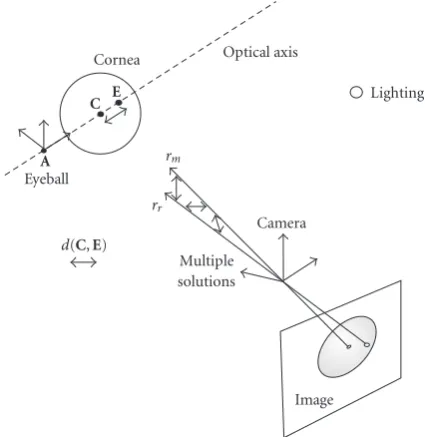
Our topic of discussion is to check if this two-feature combination, not necessarily as a difference vector, can solve the head constraint. So far, we know that the glint in the im-age is directly related to corneal centerCin the image plane. On the other hand, the 3D position of the center of the pupil is related to the location of the center of the pupil image. In order to simplify the analysis, let us propose a rough approx-imation of both features. If affine projection is assumed, the center of the pupil in the image can be considered as the pro-jection ofE. In addition, if a coaxial location of the LED with respect to the camera is given, the glint position can be ap-proximated by the projection ofC. One could back project the center of the pupil and the glint from the image plane into 3D space, generating two lines and assuring that close approximations of pointsEandCare contained within the lines. One of them joins the center of the pupilpand the pro-jection center of the camera, that is,rm, andrr connects the
glintgand the projection center of the camera (seeFigure 6). This hypothesis facilitates considerably the analysis and the obtained conclusions are preserved for the real features.
As shown in the figure, knowing the distance between CandEpoints, that is,h, does not solve the indetermina-tion, since more than one combination of points inrm and rr can be found having the same distance. Therefore, there
Image features
Pupil center
Glint or multiple glints
Pupil elipse
Models
Models based on points
Models based on shapes
Hybrid models
Center of the pupil Glint
Multiple glints Center pupil+glint Center pupil+mult. glints
Pupil elipse
Pupil elipse+glint Pupil elipse+mult. glints
Figure5: Models classification according to image features.
d(C,E) Eyeball
A
C E
Cornea Optical axis
Lighting
rr rm
Camera
Multiple solutions
Image
Figure6: Back-projected lines.
Figure 6). Therefore, once again the 3D optical position is not determined.
(b) Pupil center and multiple glints
Following the law of reflection, it can be stated that, given an illumination sourceL1, the incident and reflected rays and
the normal vector on the surface of reflection at the point of incidence are coplanar in a plane denoted asΠ1. It is
straight-forward to deduce that the center of the corneaCis contained in the same plane since the normal line contained by the plane crosses it. In addition, following the same reasoning, the camera projection centerOand the glintgwill be also contained in the same plane. If another lighting sourceL2is
introduced, a second planeΠ2can be calculated containing C.
IfCis contained in the planesΠ1andΠ2, for the case
under study for whichO=(0, 0, 0), we have
C·L1×g1
=C·L2×g2
=0. (2)
Considering the cornea as a specular surface and the reflec-tion points on the cornea asCifor eachLi(i=1,2), the
fol-lowing vector equations can be stated from the law of reflec-tion:
ri=2
ni·li
ni−li, (3)
whereriis the unit vector ingidirection,liis the unit vector
in (Li−Ci) direction, andniis the normal vector at the point
of incidence in (Ci−C) direction.
Assuming that the corneal radiusrcis known or can be
calibrated as will be shown later, Ci can be expressed as a
function ofCsince the distance between them is known:
dCi,C
=rc. (4)
The solution for these equations (2)–(4) will be the corneal centerCas described in the works by Shih and Liu [11] and Guestrin and Eizenman [20]. Consequently, using two glints breaks the indetermination arising from the preceding model based on the center of the pupil and one glint. In other words, onceCis found, the center of the pupil can be easily found knowing rm and if the distance between pupil and corneal
centers, that is,h, is known or calibrated. Affine projection is assumed forE; therefore, an error must be considered for the pupil center sinceEis not exactly contained inrm. However,
no approximations have been considered for the glints andC estimation.
3.1.2. Models based on shapes
It is already known that the projection of the pupil results in a shape that can be approximated to an ellipse. Since in this stage refraction is omitted, the pupil is considered to be a circle and its projection is considered as an ellipse. The size, position, orientation, and eccentricity of the obtained ellip-tical shape are related to the position, size, and orientation of the pupil in 3D space. The projected pupil ellipse is geomet-rically connected to the pupil 3D position and consequently provides information aboutEposition but not forC. There-fore, the model based on the pupil ellipse does not allow for the estimation of the optical axis of the eye.
3.1.3. Hybrid models
Pupil ellipse Solution 2
Solution 1
Pupil back projection cone
(a)
Camera Pupil back projection cone
Potential optical axes
Circular parallel sections
E E
E rr
(b)
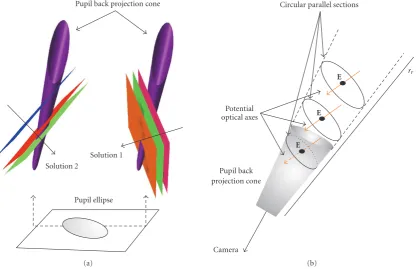
Figure7: (a) Multiple solutions collected in two possible orientations; (b) each plane intersects the cone in a circle resulting in an optical axis crossing its centerE.
of the models based on collections of features consisting of points and shapes. Among the features consisting of a point, it is of no great interest to select the center of the pupil since considering the pupil ellipse as a working feature already in-troduces this feature in the model.
(a) The pupil ellipse and glint
Once again and in order to simplify the analysis, we can de-duce a 3D line, that is,rr, by means of the back projection of
the glint in the image, that is,g, which is supposed to con-tain an approximation ofC. The back projection of the pupil ellipse would be a cone, that is, back projection cone, and it could be assured that there is at least one plane that in-tersects the cone in a circular section containing the pupil. The matter to answer is actually the number of possible cir-cular section planes and consequently the number of possi-ble solutions that can be obtained from a single ellipse in the image. The theory about conics claims that parallel intersec-tions of a quadric result in equivalent conic secintersec-tions. In the case under study, considering the back projection cone as a quadric, it is clear that if we find a plane with a circular sec-tion for the specific quadric, that is, back projecsec-tion cone, an infinite number of pupils of different sizes could be defined employing intersecting parallel planes. Moreover for the case under analysis, that is, back projection cone of the pupil, the analysis carried out provides two possible solutions, or more specifically two possible orientations for planes result-ing in circular sections of the cone. In summary, two groups of an infinite number of planes can be calculated, each of
them intersecting the back projection cone in a circular shape and containing a suitable solution for the gaze estimation problem (seeFigure 7(a)). The theory used to arrive at the conclusion can be found in the work by Hartley and Zis-serman [25] and more specifically in the book by Montes-deoca [26] and is summarized in the appendix. Each possi-ble intersection plane of the cone determines a pupil center E and an optical axis that is calculated as the 3D line per-pendicular to the pupil plane that crosses its centerE (see
Figure 7(b)). It can be verified that the resulting pupil cen-ters for alternative parallel planes belong to the same 3D line [26].
Givenrr, the solution is deduced if the distance between
the center of the pupilEand the corneal centerCis known or calibrated as will be explained later. The pupil plane for which the optical axis meets therrline at the known distance
fromEwill be selected as a solution. In addition, the inter-section between the optical axis and therr line will be the
corneal centerC.
Camera Optical axis 1
Solution 1 E1
C1
Solution 2
E2
C2 Choice at correct
distance
Optical axis 2
rr Cone
Figure8: One of the solutions assumes that the cornea is closer to the camera than the pupil center, which represents a nonvalid solution.
looking at the screen [18].Figure 8shows the inconsistency of the second solution (C2−E2) in its planar version.
(b) The pupil ellipse and multiple glints
It is already known that the combination of two glints and the center of the pupil provides a solution to the tracking prob-lem (seeSection 3.1.1(b)). Therefore, at least the same result is expected if the pupil ellipse is considered since it contains the value of the center. In addition, the preceding section showed that the ellipse and one glint were enough to sketch the gaze, so only a system performance improvement can be expected if more glints are employed. The most outstanding difference amongst models with one or multiple glints is the fact that employing the information provided exclusively by the glints, the corneal center can be accurately determined. The known point Cmust be located in one of the optical axes calculated from the circular sections and crossing the corresponding centerE, and consequently the data about the distance betweenCandE, that is,h, can be ignored.
3.2. Refraction analysis
The models selected inSection 3.1are the model based on thepupil centerandtwo glints, the model based on thepupil shapeandone glint, and the model based on thepupil shape
and two glints. The refraction is going to modify the ob-tained results and add new limitations to the model. For a practical setup, a subject located at 500 mm from the camera with standard eyeball dimensions, looking at the origin of the screen (17), that is, (0,0) point, the difference in screen
Pupil image
O
Virtual pupils
Projection cone
E
C Refracted rays
Real pupil Cornea
Figure9: The cornea produces a deviation in the direction of the light reflected back in the retina due to refraction. The consequence is that the obtained image is not the simple projection of the real pupil but the projection of a virtual shape. Each dotted shape in the projection cone produces the same pupil image and can be consid-ered as a virtual pupil.
coordinates whether considering refraction or not, that is, thinking of the image as a plain projection of the pupil in the image plane, is∼26.52 mm, which represents a considerable error (>1◦). Obviating refraction can result in non acceptable errors for a gaze tracking system and consequently its effects must be introduced in the model.
It must be assumed that a ray of light coming from the back part of the eye suffers a refraction and consequently a deviation in its direction when it crosses the corneal surface due to the fact that the refraction indices inside the cornea and the air are different. The obtained pupil image can be considered as the projection of a virtual pupil and any par-allel shape in the projection can be considered as a possible virtual pupil as it is not physically located in 3D space. In fact, there is an infinite number of virtual pupils.Figure 9 il-lustrates the deviation of the rays coming from the back part of the eye and the so-called virtual pupil.
The opposite path could be studied; a point belonging to the pupil contour in the image could be back projected by means of the projection center of the camera. It is assumed that the back-projection ray will intersect the cornea at a cer-tain point and employing the refraction law, the path of the ray coming into the cornea could be deduced. That should intersect a point of the real pupil contour. The refraction af-fects each ray differently. After refraction, the collection of lines does not have a common intersection point or vertex and the cone loses its reason to exist when refraction is con-sidered.
the preceding paragraph could be applied at any point ofrr.
Consequently, the model based on the pupil shapeandthe glint fails this analysis since it does not accomplish a pre-vious determination of the corneal center. Contrary to this model, the one based on thepupil centerandtwo glintsmakes a prior computation of the corneal center; however, it can no longer be assumed that the center of the real pupil is the one contained inrm, but it is the center of the virtual pupil.
One could expect thatEwill be contained in a 3D line ob-tained as a consequence of the refraction ofrmwhen crossing
the cornea. This statement is unfortunately not true, since re-fraction through a spherical surface is not a linear transfor-mation. The paper by Guestrin and Eizenman [20] implicitly assumes this approximation as correct; that is, it assumes that the image of the pointEis the center of the pupil image. This is strictly not correct since the distances between points be-fore and after refraction through a spherical surface are not proportional. Moreover, if this approximation is considered, that is, the image of the center is the center of the image, the errors for the tracking system are>1◦ at some points. This error, as expected, depends strongly on the setup values of the gaze tracking session and can be compensated by means of calibration, but considering our objective of a geometrical description of the gaze estimation problem, this error is not acceptable in a theoretical stage for our model requirements. The model based ontwo glintsandthe shape of the pupil
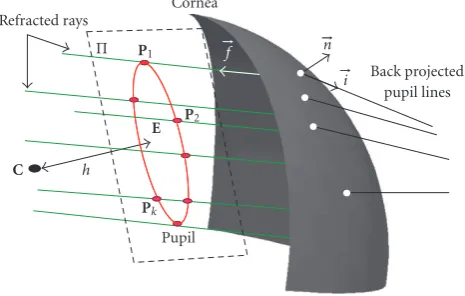
provides the most accurate solution to the matter. The model deduces the value ofCemploying exclusively the two glints of the image. Considering refraction, it is already known that the back-projected shape suffers a deformation at the corneal surface. The center of the pupil should be a point at a known distanced(C,E)= hfromCthat represents the center of a circle whose perimeter is fully contained in the refracted lines of the pupil, and perpendicular to the line connecting pupil and corneal centers. Mathematically, this can be described as follows. First, the corneal center C is estimated assuming that rcis known (seeSection 3.1.1(b)).
(i) The pupil contour in the image is sampled to obtain the set of pointspk k = 0,. . .,N. Each point can be
back projected through the camera projection center O and the intersection with the corneal sphere cal-culated as I(pk). From Snell’s Law, it is known that nasinδi = nbsinδf, wherenaandnbare the
refrac-tive indices of air and the aqueous humour in contact with the back surface of the cornea (1.34), meanwhile δi and δf are the angles of the incident and the
re-fracted rays, respectively, with respect to the normal vector of the surface. Considering this equation for a point of incidence in the corneal surface, the refraction can be calculated as (see [27])
fpk= na nb
ipk−
ipk·npk
+ na nb 2
−1 +ipk·npk 2
npk
,
(5)
wherefpk is the unit vector of the refracted ray at the point of incidence I(pk), ipk represents the unit vec-tor of the incident ray from the camera pointing to
Pupil
C h
Pk
E P2 P1 Π Refracted rays Cornea − → f −→ i − →n Back projected pupil lines
Figure10: Cornea and pupil after refraction.Eis the center of a circumference formed by the intersections of the planeΠwith the refracted rays. The planeΠis perpendicular to (C−E) and the dis-tance between pupil and corneal centers ish.
I(pk), andnpkis the normal vector at that certain point on the cornea. In this manner, for each pointpk of
the image, the corresponding refracted line with di-rectionfpkcontaining pointI(pk) is calculated, where k=0,. . .,N.
(ii) The pupil will be contained in a planethat has (C− E) as normal vector having a distance ofd(C,E)= h with respect toC. Given a 3D pointx=(x,y,z) with respect to the camera, the planeΠcan be defined as
(C−E)
h .(x−C) +h=0. (6)
(iii) Once is defined, the intersection of the refracted lines fpk can be calculated, using (5) and (6), and a set of points can be determined asPk,k=0,. . .,N. The
ob-tained shape fitted to the points must be a circumfer-ence with its center inE:
dP1,E
=dP2,E
= · · · =dPk,E
. (7)
The pupil center E is solved numerically using equa-tions like (7) to find out the constrained global optima (see
Figure 10). The nonlinear equations are given as constraints of a minimization algorithm employing the iterative Nelder-Mead (simplex) method. The objective function is the dis-tance of thePkpoints to the best fitted circumference. The initial value for the point Eis the corneal centerC. Theo-retically, three lines are enough in order to solve the prob-lem since three points are enough to determine a circle. But in practice, more lines (about 20) are considered in order to make the process more robust.
us to calculate LoS direction with respect to the camera by means of the Euclidean coordinate transformation:
C+RαRθϕ∗vT, (8)
whereRθϕis the rotation matrix calculated as a function of the vertical and horizontal rotations of vector (C−E) with respect to the camera coordinate system andRα represents
the rotation matrix of the needed torsion around the optical axis to deduce final eye orientation. The computation of the PoR as the intersection of the gaze line with the screen plane is straightforward.
3.3. Sensitivity analysis
From the prior analysis, the model based on two glints and the shape of the pupil appears as the only potential model for the gaze tracking system. In order to evaluate it exper-imentally, the influence of some effects that appear when a real gaze tracking system is considered such as certain intrin-sic tolerances and noise of the elements composing the eye tracker needs to be introduced.
Firstly, effects influencing the shape of the pupil such as noise and pixelization have been studied. The pixelization ef-fect has been measured using synthetic images. Starting from elliptical shapes, images of size 200×200 have been assumed. A pixel size of 13 ×13μm is selected to discretize the el-lipse according to the image acquisition device to be used in the experimental test (Hamamatsu C5999). The noise has been estimated as Gaussian from alternative images captured by the camera employing well-known noise estimation tech-niques [28]. This noise has been introduced in previously discretized images. The obtained PoR is compared before and after pixelization and before and after noise introduction. The conclusion shows that a deviation in the PoR appears, but the system can easily assume it since in the worst case and taking into account both contributions, it remains un-der acceptable limits for gaze estimation (≤0.05◦).
The reduced size of the glint in the image introduces cer-tain indetermination in the position of the corneal reflection and consequently in the corneal center computation. The glint can be found with alternative shapes in the captured images. The way to proceed is to select a collection of real glints, extracted from real images acquired with the already known camera. The position of the glint center is calculated employing two completely different analysis methods. The first method extracts a thresholded contour of the glint and estimates its center as the center obtained after fitting such a border to an ellipse [13]. The second method binarizes the image with a proper threshold and calculates the gravity cen-ter of the obtained area. Images from different users and ses-sions have been considered for the analysis and the differ-ences between the glint values employing the two alternative methods have been computed to extract consistent results about the indetermination of the glint. The obtained results show that, on average, an indetermination of∼0.1 pixel can be expected for the center of the glint in eye images for dis-tances below 400 mm from the user to the camera, but it rises to∼0.2 pixel when the distance increases, leading the model to nonacceptable errors (>1◦).
7 (0, 355)
6 (177.5, 355)
5 (355, 355) 17
(27, 277) 13 (100, 255)
12 (255, 255)
16 (328, 277) 8
(0, 177.5)
9
(177.5, 177.5) (355, 177.5)4 14
(27, 78) 10
(100, 100)
11
(255, 100) 15
(328, 78) 1
(0, 0)
2 (177.5, 0)
3 (355, 0)
Figure11: Test sheet.
To reduce the sensitivity to glint indetermination, larger illumination sources can be employed, by means of arrays of illuminators. One interesting solution to explore, which has been adopted by this study, is to increase the number of illu-mination sources to obtain an average value for the pointC. It is already known that two glints can determine the center of the cornea, when the locations of the illumination sources are known. In this manner, if more than two illuminators are employed, alternative pairs can be used to estimate the pursued point and the calculated average. An increase in the number of LEDs is supposed to reduce the sensitivity of the model.
4. EXPERIMENTAL RESULTS
Ten users were selected for the test. The working distance was selected in the range of 400–500 mm from the cam-era. They had little or no experience with the system. They were asked to fixate each test point for a time. Figure 11
Figure12: The LEDs are attached to the inferior and lateral borders of the test area.
Glint extraction
Captured image
Pupil border extraction
1 4 3 2
Figure13: Analysis carried out.
The constructed model presents the following require-ments.
(i) The camera must be calibrated [29].
(ii) Light source and screen positions must be known with respect to the camera [18].
(iii) The subject eyeball parametersrc,β, andh must be
known or calibrated.
The images have been captured with a calibrated Hama-matsu C5999 camera and digitalized by a Matrox Meteor card with a resolution of 640 × 480 (RS-170). The LEDs used for lighting have a spectrum centered at 850 nm. The whole system is controlled by a dual processor Pentium at 1.7 GHz with 256 MB of RAM. Four LEDs were selected to produce the needed multiple glints. They were located in the lower part and its positions with respect to the camera calculated ((−189.07,−165.5) mm, (−77.91,−187.67) mm, (98.59,−191.33) mm, and (202.48,−152.78) mm), which re-duces considerably the misleading possibility of partial oc-clusions of the glints by eyelids when looking at different points of the screen because in this way the glints in the im-age appear in the lower pupil half.Figure 12shows a frontal view of the LEDs area.
The images present a dark pupil and four bright glints as shown inFigure 13. The next step was to process each im-age separately to extract the glints coordinates [30] and the
contour of the pupil. It is not the aim of this paper to dis-cuss the image processing algorithms used, distracting the reader from the main contribution of the work, that is, the mathematical model. The objective of the experimental tests was to confirm the validity of the constructed model. To this end, the analysis of the images was supervised to minimize the influence of the results of possible errors due to the im-age processing algorithms used. The glints were supervised by checking the standard deviation of each glint center po-sition among the ten images for each subject’s fixation, and exploring more carefully those cases for which the deviation exceeded a certain threshold. For the pupil, deviations on the ellipse parameters were checked in order to find inconsisten-cies among the images. The errors were due to badly focused images, subject’s large movement, or partially occluded eyes. These images were eliminated from the analysis to obtain re-liable conclusions.
Once the hardware was defined and in order to apply the constructed model based on the shape of the pupil and glints positions, some individual subject eyeball characteris-tics need to be calculated, that is,rc,β, andh. To this end, a
calibration was performed. The constructed model based on multiple glints and pupil shape permits, theoretically, deter-mining this data by means of a single calibration mark and applying the model already described inSection 3. Giving the PoR as the intersection of the screen and LoS, model equa-tions, that is, (2)–(4) and (6)–(8), can be applied to find the global optima for the parameters that minimize the diff er-ence between model output and real mark position. Together with the parameter values, the positions ofCandEwill be es-timated for the calibration point. InFigure 14, the steps for the subject calibration are shown.
In practice and to increase confidence in the obtained values, three fixations were selected for each subject to es-timate a mean value for eye parameters. For each subject, the three points with lower variances in the extracted glint po-sitions were selected for calibration. Each point among the three permits estimating values forh,β, andrc. The personal
eyeball parameters for each subject are given as the average of the values obtained for the selected three points. The per-sonal values obtained for the ten users are shown in Tables
1and2. It is evident that the sign of the angular offset was
directly related to the eye used for the test. Since the model was constructed for the left eye, it is clear that a negative sign indicates that the subject used the right eye to conduct the experiment.
Once the system and the subject were calibrated, the per-formance of the model was tested for two, three, and four LEDs.Figure 15shows the results obtained for users 1–5. For each subject, black dots represent the real values for the fix-ations. The darkest points show results obtained with four LEDs. The lightest ones are the estimations by means of three LEDs. The rest show the estimations of the model using two LEDs.Figure 16exhibits the same results for users 6–10.
1 calibration point Image features: - Glints positions - Pupil elipse
Calibration Subject parameters
rc,β,h
Model defined for
the subject Gaze estimation Model HW calibrated
Figure14: The personal calibration permits us to extract the physical parameters of the subject’s eyeball using one calibration point, the captured image, and gaze estimation model information.
Table1: Values for eyeball parameters obtained for subjects 1–5 by means of calibration, using three calibration points.
Subject 1 2 3 4 5
rc 9.334±0.83 9.103±0.97 9.544±0.88 9.875±0.79 9.673±1.03
h 5.034±0.83 4.730±0.68 5.270±0.41 5.565±0.20 4.581±0.97
β 6.25±0.76 4.15±0.65 −4.49±0.54 −3.36±0.31 −5.16±0.92
under the monitor. When the camera is located under the monitor, the eye rotation increases and the refraction points move toward the peripheral area of the cornea. In these cases, system accuracy may decrease. A simulation is made with a standard eyeball to evaluate the influence of refraction for the points selected by using the model without refraction. The average error for the points selected is∼3◦, which ex-ceeds the limit of 1◦, and the highest error∼5◦appears for the most extreme points in the corners for which the refrac-tion effects increase. Consequently, it is necessary to consider refraction for the selected distribution of points in the model. It is clear that the errors due to refraction would increase for cases in which larger eye rotations were accomplished, for ex-ample, when the camera is located under the monitor (error for the corner points is∼8◦). In Figures15and16, we can-not find significant differences between the error for corner points and the rest; in other words, if the model could not take into account refraction adequately, higher errors should be expected for the corners. In conclusion, the accuracy does not depend on eye rotation and the model is not affected by an increase of refraction effect since it is compensated.
The aim ofTable 3is to show a quantitative evaluation of the model competence for two, three, and four LEDs. For each subject, the average error for the 17 fixation marks was calculated in visual degrees since this is the most significative measurement of the model performance.
It is clear that the model with four LEDs presents the low-est errors. On average, the model with two LEDs presents an error of 1.08◦, the model with three LEDs presents 0.89◦, and the model with four LEDs presents 0.75◦. Therefore, it can be said that, on average, the models with three and four LEDs render acceptable accuracy values. As expected, an increase in the number of illumination sources results in an improve-ment of the system tracking capacity.
5. CONCLUSIONS
The intrinsic connection between the captured image from the eye and gazed point has been explored. A model for a video-oculographic gaze tracking system has been
con-structed. A model is understood as a mathematical connec-tion between the point on a screen the subject is looking at and the variables describing the elements of the system to-gether with the data extracted from the image. The objec-tive was not to find the most robust system but to find out the minimal features of the image that are necessary to solve the gaze tracking problem in an acceptable way. It has been demonstrated that the model based on the pupil shape and multiple glints allows for a competent tracking and matches the pursued requirements, that is, permits free head move-ment, has minimal calibration requiremove-ment, and presents an accuracy in the range of the already existing systems with longer calibrations and more restrictions for the head. The-oretically, once the hardware has been calibrated, one point is enough for personal calibration. In addition, the minimal hardware needed by the system is also determined, that is, one camera and multiple infrared light sources.
The objective has been mainly to give some enlighten-ment to this aspect of gaze tracking technology. The accom-plished work has reviewed the alternative mathematical as-pects of these systems in depth, providing a basis that can allow technologists to carry out theoretical studies on gaze tracking systems behavior. The obtained conclusions pro-vide valid guidelines to construct more robust trackers, to in-crease its possibilities, or to reduce calibration processes. Re-garding eye tracking technology, developing new image pro-cessing techniques to reduce systems sensitivity to light vari-ations and increase system robustness is one of the most im-portant working areas. However, together with this, explor-ing the mathematical and geometrical connections involved in video-oculographic systems appears as a promising and attractive research line to improve their performance from the root.
APPENDIX
The most simple definition for a quadric would be that it can be considered as a geometric place (curve or sur-face) in P3(R) with an equation of second degree.
User 1
(a)
User 2
(b)
User 3
(c)
User 4
(d)
User 5
(e)
User 6
(a)
User 7
(b)
User 8
(c)
User 9
(d)
User 10
(e)
Table2: Values for eyeball parameters obtained for subjects 6–10 by means of calibration, using three calibration points.
Subject 6 7 8 9 10
rc 9.123±0.82 9.567±1.10 9.765±1.22 9.842±0.87 9.665±0.98
h 5.887±0.67 4.003±1.02 4.743±0.55 5.342±0.66 4.557±0.71
β −4.33±0.42 −5.63±0.70 6.89±0.43 5.65±0.65 −4.78±0.83
Table3: Error quantification (degree) of the final model using two, three, and four LEDs for ten users.
Subject 1 2 3 4 5 6 7 8 9 10
2 LEDs 1.47 0.85 1.46 0.90 0.92 0.97 1.24 0.78 1.19 1.06
3 LEDs 1.06 0.80 1.35 0.58 0.75 0.78 1.20 0.79 0.74 0.86
4 LEDs 1.04 0.76 1.01 0.62 0.72 0.71 0.62 0.65 0.59 0.80
the theory points out that a quadric can be expressed as f((x0,x1,x2,x3))=3
i,j=0ai jxixj=0,ai j=aji.
The definition of the absolute conic lying on the plane at infinity isx0 = 0;3
i=0(xi) 2
= 0 and is the place of all the cyclic sections of the planes in space, where a cyclic sec-tion of a quadric is defined as a planar secsec-tion of the quadric that is a circumference. Consequently, the intersection of a quadric with the absolute conic is a circumference. From this point of view, the mathematical solution of this intersection finds out the direction of the parallel planes or sets of parallel planes that intersect the quadric with a circular shape since these must match the same orientations found for the result-ing conic at infinity. In summary, to find out the planes of circular section of a quadric, the following equation must be solved:
3
i,j=0
ai jxixj=λ 3
i=0
xi2=0, x0=0. (A.1)
For the specific case of the imaged pupil in the gaze tracking system, the corresponding quadric is a cone defined as
1 m2
z
−z2+ϑ1 b2 +
ϑ2 a2
=0, (A.2)
where
ϑ1=
mzy−myz
cosσ+−mzx+mxz
sinσ2,
ϑ2=
mzx−mxz
cosσ+mzy+myz
sinσ2.
(A.3)
This is the equation of a cone whose vertex is located in the origin of the system of coordinates (x,y,z) in the cam-era projection center, with an elliptical basis, rotated with respect to the image plane axes. In the preceding equation, (mx,my,mz) represents the center of the ellipse in the image
with respect to the camera projection center. It is clear that mz = −f, that is, the focal distance of the camera. On the
other hand, it is already known thata andb represent the semimajor and semiminor axes lengths, respectively. Finally, σ describes the orientation of the ellipse with respect to the image plane axes.
Therefore, the objective would be to find out the values ofλthat result in a plane matching the equation [26]
1 m2
z
−z2+ϑ1 b2
+ϑ2 a2
=λx2+y2+z2. (A.4)
A solution in form of a plane or collection of planes is pur-sued. Ifyis extracted, two possible solutions are found:
y=χ1± √χ3 χ2
, (A.5)
where
χ1=
a2+b2m
ymzz+ (a−b)(a+b)mz
×myzcos 2σ+
mzx−mxz) sin 2σ
,
χ2=2m 2 z
a2cos2σ+b2−a2λ+ sin2σ, χ3=b0x2+b1z2+b2xz,
b0= −4a2b2m2z
−1 +a2λ−1 +a2λ, b1=2a2b2
a2+b2−2m2
x−2a2b2λ
+a2m2
xλ+b2m2xλ+a2m2yλ+b2m2yλ
+a2m2
zλ+b2m2zλ−2a2b2m2zλ2
−a2−b2−1 +m2
xλ−m2yλ−m2zλ
×cos 2σ−2a2−b2m
xmyλsin 2σ
, b2=2a2b2
−2mxmz
−2 +a2+b2λ + 2a−ba+bmzλ
mxcos 2σ+mysin 2σ
.
(A.6)
In order to have a plane of the formPxx+Pyy+Pzz+po,χ3
should have the form (b0x+
b1z)
2
or (b0x−
b1z)
2
. Ifχ3=(
b0x+
b1z)
2
, we have
b0x+
b1z
2
=b0x2+b1z2+ 2
b0b1xz (A.7)
and consequently
2b0b1=b2. (A.8)
On the other hand, ifχ3 =(
b0x+
b1z)
2
, we arrive at the result
Depending on the setup of the system, (5) or (6) need to be solved in order to obtain the corresponding values for λ. Each equation renders four possible values for the un-known. However, as expected, just one provides nonimagi-nary solutions. This value forλarises in two possible planes as shown in (4), or more specifically in two possible orien-tations for planes resulting in circular sections of the cone. Once (Px,Py,Pz) have been calculated as the normal vector
for a particular orientation of a plane, additional solutions could be found, varyingPo in order to determine parallel
planes with equivalent solutions.
REFERENCES
[1] R. Jacob, “The use of eye movements in human-computer in-teraction techniques: what you look at is what you get,”ACM Transactions on Information Systems, vol. 9, no. 2, pp. 152–169, 1991.
[2] K. Kohzuki, T. Nishiki, A. Tsubokura, M. Ueno, S. Harima, and K. Tsushima, “Man-machine interaction using eye move-ment,” inProceedings of the 8th International Conference on Human-Computer Interaction: Ergonomics and User Interfaces (HCI ’99), vol. 1, pp. 407–411, Munich, Germany, August 1999.
[3] W. Teiwes, M. Bachofer, G. W. Edwards, S. Marshall, E. Schmidt, and W. Teiwes, “The use of eye tracking for human-computer interaction research and usability test-ing,” in Proceedings of the 8th International Conference on Human-Computer Interaction: Ergonomics and User Interfaces (HCI ’99), vol. 1, pp. 1119–1122, Munich, Germany, August 1999.
[4] J. Merchant, R. Morrissette, and J. L. Porterfield, “Remote measurement of eye direction allowing subject motion over one cubic foot of space,”IEEE Transactions on Biomedical En-gineering, vol. 21, no. 4, pp. 309–317, 1974.
[5] LC Technologies, “Eyegaze Systems,” McLean, Va, USA,http:// www.eyegaze.com/.
[6] Applied Science Laboratories, Bedford, Mass, USA, http:// www.a-s-l.com/.
[7] Eyetech Digital Systems, Mesa, Ariz, USA, http://www .eyetechds.com/.
[8] Tobii Technology, Stockholm, Sweden,http://www.tobii.se/. [9] A. Tomono, M. Iida, and Y. Kobayashi, “A TV camera system
which extracts feature points for noncontact eye-movements detection,” inOptics, Illumination and Image Sensing for Ma-chine Vision IV, vol. 1194 of Proceedings of SPIE, pp. 2–12, Philadelphia, Pa, USA, November 1989.
[10] D. H. Yoo and M. J. Chung, “Non-intrusive eye gaze estima-tion without knowledge of eye pose,” inProceedings of the 6th IEEE International Conference on Automatic Face and Gesture Recognition (FGR ’04), pp. 785–790, Seoul, Korea, May 2004. [11] S.-W. Shih and J. Liu, “A novel approach to 3-D gaze tracking
using stereo cameras,”IEEE Transactions on Systems, Man, and Cybernetics, Part B, vol. 34, no. 1, pp. 234–245, 2004.
[12] Z. Zhu and Q. Ji, “Eye gaze tracking under natural head move-ments,” inProceedings of IEEE Computer Society Conference on Computer Vision and Pattern Recognition (CVPR ’05), vol. 1, pp. 918–923, Diego, Calif, USA, June 2005.
[13] D. Beymer and M. Flickner, “Eye gaze tracking using an ac-tive stereo head,” inProceedings of the IEEE Computer
Soci-ety Conference on Computer Vision and Pattern Recognition (CVPR ’03), vol. 2, pp. 451–458, Madison, Wis, USA, June 2003.
[14] X. L. C. Brolly and J. B. Mulligan, “Implicit calibration of a remote gaze tracker,” inProceedings of the IEEE Computer So-ciety Conference on Computer Vision and Pattern Recognition Workshops (CVPR ’04), p. 134, Washington, DC, USA, June-July 2004.
[15] T. Ohno and N. Mukawa, “A free-head, simple calibration, gaze tracking system that enables gaze-based interaction,” in Proceedings of the Symposium on Eye Tracking Research & Ap-plications (ETRA ’04), pp. 115–122, San Antonio, Tex, USA, March 2004.
[16] D. W. Hansen and A. E. C. Pece, “Eye tracking in the wild,” Computer Vision & Image Understanding, vol. 98, no. 1, pp. 155–181, 2005.
[17] J.-G. Wang, E. Sung, and R. Venkateswarlu, “Eye gaze estima-tion from a single image of one eye,” inProceedings of the 9th IEEE International Conference on Computer Vision (ICCV ’03), vol. 1, pp. 136–143, Nice, France, October 2003.
[18] A. Villanueva, Mathematical models for video oculography, Ph.D. thesis, Public University of Navarra, Pamplona, Spain, 2005.
[19] C. Hennessey, B. Noureddin, and P. Lawrence, “A single cam-era eye-gaze tracking system with free head motion,” in Pro-ceedings of the Symposium on Eye Tracking Research & Appli-cations (ETRA ’05), pp. 87–94, San Diego, Calif, USA, March 2005.
[20] E. D. Guestrin and M. Eizenman, “General theory of remote gaze estimation using the pupil center and corneal reflections,” IEEE Transactions on Biomedical Engineering, vol. 53, no. 6, pp. 1124–1133, 2006.
[21] R. H. S. Carpenter,Movements of the Eyes, Pion, London, UK, 1988.
[22] G. Fry, C. Treleaven, R. Walsh, E. Higgins, and C. Radde, “De-ifinition and measurement of torsion,”American Journal of Optometry and Archives of American Academy of Optometry, vol. 24, pp. 329–334, 1947.
[23] M. R. M. Mimica and C. H. Morimoto, “A computer vi-sion framework for eye gaze tracking,” inProceedings of XVI Brazilian Symposium on Computer Graphics and Image Process-ing (SIBGRAPI ’03), pp. 406–412, S˜ao Carlos, Brazil, October 2003.
[24] C. H. Morimoto and M. R. M. Mimica, “Eye gaze tracking techniques for interactive applications,”Computer Vision and Image Understanding, vol. 98, no. 1, pp. 4–24, 2005.
[25] R. I. Hartley and A. Zisserman, Multiple View Geometry in Computer Vision, Cambridge University Press, Cambridge, UK, 2nd edition, 2004.
[26] A. Montesdeoca, Geometr´ıa Proyectiva C´onicas y Cu´adricas, Direcci ´on General de Universidades e Investigaci ´on. Conse-jer´ıa de Educaci ´on Cultura y Deportes, Gobierno de Canarias, Spain, 2001.
[27] T. Ohno, N. Mukawa, and A. Yoshikawa, “FreeGaze: a gaze tracking system for everyday gaze interaction,” in Proceed-ings of the Symposium on Eye Tracking Research & Applications (ETRA ’02), pp. 125–132, New Orleans, La, USA, March 2002. [28] R. C. Gonzalez and R. E. Woods, Digital Image Processing, Prentice-Hall, Upper Saddle River, NJ, USA, 2nd edition, 2002. [29] J. Boughet, “Camera calibration toolbox for Matlab,”
[30] S. Go˜ni, J. Echeto, A. Villanueva, and R. Cabeza, “Robust algo-rithm for pupil-glint vector detection in a video-oculography eyetracking system,” inProceedings of the 17th International Conference on Pattern Recognition (ICPR ’04), vol. 4, pp. 941– 944, Cambridge, UK, August 2004.