ReseaRch aRticle
P
OTENTIALE
FFECTS OFD
ISTURBANCET
YPES ANDE
NVIRONMENTALV
ARIABILITY ONS
AGEBRUSH-S
TEPPEC
OMMUNITYD
YNAMICSLouisa B. Evers1*, Richard F. Miller2, and Paul S. Doescher3
1 Bureau of Land Management, Oregon State Office, 333 SW First Avenue, Portland, Oregon 97204, USA
2 Oregon State University, Eastern Oregon Agricultural Research Station, 202 Strand Hall, Corvallis, Oregon 97331, USA (emeritus)
3 Oregon State University, Department of Forest Ecosystems and Society, 321 Richardson Hall, Corvallis, Oregon 97331, USA
* Corresponding author: Tel.: 001-503-808-6377; e-mail: [email protected]
ABSTRACT
While fire is widely recognized as an important factor shaping sagebrush (Artemisia spp.) ecosystems, little is known about the role other natural events play in these systems. Using a state-and-transition modeling frame-work in conjunction with the scientific literature and data for climate (tem-perature, precipitation, and snow), soils (soil surveys and ecological site descriptions), and modern fire occur-rence records, we explored how fire and various other natural events might shape sagebrush ecosystems in eastern Oregon, USA, and whether those events could affect fire rotation. Mod-el results suggested other disturbance events were important in shaping all but the most productive sagebrush communities and influenced fire rota-tion in drier sagebrush communities. Insects and pronghorn browsing may have been as important as fire in shap-ing sagebrush-steppe landscapes with freezekill and snow mold locally im-portant. Our study also demonstrated the use of climate, soils, ecological
RESUMEN
Keywords: Artemisia arbuscula, Artemisia tridentata, big sagebrush, climate, fire, little sage-brush, Oregon, reference conditions, state-and-transition, USA
Citation: Evers, L.B., R.F. Miller, and P.S. Doescher. 2013. Potential effects of disturbance types and environmental variability on sagebrush-steppe community dynamics. Fire Ecology 9(2): 57-79. doi: 10.4996/fireecology.0902057
INTRODUCTION
Rarely are multiple disturbances examined to determine how they may interact to shape plant communities. While fire is widely re-garded as the key natural disturbance shaping sagebrush (Artemisia spp.) ecosystems (Con-nelly et al. 2004, Miller et al. 2011), few stud-ies have examined the role of other disturbanc-es or the interactions between thdisturbanc-ese distur-bances and fire. Sagebrush ecosystems pro-vide many important economic and social val-ues in the Intermountain West, such as live-stock forage, water, recreational opportunities, and wildlife habitat. Changes to sagebrush ecosystems over the last 150 years threaten their ability to provide many of these values in the future (Connelly et al. 2004, Miller et al.
2011). Human-related disturbances, invasive species, expansion of conifer woodlands, changes in fire regimes, and changes in climate are a complex group of interacting factors that have reduced the area occupied by sagebrush ecosystems by an estimated 14.8 million ha across the western United States (USDI Bu-reau of Land Management 2004). A better un-derstanding of how other natural events in conjunction with fire might influence the abun-dance of sagebrush community phases would provide a more sound basis for evaluating the sustainability of current practices and their ef-fects on ecosystem services, such as forage and habitat.
State-and-transition modeling frameworks, such as the Vegetation Dynamics Development
Tool (VDDT) (ESSA Technologies 2007), can be used to examine the influence of natural events on the abundance of different plant com-munity types. Since the current state-and-tran-sition modeling frameworks, such as VDDT, are probabilistic instead of mechanistic, they can operate based on a combination of empiri-cal data and expert opinion when empiriempiri-cal data are lacking. Given that climate is an im-portant top-down driver of the types and fre-quencies of disturbance events (Breckle 1999, Chapin et al. 2002, Holechek et al. 2004, Ad -ams 2010), it can be used as a basis for estimat-ing the probability of natural disturbance events within a state-and-transition modeling frame-work. We used VDDT to explore the following questions concerning sagebrush dynamics: 1) what natural disturbance events in addition to fire might be important influences on the pro-portions of different sagebrush community phases (seral stages)?, 2) which natural distur-bances may have greater influence on sage-brush ecosystem dynamics?, and 3) could other natural disturbances also affect fire frequency?
METHODS
Study Area
We selected the 4-million ha Malheur High Plateau major land resource area (USDA Natu-ral Resources Conservation Service 2006) in southeastern Oregon, USA, as the physical ba-sis for model development. Much of the area lies between 1200 m and 2100 m elevation, incidencia de incendios puede ser útil para estimar las probabilidades de diversos eventos naturales, suministrando una aproximación más objetiva para determinar condiciones de referencia.
with a few higher mountains. The rolling ter-rain is interspersed with hills, buttes, isolated mountains, and north-south trending fault-block mountains, and contains little surface water. Soils are primarily loamy to clayey, well-drained and shallow (25 cm to 50 cm) to moderately deep (50 cm to 90 cm) on uplands, and poorly to well-drained and deep to very deep (>90 cm) in valley and basin bottoms. The average annual precipitation ranges from <105 mm in the Alvord Desert to >450 mm on Steens Mountain, but with most of the area re-ceiving 200 mm to 350 mm. Winter and spring are the wettest periods while summer is the driest. January is the coolest month, averaging −2 °C, and July the warmest, averaging 19 °C.
Model Development
We searched the sagebrush literature to lo-cate studies that discussed sagebrush succes-sional rates and establishment episodes, distur-bance events associated with notable sagebrush mortality, and climate factors potentially asso-ciated with all of these. We followed addition-al leads from the references within promising papers. To help identify successional rates, we included studies on the duration of vegetation treatments, such as herbicide use, prescribed fire, and mechanical treatments. Since we were only interested in natural disturbances, we did not include the effects of livestock grazing, invasive plants, or conifer expansion. Although conifer expansion is partially a natu-ral disturbance event with respect to sagebrush, much of the current expansion has been attrib-uted to the effects of past livestock grazing and the resulting impact to fire frequencies, fire suppression, and to increased atmospheric car-bon dioxide concentrations (Romme et al.
2009). In addition, we obtained ecological site descriptions, soil surveys, climate data, and fire occurrence data to use with the results of the literature review.
Sagebrush groups. In developing the sage-brush groups, we assumed that site
productivi-ty was a strong influence on recovery rates. Since fire was the most-studied natural distur-bance in sagebrush-steppe, and because many studies indicated that site productivity is a strong influence on recovery rates following fire (e.g., Harniss and Murray 1973, Boltz 1994, Cook et al. 1994, Lesica et al. 2007, Bollinger and Perryman 2008), we based our indicator of site productivity on fine fuel pro-duction. We used grass production of 672 kg ha-1 as the threshold for these divisions since
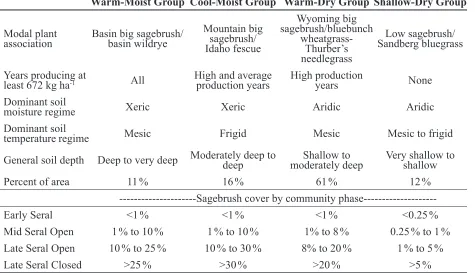
that level of production is considered the mini-mum needed to support fire spread in bunch-grass fuels under moderate burning conditions (Gruell et al. 1986, Bunting et al. 1987). We used ecological site descriptions for the Mal-heur High Plateau (http://esis.sc.egov.usda. gov) to sort sagebrush communities into four groups based on our identified production threshold for low, average, and high productiv-ity years (Table 1), and on soil surveys to fur-ther describe the typical setting for each group.
The Warm-Moist Sagebrush Group (WM Group) occurs mostly in swales, terraces, and near or in riparian areas below 1220 m eleva-tion. The Cool-Moist Sagebrush Group (CM Group) typically occurs on northerly aspects and ridges, but can occur on higher elevation, cooler southerly aspects as well. The Warm-Dry Sagebrush group (WD Group) is found mostly on southerly aspects, well-drained soils, and relatively shallow soils in basin bot-toms and terraces typically in the elevation belt below the CM Group. The Shallow-Dry Sage-brush Group (SD Group) resides on soils with low water storage capacity and high evapora-tion rates that become quite dry by late spring or early summer.
co-Warm-Moist Group Cool-Moist Group Warm-Dry Group Shallow-Dry Group
Modal plant
association Basin big sagebrush/ basin wildrye Mountain big Idaho fescuesagebrush/
Wyoming big sagebrush/bluebunch
wheatgrass-Thurber’s
needlegrass
Low sagebrush/ Sandberg bluegrass
Years producing at
least 672 kg ha-1 All High and average production years High production years None
Dominant soil
moisture regime Xeric Xeric Aridic Aridic
Dominant soil
temperature regime Mesic Frigid Mesic Mesic to frigid
General soil depth Deep to very deep Moderately deep to deep moderately deepShallow to Very shallow to shallow
Percent of area 11 % 16 % 61 % 12 %
---Sagebrush cover by community
phase---Early Seral <1 % <1 % <1 % <0.25 %
Mid Seral Open 1 % to 10 % 1 % to 10 % 1% to 8 % 0.25 % to 1 %
Late Seral Open 10 % to 25 % 10 % to 30 % 8% to 20 % 1 % to 5 %
Late Seral Closed >25 % >30 % >20 % >5 %
Table 1. Characteristics of each sagebrush group including modal potential natural plant community, grass production, and sagebrush cover by community phase. The top portion of the table describes modal site characteristics. The bottom portion of the table identifies sagebrush cover thresholds for the different community phases in each sagebrush group. Scientific names for the community species are given in the footnote.
Note: Characteristics are based on ecological site information for the Malheur High Plateau (available at http://esis. sc.egov.usda.gov), Winward (1991), and Miller and Eddleman (2000).
Scientific names for community species:
Basin big sagebrush= Artemisia tridentata Nutt. ssp. tridentata (Scribn. & Merr.) A. Löve Basin wildrye = Leymus cinereus (Scribn. & Merr.) A. Löve
Mountain big sagebrush = Artemisia tridentata Nutt. ssp. vaseyana (Rydb.) Beetle Idaho fescue = Festuca idahoensis Elmer
Wyoming big sagebrush = Artemisia tridentata Nutt. ssp. wyomingensis Beetle & Young Bluebunch wheatgrass = Pseudoroegneria spicata (Pursh) A. Löve
Thurber’s needlegrass = Achnatherum thurberianum (Piper) Barkworth Low sagebrush = Artemisia arbuscula Nutt.
Sandberg bluegrass = Poa secunda J. Presl
dominate; and 4) Late Seral Closed (LSC), where sagebrush is dominant (Figure 1). A community phase is a distinctive plant com-munity with associated dynamic soil property levels that occur over time (Bestelmeyer et al.
2009) within a state or reference community. We used sagebrush cover and the relative pro-portion of sagebrush and herbaceous vegeta-tion as the primary descriptors for each com-munity phase (Table 1) and ignored sprouting shrubs to simplify model development.
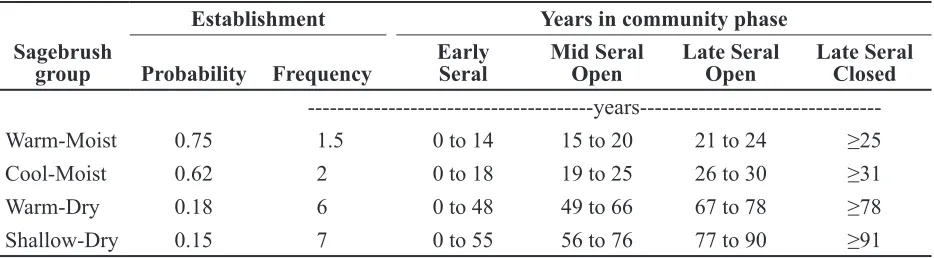
Successional rates. We modeled determin-istic movement through the community phases as a function of sagebrush establishment and expansion of sagebrush cover. We used spring and early summer precipitation and tempera-ture records for Oregon Climate Division 7 to estimate the frequencies of sagebrush estab-lishment episodes (Johnson and Payne 1968, Daubenmire 1975, Boltz 1994, Forman et al.
establish-ment episode. Using crown areas of individual adult sagebrush grown in the wild and in com-mon gardens (Tisdale et al. 1965, McArthur and Welch 1982), we estimated potential crown area for individual wild plants; the crown area of basin big sagebrush (Artemisia tridentata Nutt. ssp. tridentata) represented the WM Group, mountain big sagebrush (A. tri-dentata. Nutt. ssp. vaseyana [Rydb.] Beetle) represented the CM Group, Wyoming big sagebrush (A. tridentata. Nutt. ssp. wyomin-gensis Beetle & Young) represented the WD Group, and low sagebrush (A. arbuscula Nutt.) represented the SD Group. Assuming that a sagebrush seedling took six years to reach physical maturity (McArthur and Welch 1982),
we then calculated the number of years needed to cross from one community phase to another in each sagebrush group (Johnson 1969, Win-ward 1991, Miller and Eddleman 2000, Perry-man et al. 2001, Lesica et al. 2007) (Table 2).
Disturbances. In addition to fire (Knick et al. 2003, Connelly et al. 2004, Knick et al.
2005), our review indicated that drought (Elli-son and Woolfolk 1937, Pechanec et al. 1937, Allred 1941), freezekill (Hanson et al. 1982, Walser et al. 1990), and snow mold (Nelson and Sturges 1986; Sturges 1986, 1989; Sturges and Nelson 1986); as well as herbivory by pronghorn (Antilocapra americana Ord) (Han -sen and Clark 1977, MacCracken and Han-sen 1981, Howard 1995, Verts and Carraway
Sagebrush group
Establishment Years in community phase
Probability Frequency Early Seral Mid Seral Open Late Seral Open Late Seral Closed
---years---Warm-Moist 0.75 1.5 0 to 14 15 to 20 21 to 24 ≥25
Cool-Moist 0.62 2 0 to 18 19 to 25 26 to 30 ≥31
Warm-Dry 0.18 6 0 to 48 49 to 66 67 to 78 ≥78
Shallow-Dry 0.15 7 0 to 55 56 to 76 77 to 90 ≥91
Table 2. Estimated establishment and successional rates (years) in the absence of disturbance.
Note: Establishment parameters based on probabilities of certain climatological conditions in Oregon Climate Divi-sion 7. Years in each community phase based on establishment frequency and estimates of canopy closure derived from the literature.
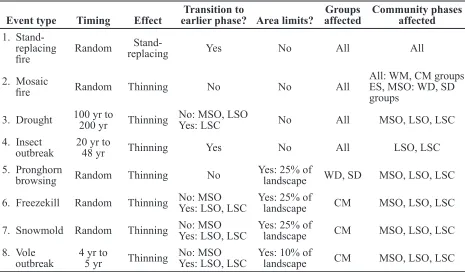
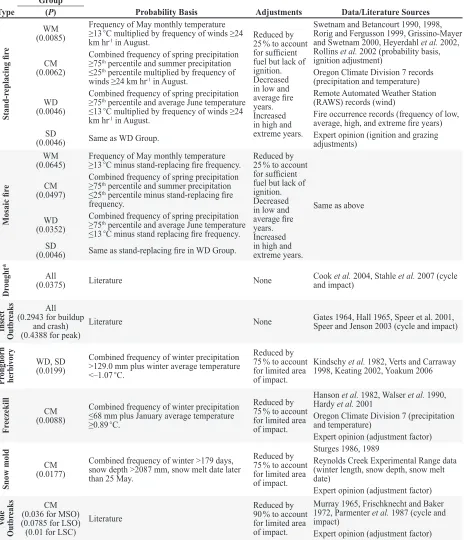
1998), voles (Microtus spp.) (Hubbard and McKeever 1961, Mueggler 1967), and aroga moth (Aroga websteri Clarke) (Allred 1941, Gates 1964, Hall 1965, Welch 2005) have caused notable sagebrush mortality. Our re-view of the sagebrush literature helped us to develop estimates of the frequency, severity, and extent of those events, and what climate indicators might be associated with event fre-quency (Table 3 and Table 4). Based on the nature of the climate association, we modeled fire, pronghorn browsing, freezekill, and snow mold as random events. The only clearly doc-umented drought-related mortality of sage-brush occurred during the 1930s drought
(Elli-son and Woolfolk 1937, Pechanec et al. 1937); therefore, we used the estimated frequency of such droughts (Keen 1937, Graumlich 1987, Cook et al. 2004), treating it as a cyclical event given the ties of severe drought to various ocean-atmosphere teleconnections (Cayan et al. 1998, Knapp et al. 2004, Michels et al.
2007). The literature for aroga moth was too sparse to characterize the frequency and causes of outbreaks, therefore we used the literature from pandora moth (Coloradia pandora Blake) as a surrogate to estimate the frequency and size of outbreaks. Since the literature on forest defoliators indicated that outbreaks have no clear ties to climate (Meyers 1988, Cooke and
Event type Timing Effect earlier phase? Area limits?Transition to affectedGroups Community phases affected 1.
Stand-replacing
fire Random
Stand-replacing Yes No All All
2. Mosaic
fire Random Thinning No No All
All: WM, CM groups ES, MSO: WD, SD
groups
3. Drought 100 yr to 200 yr Thinning No: MSO, LSOYes: LSC No All MSO, LSO, LSC
4. Insect
outbreak 20 yr to 48 yr Thinning Yes No All LSO, LSC
5. Pronghorn
browsing Random Thinning No Yes: 25% of landscape WD, SD MSO, LSO, LSC
6. Freezekill Random Thinning No: MSOYes: LSO, LSC Yes: 25% of landscape CM MSO, LSO, LSC
7. Snowmold Random Thinning No: MSOYes: LSO, LSC Yes: 25% of landscape CM MSO, LSO, LSC
8. Vole
outbreak 4 yr to5 yr Thinning No: MSOYes: LSO, LSC Yes: 10% of landscape CM MSO, LSO, LSC
Table 3. General description of event types included in all models and their effects. Drought timing and effects based on Cook et al. 2004, and Stahle et al. 2007. Insect outbreak timing and effects based on
Gates 1964, Hall 1965, Hsaio 1986, Speer et al. 2001, Speer and Jenson 2003, and N.L. Hampton (Idaho
National Lab, unpublished manuscript). Pronghorn browsing effects based on Smith 1949, McArthur et al.
1988, Bilbrough and Richards 1993, and Hoffman and Wambolt 1996. Freezekill effects based on Hanson
et al. 1982, Walser et al. 1990, and Hardy et al. 2001. Snow mold effects based on Sturges 1986 and 1989.
Vole outbreak timing and effects based on Murray 1965, Frischknecht and Baker 1972, and Parmeter et al.
1987.
Type Group(P) Probability Basis Adjustments Data/Literature Sources Stand-r eplacing fir e WM (0.0085)
Frequency of May monthly temperature ≥13 ◦C multiplied by frequency of winds ≥24
km hr-1 in August. Reduced by 25 % to account
for sufficient fuel but lack of ignition. Decreased in low and average fire years. Increased in high and extreme years.
Swetnam and Betancourt 1990, 1998, Rorig and Fergusson 1999, Grissino-Mayer and Swetnam 2000, Heyerdahl et al. 2002,
Rollins et al. 2002 (probability basis, ignition adjustment)
Oregon Climate Division 7 records (precipitation and temperature) Remote Automated Weather Station (RAWS) records (wind)
Fire occurrence records (frequency of low, average, high, and extreme fire years) Expert opinion (ignition and grazing adjustments)
CM
(0.0062)
Combined frequency of spring precipitation ≥75th percentile and summer precipitation
≤25th percentile multiplied by frequency of
winds ≥24 km hr-1 in August.
WD
(0.0046)
Combined frequency of spring precipitation ≥75th percentile and average June temperature
≤13 ◦C multiplied by frequency of winds ≥24
km hr-1 in August.
SD
(0.0046) Same as WD Group.
Mosaic fir
e
WM
(0.0645) Frequency of May monthly temperature ≥13 ◦C minus stand-replacing fire frequency. Reduced by 25 % to account for sufficient fuel but lack of ignition. Decreased in low and average fire years. Increased in high and extreme years.
Same as above
CM
(0.0497)
Combined frequency of spring precipitation ≥75th percentile and summer precipitation
≤25th percentile minus stand-replacing fire
frequency.
WD
(0.0352)
Combined frequency of spring precipitation ≥75th percentile and average June temperature
≤13 ◦C minus stand replacing fire frequency.
SD
(0.0046) Same as stand-replacing fire in WD Group.
Dr
ought* (0.0375)All Literature None Cook and impact)et al. 2004, Stahle et al. 2007 (cycle
Insect
Outbr
eaks (0.2943 for buildup All and crash) (0.4388 for peak)
Literature None Gates 1964, Hall 1965, Speer et al. 2001, Speer and Jenson 2003 (cycle and impact)
Pr
onghorn
herbivory
WD, SD
(0.0199)
Combined frequency of winter precipitation >129.0 mm plus winter average temperature <–1.07 ◦C.
Reduced by 75 % to account
for limited area
of impact.
Kindschy et al. 1982, Verts and Carraway 1998, Keating 2002, Yoakum 2006
Fr
eezekill (0.0088)CM
Combined frequency of winter precipitation ≤68 mm plus January average temperature ≥0.89 ◦C.
Reduced by 75 % to account
for limited area
of impact.
Hanson et al. 1982, Walser et al. 1990, Hardy et al. 2001
Oregon Climate Division 7 (precipitation
and temperature)
Expert opinion (adjustment factor)
Snow mold
CM
(0.0177)
Combined frequency of winter >179 days, snow depth >2087 mm, snow melt date later than 25 May.
Reduced by 75 % to account
for limited area
of impact.
Sturges 1986, 1989
Reynolds Creek Experimental Range data (winter length, snow depth, snow melt
date)
Expert opinion (adjustment factor)
Vole
Outbr
eaks (0.036 for MSO)CM (0.0785 for LSO) (0.01 for LSC)
Literature
Reduced by 90 % to account
for limited area
of impact.
Murray 1965, Frischknecht and Baker
1972, Parmenter et al. 1987 (cycle and impact)
Expert opinion (adjustment factor)
Table 4. Factors used to estimate probabilities of the occurrence (random events) or impact (cyclical events) of each type of event. Temperature and precipitation values are based on Oregon Climate Division 7 descriptive statistics for water years 1885 to 1886 through 2007 to 2008. Fire occurrence records cover 1980 to 2006 fire years for Lakeview and Burns Bureau of Land Management districts and Hart Mountain Refuge. Wind frequency is based on 10-minute average wind speeds in August from 12 remote automated weather stations located within the Malheur High Plateau area. Reynolds Creek Experiment Range snow data cover 1967 to 1968 through 1996 to 1997 water years.
Roland 2000, Speer et al. 2001, Speer and Jen-son 2003), we treated aroga moth outbreaks as cyclical. Lastly, vole population peaks have no clear tie to climate (Murray 1965, Frisch-knecht and Baker 1972), so we treated vole outbreaks as cyclical events, although we mod-ified event probability by the frequency of deep snowpacks (Mueggler 1967, Frischknecht and Baker 1972, Parmenter et al. 1987).
We assigned events, timing, effect includ-ing whether the event results in a transition to a different community phase, and any area limitations on the event, to each community phase in each sagebrush group (Table 3). We based each event frequency and adjustment factor on information gleaned from the ture, including what climate factors the litera-ture suggested may be associated with a par-ticular event (Table 4). For example, we esti-mated the probability of any fire in the WD Group by identifying the frequency of a wet spring and cool June (creating sufficient fuel). We multiplied that initial probability by the frequency of high winds in August to estimate the probability of a stand-replacing fire, and then estimated the probability of a mosaic fire by subtracting the probability of a stand-re-placing fire from the initial fire probability. We multiplied both probabilities by 0.75 to ac-count for the presence of sufficient fuel but lack of ignitions (Table 2). Lastly, we included variability in those probabilities based on the frequency of different types of fire years using 1980 to 2006 fire occurrence records for the Burns and Lakeview districts of the Bureau of Land Management and Hart Mountain and Malheur national wildlife refuges; the occur-rence of low and average fire years further re-duces the probability of a fire while the occur-rence of a high or extreme year increases the probability.
Analysis Procedures
Data Sources. We obtained monthly pre-cipitation and temperature data from 1895 to 2009 for Oregon Climate Division 7 (available
at http://www7.ncdc.noaa.gov/CDO/CDODi-visionSelect.jsp) and snow data from 1967 to 1996 for the Reynolds Creek Experimental Range (Hanson et al. 2001, Marks et al. 2001). Although Reynolds Creek Experimental Range lies outside the Malheur High Plateau, it has a climate that is similar; this data set provided detailed information on snowpack not avail-able for Oregon Climate Division 7. We sum-marized monthly and seasonal means (temper-ature) and medians (precipitation) using a tem-perature-based definition of winter and sum-mer that better matches plant phenology and hydrological cycles than the typical 3-month definitions (Neilson et al. 1992). We estimated the mean and standard deviation for snowpack duration, snow depth, and snowmelt date for the highest elevation station on the experimen-tal range.
The user can incorporate variability in the probability of a transition or establish cycles that control the number of years between a given transition type. To incorporate interan-nual variability, we created multipliers that in-creased or dein-creased the probability of fire and pronghorn browsing. These multipliers were based on the estimated percentage of years in different severity categories (low, average, high, and extreme), and a ratio of hectares af-fected in each type of year. In the case of fire, we used the fire occurrence records to estimate the severity categories and number of hectares affected in each category. For pronghorn browsing, we created a very simple model of pronghorn population dynamics based on the literature (Kindschy et al. 1982, O’Gara and Yoakum 2004, Smyser et al. 2006, Yoakum 2006) and estimated the joint probability of a high pronghorn population and severe winter (cold and wet) and assumed pronghorn only used a portion of the landscape during winter. We constrained drought, insect outbreaks, and vole outbreaks to a specified range of years de-fining the maximum and minimum years be-tween outbreaks and duration of each outbreak (ESSA Technologies 2007). We created 50 randomly-generated sets of multipliers over 500 years each for fire, pronghorn browsing, drought, insect outbreaks, and vole outbreaks, saved these in a multiplier file and used the same multiplier file for all runs.
Each model used 1000 cells of indetermi-nate size and all models were initialized with an equal proportion of the community phases. We ran 50 simulations for 500 years each, saved the area in each community phase every 10 years, and estimated the average annual area affected by each type of event. To allow ample time for the models to come into dy-namic equilibrium, we analyzed model outputs for only the last 250 years of the 500-year sim-ulation runs. We estimated fire rotation by ex-tracting model estimates of the average annual percent of cells affected by fire and taking the inverse value to estimate the number of years
it would take for the cumulative affected area to equal the analysis area (Romme et al.
2009).
We evaluated which disturbance events might be important influences on sagebrush dynamics by running the model with each dis-turbance type by itself and then in various combinations, comparing the predicted abun-dance of the different community phases to the full model and when fire only was included in the model. We evaluated which disturbance types may have had a greater influence by varying the probability of each event type be-tween 0 and 2 times the initial probability and comparing how much predicted abundance of the different community phases changed. To evaluate the potential impact of the other dis-turbance types on fire frequency, we compared the estimated fire rotation from the previous two analyses. Because the abundances of most community phases were not normally distrib-uted, we based all analyses on medians rather than means. We tested for significant differ-ences between medians using the Kruskal-Wallis one-way analysis of variance on ranks. When significant differences were found, we ran a Tukey test on all pairwise comparisons with the significance level set at P < 0.05.
RESULTS
Influence of Disturbance Types Other than Fire
Adding and removing events singly and in combination altered the mix of community phases in all four groups and all four commu-nity phases (P < 0.001 in all community phas-es and groups). Since fire was the only distur-bance type that created the early seral phase, this phase was absent when fire was excluded from all models. In the WM Group, including drought, insects, or both with fire produced the same mix of community phases as the full model and when only fire was included (Fig-ure 3). The full model and fire-only variant did not differ from each other. The only sig-nificant differences occurred when fire was ex-cluded from the model.
Data for the CM Group are not shown due to the large number of combinations examined.
In the CM Group, the abundance of the MSO, LSO, and LSC phases in the full model dif-fered significantly from the fire-only variant (P
< 0.05). Removing drought or vole outbreaks from the full model produced a mix of com-munity phases most similar to the full model. Combining insect outbreaks and snow mold; drought and fire; and drought, fire, and vole outbreaks produced mixes of community phas-es most similar to the fire-only variant. In all of the combinations examined, including drought or voles produced minor differences in the mix of community phases relative to when these disturbance types were absent, al-though vole outbreaks had a slightly greater effect. Variants consisting of drought, insect outbreaks, and vole outbreaks singly or in combination produced the highest proportion of the LSC phase and lowest of the other phas-es. Adding freezekill or snow mold to these other disturbance types, even in the absence of
Figure 2. Mix of community phases. The Late Seral Closed (LSC) phase is the most common in all models, although more dominant in the Warm-Moist (WM) and Cool-Warm-Moist (CM) groups. The Mid Seral Open (MSO) phase is the least common in the WM, Warm-Dry (WD), and Shallow-Dry (SD) groups while the Early Seral (ES) phase is the least common in the CM Group.
Figure 3. Mix of community phases in the Warm-Moist Sagebrush Group resulting from the addition or subtraction of event types as compared to the full model. Removing fire from the model resulted in complete loss of the Early Seral and Mid Seral
fire, significantly reduced the abundance of the LSC phase and increased that of the MSO and LSO phases, although these combinations still produced a higher abundance of the LSC phase and lower abundance of the MSO and LSO phases than if fire were included in the model, largely because the ES phase is absent without fire.
The WD and SD groups exhibited similar behavior (Figure 4). As in the CM Group, the
fire-only variant differed significantly from the full model (P < 0.05 for the MSO, LSO, and LSC phases). Adding drought to fire produced a mix of community phases most similar to the fire-only variant, and removing drought from the full model produced a mix of community phases most similar to the full model. Exclud-ing drought from any combination did alter the mix of community phases as compared to vari-ants that included drought, but the differences were small even when pairwise comparisons indicated that the difference was significant. Including or excluding pronghorn browsing and insect outbreaks usually produced mixes of community phases that differed significantly from one another (P < 0.05).
Potential Importance of All Disturbance Types
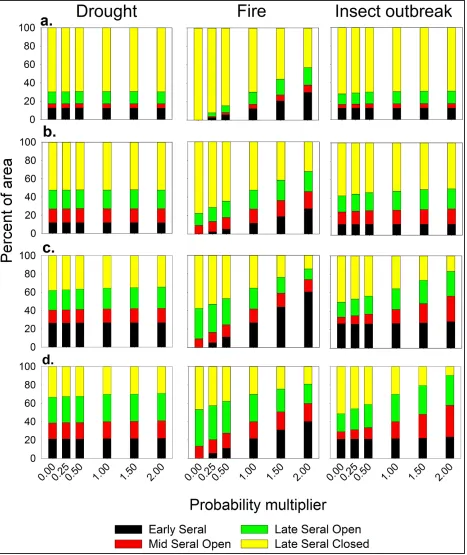
In random disturbance types (fire, freeze-kill, snow mold, and pronghorn browsing), varying the base probability in the model had the effect of varying the probability that the event would occur. In cyclical disturbance types (drought, insect outbreaks, and vole out-breaks), varying the base probability in es-sence varied the probability of mortality, not the probability of the event itself. As would be expected, varying the probability of fire result-ed in significant differences in the mix of com-munity phases in all four models (Figure 5); this effect is not discussed further. Similarly, since fire was the only disturbance type to pro-duce the ES phase, there were no differences in the abundance of this phase in all variants examined.
Varying the probability of mortality from drought in the WM Group produced no signifi-cant differences in the abundance of any com-munity phase (P = 0.996, 0.967, and 0.941 for the MSO, LSO, and LSC phases, respectively). Varying the probability of mortality from in-sect outbreaks in this group produced only small differences in the abundance of the MSO, LSO, and LSC phases, and only when the probability of mortality was reduced
ure 5a). Altering the probability of mortality from drought in the CM Group had no effect as well (P = 0.427, 0.994, and 0.965 for the MSO, LSO, and LSC phases, respectively) (Figure 5b). Unlike in the WM Group, vary-ing the probability of mortality from insect outbreaks in the CM Group had a significant effect except at the two highest levels tested (Figure 5b), although this effect was still rela-tively small.
Altering the probability of freezekill and snow mold in the CM Group produced signifi-cant changes in the abundance of the MSO, LSO, and LSC phases (Figure 6a and b). The differences associated with snow mold were more clear for all three phases than for freeze-kill. Altering the probability of mortality from vole outbreaks also produced significant dif-ferences in the abundance of the MSO, LSO, and LSC community phases (Figure 6c), but the differences were smaller and varied by community phase. Differences in the MSO phase were significant at all levels tested, whereas differences in the LSO phase were significant only when the absence of vole-re-lated mortality was compared to a doubling of the likelihood of mortality, and differences in the LSC phase were significant only when the mortality probability increased over that in the base model.
As occurred when disturbance types were added and removed in different combinations, varying probabilities in the WD Group and SD Group produced similar results. Unlike the two moist sagebrush groups, varying the prob-ability of mortality from drought did produce some significant differences in the two dry sagebrush groups (Figure 5c and d). In the MSO and LSC phases, the differences were significant only when increased probabilities were compared to decreased probabilities, and in the LSO phase, they were significant only when absence of drought was compared to a doubled probability of mortality. In both groups, varying the probability of mortality from insect outbreaks (Figure 5c and d) and of pronghorn browsing episodes (Figure 7)
Figure 7. Mix of community phases resulting from varying the probability of severe pronghorn browsing in the two dry sagebrush groups. As the probability of pronghorn browsing effects increases, abundance of the Late Seral Closed phase decreases, and abundance of the Late Seral and Mid-Seral Open phases increases.
duced significant differences in the abundance of community phases with larger differences in the case of pronghorn browsing.
Effects on Predicted Fire Rotation
The full models (all events included) pro-duced fire rotations of 24 yr, 33 yr, 83 yr, and 196 yr for the WM, CM, WD, and SD groups, respectively. In both moist sagebrush groups, neither adding nor removing events other than fire or varying probabilities resulted in any change in the predicted fire rotation, unlike in the two dry sagebrush groups. In the WD Group, the full model produced an estimated fire rotation of 83 yr while the fire-only variant produced an estimated rotation of 99 yr. Re-moving drought from the full model or adding it to the fire-only variant had little effect on fire rotation. Adding or removing insect outbreaks and pronghorn browsing produced an
estimat-ed fire rotation that was longer than the full model but shorter than the fire-only variant. Varying the probability of drought mortality had a small effect on fire rotation. Varying the probability of mortality from an insect out-break caused fire rotation to range from 96 yr when insects were absent to 69 yr when the probability was doubled. With pronghorn browsing, fire rotation ranged from 92 yr when pronghorn browsing was absent to 75 yr when the probability was doubled.
insect outbreaks from the full model produced the same estimated rotation as the fire-only variant. There was no effect on fire rotation when varying the probability of mortality from drought. Varying the probability of mortality from insect outbreak caused fire rotation to range from 213 yr when insect outbreaks were absent to 182 yr when the probability was dou-bled. Varying the probability of pronghorn browsing caused fire rotation to range from 204 yr when pronghorns were absent to 192 yr when the probability was doubled. The effect of varying the probability of pronghorn brows-ing was less in the SD Group than in the WD Group and had no effect on fire rotation when the probability decreased.
DISCUSSION
Estimated fire rotations produced by the four models were similar to fire return inter-vals reported in the literature for the different major subspecies of big sagebrush and for low sagebrush (Burkhardt and Tisdale 1976, Whisenant 1990, Miller and Rose 1999, Miller
et al. 2001, Knick et al. 2005, Baker 2006, Heyerdahl et al. 2006, Mensing et al. 2006, Miller and Heyerdahl 2008). Tree-ring studies at the sagebrush-conifer ecotone indicate an average fire return interval of 10 yr to 35 yr (Burkhardt and Tisdale 1976, Miller and Rose 1999, Miller et al. 2001, Heyerdahl et al. 2006, Miller and Heyerdahl 2008). Our estimated fire rotation for the CM Group was near the upper end of these reported intervals. Expert opinion for fire return intervals range from 10 yr to 25 yr on more productive sites, 30 yr to 80 yr on less productive sites, and over 100 yr on very dry, low-productivity sites (Miller and Rose 1999, Knick et al. 2005, Miller and Hey-erdahl 2008). Our modeled fire rotations all fell within these general categories. However, fire return interval and fire rotation are not the same measures of fire frequency. Fire return interval estimates how often a given spot has burned while fire rotation estimates the
num-ber of years needed to burn an area equivalent in size to the analysis area (Agee 1993, Rom-me et al. 2009). While no clear relationship between the two measures has ever been estab-lished, many fire ecologists assume that fire rotation is longer than fire return interval for a given site.
The importance of fire in shaping sage-brush ecosystems is well established (Knick et al. 2005, Mensing et al. 2006, Miller et al.
2011); model results concerning the influence of fire presence, absence, and differing proba-bilities on the mix of community phases were expected. Our results suggest that fire may in-deed be the only significant factor in the most productive sagebrush communities but not in lower productivity sagebrush communities. Our results also suggested two other intriguing linkages between fire and other disturbances and how they affect the mix of community phases: 1) there may be a threshold related to the extent of area a disturbance might affect, above which it has an influence on both fire ro-tation and the mix of community phases, and below which it does not; and 2) the relative frequency of another disturbance relative to the frequency of fire may also be an important consideration.
phases and no influence on fire rotation in the two moist sagebrush groups, which had esti-mated average fire rotations of less than 35 yr. In contrast, drought had a more noticeable ef-fect in the Warm-Dry Group where the esti-mated fire rotation was 83 yr, and a somewhat larger influence in the Shallow-Dry Group where the estimated fire rotation was 196 yr.
Insect outbreaks may be more important than previously recognized, particularly in the drier sagebrush groups, affecting the mix of community phases in all four sagebrush groups and modifying fire rotation in the two dry groups. The link between insect outbreaks and subsequent fires is well established in forest ecosystems. By opening tree canopies, insect outbreaks alter fuel amount and arrangement, and within-stand environmental conditions, fa-cilitating the start and spread of fires (Furniss and Carolin 1977, Wright and Bailey 1982, Agee 1993), although there may be several years between an outbreak and a fire and not all forest stands affected by an insect outbreak necessarily burn. Insect outbreaks in sagebrush may operate in a similar manner by opening canopies (Hsiao and Temte 1976; Hsiao 1986; N.L. Hampton, unpublished manuscript) and shifting site resources to grasses and forbs. The subsequent increase in grasses and fine fuel continuity should facilitate the start and spread of fires in sagebrush ecosystems.
The apparent importance of pronghorn browsing in the Warm-Dry and Shallow-Dry sagebrush groups was a surprise, having a greater effect on the mix of community phases and fire rotation than we expected. As with in-sect outbreaks, pronghorn browsing when ani-mal populations were high and winters were severe would shift site resources to grass, in-creasing fuel amount and continuity, and sub-sequent fire risks. However, we are less confi-dent that this particular interaction is as strong as the model suggests. Although pronghorn populations were much higher before 1850 (Elliott 1910, O’Gara and Yoakum 2004), they were also lower than populations east of the
continental divide where the impact of high pronghorn populations during severe winters has been documented (O’Gara and Yoakum 2004). Thus, we are less certain that popula-tion peaks would have had the same effect on the Malheur High Plateau as on the western Great Plains. If we overestimated the proba-bility of pronghorn browsing, then the Late Seral Closed community phase might have been more abundant and the Mid Seral and Late Seral Open phases less abundant in both dry sagebrush groups.
We are puzzled by the lack of effect on fire rotation in the two moister sagebrush groups in our models. We allowed for mosaic fire in the Late Seral Open and Late Seral Closed community phases in the WM and CM groups but not in the WD and SD groups. This differ-ence in model design could have removed a source of variability, particularly given that the two late seral community phases comprised more than half the area of all four models (Fig-ure 2). Alternatively, this result may also indi-cate that how fires burn could be as important as whether they burn. According to fire occur-rence records for Burns and Lakeview BLM districts and Malheur and Hart Mountain na-tional wildlife refuges (1980 to 2011), only 2% of fires exceeded 2023 ha, yet these fires accounted for 73 % of the total hectares burned. Use of fire by Native Americans was well doc-umented in the Great Basin (Gruell 1985, Rob-bins 1999, Griffen 2002, Stewart 2002), al-though the number of fires and area affected were not. Tree-ring studies of fire extent in pre-1850 forests indicate that regional fire years (years where fire is widespread through-out a large area, the equivalent of extreme fire years today) occurred at about the same fre-quency before 1850 as in modern fire records (Swetnam and Betancourt 1998, Hessl et al.
ACKNOWLEDGEMENTS
We wish to thank N. Hampton for generously sharing her unpublished aroga moth data. We thank R. Neilson for providing advice on how best to use climate data to derive event probabili-ties, and M. Hemstrom and J. Merzenich for valuable assistance in using VDDT. We greatly ap-preciate the comments provided by two anonymous reviewers and the associate editor, which helped to improve this paper. This study was funded by the Bureau of Land Management, Fire and Aviation Management.
LITERATURE CITED
Adams, J. 2010. Vegetation-climate interaction: how plants make the global environment. Sec-ond edition. Springer, New York, New York, USA. doi: 10.1007/978-3-642-00881-8
Agee, J.K. 1993. Fire ecology of Pacific Northwest forests. Island Press, Covelo, California, USA.
suggested by Stewart (2002) and the low num-ber of lightning strikes that actually start fires in rangeland ecosystems (Latham and Wil-liams 2001). Since 1980, such years consisted of a few very large fires, believed to be largely due to changes in fuel structure resulting from a combination of past grazing, aggressive fire suppression, and a variety of other human-caused changes (Connelly et al. 2004, Knick
et al. 2005, Heyerdahl et al. 2006). The result-ing landscape patterns would have been very different before 1850 than since 1980 even if the frequencies of the different types of fire years were similar.
These models allowed us to explore the re-lationships between fire and other types of nat-ural events: how they may have collectively shaped the abundance of different community phases and whether other disturbance types could affect fire rotation. Our results suggest that fire is the only significant shaper of the most productive sagebrush communities but that the importance of other disturbance types increases as site productivity declines. There may also be thresholds associated with how much area is affected by a given disturbance type if disturbance effects are significant above the area threshold but insignificant below it. The relative significance of a disturbance type other than fire may also depend on how much
Allred, B.W. 1941. Grasshoppers and their effect on sagebrush on the Little Powder River in Wyoming and Montana. Ecology 22: 387-392. doi: 10.2307/1930712
Baker, W.L. 2006. Fire and restoration of sagebrush ecosystems. Wildlife Society Bulletin 34: 177-185. doi: 10.2193/0091-7648(2006)34[177:FAROSE]2.0.CO;2
Bestelmeyer, B.T., A.J. Tugel, G.L. Peacock Jr., D.C. Robinett, P.L. Shaver, J.R. Brown, J.E. Her-rick, H. Sanchez, and K.M. Havstad. 2009. State-and-transition models for heterogeneous landscapes: a strategy for development and application. Rangeland Ecology & Management 62: 1-15. doi: 10.2111/08-146
Bilbrough, C.J., and J.H. Richards. 1993. Growth of sagebrush and bitterbrush following simu-lated winter browsing: mechanisms for tolerance. Ecology 74: 481-492. doi:
10.2307/1939309
Bollinger, A.P., and B.L. Perryman. 2008. 20 years of natural recovery after wildfire on northern Nevada rangelands. Pages 169-173 in: S.G. Kitchen, R.L. Pendleton, T.A. Monaco, and J. Vernon, editors. Proceedings of the symposium on shrublands under fire: disturbance and re-covery in a changing world. USDA Forest Service Proceedings RMRS-P-52, Rocky Moun-tain Research Station, Fort Collins, Colorado, USA.
Boltz, M. 1994. Factors influencing postfire sagebrush regeneration in south-central Idaho. Pag-es 281-290 in: S.B. Monsen and S.G. Kitchen, editors. Proceedings of the symposium on ecology and management of annual rangelands. USDA Forest Service General Technical Re-port INT-GTR-313, Intermountain Research Station, Ogden, Utah, USA.
Breckle, S.-W. 1999. Walter’s vegetation of the Earth: the ecological systems of the geo-bio-sphere. 4th edition. Springer-Verlag, Bielefeld, Germany.
Bunting, S.C., B.M. Kilgore, and C.L. Bushey. 1987. Guidelines for prescribed burning sage-brush-grass rangelands in the northern Great Basin. USDA Forest Service General Technical Report INT-231, Intermountain Research Station. Ogden, Utah, USA.
Burkhardt, J.W., and E.W. Tisdale. 1976. Causes of juniper invasion in southwestern Idaho. Ecology 57: 472-484. doi: 10.2307/1936432
Cayan, D.R., M.D. Dettinger, H.F. Diaz, and N.E. Graham. 1998. Decadal variability of pre-cipitation over western North America. Journal of Climate 11: 3148-3166. doi:
10.1175/1520-0442(1998)011<3148:DVOPOW>2.0.CO;2
Chapin, F.S., III, P.A. Matson, and H.A. Mooney. 2002. Principles of terrestrial ecosystem ecol-ogy. Springer, New York, New York, USA.
Connelly, J.W., S.T. Knick, M.A. Schroeder, and S.J. Stiver. 2004. Conservation assessment of greater sage-grouse and sagebrush habitats. Western Association of Fish and Wildlife Agen-cies, Cheyenne, Wyoming, USA.
Cook, E.R., C.A. Woodhouse, C.M. Eakin, D.M. Meko, and D.W. Stahle. 2004. Long-term aridity changes in the western United States. Science 306: 1015-1018. doi: 10.1126/science.1102586
Cook, J.G., T.J. Hershey, and L.L. Irwin. 1994. Vegetative response to burning on Wyoming mountain-shrub big game ranges. Journal of Range Management 47: 296-302. doi:
10.2307/4002550
Cooke, B.J., and J. Roland. 2000. Spatial analysis of large-scale patterns of forest tent caterpillar outbreaks. Ecoscience 7: 410-422.
Daubenmire, R. 1975. Ecology of Artemisia tridentata subsp. tridentata in the state of Washing-ton. Northwest Science 49: 24-35.
Ellison, L., and E.J. Woolfolk. 1937. Effects of drought on vegetation near Miles City, Montana. Ecology 18: 329-336. doi: 10.2307/1931204
ESSA Technologies. 2007. Vegetation Dynamics Development Tool users guide, version 6.0. ESSA Technologies Ltd., Vancouver, British Columbia, Canada.
Forman, A.D., R.D. Blew, J.R. Hafla, and J.P. Shive. 2007. Post-fire spatial recruitment patterns of Wyoming big sagebrush (Artemisia tridentata ssp. wyomingensis) [Abstract]. <http://eco. confex.com/eco/2007/techprogram/P5290.HTM>. Accessed 30 July 2007.
Frischknecht, N.C., and M.F. Baker. 1972. Voles can improve sagebrush rangelands. Journal of Range Management 25: 466-468. doi: 10.2307/3897010
Furniss, R.L., and V.M. Carolin. 1977. Western forest insects. USDA Forest Service Miscella-neous Publication No. 1339, Washington, D.C., USA.
Gates, D.H. 1964. Sagebrush infested by leaf defoliating moth. Journal of Range Management 17: 209-210. doi: 10.2307/3895769
Graumlich, L.J. 1987. Precipitation variation in the Pacific Northwest (1675-1975) as recon-structed from tree rings. Annals of the Association of American Geographers 77: 19-29. doi: 10.1111/j.1467-8306.1987.tb00142.x
Griffen, D. 2002. Prehistoric human impacts on fire regimes and vegetation in the northern In-termountain West. Pages 77-100 in: T.R. Vale, editor. Fire, native peoples, and the natural landscape. Island Press, Covelo, California, USA.
Grissino-Mayer, H.D., and T.W. Swetnam. 2000. Century-scale climate forcing of climate re-gimes in the American Southwest. The Holocene 10: 213-220. doi: 10.1191/0959683006684 51235
Gruell, G.E. 1985. Fire on the early Western landscape: an annotated record of wildland fires 1776-1900. Northwest Science 59: 97-107.
Gruell, G.E., J.K. Brown, and C.L. Bushey. 1986. Prescribed fire opportunities in grasslands in-vaded by Douglas-fir: state-of-the-art guidelines. USDA Forest Service General Technical Report INT-198, Intermountain Research Station. Ogden, Utah, USA.
Hall, R.H. 1965. Sagebrush defoliator outbreak in northern California. USDA Forest Service Research Note PSW-75, Pacific Southwest Forest and Range Experiment Station, Berkeley, California, USA.
Hansen, R.M., and R.C. Clark. 1977. Foods of elk and other ungulates at low elevations in northwestern Colorado. Journal of Wildlife Management 41: 76-80. doi: 10.2307/3800093 Hanson, C.L., C.W. Johnson, and J.R. Wright. 1982. Foliage mortality of mountain big
sage-brush (Artemisia tridentata subsp. vaseyana) in southwestern Idaho during the winter of 1976-77. Journal of Range Management 35: 142-145. doi: 10.2307/3898378
Hanson, C.L., D. Marks, and S.S. Van Vactor. 2001. Long-term climate database, Reynolds Creek Experimental Watershed, Idaho, USA. Water Resources Research. <ftp://ftp.nwrc.ars. usda.gov/reynoldscreek/>. Accessed 6 November 2008.
Hardy, J.P., P.M. Groffman, R.D. Fitzhugh, K.S. Henry, A.T. Welman, J.D. Demers, T.J. Fahey, C.T. Discoll, G.L. Tierney, and S.Nolan. 2001. Snow depth manipulation and its influence on soil frost and water dynamics in a northern hardwood forest. Biogeochemistry 56: 151-174. doi: 10.1023/A:1013036803050
Harniss, R.O., and R.D. Murray. 1973. 30 years of vegetal change following burning of sage-brush-grass range. Journal of Range Management 26: 322-325. doi: 10.2307/3896846
Heyerdahl, E.K., L.B. Brubaker, and J.K. Agee. 2002. Annual and decadal climate forcing of historical fire regimes in the interior Pacific Northwest. The Holocene 12: 597-604. doi:
10.1191/0959683602hl570rp
Heyerdahl, E.K., R.F. Miller, and R.A. Parsons. 2006. History of fire and Douglas-fir establish-ment in a savanna and sagebrush-grass mosaic, southwestern Montana, USA. Forest Ecology and Management 230: 107-118. doi: 10.1016/j.foreco.2006.04.024
Heyerdahl, E.K., P. Morgan, and J.P. Riser II. 2008. Multi-season climate synchronized histori-cal fires in dry forests (1650-1900), northern Rockies, USA. Ecology 89: 705-716. doi:
10.1890/06-2047.1
Hoffman, T.L., and C.L. Wambolt. 1996. Growth response of Wyoming big sagebrush to heavy browsing by wild ungulates. Pages 242-245 in: J.R. Barrow, E.D. McArthur, R.E. Sosebee, and R.J. Tausch, editors. Proceedings of the symposium on shrubland ecosystem dynamics in a changing environment. USDA Forest Service, General Technical Report INT-GTR-338, In-termountain Research Station, Ogden, Utah, USA.
Holechek, J.L., R.D. Pieper, and C.H. Herbel. 2004. Range management: principles and practic-es. 5th edition. Prentice Hall, Engelwood Cliffs, New Jersey, USA.
Howard, J.L. 1995. Antilocapra americana. Fire Effects Information System. <http://www.fs. fed.us/database/feis/>. Accessed 28 March 2007.
Hsiao, T.H. 1986. Biology and demography of the sagebrush defoliator and its impacts on big sagebrush. Pages 191-198 in: E.D. McArthur and B.L. Welch, editors. Proceedings of the symposium: the biology of Artemisia and Chrysothamnus. USDA Forest Service General Technical Report INT-200, Intermountain Research Station, Ogden, Utah, USA.
Hsiao, T.H., and A.K. Temte. 1976. Demographic studies of sagebrush insects as functions of various environmental factors: 1975 progress report (final). Ecology Center, Utah State Uni-versity US/IBP Desert Biome Research Memo 76-23, Logan, Utah, USA.
Hubbard, R.L., and S. McKeever. 1961. Meadow mouse girdling—another cause of death of re-seeded bitterbrush plants. Ecology 42: 198. doi: 10.2307/1933291
Johnson, J.R., and G.F. Payne. 1968. Sagebrush reinvasion as affected by some environmental influences. Journal of Range Management 21: 209-213. doi: 10.2307/3895815
Johnson, W.M. 1969. Life expectancy of a sagebrush control in central Wyoming. Journal of Range Management 22: 177-182. doi: 10.2307/3896337
Keating, K.A., editor. 2002. History of pronghorn population monitoring, research, and manage-ment in Yellowstone National Park. USGS Northern Rocky Mountain Science Center, Boze-man, Montana, USA.
Keen, F.P. 1937. Climatic cycles in eastern Oregon as indicated by tree rings. Monthly Weather Review 65: 175-188. doi: 10.1175/1520-0493(1937)65<175:CCIEOA>2.0.CO;2
Kindschy, R.R., C. Sundstrom, and J.D. Yoakum. 1982. Wildlife habitat in managed range-lands—the Great Basin of southeastern Oregon: pronghorns. USDA Forest Service General Technical Report PNW-145, Pacific Northwest Research Station. Portland, Oregon, USA. Knapp, P.A., P.T. Soulé, and H.D. Grissino-Mayer. 2004. Occurrence of sustained droughts in
the interior Pacific Northwest (A.D. 1733-1980) inferred from tree-ring data. Journal of Cli-mate 17: 140-150. doi: 10.1175/1520-0442(2004)017<0140:OOSDIT>2.0.CO;2
Knick, S.T., D.S. Dobkin, J.T. Rotenberry, M.A. Schroeder, W.M. Vander Haegen, and C.I. van Riper III. 2003. Teetering on the edge or too late? Conservation and research issues for avi-fauna of sagebrush habitats. The Condor 105: 611-634. doi: 10.1650/7329
Latham, D., and E. Williams. 2001. Lightning and forest fires. Pages 375-418 in: E.A. Johnson and K. Miyanishi, editors. Forest fires: behavior and ecological effects. Academic Press, San Diego, California, USA. doi: 10.1016/B978-012386660-8/50013-1
Lesica, P., S.V. Cooper, and G. Kudray. 2007. Recovery of big sagebrush following fire in southwest Montana. Rangeland Ecology and Management 60: 261-269. doi:
10.2111/1551-5028(2007)60[261:ROBSFF]2.0.CO;2
MacCracken, J.G., and R.M. Hansen. 1981. Diets of domestic sheep and other large herbivores in southcentral Colorado. Journal of Range Management 34: 242-243. doi:
10.2307/3898054
Marks, D., K.R. Cooley, D.C. Robertson, and A. Winstral. 2001. Long-term snow database, Reynolds Creek Experimental Watershed, Idaho, USA. Water Resources Research 37: 2835-2838. doi: 10.1029/2001WR000416
McArthur, E.D., and B.L. Welch. 1982. Growth rate differences among big sagebrush (Artemisia tridentata) accessions and subspecies. Journal of Range Management 35: 396-401. doi:
10.2307/3898327
McArthur, E.D., A.C. Blauer, and S.C. Sanderson. 1988. Mule deer-induced mortality of moun-tain big sagebrush. Journal of Range Management 41: 114-117. doi: 10.2307/3898944
Mensing, S., S. Livingston, and P. Barker. 2006. Long-term fire history in Great Basin sagebrush reconstructed from macroscopic charcoal in spring sediments, Newark Valley, Nevada. West-ern North American Naturalist 66: 64-77. doi: 10.3398/1527-0904(2006)66[64:
LFHIGB]2.0.CO;2
Meyers, J.M. 1988. Can a general hypothesis explain population cycles of forest Lepidoptera? Advances in Ecological Research 18: 179-242. doi: 10.1016/S0065-2504(08)60181-6
Michels, A., K.R. Laird, S.E. Wilson, D. Thomson, P.R. Leavitt, R.J. Oglesby, and B.F. Cum-ming. 2007. Multidecadal to millennial-scale shifts in drought conditions on the Canadian prairies over the past six millennia: implications for future drought assessment. Global Change Biology 13: 1295-1307. doi: 10.1111/j.1365-2486.2007.01367.x
Miller, R., C. Baisan, J. Rose, and D. Pacioretty. 2001. Pre- and post-settlement fire regimes in mountain big sagebrush steppe and aspen: the northwestern Great Basin—final report. Na-tional Interagency Fire Center, Boise, Idaho, USA.
Miller, R.F., and L. Eddleman. 2000. Spatial and temporal changes of sage grouse habitat in the sagebrush biome. Oregon State University Agricultural Experiment Station Technical Bulle-tin 151, Corvallis, Oregon, USA.
Miller, R.F., and E.K. Heyerdahl. 2008. Fine-scale variation of historical fire regimes in sage-brush-steppe and juniper woodland: an example from California, USA. International Journal of Wildland Fire 17: 245-254. doi: 10.1071/WF07016
Miller, R.F., S.T. Knick, D.A. Pyke, C.W. Meinke, S.E. Hanser, M.J. Wisdom, and A.L. Hild. 2011. Characteristics of sagebrush habitat and limitations to long-term conservation. Pages 145-184 in: S.T. Knick and J.W. Connelly, editors. Ecology and conservation of greater sage-grouse: a landscape species and its habitats. Studies in Avian Biology 38, University of Cali-fornia Press, Berkeley, USA.
Miller, R.F., and J.A. Rose. 1999. Fire history and western juniper encroachment in sagebrush-steppe. Journal of Range Management 52: 550-559. doi: 10.2307/4003623
Mueggler, W.F. 1967. Voles damage big sagebrush in southwestern Montana. Journal of Range Management 20: 88-91. doi: 10.2307/3895951
Neilson, R.P., G.A. King, and G. Koerper. 1992. Toward a rule-based biome model. Landscape Ecology 7: 27-43. doi: 10.1007/BF02573955
Nelson, D.L., and D.L. Sturges. 1986. A snowmold disease of mountain big sagebrush. Phyto-pathology 76: 946-951. doi: 10.1094/Phyto-76-946
O’Gara, B.W., and J.D. Yoakum, editors. 2004. Pronghorn ecology and management. Universi-ty Press of Colorado, Boulder, USA.
Parmenter, R.R., M.R. Mesch, and J.A. Macmahon. 1987. Shrub litter production in a sage-brush-steppe ecosystem: rodent population cycles as a regulating factor. Journal of Range Management 40: 50-54. doi: 10.2307/3899361
Pechanec, J.F., G.D. Pickford, and G. Stewart. 1937. Effects of the 1934 drought on native veg-etation of the upper Snake River plains, Idaho. Ecology 18: 490-505. doi: 10.2307/1930575
Perryman, B.L., A.M. Maier, A.L. Hild, and R.A. Olson. 2001. Demographic characteristics of 3
Artemisia tridentata Nutt. subspecies. Journal of Range Management 54: 166-170. doi: 10.2307/4003178
Robbins, W.G. 1999. Landscape and environment: ecological change in the intermontane North-west. Pages 219-237 in: R. Boyd, editor. Indians, fire and the land in the Pacific NorthNorth-west. Oregon State University Press, Corvallis, USA.
Rollins, M.G., P. Morgan, and T. Swetnam. 2002. Landscape-scale controls over 20th century fire
occurrence in two large Rocky Mountain (USA) wilderness areas. Landscape Ecology 17: 539-557. doi: 10.1023/A:1021584519109
Romme, W.H., C.D. Allen, J.D. Bailey, W.L. Baker, B.T. Bestelmeyer, P.M. Brown, K.S. Eisen-hart, M.L. Floyd, D.W. Huffman, B.F. Jacobs, R.F. Miller, E.H. Muldavin, T.W. Swetnam, R. J. Tausch, and P.J. Weisberg. 2009. Historical and modern disturbance regimes, stand struc-tures, and landscape dynamics in piñon-juniper vegetation of the western United States. Rangeland Ecology and Management 62: 203-222. doi: 10.2111/08-188R1.1
Rorig, M.L., and S.A. Ferguson. 1999. Characteristics of lightning and wildland fire ignition in the Pacific Northwest. Journal of Applied Meteorology 38: 1565-1575. doi:
10.1175/1520-0450(1999)038<1565:COLAWF>2.0.CO;2
Smith, A.D. 1949. Effects of mule deer and livestock upon a foothill range in northern Utah. Journal of Wildlife Management 13: 421-423. doi: 10.2307/3795636
Smyser, T.J., A.F. Reeve, and E.O. Garton. 2006. Evaluation of pronghorn population productiv-ity relative to broad-scale habitat variables in Wyoming (1978-2003). Pages 41-52 in: D E. Toweill, editor. Proceedings of the 22nd biennial pronghorn workshop 209, Boise, Idaho, USA.
Speer, J.H., and R.R. Jenson. 2003. A hazards approach towards modelling pandora moth risk. Journal of Biogeography 30: 1899-1906. doi: 10.1111/j.1365-2699.2003.00951.x
Speer, J.H., T.W. Swetnam, B.E. Wickman, and A. Youngblood. 2001. Changes in pandora moth outbreak dynamics during the past 622 years. Ecology 82: 679-697. doi:
10.1890/0012-9658(2001)082[0679:CIPMOD]2.0.CO;2
Stahle, D.W., F.K. Fye, E.R. Cook, and R.D. Griffin. 2007. Tree-ring reconstructed mega-droughts over North America since A.D. 1300. Climatic Change 83: 133-149. doi: 10.1007/ s10584-006-9171-x
Stewart, O.C., editor. 2002. Forgotten fires: Native Americans and the transient wilderness. The University of Oklahoma Press, Norman, USA.
Sturges, D.L. 1986. Responses of vegetation and ground cover to spraying a high elevation, big sagebrush watershed with 2,4-D. Journal of Range Management 39: 141-146. doi:
Sturges, D.L. 1989. Response of mountain big sagebrush to induced snow accumulation. Jour-nal of Applied Ecology 26: 1035-1041. doi: 10.2307/2403710
Sturges, D.L., and D.L. Nelson. 1986. Snow depth and incidence of a snowmold disease on mountain big sagebrush. Pages 215-221 in: E.D. McArthur and B.L. Welch, editors. Pro-ceedings of the symposium: the biology of Artemisia and Chrysothamnus. USDA Forest Ser -vice General Technical Report INT-200, Intermountain Research Station, Odgen, Utah, USA. Swetnam, T.W., and J.L. Betancourt. 1990. Fire-southern oscillation relations in the
southwest-ern United States. Science 249: 1017-1020. doi: 10.1126/science.249.4972.1017
Swetnam, T.W., and J.L. Betancourt. 1998. Mesoscale disturbance and ecological response to decadal climate variability in the American Southwest. Journal of Climate 11: 3128-3147.
doi: 10.1175/1520-0442(1998)011<3128:MDAERT>2.0.CO;2
Tisdale, E.W., M. Hironaka, and M.A. Fosberg. 1965. An area of pristine vegetation in Craters of the Moon National Monument, Idaho. Ecology 46: 349-352. doi: 10.2307/1936343
USDA Natural Resources Conservation Service. 2006. Land resource regions and major land resource areas of the United States, the Caribbean, and the Pacific Basin. USDA Natural Re-sources Conservation Service Agricultural Handbook 296, Washington, D.C., USA.
USDI Bureau of Land Management. 2004. National sage-grouse habitat conservation strategy: 1.4.1 guidance for the management of sagebrush plant communities for sage-grouse conser-vation. USDI Bureau of Land Management, Washington, D.C., USA.
Verts, B.J., and L.N. Carraway, editors. 1998. Land mammals of Oregon. University of Califor-nia Press, Berkeley, USA.
Walser, R.H., D.J. Weber, E.D. McArthur, and S.C. Sanderson. 1990. Winter cold hardiness of seven wildland shrubs. Pages 115-118 in: E.D. McArthur, E.M. Romney, S.D. Smith, and P. T. Tueller, editors. Proceedings of the symposium: cheatgrass invasion, shrub die-off, and other aspects of shrub biology and management. USDA Forest Service, General Technical Report INT-276, Intermountain Research Station, Ogden, Utah, USA.
Welch, B.L. 2005. Big sagebrush: a sea fragmented into lakes, ponds and puddles. USDA For-est Service General Technical Report RMRS-GTR-144, Rocky Mountain Research Station, Fort Collins, Colorado, USA.
Whisenant, S.G. 1990. Changing fire frequencies on Idaho’s Snake River Plains: ecological and management implications. Pages 4-10 in: E.D. McArthur, E.M. Romney, S.D. Smith, and P. T. Tueller, editors. Proceedings of the symposium on cheatgrass invasion, shrub die-off, and other aspects of shrub biology and management. USDA Forest Service General Technical Report INT-276, Intermountain Research Station, Ogden, Utah, USA.
Winward, A. 1991. A renewed commitment to management of sagebrush grasslands. Pages 2-7 in: R.F. Miller, editor. Management of sagebrush steppe. Special Report 880, Oregon State University Agricultural Experiment Station, Corvallis, USA.
Wright, H.A., and A.W. Bailey. 1982. Fire ecology: United States and southern Canada. John Wiley & Sons, New York, New York, USA.