R E S E A R C H
Open Access
Design principles for effective video-based
professional development
Kathleen J. Roth
1*, Jody Bintz
2, Nicole I. Z. Wickler
1, Connie Hvidsten
2, Joseph Taylor
2, Paul M. Beardsley
1,
Arlo Caine
1and Christopher D. Wilson
2Abstract
Background:Most studies of teacher professional development (PD) do not rigorously test impact on teaching practice and student learning. This makes it difficult to define what is truly“effective.”TheScience Teachers Learning from Lesson Analysis(STeLLA) PD program, in contrast, was studied in a cluster randomized experimental design that examined impact on teaching practice and student learning. The STeLLA video-based PD (VbPD) program demonstrated significant impact, with high effect sizes, on elementary teachers’science teaching practice and their students’learning. Previously published reports provide details about research methods and findings but only broad sketches of the STeLLA program design and implementation. Deeper explorations of the STeLLA design principles can contribute evidence-based knowledge about the features of effective PD and enrich the existing but limited consensus model of effective PD. This article addresses the following questions:
What design principles guided the development, implementation, leadership, and scaling up of a video-based PD program that had significant impact on student learning?
What do the STeLLA design principles contribute to the existing knowledge base about effective video-based PD?
Results:Results from rigorous studies of the STeLLA program are summarized in this paper; details are reported elsewhere and included here as supplementary materials. This article is not a standard research results paper but instead describes the design principles guiding the development, implementation, leadership, and scaling up of the STeLLA VbPD program.
Conclusions:The authors argue that this set of design principles is powerful for four reasons: 1) its demonstrated impact on teaching practice and student learning, 2) its strong theoretical and research foundations, 3) the stability and usefulness of the design principles as implemented in changing contexts over a 10-year period, and 4) the coherence and interconnectedness of the principles. The STeLLA VbPD design principles contribute to the field by empirically supporting and advancing the existing consensus model of effective PD. Further study can build on this effort to strengthen our understanding of effective PD based on evidence of impact on teaching practice and student learning.
Keywords:Professional development, Video-based professional development, Design principles, Facilitation of professional development, Teacher leaders, Science teaching and learning, Elementary science, Experimental study, Sustainability
* Correspondence:[email protected]
1California State Polytechnic University, Pomona, Building 4-2-515, 3801 West
Temple Ave, Pomona, CA 91768, USA
Full list of author information is available at the end of the article
What are the key features of effective professional develop-ment? Researchers have been writing about this question for decades (Ball and Cohen 1999; Desimone, Porter, Garet, Yoon, and Birman 2002; Garet, Porter, Desimone, Birman, and Yoon 2001; Kennedy 1999; Loucks-Horsley, Hewson, Love, and Stiles 1998; National Academy of Sciences, Engineering, and Medicine (NASEM) 2015; Wilson and Berne 1999; Wilson 2013). But answers to this question have not changed much over the years because most stud-ies of teacher professional development (PD)—today, as in the past—do not include rigorous tests of impact on teach-ing practice and student learnteach-ing and do not include strong comparisons to other PD approaches (Borko 2004; NASEM 2015; Wilson 2013). This makes it difficult to define what is truly“effective”teacher professional development.
In the USA, the need for such knowledge has been made more urgent by the release of theNext Generation Science Standards (NGSS Lead States 2013) which sets expectations for science teaching and learning that are in striking contrast with current US science teaching practice (Banilower, Smith, Pasley, and Weiss 2006; Roth et al., 2006; Weiss, Pasley, Smith, Banilower, and Heck, D.J. 2003). This has resulted in a high demand for professional development opportunities that support teachers in changing their science teaching practice to better engage students in using science practices—such as explanation and argumentation—to develop rich understandings of science ideas and concepts. Science educators in other countries face similar challenges. But developers and leaders of science professional develop-ment efforts are hampered in designing and impledevelop-ment- implement-ing such PD opportunities by the dearth of research that follows the pathway of impact of PD programs on teacher knowledge, teaching practice, and student learn-ing in rigorous comparison with other PD approaches.
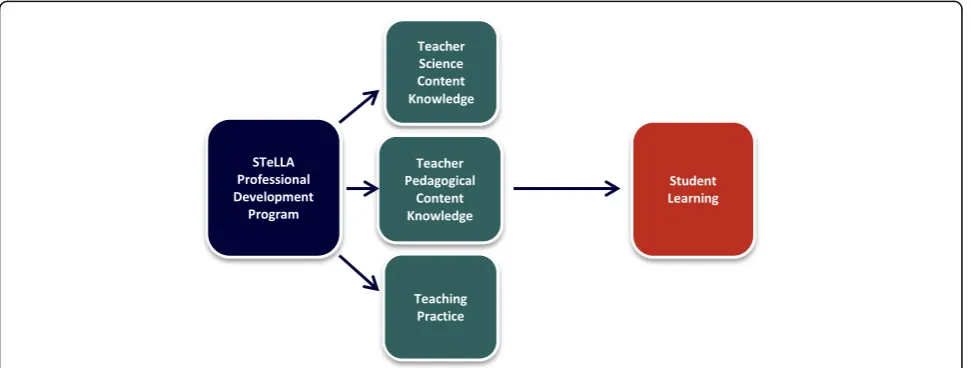
The Science Teachers Learning from Lesson Analysis (STeLLA) PD program is one of a handful of programs that has been studied in a cluster randomized experimental study where the program was compared with another PD program of equal duration and where analysis included impact on teaching practice and student learning. This yearlong, video-based, analysis-of-practice PD program demonstrated significant impact, with high effect sizes, on upper elementary teachers’ science content knowledge, teachers’ pedagogical content knowledge (PCK), teachers’ science teaching practice, and, most importantly, on student learning (Fig. 1). As a result of strong findings from this and other studies of the program, the scalability and sustainabil-ity of this program when led by K-6 teacher leaders in a high-needs, urban school district is currently being tested in a project titled,Reinvigorating Elementary Science through a Partnership with California Teachers(RESPeCT).
Research reports about this STeLLA line of research pro-vide details about research methods that explain how we know that the STeLLA video-based, analysis-of-practice program is effective, but they provide only a surface-level sketch of the program design and implementation (Roth, Garnier, Chen, Lemmens, Schwille, & Wickler, 2011; Taylor, Roth, Wilson, Stuhlsatz, & Tipton, 2016). These previously published research reports provide strong evidence that video analysis is a powerful approach to science teacher PD, but they fall short of helping the field understand what it takes to design, implement, and scale such a video-based PD (VbPD) program. To address this gap, this article goes “behind the scenes”to examine the design principles under-girding the development, implementation, leadership, and scaling up of this effective PD program. While the research results will be briefly summarized, this article is not a standard research results paper. Instead, it explores the following questions:
What design principles guided the development, implementation, leadership, and scaling up of a video-based professional development program that had significant impacts on teaching practice and student learning?
What do the STeLLA design principles contribute to the existing knowledge base about effective video-based, analysis-of-practice PD?
To answer the first question, we describe in the body of the paper how the STeLLA program’s design principles shaped (a) the substance and form of the STeLLA ap-proach to video-based analysis of practice, (b) the imple-mentation of video analysis in the STeLLA program, (c) the leadership of the program, and (d) the scaling of this VbPD program through the development of teacher PD leaders in a school district-university partnership. To ad-dress the second question, we begin the paper by placing this work in the context of the larger body of research on teacher professional development, focusing on the limita-tions of the existing “consensus model of effective PD” and the need to better understand what it takes for PD to make a difference in terms of student learning. In the discussion at the end of the paper, we consider the power of the STeLLA approach to video-based analysis of practice and ways in which the STeLLA design prin-ciples advance and deepen the field’s current under-standing of the consensus model of effective PD. In the end, we hope readers will find their understanding of the STeLLA VbPD design principles to be useful in their own work in designing, implementing, sustaining, and rigorously studying the impact of VbPD ap-proaches. In this way, the science education community can move forward toward a more refined consensus model of PD that is supported by research showing changes in teaching practice that are linked to im-proved student learning.
The problem: the limitations of the consensus model of effective PD
While there is widespread agreement that teacher profes-sional development is key to improving teaching and learn-ing, there is little research that examines the impact of various PD approaches on student learning—in science or in other subject matter areas. Despite this lack of student learning evidence, there is a widely accepted consensus model of effective professional development (Desimone 2009; Wilson 2013). In this consensus model, effective PD:
(i) Focuses on specific subject matter content, (ii)Engages teachers in active learning,
(iii) Is consistent with reform documents and school, district, and state policies and practice,
(iv) Is of sufficient duration (both in intensity and contact hours), and
(v)Involves the collective participation of teachers (e.g., at a school, at a grade level).
This consensus model was generated from studies whose research designs are weakened by heavy reliance on teacher self-report data, small sample sizes, and lack of control or comparison groups (Desimone 2009: Wilson 2013; Yoon, Duncan, Lee, Scarloss, and Shapley 2007; NASEM 2015). For example, studies by Garet et al. (2001) and Desimone et al. (2002) relied on survey responses from science and math teachers who had participated in federally funded Eisenhower PD programs. In addition, most PD studies focus primarily on teacher knowledge and belief outcomes rather than on teaching practice and student learning (Little 2011; Desimone 2009; Yoon et al. 2007; NASEM 2015). In a review of over 1300 studies of professional development that examined the relation-ship between PD and student learning, only nine had randomized controlled or quasi-experimental designs that included measures of both teacher and student outcomes and only two of these studies examined science PD (Yoon et al. 2007).
Over the past two decades, various authors have made conceptual arguments to characterize this consensus view and have written syntheses of the existing research on PD (across subject matters) (Ball and Cohen 1999; Blank, de las Alas, and Smith 2008; Borko 2004; Borko, Jacobs, and Koellner 2010; Darling-Hammond, Chung Wei, Andree, Richardson, and Orphanos 2009; Hawley and Valli 2007; NASEM 2015; Wilson and Berne 1999; Wilson 2013; Yoon et al. 2007). The most recent reviews of PD for STEM edu-cators sound strikingly similar to those of reports from a decade ago: There is consensus about what high-quality PD should look like and little empirical evidence to support that consensus model (Wilson 2013; NASEM 2015).
In fact, some research studies challenge the consensus model. Studies that test separately for each feature of the model reveal inconsistent results in terms of impact (Garet et al. 2008, 2011; Scher and O’Reilly 2009). And when tested using rigorous experimental designs that examine impact on student learning, the consensus model is not always predictive of student learning (Garet 2016; Heller, Daehler, Wong, Shinohara, and Miratrix 2012; National Center for Education Evaluation and Regional Assistance (NCEE) 2017). These results suggest that the consensus model is not sufficient for describing PD that is effective in terms of student learning. Instead, the consensus model is perhaps capturing“surface char-acteristics and not the mechanisms that account for teacher [and student] learning”(NASEM 2015, p. 118).
designing professional development programs—in science and in other subject areas. In their reviews of research on science professional development, for example, Capps, Crawford, and Constas (2012) and van Driel and Berry (2012) found that most of the PD programs that were reviewed reflected the consensus model. This is also true of more recent studies of science professional develop-ment that examined both teacher and student learning outcomes (Greenleaf et al. 2011; Heller et al. 2012; Johnson and Fargo 2010; Penuel, Gallagher, and Moorthy 2011; Roth et al., 2011; Taylor et al., 2016).
So, there is wide use of the consensus model despite a lack of strong evidence to support its usefulness as a pre-dictor of student learning. There is also much interest in the use of video as a strategy for supporting teachers in the active learning called for in the consensus model. The STeLLA PD program uses a video-based approach and has been demonstrated to have impact on student learning (the research findings will be summarized in the next section). What can our experiences from this program contribute to the field that goes beyond the features identified in the con-sensus model of effective professional development? Since the STeLLA program demonstrated evidence of student learning, this is a good place to dig deeper—to go beyond the surface, to examine: What is going on in the STeLLA approach to video-based PD that makes it have such dra-matic impact?
In this article, we share the STeLLA design principles and consider ways that they might be a starting place for developing a more specific and useful model of effective VbPD. Before describing the design principles, we pro-vide a brief summary of the research that supports our assertions of the impact of the STeLLA program.
Research background: the impact of the STeLLA VbPD program
Research documenting the impact of the STeLLA video-based professional development program on upper elem-entary teacher and student learning has been completed in two studies, which we will refer to as STeLLA-I and STeLLA-II. Ongoing research is extending this line of research by examining impact on K-6 teachers and their students when university science faculty and later teacher leaders in an urban district facilitate the program in the
Reinvigorating Elementary Science through a Partnership with California Teachers (RESPeCT) program. Additional studies are currently studying impact of the STeLLA VbPD approach on preservice/first year elementary teachers and their students and on high school teachers and their stu-dents. In this section, we summarize findings from the two completed studies (STeLLA-I and STeLLA-II) and provide preliminary findings from the RESPeCT study which is test-ing the scalability and sustainability of this program. Details of the STeLLA-I and STeLLA-II studies can be found in
previously published reports which are available in the sup-plementary materials (Roth et al., 2011; Taylor et al., 2016).
In the original STeLLA-I study, the program was de-signed, piloted, and then studied using a quasi-experimental design. Forty-eight upper elementary teachers who were teaching in urban settings in Southern California volun-teered for either the year-long STeLLA lesson analysis VbPD program or a 2-week summer science content deepening program. The content deepening program was an existing program (e.g., business as usual) based at the California State Polytechnic University at Pomona (CPP) which was supported by the California Subject Matter Projects network. The goal of this network was to engage uni-versity faculty and other educators in providing high-quality, content-specific professional development for teachers across the state of California in nine subject matter areas. The CPP math and science content deep-ening programs were popular with regional elementary teachers and had been in existence for years.
The STeLLA-I study examined teachers’ and students’ science content knowledge via written tests (pre-mid-post), teachers’ability to use PCK in their analysis of video clips of science teaching (pre-mid-post), and teachers’ science teaching practice as captured in lesson videos (pre-post). Research findings (Roth et al., 2011) showed that, in com-parison with teachers who received science content deep-ening PD only (n= 16), teachers experiencing the 1-year STeLLA VbPD lesson analysis program (n= 32) developed deeper science content knowledge (p< .001) and stronger abilities to use PCK to analyze science-teaching practice (p< .001). In addition, teachers in the STeLLA VbPD program increased their use of teaching strategies that made student thinking visible and contributed to the coherence of the science lesson (p< .01). Most import-antly, their students’learning showed significant improve-ment (p< .01, average effect sized= 0.47).
Analyses showed that the STeLLA video-based, analysis-of-practice intervention was more effective for both students and teachers than the content deepening program of equal duration (see Table 1) (Wilson, Taylor, Roth, Stuhlsatz, & Hvidsten, 2016). All effects on teachers were statistically significant with associated effect sizes ran-ging from 0.66 to 2.05. The effect of STeLLA on students was also statistically significant with an effect size of 0.68 which far exceeds empirical benchmarks for interventions for elementary school students (see Hill, Bloom, Black, and Lipsey 2008). While students from both groups showed significant growth in their science understanding, students whose teachers were in the STeLLA treatment group out-performed students from the content deepening group. Looking more closely at the results of student content tests, a distinction emerges between the types of questions the average students of STeLLA teachers were able to answer and those that the average student in the content deepening group could answer. Students of STeLLA teachers were better able to answer questions involving more scientific reasoning and application of science concepts in new contexts.
At the teacher level, teachers in the STeLLA treatment group significantly outperformed teachers in the content deepening group on the science content knowledge as-sessment, despite the fact that they spent much less time focused on content deepening work. The effects of STeLLA on teachers’pedagogical content knowledge and classroom practice were even larger. Mediation analyses suggested that only the teaching practice outcome had a statistically significant relationship with students’ science achievement scores (at the 5% significance level).
A major challenge for school districts and the science education research community is how to scale up rigor-ously tested video-based professional development experi-ences, such as STeLLA, so that they can reach larger numbers of teachers (and their students) in a manner that is practical and sustainable. The RESPeCT project is an NSF-funded partnership project that is studying whether the STeLLA VbPD approach can be scaled to eventually reach most K-6 teachers in an urban, high-needs, Title I school district. The partners are California State Polytech-nic University at Pomona, the Pomona Unified School Dis-trict (PUSD), and the nonprofit science education research organization, Biological Sciences Curriculum Study (BSCS). The goal is that by the end of the 5-year project, PUSD will
have the capacity to continue to implement the STeLLA VbPD program with limited input from CPP and have a direct, lasting, and positive impact on their students’ learn-ing. The key to this scale-up effort is the development of a cadre of K-6 grade level teacher leaders within the district.
The RESPeCT project is using a quasi-experimental research design with a comparison group of “ business-as-usual” teachers from schools matched to treatment school demographics. The research phase of the project is still underway but preliminary analyses of teachers' science con-tent learning and students' science learning in grades 1–6 (kindergarten assessments are still being analyzed) demon-strate significant growth in all content areas as compared with teacher and student learning in business-as-usual classrooms. For example, initial analyses of student content learning gains show a mean effect size of 0.97 across 11 content modules (one module in grade 1, two modules for each grades 2–6; range 0.32–1.86). For teacher content knowledge, there is a strong interaction between the pre-and posttest pre-and group assignment (treatment versus comparison). The null hypothesis that gains by STeLLA treatment teachers and comparison teachers are equal can be rejected with a high degree of confidence (p< .0001). An effect size of 1.6 shows that the treatment teachers made very large gains in their content knowledge versus comparison teachers.
Overview of STeLLA VbPD design principles
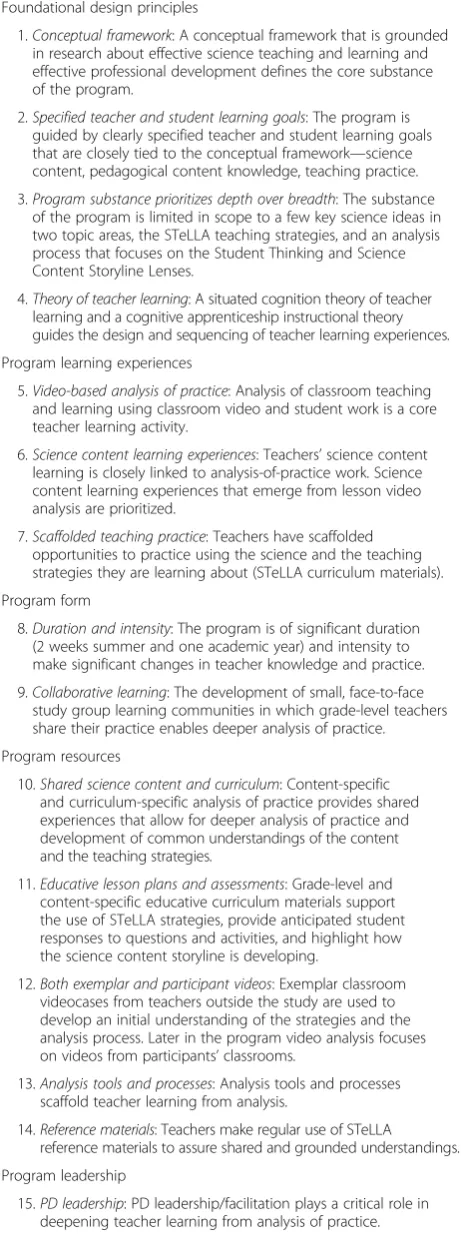
What makes this VbPD program so effective? Although the STeLLA VbPD program includes the surface features of the consensus model, we assert that these features do not explain the program’s power. It is not just that teachers were engaged in content-specific, collaborative, video-based analysis-of-practice. Instead, the program has been guided by a more specific set of 19 design principles that challenge us to dig beneath the surface of the consensus model (see Table 2). In the next sections, we describe how these design principles guided the substance and form, imple-mentation, leadership, and scaling up of the STeLLA VbPD program.
Foundational design principles of the STeLLA video-based PD program
We begin with four foundational design principles that have played central roles throughout the development, implementation, leadership, and scaling up of the program.
Table 1STeLLA-II impact estimates
Outcome Unstandardized treatment effect Standard error t df p Hedges’g(WWC)
Student achievement 6.11 [4.46, 7.76] 0.84 7.27 74 <.001 0.68 [0.60, 0.76]
Teacher content knowledge 4.77 [3.26, 6.28] 0.77 6.16 75 <.001 0.66 [0.31, 1.00]
Teacher pedagogical content knowledge 5.33 [3.74, 6.92] 0.81 6.58 75 <.001 1.17 [0.81, 1.53]
Design principle 1: conceptual framework
The STeLLA VbPD program was designed to improve elementary science teaching at a time when science teaching and science PD activities were low on teachers’ priority lists (Dorph, Shields, Tiffany-Morales, Hartry, and McCaffrey 2011). At the same time, researchers and PD providers were advocating that effective PD engages teachers in sustained, collaborative analysis of practice over time using artifacts of practice such as videos and student work (Ball and Cohen 1999; Garet et al. 2001). How could we interest elementary teachers in participat-ing in such sustained science PD? In this context, the STeLLA research and design team decided to explore what would be possible if elementary teachers engaged in video-based, analysis-of-practice PD activities inten-sively for 1 year. This limited time frame raised import-ant questions about the substance of the PD program: What is possible within a 1-year period? Is it possible to change science teaching practice enough in just 1 year to impact student learning? To achieve such a goal within a 1-year period, it was assumed that the substance of the program would need to be tightly focused on a few ideas and teaching practices addressed in depth and over time.
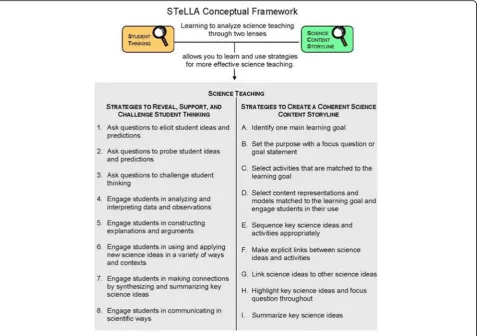
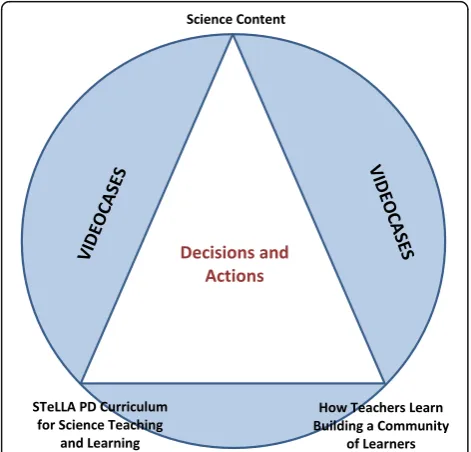
Based on a thorough review of the research on effective PD and the much larger research base about effective science teaching, the STeLLA-I design team made difficult choices about what to focus on and what to leave out. The result was a conceptual framework for the entire PD program (see Fig. 2). The framework centers on two types of pedagogical content knowledge (PCK) that were hypothesized to have the most impact on teacher learning, science teaching practice, and student learning within a 1-year time frame: (1) revealing, supporting, and challen-ging students’ ways of thinking about specific science content, and (2) supporting students in constructing coherent science content storylines. Note that we did not attempt to address all kinds of pedagogical content Table 2Design principles in the STeLLA line of research
Foundational design principles
1.Conceptual framework: A conceptual framework that is grounded in research about effective science teaching and learning and effective professional development defines the core substance of the program.
2.Specified teacher and student learning goals: The program is guided by clearly specified teacher and student learning goals that are closely tied to the conceptual framework—science content, pedagogical content knowledge, teaching practice.
3.Program substance prioritizes depth over breadth: The substance of the program is limited in scope to a few key science ideas in two topic areas, the STeLLA teaching strategies, and an analysis process that focuses on the Student Thinking and Science Content Storyline Lenses.
4.Theory of teacher learning: A situated cognition theory of teacher learning and a cognitive apprenticeship instructional theory guides the design and sequencing of teacher learning experiences.
Program learning experiences
5.Video-based analysis of practice: Analysis of classroom teaching and learning using classroom video and student work is a core teacher learning activity.
6.Science content learning experiences: Teachers’science content learning is closely linked to analysis-of-practice work. Science content learning experiences that emerge from lesson video analysis are prioritized.
7.Scaffolded teaching practice: Teachers have scaffolded opportunities to practice using the science and the teaching strategies they are learning about (STeLLA curriculum materials).
Program form
8.Duration and intensity: The program is of significant duration (2 weeks summer and one academic year) and intensity to make significant changes in teacher knowledge and practice.
9.Collaborative learning: The development of small, face-to-face study group learning communities in which grade-level teachers share their practice enables deeper analysis of practice.
Program resources
10.Shared science content and curriculum: Content-specific and curriculum-specific analysis of practice provides shared experiences that allow for deeper analysis of practice and development of common understandings of the content and the teaching strategies.
11.Educative lesson plans and assessments: Grade-level and content-specific educative curriculum materials support the use of STeLLA strategies, provide anticipated student responses to questions and activities, and highlight how the science content storyline is developing.
12.Both exemplar and participant videos: Exemplar classroom videocases from teachers outside the study are used to develop an initial understanding of the strategies and the analysis process. Later in the program video analysis focuses on videos from participants’classrooms.
13.Analysis tools and processes: Analysis tools and processes scaffold teacher learning from analysis.
14.Reference materials: Teachers make regular use of STeLLA reference materials to assure shared and grounded understandings.
Program leadership
15.PD leadership: PD leadership/facilitation plays a critical role in deepening teacher learning from analysis of practice.
Table 2Design principles in the STeLLA line of research
(Continued)
16.PD leader knowledge and decision-making abilities:
PD leadership/facilitation requires the ability to draw from a rich base of knowledge (Pedagogical Content Knowledge for PD Leaders) to make planning and in-the-moment, program-aligned decisions and adaptations.
Scalability and sustainability
17.PD leader development: PD leaders are continuously supported in learning how to effectively implement this program.
18.Partnership development: A partnership of science education experts and researchers, scientists and mathematicians, and school personnel at multiple levels are involved in ensuring successful implementation across a school district.
knowledge. We selected these two dimensions for three reasons. First, they represent an important subset of the topic-specific professional knowledge defined in expert models of PCK (Gess-Newsome 2015). Second, we hy-pothesized that these two dimensions would be impacted by the video analysis intervention. And finally, these are perspectives that teachers do not typically use to frame and guide their planning and teaching (Sherin and Van Es 2002; Zannoni and Santagata 2002). To focus on these aspects of PCK, teachers in the program use two lenses to guide their video-based analysis work and their classroom science teaching practice: the Student Thinking Lens and the Science Content Storyline Lens.
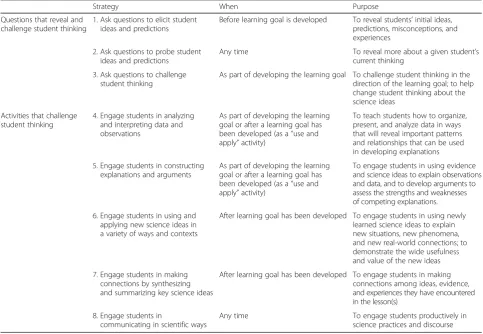
The Student Thinking Lens focuses teachers’attention on revealing, supporting, and challenging student thinking. It builds on a large body of research regarding students’ ideas about natural phenomena, how student ideas might influence science teaching, and the importance of attending to student ideas and cultures in supporting science learning of students from groups underrepresented in science (National Research Council (NRC) 2000; NRC 2005; NRC 2007). Eight teaching strategies support teachers in enacting the Student Thinking Lens in their classrooms
(see definitions in Appendix 1). These teaching strategies reflect an instructional model that:
Elicits students’initial ideas and predictions about phenomena,
Engages students with data, observations, and models that challenge their initial thinking and reasoning, Supports students in constructing explanations
from evidence,
Challenges students to use and apply new ideas to explain new phenomena, and
Focuses students on making connections by synthesizing and summarizing key ideas.
Throughout all of this, the teacher probes student thinking to find out how students are making sense of new data or ideas, challenges students to stretch their thinking and to make new connections, and teaches stu-dents to communicate in scientific ways (such as making claims, providing evidence and reasoning to support claims, and listening and responding to others’ideas).
The Science Content Storyline Lens focuses attention on how the science ideas in a science lesson or unit are
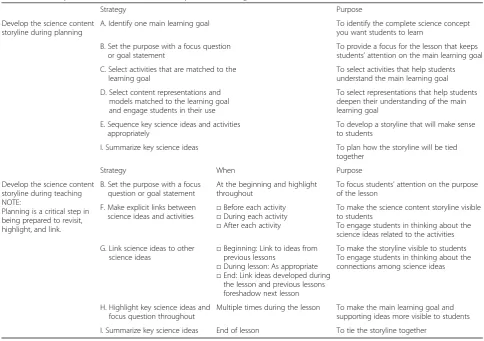
sequenced and linked to one another and to lesson activities to help students construct a coherent “story” that makes sense to them. The Trends in International Mathematics and Science Study’s (TIMSS) video analysis of science teaching and Horizon’s Looking Inside the Classroomobservational study of science teaching in the USA both identified that US science lessons frequently fail to support students in making connections between science classroom activities and the development of science ideas and explanations (Roth et al., 2006; Weiss et al. 2003). The Science Content Storyline Lens addresses this gap by supporting teachers in using nine planning and teaching strategies that help students build coherent content storylines (see definitions in Appendix 2)
Grounded in research, the conceptual framework serves as the foundation and the centerpiece of the PD program, with all summer and school-year sessions organized around the STeLLA lenses and strategies. It anchors the program and assures program coherence by keeping the substance and activities in the program tightly focused on two analytical lenses and a few key ideas and teaching strategies that can be explored in depth and developed into teachers’practice.
Design principle 2: specified teacher and student learning goals
The STeLLA VbPD program is guided by clearly specified teacher and student learning goals that are closely tied to the conceptual framework. Identifying and articulating these learning goals from the beginning is essential for designing and implementing both science lessons and PD sessions that are coherent, focused, and supportive of student/teacher learning. In our work, learning goals for students focus on understanding and using core science ideas. Learning goals for teachers include science content knowledge, pedagogical content knowledge related to classroom science teaching, and abilities to use both these types of knowledge to analyze and teach science.
Science content learning goals for students and teachers
The goal in STeLLA work is for teachers and students to develop understandings of key science ideas and re-lated crosscutting concepts through the use of science practices such as analyzing and interpreting data and constructing explanations (STeLLA strategies 4 and 5, see Fig. 2). This aligns with the emphasis in the NGSS that school science learning should parallel how scien-tists use science practices to develop conceptual under-standings of the world around us (NGSS Lead States 2013). By developing understandings of key science ideas through such evidence-based reasoning, we expect stu-dents and teachers to be able to use and apply these ideas to analyze, interpret, and/or explain new data or pheno-mena that they encounter (STeLLA strategy 6, see Fig. 2).
For this reason, our assessments include reasoning items which challenge students and teachers to use their under-standings of core science ideas to analyze or explain data or representations that are new to them.
The STeLLA conceptual learning goals are stated as complete sentence ideas (similar to what is written as Disciplinary Core Ideas and Crosscutting Concepts in the NGSS). For each grade level in STeLLA-I and STeLLA-II, we identified student and teacher sets of science learning goals in two content areas that were in the state standards and school curricula of participating teachers. In the RE-SPeCT project, which started after the release of the NGSS, these content learning goals focused largely on NGSS-defined disciplinary core ideas and crosscutting concepts.
Several criteria were used to select the science learning goals. Priority was given to ideas that are (a) challenging for teachers and students, (b) that can be used to explain a variety of phenomena in teachers’and students’ experi-ence, and (c) that are supported by a research base that identifies common student difficulties and naïve theories related to learning this content. In addition, we wanted the subset of approximately 5–10 science ideas in each content area to be interconnected so that they could all be used together in culminating“use and apply”problem solving tasks. All lesson plans, content deepening work, and video analysis work remained focused on this set of interconnected ideas.
Theteacher science content learning goals include the student science learning goals but go beyond them so that teachers have a deeper understanding of the science ideas they will be teaching and a better sense of the fu-ture trajectory of their students’ learning in this content area. The teacher science learning goals are addressed in the program in two main contexts: (a) through content deepening activities for teachers in the summer institute that are similar to those in the lesson plans for students, and (b) through opportunities that arise in the context of lesson video analysis throughout the program.
Additional learning goals for teachers
In addition to science content learning goals, STeLLA teachers are also expected to develop pedagogical con-tent knowledge related to the Student Thinking and Science Content Storyline Lenses and teaching strategies. Furthermore, it is a goal for teachers to be able to use their content knowledge and their pedagogical content know-ledge to analyze science teaching and learning. A final broad learning goal is for teachers to use their content and pedagogical content knowledge about the STeLLA lenses and strategies in their science teaching practice. The con-ceptual framework outlines the specific teaching strategies that teachers learn to understand and use (Fig. 2).
creating the overall design of the STeLLA program and the development of research assessments. However, these overall program goals were insufficient for map-ping out the daily PD sessions during the summer insti-tutes and school year study group sessions. Over time, especially as we began to develop new PD leaders and to write detailed PD leader guides, we recognized the need to state more specifically the teacher learning goals for each professional development session and for each segment of a PD session. We recognized that just as students’science lessons are more coherent and power-ful if they remain clearly focused on one main learning goal throughout a lesson (STeLLA strategy A, see Fig. 2), so our PD sessions are more coherent and powerful if we remain focused on what we expect teacher partici-pants to learn from a particular session and from par-ticular segments of a PD session. Figure 3 shows how the STeLLA PD leader guide provides fifth grade PD leaders with specific statements of purpose and intended learning goals for a 70-min time segment that occurs during a full-day summer institute session.
In STeLLA VbPD, such specificity of the learning goals is critical in assuring coherence among all the compo-nents of the program. It plays a key role in developing the science lesson plans and videocases, in selecting video clips to use for analysis, and in deciding how to focus the video analysis discussions. Video analysis work
is time intensive, so planning for a productive session is important. Video clips for STeLLA analysis are selected not just because they are interesting but because they will help teachers wrestle productively with intended learning goals—both specific science content learning goals and pedagogical learning goals.
Design principle 3: program substance prioritizes depth versus breadth
A key design feature of all STeLLA-related programs is depth over breadth—maintaining a relatively small set of teacher learning goals that are introduced early in the program and then revisited and practiced throughout the program. The substance of the program is limited to a few core science ideas in two topic areas, the STeLLA teaching strategies, and the STeLLA video analysis process that uses the Student Thinking and Science Content Storyline Lenses as analytical tools. In parallel with what we know about students’needs in developing understandings of science ideas, teachers also need multiple opportunities to use and analyze the science content ideas and the STeLLA teaching strategies that they are learning. Teachers initially encounter almost all of the program’s science content ideas and STeLLA teach-ing strategies durteach-ing the summer institute. Across the school year, only a few new learning goals are introduced. Instead, teachers have multiple opportunities to use and
deepen their understandings of previously introduced ideas in their teaching and in their collaborative analyses of videos and student work.
Design principle 4: theory of teacher learning
Many PD programs are not guided by an articulated theory of teacher learning (Ball and Cohen 1999; Borko 2004; Putnam and Borko 2000). In the STeLLA program, in contrast, decisions about program design are explicitly guided by a situated cognition theory of teacher learning and a cognitive apprenticeship model of instruction. Situated cognition posits that learning is naturally tied to authentic activity, context, and culture (Collins 2006; Lave and Wenger 1991). In line with this theoretical stance, the STeLLA program is organized to support grade-level specific, classroom-based (“situated”) learning over time, with more direct scaffolding and guidance by PD tools and PD leaders at the beginning of the program that moves toward more teacher-directed work at the end of the 1-year program. The cognitive apprentice-ship phases of modeling, coaching and scaffolding, and fading guide how the PD leaders work with par-ticipants across time.
Implementation design principles for STeLLA video-based analysis of practice
Because this special issue focuses specifically on video-based PD, we will anchor our description of the implemen-tation of the STeLLA PD around a central activity in the program: video analysis-of-practice (design principle 5). In this section, we describe how the video analysis work is supported and linked to other design principles, highlight-ing ways in which the design principles work together to support meaningful video analysis.
Although we are highlighting the role of video ana-lysis in the STeLLA program, it is important to keep in mind that teachers in this program are doing more than video analysis. Their analysis-of-practice work (design principle 5) includes analysis of student work, especially the comparison of students’ pre- and posttest writing, and the analysis of the STeLLA lesson plans. In addition, teachers are engaged in teaching STeLLA exem-plar lesson plans in the fall and in planning and teaching lessons in a second content area in the spring (design principle 7). Teachers have opportunities to learn from this planning and teaching work that go beyond what they are learning from video analysis work.
Design principle 5: video-based analysis of practice
What is being analyzed in STeLLA video analysis? Before describing what teachers and PD leaders do in STeLLA video analysis, we start by linking back to the foundational design principles 1–3 and the importance of clearly defining the substance of the PD program; that
is, what are teachers going to learn from this video ana-lysis work? What are they analyzing and why?
While most descriptions of PD programs in research reports provide only a broad, general view of the pro-gram substance, we attempted to be more specific in defining what teachers would learn from video analysis while at the same time resisting the temptation to “cover”everything that we know is important in achiev-ing the best practice in science teachachiev-ing. For the science content, we identified science ideas in the teachers’ cur-riculum that we knew to be challenging for students and teachers, to be useful in explaining a variety of phenomena in teachers’and students’experiences, and to be linked to important crosscutting concepts (e.g., matter and energy).
To identify the STeLLA teaching strategies, we reviewed the research on science teaching and learning to identify what others now refer to as“high-leverage teaching prac-tices” (Ball and Forzani 2011; Windschitl, Thompson, Braaten, and Stroupe 2012: Grossman, Hammerness, and McDonald 2009). And it was important to us that the lenses and strategies in the conceptual framework were not just a random collection of teaching strategies but that they hung together to help teachers develop a vision of effective science teaching that they could internalize over time. Thus, before we decided how to organize and structure video analysis, we worked hard to clarify why teachers would be analyzing videos and to sharpen our understanding of what they would be learning from this work.
But there is an important way in which the STeLLA program goes beyond the consensus model in defining its program form. Decisions about STeLLA program form are driven by the situated cognition of teacher learning and the cognitive apprenticeship model of instruction (foundational design principle 4). This is especially evident in the way different kinds of activities are sequenced over time.
In the summer institute, teachers begin the analysis process using videocases from more experienced teachers. In addition to the modeling provided by these teachers in the videos, PD leaders model how to pro-ductively analyze these videos and they coach teachers in their analytical efforts. Thus, in line with our theoret-ical stance, teacher participants have access at the begin-ning of the program to models of expertise.
During the fall of the school year, they transition to analyzing video their own and their peers’ efforts to teach STeLLA model lesson plans, receiving support, feedback, and guidance in this work through their col-laborative analyses of videos and student work in study group interactions. This is consistent with the coaching phase of the cognitive apprenticeship model.
In the second half of the school year, scaffolding supports such as model lesson plans are removed (fading) and teachers are challenged to use STeLLA strategies and tools to plan and teach lessons in a new content area. This intentional use of a theory of teacher learning required us to consider what types of activities would be most beneficial for teacher learning across time, rather than settling on one type of video analysis and using it throughout the program.
What features contribute to productive video analysis? While the foundational design principles drive the sub-stance and form of STeLLA video analysis, there are a number of other features that work together to make important contributions to the quality of video analysis and to teacher learning:
Design principle 10: shared science content In line with our situated cognition theory of teacher learning, it is essential that teachers work on science content that is in their grade-level curriculum. This assures that each teacher is working in a meaningful, authentic context. In addition, when teachers are all using the same content learning goals, it enables shared experiences that allow for deeper analysis of practice and for development of common understand-ings of the content and teaching strategies.
Design principle 11: educative curriculum materials and assessments In the fall, teachers are supported in teaching exemplar lesson plans that are designed to highlight anticipated student thinking, the science content storyline, and the STeLLA strategies. These educative curriculum materials are intended to scaffold teachers’ developing understanding of the science content and their
beginning use of the STeLLA teaching strategies. For each content area, there is a set of 6–12 lesson plans and a pre-post assessment. As with design principle 10, these shared curriculum materials provide participants with a common teaching experience that enables deeper and more mean-ingful analyses of that practice.
Design principle 12: both exemplar and participant videos In the STeLLA program, teachers begin the video analysis process in the summer by analyzing the practice of other teachers shown in grade-level and content-specific videocases prepared by the STeLLA program development team. These videocases include classroom video of science teaching that shows the STeLLA strategies in action, video of student interviews about the science content before and after an instruc-tional sequence of lessons, and written student work on pre- and posttests. The STeLLA researchers review these videocases and select clips that will be used during the summer institute to engage teachers in developing their initial understandings of (a) the science content, (b) the STeLLA teaching strategies, and (c) the video analysis process. During the school year, teachers use the STeLLA lesson plans and are each videotaped during one lesson. During study group sessions, teachers analyze video clips of the implementation of these lessons from their own and their colleagues’classrooms.
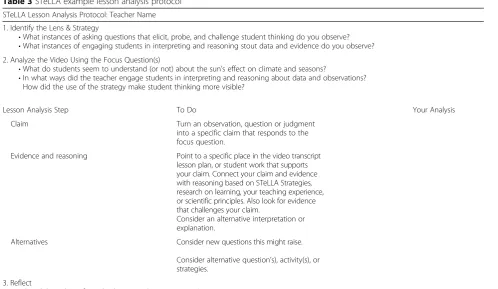
Design principle 13: analysis tools and processes
questions, (2) evidence from the video or transcript to support the claim, (3) reasoning from STeLLA resources and/or research that clarifies why the claim and evidence are important, and (4) an alternative interpretation, sug-gested teaching approach, or a missed opportunity. During discussion, teachers share and discuss their analyses. The process ends with participants reflecting on what they learned from the analysis discussion.
Design principle 14: reference materials There are two key reference documents that are used extensively at the beginning of the program and are then referred back to throughout the program to support teachers in developing and maintaining common understandings of the STeLLA conceptual framework and strategies and of the science content. In the summer institute, teachers first learn about each of the STeLLA strategies by read-ing about them in theSTeLLA Strategiesbooklet. During the school year, this booklet is frequently used as a re-source to support teachers’claims, evidence, reasoning, and alternatives in the lesson analysis process.
Teachers also refer often to a topic-specific content and pedagogical content background document. On the one hand, this is a content background document that is matched to the student and teacher science learning goals in the STeLLA program. But it is also a peda-gogical content knowledge (PCK) document. In this
regard, it describes the science content in the context of teaching situations, analyzes common student misunder-standings and difficulties, and describes strengths and weaknesses of common teaching activities, analogies, and content representations.
Leadership design principles for STeLLA video-based analysis of practice
Design principle 15: PD leadership
In the STeLLA design, leadership of analysis-of-practice work plays a critical role in deepening teacher learning. Our choice of the title, “PD leaders,” reflects our recogni-tion that leadership is necessary for the kinds of trans-formative change we seek. Some might view this as too “top down”and argue for an approach where teachers and PD leaders are co-constructing knowledge together (this is what some refer to as “facilitating” rather than“leading”). But our experience early on in the development of the STeLLA program convinced us that elementary teachers— who are typically reluctant to teach science—initially need both access to expertise from the science education com-munity and support in learning to incorporate this know-ledge into their science teaching practice. With fading supports from PD leaders over time, study groups gradually begin to function in a more bottom up way. In fact, we can imagine experienced STeLLA study groups functioning productively without a PD leader as they continue beyond Table 3STeLLA example lesson analysis protocol
STeLLA Lesson Analysis Protocol: Teacher Name
1. Identify the Lens & Strategy
•What instances of asking questions that elicit, probe, and challenge student thinking do you observe?
•What instances of engaging students in interpreting and reasoning stout data and evidence do you observe? 2. Analyze the Video Using the Focus Question(s)
•What do students seem to understand (or not) about the sun’s effect on climate and seasons?
•In what ways did the teacher engage students in interpreting and reasoning about data and observations? How did the use of the strategy make student thinking more visible?
Lesson Analysis Step To Do Your Analysis
Claim Turn an observation, question or judgment into a specific claim that responds to the focus question.
Evidence and reasoning Point to a specific place in the video transcript lesson plan, or student work that supports your claim. Connect your claim and evidence with reasoning based on STeLLA Strategies, research on learning, your teaching experience, or scientific principles. Also look for evidence that challenges your claim.
Consider an alternative interpretation or explanation.
Alternatives Consider new questions this might raise.
Consider alternative question’s), activity(s), or strategies.
3. Reflect
the 1-year STeLLA program because they know how to analyze science teaching and learning productively to im-prove their science teaching practice, they know when and where to find outside expertise, they understand how to function as a true learning community, and they under-stand the kinds of science knowledge they need to develop when they approach new science content areas—knowledge that enables them to explain a variety of phenomena using key science concepts and practices.
Design principle 16: PD leader knowledge and decision-making abilities
It is not enough to say that“PD leadership is important.” In thinking toward the scale up of the STeLLA approach, we recognized the need to understand what it takes to develop new PD leaders: What kinds of knowledge and abilities are needed? Analysis of the work of effective STeLLA leaders enabled us to answer this question with the knowledge and decision-making model of STeLLA PD leadership shown in Fig. 4 (Landes & Roth, 2013).
The model highlights that effective leadership of STeLLA lesson video analysis depends on PD providers who are able to draw from a rich knowledge base to make decisions and take actions—both in planning and while leading video analysis sessions—that support teacher learning through deep and meaningful analyses. The model specifies that well-prepared STeLLA PD leaders make decisions and take actions by drawing from three types of knowledge: (a) knowledge of the STeLLA PD curriculum (conceptual framework, learning goals, STeLLA strategies, STeLLA resources, lesson plans, etc.),
(b) science content knowledge (including how science practices can be used to explain phenomena and to under-stand disciplinary core ideas and cross cutting concepts), and (c) research-based knowledge about how teachers learn in communities of learners. In addition, PD leaders draw from knowledge of the particular videos that are being analyzed. PD leaders know how to use all of this knowledge to make planning and in-the-moment, program-aligned decisions and adaptations.
A key planning decision made by PD leaders is the selection and sequencing of video clips so that they best support targeted teacher learning goals for a given study group session. PD leaders watch the full lesson videos from the participating teachers to select a 3–8-min video clip from each teacher whose video will be analyzed during a given study group session. In making these selections, the PD leaders consider ways in which the video clips can be used (a) to deepen teachers’ under-standing of the STeLLA strategies, (b) to clarify and deepen teachers’science content understandings, and (c) to analyze interesting examples of student thinking. PD leaders also consider how the set of 3–4 video clips for a given study group session can hang together to focus on specific teacher learning goals for the overall meeting. From watching the full lesson videos, the PD leader learns a great deal about the strengths and weaknesses of the lessons and of teacher implementation of the les-sons and uses this knowledge to identify key issues that could be productively examined through video analysis. Last but not least, PD leaders consider how a video clip might support and encourage the teacher featured in the clip while also challenging that teacher to reflect on her/ his own teaching in ways that lead to growth; this re-quires assessing that teacher’s readiness to be challenged. All of this is considered as PD leaders select the video clips, identify specific teacher learning goals for the ses-sion, and create specific identify and analysis questions to focus the discussion and analysis for each clip.
During video analysis discussions, PD leaders make in-the-moment decisions about when and how to take the following kinds of actions:
Asking elicit and probe questions to encourage teachers to share and elaborate their thinking Asking challenge questions to scaffold and
deepen teachers’analyses and understandings of both science content and pedagogical content (e.g., What is your evidence? Can you find something in the strategies booklet or science content background document that supports your reasoning?)
Modeling the video analysis process by sharing her/ his own claim, evidence, reasoning, and alternative about a video clip
Modeling and reflecting metacognitively on the PD leader’s use of STeLLA teaching strategies (e.g., PD leaders explicitly name or ask about STeLLA strategies that they are modeling) Encouraging participation by all (e.g., directing
teachers to do a turn and talk before a whole group discussion, using a round robin strategy to hear ideas from each person, asking questions such “What do others think?,”encouraging teachers to respond to each other and to ask probe and challenge questions to each other)
Interrupting the video analysis process to engage in some needed science content deepening work Highlighting and summarizing key points
(e.g., charting key science ideas, summarizing the key ideas coming out of analysis of a video clip) Asking teachers to summarize or paraphrase what
they have heard
Providing feedback about the quality and accuracy of teacher ideas (generally limited to times when discussions hit a roadblock and the PD leader assesses that it is not a good use of time to resolve the issue by sending teachers to resources or engaging in a content deepening activity)
Remaining silent (e.g., letting the conversation be more teacher directed)
A key decision PD leaders make is about when and how to address gaps in teachers’science understandings that arise during video analysis. Taking the time in video analysis sessions to wrestle with science content confu-sions is a critical aspect of the STeLLA program. Our research results show that teachers’science understand-ings were better developed in the context of lesson video analysis (in the STeLLA program) than in sessions that focused specifically on deepening teachers’ understand-ings of the science content (in the content deepening comparison program). This is consistent with our situated theory of teacher learning—understanding the science content is more meaningful to teachers when it occurs in relationship to their teaching context.
Without the PD leaders’ active role in scaffolding the video analysis process, especially at the beginning of the program, teachers tend toward a surface level discussion of video clips, favoring positive comments about the teaching or teacher featured in the clip. With PD leader guidance and use of the Lesson Analysis Protocol, teachers’ attention is focused on student thinking, the science content, the storyline, and the use of STeLLA strategies, minimizing the focus on an individual teacher while maximizing the analysis of more consequential issues that impact student learning.
Design principles for scaling and sustaining the STeLLA video-based PD program
The effectiveness of the STeLLA VbPD program has been demonstrated through careful research—effective not only for teacher learning and practice but more im-portantly for student learning. But video-based analysis of practice is intense, requiring significant human and other resources to support its success. It is definitely not a quick fix. STeLLA-I and STeLLA-II VbPD programs were designed to be workable and sustainable as long as there was significant project funding from the National Science Foundation. The video focus, the need for transcripts to support evidence-based video analysis, the need for science hands-on materials to support the teaching of the STeLLA lessons, and the facilitated, small study group face-to-face structure of this PD approach pose challenges for scalability and sustainability. The RE-SPeCT project is addressing the challenge of scaling and sustaining this VbPD approach by (a) developing a cadre of teacher leaders at both the district level (teacher specialists) and school levels (classroom teachers), (b) developing university science and mathematics faculty who can support this work beyond the life of the grant in PUSD or in new school districts, and (c) implement-ing changes within the district and university systems that will enable teachers and professors to participate effectively in this program.
In this section, we describe more specifically what we are doing in the RESPeCT project to support the scaling and sustainability of this VbPD program. Three design principles guide this work: principle 17 pertains to the development of new VbPD leaders while principles 18 and 19 focus on development and sustainability of systems in which VbPD PD leaders can effectively work.
Design principle 17: PD leader development
The development of STeLLA VbPD leaders who have the knowledge and abilities described in Fig. 4 is critical to enabling more teachers and students to have access to this powerful program. To address this need, a leadership development program was designed, developed, and enacted in the RESPeCT project. The leadership develop-ment program attends to the full scope of the STeLLA knowledge and decision-making model (Fig. 4).
The content of the leadership program and the process of developing VbPD leaders changes based on the needs of the audience. We have worked with a variety of audiences, including (but not limited to):
Experienced science education PD leaders who are unfamiliar with the STeLLA PD program
have limited knowledge and experience in leading adult learning
District level PD specialists who have experienced the STeLLA program as learners
University science and mathematics faculty unfamiliar with the STeLLA approach and with varying levels of experience in working with teachers.
When the audience is experienced science PD leaders with little experience with the STeLLA VbPD program, the balance of leadership development tips toward the content of the STeLLA VbPD curriculum (lower left hand corner in Fig. 4). However, when the audience has experi-enced the STeLLA VbPD program and implemented the STeLLA classroom curriculum, the balance of leadership development tips toward developing understandings about and abilities to lead adult learning (lower right hand cor-ner in Fig. 4). For science and mathematics professors unfamiliar with either the STeLLA approach or working with teachers, leadership development focuses on the bottom two corners of the triangle in Fig. 4, developing their understanding of the STeLLA VbPD program goals and components and their knowledge about teacher learning in learning communities.
Regardless of audience, one element of VbPD leader-ship development remains constant—a focus on making decisions and taking actions consistent with the STeLLA approach. Effective PD leaders know the purpose for each component of the program. They understand what they are doing as PD leaders and why they are doing it. Major goals and activities in the leadership program are described in the following paragraphs.
Taking on a leadership identity
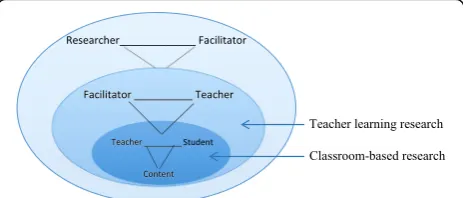
To help classroom teachers who have not previously led PD see themselves as leaders, we are explicit about how the leadership development program helps prepare them to lead the learning of their teacher colleagues. For each PD experience, we point to a model similar to the figure presented in the introduction to this special issue (Tekkumru-Kisa and Stein 2017, Fig. 5). This model helps RESPeCT teacher participants see where they fit in
terms of their experiences as a learner in the STeLLA program (teacher as learner, inner layer), their experi-ences in the RESPeCT leadership development program (facilitator as learner, outer layer), and their eventual role as PD facilitators (middle layer).
STeLLA strategies become PD leader strategies
The leadership development program supports PD leaders in learning to use the STeLLA lenses and strategies in the PD setting. Most of the STeLLA strategies are just as use-ful in the VbPD context as they are in supporting elemen-tary students’science learning. PD leaders are supported in learning how to use the STeLLA strategies through three types of analysis experiences: (1) analysis of their own experiences observing PD leaders in the leadership development program, (2) video analysis of other PD leaders working with study groups, and (3) video analysis of their own PD leadership practice after they begin to lead groups of teachers in this VbPD.
The balance between supporting and challenging teachers
PD leaders need to find the right balance between “ sup-porting” and “challenging” teachers. By supporting, we mean using PD leader moves that encourage teachers by signaling that their ideas are valued and that they are making progress toward program goals. By challenging, we mean PD leader moves that press teachers to recon-sider, revise, or better support their ideas. This often comes with some level of discomfort. PD leaders learn to make decisions about when and how to support or challenge teachers by analyzing video of other PD leaders and later by analyzing video of their own leader-ship practice, focusing on PD leader moves that support and/or challenge teachers. In working toward this bal-ance, PD leaders learn to be intentional when they pose questions that elicit or probe teachers’ ideas, when they ask questions that challenge teacher thinking, or when they use any of the other STeLLA strategies in the con-text of teaching professionals.
Communities of learners
The leadership development program explicitly ad-dresses how to develop communities of learners. For example, PD leaders consider their own experiences in light of readings about characteristics of professional learning communities (PLCs) (Garmston and Wellman 2009; Hall and Hord 2015; Loucks-Horsley, Stiles, Mundry, Love, and Hewson 2010) and identify aspects of the STeLLA VbPD program that contribute to the development of such communities. Use of the STeLLA study group norms and the Lesson Analysis Protocol for video analysis help to develop shared values and behaviors that provide a safe environment for develop-ing relational trust. Participants come to understand
how STeLLA video analysis promotes reflective dialogue and deprivatized practice. Taking a step back, they come to understand how the coherence of the STeLLA lessons, content deepening, and lesson analysis planning work contribute to a collaboration focused on student learning.
Understanding change
For audiences with little experience in leading PD, such as RESPeCT teacher leaders or many science professors, the leadership development program includes a focus on leading adult learning. Specific attention is paid to un-derstanding change and what it means to lead change, anticipating and mediating sources of resistance, and managing their own responses during conflict (Hall and Hord 2015). For new teacher leaders in the RESPeCT program, this is particularly important as they anticipate work with their grade-level teacher peers.
Selecting video and planning coherent PD study group sessions
Participants in the leadership development program examine models of video clips and rationales for their selection. PD leaders learn to select clips which repre-sent a progression in the use of STeLLA strategies and a storyline of the science content. For example, the first clip in a study group session might focus on an early lesson in the sequence that reveals common student ideas about steam through the use of elicit and probe questions (STeLLA teaching strategies 1 and 2). The second clip may show a later lesson where students negotiate this idea through an activity matched to the learning goal (STeLLA teaching strategy C) in which students analyze and interpret data from their observa-tions of a tea kettle (STeLLA teaching strategy 4). A third video clip may come from later yet in the lesson sequence and show students attempting to use and apply science ideas (STeLLA teaching strategy 6) about evap-oration and condensation as they compare/contrast cloud formation and steam from a tea kettle.
Deepening PD leaders’science content knowledge
To effectively facilitate science content deepening, PD leaders must achieve a level of confidence with the con-tent that enables them to identify gaps in participants’ content knowledge and to decide“in-the-moment”how to address them. In the leadership program, content deepe-ning is embedded in two contexts. First, as in the STeLLA program itself, content deepening in the leadership pro-gram is addressed by engaging participants (teacher leaders as learners) in video analysis. For example, teacher leaders watch a science lesson clip followed by a study group clip in which teachers are discussing the lesson clip. In the clips, both student and teacher misunderstandings
of science content are revealed. This provides an oppor-tunity for teacher leaders in the leadership program to clarify their own content understandings as they also think about how to lead sessions where such misunderstandings arise. Content deepening also occurs as teacher leaders are supported by science and mathematics faculty in prac-ticing their implementation of content deepening seg-ments of the VbPD program.
Deepening pedagogical content knowledge
Video analysis is also used to deepen leaders’pedagogical content knowledge regarding the use of STeLLA lenses and strategies. As participants in the leadership program examine video of study groups, they analyze PD leader knowledge, moves, and decision-making. In this context, opportunities also arise to clarify teacher leaders’ under-standing of common student ideas and effective use of the STeLLA strategies related to the target science content learning goals.
Practice leading STeLLA PD
The leadership development program engages PD leaders in practice facilitation of both lesson analysis experiences and content deepening activities. To create safe learning contexts, the practice facilitation involves participants in leading content deepening experiences within their own study group and in leading analysis of video to RESPeCT teacher leaders from other grade level study groups. These practice opportunities are scaffolded to include planning, doing, and reflecting stages. PD leader guides support the practice facilita-tion, providing details about how to implement each summer institute and school year study group session. These guides are linked to associated PowerPoints, handouts, and video clips.
With the development of new PD leaders across the STeLLA-II and RESPeCT implementations, the STeLLA VbPD program has expanded its reach by developing 50 new PD leaders who in turn have worked with 200 teachers and their 7019 students. Through this multi-stage process, we learned that you cannot shortchange any component of the STeLLA model of PD leader knowledge and decision-making. An effective STeLLA PD leader understands the science content, the many facets of the STeLLA PD and classroom curricula, how teachers learn and change their practice in a community of learners, and how to use this knowledge to lead pro-ductive video analysis.
Design principle 18: partnership development and design principle 19: scalability and sustainability
learning, it is an ambitious program that faces chal-lenges in expanding the reach of the program. One challenge is the development of new, grade-level specific PD leaders who have the knowledge and abilities de-scribed in the previous section. Other requirements that might be impediments to long-term sustainability are the need for funding and other benefits to motivate teacher PD leaders in continuing to offer the VbPD to peer teachers; funding and other rewards to encourage teachers to participate in the VbPD; support and strategies for film-ing classrooms and makfilm-ing, transcribfilm-ing, and disseminat-ing video clips on a tight timeline; time for teacher PD leaders to review lesson videos and plan study group ses-sions; funding for and distribution of PD and science lesson plan materials; stable student science learning goals at each grade level so that the videocases remain relevant; stable grade-level teaching assignments so that teachers are teaching the content addressed in the VbPD program; supports to motivate and sustain university faculty com-mitment to providing ongoing science content advice to teacher PD leaders beyond the life of the grant; refilling the pipeline of teacher leaders and university support fac-ulty; and strong district and university leaders who can lead successful responses to changes in staffing, curricu-lum, and institutional priorities that impact the VbPD program.
To preserve fidelity to the STeLLA design features and sustain the VbPD program, we must do more than prepare new teacher PD leaders. Educational systems must also be readied. In the RESPeCT project, the systems involved in sustaining the work are the Pomona Unified School District and the California State Polytechnic University at Pomona.
Together, but not individually, CPP and PUSD have the needed expertise identified in design principle 18: science education experts and researchers, scientists and mathe-maticians, teachers, and school personnel at multiple levels. This combined expertise is necessary to modify the VbPD program in ways that preserve the STeLLA design features while incorporating features that will contribute to the program’s scalability and sustainability. Thus, neither organization can scale and sustain the program independently of each other. However, the components of readiness required by both partner systems include (a) a shared priority for improving student science learning, (b) shared values and commitments to VbPD; (c) ongoing communication and shared decision making to support, sustain, and study the collaboration; (d) investments in building capacity for VbPD; and (e) inclusion of multiple stakeholders in shaping and implementing the program.
Developing systems readiness
Both CPP and PUSD partners have worked on develop-ing these components of system readiness, as described in the following paragraphs.
Priority for improving student science learning
In response to national and local testing and funding policies, many districts and schools have raised in-structional time requirements for elementary English language arts and mathematics which have had the effect of largely squeezing science out of the curricu-lum (Dorph et al. 2011). This is not the policy of the PUSD central offices, who are particularly interested in improving elementary science teaching in light of the impending curriculum shift to match the NGSS and the testing of science at the fifth grade level in California. However, in practice, many PUSD elemen-tary teachers put a low priority on science teaching. During the writing of the RESPeCT grant proposal, the PUSD and CPP partners agreed on the import-ance of making science learning a higher priority in the district. Project leaders agreed upon ways to mod-ify the STeLLA program to provide more incentive for teachers to prioritize science teaching. One modi-fication was to integrate key Common Core English language arts and mathematics standards into the sci-ence lessons that are the focus of the videocases in the VbPD program. In this way, teachers can see science instructional time as also time for developing important literacy and math competencies.
Shared values and commitments to VbPD
In addition to the shared commitment to improving science learning in the district, the project partners from the beginning held a shared vision about and a commitment to the goals and design of VbPD work. This shared vision was developed through four main joint activities: previous partnership work in PUSD middle schools that included some video analysis work using the STeLLA conceptual framework, study of the published research about the STeLLA program, col-laborative writing of the RESPeCT proposal, and the enactment of the VbPD program over the past 3 years. This shared commitment to VbPD helped build a mutual respect for the different types of knowledge, expertise, and credibility that the university and the district bring to the work; a commitment to acknow-ledge and balance each institution’s priorities and constraints to ensure the partnership is mutually beneficial; and active support of the program and flexibility about what can be achieved together.