© Swiss Society of Economics and Statistics 2009, Vol. 145 (1) 37–60 * Zürich University of Applied Sciences, School of Management and Law, CH-8401 Winterthur,
Switzerland. Tel.: +41.58.934 6887, Fax: +41.58.935 7110, Email: [email protected]. I thank Erdal Atukeren, Rocco Mosconi, and an anonymous referee for many helpful comments. The usual disclaimer applies.
Biased Estimation in a Simple Extension
of a Standard Error Correction Model*
Christian Müller
JEL-Classification: C51, E37, E47, C32
Keywords: policy analysis, forecasting, rational expectations, error correction
1. Introduction
The concept of cointegration (see e.g., Engle and Granger, 1987; Johansen, 1988) has been extensively used to model economic equilibrium relationships (see e.g., Juselius, 1990; Johansen, 1995; Hubrich, 2001). The links between economic and econometric concepts in modelling equilibria are now well under-stood and are part of the standard tools of empirical analysis. Loosely speaking, economic equilibrium relationships have their counterparts in cointegration, or, more generally speaking, error correction relationships whose existence can be tested and whose parameters can be estimated. The other side of the coin is the necessary adjustment back to the equilibrium once it has temporarily been dis-torted. This adjustment mechanism has also been analysed quite extensively. For instance, Ericsson, Hendry, and Mizon (1998) and Ericsson (1992) look at the implications for inference in cointegrated systems in the presence, or rather absence of equilibrium adjustment in one direction or another.
MacDonald (2004) use it to qualify certain variables as causal for other vari-ables based on the characteristics of the equilibrium correction mechanism.
Looking at vector autoregressive (VAR) models for policy analysis and advice, Hendry and Mizon (1998) point out that potential policy instruments must not feature error correction behaviour if they are supposed to have a lasting impact. Finally, Pesaran, Shin, and Smith (2000) argue that knowledge about the direc-tions of error correction yields useful information about large scale VAR model-ling which would otherwise be haunted by the curse of dimensionality.
This paper focuses on the determination of the adjustment mechanism in equilibrium or error correction models. It develops an example of an economic model which is fairly general in nature and which can easily be estimated with standard econometric tools. It will be shown that under moderate assumptions these tools are producing misleading results, i.e. the equilibrium adjustment coefficients are estimated with a bias which does not disappear asymptotically. This effect is obtained by considering expectations in the data generating proc-ess. In the light of the above mentioned references this can be considered rather bad news since the interpretation of the econometric results would be severely misguided.
The remainder of the paper is organised as follows. After a brief description of the problem, empirical examples in Section 3 illustrate the main issues and Section 4 discusses the results. An informal test is proposed to cope with the issue while a rough formal statement of the problem is sketched in the appendix.
2. An Economic Model and the Econometric Approach to It
2.1 The ModelWe consider a variable or set of variables y which is a function of another variable or set of variables z. The realisations of y and z through time are denoted yt and
zt respectively. Furthermore, expectations at time t about a value of a variable xt
at time t + s is denoted Et(xt+s). The relationship between yt and zt is given by
1
1 2
( ) , 0,
,
( ) , 1 2,
( ) , ,
and ( ) ( ), for some .
t t t s t
t t t
i t i i t
t t s t s t s
t t s t s j t t s
y E z s
z z
A L i
E z z s Z
E z z E z j s
+ ,
− ,
, ,
+ + +
+ + − +
= Λ +η >
=Φ +η
η = ε = ,
= +ι ∈
Biased Estimation in a Simple Extension of a Standard Error Correction Model 39
As usual, L and Δ are the lag and first difference operator respectively with xtLi = x t−i
and Δ = 1 − L. The terms 2 1
1 2 1
( ) i p ,
i n i i i p
A L = −I A L, −A L, − − A, +L+ i = 1,2, denote polynomials in the lag operator of length p + 1 at most. Their roots are strictly outside the unit circle and the innovations εi,t, i = 1,2 are independent multivariate white noise. The (n2 × n1) matrix Λ′ has full column rank n1 with 1 ≤ n1 ≤ n2, n1,n2 ∈ N.
As I am interested in reasonable forecasts only, it is further assumed that ιt – the forecast error – is a stationary variable. With ιt stationary the expected forecast error variance does not increase over time. As a side effect the long–run proper-ties of the system are exclusively ruled by Φ only.
A situation such as in Equation (1) very often arises in macroeconomic theory. For example, the real interest rate (playing the role of yt) is very often considered nothing but the sum of the real interest rate plus expected future inflation (this sum being zt+s here). Technically, it is easy to see that (1) is a simple augmenta-tion of the process considered by Engle and Granger (1987) whose system had
p = s = 0, ι = 0 ∀t, and
2. n
I Φ =
The following comments seem to be in order. First, the linear relationship between yt and zt shall be considered an approximation of the true but probably unknown underlying function. The error processes ηi,t, i = 1,2 are approxima-tions of the (true) structure of the data generating process of yt and zt which is not captured by the assumed functional form. This interpretation can be justified by the fact that autoregressive processes in general represent useful linear approxima-tions to a wide range of (possibly also nonlinear) funcapproxima-tions. Finally, under rational expectations one could consider the additional assumption E(lt+s,zt+s−j) = 0 ∀s > 0,
j > 0,, which is not needed though for the results below.
Next, the model is transformed into an estimable version. For simplicity we first chose s = 1 and generalise the result later on. Define
1 2 1 2
1 1 2 1 1
2 1 2 2 1 2 2 2 2
2 2 2 2 2 2 2
2 2
0 1
1 1
2, 1 1
2,
0 0 0 0
0 0 0 0
0 0 0 0
n n n n
n n n n n
n n n n n n n n n
n n n n n n n
n n
t t t
t t t t
t t
I
A I A
I
y
Y z
z
× ×
× ×
× × × ×
× × ×
×
, +
+ +
⎡ −Λ ⎤ ⎡ ⎤
⎢ ⎥ ⎢ ⎥
=⎢ −Φ ⎥ =⎢ ⎥
⎢ ⎥ ⎢⎣ Φ ⎥⎦
⎣ ⎦
⎡η +Λι ⎤ ⎡ ⎤
⎢ ⎥ ⎢ ⎥
η =⎢ η ⎥ =⎢ ⎥
⎣ ⎦
η
1 Note that for Φ =In2(2) is a cointegrated system and the last columns of α and β would
vanish.
and write (1) as
0 t 1 t1 t
A Y =AY−+η , (2)
where
1 2
0l×l denotes a (l1 × l2) matrix of zeros and Il a l-dimensional identity
matrix. Pre-multiplying (2) by the inverse of A0 obtains
1 2 1 1 2 2 2 1 2 2 2 2 2 1 1 2 1 0 1 1 1 0 0
0 0 ,
0 0
n n
t n n t
n n
t n n t t
n n
t n n t
t t
y y
z z A
z z A Y × × − − × + × × × − ∗ ∗ − ⎡ ⎤ ⎡ ΛΦ ⎤⎡ ⎤ ⎢ ⎥ ⎢= Φ ⎥⎢ ⎥+ η ⎢ ⎥ ⎢ ⎥⎢ ⎥ ⎢ ⎥ ⎢ Φ ⎥⎢ ⎥ ⎣ ⎦ ⎣ ⎦⎣ ⎦
= +η (3)
In the next step, (3) is transformed into the error correction form by subtracting
Yt−1 from both sides to arrive at
1 2
1
2
2 1
2 2 2
2 2 2 2 1 1 0 (10) 0 (11)
0 0 ( )
.
n n n
n
t n n t t
n n n
n n
t t
I
Y I Y
I Y × ∗ × − × × ∗ − ⎡− ΛΦ ⎤ ⎢ ⎥ =⎢ − Φ ⎥ +η ⎢ − −Φ⎥ ⎣ ⎦ = Π +η (4)
The matrix Π can be decomposed into two full column rank matrices α and β with
1 2 1 2 1 2
1 1
2 1 2 2 2 2 1 2
2 2 2 2 2 2 1 2 2
2
0 0 0
0 0 0
0 0 0 0
n n n n n n
n n
n n n n n n n n
n n n n n n n n n
I I I I I ∗ × × × × × × × × × × ⎡ ⎤ ⎡− ⎤ −Λ ⎢ ⎥ ⎢ ⎥ ′ α=⎢ − ⎥ β =⎢ −Φ ⎥ ⎢ ⎥ − ⎢ ⎥ Ψ ⎣ ⎦ ⎣ ⎦ where 2 , n I
Biased Estimation in a Simple Extension of a Standard Error Correction Model 41
2 The lagged dependent variables in (5) are meant to account for the autocorrelation structure in ηi,t which is therefore ignored.
identification of β is usually the first and more interesting concern as it can be achieved using restrictions arising from economic theory such as the Fisher rela-tionship or interest parity conditions. In what follows the focus will be on the estimation of α conditioning on standard approaches for identifying β. It will be demonstrated that some standard econometric technique to handle models like (1) by (3) or rather, some derivative of (3) turns out inappropriate.
2.2 The Estimation Approach
The econometric counterpart of (1) can be and usually is set up as an error correc-tion system. In case of
2 n
I
Φ = (1) is a cointegrated system with β′ =(
1 n
I : −Λ) as the cointegration matrix its rank being n1. The corresponding estimation model can be written as
1 1
d
t t i t i t
i
Y Y− Y−
=
′
Δ = αβ +
∑
Γ Δ +η (5)with Yt = (y′t,z′t)′, the (n × n1) coefficient matrices α and β, the (n × n) coeffi-cient matrices Γi with n = n1 + n2 and p ≤ d, and the (n × 1) vector of innovations
1 2 2
( ) .
t ′,t ′ ′ ′,t t s+ ′ ′ ′,t
η = η +η Λ +ι Λ ,η 2 In the present context, n
1 corresponds to the number of cointegrating relationships and n2 is the number of long-run driving forces, or the number of stochastic trends in the system. The sum n = n1 + n2
matches the number of variables in Yt. Putting aside the estimation of the Γi we focus on the derivation of the estimates for α. As Granger and Lin (1995) have shown the structure of α can be used to make statements about the subset of Yt
that is driving another subset of Yt in the long run. Note that inference is usually only made with respect to zt but not with respect to zt+s even though (3) might imply so. The interpretation of zt being Granger causal for yt is nevertheless true as is the notion that zt+s is Granger causal for yt.
Letting α1 correspond to yt and α2 to zt conditions 1 and 2 represent neces-sary (but not sufficient) conditions for model (1) to be congruent with the actual observations.
Condition 1:
2 1
2 0n×n
α =
Condition 2:
1 1
1 0n n×
α ≠
order to obtain a stationary system. Therefore, condition 2 is rather weak. The appendix shows that under pretty reasonable circumstances a clear statement about the estimation outcome cannot be made even if the data is generated in line with (1). In general, the estimates for α1 and α2 will both be biased upward. Two main factors drive the outcome.
Let α , = ,ˆi i 1 2 denote the ordinary least squares estimator for αi,i = 1,2 when Λ is known, ai,i = 1,2 be the probability limit of (α −i αˆi), 1,2.i= Furthermore, the positive semi-definite
t ι
Σ and the positive definite Σηi t,, 1,2i= matrices be the variance–covariance matrices of ιt and ηi t,, 1,2,i= respectively. Assuming that model (1) holds, it can be shown that
1. Good-forecast-bias: If there exist forecast errors ιt∗ and ιt+ with correspond-ing a2( ),t
∗
ι a2( ),t
+
ι and ,
t t
d
+ ∗
ι
ι ι
Σ = Σ −Σ Σdι being positive semi-definite, a2( )t a2( ).t
∗ +
ι > ι
2. No-poor-model-bias: For any innovation processes η1∗,tand η1+,trelated to yt in (1) with corresponding a1( ),t
∗
η a1( t),
+
η and ,
t t
d
+ ∗
η
η η
Σ = Σ −Σ Σdt being positive
semi-definite,a1( )t a1( t ).
∗ +
η < η
The above list implies that the results do not improve if, for example, expecta-tions approach perfection
2
(ι →t 0 ).n ∀t Instead, the estimates do not improve but
worsen. The same holds if the variance in η1,t becomes very large. As an extreme case, one could even obtain estimates for α where α1 meets the condition 1 and
α2 meets condition 2.
This of course is rather bad news. A logical implication is that the presented and very widely used empirical approach cannot discriminate between having made a mistake when building the model or not. Section 4 proposes a convenient albeit not always feasible procedure to identify and circumvent this pitfall.
3. Empirical Examples
Biased Estimation in a Simple Extension of a Standard Error Correction Model 43
3.1 The Fisher Relation
The starting point is the notion that rational individuals focus on the real return on investments, that is, after accounting for inflation. Therefore, the (long-term) nominal interest rate ( )itl needed to convince people to lend money is the
sum of the desired real return (real interest rate, rt) plus the expected inflation
(Et(πt s+)):
( )
l
t t t t s
i = +r E π+ (6)
The difficulty that arises, is, of course, that expected inflation is not observa-ble. That’s why in empirical work it is often approximated by the current infla-tion rate, which would be the best linear forecast if inflainfla-tion followed a random walk, for example.
Therefore, the Fisher hypothesis can be cast in the framework of Section 2 with itl being the endogenous variable and πt playing the role of zt.
3.2 The Uncovered Interest Rate Hypothesis
Taking again the perspective of an investor, the portfolio choice will also be made considering foreign bonds. If the foreign bond rates are determined exogenously (e.g., the U.S. bonds with respect to the rest of the world), then the choice to buy or sell domestic bonds will depend on what is expected about the future level of the foreign alternative. Again, the role of expectations becomes central and the setting of Section 2 applicable.
In all these examples autoregressive processes are commonly used to establish a link between the observable values of the exogenous variable and the unobserv-able expectations about it.
3.3 Estimation Results
(example 1 below), the residual autocorrelation cannot be coped with in the mul-tivariate setting. Therefore, single equation methods are also used. With these, a more flexible lag structure can be implemented that also solves the problem of autocorrelation.
Another difficulty with the data is heteroscedasticity and non-normality of residuals which can often be observed when modelling interest rates. Here, no definite answer can be given. It has not always been possible to eliminate ARCH
effects and excess kurtosis. All results are presented in Table 1 except for the residual properties which are, of course, available on request.
In Table 1, the information regarding the model setup is in columns 1–7. In all cases the cointegration rank test supports the hypothetical number of cointegra-tion relacointegra-tions. In the column labelled “β coefficients”, it is checked whether the hypothetical cointegration coefficients can be imposed. These coefficients also imply that zt is an unbiased estimate for Et(zt+1). Again, this is the case in almost all instances at the 10 percent level of significance. Where this is the case (exam-ples 1–3), the following test for the restrictions on the adjustment coefficients (α) is performed including the restrictions on the β coefficients.
Each of the first lines in the examples 1–6 should, according to the outlines above, feature a rejection of the null hypothesis that the respective adjustment coefficient is zero. It should be born in mind that this variable is always sup-posed to represent the independent variable for the long-run relationship in economic terms. As expected, the estimation results seem to produce the oppo-site conclusion, namely that the presumed causal variable significantly reacts to deviations from equilibrium while the theoretically endogenous variable (2nd line) does not.
For example, in case 1 where the Fisher parity is tested for U.S. data, the hypothesis is that inflation expectations rule the nominal interest rates. In the econometric model, the expectations are replaced by current inflation which is viewed as a predictor of unobservable inflation expectations. Obviously and inde-pendent of the specific model, the null hypothesis that inflation does not adjust to deviations from the long-run equilibrium is strongly rejected. At the same time, however, it is found that interest rates do not adjust significantly. While the latter statement was found to be true at the 10 percent level only, the situation is much clearer in the Swiss case (example 2). Here, the hypothesis that interest rates do not adjust cannot be rejected at the 18 percent level.
Bi
as
ed E
st
im
at
io
n i
n a Si
mple E
xte
n
sio
n of a St
an
d
ard E
rror C
o
rr
ec
tio
n Mo
de
l
45
Table 1: Empirical Evidence
Cointegration Test β coefficients α coefficients
No. Variablesa
Country Sample H0
0 LR
b
q H1
0 LR stat.[prob.] H
2
0 LR stat.
c
[prob.] Methodd
Fisher Relation
1 CPI infl. (β1) USA 89 : 12 − 03:08 rk = 0 22.76 [.02] 5 β1 = −β2 = 1 χ2
(1) = 3.15 [.07] α1 = 0 χ2
(1) = 13.06 [.00] MV
Bond y. (β2) USA T = 161 rk = 1 3.28 [.54] α2 = 0 χ2
(1) = 2.70 [.10]
rk = 0 74.67 [.00] 2 β1 = −β2 = 1 χ2
(1) = 13.98 [.00] α1 = 0 χ2
(1) = 64.38 [.00] MV
rk = 1 3.45 [.51] α2 = 0 χ2
(1) = 2.70 [.10]
α1 = 0 χ2
(1) = 9.5 [.00] SEQ
α2 = 0 χ2(1) = 1.94 [.16]
2 CPI infl. (β1) CH 90 : 02 − 03:07 rk = 0 20.50 [.05] 4 β1 = −β2 = 1 χ2(1) = 1.78 [.18] H1
0∧ α1 = 0 χ
2(2) = 15.86 [.00] MV
Bond y. (β2) CH T = 158 rk = 1 2.61 [.66] H1
0∧ α2 = 0 χ 2
(2) = 3.34 [.18]
Uncovered Interest Rate Parity Condition
3 LIBOR (β1) GER 92 : 01 − 03:07 rk = 0 744.41 [.00] 2 β1 = −β2 = 1 χ2
(1) = 2.73 [.10] H1
0∧ α1 = 0 χ 2
(2) = 13.26 [.00] MV
LIBOR (β2) CH T = 139 rk = 1 6.23 [.18] H1
0∧ α2 = 0 χ 2
(2) = 2.80 [.25]
a CPI denotes consumer price index, Bond y. is short for government bond yield, LIBOR is the interest rate for short term credits (3-months) at the London interbank market, and Money is the interest rate on one-month interbank credits. More details can be found in Table 3.
b Likelihood ratio test for the cointegration rank test [Johansen, 1995, tab. 15.2]. c One degree of freedom if no restriction on β-vector imposed, 2 degrees of freedom if H1
0 is also imposed (no. 2,3,5–6), 6 degrees of freedom
(no. 4): H1
0 and α1 = α3 = 0 additionally imposed
3 Note that theoretically, lagging one variable of the system should not alter the cointegration test results. In the empirical example it does so. However, this alterations does not matter because in a stationary system – as it is implied by the tests in models number 5 and 6 – the framework of Section 2 in principal still holds without the additional complication of non-stationaritites.
a revaluation of the Swiss Franc versus the Euro (or Deutschmark) is considered not desirable. The way to ensure this most efficiently is, of course, to anticipate future movements of the German rate. Consequently, even though the German rate is the long-run driving force with respect to the Swiss rate, according to the model, the adjustment coefficients should seemingly imply the opposite. This is actually the case. The hypothesis that German rates do not adjust to Swiss rates is very strongly rejected while the hypothesis that Swiss rates do not adjust to German rates passes the test.
4. Discussion
4.1 Is There a Cure?Having described and illustrated the problem, a natural question is of course whether there is a cure for it. The most desirable remedy would be an estima-tion setup where the economic model itself can be tested directly. In the stand-ard situation, an indirect approach is used because the key element, the expec-tation about zt, is not observable. Replacing it by an (unbiased) estimator helps
to circumvent the measurement problem yet incurs the paradox. This point can be illustrated by the following additional regression, where the UIP between German and Swiss interest rates is used again. This time however, the unobserv-able expected German rate is approximated by a very good predictor, which is its own future realisation. Table 2 has the details.
Bi
as
ed E
st
im
at
io
n i
n a Si
mple E
xte
n
sio
n of a St
an
d
ard E
rror C
o
rr
ec
tio
n Mo
de
l
47
Table 2: Empirical Evidence 2nd Step
Cointegration Test β coefficients α coefficients
No. Variablesa
Country Sample H0
0 LR
b
q H1
0 LR stat.[prob.] H
2
0 LR stat.
c
[prob.] Methodd
Uncovered Interest Rate Parity Condition
4 LIBORt + 3 (β1) GER 92 : 01 − 03 : 04 rk = 0 25.24 [.00] 3 β1 = −β2 = 1 χ
2(1) = .63 [.43] H1
0∧ α1 = 0 χ
2(2) = .72 [.70] MV
LIBOR (β2) CH T = 136 rk = 1 11.42 [.02] H1
0∧ α2 = 0 χ
2(2) = 9.39 [.01]
5 LIBOR (β1) GER 92 : 01 − 03 : 04 rk = 0 60.727 [.00] 3 β1 = −β2 = 1 χ2
(1) = 2.56 [.01] H1
0∧ α1 = 0 χ 2
(2) = 39.97 [.00] MV
LIBORt + 3 (β2) CH T = 136 rk = 1 15.0 [.00] H
1
0∧ α2 = 0 χ 2
(2) = 2.58 [.27]
6 Moneyt + 3 (β1) CH 89 : 05 − 03 : 04 rk = 0 50.089 [.00] 4 β1 = −β2 = 1 χ2(1) = 3.82 [.05] α1 = 0 χ2(2) = 1.70 [.19] MV
LIBOR (β2) CH T = 168 rk = 1 2.64 [.66] α2 = 0 χ2
(2) = 49.58 [.00]
a CPI denotes consumer price index, Bond y. is short for government bond yield, LIBOR is the interest rate for short term credits (3-months) at the London interbank market, and Money is the interest rate on one-month interbank credits. More details can be found in Table 3.
b Likelihood ratio test for the cointegration rank test [Johansen, 1995, tab. 15.2]. c One degree of freedom if no restriction on β-vector imposed, 2 degrees of freedom if H1
0 is also imposed (no. 2,3,5–6), 6 degrees of freedom
(no. 4): H1
0 and α1 = α3 = 0 additionally imposed
4 Policy simulation and analysis are naturally related concepts, see Hendry and Mizon (1998), for example.
5 The test results indicate a good quality of the model such that it can be regarded data congruent.
Unfortunately, there are not always good predictors at hand. For example, when testing the Fisher parity for long-term bonds, it is not clear how the future inflation rates should be weighted in order to produce a good proxy for the infla-tion in the remaining time to maturity. Similar arguments hold for many other relationships.
4.2 Relevance
The literature has so far paid not too much attention to the seemingly surprising lack of weak exogeneity of the supposed long-run driving variables. There are, however, also good reasons for that. For example, it is of interest in itself if the spread between nominal interest rates and inflation is stationary or not, because it helps to learn about the Fisher hypothesis. The same holds for the other concepts briefly discussed. This inference can be made without reference to the adjustment characteristics as long as there is adjustment towards equilibrium at all.
Another stream of literature makes use of the fact that yt needs to be a good pre-dictor for futurezt+s if (1) is the true model. Thus, regressing zt on yt−s (or, rather on (zt−s − yt−s) should yield a significant coefficient and significance would be interpreted being consistent with the economic model. This conclusion, however clouds the fact that according to (1) variations in zt−s would have to affect yt high-lighting that the coefficients of such a model are very likely inefficiently estimated and more or less useless for economic policy analysis (see Ericson et al., 1998, p. 377). The latter is the ultimate goal of many econometric studies, however.
4.2.1 Forecasting and Policy Simulation
Bi
as
ed E
st
im
at
io
n i
n a Si
mple E
xte
n
sio
n of a St
an
d
ard E
rror C
o
rr
ec
tio
n Mo
de
l
49
Figure 1: Impulse-Responses in Systems 3 and 4.
0 5 10 15 20 25
0.5 1. 0
Responses in model 3 (β1=–β2=1, α2=0)
Responses in model 5 (German rate leading three periods, β1=–β2=1, α1=0)
Reaction of Swiss rate to unit shock to Swiss rate
0 5 10 15 20 25
0.5 1. 0
Reaction of German rate to unit shock to Swiss rate
0 5 10 15 20 25
1 2
Reaction of Swiss rate to unit shock to German rate
0 5 10 15 20 25
1 2
6 Note that no statement about significance with respect to the distance from zero is made. What matters most, however, is the (principal) difference between the responses in the two models.
Obviously, the responses could hardly be more different. In model 3 the reac-tion of the Swiss rate to a shock in the German rate (lower left panel) dies out pretty quickly while in model 4 it remains above two for the whole simulation period.6 Likewise striking is the reaction of the German rate in model 3 when the Swiss rate is shocked (upper right panel). It appears that the German rate responds strongly, while this cannot be observed in model 4.
Therefore, if one bases forecasts for the Swiss interest rate assuming a change in the ECB interest rate, for example, on model 3, not only would one obtain results which are at odds with conventional wisdom about the relationship between the German and Swiss economies, but one would also be diverted from the “true” causal links. Considering model 4 instead, solves the puzzle. These opposite reactions are a direct result of Hendry and Mizon’s (1998) analysis of instru-ment–target relationships. They show that weak exogeneity of the instrument variable (z in our case) with respect to Λ is a sufficient condition for a long– run zero response to a shock to the target variable (y in our case). The follow-ing argument shows that the choice between model 3 and 4 may not need to be purely arbitrary.
4.2.2 A Two-Stage-Procedure
A second situation where it may pay to account for the paradox is to test for the existence of the paradox itself. For example, for monetary policy analysis it would matter if money is causal for inflation or not. If one would assume that the demand for money were a function of the expected future price level instead of current prices an analysis based on impulse-responses can be severely impaired. In such cases rivalling economic models exist which pose causality in opposite directions and hence, not taking into account the possibility of biased estimates may result in a wrong conclusion. Even worse, since either direction of causal-ity might be possible and since the αˆ would in both cases indicate equilibrium adjustment, the chance of ever noticing are very low.
Biased Estimation in a Simple Extension of a Standard Error Correction Model 51
7 The expression plim denotes the probability limit. Of course, the value of α1 is strictly speak-ing a function of A1(L) and A2(L). For the purpose of demonstration it is relevant to note that
it will not be zero.
results in estimates for α1 and α2 (αˆ1 and αˆ ,2 respectively) which are in accord-ance with the conditions 1 and 2.
The crucial point is that now αˆ2 will be zero if forecasts are nearly perfect. We now also obtain plim( )αˆ1 = α1.
7 Thus, the economically sensible result is obtained which implies that zt drives yt in the long-run but not vice versa. There-fore, a two-step procedure can be proposed. First, the standard cointegration analysis is performed and the weak exogeneity properties are determined (see models 3). Then, the set of weakly exogenous variables, zt, is replaced by its best possible s-step ahead forecast (which, e.g., could be zt+s) and the analysis repeated (see models 4). If the results are identical to the ones obtained in the first step, one would be re-assured, that the underlying structural dependence, is as it appears to be from the face values of the estimates. If, however, some variables are now found to belong to the set yt which in step 1 have been found belonging to zt, then the true relationship is likely to be of the type sketched in Section 2.
Unfortunately, it is not always clear what the best possible forecast is. In the Fisher relationship, expected inflation is certainly not the inflation rate of a spe-cific month in the future, but some “overall” future price change. That difficulty of course limits the potential for obtaining useful test results. The estimation result of models 3 versus 4 may represent examples where the two-step proce-dure proved useful, however.
5. Conclusion
Various data examples using popular economic hypotheses have illustrated these considerations. The bias is especially relevant for forecasting and policy simulation. Under some circumstances, however, a simple cure for the paradox exists which also has the potential for testing for the true causal relations.
Appendix
A. From the Economic to the Econometric Approach
A.1 Step 1 – The Standard Regression
The model will first be re-stated and then the estimation of α will be discussed.
1 2 1 2 1 2
1 1
2 1 2 2 2 2 1 2
2 2 2 2 2 2 1 2 2
2 1
1
1
0 0 0
0 0 0
0 0 0 0
n n n n n n
n n
t
n n n n n n
t n n
t n n n n n n n n n
t
t t
t
I I
y
z I I
z I y z z ∗ × × × × × + × × × × × − ∗ − ⎡ ⎤ ⎡− ⎤ −Λ ⎡ ⎤ ⎢ ⎥ ⎢ ⎥ ⎢ ⎥ Δ⎢ ⎥=⎢ − ⎥⎢ −Φ ⎥ ⎢ ⎥ ⎣ ⎦ ⎢⎣ − ⎥⎦⎣ Ψ ⎦ ⎡ ⎤ ⎢ ⎥ ×⎢ ⎥+η ⎣ ⎦
In the standard estimation approach the second line is usually disregarded and inference is only made with respect to the first and last line of α as well as the first line of β′. For simplicity it is assumed that the matrix β can be super consist-ently estimated (e.g. in cointegrated systems), or that the economic prior regard-ing Λ is so strong that it need not be estimated at all. Then, the central casual-ity analysis is with respect to α alone. Let’s write
1 2 1 2 2 1 2 2 2 1
1 1 1 2 3 2 1
2
1 2 1 2 2 3 2
1
3 1 2 3 3 3
0 0 . 0 0 n n n t t n
t n n t t
t n n n n t
I
y y
z I z
z z ∗ × , , , − ∗ + , , , × − , , , × × ⎡ ⎤ ⎡ ⎤ −Λ ⎡ ⎤ α α α ⎢ ⎥⎡ ⎤ ⎢ ⎥ ⎢ ⎥ ⎢ ⎥ Δ⎢ ⎥= α⎢ α α ⎥⎢ −Φ ⎥⎢ ⎥+η ⎢ ⎥ ⎣ ⎦ ⎢⎣α α α ⎥⎦⎣ Ψ ⎦⎣ ⎦
Biased Estimation in a Simple Extension of a Standard Error Correction Model 53
8 Note that stationarity of the forecast error is part of the necessary conditions for writing (1) as a cointegrated system.
respectively would yield the correct interpretation, namely that in the long run causality is running from z to y but not vice versa. Let
0 0
1 1 1
1 2 1 1
1 2 3 1 2
1 1 ( ) ( ) , , , , ( ) t t t t t t t y z
y y y y z
Y z z z X
y z ∗ ∗ , , , , ∗ − − ⎡ −Λ ′ ⎤ ⎢ ⎥ ⎡α ⎤ ⎡η ⎤ Δ Δ Δ ⎡ ⎤ ′ ⎢ −Λ ′ ⎥ η =⎣⎢Δ Δ Δ ⎥⎦ = α=⎢α ⎥ =⎢η ⎥ ⎣ ⎦ ⎣ ⎦ ⎢ ⎥ ⎢ −Λ ′⎥ ⎣ ⎦
and obtain the regression model Y = α +X ηt with ordinary least squares
(OLS) estimates ˆ 1
( )
YX XX′ ′−
α= . Giving the set of elements L which solve
det
2 2 2
(In −Φ =L) 0n×n obtains
2 2
1 1
2 0 2 2
0
2 1 1 1 1 1
1 1 1 1 1 2
1 1
2 1
( )
1 (in general: finite).
t t
t
t i t i
t
t i t
i
t
t t t t
t t t t t
t
t i
i
i t k
L z z L y y z k k , , − − − , , , = , + + , , − ∗ φ − − , − + , + φ + − , = + − ⎧η ≡ η ∈ ⎪ ⎨ Δ = η ≡−Ψ Φ + Φ η +η ∈ , ⎪⎩ η Δ = Λ +Λ ι +η −η , −Λ = η +Λι +η η = Λ Φ η , =
∑
∑
The following definitions help to simplify the representation. Assume that the model is constant over time and that the innovations ηi,t, i = 1,2 as well as the forecast error, ιt has time invariant first and second moments.8 We then let for a covariance stationary stochastic variable W = (w1,w2,…, wt )
1 1
plim( ) s 0 1 2
T
w t t s
t
WW T w w s …
T = +
9 For s = 0 the subscript will be omitted.
be the probability limit for the covariance estimator of the covariance between wt
and wt+s.9 Furthermore we may note that
, | , 1 2
s j s j
w− w+ s j …
Σ = Σ | | |= , , Similar arguments hold for wt and another covariance stationary stochastic variable τt:
1 1
1 2
s
T
w t t s
t
w s …
T
,τ +
=
′
Σ =
∑
τ , | |= , ,The asymptotic OLS biases are given as
1 1 1 plim(ˆ 1 1)
a = α,−α, and a2=plim(αˆ3 1,−α3 1,),
the corresponding formulas being
1
plim i t plim , 1,3.
i X XX a i T T − , ⎛η ′⎞ ⎛ ′⎞ = ⎜⎝ ⎟⎠ ⎜⎝ ⎟⎠ =
It then follows that
1 1 2 2 1 2 1 2 1
plim(XX T) 2 2 φ φ 2
⎡ φ ⎤
⎢ ⎥
η η ι ι ,
⎢ η ι η ⎥
⎣ ⎦
′/ = Σ + Σ Λ +ΛΣ Λ + Σ Λ +Σ + Ση η′ ′ ′ (7) and
1 1 1 2 1 2 2 1 2 1
1 1 2 2 1
2 1 2 1 2 2 1 2 2
1 1 2 2 1 2
1
1 1 2 1
[ 2 2 2 ]
a , , , φ φ φ φ , φ φ η η ι η η η η η ι ι η ι η ι η η η ι η η η η φ − η η ι ι η ι η , ′ ⎡ Σ +Σ Λ +Σ′ Λ +Σ′ Φ Λ′ ′ ⎤ ⎢ ⎥ ′ ′ ′ ′ ′ = +Σ Λ +ΛΣ Λ +ΛΣ Λ +ΛΣ Φ Λ⎢ ⎥ ⎢ +Σ +Σ Λ +Σ′ Λ +Σ Φ Λ′ ′ ′ ⎥ ⎣ ⎦ ′ ′ ′ × Σ + Σ Λ +ΛΣ Λ + Σ Λ +Σ + Ση η .
Both factors on the right hand side involve the term ΛΣιΛ′ which implies that
a1 cannot be assumed to turn out zero. In fact, since ΛΣιΛ′ is positive semi-definite under reasonable circumstances there is a tendency for the αˆ1,1 to be biased upward. Hence, it will in general not be informative about the true causal links.
Turning to a3, we find
1 2 1 2 1 22
1 1 2 2 1 2
3
1 1 2 1
[ ]
[ 2 2 2 ] .
a , , φ
Biased Estimation in a Simple Extension of a Standard Error Correction Model 55
To interpret z to not depend on y the estimate of αˆ3,1 should be a matrix of zeros. This again will generally not be the case. The reason is the term
2 2φ
η η
Σ
in the first factor on the right hand side which is not going to be zero even if the remaining matrix expressions which involve cross covariances might do. Moreo-ver, it would not even help to find ιt = 0, ∀t (perfect forecasts). In that situation the most reasonable effect would be an even larger bias since the ‘denominator’, (XX′/T), would be ‘smaller’ and hence the bias would not be reduced as much as it is due to ΛΣιΛ′ for non-zero forecast errors. On the other hand, if the forecast error had a huge variance in comparison to the innovations in ηi the bias would disappear. This effect gives rise to what has been called ‘good forecast bias’. Simi-larly, for very large
1
η
Σ implying that the economic model does not make much sense, the bias would also disappear. Therefore, the true causal links between y
and z will be obtained only if the underlying economic model is poor as defined in the main text.
A.2 Step 2 – The Complementary Regression
The standard regression approach appeared to produce unreliable or even totally misleading results with respect to the coefficients of interest. Therefore, a com-plementary regression has been suggested in Section 4. Consider
1 2
1 1 1
2
2 1 2 1
0 1 1
1
1
1 1
2 1
0 0
0 0
,
t t
n n
n t n n t
n
n n t n n t
t t
t
A Y AY
I y y
I z z
−
×
× −
× + ×
, +
, +
= +η
−Λ
⎡ ⎤⎡ ⎤ ⎡ ⎤⎡ ⎤
=
⎢ ⎥⎢⎣ ⎥⎦ ⎢ Φ ⎥⎢⎣ ⎥⎦
⎣ ⎦ ⎣ ⎦
η +Λι
⎡ ⎤
+⎢⎣ η ⎥⎦
Pre-multiplying with the inverse of A0 and subtracting Yt−1 from both sides gives
1 1
2 1
1 1
1 1
0
1 0 2 1
n n t t
t t
t n n t t
I
y y
A
z z
× − − , +
+ × , +
− ΛΦ
⎡ ⎤ ⎡η +Λι ⎤
⎡ ⎤ ⎡ ⎤
Δ⎢⎣ ⎦⎥=⎢ −Ψ⎥⎢⎣ ⎥⎦+ ⎢ η ⎥
⎣ ⎦
which reproduces the triangular structure seen before and which ensures that the economic and Granger causality coincide also in this partial model. The decom-position of the matrix in front of the lagged right hand side variables follows the lines above and the coefficient of interest will be called α1,1 and α2,1 respectively. The new regressor, X, is now given by
0 1 1 2 1 ( ) ( ) ,
( t t)
y z
y z
X
y− z
′ −ΛΦ ⎡ ⎤ ⎢ −ΛΦ ′⎥ ′=⎢ ⎥ ⎢ ⎥ ′ −ΛΦ ⎣ ⎦
giving rise to
2 1 1
2 2 2 2
2 1 2 1 2
1 1 1
2 2 2
2 2 plim 2 XX T , , η ηη ηη ηι η η η η ι η η ι ι ′ ′ ′ ΛΣ Λ − ΛΣ Λ − ΛΣ − ΛΣ Λ ⎡ ⎤ ⎢ ⎥ ⎛ ′ ⎢⎞ +ΛΣ Λ + Σ′ Λ + ΛΣ Λ′ ′ ⎥ = , ⎜ ⎟ +Σ + Σ Λ′ ⎢ ⎥ ⎝ ⎠ ⎢+ΛΣ Λ′ ⎥ ⎣ ⎦ (8)
which can be simplified to yield
1 0 1 1
2
plim(XX T′/ |Φ=In ) [= Σ + Σ Λ +ΛΣ Λη, 2 η ι ′ ι ′], in case of
2 n
I
Φ = which corresponds to the cointegration approach pursued in the application. Furthermore, the biases a1, a2 for the estimates α1,1 and α2,1 are now
1 1 1 2 1
2 2 2
2 1 1 2 1 2 2 1
1 1 1 2 1 2 2
1 1 2 1
2 1 1 1
2 2 1 2 2 2
1
1
1
2
plim ,
[ ] plim
XX a T XX a , , , , , , , , , , ηη ηι ηη − η η η ι η η η η ι η η ιη ι ιη − ηη η ηη ηι ′ ′ ′ −ΛΣ Λ −ΛΣ Λ −ΛΣ Λ ⎡ ⎤ ⎢+ΛΣ Λ +ΛΣ Λ +ΛΣ′ ′ Λ′⎥ ⎛ ′⎞ ⎢ ⎥ =⎢+Σ +Σ Λ +Σ′ Λ′ ⎥× ⎜ ⎟ ⎝ ⎠ ⎢+ΛΣ +ΛΣ Λ +ΛΣ Λ′ ′ ⎥ ⎣ ⎦ ′ = ΛΣ −ΛΣ +Σ +ΛΣ × . T ⎛ ⎞ ⎜ ⎟ ⎝ ⎠
Again, one might look at the special case for
2. n
I
Biased Estimation in a Simple Extension of a Standard Error Correction Model 57
10 Independent of Φ the ‘numerators’ now only contain cross terms which would vanish if zero correlation between η1,t and η2,r for all r and t is assumed and if the corellation between η1,t , η1,t , ιt , and ιr is zero for all r ≠ t.
(
)
(
)
1 1 1 2 1 2 2
2 2
1 1 2 1
1 2 2 21
2 2
1
1
1
2
plim ,
plim
n n
n n
I I
I I
XX T a
XX T a
, ,
,
,
−
η η ι η η
Φ= Φ=
ιη ι ιη
−
η η
Φ= η ι Φ=
′ ′
Σ +Σ Λ +Σ Λ
⎡ ⎤
′ | =⎢+ΛΣ +ΛΣ Λ +ΛΣ Λ′ ′⎥× / |
⎣ ⎦
⎡ ⎤ ′
| = Σ⎣ +ΛΣ ⎦× / | .
It is thus straightforward to see that for smaller forecast errors
2 1
(ι ≈t 0n×), a2 will be closer to zero than otherwise. The same holds for small variations in η1,t.
Under the same conditions αˆ1 1, will approach α1,1. 10
Thus, the better the eco-nomic model, the higher is the chance that the true causal links will be revealed. However, it is not known a priori, if one finds herself or himself in the standard regression or in the complementary regression. That’s why the following proce-dure can be suggested.
1. Run a regression as in the standard case.
2. Lead the set of regressors which do not turn out weakly exogenous to the most likely period for which expectations of these variables may count for the weakly exogenous variables.
3. Run the complementary regression.
4. If the same set of variables turns out weakly exogenous as before they can be considered the driving variables.
5. If the set of variables that has previously been found to be endogenous turns out weakly exogenous, lead the weakly exogenous variables of the first step appropriately and run another regression.
6. If the set of variables turning out weakly exogenous is the same as in step 2, then they can be considered the driving variables
A.3 Generalisation for s ≥ 1
So far, s has been restricted to equal 1. It is easy to see however, that the results can be generalised to any value of s. Consider
1
1
, , , .
t t s
t s s
t
t s t
y z
y z I I
y z
⎡ ⎤ ⎡ ⎤
⎢ ⎥ ⎢ + −⎥
⎢ ⎥ ⎢ ⎥ + +
⎢ ⎥ ⎢ ⎥
⎢ ⎥ ⎢ ⎥
⎢ ⎥ ⎢ ⎥
⎣ −⎦ ⎣ − ⎦
= = Λ = ⊗ Λ Φ = ⊗ Φ
Then replace Λ by Λ+, Φ by Φ+, yt by yt and zt by zt in (1) and the analysis goes through.
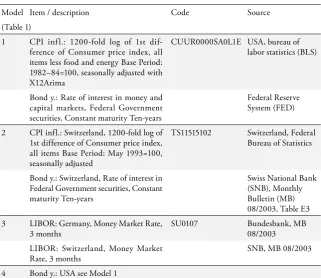
B. Data Sources
Table 3. Data Descriptions and Data Sources
Model Item / description Code Source
(Table 1)
1 CPI inf l.: 1200-fold log of 1st dif-ference of Consumer price index, all items less food and energy Base Period: 1982–84=100, seasonally adjusted with X12Arima
CUUR0000SA0L1E USA, bureau of labor statistics (BLS)
Bond y.: Rate of interest in money and capital markets, Federal Government securities, Constant maturity Ten-years
Federal Reserve System (FED) 2 CPI infl.: Switzerland, 1200-fold log of
1st difference of Consumer price index, all items Base Period: May 1993=100, seasonally adjusted
TS11515102 Switzerland, Federal Bureau of Statistics
Bond y.: Switzerland, Rate of interest in Federal Government securities, Constant maturity Ten-years
Swiss National Bank (SNB), Monthly Bulletin (MB) 08/2003, Table E3 3 LIBOR: Germany, Money Market Rate,
3 months
SU0107 Bundesbank, MB 08/2003 LIBOR: Switzerland, Money Market
Rate, 3 months
Biased Estimation in a Simple Extension of a Standard Error Correction Model 59
Model Item / description Code Source
(Table 1)
Bond y.: Japan, Government Bond Yield
M.15861…ZF… International Mone-tary Fund (IMF) LIBOR: USA Eurodollar deposits,
Pri-mary market, three-month maturity
FED LIBOR: Japan, 3-MONTH LIBOR:
Offer London
M.15860EA.ZF… IMF
References
Engle, Richard F., and Clive W. J. Granger (1987), “Co-Integration and Error Correction: Representation, Estimation and Testing”, Econometrica, 55 (2), pp. 251–276.
Ericsson, Neill Richards (1992), “Cointegration, Exogneity, and Policy Anal-ysis: An Overview”, Journal of Policy Modeling, 14, pp. 251–280.
Ericsson, Neill Richards, David F. Hendry, and Grayham E. Mizon (1998), “Exogeneity, Cointegration, and Economic Policy Analysis”, Journal of Business and Economic Statistics, 16 (4), pp. 370–387.
Fisher, Irving (1930), The Theory of Interest, New York.
Granger, Clive W. J., and J. Lin (1995), “Causality in the Long Run”, Econo-metric Theory, 11 (1), pp. 530–536.
Hendry, David F., and Grayham E. Mizon (1998), “Exogeneity, Causality, and Cobreaking in Economic Policy Analysis of a Small Econometric Model of the Money in the UK”, Empirical Economics,23 (3), pp. 267–294.
Hosoya, Yuzo (1991), “The Decomposition and Measurement of the Interde-pendence between Second-Order Stationary Processes”, Probalility Theory and Related Fields, 88, pp. 429–444.
Hubrich, Kirstin (2001), Cointegration Analysis in a German Monetary System, Heidelberg.
Johansen, Søren (1988), “Statistical Analysis of Cointegration Vectors”, Jour-nal of Economic Dynamics, 12, pp. 231–254.
Johansen, Søren (1995), Likelihood-Based Inference in Cointegrated Vector Autoregressive Models, 1st ed., Oxford.
Juselius, Katarina (1996), “An Empirical Analysis of the Changing Role of the German Bundesbank after 1983”, Oxford Bulletin of Economics and Sta-tistics, 58, pp. 791–819.
Juselius, Katarina, and Ronald MacDonald (2004), “International Parity Relationships Between the USA and Japan”, Japan and the World Economy, 16, pp. 17–34.
Lütkepohl, Helmut, and Jürgen Wolters (2003), “Transmission of German Monetary Policy in the Pre-Euro Period”, Macroeconomic Dynamics, 7 (5), pp. 711–733.
Pesaran, M. H., Yongcheol Shin, and Richard J. Smith (2000), “Structural Analysis of Vector Error Correction Models with Exogenous I(1) Variables”,
Journal of Econometrics, 97, pp. 293–343.
SUMMARY