Cooper
How Do You Replace
the Irreplaceable?
Frank Cooper Senior Lecturer and Associate Head Birmingham City University School of Jewellery Birmingham, West Midlands, UK Jade Louise Pelham KTP Associate and Jewelry Design and Innovation Team Leader Birmingham City University and SBS Insurance Services Ltd. Cannock, West Midlands, UK
Introduction
Those of us working in the jewelry industry can be susceptible to tunnel vision regarding new or non-traditional revenue streams even when they do, in fact, take advantage of our traditional skillsets as jewelry designers and manufacturers. Perhaps, after reading this paper, you might decide to give some of those “off the wall” ideas a second look. What follows is an account of the 30-month partnership between the Birmingham City University School of Jewellery and SBS Insurance Services to replace “irreplaceable” jewelry items for clients in the United Kingdom. We were challenged by SBS Insurance Services to "replace the irreplaceable" by establishing a Knowledge Transfer Partnership project. SBS is a specialist claims-handling provider which maintains a department dedicated solely to claims-handling claims for lost, stolen and damaged jewelry. We were tasked with recreating the jewelry items for the company's clients while delivering exceptional customer satisfaction and reducing claim cycle times at a lower cost than their traditional claims handling process.
The Knowledge Transfer Partnership (KTP) Scheme
Gay Penfold first introduced the Santa Fe Symposium® to this subject in her 2011 paper, “Knowledge Exchange Programs and Collaborative Projects—Do These Initiatives Really Work and Are They Worth Pursuing? How Can the Jewelry Industry Benefit From Them?”1
Cooper
Cooper
academic institution and a recent graduate. A KTP project is expected to deliver significantly increased profitability for the business partners as a direct result of the partnership through improved operational quality along with increased sales and, wherever possible, access to new markets. The KTP scheme’s core mission is to strengthen the UK’s competitiveness and wealth creation by enabling research organizations within universities to apply their research knowledge to important business problems. Typically, KTPs last from 6 to 30 months.
At the heart of each KTP is an ongoing and symbiotic relationship between a company or organization and the academic staff within a knowledge-based institution (typically a university.) The institution’s staff apply their knowledge and expertise to a well-thought-out project that will help in the development of their collaborative partner company. The actual project activity is carried out by an associate (a recent graduate or more rarely a post-doctoral student), who also benefits from a structured training program as part of the KTP project. In the KTP process the business relevance of the knowledge-based institution is expected to be enhanced. The KTP is funded jointly by the government and the company, with the company funding approximately 30% of the associate’s salary and the government meeting the balance of the project’s total costs.
How Does a KTP Project Work?
Initially, the company identifies a new product or service it seeks to access in order to improve performance or profitability. The university then provides access for the company to up-to-date and relevant skills and technology that can help them meet that need. Jointly, the company and the university develop a work plan, with an agreed upon set of objectives to achieve the company’s aims. Carrying out the work plan and achievement of the objectives will be the responsibility of the KTP associate.
A suitably skilled recent graduate (the KTP associate) is recruited jointly by the university and company partners, who draw up the job specifications and personal requirements. Together they interview the applicants for the post and appoint the successful candidate.
The associate is supported throughout the term of the project by an academic supervisor and a company-nominated KTP project supervisor. The associate, academic supervisor and company representative meet fortnightly to review the progress of the project and re-set targets where necessary. An appropriately knowledgeable and skilled member of the university staff, usually with relevant industrial experience, is nominated as the academic supervisor for the project. Through the associate and the academic supervisor the company is given access to the university’s technologies, resources, knowledge base and skills throughout the duration of the program. This is expected to result in knowledge and technology transfer in both directions and, where appropriate, result in improvements to the company’s current skills base and open up access to new markets, products and services.
The project is managed overall by the Local Management Committee (LMC).
An LMC meeting is held every four months and includes all of the KTP project partners and the regional advisor for the KTP organization. At this meeting, performance against the work plan is reviewed and discussed and future actions or redirections agreed upon. At the LMC meeting the associate presents their work and results over the preceding four months, their plans for the next four months, and their alignment with the work plan. Because the work plan is a flexible document, it can be amended if all parties agree. The associate is also in charge of managing the budget for their KTP project, which includes a number of disbursements ranging from travel expenses to funding for ongoing personal training. It also includes a budget for consumables and equipment. As the KTP intends to improve the company’s profitability, the associate is also responsible for monitoring, along with the company KTP project supervisor, the financial effect of their interventions on the company’s bottom line.
A KTP Associate
The selection of the correct associate is key to the eventual and successful completion of a good, positive, results-oriented KTP project. The associate has to be a recent graduate, within the last five years, and can be of any age. What is being sought in the perfect associate is someone who can transfer up-to-date knowledge or technology to the company; thus, anyone who has graduated recently in a subject closely related to the project is a potential candidate. However, degree discipline is not the only factor. By far the better KTP associates have also gone out into industry after gaining their degree and gained some real-life industrial experience in their subject. The ability of the associate to accumulate at least a degree of business acumen during the lifetime of the project is also important as the associate will need to successfully relate their project directly to the competitiveness and profitability of the company.
The associate will be recruited through the host university’s standard human resources process and procedures. The job description will be drawn up in joint consultations between the company and the university and widely advertised through the university’s normal channels. The associate will legally be, to all intents and purposes, an employee of the university and paid through the university’s finance structure; however, the associate will be expected to adhere to the company’s rule book, accept their usual hours of working, vacation entitlement and working practices. In practice, they become a company employee in all but name and are expected to be integrated into the company’s working systems, ethos and management structure with the ultimate aim that at the end of the KTP project, the associate is offered permanent employment, usually at a management level of some sort.
The SBS–KTP Project Associate
Cooper
Cooper
gained her Higher National Diploma in Jewellery and Silversmithing from 2011 to 2012, followed by her Design for Industry BA Hons degree in 2013 (including winning the prestigious Rowlinson Award). Jade then gained some diverse jewelry industry experience working as production manager for a local diamond dealing and diamond jewelry manufacturing company, overseeing all aspects of their bespoke manufacturing process. She also worked part-time for a local auction house where she received and catalogued jewelry and watches that had been sent in to be auctioned. As a side note, Jade is also co-author of this paper. As part of the project, Jade was required to draw up her own Personal Development Plan (PDP.) The PDP is a plan for acquiring or developing the knowledge and skills that the associate will need to work effectively both on their KTP project and to plan effectively for future career development. It covers areas such as long-term aspirations and the skills and knowledge required to achieve them, any technical knowledge and expertise upskilling that may be required for the KTP project, and also any general management skills that will help the associate both now and in the future. The associate is encouraged to think about both their short-term and longer-term objectives, but the starting point is to clarify what their long-term goals might be. Jade’s PDP, created by herself, set out a number of challenging objectives she wished to achieve during the course of the KTP project, which were;
• A master’s degree in Design Management to be studied at Birmingham City University
• A level 5 Chartered Management Institute (CMI) Diploma in Management and Leadership
• A Certificate of Appraisal Theory, a home-study course conducted by the National Association of Jewellers (NAJ)
• A Gem Basics level 2 home-study course conducted by Gem-A
• A level 3 Colored Gemstones Grading home-study course conducted by Gem-A
SBS, the Company
SBS is an insurance claims fulfilment company, not an insurance provider, set up seventeen years ago as an IT equipment repairs service (mainly for insurance companies). They are now one of the UK’s leading insurance claims fulfilment companies, supplying services across a number of commodities. They take great pride in being much more than a mere call center and their staff being as expert as possible in their particular field. To achieve this, they employ people with relevant experience in the different commodities they cover. As well as their jewelry claims department, they are active in electrical and white goods, flooring, furniture, leisure, gardening, sporting and DIY goods.3 They continuously monitor technological developments (hence the origins of this KTP project) as well as changes in lifestyle choices to ensure that their supply chain and service are able to offer the latest products and commodities.
In very simple terms, SBS is contracted by various insurance companies to provide a full claims-resolution service to the insurance companies’ policy holders (including validation of the claim plus the repair or replacement of lost, stolen or damaged items) in an efficient, timely and cost-effective manner while also giving the policy holder an excellent claims experience.
The SBS—KTP Project
The project’s stated aims were as follows:
“To develop and establish a digitally centered and focused replication and repair facility that will enable SBS to provide a holistic, cost-effective claims handling and insured items replacement service to their claimants.”
To achieve this, Jade undertook initially to investigate, measure and evaluate the company’s current process and procedures for handling jewelry claims. Then, she commenced an investigation of the newest jewelry making/manufacturing digital and technological options available and, finally, sought to create, launch and trial a new jewelry claims service. Jade was then to help establish the new SBS Jewellery Business Centre and offer a proposed launch strategy for the center. She also went on to explore the possibility of expanding the company’s current repair and replacement activities and to maintain a continuous ongoing review of the Jewellery Business Center’s performance and impact.
Cooper
Cooper
Why the Project Was Important to SBS
SBS conducted a survey4 of 2000 individuals between the ages of 18 and 65, asking their opinions about the servicing of insurance claims, with a specific section about jewelry claims. The majority of respondents, 41%, wanted their insurer to supply “a replacement and equivalent item of jewellery.”
Figure 2 The SBS survey on servicing insurance claims and the results
A Typical Jewelry Insurance Claim at SBS
Before looking at how an insurance claim works, we need to understand the cost implication that separates typical jewelry claims. There is a point at which the loss value of the claim is too low to make a digital and technological intervention a cost-effective proposition. The SBS–KTP project is almost exclusively aimed at improving the company's service on what are described internally as high-value items. These items are of a high enough value to make the digital and technological interventions suggested a potentially cost-effective option as opposed to the long-established voucher or cash exchange system.
There are essentially only four settlement options available for SBS to offer the policy holder (PH): They can agree to replace or repair the item, or they can offer cash or a redeemable voucher as reimbursement. The process set out below is how that choice is made by the SBS call handler.5
• The PH calls their insurance company to make a claim for a lost, stolen or damaged jewelry item.
• The insurance company may choose to appoint SBS to handle the claim. SBS will then place the claim onto their internal and bespoke IT system and aim to have one of their specialized jewelry call handlers contact the PH within the next two hours.
• SBS will contact the PH directly, normally by phone, to discuss the incident, obtain the jewelry item details and request any crime reference numbers issued by the police or loss reference numbers issued by the insurance company. SBS will also request any proof of purchase or ownership, including photographs, to substantiate the claim. If an item is damaged, they may also arrange to have this item collected or returned to SBS if the repair route of settlement is chosen. • The claim is validated to ensure it is genuine. SBS will also screen for any fraud concerns6 as well as value the items for replacement or the cost of the repair.
There are a number of conditions imposed at this point in the agreement SBS has with the insurance company (think in terms of “if yes, go here” or “if no, go here” gate system). Claims can be received up to a certain value from the outset where authority to act as they see fit is delegated to SBS. Alternatively, SBS can only quote the cost of replacement, which is then sent back to the insurance company for further action or agreement to proceed. The call handlers are also well trained in spotting potentially fraudulent claims. If there is any suspicion, that too is referred back to the insurance company for further action or approval, if required. If the SBS call handler is satisfied it is a legitimate claim and it is under the delegated authority agreement SBS has with the insurance company or is approved by the insurance company, they will discuss the settlement options with the PH and offer to repair or replace the item or offer a voucher in settlement. The voucher is normally redeemable at a high-street jewelry store and can be exchanged for an item nearly equivalent to the one lost or stolen, which works particularly well with branded goods and watches.
Once the claim is settled, SBS then invoices the insurance company.
The Basic Math behind a Jewelry Claim
Cooper
Cooper
from manufacturer via wholesaler to final retailer. This is on average between 200% and 300%,8 depending on the particular market place being serviced.9
Vouchers
The vouchers are purchased by SBS from various high-street jewelry chains and discounted at various levels to SBS by the jewelry retailer. They are then offered at another discount level to the insurance company by SBS.
The use of vouchers and their discounting is a complex, cost-sensitive and financially confidential process. Any amounts discounted by SBS may well vary between different insurance companies, dependent on the insurance companies’ agreements with their various claims handling companies but, for example, it typically works something like this:
The value or recommended retail price (RRP) of the item is calculated first, so let’s say in this example it is set at £2,000.00. SBS might buy the voucher from the high-street jewelry retailer for £1,650.00, but the policy holder will still be able to redeem the voucher at one of the retailer’s stores for a jewelry item valued at £2,000.00. SBS will then invoice the insurance company for £1,750.00, with the difference in the buying and selling price, in this example, £100.00. What the insurance company pays for the voucher has to cover SBS’s profit margins plus handling costs and includes the call handler’s time spent resolving the claim successfully and to the policy holder’s satisfaction. The bottom line is this: Happy customers are returning customers!
Remakes
If the decision is made to remake the same jewelry item, then the recommended retail price, i.e., the value of the replaced jewelry to the policy holder, is still costed at £2,000.00 retail. However, if we divide the RRP by three (the equivalent of removing the 300% mark-up), we have a target manufacturing cost of £666.66 for the replacement jewelry item. SBS may then offer to replace the item and to invoice the insurance company for, let us say, £1,200.00, a savings to the insurance company of £550.00 against a more traditional voucher solution.
The closer SBS can get to the target manufacturing price of £666.66 for the re-manufactured item and the less time and cost SBS expends on settling the claim, the greater the potential to maximize their profit margin. This is where phase one of the KTP project would show some quick financial gains not only to SBS but also to the insurance companies. We will provide some practical examples of the project in action later in the paper.
Time Is Money, Too
A major difficulty for SBS until now has been how to calculate the value of any lost or stolen item. This might have been achieved in any number of time- consuming ways by:
• Viewing and cross-referencing prices of similar or identical jewelry items on various jewelry websites
• Obtaining quotes from jewelry manufacturers and retailers to make or replace the piece
• Product knowledge based on the experience of the call handler in the cost of similar jewelry items
• Viewing catalogues from various jewelry retailers and attempting to identify identical or similar jewelry items
• Making calculations based on gold weights, stone descriptions and current gold and gem prices if this information were available for the item being claimed
All of these options infer a high degree of estimation, making calculations that are possibly based on spurious information from the PH and even pure guesswork. In addition, all take considerable time to investigate. The ideal solution for shortening this part of the process, and part of the KTP project, will be the creation of a “validation tool.” This is a digital tool that allows the call handler to quickly input the information, in real time, via their workstation while simultaneously dealing with the call to the PH. With sufficient information from the PH, the call handler can create a very accurate recommended retail price for the jewelry piece that is the subject of the claim. We will see more details about the validation tool later in the paper.
A key cost, very dependent on the call handler’s product knowledge and experience and an important factor in the claims handling process, is the amount of time it takes to receive, process and settle a claim. The longer the claim settlement takes, the less satisfied the policy holder is and the more expensive it can be to SBS in terms of working hours spent on completing each claim satisfactorily.
SBS Insurance Services Technical Director Paul Fairbrass said in a recent press interview:10
“The major problem for insurers is that they are often faced with valuing and settling claims for high value items based on vague descriptions and old records, such as photographs, outdated valuations or sales invoices. Once an item has been validated the insurer needs to find a matching equivalent from a limited range on offer from retailers. This can be impossible with bespoke items or family heirlooms. Alternatively, a bespoke item can be re-manufactured using wax carving to try and replicate the lost item. But this has proven to be expensive, cumbersome to
Cooper
Cooper
Disadvantages of Original SBS Replacement or Remake Claims-handling Process
Direct replacements or remakes were typically processed by the use of photos or verbal and written descriptions of the lost or stolen jewelry item, frequently with no approval of the design of the proposed replacement item by the PH. These photos are often old, blurred and typically not meant to feature the jewelry item in question. It was not unusual for a replacement to be manufactured in this way and, without PH pre-approval, could often result in the replacement item being rejected or returned for alterations by the PH, thus incurring more cost.
Customers who wished to see the design of a replacement first usually got an expensive, hand-carved wax model which, if approved, had to be returned to be processed. The model could easily break in transit and create an extended claim settlement time. Designs that the client wished to be adjusted in some way couldn’t be changed easily, especially if the wax had been broken or damaged. If the customer approved a broken wax, then the replacement hand-carved wax might eventually look significantly different from the original.
Advantages of the KTP Project Plans
• A central pillar of the KTP project plan is the creation of an extensive CAD file and render database, specifically for insurance policies for high-value jewelry.
• Using CAD software allows simpler and swifter replication of the jewelry item, and communication between the policy holder and the call handler can be conducted online.
• Pre-loss validation, especially of older and often heirloom jewelry, can be done quickly and easily, thus ensuring the policy holder is not under insured.
• An internal digital audit trail is far more complete and can be quickly probed or reviewed.
• Approval from customers can be quickly gained to speed up the claims handling process and could result in more cost-effective replacements being generated.
• An enhanced customer journey results in a happy customer who is more likely to stay with their insurance company.
• The digital validation tool database will make it a more efficient process with fewer mistakes, which equates to fewer unrecoverable costs. An exercise by Jade early in the project to analyze average replacement claim times gave these results from 1,119 claims examined: Average claim time was found to be 56 days or 8 weeks and the longest claim times were a huge 105 days or 15 weeks for more complex items like bangles, cuff links and brooches.
The savings from initiating the new and approved process now results in average claim times that are calculated to be almost half of those before instigation of the project, i.e., 30 days or 4.5 weeks across all product types.
Real-time Testing of the KTP Project Theory
These real-life, real-time claims provided an ideal opportunity to test a number of the theories and propositions behind the SBS–KTP project. SBS wanted this test of the manufacturing process carried out in the most high-tech way possible rather than the most cost-effective (cheapest) for reasons that will become evident later in this paper.
The Bangle Project
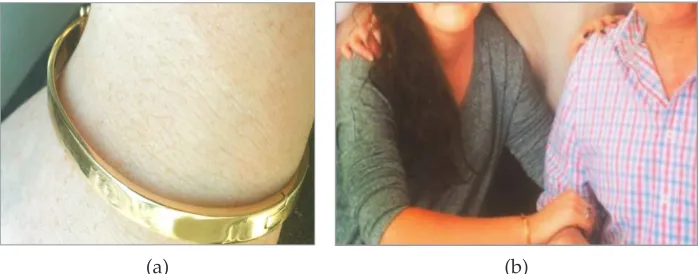
An 18K yellow-gold bangle was given to the policy holder’s daughter for her eighteenth birthday in April 2016 by her grandparents. To make the bespoke bangle, the grandmother had melted down much of her old jewelry and the bangle was to be manufactured with some details on one-half of the bracelet with the other half plain and polished. It became evident to the call handler speaking to the PH that this had to be an exact replacement as the grandparents did not know it has been lost or stolen and, if at all possible, they should never find out. Figure 3 shows the only visual/pictorial information available to Jade for use in recreating the bangle.
(a) (b)
Figure 3 The only photo of the lost or stolen bangle (a), enlarged from photo (b)
Cooper
Cooper
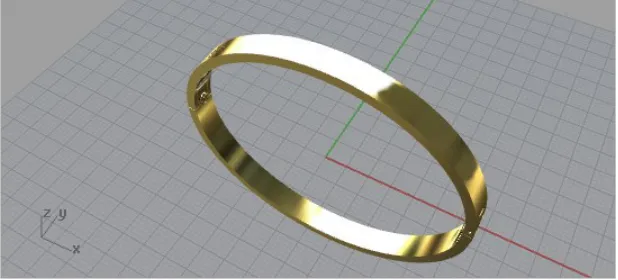
Figure 4 The first CAD rendering
Upon receiving and viewing the files only one day later, SBS received the following response from the PH.
“Hello,
Thank you very much for your email, the pictures look great, but I feel the edges need to be slightly more rounded and thus the bracelet perhaps a slightly thinner width. I would feel more able to give you a better description of the small changes I feel need to be made over the phone.
I shall ring you this coming Monday to facilitate you making such changes if possible,
Thank you very much for your time in this matter, Kind Regards,
Molly”
She then called in response to the images received, giving the following information: Details should be on the front side only and from clasp to hinge, and the edges should be more rounded. They look very square at the moment. Based on this feedback, Jade created the revised CAD renders (Figure 5), which were again sent to the PH for approval.
Figure 5 The second set of renders, which were approved
The renders very quickly resulted in the following approval response:
“Hello,
I’m really happy with those images, if possible I would like the edges to be only just slightly more rounded, but I’m happy to go ahead with the design!
Thank you for your patience in this matter. Kind regards,
Molly”
The decision was then made to manufacture the two parts of the bangle (Figure 6) at Cooksongold on their M 080 in 18K yellow gold.
Cooper
Cooper
The cost analysis of this test proved very illuminating, as well.
DMLM M 080 process including gold £1311.04 Polishing and finishing costs £220.00 Laser Hallmarking £29.03
Total Cost £1560.07
The standard buy rate would have been £1800.00, i.e., how much SBS would have paid for a replacement from an existing supplier.
Studs 1 Project
The pair of 18K white-gold and diamond stud earrings in Figure 7 was estimated to have a recommended retail price of well over £8,000.00 and so very worthy of the re-make route. The PH who had lost these earrings was about to depart for a holiday in Australia. Using the traditional methods, this claim would have taken many weeks, but the CAD images were emailed to her in Australia and approved by the PH the same day. They were manufactured on an M 080, finished, polished, set and supplied to the PH 20 days later.
Recommended retail price £8,800.00 Manufacturing and materials cost £2940.00
Figure 7 Studs 1 of 18K white gold
Studs 2 Project
Another pair of 18K white-gold diamond stud earrings resulted in some minor changes being requested when the original CAD images were received. The PH asked for a change to the pins on the back and wanted the more secure screw-type fittings as shown in Figure 8 (right) and a reduction in the thickness of the prong settings, both of which SBS was happy to accommodate due to the overall high net savings that were available for this particular claim. The revised drawings were quickly accepted and they went into production, again on the M 080, and were supplied to the PH 30 days later.
Recommended retail price £9030.00 Manufacturing and materials cost £3010.00
Figure 8 Studs 2, 18K white-gold originals (left), re-makes (right)
Pendant Project
The third and final example was another 18K white-gold and diamond item—this time a pendant (Figure 9). The email exchange with the PH and Jade is a good example of how much the KTP project interventions were impacting the PH’s overall experience (new pendant supplied to the PH 27 days later). In this case the item was stolen while the PH was on an extended holiday in India. All the information exchanges and approval were done via email and the replacement was with the PH 15 days after she returned to the UK.
“Dear Jade
This is superb you have done a fantastic job. Thank you so much for all your attention and hard work. I can’t wait to wear it. I am really grateful, I never expected such personal attention.
Thanks you so much once again. Kind regards
Xxx”
Cooper
Cooper
Figure 9 The renders of the pendant in 18K white gold approved by the PH
Once again, SBS chose to go for the high-tech approach and had this item printed on the M 080 machine in 18K white gold, again for eventual use for publicity reasons that will become apparent later in this paper. All three of the white-gold replacement projects were printed at the same time and are shown in Figure 10 as they were removed from the machine and prior to post processing. They are a good example of how the technology lends itself well to the production of small batches in multiple configurations.
Figure 10 All the 18K white-gold project items built on the M 080
Following are a few more real-time examples, this time using the more traditional manufacturing processes of CAD and 3D printing in wax and then investment casting.
Five-stones Ring Project
The following claim arrived at SBS and serves as a perfect example of the sort of poor levels of information the call handlers have to deal with and which was passed to Jade in order to create the CAD file for sending to the customer.
Ladies ring. 18ct yellow gold. Stones were only in the middle of finger. Could see gold each side. Set with 3 rubies and 2 diamond. Rubies were oblong shaped and diamonds were round. Diamonds were bit bigger than pinhead sized. Rubies were a bit bigger than a matchhead. Ct weight & quality unknown. Thinks rubies were Burmese. Deep red and very sparkly. Very clean. Stones were all claw set. Band standard width. Can’t give measurements. Medium weight. No estimate.
The validation process arrived at the following specification for the claim: • 3x baguette rubies, 3.5 x 1.5 mm
• 2x round brilliant cut diamonds, 0.035ct each • Finger size S
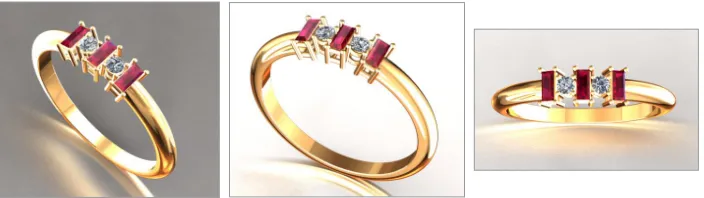
From this Jade extrapolated the look of the ring, created the CAD render and sent it on to the customer who, three days later , asked for a number of minor revisions. The file was reworked and returned to the PH two days later (Figure 11). She called the next day to say she was happy with the design and please go ahead and manufacture. The time to settle claim in full: 28 days. The actual re-made ring is shown in Figure 12.
Cooper
Cooper
Figure 12 The actual five-stone ring remake
Trilogy 1 Project
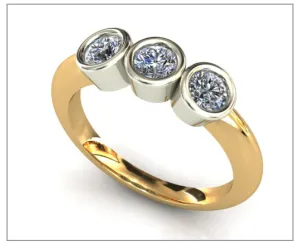
Again, the original PH description was extracted by the call handler as no images were available. The jewelry item to be re-made was an 18K yellow-gold ring with three diamonds set into white gold. The diamonds were small and round in shape. They were inset into the gold with white gold running around the edge of the stone. A photograph of the “certificate of authenticity” for the item was received from the PH. No values were given. Gold content was determined to be .750 (18K) and the total weight of the diamonds 0.55ct. Below is the timeline for this re-make.
14 October 2015 CAD created
15 October 2015 Sent images to PH via post (Figure 13)
16 October 2015 PH called in to advise that she was happy with the images sent. She said the rendering is a brilliant match and she is pleased with it. She advised it is ring size “M.”
The time to settle the claim in full: 32 days. Figure 14 shows the re-made ring.
Figure 13 The approved rendered version
Figure 14 The actual ring produced
Trilogy 2 Three-Stone Wedding Band Project
The description received from the policy holder was that it’s a thick gold wedding band with three diamonds in it. It matched his wife’s wedding band. The PH got a ruler and estimated that the width of the band was approximately 8 mm. The band was d-shaped with three flush-set diamonds. It was also engraved internally with “Victoria 24/08/2002.” The three diamonds were round in shape and were of even spacing but could all be seen on the top of the finger. He said the diamonds were 4 mm, approximately 0.25cts each (considered to either be wrong or an exaggeration!), making 0.75cts total. The PH said he didn’t remember any of this from time of purchase. The ring was 18K yellow gold.
The SBS call handler was advised by the selected manufacturing jeweler that the ring with the stones set flush in the band could not be manufactured because, even with the heaviest ring that was available for the manufacturing price point being sought, the points of the diamonds would still protrude.
Jade was commissioned to create suitable CAD renders for the PH to approve (Figure 15) as she needed to explain to the PH how they could possibly make it.
Cooper
Cooper
However, the policy holder was not happy with the CAD renders. He definitely wanted the diamonds to be flush with the surface of the ring and without collets. He was willing to pay more to cover the extra gold needed that wasn’t covered by his insurance policy limit.
“I wanted to update some of the other information regarding my wedding ring which was attached on the recent Email. The diamonds are flush with the ring and a little further apart than in the picture, in clock terms 12 O’clock for the central one and 10 & 2 o’clock for the position of the other 2 (hope that makes sense) The ring is 18 carrot yellow gold and would it be possible to send a follow up picture of what the new ring will look like with the changes.”
The rendering was amended and returned to the PH three days later, who called the same day to authorize manufacture and payment of the extra charges. The total time to settle the claim was 42 days. The finished ring is shown in Figure 16.
Figure 16 The finished ring
The benefits of the KTP project immediately started to become apparent with this claim. SBS was able to have relatively quick confirmation of PH approval before commencing manufacture. This also gave them an auditable and quickly changed file which would also be available should there be any further losses or damage to the same piece of jewelry. Manufacturing from CAD and using 3D printing made manufacturing quicker and less problematical. Because the PH was involved at all stages and invested time and emotion into the process, he felt ownership of the eventual solution and was a happier customer of the insurance company.
The Validation Tool
As part of the project, Jade was also tasked with developing a validation tool (VT), i.e., a digital tool that allows the call handler to quickly input the information from the PH, in real time, via their workstation while simultaneously dealing with the call to the PH. With sufficient information from the PH, the call handler can create a very accurate recommended retail price for the jewelry piece that is the subject
of the claim. It also gives SBS a reasonably accurate estimation of the probable cost to remake the item. In order to achieve this, Jade had to work very closely with SBS’s bespoke software programmers and developers, who are an external third-party company. Jade has also had to build extensive part and finished item libraries into the validation tool. This represents a number of CAD-based reference files, eventually running into the thousands and each of which has to be individually drawn in CAD.
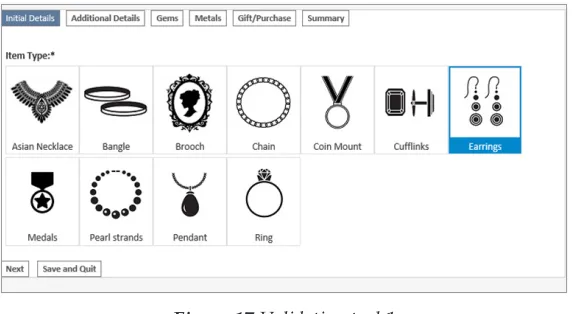
The VT will also give what the insurance industry calls a “pre-loss valuation,” which means when an expensive new piece of jewelry is to be insured, the details, when entered into the VT, will give an accurate value to ensure the item is not under insured when a policy is raised. This is particularly useful and important when family heirlooms are handed down and their modern value often far exceeds their original purchase price. SBS will also be seeking opportunities in the future to commercially exploit the VT as a piece of software they can monetize in some way. In addition, SBS intends to develop a validation tool “light” version, which will be an online smartphone and Android app on which policy holders can check that their existing jewelry is not under insured. Once again, the items shown in Figure 17 are merely test examples and do not actually relate to real jewelry insurance claims.
Figure 17 Validation tool 1
Cooper
Cooper
Now information about the metal content is added to the data being gathered and drop-down menus are added where suitably appropriate (Figure 21). The metal cost shown (£70.78) is automatically linked to that day’s metal price.
Figure 21 Validation tool 5
Any additional purchase information available is now added and the tool starts to produce a value figure for the lost or stolen item (Figure 22).
Figure 22 Validation tool 6
Figure 18 Validation tool 2
Figure 19 Validation tool 3
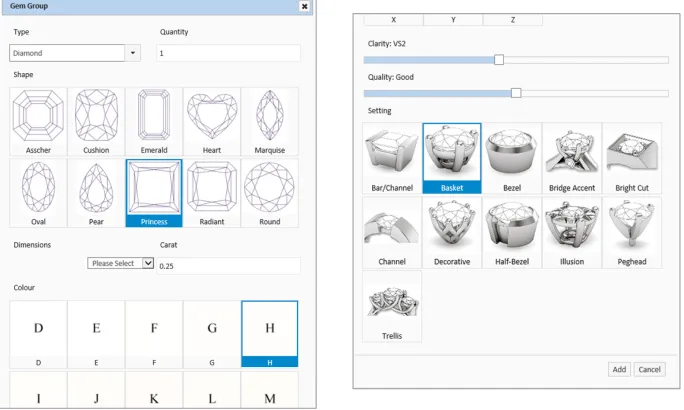
Further screens in the VT (Figure 20) capture as much information as is available about the stone(s) including color, clarity, cut and quality and about the setting.
Cooper
Cooper
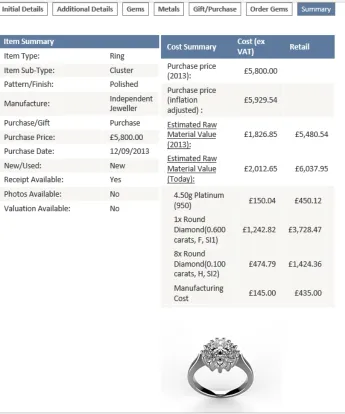
The claim described in Figure 24 represents a gift item purchased earlier that year for which the original purchase price is unknown. Note the item sub-type is single, which indicates only one of a pair of earrings has been lost and is being claimed, and that, once again, physically re-making the item is considered to be the most cost-effective solution.
Figure 24 Valuation tool 8
A Prize-winning Project
SBS entered what were essentially the results of the KTP project for the 2016 British Insurance Awards, which are considered to be the premier UK insurance industry event of the year and sometimes called the Insurance Industry Oscars. SBS went on to win the Technology Award! This is why direct metal laser melting on an M 080 was specifically chosen for the first few case studies. The awards were presented at a glitzy event held at the Royal Albert Hall in London and were The screen in Figure 23 gives us a summary of the claim in enough detail to
make an accurate assessment of how to process the claim. It shows that, even if technically under insured at its 2013 value, remaking it is still a very cost-effective option when compared to a voucher solution, which could have cost in the region of £3,500.00 to arrange.
Cooper
Cooper
As for the future, Jade continues to assess and explore other exciting new technological options that might be suitable for adoption in both the jewelry and the wider SBS business models. These include things like molecular scanners or spectrometers11 or a simple option for policy holders to 3D scan their jewelry using their own smartphone and a photogrammetry-based app supplied by SBS. Another possibility is the slightly more technological option of attaching a green-light laser scanner to the smartphone and placing the jewelry to be scanned on a linked turntable (Figure 26). Perhaps the most exciting new development on the horizon will be Jade’s newest work on how Artificial Intelligence might be adopted into the broader SBS business model via the jewelry section.
Figure 26 Smartphone scanner
attended by all the main players in the UK insurance industry. It proved to be an ideal place to introduce to the wider insurance industry this revolutionary new way of dealing with insurance claims for jewelry losses, theft and damage. Since the awards, and also as a result of some intensive work by the SBS marketing and management teams, a number of new jewelry-specific accounts have been opened by SBS with some new and important UK insurance companies.
Figure 25 SBS wins a British Insurance Industry Technology Award.
Conclusion
What this KTP project shows is that it is possible to apply what are, nowadays, fairly common digital technologies in the jewelry industry to new and novel applications and use them in ways and within industries you may not have considered before as being part of the jewelry “family.” It also shows the importance of getting in place the right KTP associate with the appropriate skillsets and desire to succeed to successfully deliver such a project.
Cooper
References
1. Gay Penfold, “Knowledge Exchange Programs and Collaborative Projects— Do These Initiatives Really Work and Are They Worth Pursuing? How Can the Jewelry Industry Benefit from Them?” The Santa Fe Symposium on Jewelry Manufacturing Technology 2011, ed. E. Bell (Albuquerque: Met-Chem Research, 2011): 443-460.
2. http://ktp.innovateuk.org/.
3. https://www.sbs-claims.co.uk/index4763.html?insurance=jewellery- insurance.
4. http://clientstatements.lizmale.co.uk/f631.
5. Carol S.C. Bennet, Dictionary of Insurance, Pearson Education online edi-tion (2004); http://www.universitynouvellegrandanse.org/download-pdf-dictionary-of-insurance-book-by-pearson-education.pdf.
6. M. Button et al., “‘All walks of life’: A profile of household insurance fraudsters in the United Kingdom,” Security Journal 29, no. 3 (Springer, 2016): 501-519; https://link.springer.com/article/10.1057/sj.2013.43 (first online 27 January 2014).
7. Swapna Pradhan, Retailing Management: Text and Cases, 2nd ed. (New Delhi: Tata McGraw-Hill Publishing Company Limited, 2007).
8. http://worldeconomy-wingate.blogspot.co.uk/2010/12/buying-diamond-ring-beware-of-huge.html.
9. https://hellogiggles.com/fashion/price-markup-diamond-rings-will- probably-stun-you/.
10. http://clientstatements.lizmale.co.uk/f631.