NOTE
Keisuke Kojiro · Yuzo Furuta · Makoto Ohkoshi Yutaka Ishimaru · Misao Yokoyama · Junji Sugiyama Shuichi Kawai · Takumi Mitsutani · Hiromasa Ozaki Minoru Sakamoto · Mineo Imamura
Changes in micropores in dry wood with elapsed time in the environment
Abstract To investigate the changes in microstructures of wood with elapsed time in the environment, CO2 adsorption onto dry wood was measured at ice–water temperature (273 K) for samples aged from 0.1 years to over 1000 years. The micropore size distribution was obtained using the Horvath-Kawazoe method. Micropores smaller than 0.6 nm in wood decreased in number with elapsed time in the envi-ronment, and a negative correlation was found between cumulative pore volume for pores smaller than 0.6 nm and elapsed time in the environment. Cumulative pore volume in the 1000-year sample was almost half of that in the 0.1-year sample. Micropores smaller than 0.6 nm in wood with a few decades or more of elapsed time increased in number after rewetting and drying. Consequently, microstructures of wood with longer time elapsed in the environment were considered to be more stable, because of longer-term thermal motion and possibly more repeated moisture adsorption and desorption and/or temperature variation in the environment.
K. Kojiro (*)
Advanced Wood-Based Material Technology Group, Materials Research Institute for Sustainable Development, National Institute of Advanced Industrial Science and Technology (AIST), 2266-98 Anagahora, Shimoshidami, Moriyama-ku, Nagoya 463-8560, Japan Tel. +81-52-736-7320; Fax +81-52-736-7533
e-mail: [email protected]
Y. Furuta · M. Ohkoshi · Y. Ishimaru
Graduate School of Life and Environmental Sciences, Kyoto Prefectural University, Kyoto 606-8522, Japan
M. Yokoyama · J. Sugiyama · S. Kawai
Research Institute for Sustainable Humanosphere, Kyoto University, Uji 611-0011, Japan
T. Mitsutani
Nara National Research Institute for Cultural Properties, Nara 630-8577, Japan
H. Ozaki · M. Sakamoto · M. Imamura
National Museum of Japanese History, Sakura 285-8502, Japan
Part of this report was presented at the 57th Annual Meeting of the Japan Wood Research Society, Hiroshima, August 2007
Key words Unstable state · Micropore structure · HK method · Old wood · Elapsed time
Introduction
It is well known that the properties of wood change over a long period in the environment after harvesting. Japan has many wooden buildings in temples and shrines that were built long ago. Studies about the changes in physical and mechanical properties with elapsed time have been con-ducted due to the importance of safe long-term use and as basic studies of wood science.1–6
Kohara1,2
widely studied the physical and mechanical properties of old wood. It was reported that compressive strength, bending strength, and hardness of old wood from hinoki (Chamaecyparis obtusa Endl.), a softwood used in temple structures for over 1300 years, initially increased for a few hundred years and then decreased with time. The same properties of old wood from keyaki (Zelkova serrata Makino), a hardwood, decreased over a period of 650 years. Hirashima et al.3–5
investigated the strength properties of old wood used in temple structures over a couple of hundred years, considering the effects of density, unlike Kohara’s reports.1,2
Compressive strength, modulus of elasticity, shearing strength, and static bending strength of old wood were larger for akamatsu (Pinus densifl ora Siebold et Zuccarini), a softwood, and smaller for keyaki, a hardwood, than for both specimens of new wood, respectively. Tensile strength, impact strength, and hardness were not signifi -cantly different between old wood and new wood of aka-matsu and keyaki, or tended to be smaller in old wood than in new wood of akamatsu and keyaki.3–5
Interestingly, as mentioned above, many mechanical properties of softwood such as hinoki and akamatsu improved for a long time; however, the reason has not been clarifi ed yet.
On the other hand, many recent studies7–13
about the mechanical properties of wood in the unstable state, which is a state of transition to the thermodynamic equilibrium state, have been reported. Wood subjected to changes in
temperature and/or the swelling state shows a lower elastic modulus and greater fl uidity, judging from creep or stress-relaxation measurements, than wood kept for a long time under constant temperature and humidity. This is inter-preted as a result of the instability caused by localized stress in the microstructures of wood cell walls caused by changes in environmental conditions such as temperature and humidity. These stresses weaken intermolecular and intra-molecular hydrogen bonds and lower resistance to defor-mation. A similar phenomenon, called physical aging, is well known in various amorphous polymers,14,15
and the phenomenon is explained by the free volume temporarily created by freezing molecular chain motion.
In previous reports,16,17
we have attempted to clarify the infl uence of heating history on the dynamic viscoelastic properties and dimensions of dry wood, and the infl uence of heating on micropores of dry wood. Instability of dry wood still existed after heating at 105°C for 30 min and was modifi ed by activated molecular motion in the fi rst heating process to temperatures above 105°C, judging from larger dynamic elastic modulus (E′) and smaller loss modulus (E″) in the second heating process than in the fi rst heating process. Furthermore, to obtain more information about microstructures of dry wood having various heating and drying histories, adsorption of CO2 was measured at ice– water temperature (273 K), and micropore size distribution was determined using the Horvath-Kawazoe method (HK method),18
which is suitable for measuring micropore struc-tures below 2 nm. It was revealed that the cumulative volume of micropores smaller than 0.6 nm in dry wood decreased with increasing heating temperature. This means that the instability of wood caused by drying is modifi ed by more active molecular motion at a higher temperature, and it is expected to be more slowly modifi ed at lower tempera-ture, that is, in the environment. Therefore, if stabilization of the molecular chain in wood components occurs during the time elapsed in the environment, measuring the micro-pore volume is considered to be very effective for obtaining information about changes in the microstructure.
Accordingly, in this report, to obtain new information about changes in the microstructures of unstable wood exposed to the environment for a long period, the
adsorp-tion of CO2 was measured at ice–water temperature (273 K) and micropore size distribution of old wood (long time elapsed after harvesting), was determined using the HK method. The results obtained were compared with the pore size distributions of new wood.
Materials and methods
Materials
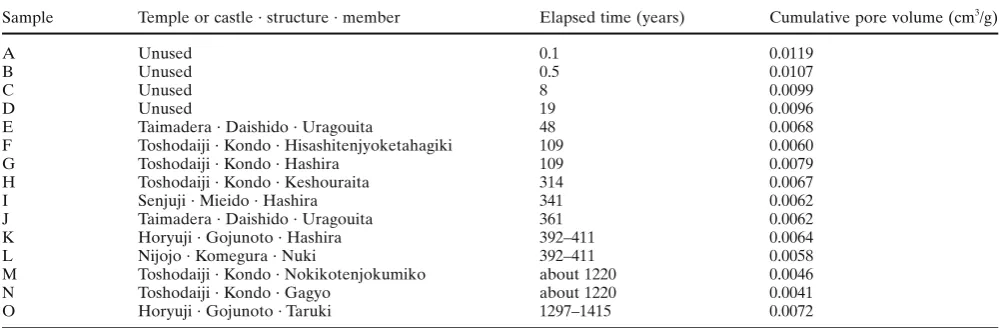
Hinoki (Chamaecyparis obtusa Endl.) was used as the sample for measurement. The elapsed times after harvest-ing of the samples (samples A–O) are shown in Table 1. Samples E to O were collected from temples and a castle, such as Taimadera, Toshodaiji, and Horyuji19
in Nara Pre-fecture, Senjuji19
in Mie Prefecture, and Nijojo19
in Kyoto Prefecture. Samples A to D were not used in buildings. Samples had different histories and different elapsed times in the environment, from 0.1 to about 1300 years. The elapsed times of samples E to O were determined from information such as existing old documents regarding the structures, and, in addition, for some samples, by dendro-chronology and radiocarbon dating. Even if samples were obtained from the same structure, they had been used as different members in the structure and had different histories; therefore, samples with different labels were essentially different. Samples were obtained from parts of the structures that had not been directly exposed to the weather.
To measure CO2 adsorption for the determination of pore-size distribution, the samples were cut into small cubes with edge lengths around 2 mm or smaller. Samples were used for measurements without any treatment after being conditioned in a room for several days at 20°C and 65% relative humidity (RH).
Methods
For analysis of the micropore structure, about 1 g of sample in the air-dried state was put into a sample cell for
adsorp-Table 1. Sample origin, elapsed time in the environment, and cumulative pore volume of pores smaller than 0.6 nm
Sample Temple or castle · structure · member Elapsed time (years) Cumulative pore volume (cm3/g)
A Unused 0.1 0.0119
B Unused 0.5 0.0107
C Unused 8 0.0099
D Unused 19 0.0096
E Taimadera · Daishido · Uragouita 48 0.0068
F Toshodaiji · Kondo · Hisashitenjyoketahagiki 109 0.0060
G Toshodaiji · Kondo · Hashira 109 0.0079
H Toshodaiji · Kondo · Keshouraita 314 0.0067
I Senjuji · Mieido · Hashira 341 0.0062
J Taimadera · Daishido · Uragouita 361 0.0062
K Horyuji · Gojunoto · Hashira 392–411 0.0064
L Nijojo · Komegura · Nuki 392–411 0.0058
M Toshodaiji · Kondo · Nokikotenjokumiko about 1220 0.0046
N Toshodaiji · Kondo · Gagyo about 1220 0.0041
tion measurement of CO2, and out-gassed for 5 h at 50°C under a high vacuum below 10−5
Pa. Pretreatment condi-tions were strictly the same among samples to equalize the effects of pretreatment history on the results. The amount of CO2 adsorbed was measured at ice–water temperature (273 K) with 5 min of adsorption time, which was reported as the most appropriate condition to test wood micropores, using an automatic gas adsorption device AUTOSORB-1 (Quantachrome, USA).20
The pore-size distribution of micropores smaller than 0.6 nm was determined using the HK method from the adsorption isotherms obtained.
Results and discussion
Infl uence of elapsed time in the environment on microstructures of dry wood
Physical and mechanical properties of wood are affected by histories such as temperature and/or swelling state, and microstructures of wood are considered to be strongly related to changes in those properties. In recent years, adsorption of CO2 onto wood has been successfully mea-sured at ice–water temperature (273 K) by Nakatani et al.20 and Kojiro et al.17
The latter reported that the number of micropores smaller than 0.6 nm in wood decreased with increasing heating temperature and were affected by the conditioning histories. When considering the relation of the unstable state to the microstructure of wood, investigating the micropore structure is very effective. Therefore, in this study, micropores in dry wood were measured with a similar method to that in the previous report, using samples with various elapsed times in the environment.
Micropore size distributions of dry wood
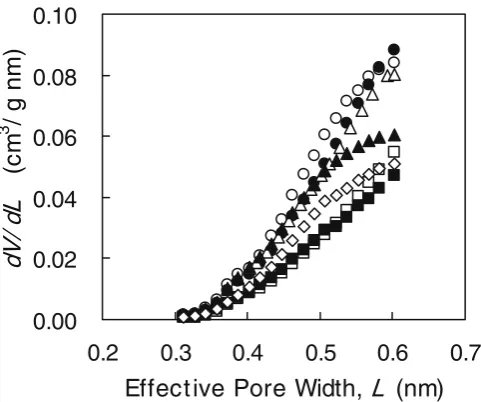
Figure 1 shows micropore size distributions determined by the adsorption of CO2 with samples A, B, C, D, F, L, and O in Table 1, having various elapsed times in the environ-ment. Samples in the air-dried state were dried by out-gassing at 50°C for 5 h before adsorption measurements. Pore size distribution of pores smaller than 0.6 nm differed among samples with different elapsed time in the environ-ment. Except for the result of sample O, pore volume within this range decreased with increased elapsed time in the environment. As shown in the previous report,17
high repro-ducibility was obtained for similar measurements when the sample was conditioned in the same manner. Thus, differ-ences in pore size distribution in Fig. 1 are considered to be attributable to differences in the microstructures of the measured samples.
When wood is dried, localized stresses are produced in the microstructure of wood components in cell walls. Insta-bility of the microstructures of wood in the air-dried state is considered to still exist at around room temperature, because wood components in the air-dried state do not surpass their glass transition temperatures.21
Immediately after drying, microstructures in wood are highly unstable,
as judged from the result that wood immediately after drying had higher micropore volume than wood that expe-rienced higher temperatures. A longer elapsed time in the environment is considered to make the microstructures in wood more stable, that is, with fewer micropores. If this deduction is correct, it is expected that the decrease in the number of micropores with elapsed time in the environment should be reversed after rewetting followed by drying.
Figure 2 shows micropore size distributions in the fi rst measurements and the second measurements after rewet-ting and drying of samples D and O with elapsed times of
0.00
0.02
0.04
0.06
0.08
0.10
0.2
0.3
0.4
0.5
0.6
0.7
Effect ive Pore Width,
L
(nm)
dV
/
d
L
(c
m
3
/g
n
m
)
Fig. 1. Pore-size distributions determined by the adsorption of CO2 at
ice–water temperature (273 K) with samples A, B, C, D, F, L, and O.
Open circles, sample A; fi lled circles, sample B; open triangles, sample
C; fi lled triangles, sample D; open squares, sample F; fi lled squares, sample L; open diamonds, sample O
0.00
0.02
0.04
0.06
0.08
0.10
0.2
0.3
0.4
0.5
0.6
0.7
Effect ive Pore Width,
L
(nm)
dV
/
dL
(c
m
3
/g
n
m
)
Fig. 2. Infl uence of rewetting and drying on pore-size distributions determined by the adsorption of CO2 at ice–water temperature (273 K). Open circles, sample O; fi lled circles, sample O after rewetting and
19 years and at least 1300 years in the environment, respec-tively. The samples were fi rst measured after drying by out-gassing at 50°C for 5 h, and, after the measurements, the samples were boiled for 1 h and dried in a conditioned room (20°C and 65%RH) for several days. The samples were then second measured after drying by out-gassing at 50°C for 5 h. More micropores existed in samples D and O after rewetting and drying than in the fi rst measurements. The number of micropores of sample D increased by rewet-ting and drying to a similar degree of pore volume for sample A with elapsed time of 0.1 years; however, the micropores of sample O did not recover so much by rewet-ting and drying. These results mean that elapsed time in the environment makes the microstructures in wood compo-nents more stable with fewer micropores, although micro-pores of wood with elapsed time of more than 1000 years do not return to the initial pore volume after harvesting, by rewetting and drying.
Cumulative micropore volume
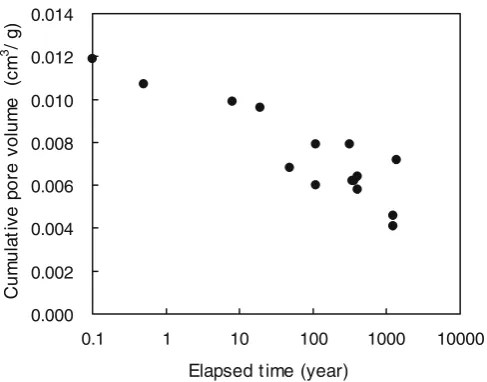
In addition to micropore size distributions of samples with different elapsed time in the environment, cumulative pore volume should also be noted. Figure 3 shows the depen-dence of cumulative volume of micropores smaller than 0.6 nm, which was obtained from the result shown in Table 1, on elapsed time in the environment. In the range of elapsed time from 0.1 years to about 1300 years, a negative correlation was found between cumulative pore volume and elapsed time in the environment, although the data are spread to some degree. Moreover, judging from Fig. 3, cumulative pore volume of micropores smaller than 0.6 nm for the sample with elapsed time of about 1000 years in the environment was almost half of that for the sample with elapsed time in the environment for 0.1 years.
From the results above, it is clear that the volume of micropores smaller than 0.6 nm in wood decreases with
elapsed time in the environment. This means that the microstructures of wood after longer elapsed times in the environment are more stable. This is attributable to the thermal motion of molecules of wood constituents for the long term and possibly to the repetition of adsorption and desorption of moisture and change in temperature making the microstructures of wood more stable than those of wood with less elapsed time in the environment. There-fore, improvement of the mechanical properties of wood with elapsed time is considered to partly result from sta-bilizing the microstructures of wood. In addition, consider-ing the recent reports by Nakatani et al.20,22
and the present result, changes in the microstructures of wood with elapsed time in the environment are considered to occur in lignin. However, to ascertain this, further investigation, including methodology such as the combination of spectrometry and measurement of viscoelastic pro perties, is needed.
Conclusions
Changes in the microstructures of dry wood with elapsed time in the environment were revealed by characterizing the micropore structures smaller than 0.6 nm from CO2 adsorption at ice–water temperature (273 K). The results for samples aged from 0.1 years to about 1300 years are as follows.
Micropores smaller than 0.6 nm in wood decreased in number with elapsed time in the environment, and a nega-tive correlation was found between cumulanega-tive pore volume for pores smaller than 0.6 nm and elapsed time from 0.1 years to about 1300 years in the environment. Cumulative pore volume for pores smaller than 0.6 nm in the 1000-year sample was almost half of that in the 0.1-year sample. The micropores increased in number by rewetting and drying. These results indicate that longer elapsed time in the envi-ronment makes the microstructures of wood more stable and decreases the number of micropores in wood, because of the thermal motion of molecules of wood constituents for the long term and possibly the repetition of adsorption and desorption of moisture and change in temperature.
Acknowledgments The authors express their gratitude, for the provi-sion of the samples of old wood and helpful advice, to those affi liated with Taimadera and Toshodaiji in Nara Prefecture and Senjuji in Mie Prefecture, to the offi cials of the Nara Prefectural Board of Education, and to Dr. Haruko Sakai of the Nara Forest Research Institute.
References
1. Kohara J (1958) Study on the old timber. Res Rep Fac Eng Chiba Univ 9(15):1–55
2. Kohara J (1958) Study on the old Timber. Res Rep Fac Eng Chiba Univ 9(16):23–65
3. Hirashima Y, Sugihara M, Sasaki Y, Ando K, Yamasaki M (2004) Strength properties of aged wood I. Tensile strength properties of aged keyaki and akamatsu woods (in Japanese). Mokuzai Gakkaishi 50:301–309
4. Hirashima Y, Sugihara M, Sasaki Y, Ando K, Yamasaki M (2004) Strengh properties of aged wood II. Compressive strength
proper-0.000 0.002 0.004 0.006 0.008 0.010 0.012 0.014
0.1 1 10 100 1000 10000
Elapsed t ime (year)
C
u
m
u
la
ti
v
e
p
o
re
v
o
lu
m
e
(c
m
3 /g
)
ties, shearing strength and hardness of aged keyaki and akamatsu woods (in Japanese). Mokuzai Gakkaishi 50:368–375
5. Hirashima Y, Sugihara M, Sasaki Y, Ando K, Yamasaki M (2005) Strength properties of aged wood III. Static and impact bending strength properties of aged keyaki and akamatsu woods (in Japanese). Mokuzai Gakkaishi 51:146–152
6. Ando K, Hirashima Y, Sugishita M, Hirao S, Sasaki Y (2006) Microscopic processes of shearing fracture of old wood, examined using the acoustic emission technique. J Wood Sci 52:483–489 7. Furuta Y, Norimoto M, Yano H (1998) Thermal-softening
proper-ties of water-swollen wood V. The effects of drying and heating histories (in Japanese). Mokuzai Gakkaishi 44:82–88
8. Kudo M, Iida I, Ishimaru Y, Furuta Y (2003) The effect of quench-ing on the mechanical properties of wet wood (in Japanese). Mokuzai Gakkaishi 49:253–259
9. Kamei K, Ishimaru Y, Iida I, Furuta Y (2004) Effect of sample preparation methods on mechanical properties of wood I (in Japanese). Mokuzai Gakkaishi 50:10–17
10. Ishimaru Y (2003) Mechanical properties of wood in unstable states caused by changes in temperature and/or swelling. Proceed-ings of the 2nd International Conference of the European Society for Wood Mechanics, Stockholm, pp 69–78
11. Takahashi C, Ishimaru Y, Iida I, Furuta Y (2006) The creep of wood destabilized by change in moisture content. Part 3: the infl u-ence of changing moisture history on creep behavior. Holzforsc-hung 60:299–303
12. Nakano T (2005) Effects of quenching on relaxation properties of wet wood. J Wood Sci 51:112–117
13. Kojiro K, Furuta Y, Ishimaru Y (2008) Infl uence of histories on dynamic viscoelastic properties and dimensions of water-swollen wood. J Wood Sci 54:95–99
14. Kovacs AJ (1964) Transition vitreuse dans les polymers amorphes. Etud Phenomenol Hochpolym Forsch 3:394–507
15. Struik LCE (1978) Physical aging in amorphous polymers and other materials. Elsevier, Amsterdam
16. Kojiro K, Furuta Y, Ishimaru Y (2008) Infl uence of heating history on dynamic viscoelastic properties and dimensions of dry wood. J Wood Sci 54:196–201
17. Kojiro K, Furuta Y, Ishimaru Y (2008) Infl uence of heating and drying history on micropores in dry wood. J Wood Sci 54: 202–207
18. Harvath G, Kawazoe K (1983) Method for the calculation of effec-tive pore size distribution in molecular sieve carbon. J Chem Eng Jpn 16:470–475
19. Yokoyama M (2007) Establishment of database for the aging wood from Japanese historical buildings. Proceedings of the 65th RISH Symposium, Kyoto, pp 16–25
20. Nakatani T, Ishimaru Y, Iida I, Furuta Y (2008) Micropore struc-ture of wood: change in micropore distribution according to delig-nifi cation J Wood Sci 54:252–255
21. Goring DAI (1963) Thermal softening of lignin, hemicellulose and cellulose. Pulp Pap Canada 64:T517–527