Fine Mapping of
HWC2
, a Complementary Hybrid
Weakness Gene, and Haplotype Analysis Around the Locus
in Rice
Tsutomu Kuboyama&Toshiya Saito&Takashi Matsumoto&Jianzhong Wu& Hiroyuki Kanamori&Satoru Taura&Muneharu Sato&Wataru Marubashi& Katsuyuki Ichitani
Received: 25 March 2009 / Accepted: 13 May 2009 / Published online: 10 June 2009 #Springer Science + Business Media, LLC 2009
Abstract Hybrid weakness is a reproductive barrier. In rice, the hybrid weakness caused by two complementary genes––HWC1andHWC2––has been surveyed extensively. However, their gene products and the molecular mechanism that causes hybrid weakness have remained unknown. We first performed fine mapping of HWC2, narrowing down
the area of interest to 19 kb. We thereby identified five candidate genes. Second, we performed haplotype analysis around the HWC2 locus of 33 cultivars. With 15 DNA markers examined, all the 13 Hwc2-1 carriers share the same haplotype for consecutive 14 DNA markers. As for
hwc2-2 carriers, five out of 20 have the haplotypes relatively similar to those of Hwc2-1 carriers. However, the other haplotypes differ remarkably from them. These results are useful to identify theHWC2 gene and to study rice varietal differentiation.
Keywords Reproductive barrier . Linkage analysis . Haplotype analysis . Hybrid weakness
Introduction
Hybrid weakness is a reproductive barrier. It can be defined as weak growth occurring in hybrids derived from crosses between two normal strains. According to its degree or symptom, it is also called hybrid lethality, hybrid abnor-mality, or hybrid necrosis. This phenomenon has been observed in many plant species including Arabidopsis thaliana (Bomblies et al. 2007) and Phaseolus vulgaris
(Shii et al. 1980).
In Asian cultivated rice (Oryza sativa), two hybrid weakness phenomena from different cross combinations have been reported (for a review, see Sato 1997). One reportedly exists in some Indian rice crosses (Oka 1957), the other in the cross between a Peruvian cultivar Jamaica and Japanese lowland cultivars such as Norin 8 (Amemiya and Akemine 1963). Among the two hybrid weakness phenomena, the latter phenomenon has been studied more extensively. Genetically, this hybrid weakness is caused by DOI 10.1007/s12284-009-9026-y
Tsutomu Kuboyama and Katsuyuki Ichitani contributed equally to this paper.
T. Kuboyama:T. Saito
College of Agriculture, Ibaraki University, 3-21-1 Chuo,
Ami, Ibaraki 300-0393, Japan
M. Sato
:
K. Ichitani (*)Faculty of Agriculture, Kagoshima University, 1-21-24 Korimoto,
Kagoshima, Kagoshima 890-0065, Japan e-mail: [email protected]
T. Matsumoto
:
J. WuNational Institute of Agrobiological Resources, 2-1-2 Kannondai,
Tsukuba, Ibaraki 305-8602, Japan
H. Kanamori
Institute of the Society for Techno-Innovation of Agriculture, Forestry, and Fisheries,
446-1 Ippaizuka, Kamiyokoba, Tsukuba, Ibaraki 305-0854, Japan
S. Taura
Institute of Gene Research, Kagoshima University, 1-21-24 Korimoto,
Kagoshima, Kagoshima 890-0065, Japan
W. Marubashi
School of Agriculture, Meiji University, 1-1-1 Higashimita,
two complementary genes: Hwc1from Jamaica and Hwc2
from Japanese lowland cultivars. According to the new gene nomenclature system for rice (McCouch 2008), we hereafter change our description of the gene symbols, as shown in Table1. The distribution of the two genes was surveyed by Sato and Hayashi (1983) and Sato and Morishima (1987). Among the cultivars they surveyed, most of temperate Japonica cultivars carry Hwc2-1, although few tropical Japonica and Indica cultivars carry this gene. None of the 30 strains of wild relatives (Oryza rufipogon and Oryza nivara) carries Hwc2-1. As for
HWC1, Jamaica is reportedly the only carrier of Hwc1-1
gene. From these results, Sato and Morishima (1988) inferred that the Hwc2-1 gene arose at an early stage of differentiation of temperate Japonica cultivars.
The molecular mechanism of the hybrid weakness has remained unknown. To understand the mechanism, we should clarify the causal genes and their gene products. We selected a map-based cloning strategy to identify the two causal genes: HWC1 and HWC2. We performed linkage analysis ofHWC1(Ichitani et al.2007) and thereby located this locus on the long arm of chromosome 1, narrowing down the area of interest to 60 kb. We also performed linkage analysis ofHWC2 (Ichitani et al.2001) and tagged this locus between the two restriction fragment length polymorphism (RFLP) markers on the long arm of chromosome 4. However, we have not located this gene on a physical map. In the present study, we performed high-resolution mapping ofHWC2, narrowing down the area of interest to 19 kb. We also performed haplotype analysis around the HWC2 locus and identified linkage disequilib-rium around this locus.
Results
Fine mapping using the F2population from the cross
between Nipponbare and Kasalath
First, we selected the F2population from the cross between
the two cultivars, Nipponbare and Kasalath, as a mapping
population (Table2) for two reasons: first, our preliminary experiments indicated that Nipponbare carries Hwc2-1, whereas Kasalath carries neitherHwc1-1norHwc2-1. The second reason is that high-density rice linkage maps have already been constructed using the same cross combination (Kurata et al. 1994; Harushima et al. 1998). This DNA marker information is also useful forHWC2 mapping. Our previous study (Ichitani et al.2001) showed thatHWC2is encompassed by the two RFLP markers, XNpb264 and
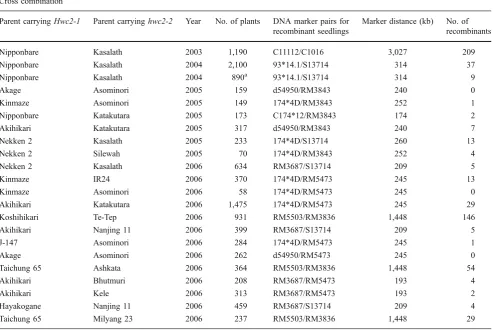
XNpb197. In the present study, a sequence-tagged site (STS) marker C11112 and a cleaved amplified polymorphic sequence (CAPS) marker C1016 (Table3, Fig.1a, b) were used for selecting recombinants around theHWC2locus in 2003 because the two markers encompass the two RFLP markers and show polymorphism between the two culti-vars. In all, 209 recombinants between the two DNA markers were selected from 1,190 F2plants. Among them,
165 recombinants were crossed to Jamaica to determine each genotype for the HWC2 locus. This means that the number of F2 plants in 2003 was equivalent to 939
(=1,190 ×165/209). Then, these recombinants were ana-lyzed for the genotypes of the DNA markers encompassed by C11112 and C1016 to localize theHWC2locus. Results of this analysis showed that the HWC2 locus was located between 93*14.1 and RM5473 and that the target region could be narrowed down to 298 kb.
In 2004, 37 recombinants between two DNA markers, 93*14.1 and S13714, were selected from 2,100 F2 plants
from the same cross combination. Among them, 33 recombi-nants were crossed to Jamaica to determine each genotype for theHWC2 locus. This means that the number of F2 plants
in 2004 was equivalent to 1,873 (=2,100 × 33/37). Nine recombinants were found in the three-way cross population consisting of 890 plants. Consequently, the
HWC2 locus was located between dG264H and RM5473; the target region was narrowed down to 150 kb. As for the
HWC1 locus, the area of interest was narrowed to 60 kb using 883 F2 plants (Ichitani et al. 2007). Therefore, we
inferred that crossover events were suppressed around the
HWC2 locus in this cross combination. In Fig. 1b, recom-bination events per kilobase pair of 50 recombinants between
Old New
Gene full name Gene symbol Gene full name Gene symbol
Locus/gene Hybrid weakness c1 Hwc1 Hybrid WEAKNESS C1 HWC1
Dominant allele Hybrid weakness c1 Hwc1 Hybrid weakness c1-1 Hwc1-1
Recessive allele hybrid weakness c1 hwc1 hybrid weakness c1-2 hwc1-2
Locus/gene Hybrid weakness c2 Hwc2 Hybrid WEAKNESS C2 HWC2
Dominant allele Hybrid weakness c2 Hwc2 Hybrid weakness c2-1 Hwc2-1
Recessive allele hybrid weakness c2 hwc2 hybrid weakness c2-2 hwc2-2 Table 1 Gene Symbols
93*14.1 and S13714 were calculated for each pair of neighboring DNA markers. We observed the tendency that recombination events per kilobase pair were smaller for the DNA marker pairs that were closer to the HWC2 locus, supporting the inference presented above.
Fine mapping using the F2population from other cross
combinations
We examined 1,101 F2 plants from other six cross
combinations in 2005 to avoid the recombination suppres-sion problem (Table 2). One useful recombinant was obtained from the cross between Kinmaze and Asominori. The recombination event occurred between C111*4 and C111*8, localizing the HWC2 locus between C111*4 and RM5473. In 2006, we examined 5,994 F2 plants from 13
cross combinations (Table2). We confirmed the result in 2005 and obtained one useful recombinant from the cross between Kinmaze and IR24. The recombination event occurred between KGC4M28 and KGC4M29, localizing theHWC2 locus between KGC4M28 and RM5473. From 2003 to 2006, RM5473 has remained the nearest DNA
markers from the telomere of the long arm. These results showed that the position of HWC2 was confined to about the 19-kb region between the two DNA markers, KGC4M28 and RM5473, both of which were located on the Nipponbare bacterial artificial chromosome (BAC) clone OSJNBa0053K19 (Table2, Fig.1c)
Candidate gene analysis
In all, five open reading frames (ORFs) were found between KGC4M28 and RM5473 in Nipponbare genome (Feng et al. 2002; Fig. 1c, Table 4). In an Indica cultivar Guangluai 4 genome, of which 2.3 Mb of three contiguous segments of chromosome 4 was sequenced (Feng et al. 2002), corresponding ORFs were found in the same order (data not shown). According to the Rice Full-Length cDNA Consortium (2003), all ORFs but ORF4 are expressed.
In fact, ORF1 has some similarity with a blight resistance geneXa1 (Yoshimura et al.1998) from IRBB1, a near-isogenic line for bacterial blight genes (Ogawa et al. 1991), and has NBS-LRR motif, which is detected in most plant pest resistance genes. A reported full-length cDNA
Table 2 The Cross Combinations forHWC2Fine Mapping
Cross combination
Parent carryingHwc2-1 Parent carryinghwc2-2 Year No. of plants DNA marker pairs for recombinant seedlings
Marker distance (kb) No. of recombinants
Nipponbare Kasalath 2003 1,190 C11112/C1016 3,027 209
Nipponbare Kasalath 2004 2,100 93*14.1/S13714 314 37
Nipponbare Kasalath 2004 890a 93*14.1/S13714 314 9
Akage Asominori 2005 159 d54950/RM3843 240 0
Kinmaze Asominori 2005 149 174*4D/RM3843 252 1
Nipponbare Katakutara 2005 173 C174*12/RM3843 174 2
Akihikari Katakutara 2005 317 d54950/RM3843 240 7
Nekken 2 Kasalath 2005 233 174*4D/S13714 260 13
Nekken 2 Silewah 2005 70 174*4D/RM3843 252 4
Nekken 2 Kasalath 2006 634 RM3687/S13714 209 5
Kinmaze IR24 2006 370 174*4D/RM5473 245 13
Kinmaze Asominori 2006 58 174*4D/RM5473 245 0
Akihikari Katakutara 2006 1,475 174*4D/RM5473 245 29
Koshihikari Te-Tep 2006 931 RM5503/RM3836 1,448 146
Akihikari Nanjing 11 2006 399 RM3687/S13714 209 5
J-147 Asominori 2006 284 174*4D/RM5473 245 1
Akage Asominori 2006 262 d54950/RM5473 245 0
Taichung 65 Ashkata 2006 364 RM5503/RM3836 1,448 54
Akihikari Bhutmuri 2006 208 RM3687/RM5473 193 4
Akihikari Kele 2006 313 RM3687/RM5473 193 2
Hayakogane Nanjing 11 2006 459 RM3687/S13714 209 4
Taichung 65 Milyang 23 2006 237 RM5503/RM3836 1,448 29
aThree-way cross combination (Nipponbare×Kasalath)×Jamaica. The other cross combinations were F
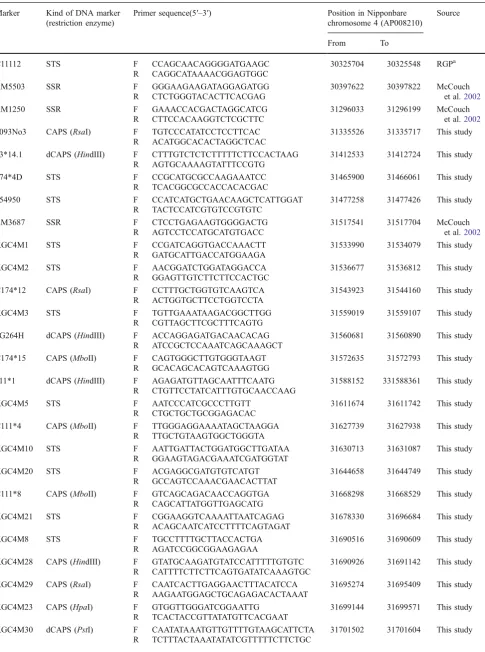
Table 3 Primer Sequences Designed and Used for Fine Mapping of theHWC2Locus
Marker Kind of DNA marker (restriction enzyme)
Primer sequence(5′–3′) Position in Nipponbare chromosome 4 (AP008210)
Source
From To
C11112 STS F CCAGCAACAGGGGATGAAGC 30325704 30325548 RGPa
R CAGGCATAAAACGGAGTGGC
RM5503 SSR F GGGAAGAAGATAGGAGATGG 30397622 30397822 McCouch
et al.2002 R CTCTGGGTACACTTCACGAG
RM1250 SSR F GAAACCACGACTAGGCATCG 31296033 31296199 McCouch
et al.2002 R CTTCCACAAGGTCTCGCTTC
0093No3 CAPS (RsaI) F TGTCCCATATCCTCCTTCAC 31335526 31335717 This study
R ACATGGCACACTAGGCTCAC
93*14.1 dCAPS (HindIII) F CTTTGTCTCTCTTTTTCTTCCACTAAG 31412533 31412724 This study R AGTGCAAAAGTATTTCCGTG
174*4D STS F CCGCATGCGCCAAGAAATCC 31465900 31466061 This study
R TCACGGCGCCACCACACGAC
d54950 STS F CCATCATGCTGAACAAGCTCATTGGAT 31477258 31477426 This study
R TACTCCATCGTGTCCGTGTC
RM3687 SSR F CTCCTGAGAAGTGGGGACTG 31517541 31517704 McCouch
et al.2002 R AGTCCTCCATGCATGTGACC
KGC4M1 STS F CCGATCAGGTGACCAAACTT 31533990 31534079 This study
R GATGCATTGACCATGGAAGA
KGC4M2 STS F AACGGATCTGGATAGGACCA 31536677 31536812 This study
R GGAGTTGTCTTCTTCCACTGC
C174*12 CAPS (RsaI) F CCTTTGCTGGTGTCAAGTCA 31543923 31544160 This study
R ACTGGTGCTTCCTGGTCCTA
KGC4M3 STS F TGTTGAAATAAGACGGCTTGG 31559019 31559107 This study
R CGTTAGCTTCGCTTTCAGTG
dG264H dCAPS (HindIII) F ACCAGGAGATGACAACACAG 31560681 31560890 This study R ATCCGCTCCAAATCAGCAAAGCT
C174*15 CAPS (MboII) F CAGTGGGCTTGTGGGTAAGT 31572635 31572793 This study
R GCACAGCACAGTCAAAGTGG
111*1 dCAPS (HindIII) F AGAGATGTTAGCAATTTCAATG 31588152 331588361 This study R CTGTTCCTATCATTTGTGCAACCAAG
KGC4M5 STS F AATCCCATCGCCCTTGTT 31611674 31611742 This study
R CTGCTGCTGCGGAGACAC
C111*4 CAPS (MboII) F TTGGGAGGAAAATAGCTAAGGA 31627739 31627938 This study R TTGCTGTAAGTGGCTGGGTA
KGC4M10 STS F AATTGATTACTGGATGGCTTGATAA 31630713 31631087 This study
R GGAAGTAGACGAAATCGATGGTAT
KGC4M20 STS F ACGAGGCGATGTGTCATGT 31644658 31644749 This study
R GCCAGTCCAAACGAACACTTAT
C111*8 CAPS (MboII) F GTCAGCAGACAACCAGGTGA 31668298 31668529 This study
R CAGCATTATGGTTGAGCATG
KGC4M21 STS F CGGAAGGTCAAAATTAATCAGAG 31678330 31696684 This study
R ACAGCAATCATCCTTTTCAGTAGAT
KGC4M8 STS F TGCCTTTTGCTTACCACTGA 31690516 31690609 This study
R AGATCCGGCGGAAGAGAA
KGC4M28 CAPS (HindIII) F GTATGCAAGATGTATCCATTTTTGTGTC 31690926 31691142 This study R CATTTTCTTCTTCAGTGATATCAAAGTGC
KGC4M29 CAPS (RsaI) F CAATCACTTGAGGAACTTTACATCCA 31695274 31695409 This study R AAGAATGGAGCTGCAGAGACACTAAAT
KGC4M23 CAPS (HpaI) F GTGGTTGGGATCGGAATTG 31699144 31699571 This study
R TCACTACCGTTATATGTTCACGAAT
AK105096 covers only 20% of ORF1; its sequence coincides completely with the 3′ region of ORF1. The number of amino acids in ORF1 is similar to that in XA1. Therefore, longer full-length cDNA corresponding to ORF1 might exist in Nipponbare genome. In addition, ORF2 exhibits similarity with the humanRING3gene (Thorpe et al.1996); ORF2 and RING3 share bromodomain. Although ORF3 has no similarity with known genes, this gene is expressed. ORF4 has only 12 residues and has no similarity with a known protein. Also, ORF5 encodes a protein similar to LSD1, which represses transcription by deme-thylating histone H3 at K4, whose methylation is linked to active transcription (Shi et al.2004).
Haplotype analysis
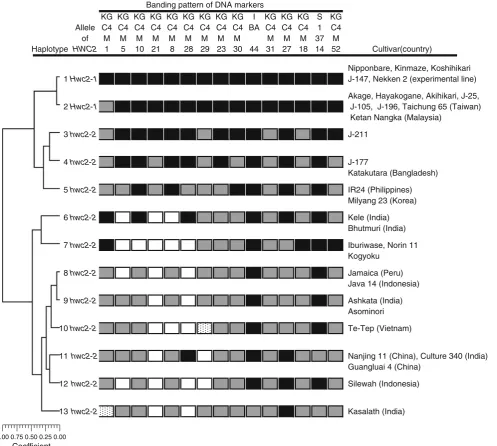
Banding patterns of 15 DNA markers aroundHWC2locus of 33 cultivars were arranged in Fig.2. The result ofχ2test for independence indicated that significant deviation from the expected ratio (P<0.01) was observed between the genotype for theHWC2locus and the banding patterns of all DNA markers except KGC4M1 (P= 0.55), IBA44 (P= 0.41), and S13714 (P= 0.09). As for IBA44 and S13714, the banding patterns not represented by Nippon-bare were very few, leading to nonsignificant results. The two markers were designed based on the insertion/deletion
between Nipponbare and Kasalath. As a whole, linkage disequilibrium was observed around the HWC2 locus, supporting the result of the fine mapping (Fig. 1c). The banding patterns of KGC4M29 and KGC4M31 coincided with the genotypes for the HWC2 locus. All cultivars produced a single band when using the KGC4M31 primer pair. The polymerase chain reaction (PCR) products were digested with the restriction enzymeHpaI in all thehwc2-2
carriers, although they were not digested with the enzyme in any Hwc2-1 carriers. As for KGC4M29, one PCR product was produced and was not digested with RsaI in
Hwc2-1 carriers. In contrast, the PCR products were all digested in hwc2-2 carriers except for a few cultivars: before the digestion with RsaI, Te-Tep showed one band with the same migration distance as the other cultivars. After the digestion, the band proved to be composed of two PCR products: one was digested with RsaI, the other not. The four cultivars, Nanjing 11, Guangluai 4, Culture 340, and Silewah, produced no bands with the KGC4M29 primer pair.
For all the DNA markers except KGC4M1, the banding pattern carried by Nipponbare was mostly shared byHwc2
-1 carriers. Among them, Koshihikari, Akihikari, and Taichung 65 are generally classified as temperate Japonica. TheHwc2-1carriers share the same haplotype ranging from KGC4M5 to KGC4M52. On the other hand, the other
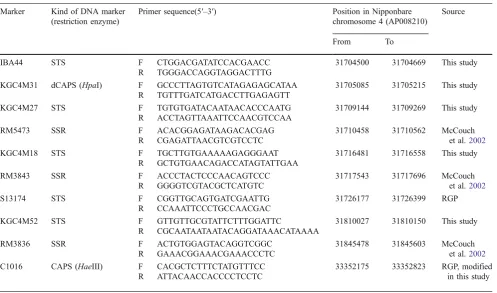
Table 3 (continued)
Marker Kind of DNA marker (restriction enzyme)
Primer sequence(5′–3′) Position in Nipponbare chromosome 4 (AP008210)
Source
From To
IBA44 STS F CTGGACGATATCCACGAACC 31704500 31704669 This study
R TGGGACCAGGTAGGACTTTG
KGC4M31 dCAPS (HpaI) F GCCCTTAGTGTCATAGAGAGCATAA 31705085 31705215 This study R TGTTTGATCATGACCTTGAGAGTT
KGC4M27 STS F TGTGTGATACAATAACACCCAATG 31709144 31709269 This study
R ACCTAGTTAAATTCCAACGTCCAA
RM5473 SSR F ACACGGAGATAAGACACGAG 31710458 31710562 McCouch
et al.2002 R CGAGATTAACGTCGTCCTC
KGC4M18 STS F TGCTTGTGAAAAAGAGGGAAT 31716481 31716558 This study
R GCTGTGAACAGACCATAGTATTGAA
RM3843 SSR F ACCCTACTCCCAACAGTCCC 31717543 31717696 McCouch
et al.2002 R GGGGTCGTACGCTCATGTC
S13174 STS F CGGTTGCAGTGATCGAATTG 31726177 31726399 RGP
R CCAAATTCCCTGCCAACGAC
KGC4M52 STS F GTTGTTGCGTATTCTTTGGATTC 31810027 31810150 This study
R CGCAATAATAATACAGGATAAACATAAAA
RM3836 SSR F ACTGTGGAGTACAGGTCGGC 31845478 31845603 McCouch
et al.2002 R GAAACGGAAACGAAACCCTC
C1016 CAPS (HaeIII) F CACGCTCTTTCTATGTTTCC 33352175 33352823 RGP, modified
in this study R ATTACAACCACCCCTCCTC
banding patterns and null bands were not shared byHwc2-1
carriers but by hwc2-2 carriers. Among them, IR24, Milyang 23, Guangluai 4, and Kasalath are generally classified as Indica whereas Jamaica and Silewah are generally classified as tropical Japonica, and Norin 11, Iburiwase, and Asominori are generally classified as temperate Japonica. With 15 DNA markers scattered on the 276 kb of Nipponbare genome coveringHWC2 gene, the cultivars examined were classified into 13 haplotypes. The relationship between haplotypes is portrayed in Fig.2. The cultivars were largely divided into two groups: one com-posed of Hwc2-1 carriers and hwc2-2 carriers whose haplotypes were relatively similar to those of Hwc2-1
carriers and the other composed of hwc2-2 carriers whose haplotypes differ remarkably from those ofHwc2-1carriers.
Discussion
Our previous study showed that the HWC2 locus was located within the 3.9-cM region between two RFLP markers: XNpb264 and XNpb197. The present study localized this gene on 19-kb region of the chromosome 4 physical map, where five candidate genes were annotated. We first selected the F2population from the cross between
Nipponbare and Kasalath because of high DNA
polymor-4S 4L
Centromere
a
c
b
Fig. 1 Location of HWC2 on rice chromosome 4. a Approximate location of the C1112 and C1016, initially used DNA markers for recombinants around the HWC2 locus from the cross between Nipponbare and Kasalath, on the high-density linkage map of chromosome 4 modified from Harushima et al. (1998). b Fine mapping ofHWC2using the cross between Nipponbare and Kasalath.
A total of 50 recombinants between two DNA markers, 93*14.1 and S13714, were crossed to Jamaica and were analyzed for the order of
HWC2and the internal DNA markers.cThe 19-kb region containing
phism and accumulation of DNA marker information. However, the candidate region was not narrowed down to less than 150 kb even though approximately 6,500 gametes were analyzed. We further examined 14,190 gametes from 18 kinds of other cross combinations and finally narrowed down the area of interest to 19 kb. In the cross between Nipponbare and Kasalath, chromosomal rearrangement such as inversion and insertion near the HWC2 locus probably suppressed crossover events thereby.
Bomblies et al. (2007) showed that hybrid necrosis inA.
thalianawas caused by complementary effect of two genes and that one causal gene encodes NB-LRR protein. This fact suggests that ORF1 can be a good candidate ofHWC2. ORF2 was annotated to contain bromodomain, which is widely distributed among the different enzymes that acetylate, methylate, or remodel chromatin; it also has the ability to bind acetylated histone tails in vivo (De la Cruz et al. 2005). Therefore, it has been thought that chromatin-remodeling enzymes can utilize the bromodomain to find and/or act on their targets. Shi et al. (2004) showed that LSD1 specifically demethylates histone H3 lysine 4, which is linked to active transcription. ORF5, a homolog of LSD1, might catalyze the same reaction. Unusual expression of ORF2 or ORF5, working together withHWC1, might affect expression of other genes, engendering hybrid weakness.
Result of the haplotype analysis was consistent with the result of fine mapping. Among the DNA markers examined, the genotypes of KGC4M29 and KGC4M31 completely coincided with those for HWC2. The recognition site in KGC4M29 was located in ORF1, whereas that of KGC4M31 was in ORF5 (Fig.1c). The results of the haplotype analysis suggest that ORF1 and ORF5 are the good candidates of
HWC2gene, as inferred from their predicted functions. The haplotype analysis also offered interesting results from the perspective of rice varietal differentiation. The
Hwc2-1 carriers share the same haplotype ranging from KGC4M5 to KGC4M52. Thehwc2-2 carriers have
differ-ent haplotypes, most of which are distinct from those of the
Hwc2-1 carriers. Many haplotypes in hwc2-2 carriers and only two haplotypes in Hwc2-2 carriers led us to the following inferences: (1) the hwc2-2 alleles have been differentiated at sequence level, some similar to Hwc2-1, others not. (2) The“gain-of-function”mutation from hwc2-2, probably of haplotype 3, toHwc2-1occurred. (3) Hwc2-1 gene diffused in temperate Japonica, dragging adjacent genes with it. To identify the origin and diffusion process of
Hwc2-1 and adjacent genes, we are undertaking larger haplotype analysis around HWC2. The DNA markers developed in this study will be very useful for that purpose. After cloning of HWC2, we also plan to perform the sequence analysis of HWC2to clarify the relation between the haplotypes andHWC2alleles or sequence variants.
Results of our previous study (Ichitani et al. 2001) indicated thatHWC2andXa1loci are closely linked to each other. A Japanese cultivar, Kogyoku, shows an example of conserved linkage block coveringhwc2-2andXa1surviving the selection in rice breeding history in Japan, whereHwc2-1
carrier temperate Japonica cultivars have been prevalent (Sato and Hayashi 1983). Amemiya and Akemine (1963) reported that Kogyoku, which was originally written in Chinese characters and was called Kidama in Amemiya and Akemine (1963), does not carryHwc2-1. Kogyoku carries a bacterial blight gene Xa1, which was introduced into a susceptible cultivar IR24 background by backcrossing to develop an isogenic line IRBB1 (Ogawa et al. 1991). The cDNA sequence ofXa1(AB002266; Yoshimura et al.1998) of IRBB1 differed greatly from the corresponding sequence of Nipponbare, a typical temperate Japonica cultivar in Japan. The haplotype of the 15 DNA markers of Kogyoku is also very different from that of Nipponbare (Fig. 2). Nevertheless, we compared the electrophoresis patterns of the two cultivars of the 36 STS markers scattering on all the chromosomes with the result that the two cultivars share the same patterns except for one marker on chromosome 10
Table 4 Candidate Genes in theHWC2Region with the aid of RiceGAAS (Sakata et al.2002)
ORF Protein Rice ESTs EST source Corresponding predicted genes in
RAP-DBa MSU rice genome annotationb
1 Putative XA1 AK105096c Nipponbare Os04g0622600 LOC_Os04g53160
AB002266d IRBB1
2 putative RING3 AK067276c Nipponbare Os04g0623100 LOC_Os04g53170
3 Unknown protein AK105231c Nipponbare Os04g0623200 LOC_Os04g53180
4 Hypothetical protein None None
5 Putative LSD1 AK064902c Nipponbare Os04g0623300 LOC_Os04g53190
aThe Rice Annotation Project (2008)
b
Ouyang et al. (2007) c
The Rice Full-Length cDNA Consortium (2003) d
(Ichitani et al., unpublished results). These facts imply that the chromosomal segment encompassing hwc2-2 and Xa1
gene pair of Kogyoku originated from Indica or tropical Japonica was introduced to temperate Japonica background by introgression. A similar story might be applied tohwc2-2
carrier Japanese cultivars Norin 11, Iburiwase, and Asomi-nori, and the opposite case might be an Hwc2-1 carrier Malaysian cultivar Ketan Nangka, which is generally classified into tropical Japonica (Fig.2).
Recently, two blast resistance gene have been mapped proximal to theHWC2locus: (1) a strong quantitative trait locus of field rice blast resistance named Pikahei-1(t) from upland rice cultivars Kahei cosegregated with RM5473 and mapped within 300 kb (Xu et al. 2008). (2) A blast field resistance gene Pi39(t) from Chubu 111 cosegregated with RM5473 and RM3843 (Terashima et al. 2008). A blight resistance gene Xa2 (He et al. 2006) from a Vietnamese cultivar Te-Tep and a gall midge resistance gene Gm7
Banding pattern of DNA markers
KG KG KG KG KG KG KG KG KG I KG KG KG S KG Allele C4 C4 C4 C4 C4 C4 C4 C4 C4 BA C4 C4 C4 1 C4 of M M M M M M M M M M M M 37 M
Haplotype HWC2 1 5 10 21 8 28 29 23 30 44 31 27 18 14 52 Cultivar(country)
Nipponbare, Kinmaze, Koshihikari 1 Hwc2-1 J-147, Nekken 2 (experimental line)
Akage, Hayakogane, Akihikari, J-25, 2 Hwc2-1 J-105, J-196, Taichung 65 (Taiwan)
Ketan Nangka (Malaysia)
3 hwc2-2 J-211
4 hwc2-2 J-177
Katakutara (Bangladesh)
5 hwc2-2 IR24 (Philippines) Milyang 23 (Korea)
6 hwc2-2 Kele (India)
Bhutmuri (India)
7 hwc2-2 Iburiwase, Norin 11 Kogyoku
8 hwc2-2 Jamaica (Peru) Java 14 (Indonesia)
9 hwc2-2 Ashkata (India) Asominori
10 hwc2-2 Te-Tep (Vietnam)
11hwc2-2 Nanjing 11 (China), Culture 340 (India) Guangluai 4 (China)
12hwc2-2 Silewah (Indonesia)
13hwc2-2 Kasalath (India)
1.00 0.75 0.50 0.25 0.00 Coefficient
Fig. 2 Haplotype diversity around theHWC2locus. Banding patterns of 15 DNA markers around HWC2 locus from KGC4M1 to KGC4M52 were analyzed for 33 cultivars whose genotypes of the
HWC2locus had been identified, including parental cultivars of the fine mapping of theHWC2gene (Table2). When the countries from which cultivars are originated are not specified, they are from Japan. The same banding patterns as Nipponbare are indicated by solid
rectangles; the other patterns are indicated by shaded and dotted rectangles.Open rectangles indicate that no bands appeared. To the
(Sardesai et al. 2002) from an Indica cultivar RP2333 are also located proximal to theHWC2 locus. These resistance genes might have been introgressed into the local cultivars grown in the region where the above pests have been prevalent and have contributed to the adaptability of these cultivars. The alleles of the HWC2 locus must have been dragged along by these resistance genes. Discussion of the distribution of HWC2 gene should include the effect of linked genes on regional adaptability. The haplotype analysis showed that the banding pattern of KGC4M1 was indepen-dent of the genotype for theHWC2locus, although they are linked closely to each other genetically. This independence suggests that a small patch of chromosomal region around theHWC2locus might have been under selective pressure. Sato and Morishima (1987) reported a latitudinal cline of
HWC2gene:Hwc2-1is more frequent in the more northern regions. The conserved haplotype aroundHWC2locus that is observed in Hwc2-1 carriers might reflect the existence of linkage block adjusting to the environment of high latitudes. We are performing closer linkage analyses of both
HWC1 and HWC2 genes to clone them. Identification of these genes will contribute to understanding of the molecular mechanism causing hybrid weakness and rice varietal differentiation.
Materials and methods
Mapping strategy
The F2or three-way cross populations in which theHWC2
gene segregated (Table2) were grown in nurseries. At the seedling stage, recombinants between two DNA markers encompassing the HWC2 locus were selected and trans-planted individually in plastic pots. The detection of the genotypes of the recombinants for the HWC2 locus followed the procedure described by Ichitani et al. (2001). They were crossed withHwc1-1carrier Jamaica as a pollen donor. After harvest, hybrid seeds were dried at 50°C for 5 days to break dormancy. They were sown on Petri dishes containing 5-mm-deep tap water and left in the dark at 28°C for 5 days. The genotypes of each recombinant were estimated to beHwc2-1/Hwc2-1if all hybrid plants showed inhibition of root elongation (usually less than 1 cm), hwc2-2/hwc2-2 if they showed normal root elongation (usually more than 5 cm), and Hwc2-1/hwc2-2 if hybrid plants segregated. A few intermediate phenotypes were trans-planted in pots and grown for 1 month to check if hybrid weakness symptom as reported in our previous paper (Saito et al.2007) was observed or not. The genotypes of internal DNA markers between the two initial encompassing markers of HWC2 (Table 3) were tested to narrow down the area of interest.
DNA marker analysis
The DNA was extracted according to Dellaporta et al. (1983) with some modifications. The PCR conditions for STS, simple sequence repeat (SSR), and CAPS markers used in this study (Table 3) were: 95°C for 10 min, 40 cycles of 94°C for 30 s, 55°C for 30 s, and 72°C for 30 s, followed by a final extension of 72°C for 1 min, except that the annealing temperature of KGC4M29 was 60°C instead of 55°C. Those for derived CAPS (dCAPS) markers were: 95°C for 10 min, ten cycles of 94°C for 30 s, 55°C for 2 min, and 72°C for 30 s, followed by 25 cycles of 94°C for 30 s, 55°C for 30 s, and 72°C for 30 s, with a final extension of 72°C for 1 min, except that the annealing temperature of KGC4M30 was 50°C instead of 55°C. The PCR mixture (5 μl) contained 10-ng template DNA, 200 mM of each dNTP, 0.2 μM of primers, 0.25 units of Taq polymerase (AmpliTaq Gold; Applied BioSystems), and 1× buffers containing MgCl2. As for KGC4M23, which
contains GC-rich sequences, we used Takara LA Taq with GC buffer I (Takara Bio Inc.) instead of AmpliTaq. The PCR condition for KGC4M23 was 40 cycles of 94°C for 30 s, 55°C for 30 s, and 72°C for 60 s, followed by a final extension of 72°C for 1 min. The PCR products were analyzed using electrophoresis in 10% (29:1) poly-acrylamide gel or 3% agarose gel, followed by ethidium bromide staining and viewing under ultraviolet light irradiation. The PCR products of CAPS and dCAPS markers were digested by respective restriction enzymes (Table 3) before electrophoresis.
Development of new DNA markers
Because the target region has been narrowed, no published DNA markers were present there. Therefore, we developed new PCR-based DNA markers. We collected DNA sequen-ces covering the target region of three cultivars, Nipponbare, 93-11, and Guangluai 4. The Nipponbare chromosome 4 was sequenced completely (Feng et al.2002). 93-11 is a parental cultivar of a superhybrid rice grown in China. It belongs to Indica: its draft sequence was produced by whole-genome shotgun sequencing (Yu et al.2002). Guangluai 4 belongs to Indica. Its 2.3 Mb of three contiguous segments of chromosome 4 was sequenced (Feng et al.2002). We also selected a Kasalath BAC clone K0211H09 covering the
HWC2region by BLAST searching for BAC end sequences (http://rgp.dna.affrc.go.jp/blast/runblast.html, Katagiri et al. 2004). Shotgun sequencing was performed for the clone. We have already constructed a BAC library of Jamaica, which consists of 19,282 clones with average insert size of 104 kb, to cloneHWC1gene from Jamaica. From the BAC library, we selected three Jamaica BAC clones covering the
linked DNA markers of HWC2 at that point using three-dimensional BAC pools as template DNA. Shotgun sequencing was performed also for these clones. The sequences of Kasalath and Jamaica consisted of several contigs and were therefore incomplete, but they provided sufficient information for the development of new DNA markers. The complete sequences of the two cultivars covering theHWC2 region will be published elsewhere in the near future. We made alignments of the sequences of the five cultivars using DNAsis Pro (Hitachi Software Engineering Co. Ltd.) and detected substitutions and insertion/deletion (indels). We tried to produce STS markers by designing primers encompassing indels using Primer 3 (Rozen and Skaletsky2000) if the indel size was longer than three bases. Regarding substitutions and indels shorter than four bases, we searched for restriction enzyme recognition sites along the polymorphic sequences with DNAsis Pro. We tried to produce CAPS markers by designing primers encompassing restriction enzyme recog-nition sites using Primer 3 if restriction enzyme recogrecog-nition sites were present. Otherwise, we tried to make dCAPS markers by designing dCAPS primers including necessary mismatches using dCAPS finder 2.0 (Neff et al.2002) and reverse primers using Primer 3.
Gene annotation
ORFs in the Nipponbare genomic DNA sequences contain-ing the HWC2 gene and the corresponding Guangluai 4 genomic sequences were predicted using a rice genome automated annotation system (RiceGAAS; Sakata et al. 2002or http://RiceGAAS.dna.affrc.go.jp).
Haplotype analysis
We examined the genotypes of 15 DNA markers in the target region (Fig.2) of 33 cultivars whose genotypes of the
HWC2 locus had been identified, including parental cultivars of the fine mapping of HWC2 gene (Table 2). Actually, J-25, J-105, J-147, and J-177 were provided by Dr. Y. I. Sato, Research Institute for Humanity and Nature, Japan. The National BioResource Project, Japan, provided J-196 and J-211. Kogyoku and Guangluai 4 were provided by the Genebank of the National Institute of Agrobiological Sciences, Japan.
Cluster analysis of haplotypes
Genetic relations among the 13 haplotypes ofHWC2region (Fig. 2) were evaluated using the 15 DNA markers. Each fragment size was treated as a unique characteristic and scored as present (1) or absent (0). The data matrix was used to calculate genetic similarities using the Jaccard
(1908) coefficient. A phenogram of 13 haplotypes was constructed using unweighted pair-group method with an arithmetic mean (UPGMA) using software (NTSYS-pc ver. 2.2; Exeter Software).
Acknowledgements We gratefully acknowledge Dr. Atsushi Yoshi-mura of Kyushu University for valuable technical advice on DNA markers. We are also grateful to Dr. Yo-Ichiro Sato of the Research Institute for Humanity and Nature, National BioResource Project, and the Genebank of the National Institute of Agrobiological Sciences for their kind provision of rice cultivars. We thank Mr. Takashi Sakamoto of Kagoshima University and Ms. Mariko Ono of University of Otago for their technical assistance. This work was funded by the Ministry of Education, Culture, Sports, Science, and Technology and by the Ministry of Agriculture, Forestry, and Fisheries of Japan (Green Technology Project GD-2005), Japan.
References
Amemiya A, Akemine H. Biochemical genetic studies on the root growth inhibiting complementary lethals in rice plant (studies on the embryo culture in rice plant. 3). Bull Nat Inst Agric Sci. 1963;D10:139–226. in Japanese with English summary. Bomblies K, Lempe J, Epple P, Warthmann N, Lanz C, Dangl JL, et al.
Autoimmune response as a mechanism for a Dobzhansky– Muller-type incompatibility syndrome in plants. PLoS Biol. 2007;9:1962–72. De la Cruz X, Lois S, Sanchez-Molina S, Martinez-Balbas MA. Do protein motifs read the histone code? BioEssays. 2005;27:164–75. Dellaporta SL, Wood J, Hicks JB. A plant DNA minipreparation:
version II. Plant Mol Biol Rep. 1983;1:19–21.
Feng Q, et al. Sequence and analysis of rice chromosome 4. Nature. 2002;420:316–20.
Harushima Y, Yano M, Shomura A, Sato M, Shimano T, Kuboki Y, et al. A high-density rice genetic linkage map with 2, 275 markers using a single F2population. Genetics. 1998;148:479–94. He Q, Li D, Zhu Y, Tan M, Zhang D, Lin X. Fine mapping ofXa2, a
bacterial blight resistance gene in rice. Mol Breed. 2006;17:1–6. Ichitani K, Fukuta Y, Taura S, Sato M. Chromosomal location of
Hwc2, one of the complementary hybrid weakness genes, in rice. Plant Breed. 2001;120:523–5.
Ichitani K, Namigoshi K, Sato M, Taura S, Aoki M, Matsumoto Y, et al. Fine mapping and allelic dosage effect of Hwc1, a complementary hybrid weakness gene in rice. Theor Appl Genet. 2007;114:1407–15.
Jaccard P. Nouvelles recherches sur la distribution florale. Bull Soc Vaudoise Sci Nat. 1908;44:223–70.
Katagiri S, Wu J, Ito Y, Karasawa W, Shibata M, Kanamori H, et al. End sequencing and chromosomal in silico mapping of BAC clones derived from anindicarice cultivar, Kasalath. Breed Sci. 2004;54:273–9.
Kurata N, Nagamura Y, Yamamoto K, Harushima Y, Sue N, Wu J, et al. A 300 kilobase interval genetic map of rice including 883 expressed sequences. Nat Genet. 1994;8:365–72.
McCouch SR, Teytelman L, Xu Y, Lobos KB, Clare K, Walton M, et al. Development and mapping of 2240 new SSR markers for rice (Oryza sativaL.). DNA Res. 2002;9:199–207.
McCouch SR. Gene nomenclature system for rice. Rice. 2008;1: 72–84.
blight pathogen (Xanthomonas campestris pv. oryzae). Jpn J Breed. 1991;41:523–9.
Oka HI. Phylogenetic differentiation of cultivated rice. XV. Comple-mentary lethal genes in rice. Jpn J Genet. 1957;32:83–7. Ouyang S, Zhu W, Hamilton J, Lin H, Campbell M, Childs K, et al.
The TIGR rice genome annotation resource: improvements and new features. Nucleic Acid Res. 2007;35:D883–7.
Rice Annotation Project. The rice annotation project database (RAP-DB): 2008 update. Nucleic Acid Res. 2008;36:D1028– 33.
Rozen S, Skaletsky HJ. Primer3 on the WWW for general users and for biologist programmers. In: Krawetz S, Misener S, editors. Bioinformatics methods and protocols: methods in molecular biology. Totowa: Humana; 2000. p. 365–86.
Saito T, Ichitani K, Suzuki T, Marubashi W, Kuboyama T. Developmental observation and high temperature rescue from hybrid weakness in a cross between Japanese rice cultivars and Peruvian rice cultivar‘Jamaica’. Breed Sci. 2007;57:281–8. Sakata K, Nagamura Y, Numa H, Antonio B-A, Nagasaki H, Idonuma
A, et al. RiceGAAS: an automated annotation system and database for rice genome sequence. Nucleic Acid Res. 2002;30:98–102.
Sardesai N, Kumar A, Rajyashri KR, Nair S, Mohan M. Identification and mapping of an AFLP marker linked toGm7, a gall midge resistance gene and its conversion to a SCAR marker for its utility in marker aided selection in rice. Theor Appl Genet. 2002;105:691–8.
Sato YI, Hayashi K. Distribution of the complementary genes causing F1weakness in the common rice and its wild relatives. 1.L-2-a gene in Asian native cultivars. Jpn J Genet. 1983;58:411–8. Sato YI, Morishima H. Studies on the distribution of the
complemen-tary genes causing F1weakness in the common rice and its wild relatives. 2. Distribution of two complementary genes,Hwc1and
Hwc2gene in native cultivars and its wild relatives of tropical Asia. Euphytica. 1987;36:425–31.
Sato YI, Morishima H. Distribution of the genes causing F2chlorosis in rice cultivars of the Indica and Japonica types. Theor Appl Genet. 1988;75:723–7.
Sato YI. Mode of inheritance of inviability. In: Matsuo T, Futsuhara Y, Yamaguchi H, editors. Science of the rice plant, 3, genetics. Tokyo: Food and Agriculture Policy Research Center; 1997. p. 344–8.
Shi Y, Lan F, Matson C, Mulligan P, Whetstine JR, Cole PA, et al. Histone demethylation mediated by the nuclear amine oxidase homolog LSD1. Cell. 2004;119:941–53.
Shii CT, Mok MC, Temple SR, Mok DWS. Expression of developmental abnormalities of Phaseolus vulgaris L. Interaction between temperature and allelic dosage. J Hered. 1980;71:219–22. Terashima T, Fukuoka S, Saka N, Kudo S. Mapping of a blast field
resistance gene Pi39(t) of elite rice strain Chubu 111. Plant Breed. 2008;127:485–9.
The Rice Full-Length cDNA Consortium. Collection, mapping, and annotation of over 28, 000 cDNA clones from japonica rice. Science. 2003;301:376–9.
Thorpe KL, Abdulla S, Kaufman J, Trowsdale J, Beck S. Phylogeny and structure of theRING3gene. Immunogenetics. 1996;44:391–6.
Xu X, Chen H, Fujimura T, Kawasaki S. Fine mapping of a strong QTL of field resistance against rice blast, Pikahei-1(t), from upland rice Kahei, utilizing a novel resistance evaluation system in the greenhouse. Theor Appl Genet. 2008;117:997–1008. Yoshimura S, Yamanouchi U, Katayose Y, Toki S, Wang Z-X, Kono I,
et al. Expression ofXa1, a bacterial blight-resistance gene in rice, is induced by bacterial inoculation. Proc Natl Acad Sci USA. 1998;95:1663–8.
Yu J, et al. A draft sequence of the rice genome (Oryza sativaL. spp.