© 2018 IJSRSET | Volume 4 | Issue 8 | Print ISSN: 2395-1990 | Online ISSN : 2394-4099 Themed Section : Engineering and Technology
Job Shop Scheduling Using Hybrid Genetic Algorithm
Basavaraj Shrikanth Vijapure, Ajay Nadargi
Department of Computer Enginnering, Sinhgad Institute of Technology, Savitribhai Phule University, Pune, Maharashtra, India
ABSTRACT
Genetic algorithms are a very popular heuristic which have been successfully applied to many optimization problems within the last 30 years. In this chapter, we give a survey on some genetic algorithms for shop scheduling problems. In a shop scheduling problem, a set of jobs has to be processed on a set of machines such that a specific optimization criterion is satisfied. According to the restrictions on the technological routes of the jobs, we distinguish a flow shop (each job is characterized by the same technological route), a job shop (each job has a specific route) and an open shop (no technological route is imposed on the jobs). We also consider some extensions of shop scheduling problems such as hybrid or flexible shops (at each processing stage, we may have a set of parallel machines) or the inclusion of additional processing constraints such as controllable processing times, release times, setup times or the no-wait condition. After giving an introduction into basic genetic algorithms discussing briefly solution representations, the generation of the initial population, selection principles, the application of genetic operators such as crossover and mutation, and termination criteria, we discuss several genetic algorithms for the particular problem types emphasizing their common features and differences. Here we mainly focus on single-criterion problems (minimization of the makespan or of a particular sum criterion such as total completion time or total tardiness) but mention briefly also some work on multi-criteria problems. We discuss some computational results and compare them with those obtained by other heuristics. In addition, we also summarize the generation of benchmark instances for makespan problems and give a brief introduction into the use of the program package ’LiSA - A Library of Scheduling Algorithms’ developed at the Otto-von-Guericke-University Magdeburg for solving shop scheduling problems, which also includes a genetic algorithm.
Keywords : Job Shop, Scheduling, Genetic Algorithm, Hybird Scheduler
I.
INTRODUCTIONGenetic algorithms belong to the class of evolutionary algorithms. These are algorithms which are based on the principles of natural evolution, and they can be divided into four major types of algorithms: genetic algorithms (GA), genetic programming, evolution strategies and evolutionary programming. All these types of algorithms are based on a population of individuals. Evolutionary algorithms have been applied to many problems in management, e.g., to
location, inventory, production, scheduling, distribution or timetabling problems (for an overview on such applications ).The use of evolutionary algorithms for shop scheduling problems started around 1980.
Scheduling is the strategy in which work is doled out to resources. The principle motivation behind Scheduling is to limit resource starvation. Issue of Scheduling is designating of constrained assets to activities after some time. It is a muddled undertaking by utilizing requirement based portrayal. Booking is practicality issue. Last arrangement cosiders all requirement, Scheduling imperatives ,due dates and so on.
The number and personality of tasks that require an asset over specific time interim is snippet of data. Such can be utilized as heuristic variable and value orderings. Scheduling are typically disjunctive ones that is two tasks can't utilize same asset in the meantime. The issue of disjunctive imperative is NP-hard, with the constraint-satisfaction problem (CSP) method utilized. Because of imbalance imperatives create vast hunt spaces that have couple of doable arrangements. A schedule is the achievable determination of the priority and limit requirements in the optimization problem COP Baker [1]. A Schedule characterized by total and possible requesting of tasks to be handled on each machine and job shop are two fundamental ways like Disjunctive Graph and Gantt Chart.
For low volume system job shop scheduling (JSS) can be utilized with various varieties in necessities. Using genetic algorithms (GA) with little modifications it manage issue of job shop scheduling. Here, we produced an underlying populace haphazardly including the outcome get by some notable need rules ,populace experience procedure of propagation, hybrid to make new populace for cutting edge until the point that some ceasing criteria characterized were come to.
In many genetic algorithms, often a binary encoding is used, i.e., each gene of an individual contains either the number 0 or the number 1. Of course, integers can be converted to such a representation but for permutation problems, this is often not favorable. For
flow shop problems with the permutation condition (prmu 2 b), a standard way of representing a feasible solution is the permutation code, i.e., an individual consists of a string of length n, and the i-th gene contains the index of the job at position i, so an individual describes the job sequence chosen on all machines. In the case of a regular criterion, a permutation is decoded into a feasible solution by construction the resulting semi-active schedule.
In this paper further we will see: Section II talks about related work studied till now on topic. Section III current implementation details, introductory definitions.
II.
RELATED WORKIn this section discuss existing work done by the researchers for text mining process.
In this paper [1], author has The job shop planning is typical task which can improve the use offices in this paper planning issue for 5 employments on 5 machine is introduced to decide the optimal priority sequence of the jobs shifting bottleneck algorithm is considered the make span got from the algorithm is contrast and lekin software.
In this paper [2], Because of the NP-hardness of the job shop scheduling problem (JSP), numerous heuristic methodologies have been proposed; among them is the genetic algorithm (GA). In the writing, there are eight distinctive GA portrayals for the JSP; every one plans to give unobtrusive condition through which the GA's generation and change administrators would succeed in finding close ideal arrangements in little computational time. This paper gives a computational report to look at the execution of the GA under six distinct portrayals.
Artificial Intelligence amid the most recent decades. Because of its high unpredictability, as it were little cases can be fathomed by correct strategies, while examples with a size of down to earth intrigue ought to be settled by methods for surmised techniques guided by heuristic learning. In this paper we stand up to the Job Shop Scheduling with Sequence Dependent Setup Times (SDJSS). The SDJSS issue models numerous genuine circumstances superior to the JSS. Our approach comprises in expanding a hereditary calculation and a neighborhood look strategy that showed to be proficient in tackling the JSS issue. We report comes about because of a test think about demonstrating that the proposed approaches are more effective than other hereditary algorithm proposed in the writing, and that it is very focused with a state-of-the-art approaches.
In this paper [4], author says All things considered, generation situations usually the case that the handling of an errand on a given machine requires the help of a human administrator uniquely gifted to process that assignment. In this paper, we handle a planning issue including administrators that are talented to oversee just subsets of the entire arrangement of errands in a given shop floor. This issue was as of late proposed spurred by a handiwork organization. To explain it, we make a few commitments. We initially propose a general calendar developer and particularize it to produce a few finish arrangement spaces. This timetable developer is then misused by a hereditary calculation that joins a number of issue particular segments, including a coding outline and additionally hybrid and transformation hereditary administrators. A test examine demonstrates significant changes over existing techniques in the writing and uncovers valuable experiences of down to earth intrigue.
In this paper [5], author has the majority of researches on scheduling expect setup times unimportant or as a piece of the processing time. In this paper, job shop scheduling with grouping subordinate setup times is
considered. In the wake of characterizing the issue, a numerical model is produced. Actualizing the numerical model in extensive issues shows a powerless execution to locate the ideal outcomes in sensible computational circumstances. In spite of the fact that the proposed scientific demonstrate presents a decent execution to acquire possible arrangements, it can't achieve the ideal outcomes in bigger issues. Along these lines, a heuristic model in light of need rules is created. In light of the powerlessness to discover ideal arrangements in sensible computational circumstances, 3 distinctive imaginative lower limits are created, which could be executed to assess distinctive heuristics and metaheuristics in expansive issues. The execution of the heuristic model assessed with a wellknown case in the writing protects that the model appears to have a solid capacity to unravel jobshop scheduling ith succession subordinate setup times issues and to acquire great arrangements in sensible computational circumstances.
In this paper [6], author says,We think about the issue of mining successive itemsets from un- certain information under a probabilistic structure . We consider exchanges whose things are connected with existential probabilities and give a formal meaning of successive examples under such a dubious information model. We demonstrate that customary calculations for mining continuous itemsets are either inapplicable or computationally wasteful under such a model. A information trimming system is proposed to enhance mining productivity. Through broad examinations, we demonstrate that the information trimming technique can accomplish critical investment funds in both CPU expense and I/O cost.
III.
IMPLEMENTATION DETAILSdetail, proposed algorithm, mathematical model of the proposed system
A. System Overview
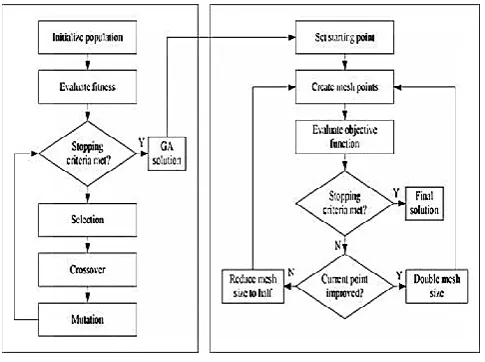
The following figure 1 shows the architectural view of the proposed system. The description of the system is as follows:
Figure 1: System Architecture
In the proposed system initially input is a Iris Dataset.
Job shop scheduling problem is solved by using hybrid genetic algorithm. JSSP is one of the most complicated and NP-Hard problem. So, the complexity of scheduling depends on number of jobs, number of machines, and sequences of jobs. JSSP is developed using Hybrid Genetic Algorithm. In this shortest processing time (SPT) rule and genetic operators are used. Here random key is representation to encode a chromosome. A chromosome represents the relative priorities of all operations and also the parameters to limit idle times on machines. To adjust idle times is a way to control the scope of search space. A chromosome is decoded into a feasible schedule by the hybrid scheduler, which is a modification of active scheduler.
For job shop minimizing makespan problems, the critical active chain has strong power on makespan. Thus a local search executing in the neighborhood
determined by the critical active chain is used to improve the performance of the schedule.
B. Algorithm
System Algorithm
Algorithm 1: Genetic Alogrithm
Input: Data set 3x3 job and machine
Output: Minimum processing combination of job machine
Process: Step 1: START
Step 2: Generate the initial population Step 3: Compute fitness
Step 4: REPEAT Selection Crossover Mutation Compute fitness
Step 5: UNTIL population has converged Step 6: STOP
C. Experimental Setup
The system is built using Java framework (version jdk 8) on Windows platform. The Netbeans (version 8.1) is used as a development tool. The system doesn’t require any specific hardware to run; any standard machine is capable of running the application.
IV.
RESULT AND DISCUSSIONA. DataSet
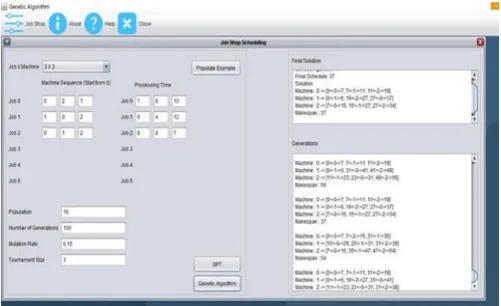
Figure 1: Result
B. Results
Applying Shortest processing time (SPT) rule , Unlike flow shop each job has unique route or order to visit machine. In figure 5.2 , there are 3 jobs and 3 machines. Every job has unique path or order to visit machine. In Job Shop Scheduling each job has prespecified path of machine.The JSSP consists of n jobs and m machines. Each job must go through m machines to complete its work. We consider one job consists of m operations. Each operation uses one of m machines to complete one job‘s work for a fixed time interval. Here two jobs (J1,J2) are given to machines (M1,M2). Each job having processing time for particular machine. For eg. Job1 having 7 processing time for machine1,for machine3 it takes 8 units of time and for machine2 it require 10 units of time. Each machine has processing time which is shown in snapshots. This GUI contains the eight main processing steps as load the datasets in jobs, machines along with processing time, number of generation, population, mutation rate, SPT and Genetic algorithm. Gantt chart is a tool to represent result of job shop scheduling. Once one operation is processed on a given machine, it cannot be interrupted before it finishes the job‘s work. The sequence of operations of one job should be predefined and may be different for any job. In general, one job being processed on one machine is considered as one operation noted as Oji (means jth job being processed on ith machine,1 ≤ j ≤ n,1 ≤ i′ ≤ m). The JSSP has n jobs to b processed on m machines.
Figure 2: Dataset 3x3
V.
CONCLUSION AND FUTURE SCOPE
This paper faces the issue of the examination on GA and job shop scheduling issue gives a rich ordeal to the Costrained combinational enhancement issues. Utilization of genetic algorithm gives a decent outcome more often than not. In spite of the fact that GA sets aside a lot of opportunity to give a decent outcome, it gives a Flexible structure to transformative calculation and it can deal with assortments of target capacity and imperative.
Current study about job shop scheduling problem resulted in following future works.The methodology developed in this study can be used for large sized problems. The methodology developed in this study can be demonstrated for other datasets problems as 10x15, 15x20, or 20x20.Development and Comparison of Hybrid Genetic Algorithms for Network Design problem in Closed Loop Supply Chain. A specific version of HGA has been applied and compared with GA and Bacteriologic Algorithm. Presently, our system generates infrequent itemsets, in future it maintains the accuracy for mining frequent itemsets.
VI.
ACKNOWLEDGMENT
important proposals. We likewise thank the school powers for giving the required base and support. At long last, we might want to extend a sincere appreciation to companions and familymembers.
VII.
REFERENCES
1. Adams, J.; Balas, E.; and Zawack, D. 1988. The shifting bottleneck procedure for job shop scheduling. Managament Science 34:391-401. 2. Applegate, D., and Cook, W. 1991. A
computational study of the job-shop scheduling problem. ORSA Journal of Computing 3:149-156.
3. Artigues, C., and Lopez, P. 2000. Extending GifflerThompson algorithm to generate active schedules for jobshops with sequence-dependent setup times. LIA report 129, University of Avignon.
4. Artigues, C.; Lopez, P.; and Ayache, P. 2005. Schedule generation schemes for the job shop problem with sequence-dependent setup times: Dominance properties and computational analysis. Annals of Operations Research 138:21-52
5. Artigues, C., and Feillet, D. 2008. A branch and bound method for the job-shop problem with sequence-dependent setup times. Annals of Operations Research 159(1):135-159.