Original Research Article
Adherence to anti-retroviral therapy and factors influencing it among
HIV/AIDS adult patients in Agra: a cross-sectional study
Sunil K. Meena, Rudresh Negi*, Shailendra S. Chaudhary, Sunil K. Misra
INTRODUCTION
Treatment of HIV/AIDS is aimed at reducing death or to prolong life or to improve quality of life of people infected with HIV. In the world today efforts have been exerted to contain the pandemic by treating HIV positive people with newly discovered highly effective antiretroviral drugs. Where it has succeeded, antiretroviral therapy (ART) has altered the nature of the disease, transforming an almost uniformly fatal illness into a chronic but reasonably stable condition. The success of antiretroviral treatment largely depends on the frequency of use, adherence and effectiveness of drugs. Globally 59% of people living with HIV were receiving
antiretroviral treatment in 2017, however this percentage is lesser in India at 56%.1,2 Currently the national adult (15–49 years) HIV prevalence in Uttar Pradesh (U.P.) is estimated at 0.09% [0.07-0.12] and has since plateaued. There are estimated 1.34 lakh [1.018-1.776] people living with HIV (PLHIV) in U.P.3 First line ART is provided free of cost to all eligible PLHIV through ART centers. Positive cases referred by Integrated Counselling and Testing Centers (ICTCs) are registered in ART center for pre-ART and ART services. Patients are also provided counselling on adherence, nutrition, positive prevention and positive living. Follow up of patients on ART is done by assessing drug adherence, regularity of visits, periodic examination and CD4 count.
ABSTRACT
Background: HIV/AIDS remains a significant global public health problem. With approximately 56% HIV patients in India receiving treatment, adherence to drugs is a crucial element for successful management. Sustainable development goals, National Strategic plan for HIV/AIDS and STI (2017-24) and 90-90-90 target pushing towards ending of AIDS epidemic require adequate adherence and this research estimates the adherence, associated factors and reasons for non-compliance.
Methods: This analytical cross sectional study was undertaken on 160 HIV patients from an ART Centre. A pre-structured, pilot tested, face validated questionnaire was used and data collected by face to face interviews, through random selection of participants from outpatient department register. Data was analysed using Epi Info software and chi squared test applied.
Results: Of the 160 study subjects, 86.8% remained adherent to the treatment with forgetfulness (71.4%) being the most common cause for non-adherence. Statistically significant treatment adherence was observed to be associated with socio-economic status (p=0.021) and period elapsed since diagnosis (p=0.041).
Conclusions: Improving adherence to drug therapy through intensive counselling, streamlined drug supply and increased family participation would go a long way in reducing the menace of HIV.
Keywords: HIV, AIDS, Adherence, Treatment
Department of Community Medicine, S. N. Medical College, Agra, Uttar Pradesh, India
Received: 30 April 2019 Revised: 18 June 2019 Accepted: 25 June 2019
*Correspondence: Dr. Rudresh Negi,
E-mail: [email protected]
Copyright: © the author(s), publisher and licensee Medip Academy. This is an open-access article distributed under the terms of the Creative Commons Attribution Non-Commercial License, which permits unrestricted non-commercial use, distribution, and reproduction in any medium, provided the original work is properly cited.
The sustainable development goals (SDGs) aim to achieve end of AIDS as a public health threat by 2030. As a signatory, India stands committed to achieve this goal through its National AIDS Control Programme. National Health Policy (NHP 2017) and National Strategic Plan for HIV/AIDS and STI 2017-2024 reiterate to achieve End of AIDS through a well-defined roadmap and has articulated medium term targets for 2020.The recent launch of Mission ‘Sampark’ (i.e. Contact), which aims to facilitate identification and contacting of ART patients who have been lost to follow-up to bring them back into the ART programme and foster treatment adherence for lasting viral load suppression, is a promising step in this regard.3
India specific data on adherence is few and far between and this research aims to explore adherence rates, its associated factors and the causes for non-adherence to treatment.
METHODS
This analytical cross sectional study was undertaken on 160 HIV patients from the ART Centre of a governmental medical college in Agra. Permission for the study was sought from principal of the college, officer-in-charge of ART centre and Institution Ethics Committee. Inclusion criteria
Inclusion criteria were patients registered at ART Centre of a governmental medical college in Agra; those who are taking ART for at least 3 months.
Exclusion criteria
Exclusion criteria were those who refused to participate in the study; critically ill patients; age less than 18 yr. The pre-structured, pilot tested, face validated questionnaire consisted of questions relating to socio-demographic profile, addiction, family support, disclosure status, CD4 count, adherence status and time since diagnosis.
Sample size was calculated using 73% as the prevalence rate of adherence to ART as observed by Shah et al.4 N = Z2α/2 PQ/L2
Thus substituting Zα/2=1.96, P=73%, Q=100-P=(100- 73)% =27%, L=10% of P and allowing 10% margin for incomplete questionnaires; the sample size was rounded off to 160.
3 patients were randomly selected from the OPD register of ART centre each day and the process was continued till the desired sample size was fulfilled. A written informed consent was obtained in the local language and each subject fulfilling eligibility criteria was individually interviewed in privacy. Data was analysed in Epi Info using chi square test and p value<0.05 was taken as statistically significant
Adherence to drug-adherence of >95% was considered as adherent and <95% non-adherent.5
RESULTS
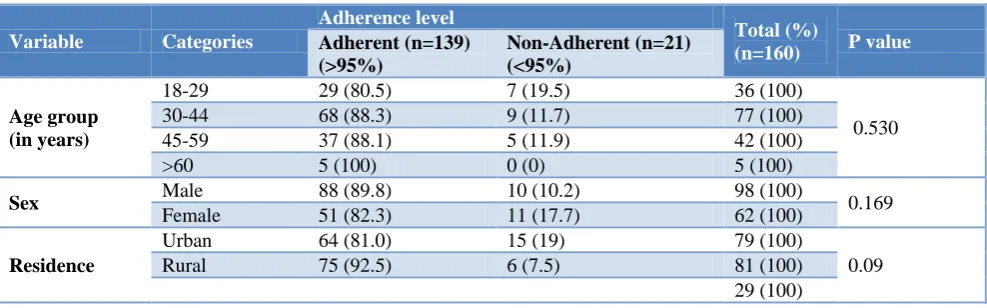
Of the total 160 participants there was a slight rural predominance (51.2%) with 1.6:1 male to female ratio. Majority of the patients (86.8%) remained adherent to the treatment. Adherence to ART was more among males (89.8%) as compared to females (82.3%) Study subjects residing in rural area were more adherent to ART (92.5%) than their urban counterparts (81.0%). In present study as the adherence to ART was nearly similar, in those having family support (87.3%) and lacking it (85.2%). Among disclosed study subjects, 11.1 percent subjects were found to be non-adherent while 14.8 percent of subjects with non-disclosed HIV status were found non-adherent to ART. Statistically significant treatment adherence was observed to be associated with socio-economic status (p=0.021) and period elapsed since diagnosis (p=0.041). Adherence was more in age group 30-44 years, males, rural residents, literates above primary education, married, non-alcoholics and with family support, but these factors were statistically insignificant (Table 1).
Table 1: Adherence to treatment and its associated factors.
Variable Categories
Adherence level
Total (%)
(n=160) P value
Adherent (n=139) (>95%)
Non-Adherent (n=21) (<95%)
Age group (in years)
18-29 29 (80.5) 7 (19.5) 36 (100)
0.530
30-44 68 (88.3) 9 (11.7) 77 (100)
45-59 37 (88.1) 5 (11.9) 42 (100)
>60 5 (100) 0 (0) 5 (100)
Sex Male 88 (89.8) 10 (10.2) 98 (100) 0.169
Female 51 (82.3) 11 (17.7) 62 (100)
Residence
Urban 64 (81.0) 15 (19) 79 (100)
0.09
Rural 75 (92.5) 6 (7.5) 81 (100)
Variable Categories
Adherence level
Total (%)
(n=160) P value Adherent (n=139)
(>95%)
Non-Adherent (n=21) (<95%)
Literacy
Illiterate 42 (85.7) 7 (14.3) 49 (100)
0.982
Primary 25 (86.2) 4 (13.8) 29(100)
Above Primary 72 (87.8) 10 (12.2) 82 (100)
Marital status
Married 114 (86.3) 18 (13.7) 132 (100) 0.866
Unmarried 19 (90.5) 2 (9.5) 21 (100)
Widow/er 6 (85.7) 1 (14.3) 7 (100)
Socio economic class
(Modified B G Prasad Classification)
Class I 4 (66.7) 2 (33.3) 6 (100)
0.021*
Class II 14 (70) 6 (30) 20 (100)
Class III 31 (86.1) 5 (13.9) 36 (100)
Class IV 48 (87.3) 7 (12.7) 55 (100)
Class V 42 (97.7) 1 (2.3) 3 (100)
Alcohol use Present 26 (86.7) 4 (13.3) 30 (100) 0.0970
Absent 113 (86.9) 17 (13.1) 130 (100)
Tobacco use Present 55 (90.2) 6 (9.8) 61 (100) 0.334
Absent 84 (84.8) 15 (15.2) 99 (100)
family support Present 110 (87.3) 16 (12.7) 126 (100) 0.846
Absent 29 (85.2) 5 (14.8) 34 (100)
disclosure status
Disclosed 64 (88.9) 8 (11.1) 72 (100)
0.495
Not disclosed 75 (85.2) 13 (14.8) 88(100)
CD4 count <350 84 (85.7) 14 (14.3) 98 (100)
0.585
>350 55 (88.7) 7 (11.3) 62 (100)
Time since diagnosis
<5 yr 110 (91.6) 10 (8.4) 120 (100)
0.041*
>5 yr 29 (72.5) 11 (27.5) 40 (100)
A total of 13.1 percent of study subjects reported missed dose in the last week. Forgetfulness was most commonly (71.4%) observed reason for a missed dose. Side effects of drugs (14.2%), under supply of drug (9.6%) and did not take medicine because feeling better (4.8%) were also cited as reasons for a missed dose (Table 2).
Table 2: Cause of non-adherence to treatment. Reason for a missed
dose in last week
Number of individuals
Percentage (%)
Just Forgot 15 71.4
Side effects of drug 3 14.2 Drugs unavailability 2 9.6
Feeling better 1 4.8
Total 21 100
DISCUSSION
Adherence to ART is critically important for successful treatment of HIV/AIDS. In the present study measuring patient’s adherence to ART by self-report we found that 86.9% patients were more than 95% adherent to their prescribed regimen in the recall period of previous seven days.
Among males 89.8% were (more than 95%) adherent to ART as compared 82.3% female subjects, although the difference is statistically insignificant. In congruence to
our study, Lal et al, Asmare et al, Shigdel et al, Shukla et al also found 90%, 88.6%, 86.7%, and 89.1% mean adherence to ART respectively.6-9 In contrast to our study Venkatesh et al and Rai et al reported comparatively lower mean adherence (51% and 57% respectively).10,11 This may be because the recall period of these studies was more than 30 days. Sarna et al showed very high level of adherence at 100% which may be because the adherence was assessed for 4 and 3 days respectively for above studies.12
In present study, statistically significant difference was not observed in mean adherence of both sexes. Unlike our study Venkatesh et al from Chennai showed that females had comparatively lower of adherence to ART as compared to males (34% and 66% respectively).10 In the present study older subjects showed a tendency toward better adherence to ART medication than younger subjects; but the differences were not statistically significant. Similarly Sarna et al, Rai et al and Venkatesh et al also reported no significant association of age with adherence.10-12 Though Shigdel et al showed that ART adherence decreased significantly with increasing age.8 This variation can be explained by taking into account that this was a multisite setting conducted in Nepal with entirely different socio-cultural milieu and low literacy.
a study by Shukla et al (also demonstrates no association of adherence with marital status but a study by Asmare et al reported association of adherence with marital status.7-9 In present study adherence was higher among rural subjects (92.5%) than urban (88.5%) but the association is not statistically significant. Similarly Shukla et al did not found association of residence with adherence level among study subject.9
In our study effect of literacy is not observed on adherence level. In congruence Rai et al also reported no significant difference between the level of adherence and education status, though Sarna et al found lower education associated with lower level of adherence which may be because the study subjects were drawn from a private hospital a setting with entirely different proportion of subjects in various literacy levels.11,12 In current study association of alcohol consumption was not observed with adherence. In congruence Shukla et al and Banagi et al have also shown that alcohol consumption is not associated with lower adherence.9,13 Contrarily Venkatesh et al and Shigdel et al have reported significant association of alcohol with adherence level.8,10 The differences may be due to variation in criteria for considering a subject alcoholic.
In present study, adherent subjects were 87.3% and 97.7% respectively among study subjects who belonged to lower middle and lower class, this was higher than upper middle and upper class (66.7% and 70% respectively). This difference was statistically significant. In congruence to our study, Shah et al found higher level adherence among lower socioeconomic group as compared to upper socioeconomic group.4 Shukla et al applying multivariate regression however reported upper class were more adherent to ART than lower socioeconomic class.9
In this study association of adherence was not observed with family support. Similar to our finding Sarna A et al (2008) also found no association of adherence with family support.12 Contrarily Gokarn et al found that family support effected adherence to ART.14 The difference might be because of difference in criteria of family support in their study.
In our study social disclosure of HIV status was not found significantly associated with adherence. In congruence to this finding, Sarna et al also demonstrated no association of adherence with disclosure of HIV status.12 On the contrary, Gokarn et al considering recall period of one month for adherence observed that who have not disclosed HIV status to anyone were more likely to be non-adherent.14
Significant effect of duration (since diagnosis of HIV) was observed on adherence level. Adherence to ART was found to decline with increasing duration (since diagnosis
of HIV). It may be due to the decrement in disease and its consequences related fear with advancing time. On contrary to our study in Venkatesh et al and Sarna et al have found increasing adherence to ART with increasing duration of illness.10,12 Both of these studies were conducted at cosmopolitan cities and the study subjects were derived from private institution/Hospitals, obviously the subjects a likely to belong to middle or higher socioeconomic class with higher literacy status; thus more sustained adherence to ART.
The most common reason for non-adherence was forgetfulness (68.6%) and side effect of drug (16.4%) followed by feeling better (9.5%) in our study. Few subjects (5.5%) ran out of drug because of untimely follow-up.
In consonance to our finding studies viz. Sarna et al, Banagi et al, and Shukla et al have also shown most common reason for non-adherence is ‘forgot taking drug’ and other reasons include; ‘travelled out of town’, ‘ran out of medication’, ‘no money to visit ART centre’, ‘drug reaction’, ‘work demands’.9-13
CONCLUSION
To conclude non-adherence to treatment in HIV patients is multi factorial and these dimensions need to be addressed through participative counselling, adequate drug supply, and increased awareness in community, social acceptance and family support.
Recommendations
In a progressive society patients show higher adherence, efforts should be made to further improve the social acceptance of HIV patients.
Higher the education for better the adherence, so energy should be directed to better the education level of ART patients.
With advancing time, patients tend to be non-adherent and majority of candidates forget to take medicine because of being busy in other work, it signifies the role of counsellor. Strengthening of counselling services needs to be endeavoured. Some innovative approach like reminder to take medicine on time by timers with alarm, by text messaging on mobile phone can also work to keep adherence at optimum level.
Being a government institution, government is solely responsible for uninterrupted drug supply, so government should be held liable for it as one of the reasons for missed dose was drug ran out due to shortage.
Limitations
In spite of the best motivation from the investigator the respondents might not have given complete and unbiased information.
ACKNOWLEDGEMENTS
We would like to acknowledge study participants for their active voluntary participation and Department of Medicine for their support and assistance.
Funding: No funding sources Conflict of interest: None declared
Ethical approval: The study was approved by the Institutional Ethics Committee
REFERENCES
1. WHO. Data and statistics. WHO. World Health Organization. 2018. Available at: https://www.who. int/hiv/data/en/. Accessed on 2 January 2019. 2. HIV Country Profiles. 2017. Available at:
http://cfs.hivci.org/country-factsheet.html. Accessed on 2 January 2019.
3. NACO. ICMR-NIMS. HIV Estimations, 2017: Technical Report. Available at http://naco.gov.in/ sites/default/files/HIV Estimations 2017 Report_3.pdf.
4. Shah B, Walshe L, Saple DG, Mehta SH, Ramnani JP, Kharkar RD et al. Adherence to antiretroviral therapy and virologic suppression among HIV-infected persons receiving care in private clinics in Mumbai, India. Clin Infect Dis. 2007;44(9):1235-44.
5. NACO. ART guidelines for HIV infected adult and adolescents including post exposure prophylaxis. 2013: 10-11.
6. Lal V, Kant S, Dewan R, Rai SK. Reasons for Non-adherence to Antiretroviral therapy among Adult patients Receiving free Treatment at a Tertiary Care Hospital in Delhi. Indian J Community Med. 2010;35(1):172–3.
7. Asmare M, Aychiluhem M, Ayana M, Jara D. Level of ART adherence and associated factors among HIV sero-positive adult on highly active
antiretroviral therapy in Debre Markos Referral Hospital, Northwest Ethiopia. J Antivir Antiretrovir 2014;6(3):120-6.
8. Shigdel R, Klouman E, Bhandari A, Ahmed LA. Factors associated with adherence to antiretroviral therapy in HIV-infected patients in Kathmandu District, Nepal. HIV/AIDS Auckl. 2014;6:109–16. 9. Shukla M, Agarwal M, Singh J V, Srivastava AK,
Singh D. Assessment of quality of Life of HIV-Positive People on Antiretroviral Therapy. Indian J Forensic Community Med. 2016;3(3):168-71. 10. Venkatesh KK, Srikrishnan AK, Mayer KH,
Kumarasamy N, Raminani S, Thamburaj E, et al. Predictors of non-adherence to highly active antiretroviral therapy among HIV-infected South Indians in clinical care: implications for developing adherence interventions in resource-limited settings. AIDS Patient Care STDS. 2010;24(12):795–803. 11. Rai S, Mahapatra B, Sircar S, Raj PY, Venkatesh S,
et al. Adherence to Antiretroviral Therapy and Its Effect on Survival of HIV-Infected Individuals in Jharkhand, India. PLoS ONE. 2013;8(6):e66860. 12. Sarna A, Pujari S, Sengar AK, Garg R, Gupta I,
Dam JV. Adherence to antiretroviral therapy & its determinants amongst HIV patients in India. Indian J Med Res. 2008;127(1):28-36.
13. Banagi Y A, Unnikrishnan B, Ramapuram JT, Kumar N, Mithra P, Kulkarni V et al. Antiretroviral Therapy Factors Influencing Adherence to Antiretroviral Therapy among People Living with HIV in Coastal South India. J Int Assoc Prov of AIDS Care. 2016;15(6):529-33.
14. Gokarn A, Narkhede MG, Pardeshi GS, Doibale MK. Adherence to antiretroviral therapy. J Assoc Phys India. 2012;60:16–20.