RESEARCH ARTICLE
MANAGING OF BACTERIAL CONTAMINATION IN ALCOHOLIC FERMENTATION OF
SUGAR CANE MOLASSES
1
Fadel, M.,
2Abdel Naser A. Zohri.
3El-Heeny, M.S. and
4Abdel Aziz A.M.
1
Microbial Chemistry Department, National Research Center, Cairo, Egypt
2
Botany and Microbiology Department, Faculty of Science, Assiut University, Egypt
3
Head sectors of chemicals and organic industries Egyptian Sugar and Integrated Company
4
Distillation Factories, Egyptian Sugar and Integrated Company, El- Hawamdia Giza, Egypt
ARTICLE INFO
ABSTRACT
Bacterial contamination is a significant problem for ethanol producers, because the bacteria compete with the yeast for sugar and nutrients and produce organic acids that can stress or kill the yeast as well as outbreaks can cause significant losses in the yield of the ethanol plant, or even halt the fermentation process. Antibiotics have been used to control bacterial infections during fermentation in ethanol production for many years. Now chemicals and commercial compounds also used for bacterial contamination control in distillery factories The present study focused on tried several antibiotics i.e penicillin, tetracycline, virginamycin, erythromycin, cefadroxil, amoxicillin and amoxicillin+ flucloxacillin (1:1). Chemicals such as potassium meta bisulfite and chlorine, commercial preparations like KAMORAN®, Effymoll+ and DuPont™ FermaSure® XL. Culture condition such as effect of yeast strain, inoculum yeast format, inoculum size and pH were also studied. Promising results were obtained led to an performance in ethanol from 5.8-8.9% v/v consequently fermentation efficiency.
Copyright©2017,Fadel et al.This is an open access article distributed under the Creative Commons Attribution License, which permits unrestricted use, distribution, and reproduction in any medium, provided the original work is properly cited.
INTRODUCTION
Bioethanol is one of the most important renewable fuels contributing to the reduction of the global warming effect and negative environmental impact generated by the world wide utilization of fossil fuels. Bioethanol production generally utilizes derivatives from food crops such as corn grain and sugar cane. In Egypt, sugar cane molasses is mainly used as feedstock for bioethanol production. Bacterial contamination is known to be a major cause of reduction in ethanol yield during ethanol production from molasses because of sugar
consumption by bacteria (Chang et al., 1997 and Narendranath
et al., 2000). Such bacteria also produce a by-product which
inhibits yeast growth (Skinner. and Leathers, 2004). Lactobacillus sp. and Bacillus sp. may be the most harmful of the bacteria that contaminate molasses because of their rapid
growth abilities (Narendranath et al., 1997). Lactobacillus sp.
are tolerant to high temperature and low pH, it is especially difficult to prevent Lactobacillus sp. from growing (Narendranath, and Power, 2004). It has been reported that various agents, including antiseptics such as sulfite, hydrogen peroxide, 3, 4, 4-trichlorocarbanilide, and urea hydrogen
peroxide (Chang et al., 1997; Narendranath et al., 2000 and
Oliva-Neto,. and Yokoya, 1998) and antibiotics such as
penicillin, tetracycline, monensin, and virginiamycin (Hynes et
al., 1997 and Stroppa et al., 2000) are effective in preventing
*Corresponding author: Fadel, M.,
Microbial Chemistry Department, National Research Center, Cairo, Egypt
bacterial contamination. Penicillin and virginiamycin are currently used commercially to prevent contamination in the bioethanol prophylactic ally. Bacillus sp. and Lactobacillus sp. isolated from Brazilian industrial fermentation units were shown to be susceptible to penicillin and the ionophore
antibiotic monensin (Stroppa et al., 200). Contaminants
constantly utilize carbon available for conversion to ethanol
and compete for growth factors needed by yeast (Kelly et al.,
2004). The contaminating agents produce deleterious end products such as lactic and acetic acids that inhibit the growth
of S. cerevisiae (Makanjuola et al., 1992; Narendranath et al.,
1997). Fermentation tanks and yeast propagation systems can act as reservoirs of bacteria that can continually re introduce
contaminants (Day et al., 1954). A number of antimicrobial
agents to control bacterial contamination in ethanol fermentations under laboratory conditions have been described. Urea hydrogen peroxide reduced the numbers of
Lactobacillus while providing nutrients to aid performance of
the yeast (Narendranath et al., 2000). Various agents have
been tested for control of bacterial contaminants under laboratory conditions, such as hydrogen peroxide, potassium
metabisulfite and 3,4,4-trichlorocarbanilide (Chang et al.,
1997; Gibbons and Westby 1986; Narendranath et al., 2000;
Oliva-Neto and Yokoya, 1998). Hop acids are reported as replacing agents of antibiotics (Ruckle and Senn, 2006). Penicillin and antibiotic monensin have shown effective results against the strains of Bacillus and Lactobacillus isolated from
Brazilian alcoholic fermentation units (Stroppa et al,, 2000).
ISSN: 0976-3376
Vol. 09, Issue, 01, pp.7383-7391, January,Asian Journal of Science and Technology 2018ASIAN JOURNAL OF
SCIENCE AND TECHNOLOGY
Article History:
Received 10th October, 2017
Received in revised form
25th November, 2017
Accepted 24th December, 2017
Published online 31st January, 2018
Key words:
Sugar cane molasses, Ethanol production,
Different antibiotics including penicillin, virginiamycin and tetracyciine have been reported to control contamination by lactic acid bacteria in experimentally infected alcoholic
fermentations (Aquarone, 1960; Bayrock et al., 2003; Hynes et
al., 1997).Although, there are different designs and operating
practices in distilleries, numerous chances exist for contaminants to persist or thrive in the system. To clean and sterilize the propagation and fermentation tanks is common in distilleries and as there are batch process so much time is available. Yeast propagation is a potential point of contamination which increases during fermentation. The contamination load comes continuously with molasses and this causes a great problem in fermentation. When Sugar cane molasses produced by sugar mills in poor conditions and reach the distilleries, they are found to be loaded with contaminating microorganisms. The profitability of ethanol production is dependent on favorable sugar cane molasses price and the quality of molasses (sugar% and contamination level). Cntamination control can save more $4000 per day for the
distillery producing 100, 000 L/day (Zia et al., 2011. This
study focuses on improvement of the bioethanol production process from sugar cane molasses, using various methods for bacterial contamination managing
MATERIALS AND METHODS
Sugarcane Molasses: Molasses sample (Brix. 85.6 total sugars
53.2%, fermentable 48.1% and un fermentable sugars 5.10%) was supplied by Egyptian sugar and integrated industries Company (ESIIC).
Antibiotic
Penicillin, tetracycline, virginamycin, erythromycin.,
Amoxicillin, amoxicillin+ flucloxacillin (1:1) and cefadroxil,
pharmaceutical grade were purchased.
Chemicals
Potassium meta bisulfate, chlorine (14%). production of El- Nasser for Chemicals Industries. Egypt
Commercial preparation
KAMORAN®UNION NATIONALE DES GROUPEMENTS
DE DISTILLATEURS D’ALCOOL Laboratoire: Malakoff FRANCE. Effymoll+ from praj innovate. Integrate .Deliver
.Science . India. DuPont™ FermaSure® XL ,Manufacturer
:DuPont 1007 Market Street Wilmington, DE 19898 Importer
/Distributor :International Dioxcide, Inc., A DuPont
Subsidiary, 40 Whitecap Drive, North Kingstown, RI 02852
KAMORAN® preparation
Dissolve KAMORAN® in 90-100 percent ethanol up to a concentration not to exceed 100 grams per liter. Then introduce this KAMORAN® -ethanol solution into the fermenter at not less than 1.0 nor more than 3.0 parts per million (ppm).
Yeast Strains: Saccharomyces cerevisiae F-514, S. cerevisiae
F-727 and S .cerevisiae F-111 S. cerevisiae F-25 and S.
cerevisiae F-84 which are already .applied for ethanol
production in Egyptian distillation factories supplied by
Microbial Chemistry Lab .National Research Centre, Dokki, Cairo, Egypt.
Inoculum Preparation
Sterilized 500 ml capacity conical flasks each contained 200 ml of medium containing (g /L) malt extract,3,yeast extract,3, peptone ,5 and sucrose,30 was steam sterilized at 121°C for 2o minutes, cooled to room temperature, then inoculated with a
loop of yeast strain S. cerevisiae and incubated statically at
34°C for 24 hrs, then transferred to flat round bottom flasks of 2 L capacity each containing 400 mL sterilized molasses diluted to 4-5% w/v sugar content supplemented with 0.4% di ammomium phosphate (DAP) and 0.2% yeast extract. The inoculated flat round bottom flasks incubated statically at 34°C
for 24 hrs (Fadel et al., 2013).
Preparation of Molasses Medium
The sugar cane molasses was diluted with water to 21 Brix gave total sugars involved 18.92% total sugars .0.92% un fermentable sugars and the rest 18% was fermentable sugars. The previous diluted molasses supplemented with 2 g/l urea and 2 g/l diammomium phosphate as a source for nitrogen and phosphorus and 0.5 g/l magnesium sulfate. Molasses medium was dispensed into 2L Erlenmeyer flasks contained 800 ml. The molasses medium fermentation was carried out under non septic condition and incubated statically to complete
fermentation at 35 o C under anaerobic conditions using S.
cerevisiae (0.5% v/v) inoculums. Brix was measured with the
help of ATAGO densimeter (model 2312; ATAGO Co. Ltd, Tokyo, Japan).
Analytical determination
Determination of un fermentable sugar (US) as residual sugars in fermented mash: The sugar concentration was determined by Fehling’s titrimetric method (Lane and Eynon, 1923).
Estimation of Ethanol content of the fermented wash
Ethanol content of the fermented samples was measured by
ebulliometer approved in distillation factories (Fadel et al.,
2014).
RESULTS AND DISCUSSION
Determination of bacterial load in some storages of sugar
cane molasses: Data presented in Table (1) show the total
bacterial count involved in 4 different cane molasses storages in distillation factories - Hawamdia , Egyptian sugar and integrated company .Cane molasses transported from various sugar producing factories located in different Egyptian governments i.e Edfo. Comampo, Armant, Kous, Nag Hamady and Girga through Nile transportation. The system of the sugar production operation not the same in all factories. Data reveal different bacterial load involved in molasses storages.
Table 1. Bacterial load of different molasses samples from various sugar cane molasses storages in Hawamdia distillation factories
Storage number Total bacterial count Total fermentable sugars%
4 1.1 x10⁷ 47.6
5 1.3x10⁸ 48.4
7 1.2x10⁶ 48.4
Alcoholic fermentation of some sugarcane molasses
Presented data in Table (2) show that the fermentation efficiency were different so the ethanol yield for Ethanol yield L/ ton molasses50 % fermentable sugars was varied . The data can be discussed on the light of the data obtained in Table (1), as there are a relation between the fermentation efficiency and
bacterial load Skinner et al.(2004). Bacterial contamination is
known to be a major cause of reduction in ethanol yield during ethanol production from molasses because of sugar consumption by bacteria (Narendranath and Power, 2004)). Such bacteria also produce a by-product which inhibits yeast growth .Yeast and bacteria can compete by the same substrate during the fermentative process for alcohol production. Bacterial contamination reduces ethanol yield by 1 to 5%.
(Narendranath et al., 1997). Table(2) Ethanologenic
fermentation of different molasses samples from various sugar cane molasses storages in Hawamdia distillation factories in medium contained sugar cane molasses contained 18 %w/v
fermentable sugars after 36 hrs at 36oC by S .ceresvisiae F-
514.
Effect of antibiotics on ethanol yield
Tetracycline
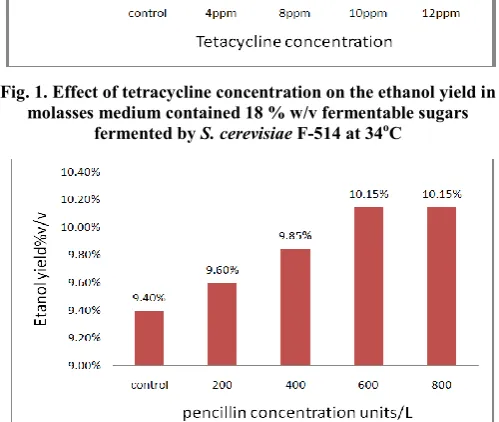
Tetracycline has a favorable action on fermentation by suppressing contamination (Strandskov and Bockelmann , 1953).Figure (1)illustrates the results obtained using Tetracycline at different concentrations in sugar cane molasses medium contained 18 % w/v fermentable sugars. Addition of tetracycline at concentration 10ppm gave the most promising increase in ethanol yield compare to control without tetracycline addition as the ethanol yield increased from 9.4% v/v to 10.10% v/v(0.0.70 v/v %) . Increase the concentration than 10ppm resulted no other increase in ethanol yield Tetracycline does not influence the fermentation time. This antibiotic acts as a contamination inhibitor when present in concentrations from 1 to 30 mg per liter. No inhibition nor activation of the yeast was observed in mashes containing tetracycline. Concentrations of 0.120 mg per liter and above, tetracycline has a favorable action on fermentation by suppressing contamination It was verified that the addition of tetracycline in several doses during fermentation and the addition of a single dose at the start of fermentation gave similar results. Tetracycline added at levels of 2.5, 5, 15, and 25mg per liter of mash did not significantly affect the rate of yeast fermentation (Borzani and Aqitarone. 1957). These results confirm those of Gordon and Taylor (1954) working with other antibiotics and other organisms. It was verified that the addition of tetracycline in several doses during fermentation and the addition of a single dose at the start of fermentation gave similar results. . The odor of the fermenting mashes without tetracycline became disagreeable whereas that of the mashes containing tetracycline was characteristic of a normal alcoholic fermentation of Gordon and Taylor, 1954).
Penicillin
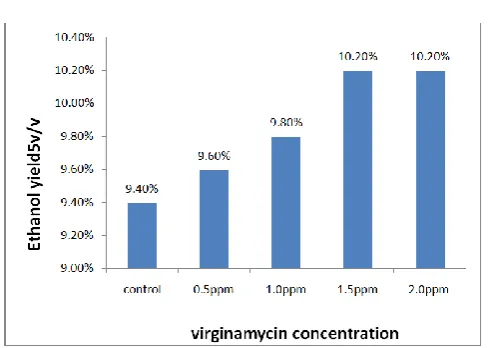
Penicillin was reported as a good contamination control agent (Borzani and Aqitarone. 1957. and Borzani and Falcone, 1953)Figure (2 ) illustrates the results obtained using penicillin in fermentations sugar cane molasses medium contained 18 %w/v fermentable sugars . Addition of penicillin at concentration 600 units/L improved the ethanol yield compare to control without penicillin addition as the ethanol yield increased from 9.4% v/v to 10.15% v/v(0.75 %v/v) . Increase the concentration than 600 units /L resulted no other increase in ethanol yield. The odor of the fermenting media without penicillin became quite disagreeable, whereas that of the mashes containing penicillin was characteristic of a normal alcoholic fermentation. Penicillin does not influence directly
the fermentative activity of the yeast (Andrieta, et al.,2000 ).
This fact shows that the antibiotic acts only as an inhibitor of contaminants. Penicillin and are currently used commercially to prevent contamination in the bioethanol prophylactic ally. Bacillus sp. and Lactobacillus sp. isolated from Brazilian
industrial fermentation units were shown to be susceptible to
penicillin and the ionophore antibiotic monensin (Stropp et al.,
2000).
Fig. 1. Effect of tetracycline concentration on the ethanol yield in molasses medium contained 18 % w/v fermentable sugars
fermented by S. cerevisiae F-514 at 34oC
Fig. 2. Effect of penicillin concentration on the ethanol yield in molasses medium contained 18 % w/v fermentable sugars
fermented by S. cerevisiae F-514 at 34oC
Storage number
Total fermentable sugars%
Ethanol yield % v/v
Ethanol yield L/ ton molasses50 % fermentable sugars
Fermentation efficiency %
4 47.6 9.51 533 87.2
5 48.4 9.42 526 86.0
7 48.4 9.60 540 88.4
Virginiamycin
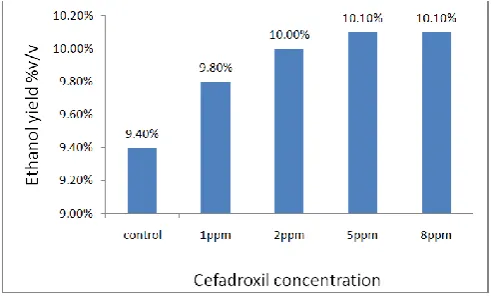
Figure (3) illustrates the results obtained using virginiamycinas bacterial control in fermentations sugar cane molasses medium contained 18 % fermentable sugars . Addition of virginiamycin at concentration 1.5ppm attained maximum achievable results in ethanol yield compare to control without virginiamycin addition as the ethanol yield increased from 9.4% v/v to 10.2% v/v(0.80 % v/v) . Increase the concentration than 1.5 ppm achieved no other improve in ethanol yield . In ethanol fermentation, virginiamycin is normally added to fermenters at a level of 0.25 to 2.0ppm, although the FDA “letter of no objection” allows a maximum use rate of 2 to 6 ppm. Virginiamycin is effective in controlling lactic acid bacteria,
preventing ethanol yield reductions (Hynes et al., 1997).The
stability of virginiamycin is not greatly affected at temperatures ranging from 25 to 35°C and at pH 3.8 to 4.8 for
72 hours during fermentation (Islam et al., 1999).Antibiotics
were used at different levels and maximum achievable results
were obtained keeping all other factors constant (Zia et al.,
2011) . When virginiamycin was used.Comparing the control with the antibiotic treated at 0.5 ppm, there was difference of 0.3% ethanol v/v. When bacteria population decreased to the
range of 104, more 0.4% ethanol was produced. When the
antibiotic dose increased to the 1.5 ppm, ethanol increased by 0.8% v/v and optimally 8.5% ethanol was obtained at 2ppm concentration of antibiotic used. These results are in agreement
with the finding of Narendranath et al. (1997). Occurrence of
10 x 106lactobacilli/ml mash resulted in 1% by vol., reduction
in the final ethanol produced by the yeast; this depended on the strain of the contaminant bacteria. The over loss in ethanol yield is 1% by vol. Results are in agreement with Makanjuola
et al. (1992) who reported 1% reduction in ethanol yield.
There is need to optimize the concentration of antibiotic use. If antibiotics are not administered correctly, the development of antibiotic resistant strains cannot become a reality (Neelakantam and Narendranath, 2004). High level of contamination will not make any impact to yeast growth nor have affect on the recovery of ethanol. In the terms of viability, there is heavy lost in yeast viability when culture is
contaminated (Thomas et al., 2001). Virginiamycin has certain
advantages over other antibiotics such as temperature and pH stability and high resistance level. Use of Virginamycin at industrial scale ethanol fermentation is a reliable source to avoid losses due to contamination. Its use should be carefully
done as per requirement. Hynes et al. (1997) stated that 6 –
12% loss of total produced alcohol (0.8-1.5% v/v ethanol concentration in fermentation) were seen when particularly contamination were present in high number.
Effect of Erythromycin
Erythromycin was employed as a good contamination control agent in ethanol fermentation (Borzani and Aqitarone, 1957. and Borzani and Falcone, 1953) Figure (4) illustrates the results obtained using Erythromycin in sugar cane molasses fermentations medium at different concentrations ranged from 1 to 8 ppm. Addition of Erythromycin at concentration 5ppm/L gave the most promising increase in ethanol yield compare to control without Erythromycin addition as the ethanol yield increased from 9.4% v/v to 10.1% v/v (0.70 % v/v) . Increase the concentration than 5ppm /L resulted no other performance in ethanol yield, so is not economic.
Figure 3. Effect of virginamycin concentration on the ethanol yield in molasses medium contained 18 % w/v fermentable sugars
fermented by S. cerevisiae F-514 at 34o
Figure 4. Effect of Erythromycin concentration on the ethanol yield in molasses medium contained 18 % w/v fermentable sugars
fermented by S. cerevisiae F-514 at 34oC
Effect of amoxicillin
Amoxicillin is described as a broad spectrum antibiotic and not reported before as a contamination control agent in ethanol fermentation. Figure (5) illustrates that when amoxicillin was added to fermentation medium gave renewable increased in ethanol yield from 9.4% v/v to 10.1% v/v(0.70 % v/v) .like the above result obtained by using erythromycin as anti contaminant antibiotic. Increase the concentration than 5ppm resulted no other performance in ethanol yield. Amoxicillin may be considered for ethanol producers from cane molasses as bacterial control, taking economic cost in consecration.
Figure 5. Effect of amoxycillin concentration on the ethanol yield in molasses medium contained 18 % w/v fermentable sugars
Effect of amoxicillin + flucloxacillin (1:1)
Amoxicillin + flucloxacillin(1:1) is described as
pharmaceutical broad spectrum antibiotic and not reported before as a contamination control agent in ethanol fermentation Figure (6) illustrates that when was added to fermentation medium gave acceptable increase in ethanol yield. Addition concentration ppm/L gave the most promising increase in ethanol yield compare to control without addition as the ethanol yield increased from 9.4% v/v to 10.15% v/v(0.75 % v/v) . Increase the concentration than ppm resulted no other increase in ethanol yield. Amoxicillin + flucloxacillin (1:1) may be take in consideration as a bacterial contamination control in distillation factories for ethanol production from cane molasses.
Figure 6. Effect of amoxicillin+ flucloxacillin (1:1) concentration on the ethanol yield in molasses medium contained 18 % w/v fermentable sugars fermented by S. cerevisiae F-514 at 34oC
Effect of cefadroxil
Cefadroxil is another antibiotic also not reported before as a contamination control agent in ethanol fermentation Figure (7) illustrates that when cefadroxil was added to fermentation medium resulted in datable increase in ethanol yield. Addition cefadroxil at concentration ppm/L gave the most promising increase in ethanol yield compare to control without penicillin addition as the ethanol yield increased from 9.4% v/v to 10.1% v/v(0.70 % v/v) . Increase the concentration than ppm resulted no other increase in ethanol yield. cefadroxil must be considered and can added to the list of antibiotic as a bacterial contamination control in ethanol production factories from cane molasses.
Figure 7. Effect of cefadroxil concentration on the ethanol yield in molasses medium contained 18 % w/v fermentable sugars
fermented by S. cerevisiae F-514 at 34oC
Potassium meta bisulfite(PMB)
Figure (8) revealed that use75 ppm is satisfy for controlling bacteria in ethanol fermentation from sugar cane molasses. Addition(PMB) at concentration 75ppm achieved the most promising upgrade in ethanol yield compare to control as the ethanol yield rich from 9.4% v/v to 10.1% v/v(0.70 % v/v). Increase than 72ppm affect yeast viability consequently reduced ethanol yield. Potassium meta bisulfite is principle source of SO2. Potassium metabisulfite contains approximately 55% SO2 by weight. This free SCX, kills the microorganisms (Kelly, 2003). Culture yeast is generally tolerant to SO2, than bacteria but at higher concentrations it shows loss of viability. Potassium meta bisulfite (PMB) was used to control bacterial contamination during batch diffusion fermentation. At a PMB concentration of 0·25%, contamination was prevented and the ethanol yield was 85% of theoretical and fermentation
efficiency reached 96% (William et al.,1986).
Figure 8. Effect of potassium meta bisulfite concentration on the ethanol yield in molasses medium contained 18 % w/v fermentable sugars fermented by S. cerevisiae F-514 at 34oC
Chlorine
Chlorine dioxide, has been used for decades in drinking water disinfection treatments. It is also now used in other industries, including for food production facility sanitizing and even in mouthwash. Chlorine rapidly attacks bacteria that are harmful in fermentation without attacking the yeast, enzymes or other
desirable mash components (Meneghin et al., 2008). It
selectively inhibits growth of acid-producing bacteria, minimizing the accumulation of lactic and acetic acids and enabling the yeast to produce ethanol more efficiently. It doesn’t inhibit yeast growth or reproduction, so it does not
affect the performance of enzymes (Meneghin et al., 2008)
.The obtained results illustrated in Figure (9)reveled that use 50 ppm is more suitable when used in ethanol fermentation for controlling bacteria. The ethanol yield increased from 9.4% v/v to 9.95% v/v(0. 55 % v/v) This finding was confirmed with
that reported by Meneghin et al. (2008) For the safe usage of
chlorine dioxide as antibacterial agent in alcoholic fermentation, it is not advisable to utilize more than 50 ppm in order to avoid harmful effects on the yeast inoculum. However, Lactobacillus bacteria had presented minimum inhibitory concentration for chlorine dioxide above 50 ppm. Further studies are encouraged since activation in pH below 4 brought about more efficiency, demanding lower dosages than
those recommended here). Besides, other important
approval at USDA Organic for application in organic products; prevention of resistance occurrence in bacterial populations by the use of antibiotics; higher profits with the sales of yeast for feed since antibiotics are not allowed; saving of sulphuric acid, once chlorine dioxide has anti-buffering effect when applied to the inoculum production step; besides antibiotics replacing, chlorine dioxide also eliminated the usage of other antibacterial agents.
Figure 9. Effect of chlorine concentration on the ethanol yield in molasses medium contained 18 % w/v fermentable sugars
fermented by S. cerevisiae F-514 at34oC
DuPont™ FermaSure® XL
Antibiotics are one of the most common ways to treat or control bacterial infections, but there is a growing concern among end users over antibiotic use and the antibiotic residue left in the distillers coproduct of the ethanol fermentation process. FermaSure® composed of oxychlorine compounds15-25 % and water 75-85 % is one of the commercial product to overcome the problem of the antibiotic residue left in co product of the ethanol fermentation. The obtained results illustrated in Figure (9) reveled that use 50 ppm is more suitable when used in ethanol fermentation for controlling bacteria. The ethanol yield increased from 9.4% v/v to 10.25% v/v(0. 85 % v/v). DuPont. The active ingredient in FermaSure®. chlorine dioxide, has been used for decades in drinking water disinfection treatments. It is also now used in other industries, including for food production facility sanitizing and even in mouthwash, explained. FermaSure® is a selective oxidizer that rapidly attacks bacteria that are harmful in fermentation without attacking the yeast, enzymes or other desirable mash components. It selectively inhibits growth of acid-producing bacteria, the accumulation of lactic and acetic acids and enabling the yeast to produce ethanol more efficiently. FermaSure® doesn’t inhibit yeast growth or reproduction, so it does not affect the performance of enzymes. FermaSure® is working closely with ethanol producers to create sustainable solutions essential to a better, safer, healthier biofuels industry. Distilled yeast biomass the co-products of ethanol production is safe when used in feed for food producing animals.
Effymoll+
The Effymoll+ product is a combination of specific micro-elements and Biochemicals, formulated after careful study of the parameters and requirements of process. Eliminates Bacterial contaminants as well as have an advantages to convert Non-fermentable carbohydrates in to fermentable
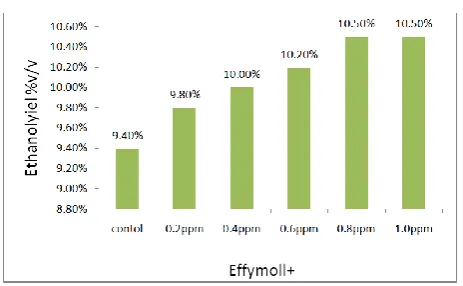
sugar provides vital elements & growth factors for yeast growth and prevents bad effects of yeast inhibitors. Application of Effymoll+ at 0.8ppm attained performance in the ethanol yield up to 10.5% v/v) compared to 9.4% v/v for control Figure (9). Effymoll+ have advantages other than antibacterial control as it can hydrolyzed non fermentable sugars involved in sugar cane molasses to fermentable sugars, led to increase the total fermentable sugars in the molasses fermentation medium consequently ethanol yield liters / MT of molasses. Added Effymoll+ cause high rate of yeast growth & metabolism.
Figure 10. Effect of FrmaSure concentration on the ethanol yield in molasses medium contained 18 % w/v fermentable sugars
fermented by S. cerevisiae F-514 at 34oC
Figure 11. Effect of Effymoll+ concentration on the ethanol yield in
molasses medium contained 18 % w/v fermentable sugars fermented by S.
cerevisiae F-514 at 34oC
KAMORAN®
The results illustrated in Figure (9)reveled that use 2 ppm KAMORAN® is more suitable when used in ethanol fermentation for controlling bacteria. The ethanol yield increased from 9.4% v/v to 10.4% v/v(1.0 % v/v) KAMORAN® has exceptional activity against bacteria indigenous to the ethanol-producing feed stocks that
commonly contaminate ethanol fermentation tanks ,
percentage of their product at higher prices to high quality users such as the perfume industry. More than 500 different micro-organisms have been identified as contaminators of ethanol. Tests in commercial ethanol production facilities have demonstrated that KAMORAN® effectively controls the mixed bacterial populations present in ethanol fermentation operations without affecting the activity of yeast.
Figure 12. Effect KAMORAN concentration on the ethanol yield in molasses medium contained 18 % w/v fermentable sugars
fermented by S. cerevisiae F-514 at 34oC
Effect of pH value
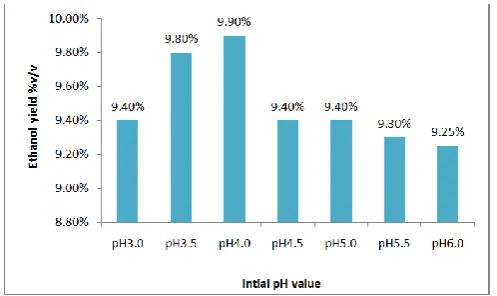
Reducing pH is a one of the factors for managing bacterial contamination in fermentation medium for ethanol production, as low pH is not suitable for most bacterial growth. Sulfuric acid is used to adjust the pH as well as a sulfur source .since
yeast is more tolerant to sulfur than bactria (de Vasconcelos et
al. 2004.
Figure 1. Effect of initial pH value on the ethanol yield in molasses medium contained 18 % w/v fermentable sugars
fermented by S. cerevisiae F-514 at 34oC
Effect of inoculum size
Figure (14) illustrates that inoculum size is vital factor in the fermentation system and performance of ethanol yield .As seen the ethanol was 9.4,9.and 10.1% v/v when inoculums size was
2.5,5.0 and 7.5 % v/v(106 cfu /mL) respectively. Narendranath
et al.( 2004) studied effect of yeast inoculation rate on the
metabolism of contaminating lactobacilli during fermentation of corn mash . They found that no differences were observed in the final ethanol concentration produced by yeast at any of the inoculation rates studied, in the absence of lactobacilli.
However, when the mash was infected with 1×10⁷ or 1×10⁸
lactobacilli/ ml, a reduction of 0.7-0.9% v/v and a reduction of 0.4-0.6% v/v in the final ethanol produced was observed in
mashes inoculated with 1×10⁶ and 1×10⁷ yeast cells/ml,
respectively. The pervious data were insured by Fadel et al.
(2013). Inoculum size to extent level affect fermentation time not affect final ethanol yield produced (Fadel, 2014). This suggests that using high inoculums size reduces the growth and metabolism of contaminating lactic bacteria significantly, which results in reduced lactic acid production by lactobacilli and concomitant increase in ethanol. Negative results was obtained when inoculum size is increased than limit level lead to reduction in final ethanol yield and this can be discussed on the light of at high concentration yeast biomass , yeast tend to consume fermentable sugars to give biomass .The obtained results is confirmed with that reported by Borzani (2006) who reported that the efficiency of batch ethanol fermentation of sugar-cane blackstrap molasses media decreased when the biomass initial concentration increased. No linier correlation between the fermentation efficiency and the biomass concentration.
Figure 14. Effect of inoculum size% v/v on the ethanol yield in molasses medium contained 18 % w/v fermentable sugars
fermented by S. cerevisiae F-514 at 34oC
Effect of yeast strain
Figure (15) illustrates that final ethanol yield was varied
between the five tested strains. S. cerevisiae F-514 achieved
the higher ethanol yield (10.1% v/v) followed by S.cerevisiae
F-727 and S.cerevisiae F-111(10.05% and 10.0 %v/v
respectively). S. cerevisiae F-25 and F-84 gave the lowest
yield. The obtained data agree with the finding of Dhamija, et al.(1980) when screening 38 yeast strains for their fermenting abilities.with regard to ethanol production in molasses medium and under limiting conditions with varying inoculums sizes, have been conducted. Under all conditions strain 21 was found to be fast fermenting compared to all other strains. Such data were also reported by Fadel et al., 2014 confirmed that yeast strain is very important factor in ethanologenic fermentation from sugar cane molasses.
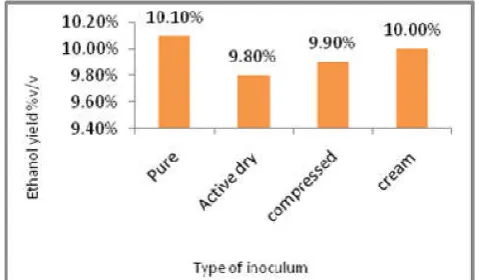
Effect of yeast inoculums format
yeast as well as higher activity than fresh or active dry yeast (Knauf, 2006). According to Lorenz et al (2000), the reduction in efficiency is attributed to the presence of wild yeast and bacterial contamination involved in other yeast format than the pure yeast culture . The efficiency reduction depends upon the extent of contamination (Connolly, 1997).
Figure 15. Effect of yeast strain on the ethanol yield in molasses medium contained 18 % w/v fermentable sugars
Figure 16. Effect inoculums format on the ethanol yield in molasses medium contained 18 % w/v fermentable sugars
Conclusion
Experimental study was carried out in an attempt to managing of the bacterial contamin- ation in alcoholic fermentation of sugar cane molasses. influence of several antibiotics, chemicals and commercial compounds as contamination controls in the alcoholic fermentation of blackstrap molasses. The present study focused on tried several antibiotics i.e
penicillin, tetracycline, virginamycin,erythromycin.
Amoxicillin, amoxicillin+ flucloxacillin (1:1) and cefadroxil.
Chemicalssuch as Potassium meta bisulfate and chlorine. Commercial preparations like KAMORAN®, Effymoll + and
DuPont™ FermaSure® XL Effect of yeast strain, inoculum
yeast format, inoculum size and pH were also studied. promising results were obtained led to perf0rmance in ethanol yield in fermentation mash ranged from 0.70 1.1 % v/v.
REFERENCES
Aquarone, E. 1960. Penicillin and tetracycline as
contamination control agents in alcoholic fermentation of
sugar cane molasses. Appl. Microbiol., 8, 263-268.
Arshad, M. 2005. Optimization of fermentation conditions for enhanced ethanol production from blackstrap molasses at
industrial scale. M, Phil thesis, Univ. Agric. Faisalabad, Pakistan.
Bayrock, D.P, Thomas KG and, Ingledew, W. M. 2003. Control of lactobacillus contaminants in continuous fuel ethanol fermentations by constant or pulsed addition of
penicillin G. Appl. Microbiol. Biotechnol., 62: 498-502.
Borzani, W. 2006. Batch ethanol fermentation: the correlation between the fermentation efficiency and the biomass initial concentration depends on what is considered as produced
ethanol. Braz J Microbiol 37, 87–89.
Borzani, W. and Aqitarone, E. 1957. Continuous fermentation-
penicillin as contamination control agent. J. Agr. Food
Chem., 5, 612-616.
Borzani, W. and Falcone, A.I. 1953 Control of starter
preparation in fermentation of molasses. J. Agr. Food
Chem., 1, 1070-1071.
Chang, I. S., Kim, B. H., and Shin, P. K. 1997. Use of sulfite and hydrogen peroxide tocontrol bacterial contamination in
ethanol fermentation, Appl. Environ. Microbiol., 63, 1–6
(1997).
Connolly, C. 1997. Bacterial contaminants and their effects on alcohol production. In: Jacques KA, Lyons TP, Kelsall DR, (eds) The alcohol.
Day, W.H. Serjak, W.C. Stratton, J.R. and Stone, L. 1954. Antibiotics as contamination control agents in grain
alcohol fermentations. J. Agric. Food Chem., 2, 252-258.
Del Rosario, E.J., Lee, K. J. and Rogers, P.L 1979. Kinetics of
alco-hoiic fermentation at high yeast levels. Biotechnol.
Bioeng. 27, 1477-1482.
Dhamija, S.S. Suresh Sharma, D. S. Dahiya, M.C. Bardiya and P. Tauro (91980)
Fadel, M. 2014. Production of Fuel Ethanol from Cane Molasses. Microbes In Procces. Chapter 4, 93-117.
Fadel, M., Abdel Naser, A. Zohri. Makawy, M., Hsona. M.S. and Abdel Aziz A M 2014. Recycling of vinasse in ethanol fermentation and application in Egyptian Distillery
Factory. African Journal of Biotechnology13 (47):4390 –
4398.
Fadel, M., Abeer A. Keera, Foukia E. Moufi and Tarek Kahil 2013. High level Ethanol from Sugar Cane Molasses by Anew Thermotolerant Saccharomyces cervisiae Strain in
industrial Scale Biotechnology Research International vol.
2013 ID253286 6 pages.
Fermentation alcohol from cane molasses by fast fermenting yeast and its cell recycling,. By-Products,2700-2710 Ftaka, J. 2008. Ethanol additive safer, effective, Feedstuffs,
November 3,
Gibbons, W. R. and Westby, C.A. 1986. Use of potassium metabisulfite to control bacterial contaminants during fermentation of fodder beet cubes for fuel ethanol.
Biomass.11: 9-13.
Gordon, W. S. and Taylor, J. H. 1954. The growth-promoting effect of antibiotics and their possible modes of action.
Proc. Roy. Soc. Med., 47, 744-747.
Hynes, S. H., Kjarsgaard, D. M., Thomas, K. C. Ingledew, W. M. 1997. Use of virginiamycin to control the growth of
lactic acid bacteria during alcohol fermentation Journal of
Industrial Microbiology and Biotechnology, 18, Issue 4, pp
284–291
Islam, M., R. Toledo, and M.K. Hamdy. 1999. Stability of virginiamycin and penicillin during alcohol fermentation.
Kelly, A. S. and Timothy, L.D. 2004. Bacterial contaminants
of fuel ethanol production. J. Ind. Microbiol. Biotechnol.,
31: 401-408.
Khan, ZM, Khalil-ur-Rehman, Shah, F.A. And Rajoka FA 2008. Optimization of process variables for minimization of byproduct formation during fermentation of blackstrap
molasses to ethanol at industrial scale. Lett. Appl.
Microbiol., 47: 410-414.
Knauf , M. and Kraus, K. 2006. Specific yeasts developed for modern ethanol 2nd Bioethanol Technology Meeting in Detmold, Germany, 25 April 2006.
Lane J.H, and Eynon. 1923. Determination of reducing sugars by means of Fehling’s solution with methylene blue as
internal indicator. J. Soc. Chem. Ind. 42,32.
Lorenz, MC, Cutler, N.S.and Heitman, J. 2000.
Characterization of Alcohol-induced Filamentous Growth
in Saccharomyces cerevisiae. Mo/. BioL Cell. 11(1):
183-199.
Makanjuola, D.B, Tymon, A,and Springham, D.G. 1992. Some effects of lactic acid bacteria on laboratory-scale
yeast fermentations. Enzyme Microbiol. Tech., 14:
350-357.
Meneghin1,S,P.; Fabricia Reis1F,C.; de Almeida ,P.G.; Ceccato-Antonini, S.R. 2008. Chlorine dioxide agent bacteria and yeas ts from the alcoholic fermentation
Brazilian Journal of Microbiology (2008) 39:337-343
Narendranath, N,V., Thomas, K.C .and Ingledew, W.M. 2000. Urea hydrogen peroxide reduces the numbers of Lactobacilli, nourishes yeast, and leaves no residues in the
ethanol fermentation. Appl. Environ. Microbiol., 66:
4187-4192.
Narendranath, N. V., Hynes, S. H., Thomas, K. C., and Ingledew, W. M. 1997. Effects of lactobacilli on
yeast-catalyzed ethanol fermentations, Appl. Environ.
Microbiol., 63, 4158–4163
Narendranath, N.V, Hynes, S.H., Thomas, K.C. and Ingledew, W.M. 1997. Effects of Lactobacilli on yeast catalyzed
ethanol fermentations. Appl. Environ. Microbiol., 63:
4158-4163.
Neelakantam ,V. and Narendranath, R.P. 2004. Effect of yeast inoculation rate on the metabolism of contaminating
lactobacilli during fermentation of corn mash. J. Ind.
Microbiol. Biotechnol., 31: 581-584
Oliva-Neto P and Yokoya, F. 1998. Effect of 3,4,4-trichlorocarbanilide o growth of lactic acid bacteria contaminants in alcoholic fermentation. Bioresour. Technol., 63: 17-23.
Rückle, L. and Senn, T. 2006. Hop acids can efficiently
replace antibiotics in ethanol production. Int. Sugar J., 108:
139-147.
Serra, G.E. 2000. Use of penicillin and monensin to control bacterial contamination of Brazilian alcohol fermentations.
Int. Sugar J., 102: 78-82.
Skinner, K. A. and Leathers, T. D. 2004. Bacterial
contaminants of fuel ethanol production, J. Ind. Microbiol.
Biotechnol., 31, 401–408
Strandskov, F. B. and Bockelmann, J. B. 1953. Antibiotics as
inhibitors of microbiological contamination in beer. J. Agr.
Food Chem., 1, 1219-1223.
Stroppa, C. T., Andrieta, M. G. S., Andrietta, S. R., Steckelberg, C., and Serra, G. E. 2000. Use of penicillin and monensin to control bacterial contamination of
Brazilian alcohol fermentations, Int. Sugar J., 102, 78–82
Thomas, K.C, Hynes, S. H. and Ingledew, W.M. 2001. Effect of lactobacilli on yeast growth, viability and batch and
semi-continuous alcoholic fermentation of corn mash. J.
Appl. Microbiol., 90: 819.
William R. Gibbons, C. Westby, A. 1986. Use of potassium meta bisulfite to control bacterial contaminants during fermentation of fodder beet cubes for fuel ethanol Biomass, 11, Issue 2, 99-113
Zia, M.A., Asghar, M .and Bhatti, H. 2011. Improving bio-ethanol yield using virginiamycin and sodium fluoride at a
Pakistani distillery. Afr. J. Biotecnol., 10(53)11071-11074.