* To whom all correspondence should be addressed. E-mail: [email protected]
Quality Management- The Key to Inherent Safety and
Reliability of Prototype fast Breeder Reactor
R.G. Rangasamy1, Prabhat Kumar1 and N.Manoharan2
1Bharatiya Nabhikiya Vidyut Nigam Limited, Kalpakkam, Chennai - 603102, India.
3Research and Development Division, AMET University, Kanathur, Chennai - 603112, India.
doi: http://dx.doi.org/10.13005/bbra/1406
(Received: 15 August 2014; accepted: 10 October 2014)
The term “Quality management” has a specific meaning within many business sectors. Quality has metamorphosed from the synonyms of “Customer satisfaction” to “Customer delight”, thriving for excellence in every sphere of business with continuous improvements. In today’s business scenario, more often quality is perceived as “Fitness for purpose “focusing on the customer. But there is horizon beyond this as, “quality” is always intertwined with “safety and reliability” if the nature of the business is perilous. The prime focus for any nuclear industry is about the safety and reliability which can be accomplished only through the inherent quality. The quality embarks right from the construction phase of the nuclear power plant till the decommissioning and the four main components i.e. quality planning, quality control, quality assurance and quality improvement trek alongside. The high temperature low pressure system of fast breeder reactors using sodium as the coolant demands very high reliability and high degree of quality during each and every stage of construction of all the individual components for trouble free operation of the reactor for the committed years. The “Quality Assurance (QA)” plan of Prototype Fast Breeder Reactor is unique. The reactor being first of its kind in India, quality assurance starts right from the raw material procurement and extends through all the stages of plant till commissioning. The principal material of construction being stainless steel for the reactor components shall be handled with care following best engineering practices coupled with stringent QA requirements to avoid stress corrosion cracking in the highly brackish environment. Integranular stress corrosion cracking and hot cracking are additional factors to be addressed for the welding of stainless steel components. The low alloy ferritic steel like 9Cr-1Mo (mod) has been extensively deployed and the fabrication requires structured inspection, testing and QA plan. Corrosion protection and preservation during fabrication, erection and post erection is mandatory be it reinforcement bar or a reactor vessel.
Key words: Quality management, Safety, Reliability, Quality Assurance, Welding.
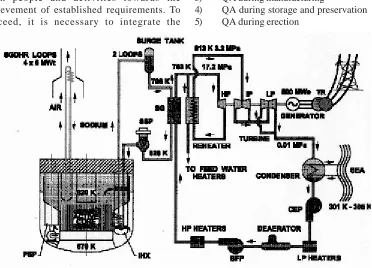
Prototype Fast Breeder Reactor (PFBR) is sodium cooled, pool type, 500 MWe reactor which is at advanced stage of construction at Kalpakkam, Tamilnadu, India. The heat generated in the reactor core is removed by circulating sodium through the core. The primary sodium circuit (PSC)
removes the nuclear heat generated in the core and transfers it to the secondary sodium circuit (SSC) through intermediate heat exchangers (IHXs).
circuits (SGDHRC) when either SWC or the SSCs are not available.
Challenging conditions of PFBR in addition to SMR
The International Atomic Energy Agency (IAEA) defines ‘small’ as under 300 MWe, and up to 700 MWe as ‘medium’ – including many operational units from 20th century. Together they are now referred to as small and medium reactors (SMRs). The challenges in SMRs owing to compact layout are extensive and PFBR poses several challenges in addition.
The key challenges are listed here 1) Hot and Humid weather conditions 2) Higher atmospheric Temperature as high as
45°C
3) Higher relative humidity ( Min 15%, Max 100% and 80% RH at 45°C)
4) Coastal Zone- Saline atmosphere
ü Brackish wind -Enclosure to withstand cyclone & monsoon rains aided by low pressure cyclone.
5) Seismic qualification- FRS for higher elevations
6) Operating temperature as high as 500°C 7) Thin walled austenitic stainless steel
construction
8) 100% radiography with stringent control on mismatch & distortion
9) HLT under vacuum to the tune of 10-4
millibar.
Quality assurance in nuclear industry
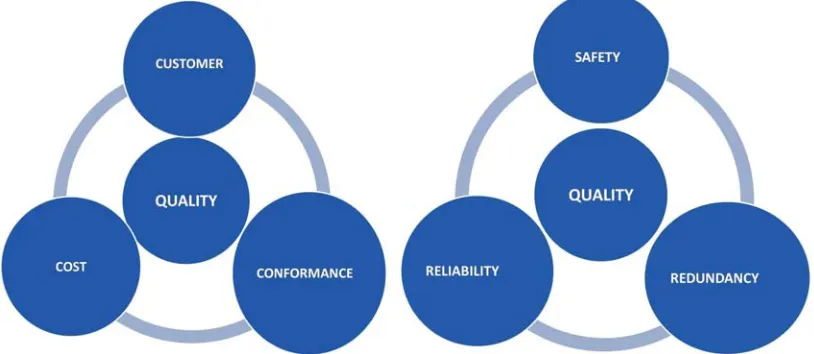
The term “Quality management” has a specific meaning within many business sectors. Quality has metamorphosed from the synonyms of “Customer satisfaction” to “Customer delight”, thriving for excellence in every sphere of business with continuous improvements. In today’s business scenario, more often quality is perceived as “Fitness for purpose “focusing on the customer. But there is horizon beyond this as, “quality” is always intertwined with “safety and reliability” if the nature of the business is perilous. The prime focus for any nuclear industry is about the safety and reliability which can be accomplished only through the inherent quality.
The quality assurance (QA) programme is an interdisciplinary management tool that provides a means for ensuring that all work is adequately planned, correctly performed and
assessed. It provides a systematic approach for accomplishing work with the ultimate goal of doing the job right the first time (RFT). The QA programme is binding on everyone and its implementation is not the sole domain of any single organizational unit or individual. The QA programme can be effective only when the management, the staff performing the tasks and those carrying out the assessment, all contribute to the quality of the project in a concerted and cost effective manner. The final goal of all these efforts is the achievement of safe, reliable and economic production of electricity.
Graded QA Programme of PFBR
Nuclear Safety shall be the fundamental consideration in the identification of items, services and process to which QA programme applies. Whilst the QA principles remain the same, the extent to which QA requirements are to be applied shall be consistent with the importance to nuclear safety of the item, service, or process. A graded approach, which can satisfy the necessary requirements and ensure the required quality and safety, shall be used. The graded approach shall reflect a planned and recognized difference in the application of specific QA requirements.
The general designation and purpose of the graded approach can be defined as “For a system of control, such as a regulatory system or a safety system, a process or method in which the stringency of the control measures and conditions to be applied is commensurate, to the extent practicable, with the likelihood and possible consequences of, and the level of risk associated with, a loss of control” The grading of activities should be based on safety analyses, regulatory requirements and engineering judgment. Other elements to be considered in grading are the complexity and the maturity of the technology, operating experience associated with the activities and the stage in the lifetime of the facility.
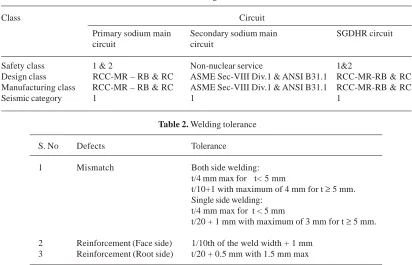
The graded QA approach to the heat transport circuits of PFBR is based on the following classification.
for class-1,2&3 components for PFBR is listed below in the following table. The acceptance criteria of LPE is similar to that of ASME but the acceptance criteria for radiographic examination is far stringent than ASME.
QA approach
System oriented approach
The system oriented approach places the emphasis on a prescribed QA methodology which requires the nuclear power plant owner and its contractors to plan, conduct, control, and document their work in a systematic way. Quality is achieved through controlled performance of all activities, and quality is verified at several levels, such as first-line inspections and testing, surveillance and monitoring of activities, and audits of the effectiveness of the complete QA system. The role of the regulatory authority is to verify the plant owner’s commitments made in a documented Q A programme by carrying out programme audits and by sampling inspection of the work
Product oriented approach
The product-oriented approach
emphasizes the extensive verification of product quality through inspections and testing. These are performed in a redundant way by manufacturers
or constructors, by purchaser or plant owner, and by third-party inspections which are performed on behalf of the regulatory authority by an independent inspection organization. The adherence to a prescribed QA methodology is less formal in this approach, and achievement of quality is considered a separate management function not directly related to QA. The emphasis is on verifying the quality of equipment and services by an independent inspection organization
Performance-based approach for PFBR to achieve RFT
A major factor influencing the positive trends in the performance of nuclear power plant construction and operation over the last several years has been the use of performance-based approach to quality assurance that places a greater emphasis on the effectiveness of programme implementation and process management in addition to documentation. Quality is achieved in a more effective, timely and productive manner when work is done “right the first time” (RFT) rather than by finding and correcting non-conformances later. Therefore, the functions of the individuals and line organizations have gained importance in assurance of the quality of items Table 1. Categorization
Class Circuit
Primary sodium main Secondary sodium main SGDHR circuit
circuit circuit
Safety class 1 & 2 Non-nuclear service 1&2
Design class RCC-MR – RB & RC ASME Sec-VIII Div.1 & ANSI B31.1 RCC-MR-RB & RC Manufacturing class RCC-MR – RB & RC ASME Sec-VIII Div.1 & ANSI B31.1 RCC-MR-RB & RC
Seismic category 1 1 1
Table 2. Welding tolerance
S. No Defects Tolerance
1 Mismatch Both side welding:
t/4 mm max for t< 5 mm
t/10+1 with maximum of 4 mm for t ≥ 5 mm. Single side welding:
t/4 mm max for t < 5 mm
t/20 + 1 mm with maximum of 3 mm for t ≥ 5 mm.
and services while at the same time, the control and verification techniques are further improved. The extent and type of quality verification need to reflect the safety significance and nature of the individual tasks. Such verification methods include audits, checks and examinations to ensure that each task has been satisfactorily performed or that any necessary actions have been taken. However, the basic responsibility for achieving quality remains with the performer of the task, not the verifier. Starting from the basic principles of
“defence-in-depth” thinking, one should
concentrate on the following three lines of defence in inspection work:
1) Prevention of failures.
2) Monitoring or detection of failures. 3) Making sure that failures cannot recur and
mitigation of consequences of failures. The overriding principle is that safety shall not be compromised for reasons of pro-duction or economics, or for any other reason. The approach emphasizes the key management responsibility and accountability for all aspects of quality of performance, including planning, organization, direction, control and support. Since the approach looks for total quality, it helps to align people and activities towards the achievement of established requirements. To succeed, it is necessary to integrate the
contribu-tions that are made to quality and safety by the people managing it, those performing the work, and those assessing it.
Stages of Quality assurance adopted for PFBR
“Quality assurance practices are an essential part of good management and are to be applied to all activities affecting the quality of items, processes and services important to safety. Inherent in the achievement of quality is the adoption of a quality assurance programme, which includes the planned and systematic actions necessary to provide adequate confidence that specified requirements are satisfied .A well planned and comprehensive QA approach needs to be adapted to plan, implement and ensure QA requirements in all stages of manufacture such as design, manufacturing, inspection & NDE, welding and process control, process qualification and approval, calibration of inspection and testing instrument.
In short the QA programme for any nuclear component of PFBR can be categorized under following headings before put into actual operation in the reactor.
1) QA during design
2) QA during raw material procurement 3) QA during manufacturing
4) QA during storage and preservation 5) QA during erection
6) QA post erection & preservation 7) QA during commissioning.
QA for structural welding and stainless steel pressure vessel welding for PFBR
QA requirements of PFBR are far stringent to ASME standards and even superior to RCC-MR standards.
For stainless steel raw material, additional mechanical tests like impact at room temperature in solution annealed and embrittled condition, tensile test at elevated temperature, control on delta ferrite (less than 1%), stringent control over inclusion content etc., are specified.The number of tests called for welding procedures for PFBR is
Fig. 2. Quality in conventional business and nuclear business
more than the tests required as per ASME requirements. Longitudinal tensile test at room temperature, transverse tensile test at high temperature, integranular corrosion test, micrography, delta ferrite test etc are additionally specified than that of ASME. The welding standards and tolerances are also stringent and classification is done based on single side or double side welding rather than longitudinal seam or circumferential seam.
The structural welding for sodium piping supports of PFBR is equivalent to pressure vessel welding. Grading system is applicable for the structural welding also and hence the QA
requirements are stringent for primary members of Class-1 structures. All the weld joints are of full penetration configuration with each pass liquid penetrant examination. Fit-up of box structures, Root and final welding of structural members are witness and hold points. Separate and sequential quality assurance plan is followed for structural welding right from raw material procurement to site erection.
Summary
Quality assurance program is often incorrectly interpreted as only a regulatory demand with no effective impact in the overall performance of the nuclear project.QA programme governing all aspects of a nuclear power project is an essential management tool as detailed in the paper. PFBR being a prototype which is being indigenously designed and built throws more challenges for
quality assurance right from material procurement to commissioning. The technology is highly sophisticated and totally new to the country, the people and the industry. New procedures and techniques needs to be developed with concurrent human resource training and development to meet the demands of quality.
REFERENCES
1. Frank Hawkins, Nestor Pieroni, Quality assurance at nuclear power plants: Basing programmes on performance, IAEA Bulletin, 4/1991