Original Research Article
A study on self-care practices and dietary barriers among type 2
diabetes patients attending outpatient department in
Karnataka Institute of Medical Sciences, Hubballi
N. P. Kavya*, Dattatreya D. Bant
INTRODUCTION
Diabetes is a chronic, progressive disease characterized by elevated levels of blood glucose and is an important cause of premature mortality and morbidity.1 Diabetes caused 1.5 million deaths contributing about 4% of NCD deaths worldwide in 2012.2 Globally, 422 million adults were living with diabetes in 2014. According to the International Diabetes Federation diabetes afflicts an estimated 69 million people in India, the second highest burden in the world after China.3
Diabetes, if not well controlled may cause micro and macro vascular complications like heart attack, stroke, blindness, kidney failure, lower limb amputation, vision loss, nerve damage and several other long-term consequences that impact significantly on quality of life.4 Studies have shown lower limb amputation rates are 10 to 20 times higher among people with diabetes.5
Self-care practice in diabetic patient is a critical factor to achieve glycaemic control thus in preventing or delaying its complications.6 Self-care in diabetes is an evolutionary process of development of knowledge or awareness by
ABSTRACT
Background: Diabetes is a chronic, progressive disease characterized by elevated levels of blood glucose and is recognized as an important cause of premature mortality and morbidity. Self-care practice in diabetes patient is a critical factor to achieve glycaemic control thus in preventing or delaying its complications.
Methods: A cross sectional study was conducted among 140 type 2 diabetic patients attending the outpatient department in Karnataka Institute of Medical Sciences, Hubballi during the period of June-July 2018. Diabetic patients diagnosed more than 3 months were included. Data was collected by interview method using pre-designed, pre-tested and semi-structured questionnaire which consists of information on socio-demographic data, diabetic profile, self-care practices and dietary barriers. Statistical analysis was done using SSPS package.
Results: This study showed that 67.9% of study participants were consuming diabetic diet, 17.1% practice exercise for more than 3 days a week, 93.6% were taking medication regularly, 15% practised foot care for >3times a week and 89.3% monitored their blood glucose regularly. The main barriers for dietary practices were lack of knowledge (24%) and lack of motivation (18%). Compliance to diabetic diet was more among the urban population compared to rural (p=0.025).
Conclusions: Study concludes that the practice of self-care activities was poor in almost all aspects except for blood sugar monitoring and adherence to medication which necessitates the need to create awareness regarding self-care practices and its importance among diabetic patients.
Keywords: Diabetes, Self-care practices, Dietary barriers
Department ofCommunity Medicine, Karnataka Institute of Medical Sciences, Hubballi, Karnataka, India
Received: 24 December 2018
Accepted: 31 January 2019
*Correspondence:
Dr. N. P. Kavya,
E-mail: [email protected]
Copyright: © the author(s), publisher and licensee Medip Academy. This is an open-access article distributed under the terms of the Creative Commons Attribution Non-Commercial License, which permits unrestricted non-commercial use, distribution, and reproduction in any medium, provided the original work is properly cited.
learning to survive with the complex nature of diabetes in a social context.7-8 The various self-care practices in diabetic patients include regular physical activity, appropriate dietary practices, compliance with the treatment regimen, monitoring of blood sugar and regular foot-care.6 Diet barriers often lead to undesirable diet management, which attributes mostly to poor glycaemic control. Consistent evidence showed that patients with poorly controlled diabetes perceived more diet barriers compared with subjects with good glycaemic control.9 As 95% of the disease management is usually carried out by the affected individual or their families nevertheless, poor adherence to self-care practices in diabetes persists as a major public health challenge globally.1,10 In developing countries like India, where the resources are limited, and treatment costs of diabetes are constantly increasing, the practice of self-care component among patients with diabetes may result in better economic and therapeutic outcomes.11
Considering all above facts and importance of self-care practices in diabetes management, the objectives of the present study are to assess the self-care practices and to identify the barriers for healthy dietary practices among type 2 diabetic patients.
METHODS
This is a cross sectional study conducted during the period of June to July 2018 to assess the self-care practices and to identify the barriers for healthy dietary practices among type 2 diabetes mellitus patients attending outpatient department of Karnataka Institute of Medical Sciences, Hubballi.
A sample size of 140 was calculated by taking the compliance to diabetic diet as 72% based on previous study, absolute precision as 8% and non-response rate as 10%.12 Approval was obtained from the institutional ethical committee. Patients of type 2 diabetes mellitus diagnosed more than 3 months were included. Study participants were selected by convenient sampling. After obtaining the informed verbal consent data was collected using a predesigned, pretested and semi structured questionnaire by interviewing study participants in their own vernacular language. The questionnaire consists of information regarding socio-demographic data, diabetic profile, self-care practices and barriers for healthy dietary practices.
The data was entered in Microsoft excel worksheet and analysed using SPSS version 21. Statistical test like the chi-square test was used and p<0.05 was considered as statistically significant.
RESULTS
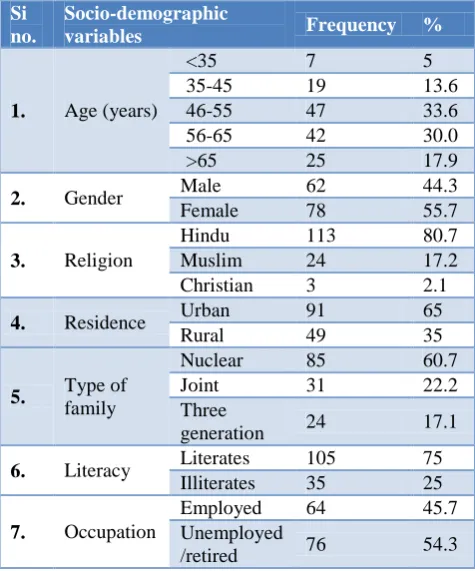
The mean age is 55.4±10.96 years. Out of 140 study participants, 78 (55.7%) were females, 113 (80.7%) were Hindus, 91 (65%) were from urban area, 35 (25%) were
illiterates and 76 (54.3%) were unemployed/retired as shown in Table 1. 5.7% of study participants were smokers and alcoholics and 8.6% were tobacco chewers.
Table 1: Socio-demographic characteristics of study participants (n=140).
Si no.
Socio-demographic
variables Frequency %
1. Age (years)
<35 7 5
35-45 19 13.6
46-55 47 33.6
56-65 42 30.0
>65 25 17.9
2. Gender Male 62 44.3
Female 78 55.7
3. Religion
Hindu 113 80.7
Muslim 24 17.2
Christian 3 2.1
4. Residence Urban 91 65
Rural 49 35
5. Type of
family
Nuclear 85 60.7
Joint 31 22.2
Three
generation 24 17.1
6. Literacy Literates 105 75
Illiterates 35 25
7. Occupation
Employed 64 45.7
Unemployed
/retired 76 54.3
Table 2 shows diabetic profile of study participants. 43.6% of study subjects had diabetes for 2-8 years, 75.7% were on oral hypoglycaemic treatment and blood glucose level was high in 60.7% patients in their last blood glucose examination. 24.3% had history of diabetic related eye complication, 2.9% has kidney complications, 4.3% had foot ulcer and 3.6% had stroke. Hypertension (74%), obesity (12%), COPD (9%), asthma (3%) are the other co-morbidities present in the study participants.
Table 3 depicts the practice of self-care activities in study participants. 67.9% patients were consuming diabetic diet, 17.1% were practicing exercise for more than 3 days a week for at least 30 minutes, adherence to medication was seen in 93.6% of study participants. 15% of study participants practice foot care with respect to washing feet, drying in between toes, examining foot and checking inside surface of shoes for >3times a week, and 89.3% were undergoing regular blood glucose examination. 17.9% and 33.6% carry biscuits/sweet and identity card when they go out.
following diabetic diet and 51.4% told that they cannot follow diabetic diet in social gathering.
Study shows that there was statistically significant association between the residence and religion with compliance to diabetic diet (Table 4).
Table 2: Diabetic profile of study participants.
Variables Frequency (%)
Duration of diabetes (in years)
<2 28 (20)
2-8 61 (43.6)
>8 51 (36.4)
Type of treatment
Oral hypoglycemics 106 (75.7)
Insulin 8 (5.7)
Oral hypoglycemic and insulin 23 (16.4)
Only diet control 3 (2.1)
Blood glucose level in their last examination
Normal 48 (34.3)
High 85 (60.7)
Low 7 (5)
Table 3: Diabetic related self-care practices among study participants.
Self-care practice component Frequency (n=140) (%)
Consuming diabetic diet Yes 95 67.9
No 45 32.1
Practice of exercise
>3 days a week for 30 minutes 24 17.1
<3 days a week for 30 minutes 28 20.0
No exercise 88 62.9
Compliance to medication
Good 131 93.6
Poor 6 4.3
Not on any medication 3 2.1
Practice of foot care (week)
>3times 21 15
<3times 15 10.7
No 104 74.3
Blood glucose testing for once in 3 months Yes 125 89.3
No 15 10.7
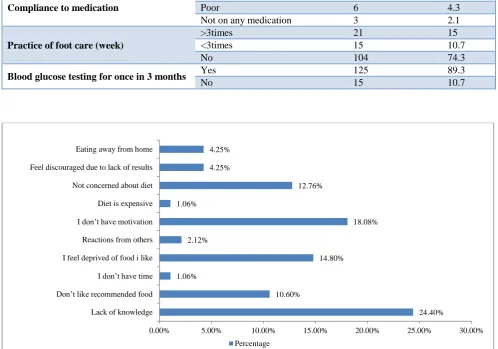
Figure 1: Self-reported barriers for healthy dietary practices among study participants.
24.40% 10.60%
1.06%
14.80% 2.12%
18.08% 1.06%
12.76% 4.25%
4.25%
0.00% 5.00% 10.00% 15.00% 20.00% 25.00% 30.00%
Lack of knowledge Don’t like recommended food
I don’t have time I feel deprived of food i like
Reactions from others I don’t have motivation
Diet is expensive Not concerned about diet Feel discouraged due to lack of results Eating away from home
Table 4: Practice of diabetic diet according to socio-demographic characteristics of study participants (n=140).
Socio-demographic factors Consuming diabetic diet Chi square test
Yes No
Age (in years)
<45 20 6
χ2=1.275 p=0.528
46-65 58 31
>65 17 8
Gender Male 38 24 χ2=2.200
p=0.138
Female 57 21
Religion Hindu 81 32 χ2=3.929
p=0.047
Muslim and Christian 14 13
Education Literate 74 31 χ2=1.321
p=0.25
Illiterate 21 14
Occupation Employed 46 18 χ2=0.873
p=0.35
Unemployed 49 27
Residence Urban 68 23 χ2=5.623
p=0.018
Rural 27 22
DISCUSSION
The present study was conducted to assess the practice of diabetes self-care activities among patients attending outpatient department in Karnataka Institute of Medical Sciences, Hubballi.
The present study found that 67.9% of patients were following diabetic diet which is similar to Arulmozhi et al (67.3%) in Puducherry and better than Rajasekharan et al (45.9%) in Mangalore.13,14 About 17.1% of the diabetics were involved in physical exercise for at least 30 minutes, for more than 3 days in a week. Similar findings were reported in Arulmozhi et al (22.7%) and Dinesh et al study, where as in Rajasekharan et al exercise practice was higher (43.4%).13-15 Compliance to diabetic medication was good (93.6%) in the present study compared to that reported by Dinesh et al study (48%).15
Regular blood sugar monitoring was done by 89.3% of patients which is quite satisfactory compared to that reported by Rajasekharan et al and Dinesh et al study as 76.6% and 65.25% respectively.14,15 15% checked their feet regularly where as it is around 16.7% and 2% in Arulmozhi et al and Dinesh et al study respectively.13,15 The main barriers identified in the present study were lack of knowledge about diabetic diet (24.4%), lack of motivation (18.08%) and feeling of deprivation (14.8%) where as in Cheng et al study feeling of deprivation and eating away from home were recognised barriers and in Ghimire study lack of knowledge and healthy diets are expensive and unaffordable are the main barriers.9,16 The present study also found that compliance to diabetic diet was good among urban population compared to rural population which emphasizes the need to create awareness among diabetic diet specially focusing on rural population.
CONCLUSION
The practice of self-care activities was poor in almost all aspects except for adherence to medication and blood sugar monitoring. The main dietary barriers identified were lack of knowledge and lack of motivation. Study findings emphasize the need to create awareness and to encourage diabetic patients to practice self-care activities which is essential in diabetes management to prevent complications thus in improving their quality of life.
Limitations
The study findings cannot be generalised as this is a hospital based study. Self-care practices were assessed by interview method, thus responses may be biased.
ACKNOWLEDGEMENTS
The authors would like to thank the 3rd year MBBS students Sampada S N, Santosh P, Sarah J J C, Savinay P V, Shakuntala H and Shankar D for their help during data collection.
Funding: No funding sources Conflict of interest: None declared
Ethical approval: The study was approved by the Institutional Ethics Committee
REFERENCES
1. World Health Organization. Global Report on
Diabetes. Geneva: World Health Organization; 2016.
2. Global status report of NCD, 2014. Available at: http://www.who.int/nmh/publications/ncd-status-report-2014/en/. Accessed on 5 June 2018.
4. Fowler MJ. Microvascular and macrovascular complications of diabetes. Clin Diabetes. 2008; 26:77-82.
5. Moxey PW, Gogalniceanu P, Hinchliffe RJ, Loftus IM, Jones KJ, Thompson MM, et al. Lower extremity amputations – a review of global
variability in incidence. Diabetic Med.
2011;28:(10):1144–53.
6. Mohandas A, Bhasin SK, Upadhyay M, Madhu SV.
Diabetes Self Care Activities among Adults 20 Years and Above Residing in a Resettlement Colony in East Delhi. Indian J Public Health. 2018;62(2):104-10.
7. Cooper HC, Booth K, Gill G. Patients’ perspectives on diabetes health care education. Health Educ Res. 2003;18:191-206.
8. Paterson B, Thorne S. Developmental evolution of expertise in diabetes self-management. Clin Nurs Res. 2000;9:402-19.
9. Cheng L, Leung DY, Sit JW, Li XM, Wu YN, Yang
MY, et al. Factors associated wih diet barriers in patients with poorly controlled type 2 diabetes. Patient Prefer Adherence. 2016;10:37-44.
10. Anderson RM, Funnell MM, Butler PM, Arnold MS, Fitzgerald JT, Feste CC, et al. Patient empowerment: results of a randomized controlled trial. Diabetes Care. 1995;18(7):943–9.
11. Loganathan A, John K. Economic burden of
diabetes in people living with the disease; a field study. J Diabetol. 2013;4(3):5.
12. Srinath K, Basavegowda M, Tharuni N. Diabetic self-care practices in rural Mysuru, Southern Karnataka, India — A need for Diabetes
Self-Management Educational (DSME) program.
Diabetes Metab Syndr. 2017;11(1):S181-6.
13. Arulmozhi S, Mahalakshmy T. Self-Care and
Medication Adherence among Type 2 Diabetics in Puducherry, Southern India : A Hospital Based Study. J Clin Diagn Res. 2014;8(4):9–11.
14. Rajasekharan D, Kulkarni V, Unnikrishnan B, Kumar N, Holla R, Thapar R. Self-care activities among patients with diabetes attending a tertiary care hospital in Mangalore Karnataka, India. Ann Med Health Sci Res. 2015;5(1):59-64.
15. Dinesh P, Kulkarni A, Gangadhar N. Knowledge and self-care practices regarding diabetes among patients with Type 2 diabetes in Rural Sullia, Karnataka: A community-based, cross-sectional study. J Family Med Primary Care. 2016;5(4):847. 16. Ghimire S. Barriers to Diet and Exercise among
Nepalese Type 2 Diabetic Patients. International Scholarly Research Notices. 2017;2017:1-9.
Cite this article as: Kavya NP, Bant DD.A study on self-care practices and dietary barriers among type 2