56
Pedagogical sciences
role oF QualiFication improvement among pedagogueS
oF a medical univerSity in realiZing training oF doctorS
in general practice
baizharkinova a.b., Zhakieva g.r., iztleuov e.m.
Western-Kazakhstan state medical university of Marat Ospanov, city of Aktobe, e-mail: [email protected]
This article demonstrates role of qualification
improvement among pedagogues of a medical uni-versity who train doctors of general practice which has changed completely since new problems arose before graduates of the 7th course. a pedagogue must
not only be efficient in training a versatile specialist
according to his communicative skills and knowl-edge in demonstrative medicine, but also form their personal qualities. in ancient greece it was consid-ered that “a pedagogue is not the one who teaches, but rather one who leads his students towards mas-tership”. doctor of general practice must be a master
of his trade after graduation. It is especially signifi -cant in case of differential diagnostics, when he must make a quick decision on where to transfer a patient. a specialist must be able to deliver emergency
medi-cal assistance in case of injuries, surficial burns, and
frostbites, even treat. according to a new programme
of DGP of years 6–7, he must fix displacements of
shoulder and maxillofacial joints, perform plaster immobilization in case of uncomplicated fracture of spoke bone, place stitches, remove them, etc. in or-der to teach these skills, a tutor must develop them-selves in problems of pedagogy, learn how it is better to deliver knowledge, master computer technologies, in other words, keep abreast of the times.
in western-kazakhstan state medical university of marat ospanov, in process of realizing standard of additional education in republic of kazakhstan in terms of improving quality of pedagogic work we take all possible measures, tutors of clinical depart-ments take training in center of continuous profes-sional development from the position of practical
significance of education.
Qualification training of a medical university tutor
contains an integrated characteristic of a pedagogue’s personality with implementation of basic knowledge in informational literacy, possession of skills on new medical technologies within training process in order to achieve the basic objective of training – form per-sonality of a general practice doctor.
knowledge of a university tutor include: skills in implementing modern technologies within edu-cational process and also readiness to train within new educational conditions in accordance with international standards of training specialists of
the new formation, who possess certain specific
knowledge in combination with a high professional
qualification. The highest category of a tutor is a
foundation for a future development of modern ed-ucational system [1].
tutors of clinical disciplines possess less knowledge and skills on new informational tech-nologies due to their basic education. therefore, methods of developing informational competence of a tutor in our university are: thematic lectures at conferences on pedagogy, communicative skills, seminars, exchange of experience, and open class-es. a special part is devoted to training in training-clinical center of western-kazakhstan state medical university of marat ospanov. in order to estimate a tutor’s knowledge level within the system of
quali-fication improvement, our university facilitates the
following methods of control: indicator documents,
certificates, and quality of meeting requirements in
programme “Sirius”. we also consider published articles in university periodical editions, kazakh-stan and foreign magazines, annual reports of train-ing and clinical work on the given course.
Conclusion: thus, development of a tutor’s
qualification is determined by objective approach
in education in regard to all subjects of educational process in accordance with requirements of
infor-mational society. Within the system of qualification
improvement this principle is realized in 5-years
interval. The basic method of defining competence
level among tutors is to establish their knowledge
level not only in their profile subjects, but also com -puter technologies.
References
1. icb ipma competence baseline (version 3); publisher ipma, iSbn 0-9553213-0-1, edition june 2006.
the work is submitted to the international
Sci-entific Conference “Research Graduate School in
priority areas of science and technology”, Switzer-land, 27 april–03 may 2015, came to the editorial
office оn 23.04.2015.
tHe Study oF tHe need For retraining and advanced
training oF SpecialiStS in tHe Field oF occupational
SaFety and identiFy optimal training programS
1Sadykova j.m., 1Suleimenova r.Z., 1Kulzhabaeva A.А., 2Zhanys a.b.,
3tuyakbaeva S.b., 1iskakov r.m.
1Agrarian Technical University. S. Seifullin,
e-mail: [email protected];
2Kokshetausy University Abai Myrzahmetova. Professor
of the Russian Academy of Natural Sciences № 7425;
3Kazakh University of Technology and Business
57
Pedagogical sciences
the field of occupational safety and identify optimal
training programs.
according to the law of the republic of ka-zakhstan “on education” [5] professional develop-ment and training are the main forms of additional professional education and be in accordance with educational institutions to deepen students’ relevant knowledge, skills and practical skills, the
acquisi-tion of new skills and qualificaacquisi-tions.
training and retraining of personnel conducted
educational organizations, as well as scientific and
educational centers, regional employment agencies. they can be carried out by the state budget, and on a contractual basis.
occupational health and safety (oHS) – is a complex, multi-faceted system that should be stud-ied in a complex of interrelated disciplines (natural, technical and social), based on the views of the in-teraction of society and nature. in developing the theory of health and safety is necessary to identify its purpose and content, and the focus should be fo-cused on the formation, development and function-ing of labor and production processes, as an active ingredient of production is the man and his work. occupational safety has historically been and is continually evolving based on the study and gener-alization of reality [6].
the labor protection of science at the present stage of development has become a direct
produc-tive force and represents a specific sphere of hu -man activity having universal application.
occupational health and safety as a
univer-sal system of scientific knowledge and practical
activities aimed to create favorable and safe liv-ing conditions of people in the labor process, the preservation of health, prevention of occupational injuries and diseases, ensuring high performance and quality of work.
to implement these tasks discipline “occupa-tional Health and Safety (oH and S)” studies the structure of labor and production processes, the re-lationship and interaction with the subject of work environment work environment in all spheres of its manifestation. more precisely, the “Health and Safety” combines theory and practice to control the production process conditions in the interest of the subject of work.
Health and safety, as an organic component of the process of social labor and production reaches its general goal – the creation of favorable and safe working conditions – in two main ways: the constant improvement and development of the material elements of the productive forces and the continuous development of the person as the sub-ject of production.
the content of occupational safety and health varied in accordance with the development of production and social restructuring of society;
al-though no scientific and theoretical foundations to
improve it did not exist. it is clear that, labor arises directly from the occurrence of work [7].
at the heart of the science of health and safety is the knowledge and use of the laws of nature. creating tools and hand tools in order to facilitate the process of human impact on the environment is the material embodiment of human knowledge accumulated in the struggle for the conquest of the forces of nature.
natural and social factors, which are
associ-ated with the flow conditions of the labor process,
the relationship between people and the instru-ments of labor, the formation of the subjective world of the person in the process – all this, in the end, should be the subject study of labor protec-tion science. in order to achieve the objectives of this science is paramount its accelerated develop-ment and above all the developdevelop-ment of the meth-odological and theoretical framework,
strengthen-ing, streamlining and improving the efficiency of
its links with social practice.
occupational health should be addressed tak-ing into account the interaction between science and differentiation of areas of knowledge.
Solving the problems of occupational safety,
it is necessary first of all proceed from the laws
of human interaction with the work environment, taking into account the structure of the mode of production.
the complexity, diversity of occupational health requires the allocation of the main objec-tives of its optimization, i.e., streamline the pro-cess of interaction between society and nature in general, as well as between man and the work en-vironment in particular. consequently, there is rea-son to talk about the theoretical and applied areas of labor protection science, the need for both basic and applied research.
basic research should achieve the general goal of occupational safety by systematizing knowl-edge, establishment of laws and disclosure mecha-nism of human interaction with the environment in the process of social production. this problem can only be solved on the basis of the insight into, structure and properties of the object being stud-ied, while investigating the process of emerging phenomena in it. basic research should be organi-cally linked with the natural sciences, engineering, social sciences and practice.
Applied research in the field of occupational safety and health should address specific practical
problems.
Health protection, increase efficiency of work -ers, their personal safety are the subject of the high-est concern of society and cannot be put on a par with other factors of production activities. occupa-tional safety as a set of links in the system of peo-ple – the working environment is, ultimately, the people, and with the help of their funds provides the
conditions for a favorable and safe flow of labor and
58
Pedagogical sciences
Thus, research in the field of occupational
health can be carried out successfully only in close cooperation with them in such a search is not only natural, technical, and social sciences.
the successful development of labor protec-tion science necessary developing models of indi-vidual work processes, and in the whole system of people – the working environment with direct and feedback.
it is therefore quite natural that at the present stage essential acquired problem of creating appro-priate working conditions and activity, enabling the working people – the main productive forces of so-ciety – an active position, the desire and the will to
carry out their duties productively and efficiently.
recommendations for training, retraining and advanced training in the occupational health and safety in the sectors of the economy
description of the existing training pro-grams for professionals. at present and in the near future one of the key in solving the problems of in-dustrial safety and health is to improve the quality of vocational training graduates in the occupational health and safety in the industry, especially at haz-ardous production facilities, targeted and continu-ous training of managers and specialists.
Security and safety in industrial plants associ-ated with the need to clearly identify the key issues and ways to resolve them. integral components of occupational safety and health are the legal frame-work, government regulation, special, technical and economic measures to ensure the safe operation of the enterprise.
training in health and safety for the various sectors of the economy in the universities should be done in full compliance with the State educational standards for the specialty 050731 “Safety and en-vironmental protection” curriculum included in the syllabus.
it should be noted that the level of prepared-ness of young professionals’ universities shows
poor knowledge in the field of industrial safety.
this is understandable, since in university curricula SyllabuS such discipline is not provided. when training in specialties “occupational safety and ac-tivity” (higher professional education) and “Safety” (bachelor) prevailing social trends.
This is certainly important, but not sufficient to
ensure industrial safety. therefore, you need a thor-ough training on industrial safety of young profes-sionals, particularly taken at hazardous production facilities. training courses should prepare young professionals to act in case of accidents and to pro-vide additional training on industrial safety.
after analyzing the training and professional development of existing training centers, it is nec-essary to note the following: educational programs and technical center apprenticeship Sait-kazakh-stan training and improve the professional com-petence of local specialists not covering the legal framework of the republic of kazakhstan on health
and safety. neboSH program also focused only on
the international level in the field of occupational
safety and health.
at the same time, it should be noted many positive data in educational programs. the program Sait-kazakhstan, for example, to address the chal-lenges of learning and improving professional com-petence of local specialists to implement the State nationalization program of kazakhstan. together with representatives of industry and the govern-ment of kazakhstan, kazakhstan Sait-program
generates industry standard training and certifica -tion. the program neboSH, internationally
rec-ognized qualification for professionals in the field
of industrial safety, as well as other professionals responsible for tb issues in organizations. the training course is designed for multi-national or-ganizations working to international standards and regulations adapted to local conditions and needs. Staff training in this program allows companies to go global standards of tb and health.
popular management training of labor protec-tion and industrial safety courses are dnv. the courses studied practical methods used in modern safety management. formed a proactive approach to risk management and loss control. dnv recom-mended courses for professionals’ health and safety, middle and senior level, which are responsible for ensuring the safe operation of the enterprise. How-ever, among the subjects studied in courses not pro-vided: topical issues of health in different sectors of the economy and the best practices of leading com-panies to improve conditions of work and rest;
in-dustrial and fire safety; providing first and first aid.
working curriculum of the institute of labor organization and Safety kStu to improve the skills of specialists coal department of jSc “metal Steel temirtau” at the proper level covers the issues
of industrial safety, open industry-specific topics
of modern mining equipment and information and measuring equipment [8].
However, do not study the laws “on compulsory insurance of civil liability of an employer for caus-ing harm to life and health”, “on industrial safety at hazardous production facilities”, “on technical regulation”, the labor code of kazakhstan, the international standard oHSaS 18001: 1999 rules
of certification of production facilities in terms of labor, hygiene criteria for evaluation and classifica -tion of working condi-tions in terms of hazards and risks in the industrial environment, the severity and intensity of the work process, and does not cover
issues providing first and first aid to victims of vari -ous types of injuries and drowning.
training topics oil and gas industry to improve the skills in matters of health and labor protection built in that branch and includes only the issues of
industrial ecology, fire and explosion on the oil and
gas companies.
59
Pedagogical sciences
kazakhstan State technical university, the most comprehensive and contain volumes of information in accordance with state educational standards, but they are designed to educate and train students in higher education.
The training program for professionals’ health and safety in modern conditions. to man-agers and specialists of enterprises, research insti-tutes and design organizations have a comprehen-sive understanding of the various manufacturing processes; it is necessary to continuously improve
staff qualifications, which should be an integral part of the training and retraining in the field of health
and safety in various industries.
this largely relates to hazardous industrial fa-cilities. in these industries among the main targets for health and safety is the willingness of companies to localize the accident occurred and the elimination of its consequences, the maximum minimization of injury deaths among staff. moreover, in addition to knowledge and skills to act in emergency situations requires appropriate psychological preparation.
the knowledge of managers and the basic con-cepts of specialists, principles and general indus-trial safety requirements – a necessary condition for ensuring safety at hazardous production facilities.
However, no less important, and for middle and junior management levels is particularly important, knowledge of special security requirements, which are assigned to their competence. to managers and specialists at the proper level focused in addressing contemporary issues of industrial safety and health, could ensure reliable operation of control systems and procedures to prevent accidents, you need a refresher course for professionals to carry out the
three main categories of employees: management, engineering and technical personnel, and working specialty.
we offer the best training programs for the three categories of employees for the purpose of uniformity in conducting training and retraining of
specialists in the field of health and safety for spe -cialized courses.
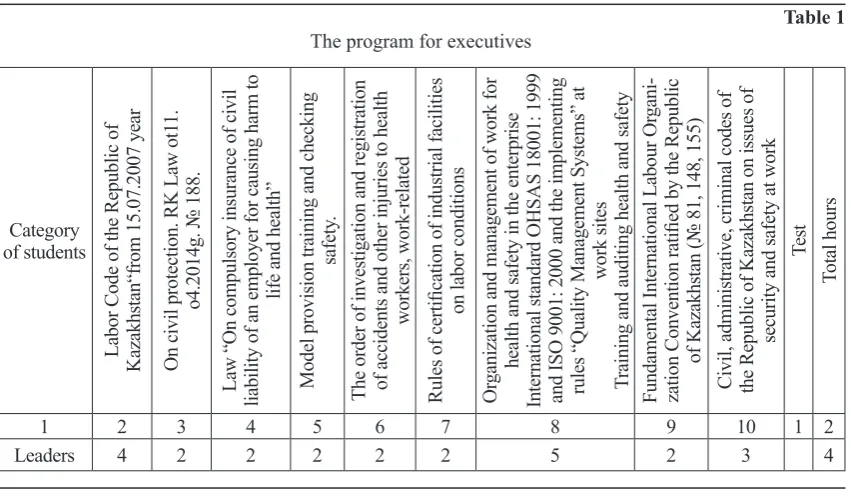
based on the analysis of training programs and advanced training should be for production man-agers, the main part of the program is to study the
laws of the Republic of Kazakhstan in the field of
occupational health and safety, and for engineers and technical workers – the emphasis in education should be directed to the study of the basic rules of work on the health and safety of various techno-logical processes. for working specialties proposed program includes at its core regulations and stand-ards necessary for the direct reference works and maintenance of equipment in the workplace.
Based on the basic qualification requirements
for specialists of different levels, it is recommended to install the following durations:
1. the executive staff – search and implemen-tation of solutions appropriate for the formation and functioning of technological systems for
monitor-ing and maintainmonitor-ing the efficiency of the enterprise
in a safe condition – 24 hours (table 1);
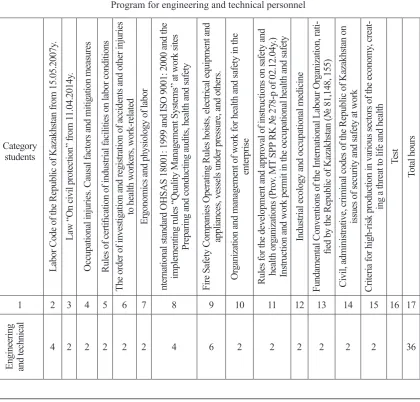
2. mid-level professionals (itr) – the use of methods of organization of the process to ensure its
safety and efficacy – 36 hours (Table 2);
3. worker – the use of safe practices and com-pliance with technological procedures in operations to ensure adequate behavior in normal and abnor-mal situations – 24 hours (table 3).
Training programs to improve the skills of specialists in the field of health and safety
Table 1 the program for executives
category of students
labor
code of the
republic of
k
azakhstan“from 15.07.2007 year on civil protection.
rk
l
aw ot1
1.
o4.2014g. №
188.
law “
o
n compulsory insurance of civil
liability of an employer for causing harm to
life and health”
m
odel provision training and checking
safety
.
the order of investigation and registration of accidents and other injuries to health
workers, work-related
Rules of certification of industrial facilities
on labor conditions
o
rganization and management of work for health and safety in the enterprise
international standard
o
HS
a
S 18001: 1999
and
iS
o
9001: 2000 and the implementing
rules “Quality
m
anagement Systems” at
work sites
training and auditing health and safety fundamental
international
labour
o
rgani
-zation Convention ratified by the Republic
of Kazakhstan (№
81, 148, 155)
civil, administrative, criminal codes of the republic of
k
azakhstan on issues of
security and safety at work
test
total hours
1 2 3 4 5 6 7 8 9 10 1 2
60
Pedagogical sciences
Table 2 program for engineering and technical personnel
category students
labor
code of the
republic of
k
azakhstan from 15.05.2007y
.
law “
o
n civil protection” from 1
1.04.2014y
.
o
ccupational injuries.
causal factors and mitigation measures
Rules of certification of industrial facilities on labor conditi
ons
the order of investigation and registration of accidents and other injuries
to health workers, work-related
er
gonomics and physiology of labor
nternational standard
o
HS
a
S 18001: 1999 and
iS
o
9001: 2000 and the
implementing rules “Quality
m
anagement Systems” at work sites
preparing and conducting audits, health and safety
fire Safety
companies
o
perating
rules hoists, electrical equipment and
appliances, vessels under pressure, and others.
o
rganization and management of work for health and safety in the
enterprise
rules for the development and approval of instructions on safety and health or
ganizations (Prov
. MT
SPP
RK №
278-p of 02.12.04y
.)
instruction and work permit in the occupational health and safety
industrial ecology and occupational medicine
fundamental
conventions of the
international
labour
o
rganization, rati
-fied by the Republic of Kazakhstan (№
81,148, 155)
civil, administrative, criminal codes of the
republic of
k
azakhstan on
issues of security and safety at work
criteria for high-risk production in various sectors of the economy
, creat
-ing a threat to life and health
test
total hours
1 2 3 4 5 6 7 8 9 10 11 12 13 14 15 16 17
engineering and technical
4 2 2 2 2 2 4 6 2 2 2 2 2 2 36
Table 3 program for working specialties
category students
the technical operation and technical safety rules when operating equipment guidelines and standards for businesses of workers
(in the field)
fire safety enterprises
first medical care, in dif
fer
-ent occupational injuries and
drowning
industrial hygiene and occupa
-tional health foundations
m
aximum permissible sanitary norms and levels (
mpc
, rc
)
concept of systems standards безопасно
сти т
ру
да (ССБ
Т)
w
orking clothes, shoes and
other personal protective equip
-ment
technological documents
(passports, industrial projects,
technological maps)
test
total hours:
1 2 3 4 5 6 7 8 9 10 11
o
61
Pedagogical sciences
working curricula training of workers should
take into account the specifics of the company,
which employs a work of the profession and
pro-vide for verification of knowledge on safe methods
of work in the amount of instructions, related to their employment duties.
it is advisable to refresher training for manag-ers gro introduction of new forms of education,
computer technology, the intensification of the ed -ucational process. at the same time must be used active forms of employment: discussion seminars,
business games, training and protection of final works on specific and relevant to the business is -sues. in the future, it is desirable introduction of individual training programs and distance learning.
the quality of teaching in educational
institu-tions provided by the presence of highly qualified
personnel. this requires refresher training for man-agers as lecturers to attract leading scientists from universities and research institutes with a degree of not less than phd and leading industry experts.
Assessment of the quality of education. as-sessment of the quality of education is desirable to perform testing. traditional test is a formal method of assessing the level of preparedness of attestation.
Subjects may be issued sheets of paper with printed tests. testing can be used as a means of
cur-rent, topical and final control.
During the final control testing is desirable to use as the primary stage of certification, and the fi -nal decision taken after an additio-nal interview with the attestation, which allows determining the level
of qualification of the expert.
in the present effective control test, this
objec-tively reflects the knowledge test.
Study of the evolution of forms of employment of executives and specialists in various sectors of the economy of kazakhstan shows that health and safety is an objective necessity that stems from the very nature of man, his biological structure, general and social character of modern production.
Health and safety, as an organic component of industrial and other human activities, reaches its general goal – the creation of favorable and safe working conditions, going two ways – constant im-provement and development of both production and the people themselves.
type of labor determines what methods and means should be used to effectively achieve the general objectives of the production activities. means of labor are thus real element of labor pro-tection economics, development and improvement of which occur on the upward trajectory. therefore, the nature of the impact on the results of production safety, comfort and safety are its intense reserves.
mechanization, automation (robotics) and computerization of production processes accompa-nied by a further decline in physical effort of man with the steady growth of the role and importance of his intellectual effort. in this context, the problem of control, regulation and control of technological
processes in manufacturing are privileges and value all the time increases, and employment rights is be-coming increasingly creative and innovative.
Conclusion. after analyzing the training and professional development of existing training cent-ers developed recommendations on the need for specialist training courses for the three main cate-gories of employees: management, engineering and technical personnel, and working specialty.
the optimal training programs for the three cat-egories of employees for the purpose of uniformity in conducting training and retraining of specialists
in the field of health and safety at the specialized
courses.
References
1. message from the president of the republic of kazakh-stan nursultan nazarbayev to the people of kazakhkazakh-stan: ka-zakhstan on the way of accelerated economic, social and political
modernization // Industrial Karaganda № 23 from 22.02.2005.
2. the bologna declaration: on the european region of higher education. – bologna: italian media, 1999. – 141 p.
3. The Lisbon Convention: On the Recognition of Qualifi -cations concerning Higher education in the european region. – lisbon: portuguese media, 1997. – 112 p.
4. fundamentals of credit system of education in kazakh-stan / S.b. abyganparova, g.k. akhmetov, S.r. ibatullin et al. – almaty: kazakh university, 2004. – 184 p.
5. education: law of the republic of kazakhstan. – al-maty: lawyer, 2002. – 172 p.
6. Zotov b.i. life safety on proizvodstve. – m.: kolos c 2004-314 with. labor code of the republic of kazakhstan dated
15.05.2007 year № 251-III.
7. the law “on civil protection in the republic of
kazakh-stan” of 11042014y. № 188-V.
8. rules and dates of training, coaching and testing knowledge on occupational health and safety of workers from
28.10.2011 year. № 1225.
9. the labour code of the republic of kazakhstan dated
15.05.2007 year № 251-III.
10. Rules of mandatory recertification production facilities in terms of labor from 05 years 8.12.2011 № 1457.
Scientific Conference “Research Graduate
School in priority areas of science and technology”, Switzerland, 27 april–03 may 2015, came to the
editorial office оn 22.03.2015.
pedagogical concept For tHe MUSICIAN-PERFORMERS LEARNING IN THE ENvIRONMENT OF
INFORMATION-EdUCATIONAL MOBILITY 1vorfolomeyeva o., 2wirth j.
1West Kazakhstan State University named after
M. Utemisov, e-mail: [email protected];
2Nizza University, e-mail: [email protected]