Original Research Article
An assessment of utilization of postnatal care services
in urban area Jabalpur district
Dhruvendra Pandey
1, Priyanka Meshram
2*, Arvind Sharma
1, Rajesh Tiwari
1, P. K. Kasar
1INTRODUCTION
Globally, over 500,000 women die around child birth every year, with over 90% of the deaths occurring in the developing countries, most of the deaths occur during or immediately after childbirth.1,2 Postnatal period is a six-week interval between birth of a new born and the return of the reproductive organs to their normal non-pregnant state.3 The timing of postnatal care is also crucial to the well-being of the mother and baby. The studies have shown that some 50% of maternal deaths and 40% of
neonatal deaths occur within 24 hours after birth, also known as the ‘immediate postnatal period’.1,4
WHO recommends that women, who have delivered in a health facility, should receive PNC for at least 24 hours after birth. If a birth is at home, the first postnatal contact should be as early as possible within 24 hours of birth. Three additional PNC contacts are recommended on day 3, between days 7–14 after birth and 6 weeks after birth.1 There are few data on early postnatal care specifically. Still, many women who give birth in facilities, are
ABSTRACT
Background: Postnatal period is a vulnerable time, because most maternal and new born deaths occur during this period, especially immediately after childbirth. Postnatal care in the first hours and days after childbirth could prevent the great majority of these deaths. The objective of study was to assess the utilization of post-natal care and associated factors for low utilization in urban area of Jabalpur district.
Methods: A community based cross-sectional study was carried 360 mothers who delivered in last one year in urban area of Jabalpur district. Sampling method was multistage sampling method. A total 36 wards with 10 mothers from each ward was selected. The questionnaire included information related to mode of delivery, post-natal checkups and visits of health care providers.
Results: Among 360 mothers, 93.9% mothers received first postnatal check-up within 24 hrs. 1.11% of mothers between 2-3 days and 1.67% of mothers received first postnatal check-up between 4-7 days while 3.33% of mothers didn’t receive any postnatal check-up. Regarding number of post-natal visits, 58.33% mothers received 3 or more postnatal visits, 35% of mother received 2 PNC visits, while 3.3% did not receive a single postnatal visit. The education of mothers, joint type of family, high socioeconomic status, early registration of pregnancy, minimum 4 ANC visits and institutional deliveries were found significantly associated with utilization of postnatal check-up.
Conclusions: Utilization of postnatal services is still poor in the urban areas even though the physical accessibility was adequate. In the present study, it was concluded that the role of education, especially of female education, is important contributing factor associated with utilization of postnatal care.
Keywords: Post natal care, Urban, Maternal and child health, Urbanization, ANC service
Department of Community Medicine, 1Government Medical College, 2N.S.C.B. Medical College, Jabalpur, Ratlam,
Madhya Pradesh, India
Received: 14 July 2019
Accepted: 02 August 2019
*Correspondence:
Dr. Priyanka Meshram,
E-mail: [email protected]
Copyright: © the author(s), publisher and licensee Medip Academy. This is an open-access article distributed under the terms of the Creative Commons Attribution Non-Commercial License, which permits unrestricted non-commercial use, distribution, and reproduction in any medium, provided the original work is properly cited.
discharged within hours after childbirth, without any indication about where they can obtain further care or support. Postnatal care utilization has been limited in south Asia, particularly in India.5-8 According to 2015–16 National Family Health Survey (NFHS-4), in urban area only 71.7% mothers received postnatal care from within 2 days of delivery, while children who received a health check after birth are very low i.e. 27.2%.9
Utilization of postnatal care can be affected by large number of factors including socio-demographic factors, economic factors, accessibility and availability of maternal and child health services etc.3 Understanding the factors that influence care-seeking behavior for postpartum services in India is vital to improve quality of care and designing appropriate interventions. Our study tried to elucidate these factors in the urban area of Jabalpur district. The principal objective of study was to assess the utilization of post-natal services and factors influencing utilization of health services.
METHODS
This was a community based cross-sectional study carried out in urban area of Jabalpur district from March 2016 to July 2017. Study population comprised mothers who delivered in last six months, and residing in urban area of Jabalpur district. The sample size was calculated by using the formula n=Z2pq/d2 (where Z=1.96 at 95% confidence; p= prevalence of post-natal check-up (PNC) utilization; q=1-p; d=absolute error), according to NFHS 4 data of urban area Jabalpur district mothers who received postnatal care from a doctor/nurse/LHV/ANM/ midwife/other health personnel within 2 days of delivery (66.7%).9 Taking this value as prevalence (p=66.7) Q becomes 33.3, with 5% absolute error sample size comes
out 355 and rounded up to 360. So, final sample size becomes 360.
Sampling was done by multistage sampling method, in first step out of total 87 wards of Jabalpur city 36 wards are selected by two-digit random number table. List of recently delivered women from these wards are collected from anganwadis in these wards and from this list 10 mothers from each ward are selected by systemic sampling method. The criteria for adequate postnatal service utilization was set by doing minimum 3 PNC visits.
Data were collected by interview, using pretested structured questionnaire, after obtaining informed consent from mother. Data analyzed using Statistical Package for Social Sciences (SPSS, version 20). Significance was set at the value of p<0.05.
RESULTS
This community-based study covered 360 recently delivered females. Out of total 360 mothers, maximum
i.e. 55.56% were in the age group of 20-25 years.Nearly
8.89% of the mothers were illiterate, while maximum i.e. 40.28% were educated up to middle school certificate, 77.5% of the mothers were house wives, and 94.44% were Hindus, about 74.72% were from joint family. Majority of the mothers (46.11%) had husbands educated up to middle school, while 4.17% were illiterate, majority 51.39% were semiskilled worker, while 1.11% were unemployed. Maximum mother 47.5% belonged to lower middle class according to Kuppuswami socioeconomic classification. 37.5% were primi-mothers, 62.5% were multi para out of which maximum mother 47.5% had second order of delivery (Table 1).
Table 1: Socio demographic characteristics of postnatal mothers.
Variables Characteristics Number of women Percentage (%)
Age of mother (in years)
<20 16 4.44
20 -25 200 55.56
26-30 101 28.06
>30 43 11.94
Education of women
Illiterate 32 8.89
Primary school certificate 17 4.72
Middle school certificate 145 40.28
High school certificate 76 21.11
Intermediate or post high school diploma 61 16.94
Graduate or post graduate 29 8.06
Occupation of women
Housewives 279 77.5
Unskilled worker 35 9.72
Semiskilled worker 29 8.06
Skilled worker 2 0.56
Clerical, shop owner farmer 15 4.17
Type of family Nuclear 91 25.28
Joint 269 74.72
Variables Characteristics Number of women Percentage (%)
Religion
Hindu 340 94.44
Muslim 10 2.78
Sikh 1 0.28
Christian 5 1.39
Jain 2 0.56
Others* 2 0.56
Education of husband
Illiterate 15 4.17
Primary school certificate 21 5.83
Middle school certificate 166 46.11
High school certificate (158) 87 24.17
Intermediate or post high school diploma 47 13.06
Graduate or post graduate 24 6.67
Occupation of husband
Unemployed 4 1.11
Unskilled worker 80 22.22
Semiskilled worker 185 51.39
Skilled worker 23 6.39
Clerical, shop owner, farmer 55 15.28
Semi-profession 11 3.06
Profession 2 0.56
Kuppuswamy’s socioeconomic score
Upper class 26-29 0 0
Upper middle class16 -25 15 4.17
Lower middle class15 -11 110 30.56
Upper lower class 5 to 10 234 65
Lower class<5 1 0.28
Order of delivery
First 135 37.5
Second 171 47.5
Third 37 10.28
Fourth 17 4.72
Table 2: Details of utilization of post-natal services (n=360).
Variables Characteristics Number of mothers Percentage (%)
First PNC service
Never 12 3.33
Within 24 hours 338 93.89
Between 2-3 days 4 1.11
Between 4-7 days 6 1.67
Number of postnatal services
Never 12 3.33
1 postnatal visit 12 3.33
2 postnatal visits 126 35
≥3 postnatal visits 210 58.33
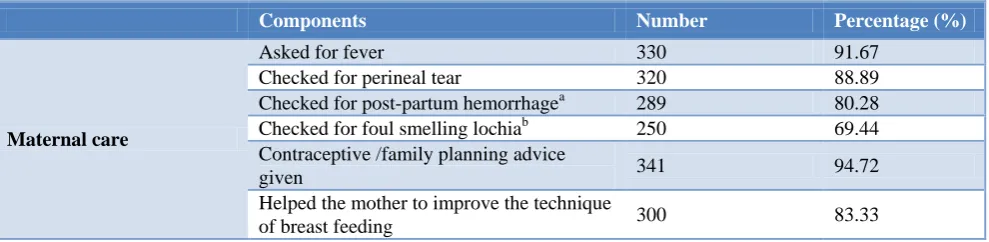
Table 3: Distribution of mothers according to components of post-natal services.
Components Number Percentage (%)
Maternal care
Asked for fever 330 91.67
Checked for perineal tear 320 88.89
Checked for post-partum hemorrhagea 289 80.28
Checked for foul smelling lochiab 250 69.44
Contraceptive /family planning advice
given 341 94.72
Helped the mother to improve the technique
of breast feeding 300 83.33
Components Number Percentage (%)
Neonatal care
Weight measured 344 95.56
Checked for condition of cord 200 55.56
General well-beingc 208 57.78
Advice given for exclusive breast feeding 328 91.11
Advice given for Immunization of new born 309 85.83
Demonstrated how to keep baby warmd 323 89.72
a: Checked and respond if the pad soaked in less than five minute; b: checked perineum for tears, discharge or pus; c: assess for movements, muscle tone, swelling/bruises at the presenting part, congenital malformations; d: demonstrate how to keep baby in skin-to-skin contact.
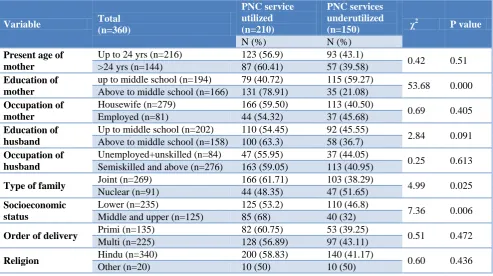
Table 4: Association of socio-demographic profile of women with postnatal services utilization.
Variable Total
(n=360)
PNC service utilized (n=210)
PNC services underutilized
(n=150) χ
2
P value
N (%) N (%)
Present age of mother
Up to 24 yrs (n=216) 123 (56.9) 93 (43.1)
0.42 0.51
>24 yrs (n=144) 87 (60.41) 57 (39.58)
Education of mother
up to middle school (n=194) 79 (40.72) 115 (59.27)
53.68 0.000
Above to middle school (n=166) 131 (78.91) 35 (21.08)
Occupation of mother
Housewife (n=279) 166 (59.50) 113 (40.50)
0.69 0.405
Employed (n=81) 44 (54.32) 37 (45.68)
Education of husband
Up to middle school (n=202) 110 (54.45) 92 (45.55)
2.84 0.091
Above to middle school (n=158) 100 (63.3) 58 (36.7)
Occupation of husband
Unemployed+unskilled (n=84) 47 (55.95) 37 (44.05)
0.25 0.613
Semiskilled and above (n=276) 163 (59.05) 113 (40.95)
Type of family Joint (n=269) 166 (61.71) 103 (38.29) 4.99 0.025
Nuclear (n=91) 44 (48.35) 47 (51.65)
Socioeconomic status
Lower (n=235) 125 (53.2) 110 (46.8)
7.36 0.006
Middle and upper (n=125) 85 (68) 40 (32)
Order of delivery Primi (n=135) 82 (60.75) 53 (39.25) 0.51 0.472
Multi (n=225) 128 (56.89) 97 (43.11)
Religion Hindu (n=340) 200 (58.83) 140 (41.17) 0.60 0.436
Other (n=20) 10 (50) 10 (50)
Table 5: Association of components of antenatal care services and place of delivery with postnatal services utilization.
Variables Total
(n=360)
PNC service utilized (n=210)
PNC services underutilized
(n=150) χ
2
P value
N (%) N (%)
Time of registration
Early, within 12 weeks (n=184) 127 (69.02) 57 (30.98)
17.69 0.000
Late, after 12 weeks (n=176) 83 (47.15) 93 (52.85)
ANC visits ≥4 (n=214) 146 (68.22) 68 (31.78) 21.37 0.000
<4 (n=146) 64 (43.83) 82 (56.17)
ANC service utilization
Utilized (n=84) 74 (88.09) 10 (11.91)
39.92 0.00
Underutilized (n=276) 136 (49.27) 140 (50.73)
Place of delivery Institutional (n=339) 203 (59.88) 136 (40.12) 5.73 0.016
Home (n=21) 7 (33.33) 14 (6.67)
The study showed that 5.84% were delivered in home. The reason behind the non-institutional delivery was didn’t have enough time in 42.86%, it’s a tradition in 33.33 and lack of transport facility in 9.52%. Assessment
between 2-3 days and 1.67% of mothers received first postnatal checkup between 4-7 days while 3.33% of mothers didn’t receive any post-natal check-up (Table 2).
In 91.67% of mothers’ health were asked for fever and advice for contraceptive and family planning was given to 94.22% mothers. On physical examination perineal tear were checked in 88.89% women, for postpartum haemorrhage in 80.28%, checked for foul smelling lochia in 69.44%. Health workers were provided help for improvement of breast-feeding technique in 83.33% of mothers. Regarding coverage of neonatal care in postnatal care weight was measured in 95.56% of newborns, while condition of cord was assessed in
55.56%, general wellbeing including congenital
malformations were checked in 57.78%, advice for exclusive breast feeding in 91.11%, advice for immunization of baby is given to 85.83% and demonstrated how to keep baby warm in 89.72% of mother (Table 3).
Factors which were significantly associated with PNC services utilization were education of mother, type of family, high socioeconomic status, early registration of pregnancy, minimum 4 ANC visits, ANC services utilization and institutional delivery, while no significant association was found between PNC services utilization with age of mother, age at marriage, age at first pregnancy, education of husband, occupation of mother and husband (Table 4).
DISCUSSION
This study showed that 339 (94.16%) mother were delivered in health facility while 21 (5.84%) mothers were delivered in home. This is quite comparable with NFHS 4 fact sheet reported that percentage of institutional deliveries was 88.7% in urban area, 93.8% in Madhya Pradesh, 92.3% in Jabalpur district.9 This percentage was quite comparable with some other studies. (Parineeta et al, Gundbowdi et al, Roy et al, Joshi et al, Meshram II et al) but this was opposite of study of Khan et al this was mainly due to regional variation and study conducted in slum population.10-15 Out of these 21 home deliveries, only 4 were attended by trained birth attendant. This is similar to NFHS 4, out of total home deliveries, 3% of deliveries were conducted by skilled health personnel.9
In this study 93.3% mother received PNC care within 24 hours this was similar to finding of Annual Health Survey
MP 12-13 16 which reported that 75.5% and Khanal et al
reported that 40.9% mothers received immediate postnatal care.17 According to Sharma et al, 67.6% received first postnatal care within 24 hours of delivery.18 Thus, percentage of mothers receiving immediate postnatal care is far more in present study than that reported by other studies.16-18
In urban area 58.33% mothers received 3 or more post-natal visits, while 3.3% did not receive a single postpost-natal visit. Study of Uppadhaya et al observed that out of 198 mothers, only 71 (35.86%) received 2 or more postnatal care visits within 42 days of delivery while Kotresh et al quoted that 53.3% mothers received postnatal care and 46.7% mothers didn’t receive any postnatal care.19,20
Pahwa et al postnatal care was sought by 33% of the women.21 Joshi et al found that 61.7% women attended postnatal visits.13 According to Sharma et al (36.6%) received one postnatal check-up, (18.5%) two, (14.7%) three and only (1.9%) received four post natal check-ups.18 (28.1%) didn’t receive any post natal check-up. Bhaisare et al reported that out of 28 mothers, 4 received 2 postnatal visits, while remaining 24 received only one visit.22 Gundbowdi et al found that 34.81% women received 4 or more PNC visits.11 Khanal et al observed that 43.2% attended postnatal care within the first six weeks of birth.17 Parineeta et alfound that 80.7% women had three PNC visits at home.10 Hence, observations of our study are more or less consistent with that of Kotresh et aland Joshi et al.13,20 While, we found more percentage of mothers availing benefits of post-natal services than those found by other studies.12,15,17,18 However, Parineeta
et alreported more percentage of mothers who completed
3 postnatal visits than present study.10
The findings depict that advice for contraceptive and family planning is given to 94.26% of mothers. Help for improvement of breast-feeding technique is given to 83.33% of mothers. Weight was measured in 95.56% of newborns, while condition of cord and congenital malformations were checked in about 57.78%. This finding is quite similar of studies done in various part of India and all studies quoted that post-natal services are mainly of counselling of breast feeding, immunization and breast feeding.11,18,19,22
In this study, education of the mother was significantly related with PNC utilization. Observations of present study corresponds with the study of Khanal et al, Sharma et al and Uppadhyay et al reported significant association between education of mother and PNC services utilization.17-19 Study conducted by Paudel et alshowed that, the level of education of mother were strong explainers of for PNC service.23 Other studies also reported similar finding with level of education of mother and PNC utilization.24-27 So, the education of mother is a positive factor for utilization of postnatal care in our study, which is similar to study conducted in different parts of India, Nepal and Nigeria. Utilization of antenatal and delivery care services has positive impact on the use of PNC which is similar to different studies.17,28-30
the mother who delivered at home, Dhakal et al reported that the women, who delivered in the hospital, were ten times more likely to have received postnatal care than the
women who delivered at home.6,18 No significant
association in this study was found with variables like age of mother, order of delivery and occupation of husband like Sharma et al, Ranganath et al.18,25 This study was concentrated on women who were already registered in anganwadis. After taking particulars from the register, we went to their houses and filled the data. Hence, study is concentrated around the women who registered themselves with the anganwadi while those women taking services directly from government or private hospitals without going to the anganwadi were missed. As most of the anganwadis were situated near the slum areas, most of the women of high socioeconomic status may also be missed.
CONCLUSION
This study reiterated that inspire of mass availability of health facility and their physical accessibility in urban area the utilization of post-natal services was still poor. Factors which were significantly associated with PNC services utilization were education of mother, in joint type of family, women with high socioeconomic status, early registration of pregnancy, minimum 4 ANC visits, ANC services utilization and institutional delivery. Therefore, in the present study, it was concluded that the role of education, especially of female education, is important contributing factor associated with utilization of postnatal care.
Funding: No funding sources Conflict of interest: None declared
Ethical approval: The study was approved by the Institutional Ethics Committee
REFERENCES
1. World Health Organization. WHO technical
Consultation on postpartum and postnatal care. Maternal, newborn, child and adolescent health; Geneva: WHO; 2010. Available at: http://www. who.int/maternal_child_adolescent/documents/WH O_MPS_10_03/en/. Accessed on 3 June 2019.
2. The world health report 2005 – make every mother
and child count. World health report. 2005.
Available at: http://www.who.int/whr/2005/en/.
Accessed on 3 June 2019.
3. Fraser DM, Cooper MA, Nolte AGW. Myles
textbook for midwives African edition. 2nd edition. London: Elsevier; 2010.
4. Nabukera SK, Witte K, Muchunguzi C, Bajunirwe
F, Batwala V, Mulogo E, et al. Use of postpartum health services in rural Uganda: knowledge, attitude and barriers. J Community Health. 2006;31:84-93.
5. Sines E, Syed U, Wall S, Worley H. Postnatal care:
A critical opportunity to save mothers and
newborns. Washington DC: Population Reference Bureau, 2007.
6. Dhakal S, Chapman GN, Simkhada PP, van
Teijlingen ER, Stephens J, Raja AE. Utilization of postnatal care among rural women in Nepal. BMC Pregnancy Childbirth. 2007;7:1–9.
7. Iqbal Anwar ATM, Killewo J, Chowdhury MK,
Dasgupta SK. Bangladesh: inequalities in utilization of maternal health care services – evidence from MATLAB. HNP Discussion Paper. Washington, DC: The World Bank; 2004.
8. Halder AK, Saha UR, Kabir M. Inequalities in
reproductive healthare utilization: evidence from Bangladesh Demographic and Health Survey 2004. World Health Popul. 2007;9:48-63.
9. NFHS-4 (2015-2016) Madhya Pradesh: Jabalpur
Available at: http://rchiips.org/nfhs/FCT/MP/
Jabalpur.pdf. Accessed on 3 June 2019.
10. Parineeta M, Bedre R, Solanki H. A study of Ante Natal Care Service Utilization & Factors Affecting
Them in Rural Bidar, Karnataka. Hindu.
2014;35:61-40.
11. Gundbowdi KD, Angolkar M, Sah JK, Agre DH.
Maternal and child health care service utilization among the mothers of Ganebail PHC, Belagavi district, India. Int J Adv Res. 2015;3(7):117-25.
12. Roy MP, Mohan U, Singh SK, Singh VK,
Srivastava AK. Factors associated with the preference for delivery at the government hospitals in rural areas of Lucknow district in Uttar Pradesh. Indian J Public Health. 2013;57(4):268.
13. Joshi KP, Kushwah SS. An epidemiological study
of social factors associated with maternal mortality in a community development block of Madhya
Pradesh. Indian J Community Health.
2011;23(2):78-80.
14. Meshram II, Rao KM, Krishna KS, Venkaiah K,
Laxmaiah A, Brahmam GN. Predictors of ante-natal care, delivery and infant feeding practices among rural women in Madhya Pradesh, India. Int J Med Public Health. 2014;4(4):385-91.
15. Khan Z, Mehnaz S, Khalique N, Ansari MA,
Siddiqui AR. Poor perinatal care practices in urban slums: possible role of social mobilization networks. Indian J Community Med. 2009;34(2):102.
16. Annual Health Survey of MP, 2012-13,vital statistic
division, office of Registrar General and Census Commissioner, New Delhi; 2013.
17. Khanal V, Adhikari M, Karkee R, Gavidia T..
Factors associated with the utilisation of postnatal care services among the mothers of Nepal: analysis of Nepal Demographic and Health Survey 2011. BMC Women's Health. 2014;14:19.
18. Sharma A, Thakur PS, Kasar PK, Tiwari R, Sharma
R. Utilization of post natal care in tribal area of Madhya Pradesh, India: A community based cross-sectional study. Int J Med Sci Public Health. 2014;3(10):1266-71.
19. Uppadhaya SK, Bhansali S, Sivodia SK, Agrawal
Services in Rural Area of Western Rajasthan, India. National J Community Med. 2016;7(7):569-72.
20. Kotresh M, Kumar P. Determinants of Use of
Maternal Health Services in Rural Field Practice
Area of Basaveshwara Medical College,
Chitradurga: A Cross Sectional Study. J Prevent Med Holistic Health. 2015;1(2):59-66.
21. Pahwa P, Aditya S. Existing practices and barriers to access of MCH services–a case study of residential urban slums of district Mohali, Punjab, India. Global J Med Public Health. 2013;2(4):1-8
22. Bhaisare KA, Rao DH, Khakase GM. Study of
utilization of antenatal care services in tribal area of Thane district. Int J Reprod Contracept Obstet Gynecol. 2015;4(2):378-83.
23. Paudel DP, Nilgar B, Bhandankar M. Determinants
of postnatal maternity care service utilization in rural Belgaum of Karnataka, India: A community based cross-sectional study. Int J Med Public Health. 2014;4:96-101.
24. Bhattacherjee S, Datta S, Saha JB, Chakraborty M. Maternal Health Care Services Utilization in Tea Gardens of Darjeeling, India. J Basic Clin Reprod Sci. 2013;2:77-84.
25. Ranganath TS, Poornima CA. Study on utilization of maternal services in urban slums of Bangalore. Int J Basic Appl Med Sci. 2011;1:70-5.
26. Chimankar DA, Sahoo H. Factors influencing the
utilization of maternal health care services in Uttarakhand. J Ethno Med. 2011;5:209-16.
27. Rahman MM, Haque SE, Zahan MS. Factors
affecting the utilization of postpartum care among young mothers in Bangladesh. Health Soc Care Community. 2011;9:138-47.
28. Titaley CR, Hunter CL, Heywood P, Dibley MJ.
Why don’t some women attend antenatal and postnatal care services? a qualitative study of community members’ perspectives in Garut, Sukabumi and Ciamis districts of West Java Province, Indonesia. BMC Pregnancy Childbirth. 2010;10:61.
29. Onah HE, Ikeako LC, Iloabachie GC. Factors
associated with the use of maternity services in Enugu, southeastern Nigeria. Soc Sci Med. 2006;63:1870–8.
30. Chakraborty N, Islam MA, Chowdhury RI, Bari W.
Utilisation of postnatal care in Bangladesh: evidence from a longitudinal study. Health Soc Care Community. 2002;10:492–502.