http://www.ijcmph.com pISSN 2394-6032 | eISSN 2394-6040
Original Research Article
Patients’ knowledge of prescribed medication: a cross sectional study in
a tertiary care centre, Mumbai
Ashis Samuel John
1*, Kamaxi M. Bhate
2INTRODUCTION
A reasonable level of understanding by patient of the prescription given to them is essential for proper adherence to treatment schedule, which in turn is crucial for treatment success. Non-compliance with treatment schedule is one of the most important reasons for treatment failure, which causes wastage of health care resources.1 Non-adherence to treatment is considered by the World Health Organization as a major epidemiological problem, causing a significant number of
deaths, and aggravated diseases, particularly in underdeveloped countries.2 Causes of poor medication adherence includes patient-related factors such as lack of understanding of their disease, lack of involvement in treatment decision-making process, sub optimal medical literacy etc., physician related factors such as prescribing complex drug regimens, failing to explain prescription effectively, inadequately considering financial burden to the patient etc., and also health system related factors that limit the patients’ access to care.3
ABSTRACT
Background: Inadequate understanding by patients of medical prescription given to them adversely affects treatment
compliance; which can result in treatment failure and increase the incidence of adverse effects. The study site is a tertiary care hospital in a metropolitan city and the patients attending here are particularly vulnerable in this regard both due to the heavy patient load in the outpatient department and their low socioeconomic status.
Methods: This was a cross sectional study conducted in the pharmacy of K.E.M. Hospital, Mumbai over a period of 1
month. Study population included general outpatient department patients of the hospital. Patients were interviewed using a pre validated questionnaire and their knowledge of the prescription analysed under five key aspects including dose, timing, duration, side effects and purpose of each drug. Data was entered using Microsoft Excel and analyzed using SPSS 22 software.
Results: The mean age of the population was 37.6, with a standard deviation of 12.4. A good overall knowledge of
the prescription was present only in 12.4% patients. In 52% of patients, the level of knowledge ranged from ‘no knowledge to little knowledge’. Age and literacy had statistically significant associations with overall knowledge of prescription.
Conclusions: There is a significant gap in prescription knowledge in the study population. Age and literacy of the patient has an effect on prescription knowledge.
Keywords: Prescription knowledge, Treatment compliance, Medication adherence
1
Indian Council of Medical Research, New Delhi, India.
2Department of Community Medicine, Seth Gordhandas Sunderdas Medical College and King Edward Memorial
Hospital, Mumbai, Maharashtra, India
Received: 02 September 2019
Revised: 17 September 2019
Accepted: 18 September 2019
*Correspondence: Dr. Ashis Samuel John, E-mail: [email protected]
Copyright: © the author(s), publisher and licensee Medip Academy. This is an open-access article distributed under
the terms of the Creative Commons Attribution Non-Commercial License, which permits unrestricted non-commercial use, distribution, and reproduction in any medium, provided the original work is properly cited.
Doctors in public hospitals of India, being overburdened with patients, are seldom able to dedicate sufficient time to educate the patients about their prescription. Also, its common knowledge that guidelines for writing medical prescriptions so that they become clear to the patients are rarely followed effectively.4,5 Hence, verbal instructions by pharmacists are most often the only source of prescription-related information to the patient.
The general outpatient department (OPD) of K.E.M. Hospital, Mumbai, managed by the Department of Community Medicine, has a daily footfall of around 275 patients who are tended to by a team of 10 doctors in a span of four hours.6 As a result, the time available for educating the patient regarding prescription is very limited both at the doctors’ end and at the pharmacist’s end. The hospital caters to a patient base which consists pre-dominantly of low socioeconomic status individuals, who are more at risk for inadequate understanding of the prescription.
The aim of the study was to assess the level of knowledge of patients regarding the name, dosage, purpose and side effects of drug prescribed to them in the OPD and to understand the factors that determine the level of knowledge.
METHODS
General OPD of K.E.M. Hospital, Mumbai had a general OPD attendance of 82900 in the year 2016 with an
average of 275 patients on each working day. There were 25 OPD working days in the month of study, bringing the population size to 6875. A sample size of 145 was obtained, assuming prevalence of knowledge as 30%, at an allowable error of 15% of prevalence.
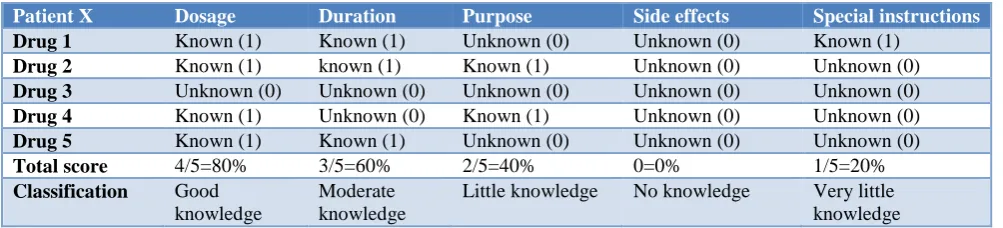
Six general OPD patients were chosen randomly every day and interviewed after they collected prescribed drugs from the pharmacy. Patients’ knowledge regarding each drug prescribed to them was assessed under five main aspects: Doses per day, Duration of regimen, Purpose of each drug, Side effect of each drug and Special instructions if any. For each aspect of each drug, 1 point was given for correct response and 0 points for incorrect response. Percentage scores in each aspect were calculated. For example, if patient gave correct response regarding the dose of 3 out of 5 drugs in the prescription, knowledge regarding dosage was calculated to be 60%. Based on this score, for each aspect mentioned, patients were categorized into five classes, such as: 0%- no Knowledge, 1-25%- very little knowledge, 26-50%- little knowledge, 51-75%- moderate knowledge and >75%- good knowledge.
In addition, overall knowledge of patients regarding prescription was calculated by taking mean of percentage knowledge in each aspect. Table 1 shows the method of calculation of overall knowledge.
Table 1: Calculation of level of knowledge of prescription.
Patient X Dosage Duration Purpose Side effects Special instructions
Drug 1 Known (1) Known (1) Unknown (0) Unknown (0) Known (1)
Drug 2 Known (1) known (1) Known (1) Unknown (0) Unknown (0)
Drug 3 Unknown (0) Unknown (0) Unknown (0) Unknown (0) Unknown (0)
Drug 4 Known (1) Unknown (0) Known (1) Unknown (0) Unknown (0)
Drug 5 Known (1) Known (1) Unknown (0) Unknown (0) Unknown (0)
Total score 4/5=80% 3/5=60% 2/5=40% 0=0% 1/5=20%
Classification Good
knowledge
Moderate knowledge
Little knowledge No knowledge Very little knowledge
Statistical analysis
Data was entered using Microsoft Excel software and analysed using SPSS 22. Percentages, means and standard deviations were used to describe the sample. Man-Whitney U-test was used as a test of significance for factors affecting level of knowledge of prescription.
RESULTS
The age of the sample population varied from 18 to 64, with a mean of 37.6 and standard deviation of 12.4. There were 90 (62.1%) males and 55 (37.9%) females in the sample.
Mean years of schooling was 8.95 with a standard deviation of 5.08. Educational status of the patients is given in Table 2.
Table 2: Educational status of patients.
Status Number %
Illiterate 28 19.3
Middle school 4 2.8
High school 51 35.2
Secondary 32 22.1
Graduate 30 20.7
Overall knowledge of prescription and source of prescription related information
Only 16% of the patients received any prescription related information from the doctor. Pharmacist was the only source of information for the remaining patients. A good overall knowledge of the prescription was present only in 12.4% while in 52% of patients, the level of knowledge ranged from no knowledge to little knowledge (Table 3).
Table 3: Overall knowledge of prescription.
Level of knowledge Number %
No knowledge 8 5.5
Very little knowledge 26 17.9
Little knowledge 44 30.3
Moderate knowledge 49 33.8
Good knowledge 18 12.4
Total 145 100
Level of knowledge for each aspect of prescription
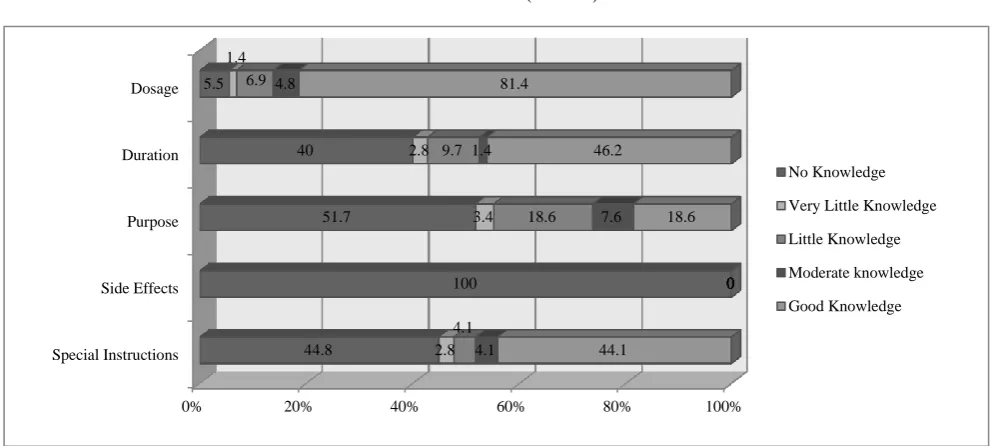
More than 80% of the patients had good knowledge regarding dosage of the drugs given to them, 46% regarding duration of treatment, 44% regarding special instructions and only 18% regarding purpose of each drug in the prescription. None of the patients had any knowledge about the potential side effects of drugs given to them (Figure 1).
Factors affecting prescription knowledge
It was found that age more than 50 (Man Whitney value- 1.189; p=0.07) has a statistically significant association with the overall knowledge of prescription. Illiteracy (Man Whitney value- 1.129; p=0.008) is another factor which had significant effect on prescription knowledge. Number of drugs in the prescription, sex of the patient or patients’ and English literacy did not have a statistically significant effect on overall prescription knowledge (Table 4).
Figure 1: Level of knowledge of each aspect of prescription.
Table 4: Factors affecting level of knowledge of prescription.
Factor Categorization N Man-Whitney U value Significance
Age (years) <50 115 1.189 0.007
>50 30
Sex Male 90 2.312 0.490
Female 55
Education Illiterate 28 1.129 0.008
Literate 117
Working knowledge in English
Yes 43
1.794 0.072
No 102
No. of drugs in Prescription
<3 68
2.186 0.76
>3 77
0% 20% 40% 60% 80% 100%
Special Instructions Side Effects Purpose Duration Dosage
44.8
100 51.7
40 5.5
2.8
0 3.4
2.8 1.4
4.1
0 18.6
9.7 6.9
4.1
0 7.6
1.4 4.8
44.1
0 18.6 46.2
81.4
DISCUSSION
The study shows that doctors in general do not devote adequate time for educating the patient about their prescription, as only 16% of patients received any prescription related information from their doctor. This could be attributed to the unfavourable doctor-patient ratio and also lack of awareness among the doctors regarding the necessity of patient education.
Patients were found to be severely lacking in overall knowledge of prescription, with only 12.4% classified as having a good overall knowledge. More than half of the patients had no or little overall knowledge of prescription. This raises serious concerns about the effectiveness of treatment. In comparison, in a study done by Raharinjatovo et al, 14% patients reported that they did not understand the content of the prescription and 32% were unaware of the treatment objectives.7 Another study by Davis et al showed that 18.9% patients failed to correctly identify their medications and 46.3% misunderstood one or more of the prescription label instructions.8
With regards to the individual aspects of prescription, wide variation was observed in knowledge of each aspect. While majority of patients were found to have good knowledge regarding the dosage of drugs given to them, less than half the patients had good knowledge regarding the duration of treatment. This can cause serious problems such as antibiotic resistance when the patient fails to complete the course, and increased incidence of adverse effects when the patient extends the course beyond physician recommended duration. Knowledge of special instructions regarding prescription such as timing of intake in relation to food was also found to be inadequate, raising further concerns about reduced treatment efficacy. Only one patient out of five was aware about the purpose of each drug in the prescription, which is a necessary knowledge in the case of anti-emetics and analgesics that are to be taken based on symptomatic need. None of the patients had any knowledge about the potential side effects of drugs given to them. In a study by Davis et al, out of the incorrect responses given by patients about their prescription, the majority (51.8%) of incorrect responses reflected an error in dosage (that is, tablespoon vs. teaspoon), and 28.2% stated the wrong dose frequency (that is, “one tablet each day for seven days” instead of “take one tablet by mouth twice daily for seven days”).8
Age more than 50 years and illiteracy was found to adversely affect the overall knowledge of prescription. However, patient’s gender, English knowledge or the number of drugs in the prescription did not have a significant effect. This is in line with the study by Raharinjatovo et al, which found a negative correlation between illiteracy and understanding of prescription.7 A study by Kalichman et al on health literacy and
significant association with medication adherence.9 In contrast, Marvanova et al found that male gender and increase in number of pre-admission medications reduces the odds of medication understanding by patients while the current study did not find a significant association between these variables.10 Another study by Edelberg et al found that understanding of prescription was inversely related to age, but found no such association with gender or level of education.11
CONCLUSION
There is a significant gap in prescription knowledge in the study population at a level that can adversely affect treatment outcomes. Doctors and pharmacists have to ensure that adequate time is spent on educating the patient about the relevant aspects of the prescription given to them. Elderly and illiterate patients require special attention in this regard. Guidelines for prescription writing such as use of capital letters and avoidance of compound writing need to be implemented strictly. Use of colour and shape differentiation of tablets so that laypersons are able to easily identify drugs and their strengths should be considered.
ACKNOWLEDGEMENTS
We would like to thank Dr. R.R. Shinde, Seth G.S.M.C and K.E.M Hospital, Mumbai, Dr. Rujuta Hadaye, Seth G.S.M.C and K.E.M Hospital, Mumbai, Dr. Yuvraj B. Chouhan, Seth G.S.M.C and K.E.M. Hospital, Mumbai.
Funding: No funding sources Conflict of interest: None declared
Ethical approval: The study was approved by the DRB, Department of Community Medicine, Seth G.S.M.C and K.E.M. Hospital, Parel, Mumbai
REFERENCES
1. Lenahan J, Mccarthy DM, Davis TC, Curtis LM, Serper M, Wolf MS. A Drug by Any Other Name: Patients’ Ability to Identify Medication Regimens and Its Association with Adherence and Health Outcomes. J Health Commun. 2013;18:31–9. 2. Adherence to long term therapies. Evidence for
action. WHO. 2003.
3. Brown MT, Bussell JK. Medication Adherence: WHO Cares? Mayo Clin Proc. 2011;86(4):304–14. 4. Bindu S. Now Doctors Have To Write Prescription
in Capital Letters. The Hindu (Delhi edition). 2015. Available at: thehindu.com/news/cities/Delhi/now-doctors-have-to-write-prescription-in-capital-letters/ article7303882.ece. Accessed on 10 September 2019.
5. Smith PD, Sharp S. Health Literacy and Prescribing: It Is Time to Change Old Habits. Am Fam Physician. 2013;87(11):755-6.
uploads/2016/04/KEM_AR_2016_Final-1.pdf. Accessed on 10 September 2019.
7. Raharinjatovo L, Ralandison S. Therapeutic Compliance and Understanding of Medication Prescriptions by Malagasy Patients. Med Sante Trop. 2015;25(1):82-6.
8. Davis TC, Wolf MS, Bass PT, Thompson JA, Tilson HH, Neuberger H, et al. Literacy and Misunderstanding Prescription Drug Labels. Ann Intern Med. 2006;145(12):887-94.
9. Kalichman SC, Ramachandran B, Catz S. Adherence to Combination Antiretroviral Therapies in HIV patients of Low Health Literacy. J Gen Intern Med. 1999;14:267-73.
10. Marvanova M, Roumie CL, Eden SK, Cawthon C, Schnipper JL, Kripalani S. Health Literacy and Medication Understanding Among Hospitalized Adults. J Hosp Med. 2011;6(9):488-93.
11. Edelberg HL, Shallenberger E, Wei JY. Medication Management Capacity in Highly Functioning Community-Living Older Adults: Detection of Early Deficits. JAGS. 1999;47:592-6.
Cite this article as: John AS, Bhate KM. Patients’
knowledge of prescribed medication: a cross sectional study in a tertiary care centre, Mumbai. Int J