Original Research Article
Seroprevalence and determinants of hepatitis B viral status in
pregnant women attending antenatal clinics in an urban community
of Oyo state, South-West Nigeria
Ajibola Idowu
1*, Oluseyi Kikelomo Israel
1, Ayodele Olatayo Aremu
1,
Adebowale Femi Akinwumi
2INTRODUCTION
Viral hepatitis is one of the emerging epidemics of public health significance worldwide. They are known causes of both acute and chronic infections with varied degree of liver and other complications. Of all the viral agents, hepatitis B virus (HBV) is responsible for majority of the liver morbidity and mortality worldwide. In fact, it is
estimated that 44% of cirrhotic liver disease and 47% of hepatocellular carcinoma cases in Sub Saharan Africa are attributable to HBV.1 Currently, about 257 million people are estimated to be living with HBV globally. In 2015 alone, HBV resulted in 8,87,000 deaths worldwide. In terms of regional distributions, HBV is found to be more prevalent in Western Pacific and The African Sub-regions of the World Health Organization (WHO), where
ABSTRACT
Background: The burden of hepatitis B virus (HBV) is assuming an epidemic proportion globally, causing grave hepatic and other complications. Mother-to-child transmission is one of the main ways of acquiring the disease. It is thus incumbent on researchers to delve more into the epidemiology of HBV. The objectives of this study is to assess respondents’ knowledge on HBV, estimated the burden of the disease among pregnant women attending antennal clinics in Ogbomoso, Nigeria and identified significant determinants of HBV positive status of the participants.
Methods: This facility-based cross-sectional study was conducted among 168 pregnant women recruited using systematic random technique. Pretested interviewer-administered, semi-structured questionnaire was used for data collection. Both descriptive and inferential statistics were carried out.
Results: Mean age of the respondents was 34±10 years, 90.5% of the respondents were 20-40 years old. HBV awareness level among the respondents was 51.8% and more than half (59.5%) of them possessed poor knowledge of the virus. Twelve percent (12.0%) of the respondents were seropositive for hepatitis B surface antigen (HBsAg). Significant determinants of HBsAg positivity were; Level of education (AOR=0.11, CI=1.56-3.47), Socio-economic class (AOR=3.23, CI=1.48-3.02) and family type (AOR=4.51, CI=0.19-0.35).
Conclusions: The burden of HBV was high among pregnant women in the study population. Awareness and knowledge of the respondent was low. Authors recommend aggressive awareness campaigns on the disease. Improving the socio-economic conditions of women will go a long way in reducing the scourge of this dreadful disease in Nigeria.
Keywords: Hepatitis B virus, Knowledge, Vaccination, Hepatitis B surface antigen, Pregnant women, Nigeria
1Department of Medicine, Bowen University Teaching Hospital, Ogbomoso, Nigeria
2Department of Community Health, Ekiti State University Teaching Hospital, Ado-Ekiti, Nigeria
Received: 09 August 2019
Accepted: 10 September 2019
*Correspondence:
Dr. Ajibola Idowu,
E-mail: [email protected]
Copyright: © the author(s), publisher and licensee Medip Academy. This is an open-access article distributed under the terms of the Creative Commons Attribution Non-Commercial License, which permits unrestricted non-commercial use, distribution, and reproduction in any medium, provided the original work is properly cited.
6.2% and 6.1% respectively of the adults are currently infected.2 About 5–15% of adults in sub-Saharan Africa are estimated to be chronically infected with HBV.3
As far back as 2004, a study conducted by Ezegbudo et al.4 in Anambra Nigeria shown that the prevalence of HBV infection in pregnant women was as high as 9.3% while the prevalence of 4.3% was reported in Port-Harcourt among pregnant women by Hou et al, in 2005.5 In 2008, Luka et al, reported a prevalence rate of 8.3% among pregnant women in Zaria, Nigeria.6 The scenario is not different in other parts of West African sub region as seroprevalence of 8%–16.2% has been reported in the region in 2012 by Mamadou et al.7 Also, more recent Nigerian studies estimated the prevalence of 11.6% among blood donors and pregnant women in Maiduguri by Adebola et al and 10.5% among pregnant women in Lagos by Atilola et al in 2018.8,9
HBV transmission occur both vertically and horizontally. Vertical transmission occurs when the virus is transmitted from mother to the child during pregnancy or delivery while horizontal transmission occurs through exposure to infected bloods and body fluids. Common human activities responsible for increasing burden of HBV include, engaging in risky sexual practices, unsafe injection practices among health workers, reuse of needles by intravenous drug abusers. Infection can also occur from surgical and dental procedures as well as tattooing and piercing procedures.
Vaccination with the monovalent HBV vaccine was introduced in Nigeria in 2004 as part of the National Program on Immunization, to be given at 6, 10, and 14 weeks of age. However, in 2012, a pentavalent vaccine comprising diphtheria, tetanus, pertussis, HBV, and Haemophilic influenza type B was introduced. Yet, HBV immunization coverage is still not adequate in Nigeria despite its availability. Currently, hepatitis B vaccine coverage in Nigeria is about 41%.10,11 Also, awareness and knowledge of most Nigerians have been low regardless of its grave complications. It is thus imperative to identify and contextualize the factors which might influence the burden of HBV among pregnant women in Ogbomoso.
This study sought to expand the existing body of scientific knowledge in relation to HBV in the study location where there is currently paucity of relevant information on the occurrence of the disease among pregnant women.
METHODS
Study setting
The study was conducted among pregnant women receiving antenatal care in Ibrhaim Taiwo primary health centre, Ojaigbo, Ogbomoso North Local Government Area. It is a comprehensive health centre and serves as
referral centre to smaller primary health centres within the LGA. The facility renders services covering all areas of maternal and child health services. Antenatal and immunization clinics are the busiest of all the clinics in the health facility. Antenatal clinic runs twice a week with clinic attendance of about 50 clients. Pregnant women are routinely screened for many diseases including HBV during booking after proper health education and counselling has been given to them.
Sample size determination
Using fisher’s formula, a minimum sample size was estimated for the study. Considering the result of a similar study conducted among pregnant women in Lagos by Atilola et al, 10.5% of our study participants were assumed to be HBV positive.9 Tolerable margin of error was set at 5% and a non-response rate of 10% was envisaged among the respondents and corrected for. A cluster factor of 1.2 was used and a minimum sample size of 166 was estimated for the study.
Sampling method
A systematic random technique was utilized to recruit study participants from May to June, 2019. Sampling interval was calculated by dividing the estimated sample size by daily clinic attendance. Thus a sampling interval of three was used. The first participant in a typical clinic day was chosen by simple random method (balloting) while every third pregnant women were selected until the estimated sample size was reached.
Data collection instrument and method
A pretested self-administered, semi-structured
questionnaire was used for data collection. The questionnaire collected information on the
socio-demographic characteristics of respondents, their
awareness and knowledge of HBV infection and their HBV status. The questionnaire was written in simple English language and was interpreted to Yoruba language for easy understanding of those who preferred to be interviewed in their local language. Back translation to English language was done to preserve the original meanings of the questions. Ten medical students were trained on questionnaire administration and helped in data collection.
Data analysis
Data collected were edited daily so as to ensure that all
the required items on the questionnaire were
appropriately answered. Data entry and analysis were done using Statistical Package for Social Sciences (SPSS) version 21.0. Descriptive statistics were carried out and Chi-square test was used to compare categorical variables. A stepwise binary logistic regression model was built at the multivariate level to identify significant predictors of HBV status among the respondents at 95% Confidence Interval and p<0.05. Variables imputed into the logistic model were selected based on whether they were statistically significant at the bi-variate level or whether they had been reported in previous studies as significant factors associated with HPV vaccination.
Ethical consideration
Ethical approval was obtained from the Ethical Review Committee of Bowen University Teaching Hospital, Ogbomoso. Written consents were obtained from the respondents at recruitment. Confidentiality was assured by making the questionnaires anonymous and by entering data collected in a pass worded computer accessible only to the principal investigators. All women who were hepatitis B surface antigen (HBsAg) positive were referred to Bowen University Teaching Hospital, Ogbomoso for further evaluation and possible treatment.
Measurements/key variables
Positive HBV status
The Rapid ResponseTM HBsAg test kit (BTNXINC) which
is a rapid, qualitative test for the detection of hepatitis B surface antigen in whole blood, serum and plasma was used on our respondents. The rapid test kit has 99.7% accuracy and uses lateral flow immunoassay method. The
kit has a box for the sample and a second box for the buffer (control). Whole bloods of respondents were used and results were read after 15 minutes. Positive results were indicated with appearance of two lines on the kit, one line indicated negative result while appearance of no line (in both sample and control boxes) suggested invalid results.
Knowledge on HBV
Ten questions were asked on HBV. Each correct answer attracted one point while incorrect answers attracted zero (0) point. Summation of scores obtained by each respondent was made and converted to percentages (ranging from 0 to 100%). Respondents who scored less than 50% were classified as having poor knowledge, those who scored 50-69.9% were categorized as having fair knowledge while those who scored at least 60% were categorized as having good knowledge.
RESULTS
A total of 180 questionnaires were administered but 168 were satisfactorily completed by the respondents (response rate=93.3%). Mean age of the respondents was 34±10 years. Majority (90.5%) of the respondents were within 20-40 years age category. More than half (54.8%) had tertiary education, 83.3% were Christians, 94.6% had 1-4 pregnancies before the survey while all of them had 1-4 living children (Table 1).
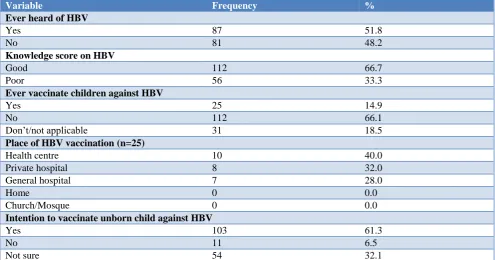
HBV awareness level among the respondents was 51.8% and more than half (59.5%) of them possessed poor knowledge of the virus. Only 14.9% of the respondents had vaccinated their youngest children against HBV; 40% of such women had their children immunized at the healthcare centre. However, 61.3% of the respondents indicated interests in obtaining HBV vaccine for their unborn children (Table 2).
Table 1: Socio-demographic characteristics of respondents.
Variable Frequency %
Age (in years)
≤30 94 56.0
≥31 74 44.0
Mean age (in years) 34±10
Educational level
No formal education 2 1.2
Primary 7 4.2
Secondary 67 39.9
Tertiary 92 54.8
Socio-economic status
High 87 51.8
Low 81 48.2
Religion
Christianity 140 83.3
Islam 28 16.7
Variable Frequency %
Family type
Monogamous 150 89.3
Polygamous 18 10.7
Number of pregnancies ever had
1-4 159 94.6
≥4 9 5.4
Number of living children
1–3 164 97.6
≥4 4 2.4
Table 2: Awareness, knowledge and practice of HBV and vaccination among respondents.
Variable Frequency %
Ever heard of HBV
Yes 87 51.8
No 81 48.2
Knowledge score on HBV
Good 112 66.7
Poor 56 33.3
Ever vaccinate children against HBV
Yes 25 14.9
No 112 66.1
Don’t/not applicable 31 18.5
Place of HBV vaccination (n=25)
Health centre 10 40.0
Private hospital 8 32.0
General hospital 7 28.0
Home 0 0.0
Church/Mosque 0 0.0
Intention to vaccinate unborn child against HBV
Yes 103 61.3
No 11 6.5
Not sure 54 32.1
Table 3: Determinants of HBV status among respondents.
Variable HBsAg status Total χ2 Pvalue AOR 95% CI
Positive, N (%) Negative, N (%) Educational level
Secondary and below (RC) 11 (14.5) 65 (85.5) 76
0.494y 0.042* 0.11 1.56–3.47
Tertiary 10 (10.9) 82 (89.1) 92
Socio-economic status
High (RC) 10 (11.5) 77 (88.5) 87
0.167 0.002* 3.23 1.48–3.02
Low 11 (13.6) 70 (86.4) 81
Family type
Monogamous 17 (11.3) 133 (88.7) 150
0.889y 0.001* 4.51 0.19–0.35
Polygamous 4 (22.2) 14 (77.8) 18
Number of pregnancies ever had
1-4 18 (11.3) 141 (88.7) 159
2.029 0.154 0.34 0.12–0.94
≥4 3 (33.3) 6 (66.7) 9
Ever heard of HBV
Yes 14 (16.1) 73 (83.9) 87
2.129 0.145 1.86 0.79–4.38
No 7 (8.6) 74 (91.4) 81
Knowledge score on HBV
Good 9 (16.1) 47 (83.9) 56
0.980 0.322 0.63 0.24–1.59
Poor 12 (10.7) 100 (89.3) 112
From Figure 1, 21 (12.0%) of the respondents were seropositive for HBSAg. In Table 3, respondents with higher educational achievements were significantly less likely to have HBV seropositive status compared to those with lower educational status (AOR=0.11, CI=1.56-3.47). Moreover, those in the lower socio-economic class were three times more likely to be hepatitis B seropositive compared to those in higher socio-economic class (AOR=3.23, CI=1.48-3.02). Also, respondents in polygamous family settings were five times more likely to be positive of hepatitis B (AOR=4.51, CI=0.19-0.35).
Figure 1: HBV status of the respondents.
DISCUSSION
This study was conducted to assess knowledge and burden of HBV among pregnant women in Ogbomoso. It shows that awareness of HBV was low among the respondents and majority of them possessed poor knowledge of the virus. These findings are in consonance with results from similar studies in Ghana,South Sudan and in Nigeria.8,9,12,13 Since awareness and good knowledge is of paramount importance to the health seeking behaviour of people and ultimately to uptake of health related interventions and programmes by them; it is vital to commence aggressive awareness campaigns against HBV. Information on prevention of HBV should be one of the key points to be emphasised during antenatal clinic sessions.
The current study has revealed high burden of HBV (12.0%) among the study participants. This finding is in tandem with what had been reported in similar studies. For instance, the prevalence of HBV in pregnant women has been estimated to be as high as 10.2% in the Northern region of Cameroon, 11.8% in Uganda, and 8.3% in a resource-poor community of Nigeria.14-16 Also, a prevalence of 8.2% was reported by Olokoba et al, in a similar study in Yola, Nigeria.17 Meanwhile, some studies had reported lower prevalence of HBV among pregnant women.18-20 The disparity in figures could have been due to differences in the socio-demographic characteristics of the respondents in the respective study settings. The high
prevalence of HBV as revealed in the current study and many others portent an emerging public health challenge which requires urgent and concerted efforts from both governmental and non-governmental health agencies to stem the rising tide. This is because of many complications which are associated with chronic infectivity in the mother and high risk of mother-to-child transmission of the virus. There is an urgent need to embark on voluntary counselling and testing of HBV in the general population and among all pregnant women in particular. Training and re-training programmes for health workers on how to prevent mother-to-child transmission of HBV should be developed as a matter of urgency. The existing policy on HBV prevention and control should be reviewed, properly harnessed and efficiently implemented by the Nigerian government.
Identified determinants of HBV status in the current study included having low educational or socio-economic status and belonging to polygamous family settings. Ngaira et al, identified family type as one of key variables influencing HBV prevalence in Nairobi Kenya while hepatitis viral status was significantly influenced by employment and educational status among pregnant women in Mayotte Island, India.21,22 There is need for the Nigerian government to improve the socio-economic conditions of Nigerian women. For example, a well-educated woman is expected to have a better access to information regarding prevention of HBV. She also has increased chance of being employed, thus would be better empowered to access needed healthcare services. Authors thus recommend intensified action towards girl-child education in Nigeria.
Study limitation
This was a single institutional study; it may be difficult to generalize its findings on entire pregnant women in Nigeria. However, a robust sampling method was employed in recruiting study participants to increase the external validity of the study.
CONCLUSION
Awareness of study participants was low and their knowledge on HBV infection was predominantly poor. The burden of the disease was high in the study population. There is urgent need for a radical approach to reduce HBV infection among Nigerian pregnant women.
ACKNOWLEDGEMENTS
Authors wish to acknowledge all the medical students who volunteered to assist in data collection.
Funding: No funding sources Conflict of interest: None declared
Ethical approval: The study was approved by the Institutional Ethics Committee
21, 12%
147, 88%
REFERENCES
1. Perz JF, Armstrong GL, Farrington LA, Hutin YJ, Bell BP. The contributions of hepatitis B virus and hepatitis C virus infections to cirrhosis and primary liver cancer worldwide. J Hepatol. 2006;45:529-38. 2. World Health Organization: Fact sheet. Available
at: http://www.who.int/news-room/fact-sheet/detail/ hepatitis-b. Accessed on 30 July 2019.
3. WHO Hepatitis B. 2014. Available at: http://www who.inf/inf-s/en/fact204.html. Accessed on 30 July 2019.
4. Ezegbudo CN, Agbonlahor DE, Nwobu GO, Igwe
CU, Agba MI, Okpala HO. The Sero-prevalence of
Hepatitis B surface antigen and Human
Immunodeficiency Virus (HIV) among pregnant women in Anambra State. Shiraz E-Medical J. 2004,5(2):1-8.
5. Hou J, Liu Z, Gu F. Epidemiology and prevention of
Hepatitis B virus infection. Int J Med Sci. 2005;2:50-7.
6. Luka SA, Ibrahim MB, Iliya SN. Seroprevalence of
hepatitis B surface antigen among pregnant women attending Ahmadu Bello University Teaching Hospital Zaria. Nigerian J Parasitol. 2008;29:38–41.
7. Mamadou S, Ide M, Maazou AR, Aoula B, Labo S,
Bozari M. HIV infection and hepatitis B seroprevalence among antenatal clinic attendees in Niger, West Africa. HIV AIDS (Auckl). 2012;4:1-4.
8. Adebola TO, Akin O, Balogun MS, Ajudua A,
Nguku P, et al. Seroprevalence of Hepatitis B infection in Nigeria: A national survey. Am J Trop Med Hygiene. 2016;95:902-7.
9. Atilola G, Obadara T, Randle M, Komolafe IO, Odutola G, Olomu J, et al. Epidemiolgy of Hepatitis B virus in pregnant women, South West Nigeria. J Epidemiol Global Health. 2018;8(3-4):115-23.
10. Odusanya OO. Hepatitis B virus vaccine: The
Nigeria Story. J Obafemi Awolowo Univ Med Student's Association (IFEMED). 2008;14(1):4-5
11. Omotowo IB, Meka IA, Ijioma UN, Okoli VE,
Obienu O, Nwagha T, et al. Uptake of Hepatitis B vaccination and its determinants among healthcare workers in a tertiary health facility in Enugu, South East Nigeria. BMC Infectious diseases. 2018. Available at: http://doi.org/10.1186/s12879-018-3191-9. Accessed on 30 July 2019.
12. Adade RB. Prevalence of Hepatitis B Among
Pregnant Women in Ghana. 2016. Available at: http://197.255.68.203/handle/123456789/21775. Accessed on 30 July 2019.
13. Kirbak ALS, Zipporah N, Omolo J, Idris H, Usman
A, Mbabazi WB. Sero-prevalence for Hepatitis B virus among pregnant women attending antenatal clinic in Juba Teaching Hospital, Republic of South Sudan. Pan African Med J. 2017;26:72.
14. Noubiap JJN, Nansseu JRN, Ndoula ST, Bigna JJR,
Jingi AM, Fokom-Domgue J. Prevalence, infectivity and correlates of hepatitis B virus infection among pregnant women in a rural district of the Far North Region of Cameroon. BMC Public Health. 2015;15(1):454.
15. Bayo P, Ochola E, Oleo C, Mwaka AD. High
prevalence of hepatitis B virus infection among pregnant women attending antenatal care: a cross-sectional study in two hospitals in northern Uganda. BMJ Open. 2014;4(11):e005889.
16. Eke AC, Eke UA, Okafor CI, Ezebialu IU, Ogbuagu
C. Prevalence, correlates and pattern of hepatitis B surface antigen in a low resource setting. Virol J. 2011;8:12.
17. Olokoba AB, Salawu FK, Danburam A, Olokoba
LB, Midala JK, Badung LH, et al. Hepatitis B virus infection amongst pregnant women in North-Eastern Nigeria- A call for action. Nigerian J Clin Prac. 2011;14:10-3
18. Eyong EM, Yankam BM, Seraphine E, Ngwa CH,
Nkfusai NC, Anye CS, et al. The prevalence of HBsAg, knowledge and practice of hepatitis B prevention among pregnant women in the Limbe and Muyuka health districts of the South West region of Cameroon: a three-year retrospective study. The Pan African Med J. 2019;32:122.
19. Obi RR, Umeh SC, Okurede OH, Iroagba II.
Prevalence of hepatitis B virus infection among pregnant women in an antenatal clinic in Port Harcourt, Nigeria. African Journal of Clinical and Experimental Microbiology. 2006;7(6):78-82.
20. Nongo BH, Agida TE, Oghenebuk U, Yunusa T.
Seroprevalence of hepatitis B virus among antenatal attendees at the University of Abuja Teaching Hospital, Nigeria. Ann Nigerian Med. 2016;10:58-62.
21. Ngaira JAM, Kimotho J, Mirigi I, Osman S,
Ng’ang’a Z, Lwembe R, et al. Prevalence, awareness and risk factors associated with Hepatitis B infection among pregnant women attending the antenatal clinic at Mbagathi District Hospital in Nairobi, Kenya. Pan African Med J. 2016;24:315.
22. Aindou M, Voirin N, Troalen D, Abaine A,
Chevallier-Queyron P, Ecochard R, et al. Socio-demographic and behavioural determinants of hepatitis B vaccination and infection in pregnant women on Mayotte Island, Indian Ocean. Vaccine. 2013;31(43):4946-52.
Cite this article as: Idowu A, Israel OK, Aremu AO, Akinwumi AF. Seroprevalence and determinants of