Original Research Article
Perception of parents of private school students on measles and rubella
vaccination campaign in Sambalpur town
Sanjeeb Kumar Mishra
1, Kulwant Lakra
1*, Durga Madhab Satapathy
2,
Sadhucharan Panda
1, Subrat Kumar Pradhan
2INTRODUCTION
Measles is a highly infectious disease that continues to kill many of our infants and young children, an estimated 2.5 million children every year are affected by measles and nearly 49 000 of them die.1 Rubella infection in pregnant women disables a child for life with congenital rubella syndrome (CRS) that may result in deafness, blindness and heart defects. The cases of CRS has steadily increased from a mere 23 cases in 2013 to about 754 cases in 2017 in South east Asia region.2 Africa, has
seen an increase of 700% up to date in 2019 as compared to the same period in 2018.3Europe has also seen a 300% increase in measles infection, with the German state of Brandenburg ordering mandatory vaccination at kindergartens.3 Congenital rubella syndrome leads to birth defects such as irreversible deafness and blindness in nearly 40 000 children every year.1 Measles and rubella (MR) immunization will directly contribute to the reduction of under-five child deaths and will prevent CRS in country population.4
ABSTRACT
Background: In order to eliminate measles and rubella (congenital rubella syndrome) WHO has emphasized on measles and rubella (MR) vaccination campaign and India launched the ambitious MR Campaign with the help of WHO and GAVI. In Odisha the MR campaign was launched on January 29 with a target to cover nearly 1.13 crore children. The objective of the present study is to assess the knowledge of parents regarding measles and rubella infection and to identify the source of information regarding MR campaign.
Methods: A cross-sectional study was conducted in Sambalpur City across 10 private schools during February 10 to March 12. Total 440 parents of children aged 5-15 years were given a questionnaire about socio-demographic characteristics, knowledge, attitudes, and behaviors towards MR Campaign. The data were collected subsequently in the next 10 days. Out of 440 parents 408 returned filled up questionnaire. Data were entered into and analyzed by using Microsoft Excel.
Results: Out of the 408 respondents 362 (88.7%) parents had knowledge about MR campaign. 156 respondents was aware about importance of rubella vaccine. Parent teacher meeting (PTM) was the leading source of information for these. 388 (95%) respondent’s children had received the vaccine during campaign.
Conclusions: Parent-teacher's meeting was the main source of information. However social mobilisation such as street play, miking, rallies by school children and NGOs etc., needs to be taken up for such campaigns in future.
Keywords: Universal immunization program, MR campaign, Congenital rubella syndrome
Department Of Community Medicine, 1VIMSAR, Burla, Sambalpur, 2MKCG Medical College, Berhampur, Odisha, India
Received: 07 June 2019 Revised: 19 July 2019 Accepted: 30 July 2019
*Correspondence: Dr. Kulwant Lakra,
E-mail: [email protected]
Copyright: © the author(s), publisher and licensee Medip Academy. This is an open-access article distributed under the terms of the Creative Commons Attribution Non-Commercial License, which permits unrestricted non-commercial use, distribution, and reproduction in any medium, provided the original work is properly cited.
The disease burden due to measles has reduced significantly after introduction of measles vaccine in1985.5 It has further been strengthened by introduction of 2nd dose of measles vaccine in the RI from 2010 onwards. WHO reports that vaccine-hesitant parents often find misinformation online, and engagement, listening and information provided by medical professionals are often the best ways to address concerns. Based on WHO recommendations a phased MR vaccination campaign is being introduced in all the states covering 9 month to <15 year old children and simultaneous introduction of MR vaccine in the national immunization schedule through UIP. MR vaccination campaign will target over 400 million children in 36 states and UTs in next two years.4
There is significant thrust on aggressive IEC activities for the success of both routine immunization and these special campaigns. For the phase 2 of this MR campaign IEC material has been developed like Handbook for health workers, ASHA, AWW, teachers, religious leaders, posters and banner for schools and community sessions site, IAP posters, leaflets and myth and fact booklets.1 The campaign also advocates for involvement of NGO in the planning as well as implementation phase.1 Measles-rubella vaccination campaign in Odisha has a target to cover nearly 1.13 crore children from the age of nine months to less than 15 years.
Perception of parents or guardians have a significant bearing in deciding the ultimate fate of the child especially vaccination. The present study was conducted among the parents of students from private schools of Sambalpur town with the objectives as to assess the knowledge of parents regarding measles and rubella infection and to identify the source of information regarding MR campaign. Our study is designed to address the key issues like knowledge about measles and rubella, MR campaign, information source and perception change due to that information. It also roughly estimates the coverage of immunization in these schools.
METHODS
Study design
A cross-sectional survey was conducted in Sambalpur city from 10 February 2018 to 12 March 2018.
Study setting
It was a school based survey. 10 private schools were randomly selected out of total 58 private schools where MR campaign had been completed.
Study participants
Parents of the students from class 1 to class 9th in these schools were the study participants. The principals of the schools was contacted and solicited for participation.
After the approval, in each school, 44 questionnaires were randomly distributed to students in these schools to be filled up by their parents.
Procedure
The complete list of schools were obtained from the District Education Office, were arranged alphabetically. The first school was chosen by lottery (from 1-10) then every fifth school was selected to get the 10 schools. In these schools the children were selected randomly by arranging them according to roll number and 4 students were selected from each class by lottery. One extra student was selected from 7th, 8th, 9th and 10th class to get the desired 44 participant. The children selected received an envelope randomly addressed to their parents. The envelope included a letter with information on the study objectives, a self-administered questionnaire. In the letter and at the beginning of the questionnaire, participants were assured of their privacy, that the survey was anonymous, and that the questionnaire responses were not linked with the participants’ identification. The letter also indicated that they received the questionnaire because their child was randomly selected in the school and they were given instructions to return the completed questionnaire to the school principal within three days. No incentives were offered for completion of the survey. Respondents were never contacted directly by the research team.
Variables and data measurement
A self-administered semi structured questionnaire was developed and pilot-tested among a convenience sample of 40 parents, who were interviewed to gain feedback on the overall acceptability of the questionnaire in terms of length, clarity, and question formats. The questionnaire had 16 questions. The initial 4 questions were regarding socio-demographic variables of the respondent (degree of education, occupation). The questions in the second section were about the knowledge about measles and rubella (CRS) and the MR campaign. The third section investigated towards the source of information of MR campaign and the vaccination status along any side effects with any missed school days following vaccination. At the very end participants were also asked about what they thought about the usefulness of this MR campaign.
Sample size
The minimum sample size required for the study was determined by using the formula
at 5%.6 It came out to be 392. To compensate the non-response rate, 10% of the determined sample was added up on the calculated sample size and the final sample size was rounded to 440.
Statistical analysis
Statistical analysis was done after thorough data cleaning with the help Microsoft Excel.
RESULTS
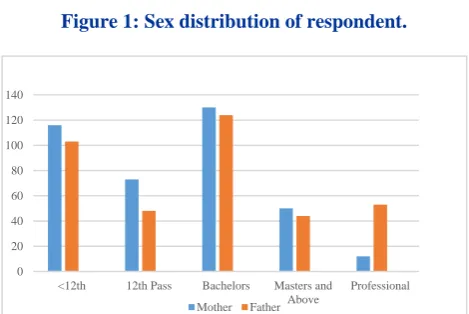
Out of the 440 questionnaire distributed 408 filled up questionnaire were returned. Out of these 408 mothers were respondent in 183 (44.9%) and rest 225 were answered by fathers. Out of 408, 124 (30.4%) fathers were having bachelor’s degree as compared to 130 (31.9%) mothers. 103 (25.3%) fathers had education bellow 12th class against 116 (28.4%) mothers. 44 fathers had master’s degree and 53 had professional degrees compared to 50 and 12 mothers respectively. In 27 cases there was no answer.
Figure 1: Sex distribution of respondent.
Figure 2: Educational qualification of parents.
Coming to occupation 110 fathers were in government service as against 21 mothers, 131 in private service against 33 mothers and 128 fathers were businessmen. 10 were skilled laborer were as 29 left it unanswered. 336 (82%) of mothers were housewives.
Table 1: Occupation of parents.
Occupation of father
Government service 110
Private service 131
Business 128
Skilled labor 10
No answer 29
Mothers occupation
Government service 21
Private service 33
Housewife 336
No answer 18
Table 2: Knowledge on MR campaign.
Out of the 408 respondents 362 (88.7%) parents had knowledge about MR vaccination campaign and 45 (11%) had no knowledge while one didn’t answer. 173 (42.4%) respondents answered both the diseases MR vaccine protects against correctly, while 87 respondents named one disease correctly. 156 respondents were aware about importance of rubella vaccine. Only 55 respondents had idea about the risks and adverse effects of rubella infection during pregnancy whereas about 332 parents were unaware about these consequences. Out of 408, 200 (49%) respondents had information about MR campaign from single source whereas 162 respondents from multiple sources. 287 parents reported that the information provided to them about the MR campaign changed their mindset in favor of vaccination in the campaign.
Parent teacher meeting (PTM) was the leading source of information for these. 238 reported information from PTM and 113 from school circular. 119 got information from print media/newspaper, 73 from TV advertisement, 69 from friends or relatives, 19 from poster/banners in public places and only 9 got information through FM, radio or miking.
0 20 40 60 80 100 120 140
<12th 12th Pass Bachelors Masters and Above
Professional Mother Father
Information changed mindset for vaccination 283
Knowledge of MR campaign
Yes 362
No 45
No answer 1
Source of information
Single source 200
Multiple source 162
PTM 238
School circular 113
Newspaper 119
TV addv 73
Poster/banner 19
FM/radio/miking 9
Friend/relative 69
55% 45%
0% 0%
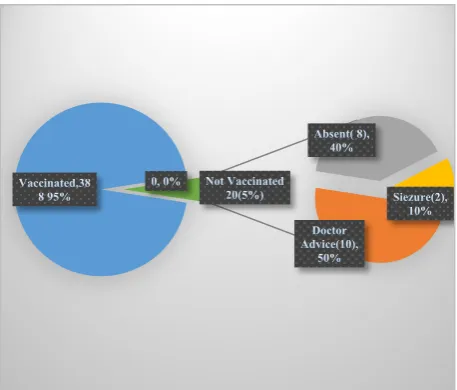
388 (95%) respondent’s children had received the vaccine during campaign and rest 20 didn’t. Out of these 20, 8 were absent during vaccination days, 2 were on treatment for epilepsy and rest 10 were advised against vaccination by their physicians as they had already been vaccinated. 19 students missed school following vaccination and 17 of them complained of pain and swelling for missing school, rest 2 reported fever as the cause for missing school following vaccination.
Figure 3: Vaccination coverage with illustration of reasons for not vaccinating.
249 respondents viewed the MR campaign as useful 41 reported it not useful in any way, rest 118 were undecided.
DISCUSSION
Mass vaccination campaigns are significant way to increase the vaccination coverage among the vulnerable groups. However the limitation of this strategy is that it is target oriented, time-limited and resource constrained.6 Therefore the aim of this study was to assess the knowledge of parents regarding measles and rubella infection, to identify the source of information regarding MR campaign, to address the key issues like knowledge about measles and rubella, MR campaign, information source and perception change due to that information and also to estimate the coverage of immunization in these schools.
Our study showed that most of the parents were well informed about the MR campaign and the benefits of this vaccination drive. Parent teacher meeting was the leading source of information for the parents followed by the circular issued by the school authorities. In the study conducted by Kumar et al parents received information mainly from the health workers (50%) and school authorities (43.3%).6 Queries and apprehensions resolved through the parent teacher meetings was one the important reasons for the 95% coverage of MR
vaccination in these schools. The policy of educational institutes being the campaign center for MR vaccination to the school children showed substantial irrefutable positive impact on vaccine coverage. The finding suggests that school-based campaign and delivery was more successful than the EPI center based campaign and delivery. 7
The non-vaccination rate in our study was 5% and one of the reasons being sickness of the child which was comparable to the finding of another study.8 In spite of WHO advisory for vaccination in already vaccinated child, physician advice against vaccination was the reason for not vaccinating the child in about 50% of unvaccinated child, which is higher than the 16.7% found by Kumar et all.6 This difference is may be due to the nature of study setting as their study was conducted in Urban slums where the access to healthcare is still a big challenge, in comparison our study participants belong to private schools with greater access to physicians. Absenteeism and current illness as a reason for not vaccinating was also found out in their study as a major deterrent to vaccination coverage.
Mass awareness to actuate people to immunize their child also served as an opportune to educate about measles and rubella, their dreaded complications and the benefits of MR campaign which served its purpose by making those people realize this as a second chance to immunize the child with both antigens who had only provided measles vaccination to their children previously.
CONCLUSION
The result of our study showed that campaign at school may serve as an ideal strategy for MR coverage with a target of 400 million children in 36 states and which may also strengthen the routine immunization in the community. Parent-teacher's meeting was the main source of information. However social mobilization as street play, public awareness miking, rallies by school children etc., needs to be taken for such campaigns in future. The role of local NGOs also plays a vital role in this process which wasn't found in the present study.
Funding: No funding sources Conflict of interest: None declared
Ethical approval: The study was approved by the Institutional Ethics Committee
REFERENCES
1. Singh PK, India’s measles-rubella vaccination campaign a big step towards reducing childhood mortality, addressing birth defects. WHO 2018 Available at http://www.searo.who.int/mediacentre/ features/2017/india-measles-rubella-vaccination-campaign/en. Accessed 15 December 2018.
2018, WHO 2018 Available at http://www.who.Int /immunization/monitoring_surveillance/data/gs_sear profile.pdf?ua=1. Accessed 17 December 2018. 3. National operational guidelines for introduction of
measles-rubella vaccine, Ministry of Health and Family Welfare, Government of India. Available at http://www.searo.who.int/india/topics/measles/meas les_rubella_vaccine_guidelines.pdf?ua=1. Accessed 17 December 2018.
4. Laharia C. A brief history of Vaccines and vaccination in India. Indian J Med Res. 2014;139(4):491-511.
5. Editorial, Measles eradication: a goal within reach, slipping away. Lancet. 2019;393(10182):1669. 6. Hajian-Tilaki K. Sample size estimation in
epidemiologic studies. Caspian J Intern Med. 2011;2(4): 289-98.
7. Kumar A, Pai DV, Chaudhary AS, Ramireddy M, Kamath A. Measles rubella campaign: coverage among slum children of Udupi municipality area in
Karnataka. Int J Community Med Public Health. 2018;5:3006-11.
8. Uddin J, Adhikary G, Ali W, Ahmed S, Odell C, Hashiguchi L, et al. Evaluation of impact of measles rubella campaign on vaccination coverage and routine immunization services in Bangladesh. BMC Infect Dis. 2016;16:411.
9. Bond L, Nolan T, Pattison P, Carlin J. Vaccine preventable diseases and immunisations: a qualitative study of mothers? Perceptions of severity, susceptibility, benefits and barriers. Aust N Z J Public Health. 1998;22(4):441-6.