This is an Open Access article licensed under a Creative Commons Attribution-NonCommercial-ShareAlike 4.0 International License (https://creativecommons.org/licenses/by-nc-sa/4.0/ ), which permits unrestricted Non Commercial use, distribution and reproduction in any medium, provided the original work is properly cited.
Published by Oriental Scientific Publishing Company © 2018
Textures and Intensity Histogram Based Retinal Image
Classification System Using Hybrid Colour Structure
Descriptor
A. JAYACHANDRAN
1and D.STALIN DAVID
21Department of CSE, PSN College of Engineering and Technology, Tirunelveli, India. 2Department of CSE, PSN College of Engineering and Technology, Tirunelveli, India.
*Corresponding author E-mail: [email protected]
http://dx.doi.org/10.13005/bpj/1410
(Received: May 03, 2017; accepted: March 21, 2018)
ABSTRACT
Medical image classiûcation system is widely used by the radiologists to segment the medical images into meaningful regions. Diabetic retinopathy is an ocular manifestation of diabetes, and diabetics are at a risk of loss of eyesight due to diabetic retinopathy. Diabetes being a blood-related phenomenon, causes vascular changes, which can often be detected visually by examining the retina, since the retina is well-irrigated by blood vessels. Worldwide, DR is a leading cause of blindness among working populations. DR is also the most frequent micro-vascular complication of diabetes. The eye is one of the first places where micro-vascular damage becomes apparent. Though diabetes is still incurable, treatments exist for DR, using laser surgery and glucose control routines. In this article, computer assisted, multi class lesion classification system using hybrid color image structure descriptor and pair of RBF kernel based SVM in retinal images is developed. It classifies the lesions in to Normal and abnormal classes.The overall classification accuracy of HCSID with HKSVM is 94%, HCSID with SVM is 90 % HCSID with RBF is 84% and HCSID with FFNN is 84%..
Keywords: Retinal images , Classification, Feature extraction, Texture, Neural Network.
INTRODUCTION
Medical images are used for investigation, education and research and hence its security is of vital importance. Therefore many authentication techniques have been proposed to protect the medical images. Medical images can be split into ROI and RONI portions. ROI is a key area in the medical image as it is used by doctors for investigation and treatment. Medical images are dissimilar in nature. Therefore ROI selection itself is a problem because ROI of different modalities disparate. Even ROIs of two head CT are unlike. There is also a possibility of having multiple ROIs
in an image. Therefore automatic feature detection methods could be useful in identifying ROI and RONI. Automated image segmentation shall also be to discriminate ROI and RONI. These tools have the advantage of minimising the task of manual inspection. Another advantage of automated tools is that there is no need to send the ROI vertices to the receiver as it is required by the receiver for
verification1-2.
progressive and irreversible damage to retinal
nerve fibers’ functionality. Funduscopic sign of the
retinalnerve fiber layer (RNFL) defect provides an early objective evidence of structural changes inglaucoma which is caused due to the loss of retinal ganglion cell axons3. Before the visualfield defect
begins, the ganglion cells have already sustained
a loss of about 50%4. Current imaging techniques
like optical coherence tomography (OCT), GDx offering RNFLD assessment are expensive and require careful interpretation by experts. Moreover, these imaging techniquesare not feasible solution for mass screening and routine checkup of glaucoma in peripheralsettings. In this regard, computer-aided lesion detection using retinal image provides apractical solution for efficient glaucoma risk assessment5-6.
Several studies have been reported in the literature that utilize data-driven approaches to sub-divide a given ROI into several functional subROIs. One approach is clustering based on features,
for example the Pearson’s pair-wise correlation between each voxel’s time course within the ROI
with that of other brain regions, and then a clustering algorithm is applied to divide the voxels into several sub-groups7-10. However, most clustering methods
require rigorous preprocessing and denoising steps to obtain spatially continuous results since they are very sensitive to outliers. Another approach, based on graph theory, is where each voxel within the ROI is rep-resented by a node in a graph. This graph is then divided into subROIs using modularity detection11
or a normalized cut approach12. Furthermore, the
robustness of the method highly depends on its optimization parameters and tuning the parameters is a challenging task. Therefore there is still a need for a complete framework for functional subROI parcellation that can incorporate both the inter-ROI and intra-ROI connectivity patterns while imposing spatial continuity for subROIs13. The rest of the
paper is organized as follows: Our proposed feature extraction technique is given in section 2 and feature
classification is given in section 3. The detailed
experimental results and discussions are given in section 4, while the conclusion is summarized in section 4.
Multi model feature extraction process
Diabetic retinopathy is an ocular manifestation of diabetes, and diabetics are at a
risk of loss of eyesight due to diabetic retinopathy. In our proposed feature extraction system consists of colour, structure and shape.The proposed method feature process consists of the following stages
Computing Feature vector H(V1)
In this work, original image is divided into 4, 18, and 24 grids. The grids are normally square in shape. Gridding results in smaller grids, so that the analysis can be performed easily, then the Feature vector is calculated for each intensity values 1 to 255of the original image.
Feature vector using orientation
Spatial Gray Level Dependence Matrix technique (SGLDM) is utilized in each ROI to extract second ordermeasurable texture features for the analysis[14]. This system is in light of the estimation of second order jointconditional likelihood density functions
Where angle (q) is varies from 0 to 180 degrees. Each P(i, j | d,è ) is the likelihood grid of two pixels which are placed with a inter test distance d and direction èhaving a gray level i to j. The calculated value for these likelihood density function is given by
where Ng is maximum grey level. In this technique, four gray level co-occurrence matrixes for four different directions are acquired for a given distance and the following five statistical texture features are computed for each gray level co-occurrence matrix. Finally, the features such as correlation ,homogeneity, contrast, energy and entropy are extracted and stored in the feature vector
H(V2).
Feature vector using TCM
Fig. 1 : Different shape of the texton for feature extraction
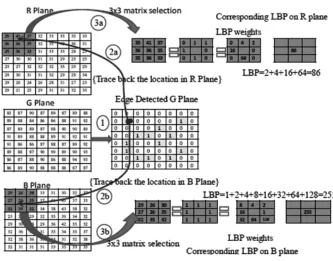
Fig. 2: Feature vector F(V4) calculation process image, co-occurrence matrix operation is performed
on the texton image to form the final feature vector
generation. Figure 1 illustrates the texton shapes which are considered
Then, the block count value is calculated for each intensity value (1-255) on this image. The
resultant feature vectorH V( )3 is obtained from the
micro structure image
Feature Vector H(V4) using RGB Plane
Table 1: Experimental results of the proposed and exiting system
Evaluation CSID+ CSID+ CSID + Our Proposed
metrics SVM RBF FFNN Approach
k1+k2 k1 k2
Input MRI True Positive(TP) 37 35 30 38 38
image data True Negative(TN) 8 7 6 9 9
set False Positive(FP) 2 3 4 1 1
False Negative(FN) 3 5 10 2 2
Sensitivity 0.925 0.875 0.75 0.95 0.95 Specificity 0.8 0.7 0.6 0.9 0.9 Accuracy 0.9 0.84 0.72 0.94 0.94
Fig. 3: Normal and abnormal retinal images
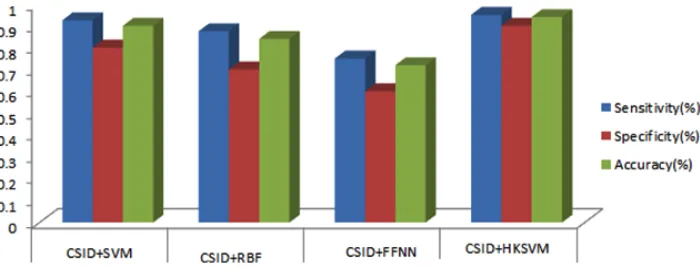
Fig. 4: Comparison results of CSID with SVM, RBF , FFNN and HKSVM the relationship of RGB plane of retinal image
calculation process is given in the following figure(2).
In this technique , the edge detection algorithm is applied in Green plane then the corresponding relationship of Red and Blue plane pixel values are in
a 3x3 matrix using various binary pattern , finally the feature vector H(V4) is calculated using histogram.
Concatenated of Four feature vectors
Finally the feature vector H(V1),H(V2), H(V3) and H(V4) are concatenated and generate a feature vector H(V)is used for feature classification. It is defined as follows
1 2 3 4
( )
( )
( )
( )
( )
H V
=
H V
+
H V
+
H V
+
H V
Feature classification
In our feature classification system, various
kernels functions are combined and to develop a
novel retinal image classification system using SVM.
It is a statistical classiûcation algorithm developed using structural risk minimization methods(15-16. It
classifies the data into two separate classes that
1/||w||. Maximizing the margin 1/||w|| is equivalent to minimizing ||w||2, whose solution is found after
resolving the following quadratic optimization problem:
By using the duality theory of optimization is
defined as follows
There are several kernel functions, and the generally used kernel functions are given as follows:
Linear kernel
( , ) (
T)
i i
k x x
=
x x
Polynomial kernel
( , ) ( (
T)
) ,
d0
i i
k x x
=
γ
x x
+
r
γ
>
RBF kernel
2
( , ) exp(
i i),
0
k x x
=
−
γ
x
−
x
γ
>
Sigmoid kernel
( , ) tanh( ( , )
T)
i i
k x x
=
γ
x x
+
r
where y, d, r ared kernel parameter for each kernel function
Experimental Results and Comparative analysis The experimental image data set contains 100 retinal images ( 80 images for abnormal and
the remaining 20 images for normal) that are collected from Government medical college hospital, Tirunelveli, Tamilnadu, India. The normal and abnormal image is shown in Fig 2.
The classification performance of our proposed system is evaluated using the following
metrics such as sensitivity,specificity and accuracy17.
The investigational results of CSID with
Hybrid SVM and other neural network based classifier are shown in Table 1 and the results are
visualized in Figure 3.
CONCLUSION
Manual segmentation results look better because it involves human intelligence but the disadvantage is that the results may differ from one person to another person and takes long time. A novel fully automatic , multi class image
classification approach using Color image hybrid
structure descriptor and pair of RBF kernel based SVM has been developed. In this research work ,Pair of RBF kernel functions are combined for
multi class retinal image classification. The overall classification accuracy of HCSID with HKSVM is 94%, HCSID with SVM is 90 % HCSID with RBF is 84% and HCSID with FFNN is 84%..
REFERENCES
1. Juuti-Uusitalo K, Delporte C, Grégoire F, Perret J, Huhtala H, Savolainen V,
et al. Aquaporin expressionand function in human pluripotent stem cell-derived retinal pigmented epithelial cells. Invest OphthalmolVis Sci.; 54: 3510–3519 (2013). 2. Schwartz SD, Hubschman J-P, Heilwell G,
Franco-Cardenas V, Pan CK, Ostrick RM,
et al. Embryonicstem cell trials for macular degeneration: a preliminary report. Lancet.; 379: 713–720 (2012).
3. Croze RH, Buchholz DE, Radeke MJ, Thi WJ, Hu Q, Coffey PJ, et al. ROCK Inhibition
cultures. InvestigOphthalmol Vis Sci.; 54: 6767–6778 (2013).
4. Jiang Y, Qi X, Chrenek M a, Gardner C, Boatright JH, Grossniklaus HE, et al.
Functional principal componentanalysis reveals discriminating categories of retinal pigment epithelial morphology in mice. Invest Ophthalmol Vis Sci.; 54: 7274–7283 (2013). 5. Vugler A, Carr A-J, Lawrence J, Chen LL,
Burrell K, Wright A, et al. Elucidating the phenomenon ofHESC-derived RPE: anatomy
of cell genesis, expansion and retinal transplantation. Exp Neurol.; 214: 347–361 (2008).
6. Nanni L, Lumini A, Brahnam S. Local binary patterns variants as texture descriptors for medical imageanalysis. ArtifIntell Med.; 49: 117–125 (2010).
7. Paci M, Nanni L, Lahti A, Aalto-Setala K, Hyttinen J, Severi S. Non-Binary Coding for
Texture Descriptorsin Sub-Cellular and Stem
Cell Image Classification. CurrBioinform.; 8:
208–219 (2013).
8. Vécsei A, Amann G, Hegenbart S, Liedlgruber M, Uhl A. Automated Marsh-like classification
of celiacdisease in children using local texture operators. ComputBiol Med.; 41: 313–325 (2011).
9. Nosaka R, Fukui K. HEp-2 cell classification
using rotation invariant co-occurrence among local binarypatterns. Pattern Recognit. Elsevier;; 47: 2428–2436 (2014).
10. Haralick R, Dinstein, Shanmugam K. Textural features for image classification. IEEE Trans Syst ManCybern. 1973; SMC-3: 610–621. 11. Hu S, Xu C, Guan W, Tang Y, Liu Y. Texture
feature extraction based on wavelet transform
and graylevelco-occurrence matrices applied to osteosarcoma diagnosis. Biomed Mater Eng.; 24: 129–143 (2014).
12. Jayachandran, A., Dhanasekaran, R.: Brain
tumor severity analysis using modified
multi-texton histogram and hybrid kernel SVM. Int. J. Imaging Syst. Technol. 24(1): 72–82 (2014).
13. Ojala T, Pietikäinen M, Mäenpää T. Multiresolution Gray-Scale and Rotation Invariant Texture Classificationwith Local Binary Patterns. IEEE Trans Pattern Anal Mach Intell. Los Alamitos, CA, USA: IEEEComputer Society; 2002; 24: 971–987. 14. Matsui M, Tashiro T, Matsumoto K, Yamamoto
S. A study on automatic and quantitative diagnosis of fundus photographs. I. Detection of contour line of retinal blood vessel images
oncolor fundus photographs (author’s
transl.). Nippon GankaGakkaiZasshi. 1973;
77(8):907–918.
15. B a u d o i n C E , L a y B J , K l e i n J C .
Automatic detection of microaneurysms in diabetic fluoresceinangiography. Rev EpidemiolSantePublique. 1984; 32(3– 4):254–261.
16. Sonka, M.; Hlavac, V.; Boyle, R. Image
Processing, Analysis, and Machine Vision. 3. Toronto,Canada: Thomson Engineering;
2008. (1st edition Chapman and Hall, London, 1993; 2nd editionPWS, Pacific Grove, CA, 1997).
17. Jayachandran, A., Dhanasekaran, R.: Severity analysis of brain tumor in MRI
images uses modified multi-texton structure