Original Research Article
Prevalence of social anxiety disorder and its determinants among
undergraduate medical students of East Delhi
Preeti, Parnava Das*
INTRODUCTION
Social anxiety disorder (SAD), is a common mental health disorder but is often under-diagnosed in early stage. As a result it leads to other comorbidities (generalized anxiety, depression, substance abuse etc.) detrimental to the health and well-being of an individual. If diagnosed and treated early, it can help the individual to lead a productive and fulfilling life. Diagnostic and statistical manual for mental disorders (DSM) V has classified social anxiety disorder (social phobia) under
anxiety disorders and is defined as “a persistent fear of one or more social or performance situations in which the person is exposed to unfamiliar people or to possible scrutiny by others. The individual fears that he or she will act in a way (or show anxiety symptoms) that will be embarrassing and humiliating”.1
Based on various scales available, it was observed that the prevalence of social anxiety disorder in general population was in the range of 4.9-80% worldwide.2,3 In India, the prevalence of phobic anxiety disorder among all the age groups was found to be 1.9% as per the National Mental Health Survey 2015–
ABSTRACT
Background: Social anxiety disorder (SAD) is a persistent fear of situations where a person is exposed to a possibility of being under scrutiny. This may lead to decreased academic performance which in turn can lead to depression and suicidal tendencies. Thus, medical students are more vulnerable since they are subjected to stress and academic pressure. The objective of the study was to find out the prevalence and determinants of SAD among medical undergraduate students.
Methods: This was a cross-sectional descriptive study done among 404 undergraduate students of a Medical College in east Delhi. Data was collected using a questionnaire containing sociodemographic details and Social interaction anxiety scale (SIAS). Data analysis was done by MS Excel and SPSS 20.0 using frequencies, chi squared test and multiple logistic regression.
Results: The mean age of the participants was 20.7 years with 75% males and two-third belonging to upper class. It was found that 12.62% of the study participants were having social phobia and 5.95% were having social anxiety. The determinants found to be significant by univariate analysis were language barrier, body image perception, facial appearance perception and academic performance satisfaction. However, after applying multiple logistic regression it was found out that language barrier (OR-4.36, 95% CI=1.567-12.165, p=0.005) and facial appearance perception (OR-2.98, 95% CI=1.206-7.375, p=0.018) were the main determinants of SAD.
Conclusions: Early detection and appropriate intervention needs to be done among the students as they are the most vulnerable and most malleable.
Keywords: Social anxiety disorder, Social phobia, Medical students
Department ofCommunity Medicine, University College of Medical Sciences, Delhi, India
Received: 13 January 2019
Revised: 09 February 2019
Accepted: 11 February 2019
*Correspondence:
Dr. Parnava Das,
E-mail: [email protected]
Copyright: © the author(s), publisher and licensee Medip Academy. This is an open-access article distributed under the terms of the Creative Commons Attribution Non-Commercial License, which permits unrestricted non-commercial use, distribution, and reproduction in any medium, provided the original work is properly cited.
2016 report.4 Unfortunately, although it is the third most common mental disorder in adults worldwide, SAD is often under diagnosed and undertreated.5,6
SAD is increasingly becoming relevant in the present age of competition and the pressure to perform well especially among students. Social anxiety among students was found to be as a result of or leading to various factors such as male or female gender, social media usage, decreased academic performance, sophomores, body dysmorphic disorder, perceived overweight, depression and staying away from family.7-12
Though there are many studies on SAD all over the world but there are a limited number of studies on medical students. This study was conducted to find out the prevalence of social anxiety and its determinants among medical undergraduate students of East Delhi.
METHODS
Study design
The study was a descriptive cross-sectional type of study.
Study place
The study was done among undergraduate medical students of University College of Medical Sciences, Delhi, during the period from May 2018 to June 2018.
Inclusion criteria
All students from first year of MBBS to final year were included in the study.
Exclusion criteria
Students who could not be contacted due to any reason, who refused to participate in the study and who already were diagnosed with a mental illness or on treatment were excluded from the study.
Sample size
Sample size was calculated based on a study by Honnekeri et alwhich showed the prevalence of social anxiety among undergraduate students as 7.8%.7 Taking 95% level of confidence and an absolute precision of 2.7%, the sample size required for the study was 395. A total of 404 undergraduate students from all semesters were included in the study by convenience sampling.
Tools
The questionnaire used in the study had two parts. First part had questions related to socio-demographic details, self-perception, language barriers, academic performance and medical history. The second part was social interaction anxiety scale (SIAS), which was a 20 item
scale designed to assess Social Anxiety among undergraduate students. The 20 items of the scale had Likert type five-point rating based on a response scale of "not at all characteristic or true of me”, to "extremely characteristic or true of me". For items 5, 9 and 11, reverse scoring was done.
Scoring
Ratings from all the items were added and total score was calculated. A total score of more than 34 indicates probable social phobia and a score of more than 43 indicates probable social anxiety.
Data collection
The participants selected for the study were contacted by investigator personally as per convenience of participant. A good rapport was built with the study participants. The aim and objectives of the study were explained to all the participants and were subsequently interviewed. A verbal consent was taken. The information was kept confidential. The students with social anxiety were referred to psychiatry department for counselling and psychotherapy.
Statistical analysis
Data was entered, compiled and cleaned in Microsoft Excel 2007 and subsequently analysed using SPSS 20.0 software. Simple descriptive tabulations were done and
frequencies were calculated. For identifying
determinants, univariate analyses was done using Chi square test. The probability (p) level of less than 0.05 was considered as significant. The factors that were found to be significant on univariate analysis were further analysed using multiple logistic regression. Backward stepwise likelihood ratio was used to find the significant predictors among the study subjects. The criteria for entering and removing the independent variables from the backward stepwise model was p<0.05 and p>0.1.
RESULTS
Socio-demographic profile
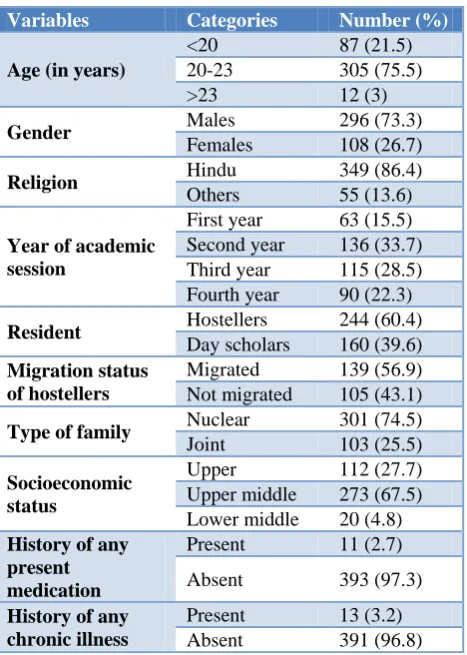
Table 1: Socio-demographic profile and medical history of the study participants (n=404).
Variables Categories Number (%)
Age (in years)
<20 87 (21.5)
20-23 305 (75.5)
>23 12 (3)
Gender Males 296 (73.3)
Females 108 (26.7)
Religion Hindu 349 (86.4)
Others 55 (13.6)
Year of academic session
First year 63 (15.5)
Second year 136 (33.7)
Third year 115 (28.5)
Fourth year 90 (22.3)
Resident Hostellers 244 (60.4)
Day scholars 160 (39.6)
Migration status of hostellers
Migrated 139 (56.9)
Not migrated 105 (43.1)
Type of family Nuclear 301 (74.5)
Joint 103 (25.5)
Socioeconomic status
Upper 112 (27.7)
Upper middle 273 (67.5)
Lower middle 20 (4.8)
History of any present medication
Present 11 (2.7)
Absent 393 (97.3)
History of any chronic illness
Present 13 (3.2)
Absent 391 (96.8)
Table 2: Self-perception and language barrier by the study participants (n=404).
Variables Categories Number
(%)
Self-perception
Body weight
Satisfied 267 (66.1)
Not
satisfied 137 (33.9)
Body image
Satisfied 302 (74.7)
Not
satisfied 102 (25.3)
Facial appearance
Satisfied 330 (81.7)
Not
satisfied 74 (18.3)
Languages known
<2 4 (1)
2-3 378 (93.6)
>3 22 (5.4)
Language barrier Present 38 (9.4)
Absent 366 (90.6)
Using a cut off score of 43, students were screened positive for social anxiety disorder if they scored 43 or higher on the SIAS scale. Similarly, a cut off value of 34 interprets social phobia among the study participants.
A total of 24 (5.94%) study participants met the criteria of social anxiety and 51 (12.62%) met that of social phobia.
Table 3: Univariate analysis of social anxiety with different characteristics among the study participants (n=404).
Variables Social anxiety Total P value
Absent (%) Present (%)
Body image perception Satisfied 262 (95.2) 13 (4.8) 275 0.004*
Not satisfied 67 (85.9) 11 (14.1) 78
Facial appearance perception
Satisfied 277 (95.1) 14 (4.9) 291
0.001*
Not satisfied 52 (83.8) 10 (16.2) 62
Language barrier Present 22 (75.8) 7 (24.2) 29 <0.005*
Absent 307 (94.7) 17 (5.3) 324
Academic performance satisfaction
Satisfied 187 (95.9) 8 (4.1) 195
0.025*
Not satisfied 142 (89.8) 16 (10.2) 158
*p value<0.05
Table 4: Determinants of social anxiety among the study participants (n=404).
Predictor variables B SE Adjusted OR (95% CI) P value
Facial appearance perception
Satisfied
1.093 0.462 1# 0.018*
Not satisfied 2.982 (1.206-7.375)
Language barrier Present 1.474 0.523 4.365 (1.567-12.165) 0.005*
Absent 1#
-3.145 0.291 0.043 <0.000
*p value<0.05, # reference.
To find out the determinants of social anxiety, binary logistic regression was applied, taking dependent variable as „social anxiety‟. Independent variables were selected
CI=1.206-7.375, p=0.018) higher in the study participants who were not satisfied with their facial appearance and 4.3 (95% CI=1.567-12.165, p=0.005) times higher in
participants who had language barrier during
communication.
DISCUSSION
This descriptive cross-sectional study provides
information on the prevalence of social anxiety, social phobia and various determinants of social anxiety among the medical students. A total of 404 undergraduate students from first to final year of MBBS were included. Mean age of the participants was 20.7 years (17 to 26 years). In our study the prevalence of social anxiety was found to be 5.94% (24/404) and the prevalence of social phobia was 12.62% (51/404) which is quite higher than the findings of National Mental Health Survey 2015-16 report.4 This might be because NMHS was done on general population and our study was focused on medical students, those are under continuous academic stress, which is likely to increase the anxiety levels. Our findings were similar to previous studies done among students by Honnekeri et al (7.8%), and Izgiç et al (9.6%), but lower than the study done by Ratnani et al (11.37%), Baptista et al (11.6%), and Ganapathi et al (12.9%).7,10,13-15 These considerable variations in prevalence findings have been attributed to the fact that there are methodological differences between studies, such as sample composition, cultural reasons and possible differences in methods of assessment and diagnostic criteria.
Social anxiety was significantly associated in students with dissatisfaction in body image perception. A previous study by Tang et al reported that adolescent who perceived themselves as overweight were more likely to have anxiety symptoms than those who perceived themselves as normal or underweight.12 Another determinant that was found significantly associated with social anxiety was dissatisfaction with facial appearance, which was a similar finding in another study among Chinese medical students revealing that those who displayed a concern with their facial appearance had higher level of social anxiety.11
Our study also showed that social anxiety was significantly associated with dissatisfaction with academic performance which is a consequence of social anxiety itself. Similar findings were observed in studies by Ganapathi et al, Izgiç et al, Gultekin et al and Baptista et al.13-16 A plausible explanation to this is that the students with social anxiety feels more anxious during oral presentations and asking for doubts during lectures and lack of self-confidence during exams, which eventually leads to bad academic performance.
To the best of our knowledge the present study is the first to investigate the direct relationship between language barrier and social anxiety. This can be explained by the
fact that India being a multilinguistic country and Delhi is the capital attracting migrants from all over the country speaking different languages. Students feel less confident if they are not fluent in English speaking specially, which makes them feel more anxious among their peers.
Our study had few limitations such as it was targeted only
on medical undergraduate students and for
generalizability of the results, it is necessary to choose a community representative sample. This study was a self-reported cross-sectional study so temporal association couldn‟t be made and a prospective, longitudinal study is needed to assess SAD among students.
CONCLUSION
The present study is one of the few studies on social anxiety disorder among medical undergraduate students. The prevalence of social anxiety was found to be 5.94% and the prevalence of social phobia was 12.62%. Dissatisfaction with facial appearance and language barrier during communication were found to be significant predictors of social anxiety disorder. Adequate information and awareness about the disorder and making provision for appropriate supportive and counselling facilities are urgently required to improve the mental health of the medical students.
ACKNOWLEDGEMENTS
We would like to thank all our study participants for their full participation and we are grateful to the faculty and staff at the University College of Medical Sciences for their generous support and valuable advice.
Funding: No funding sources Conflict of interest: None declared
Ethical approval: The study was approved by the Institutional Ethics Committee
REFERENCES
1. American Psychiatric Association. Diagnostic and statistical manual of mental disorders, Fifth Edition, Arlington, VA: American Psychiatric Publishing; 2013.
2. Wittchen HU, Stein MB, Kessler RC. Social fears and social phobia in a community sample of adolescents and young adults: prevalence, risk factors and co-morbidity. Psychological Med. 1999;29(2):309-23.
3. Stein MB, Stein DJ. Social anxiety disorder. Lancet. 2008;371(9618):1115-25.
4. National Mental Health Survey of India, 2015–2016 Prevalence, Patterns and Outcomes, Supported by
Ministry of Health and Family Welfare,
Partner Institutions; 2015–2016. Available at: http://indianmhs.nimhans.ac.in/Docs/Summary.pdf 5. Veale D. Treatment of social phobia. Advances
Psychiatric Treatment. 2003;9(4):258-64.
6. Priyamvada R, Kumari S, Prakash J, Chaudhury S. Cognitive behavioral therapy in the treatment of
social phobia. Industrial Psychiatry J.
2009;18(1):60.
7. Honnekeri BS, Goel A, Umate M, Shah N, De Sousa A. Social anxiety and Internet socialization in Indian undergraduate students: An exploratory study. Asian J Psychiatr. 2017;27:115-20.
8. Ahmad RJ, Bayan H, Faque T, Seidi PA. Prevalence
of Social Anxiety in Students of college of Education–University of Garmian. In4 th Global Conference on Psychology, Educational Science, Law and Social Science. Shiraz, Iran, 2017.
9. Elhadad AA, Alzaala MA, Alghamdi RS, Asiri SA,
Algarni AA, Elthabet MM. Social phobia among Saudi medical students. Middle East Current Psychiatry. 2017;24(2):68-71.
10. Ratnani IJ, Vala AU, Panchal BN, Tiwari DS, Karambelkar SS, Sojitra MG, et al. Association of social anxiety disorder with depression and quality of life among medical undergraduate students. J Family Med Primary Care. 2017;6(2):243.
11. Liao Y, Knoesen NP, Deng Y, Tang J, Castle DJ, Bookun R, et al. Body dysmorphic disorder, social anxiety and depressive symptoms in Chinese medical students. Social Psychiatry Psychiatric Epidemiol. 2010;45(10):963-71.
12. Tang J, Yu Y, Du Y, Ma Y, Zhu H, Liu Z. Association between actual weight status, perceived weight and depressive, anxious symptoms in Chinese adolescents: a cross-sectional study. BMC Public Health. 2010;10(1):594.
13. Izgiç F, Akyüz G, Doğan O, Kuğu N. Social phobia among university students and its relation to self-esteem and body image. Canadian J Psychiatr. 2004;49(9):630-4.
14. Baptista CA, Loureiro SR, de Lima Osório F, Zuardi AW, Magalhães PV, Kapczinski F, et al. Social phobia in Brazilian university students:
Prevalence, under-recognition and academic
impairment in women. J Affective Disorders. 2012;136(3):857-61.
15. Ganapathi KC, Duraimurugan M, Kokila K. A study
on the prevalence of social anxiety disorder (SAD) among medical undergraduate students and its
relation with self-esteem. Stanley Med J.
2017;3(4):31-5.3(4):5.
16. Gültekin BK, Dereboy IF. The prevalence of social phobia, and its impact on quality of life, academic achievement, and identity formation in university students. Turk Psikiyatri Dergisi. 2011;22(3):150.