NUTRITION AND FOOD SCIENCE
Consumer acceptability of chocolate chip cookies using applesauce as a fat
(butter) substitute
Saeed A. Hayek and Salam A. Ibrahim*
Food Microbiology and Biotechnology Laboratory, North Carolina A&T State University, 171 Carver Hall, Greensboro, NC 27411, USA
Abstract
Replacing fat in baked goods with fruit or vegetable base ingredients like applesauce would develop aid in the effort of overall reduction of fat intake and increase consumption of fruits and vegetables. The objective of this study was to determine the consumer acceptability of chocolate chip cookies prepared by replacing butter with applesauce. Three recipes were included: 1- Control: made according to Nestlé Toll House recipe. 2- Half replacement (HR): made by replacing 50% of butter with applesauce. 3- Full replacement (FR): made by replacing 100% of butter with applesauce. Nestlé Toll House recipe was employed in this study and Mott’s applesauce was used for fat replacement. The 9 point hedonic rating scale system was used to evaluate the acceptability of the following sensory characteristics: appearance, texture, color, chewiness, sweetness, moistness, flavor, aftertaste and overall acceptability. Sensory evaluation was completed at North Carolina Agricultural and Technical State University on 35 food science students and employees. Our results showed that HR was very much acceptable, control was between very much acceptable and moderately acceptable, and FR was between moderately acceptable and neither acceptable nor unacceptable for all sensory characteristics. No significant (P>0.05) differences were reported in the acceptability of control and HR, whereas FR showed significantly (P<0.05) lower acceptability. Among all panelists (n = 35) 12, 16, and 7 panelists have chosen control, HR, and FR respectively as the most preferred and most worth buying cookie. In conclusion, applesauce could be an acceptable fat substitute in baked goods, thereby adding health benefits and nutritional value to baked products, and also contributing to the reduction of obesity.
Key words: Applesauce, Fat, Acceptability, Preferences, Sensory characteristic
Introduction
Overweight and obesity are epidemic in many parts of the world. Many countries have shown dramatic increases in overweight and obesity while no developed country is quite as heavy as the United States (Philipson and Posner, 2008). In the United States, 68.3% of adults older than 20 years and 48.1% of adolescents and children younger than 20 years are obese or overweight as of 2007-2008 (Shields et al., 2011). The United States has experienced a significant increase in obesity and overweight between 1980 and 2011 (CDC, 2011; Shields et al., 2011). These increases in obesity and overweight were associated with many chronic diseases including type 2diabetes, coronary heart disease, stroke, and high blood pressure (CDC,
2011). Much evidence suggests that the increases in obesity and overweight were related to the increases in fat and caloric intake (Cutler et al., 2003; Neuhouser et al., 2004; Philipson and Posner, 2008). Fat is an essential nutrient for human and one of the main food ingredients that play an important role in our food. Ultimately, a high fat diet may lead to an increased risk for numerous health problems such as obesity, cancer, cardiovascular disease, and type 2 diabetes (Cutler et al., 2003; Kafatos and Codrington, 2000; NIH, 2000; Philipson and Posner, 2008). To prevent negative health effects of fat intake, the National Institutes of Health has recommended that dietary fat be reduced from the current 35 – 45% of the total energy intake in most Western diets to below 25 – 30% (NIH, 2000). Therefore, during the last decade, consumers’ demands in the United States and other western countries for low fat, reduced fat, and fat-free diets have increased substantially (CDC, 2011; Shields et al., 2011).
Received 03 February 2012; Revised 08 June 2012; Accepted 17 June 2012; Published Online 02 December 2012
the fat content in food products by replacing the fat with fruits or vegetables based ingredients. With this aim, oat dextrine (Shen et al., 2011), applesauce (Anding, 2008), avocado puree and oat rim (Wekwete and Navder, 2008), rice flour (Ali et al., 2011), pumpkin puree (Wang and Sullivan, 2010), okra gum (Romanchik-Cerpovicz et al., 2006), pureed eggplant (Doolittle, 2007), apricot kernel flour (Seker et al., 2010), hydrolyzed jicama starches (Amaya-Llano et al., 2008) and a composed of whey protein isolate, wheat starch, guar gum, xanthan gum or their blends (Kohrs et al., 2010) were tested in different food products as possible dietary fat substitutes. Replacing dietary fat with fruits and vegetables based ingredients will not only reduce the fat intake, although that will add additional health benefits to the produced food and contribute to increase the consumptions of fruits and vegetables. The consumption of fruits and vegetables in the United States are far short of the national target (CDC, 2011). The food industries in the United States are being encouraged to develop more enjoyable and acceptable products based on the use of fruits, vegetables, or their products. Baked food products are very much known to contain high fat, therefore, replacing fat in baked products with fruits or vegetables may contribute to healthier food. Fat is an important ingredient in baked products and contribute to the flavor, taste, texture, and final product acceptability (Jones, 2003; Colleen, 2007; Doolittle, 2007). There are different fat substitutes based on the content of carbohydrates, protein, or fat (Jones, 2003). Fat substitutes in baked products can be applesauce, prunes, eggplants, mashed banana, pureed fruit, non-fat buttermilk and non-fat yogurt (Jones, 2003; Colleen, 2007; Doolittle, 2007). Fat plays an important role in both taste and texture of baked products; therefore, choosing the appropriate fat substitute for a product or recipe is a critical step in replacing the fat. Applesauce is considered to be the best substitute for fat in fat-based baked goods such as quick breads, muffins and some cakes (Colleen, 2007;Anding, 2008). Applesauce is a puree made by cooking down peeled apples with water or apple cider to make unsweetened applesauce or adding sugar to be sweetened. Apples are not only high in pectin, apples are rich source of nutrients and phytochemicals (Gerhauser, 2008) and processing apples into applesauce has only a limited effect on the nutrients and phytochemicals in apples (Le Bourvellec et al., 2011). Apples also have many
health benefits including: anticancer, antidiabetes and prevention of heart diseases (Gerhauser, 2008; Martineau et al., 2006). Apple polyphenols can also regulate fat metabolism and lower the level of LDL cholesterol (Nagasako-Akazome et al., 2007; Jensen et al., 2009). Replacing fat with applesauce in baked products will develop healthier food and may contribute to a reduction in overall caloric intake.
To the best of our knowledge, there has been no published research to evaluate the consumer acceptability of chocolate chip cookies prepared by replacing fat with applesauce. Therefore, the purpose of this study was to develop achocolate chip cookies recipes with applesauce as a fat substitute in order to create a healthier, lower fat, and lower caloric cookies, and then to evaluate the consumer acceptability of the new cookies based on the sensory characteristics and consumer preferences.
Materials and Methods
Nestlé Toll House recipe (Nestlé-toll-house, 2011) was used in this study as control recipe. Nestlé cookies are generally considered to be one of the most popular chocolate chip cookies in the United States. Three recipes were included: 1-Control: made according to the original Nestlé Toll House recipe, 2- Half replacement (HR): made by replacing 50% of the butter with applesauce, and 3-Full replacement (FR): made by replacing 100% of the butter with applesauce.
Ingredients for making chocolate chip cookies
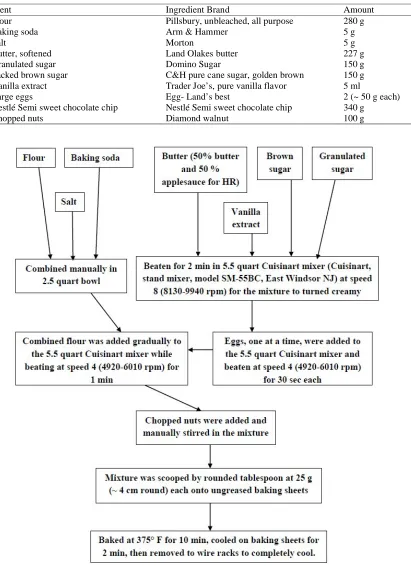
Table 1. Ingredients, brands and amounts used in the control and HR recipes to prepare the chocolate chip cookies.
Ingredient Ingredient Brand Amount
1. Flour Pillsbury, unbleached, all purpose 280 g
2. Baking soda Arm & Hammer 5 g
3. Salt Morton 5 g
4. Butter, softened Land Olakes butter 227 g
5. Granulated sugar Domino Sugar 150 g
6. Packed brown sugar C&H pure cane sugar, golden brown 150 g
7. Vanilla extract Trader Joe’s, pure vanilla flavor 5 ml
8. Large eggs Egg- Land’s best 2 (~ 50 g each)
9. Nestlé Semi sweet chocolate chip Nestlé Semi sweet chocolate chip 340 g
Preparation of chocolate chip cookies
Figure 1 shows the flow diagram for the control and HR recipes. The flow diagram was developed based on Nestlé Toll House recipe (Nestlé-toll-house, 2011). For FR recipe, in addition to the changes in ingredients, few additional changes were applied to the preparation method in order to control the moisture and improve the texture. After several initial trials, we found that replacing 100% of the butter with applesauce produced a more cake like product because of the high moisture content. In order to control the moisture level, the baking temperature was lowered to 340°F and the baking time was extended to 14 min. Also baking pans were greased to prevent stickiness of cookies, and all other steps have remained the same.
Sensory Evaluation
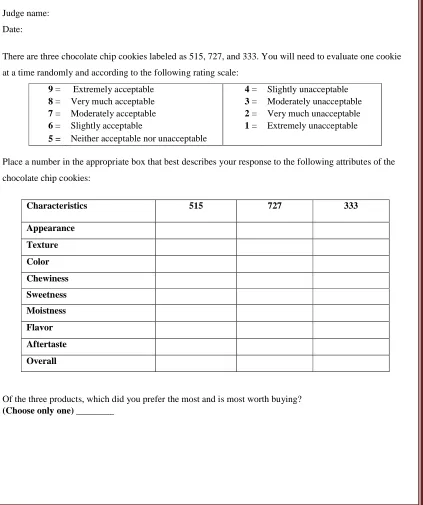
Chocolate chip cookies were prepared one day prior to sensory evaluation test. Sensory evaluation was designed based on consumer acceptability and preferences with regard to chocolate chip cookies. In this case, consumers evaluate baked products based on the physical appearance and color, texture and flavor, sweetness, moistness, and chewiness (Cauvain and Young, 2006). Panelists (n = 35) were food science students and staff members at North Carolina Agricultural and Technical State University. The 9 point hedonic rating scale system, with 9 for extremely acceptable and 1 for extremely unacceptable, was employed (Mc Williams, 2007). The sensory evaluation test has included the following characteristics: appearance, texture, color, chewiness, sweetness, moistness, flavor, aftertaste and overall acceptability. Preferences among the three cookies were evaluated by simply adding the following question at the end of the score card: Of the three products, which did you prefer the most and is most worth buying? The cookies were assigned the random numbers 515, 727, and 333 for control, HR, and FR respectively to reduce any bias. The cookies were placed on white plates separately with random arrangement and panelists were asked to make a random selection of one product at a time. The score card in Figure-1 was provided to each panelist prior to the sensory evaluation test and brief explanation was provided.
Statistical analysis
Statistical analysis of data was performed using SAS General Linear Model (GLM) program. The averages and standard deviations of scores for each characteristic were calculated and Duncan’s Multiple Range Test was used to determine
significant (P<0.05) differences. Percentage of acceptability was calculated based on the following equation:
Results and Discussion
Table 2 shows the averages of scores for each characteristic from each cookie. Even though, HR has earned higher scores than control, no significant (P>0.05) differences were shown between control and HR except for moistness. Moistness of control was also significantly (P<0.05) the least acceptable among all control characteristics. The present of applesauce, as high moisture ingredient (58% water) (Mott’s, 2011), raised the moisture content of the cookies and that was more acceptable among the panelists. However, only limited increase in moisture can be acceptable, extra moisture is not recommended for cookies and can cause cookie texture to become more like cake. Our preliminary study (not reported) showed that FR recipe prepared using regular applesauce and based on the same directions as the Nestlé Toll House recipe will make the final product more like cake instead of cookies. High moisture in fruits or vegetables based fat substitute plays an important role in determining the percentage of replacement between fat and substitute in order to avoid high moistness and maintain cookie texture. Therefore, changes in FR recipe were necessary to produce a chewy and crunchy cookie.
Young., 2006; Seker et al., 2010). The remaining FR tested characteristics were ranged between 5.20 (Neither acceptable nor unacceptable) and 6.14
(Slightly acceptable) and no characteristic was shown to be unacceptable.
Figure 2. Sensory evaluation score card.
Acceptability and Sensory Evaluation Test for Chocolate Chips Cookie made with Applesauce as fat (butter) substitute
Judge name:
Date:
There are three chocolate chip cookies labeled as 515, 727, and 333. You will need to evaluate one cookie
at a time randomly and according to the following rating scale:
9= Extremely acceptable 4= Slightly unacceptable 8= Very much acceptable 3= Moderately unacceptable 7= Moderately acceptable 2= Very much unacceptable
6= Slightly acceptable 1= Extremely unacceptable
5 = Neither acceptable nor unacceptable
Place a number in the appropriate box that best describes your response to the following attributes of the
chocolate chip cookies:
Characteristics 515 727 333
Appearance
Texture
Color
Chewiness
Sweetness
Moistness
Flavor
Aftertaste
Overall
Table 2. Effect of fat replacement with applesauce on the consumer acceptability of the sensory characteristics of chocolate chip cookies.
Characteristic
Chocolate chip cookies Control HR FR
Appearance 7.94±0.89aA 8.00±1.08aA 6.94±2.12bA
Texture 7.34±1.27aAB 7.86±0.83aA 5.31±2.18bB
Color 7.94±1.05aA 8.14±0.76aA 7.31±1.92aA
Chewiness 7.26±1.33aAB 8.11±0.72aA 6.14±2.3bAB
Sweetness 7.57±1.43aAB 7.86±1.14aA 5.51±2.67bB
Moistness 6.90±1.37bB 8.26±0.71aA 5.80±2.58cAB
Flavor 7.40±1.53aAB 8.06±0.76aA 5.20±2.89bB
Aftertaste 7.50±1.19aAB 7.91±1.33aA 5.34±2.68bB
Overall 7.30±1.03aAB 7.94±0.87aA 5.80±2.29bAB
*Acceptability is based on the 9 point hedonic rating scale system, with 9 for extremely acceptable and 1 for extremely unacceptable. *Averages with the same lower case letter in the same raw are not significantly different P<0.05.
*Averages with the same upper case letter in the same column are not significantly different P<0.05.
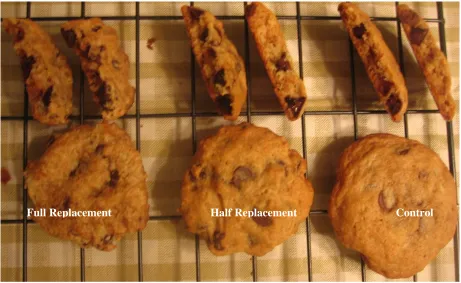
Figure 3 shows a top and side cut image of each cookie. The picture shows that replacing fat with applesauce resulted in slight changes in color, appearance, and texture. It can be seen that reducing the butter and increasing the applesauce content cause an increase in the brownish color,
thereby reducing the shape uniformity, increasing the roughness of the cookie surface, and increasing the lightness and fluffiness of the texture. However, changes in color, appearance, and texture were insubstantial and had limited effect on the acceptability of the three cookies.
Figure 3. Picture of top and side cut of the three chocolate chip cookies. The picture shows slight differences in color, appearance, and texture with respect of replacing the fat with applesauce.
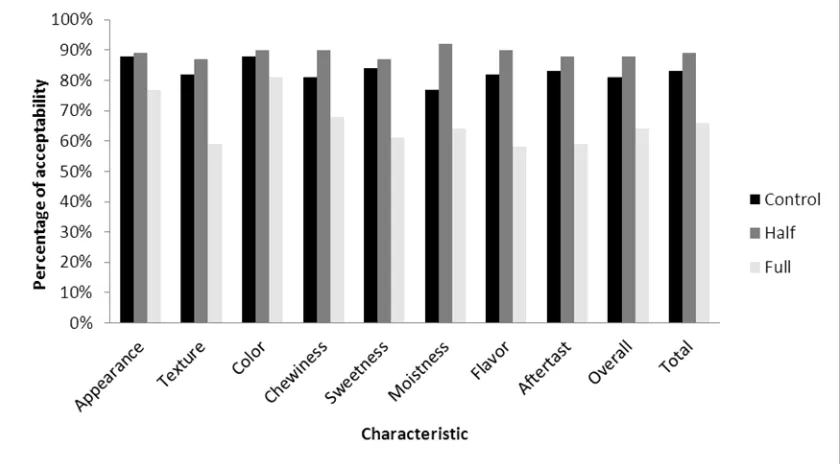
Figure 4 shows the percentages of acceptability of the tested sensory characteristics. Percentage of acceptability was defined as the total earned scores of the characteristic divided by total possible scores multiplied by 100%. Percentage of acceptability was used to determine the possible acceptance or rejection of each cookie. Rejection of one sensory characteristic was interpreted as rejection of the cookie as whole. Any percentage of acceptability lower than 50% was considered to be a rejection for the purpose of this study. HR cookie was the most accepted based on all sensory characteristics followed by control cookie then FR cookie. However, none of the sensory characteristics of the three cookies had shown rejection. Percentages of acceptability, for each cookie as a whole, were 81%, 89%, and 67% for control, HR, and FR respectively. Preference among cookies was also considered to determine the most preferred cookie and potential of commercial production. Preferences to cookie were determined by simply asking each panelist to choose one cookie as the most preferred and most worth buying. Among all panelists (n = 35) 12, 16, and 7 panelists have chosen control, HR, and FR respectively as the most preferred and most worth buying cookie. These results indicate that HR is the most acceptable cookie and FR is the least acceptable cookie. However, a fair percentage of acceptability (67%) was showed on FR and fair number (7) of
panelists chose FR as the most preferred and most worth buying cookie. These results would suggest that FR could be acceptable among a moderate percentage of consumers and could thus be commercially produced.
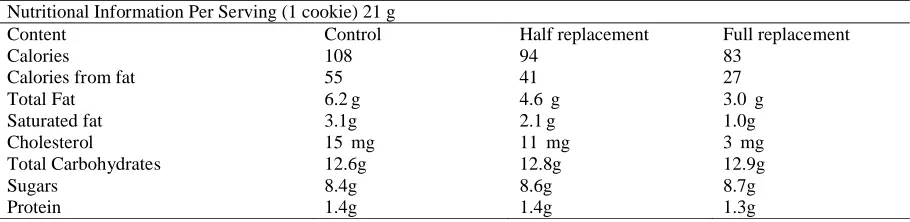
Table 3. Nutritional information of chocolate chip cookies calculated based on Nestlé Toll House chocolate chip cookies (Nestlé-toll-house, 2011) and Mott’s applesauce (Mott’s, 2011) nutritional facts.
Nutritional Information Per Serving (1 cookie) 21 g
Content Control Half replacement Full replacement
Calories 108 94 83
Calories from fat 55 41 27
Total Fat 6.2 g 4.6 g 3.0 g
Saturated fat 3.1g 2.1 g 1.0g
Cholesterol 15 mg 11 mg 3 mg
Total Carbohydrates 12.6g 12.8g 12.9g
Sugars 8.4g 8.6g 8.7g
Protein 1.4g 1.4g 1.3g
Apples and applesauce are notable for their high pectin content. Pectin in applesauce could be the main factor behind this successful replacement and sugar in applesauce could be another factor. Pectin works with gluten in the flour and helps with texture and structure just as fat does but in different technique. Fats are hydrophobic that can form a protective shields around the flour molecules and thus prevent the flour from combining with water to prevent the form of gluten (Jacob and Leelavathi, 2007). On the other hand, pectin is a gelling agent and specifically a polysaccharide. Pectin is hydrocolloid and does not actually protect the starch molecules (Lazaridoua et al., 2007). Pectin competes with the flour molecules for water and sugar also attracts the water molecules. That means less water overall reaches the flour molecules, and because of this, the dough become less able to form gluten (Lazaridoua et al., 2007). On the other hand, applesauce has high water content which could support the forming of gluten. This means, too much applesauce in chocolate chip cookies will turn it to cake and too little applesauce will fail to achieve the goal benefits. As a general rule, determining the percentage between fat and fat’s substitute is a major factor in developing the gluten and shaping the final product. The precise amount of fat varies depending on the recipe, and that is part of the issue with substituting applesauce in baked products. Other important issues to limit the amount of time in which gluten can develop are to mix the wet and dry ingredients at the last minute, and to blend them just briefly. The dough is not allowed to set and need to be baked immediately to avoid any possible gluten development. Thus when replacing fat in any baked products, it is important to understand the recipe, composition of substitute, mechanism of work, and type of fat in order to effectively choose the right fat substitute and right percent of substitution. Applesauce was
recommended as the best fat substitute for oil-based baked products, like quick breads, muffins and some cakes (Colleen, 2007; Anding, 2008). In this study, applesauce was fully acceptable as a replacement of half of the butter and fairly acceptable as a full replacement for butter in chocolate chip cookies. Therefore, applesauce is an appropriate substitute of butter in chocolate chip cookies and could be used to replace the dietary fat in other baked products. For consumers who could accept slight changes in taste and texture (sweeter and softer), replacing 100% of fat in chocolate chip cookies with applesauce might be the right choice.
Conclusion
References
Ali, M. S., G. D. Kim, H. W. Seo, E. Y. Jung, B. W. Kim, H. S. Yang and S. T. Joo. 2011. Possibility of Making Low-fat Sausages from Duck Meat with Addition of Rice Flour. Asian-Aust. J. Anim. Sci. 24:421-428.
Amaya-Llano, S. L., A. L. Martínez-Alegría, J. J. Zazueta-Morales and F. Martínez-Bustos. 2008. Acid thinned jicama and maize starches as fat substitute in stirred yogurt. LWT-Food Sci. Technol. 41:1274-1281.
Anding, J. 2008. Cooking with Applesauce. Available electronically at http://hdl.handle.net/1969 1:87034.
Cauvain, S. P. and L. S. Young. 2006. Baked products: science, technology and practice (1st Edition). Oxford OX4 2DQ, UK: Blackwell publishing.
CDC. 2011. U. S. Obesity Trends. Overweight and Obesity. Accessed at http://www.cdc.gov/obesity/data/trends.html on Nov, 3, 2011. In U.S. Obesity Trends. Overweight and Obesity. Accessed at http://www.cdc.gov/obesity/data/trends.html on Nov, 3, 2011., ed. Center for Disease Control and Prevention. Center for Disease Control and Prevention.
Colleen, N. 2007. How to substitute applesauce for oil or butter? The nest October (6)30.
Cutler, D., E. Glaeser and J. Shapiro. 2003. Why have Americans become more obese? J. Eco. Persp. 17:93–118.
Doolittle, L. 2007. The Effects of Replacing Butter with Pureed Eggplant on the Quality of Chocolate Chip Cookies. F&N. 453:11.
Gerhauser, C. 2008. Cancer chemopreventive potential of apples, apple juice, and apple components. Planta. Med. 74:1608-1624.
Jacob, J. and K. Leelavathi. 2007. Effect of fat-type on cookie dough and cookie quality. J. Food. Eng. 79:299–305.
Jensen, E. N., T. Buch-Andersen, G. Ravn-Haren and L. O. Dragsted. 2009. The effects of apples on plasma cholesterol levels and cardiovascular risk – a review of the evidence. J. Hortic. Sci. Biotech. ISAFRUIT Special Issue: 34–41.
Jones, G. 2003. Fat and Fat Substitutes. Historical Materials from University of Nebraska-Lincoln Extension: G03-1487-A:C-1482p.
Kafatos, A. and C.A. Codrington 2000. Nutrition and diet for healthy lifestyles in Europe: the'Eurodiet'Project. Public. Health. Nutr. 4(2A):265-273.
Kohrs, D., T. J. Herald, F. M. Aramouni and M. Abughoush. 2010. Evaluation of Egg Replacers in a yellow cake System. Emir. J. Food. Agric. 22:340-352.
Lazaridoua, A. , D. Duta, M. Papageorgiou, N. Belc and C. G. Biliaderis. 2007. Effects of hydrocolloids on dough rheology and bread quality parameters in gluten-free formulations. J. Food. Eng. 79:1033–1047.
Le Bourvellec, C., K. Bouzerzour, C. Ginies, S. Regis, Y. Plé and C. M. Renard. 2011. Phenolic and polysaccharidic composition of applesauce is close to that of apple flesh. J. Food. Compos. Anal. 24:537-547.
Martineau, L. C., A. Couture, D. Spoor, A. Benhaddou-Andaloussi, C. Harris, B. Meddah, C. Leduc, A. Burt, T. Vuong and P. Mai Le. 2006. Anti-diabetic properties of the Canadian lowbush blueberry Vaccinium angustifolium Ait. Phytomed. 13:612-623.
Mc Williams, M. 2007. Foods: experimental perspectives (6th Edition). Saddle River, NJ.: Margaret Mc. Prentice-Hall, Inc.
Mott’s. 2011. Mott’s® original applesauce nutritional facts. Accessed at http://www.motts.com/products/nutrition/mott sclassicapplesauce.html Oct, 13, 2011.
Nagasako-Akazome, Y., T. Kanda, Y. Ohtake, H. Shimasaki and T. Kobayashi 2007. Apple polyphenols influence cholesterol metabolism in healthy subjects with relatively high body mass index. J. Oleo. sci. 56:417-428.
Nestlé-toll-house. 2011. Original NESTLÉ ® toll house® chocolate chip cookies. Accessed at http://www.verybestbaking.com/recipes/1847 6/Original-NESTL%C3%89-TOLL-HOUSE-Chocolate-Chip-Cookies/detail.aspx Apr, 3, 2011.
Mexicans living in Washington State. J. Am. Diet. Assoc. 104:51-57.
NIH, 2000. The practical guide: identification, evaluation, and treatment of overweight and obesity in adults. National Institutes of Health. Publication No. 00-4084.
Philipson, T. and R. Posner. 2008. Is the obesity epidemic a public health problem? A decade of research on the economics of obesity. Nat. Bur. Ec. Working Paper 14010:15.
Romanchik-Cerpovicz, J. E., A. C. Costantino and L. H. Gunn. 2006. Sensory evaluation ratings and melting characteristics show that okra gum is an acceptable milk-fat ingredient substitute in chocolate frozen dairy dessert. J. Am. Diet. Assoc. 106:594-597.
Seker, I. T., O. OZBOY-OZBAS, I. Gokbulut, S. Ozturk and H. Koksel. 2010. Utilization of apricot kernel flour as fat replacer in cookies. J. Food. Process. Pres. 34:15-26.
Shen, R., S. Luo and J. Dong. 2011. Application of oat dextrine for fat substitute in mayonnaise. Food. Chem. 126:65-71.
Shields, M., M. D. Carroll and C. L. Ogden. 2011. Adult obesity prevalence in Canada and the United States, NCHS 56:8.
Wang, M. and J. Sullivan. 2010. Pumpkin puree as a fat replacer in brownies. FN 453 Written
Report. Accessed at
http://www.cfs.purdue.edu/fn/fn453/Project_ Archive/Fall_2010/Pumpkin_puree_as_fat_re placer_in_brownies.pdf on Oct, 13, 2011.