ESF EUROCORES Programme
Modelling Intelligent Interaction
(LogICCC)
Logic in the Humanities, Social and
Computational Sciences
European Science Foundation (ESF)
The European Science Foundation is an independent, non-governmental organisation, the members of which are 78 national funding agencies, research performing agencies, academies and learned societies from 30 countries. The strength of ESF lies in the influential membership and in its ability to bring together the different domains of European science in order to meet the challenges of the future.
Since its establishment in 1974, ESF, which has its headquarters in Strasbourg with offices in Brussels and Ostend, has assembled a host of organisations that span all disciplines of science, to create a common platform for cross-border cooperation in Europe.
ESF is dedicated to promoting collaboration in scientific research, funding of research and science policy across Europe. Through its activities and instruments ESF has made major contributions to science in a global context. The ESF covers the following scientific domains:
• Humanities
• Life, Earth and Environmental Sciences • Medical Sciences
• Physical and Engineering Sciences • Social Sciences
• Marine Sciences
• Materials Science and Engineering • Nuclear Physics
• Polar Sciences • Radio Astronomy • Space Sciences
www.esf.org
Cover picture: Woman and Man as Folding Diagram © Todd Davidson/Illustration Works/Corbis
EUROCORES (European Collaborative Research)
The European Collaborative Research (EUROCORES) Scheme enables researchers in different European countries to develop collaboration and scientific synergy in areas where international scale and scope are required for top class science in a global context. The scheme provides a flexible framework for national basic research funding and performing organisations to join forces in supporting forefront European research in and across all scientific areas.
Until the end of 2008, scientific coordination and networking was funded through the EC FP6 Programme, under contract no. ERASCT- 2003-980409. As of 2009, the national organisations support all aspects including scientific coordination, networking and research funding.
Editors
Dr Barry Dixon, Science Officer
Dr Eva Hoogland, Senior Science Officer Ms Päivi McIntosh, Administrator
Contents
1. Introduction 3
2. Programme Description 5
3. Facts and Figures 7
4. Overview and Highlights of the Collaborative Research Projects 9
4.1 Computational Foundations of Social Choice (CFSC) 9
4.2 Dialogical Foundations of Semantics (DiFoS) 12
4.3 Games for Analysis and Synthesis of Interactive Computational Systems (GASICS) 14
4.4 The Logic of Causal and Probabilistic Reasoning in Uncertain Environments (LcpR) 16
4.5 Logic for Interaction (LINT) 19
4.6 Logical Models of Reasoning with Vague Information (LoMoReVi) 21
4.7 SOCIAL SOFTWARE for elections, the allocation of tenders and coalition/alliance formation (SSEAC) 24
4.8 Vagueness, Approximation and Granularity (VAAG) 26
5. Cross-CRP Networking, Dissemination and Training Activities 28
6. Governing Bodies 39
6.1. Scientific Committee 39
6.2. Review Panel 39
Lo
gIC
CC
–
M
od
el
li
ng
In
te
ll
ig
en
t I
n
te
ra
ct
io
n
3
The ESF EUROCORES Programme LogICCC (‘Logic in the Humanities, Social and Computational Sciences’) has reached the end of its exciting three-year run. The facts and figures in this retrospective tell an impressive story of what was achieved on the way, in terms of new results and events. That story really speaks for itself but, as one of the ‘founding fathers’, I am happy for this chance to add a few words. Creating the LogICCC programme was a highly rewarding Europe-wide adventure in forging a coalition of congenial researchers of high quality across our continent, all sharing the same vision of new avenues for logic toward a fundamental study of intelligent interac-tion. This perspective places logic in its rightful intellectual position, at an academic crossroads of the university between the sciences, humanities and social sciences.
Many meetings, letters and dinners later, that vision also convinced many national funding agen-cies to make the strategic investment that made the actual LogICCC projects which you see in this retrospective possible. These projects reflect major strands in intelligent interaction, from language use and dialogue to ‘social software’ for public choice or elections. They run from the mathe-matical foundations of the ubiquitous notion of dependency to innovative computational meth-ods for creating social systems, and the reasoning styles that they analyse range from causal infer-ence to approximative reasoning and exploiting vagueness. In their entirety, these projects have created the contours of a new logic of interac-tion. In addition, the legacy of this programme is the existence of a European network of outward-looking young (and not so young) researchers, as
well as a platform for launching future strategic initiatives.
It has been said that Europe is more a state of mind than a restricted geographical entity. The LogICCC programme has organised some note-worthy outreach events toward colleagues and students in other continents, including ‘LogICCC Meets China’ and ‘LogICCC Meets India’. The idea of logic and intelligent interaction clearly resonated in several follow-up initiatives.
There are still many scientific challenges ahead for understanding the full richness of the logic of interaction, and we may be seeing new interfaces emerge between the fields represented in this programme, such as a ‘theory of play’ in between logic and game theory, as well as outreach to the cognitive sciences. But personally I would hope that we are also talking about eventual effects on society, and the rationality and reasonableness (not necessarily the same features…) of public dis-course, argumentation and decision making. I am convinced that logic, properly understood, should have a role to play here, and more than that: a role to the good.
Does all this mean that a strategic follow-up to LogICCC should aim for some eventual grand scientific merge of all fields involved, perhaps even throwing society into the mix? I do not think so. I rather think that the success of this programme had to do with something much more delicate and dynamic: fostering interaction while preserving diversity between disciplines. And when all is said and done, that is a dynamic balance much like what the European Union itself is trying to achieve
1.
Lo
gIC
CC
–
M
od
el
li
ng
In
te
ll
ig
en
t I
n
te
ra
ct
io
n
4
at cultural and social levels. It is therefore entirely fitting that the European Science Foundation has been the prime mover and facilitator of this programme, since it combines a light touch with high-quality impact. Our scientific community owes a lot to ‘Strasbourg’, and it is a pleasure to acknowledge that debt on a festive occasion like this.
Professor Johan van Benthem
Institute for Logic, Language & Computation (ILLC), University of Amsterdam, The Netherlands One of the proponents of the original LogICCC research programme
The proposal for a EUROCORES Programme on Logical Modelling in Interaction, Communication,
Cognition and Computation (LogICCC) was submitted to the ESF in 2006 by the following scientists:
Professor Samson Abramsky
Computing Laboratory, Division of Mathematical, Physical and Life Sciences, Oxford University, United Kingdom
Professor Luigia Aiello
Dipartimento di Informatica e Sistemistica, Università di Roma ‘La Sapienza’, Italy
Professor Nicholas Asher
Institut de Recherche en Informatique de Toulouse, Université Paul Sabatier, France
Professor Johan van Benthem
Institute for Logic, Language and Computation, University of Amsterdam, the Netherlands
Professor Dov Gabbay
Group of Logic, Language and Computation, Department of Computer Science, King’s College London, United Kingdom
Professor Peter Gärdenfors
Department of Cognitive Science, Lund University, Sweden
Professor Erich Grädel
Mathematische Grundlagen der Informatik, RWTH Aachen University, Germany
Professor Jesus Larrazabal
Institute for Logic, Cognition, Language and Information (ILCLI), Universidad del Pais Vasco, Spain
Professor Jaroslav Peregrin
Institute of Philosophy, Academy of Sciences, Czech Republic
Professor Hans Rott
Institut für Philosophie, Universität Regensburg, Germany
Professor Gabriel Sandu
IHPST, Université Paris I, France
Professor Dag Westerståhl
Lo
gIC
CC
–
M
od
el
li
ng
In
te
ll
ig
en
t I
n
te
ra
ct
io
n
5
2.
Programme Description
l l l
Recent decades have seen major changes in the field of logic. Moving far beyond the traditional empha-sis on philosophical argument, formal grammar or mathematical proof, modern logic has become a much richer interdiscipline which transcends the usual borderlines between academic ‘cultures’.
The goal of the LogICCC programme was to stimulate and coordinate research projects aiming towards:
– Finding a common view of the key structures and phenomena in intelligent interaction between humans, as embedded in their physical environ-ment;
– Creating unifying logical frameworks that function across all disciplines concerned with information flow and rational goal-directed behav-iour;
– Understanding - and eventually improving - exist-ing social mechanisms and behaviour, includexist-ing their links with new computational advances.
The LogICCC programme worked towards the above goals under four headings – whence the
ICCC:
– Interaction
– Communication
– Computation
– Cognition
Interaction
Human interaction and social procedures has been an active field of research for many years in the social sciences, including issues of conflict resolu-tion, comparative justice or optimal organisation. Researchers in quite different fields have noticed that the same issues of aggregation of individual judgments, actions or preferences which make a collective judgment, action or preference appear all over, from modern multi-agent computer sys-tems to understanding language and reasoning. Notions from game theory like strategy and equi-librium have already proven useful for a common understanding of these phenomena and have led to a new research cluster bringing together game-theorists, computer scientists and social scientists. At the launch of the EUROCORES Programme LogICCC, the time seemed ripe for adding a logi-cal fine-structure dimension to these. LogICCC worked towards producing a unified logical model of interaction which spanned these disciplines.
Communication
Lo
gIC
CC
–
M
od
el
li
ng
In
te
ll
ig
en
t I
n
te
ra
ct
io
n
6
LogICCC linked the various disciplines which hold crucial ingredients of the total model that is needed.
Computation
A significant trend in modern computer science has been the emergence of ‘computation with a human slant’: modern computational models involve many interacting agents and the relevant issues of efficient computation are looking more and more like issues of rational human behaviour. This interactive aspect extends all the way from the modern internet to new paradigms like quantum computing, where the interaction between physical systems and agents measuring them is essential. We are now seeing the emergence of logic-inspired models of computation doing justice to this richer setting, and putting them side by side with human-oriented models has great promise. Some researchers even believe that efficient computation is very much like successful conversa-tion. LogICCC included projects which developed this ‘informatics’ as a new fundamental science of information flow and interaction, and helped link it to other disciplines.
Cognition
Originally aiming at identifying ‘correct’ inferences, logical models nowadays account for computa-tional resource bounds, brain architecture and other empirical constraints coming from cogni-tive science. LogICCC aimed at bringing together researchers interested in this psychological turn in logic, and relating it to parallel developments elsewhere. One crucial issue here is links between a high-level description of cognitive agents (logi-cal reasoning, propositional attitudes, preferences, belief revision) with low-level empirical studies on brain architecture, sub-symbolic processes, etc. This linkage is leading to more efficient systems for
reasoning and decision making which reflect the actual inference, learning, representation and per-formance of humans. To study this whole chain we need insights ranging from cognitive neuroscience all the way to linguistics and philosophy.
A full analysis of these issues requires a com-mon language and a framework which makes major structures visible across the humanities, social, com-putational and cognitive sciences and integrates them into comprehensive systems. Logic has played this role in the past for the foundation of the sci-ences, computation and the semantics of natural languages. The LogICCC programme was based on the firm conviction that present-day logic will con-tinue to play this role in the much broader setting described here. Whether this conviction has been
proven right, and to what extent the LogICCC pro-jects have contributed to its fulfilment, is something you are about to find out in the present brochure.
About this retrospective
This retrospective offers an overview of all aspects of the EUROCORES Programme LogICCC. You will find details of all of the eight Collaborative Research Projects (CRPs) including their constitu-ent Project Leaders, Principal Investigators, Project Members and Associated Partners, not to mention the various national funding agencies which finan-cially supported the projects. Each of the CRPs also describes the scientific highlights of their projects, including some of the most important outcomes and results of their work. In addition to this, the retrospective contains some personal reflections on the programme from some Project Members. These testimonials offer a window into the heart of
the various projects and, when combined with the other information, add a distinctive fingerprint to LogICCC.
The members of LogICCC were extremely active in organising inter-CRP activities. As the Review Panel concluded in their mid-term evaluation:
“The investigators are making excellent use of the opportunities provided by the LogICCC programme: networking, training, cross-disciplinary collaboration, pooling of various types of expertise and integration of different methodologies make this an excellent exam-ple of what a EUROCORES programme can achieve.”
The retrospective provides brief descriptions of these activities, allowing us a good glimpse of the considerable amount of work that went into making LogICCC such a success.
In all, this retrospective is intended to help dis-seminate and, indeed, celebrate the significant achievements of the LogICCC programme. Whether you are part of LogICCC or not, we hope
Lo
gIC
CC
–
M
od
el
li
ng
In
te
ll
ig
en
t I
n
te
ra
ct
io
n
7
3.
Facts and Figures
l l l
Following agreement with 18 funding organisa-tions in Austria, Belgium, Croatia, Cyprus, Czech Republic, Denmark, Finland, France, Germany, Israel, the Netherlands, Portugal, Romania, Spain, Sweden and Turkey, the European Science Foundation launched the LogICCC Call for Outline Proposals in March 2007.
At the time of the deadline, 11 May 2007, the Call had attracted 34 outline proposals, with 157 indi-vidual projects and 46 projects with associate status. On the basis of the criteria published in the Call, the Review Panel (for their composition, see Section 6) selected 16 proposals to be invited to submit a full proposal. Out of these, a total of 8 propos-als have been funded, with 29 individual projects and 19 associated partners from across 17 diff erent countries. Th e launch conference in Prague, from 5-7 October 2008, marked the formal start of the programme. Th e programme runs for three years and formally comes to an end at the fi nal conference, in September 2011.
The following 13 national funding organisa-tions supported the 29 individual projects in the EUROCORES Programme LogICCC: Academy of Finland (AKA), Academy of Sciences of the Czech Republic (GAČR), Austrian Science Fund (FWF),
Danish Agency for Science, Technology and Innovation
(FIST), Deutsche Forschungsgemeinschaft (DFG),
Israel Science Foundation (ISF), Fund for Scientifi c Research (FNRS), Th e Netherlands Organisation for Scientifi c Research (NWO), Foundation for Science and Technology (FCT), Interministerial Commission of Science and Technology (CICYT), Swedish Research Council (VR), Croatian Science Foundation
(HRZZ), Th e Scientifi c and Technological Research Council of Turkey (TÜBITAK).
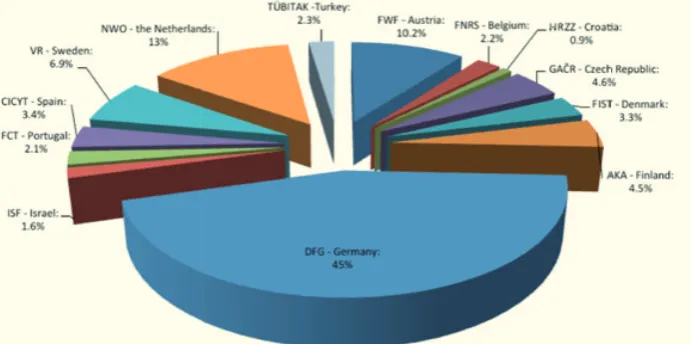
The total research budget for the LogICCC programme exceeded 6 M€. Th e following graphic analyses the proportion of the research budget allocated by the national funding organisations to the LogICCC projects in the context of the general research budget (see Figure 1).
Figure 1:
Lo
gIC
CC
–
M
od
el
li
ng
In
te
ll
ig
en
t I
n
te
ra
ct
io
n
8
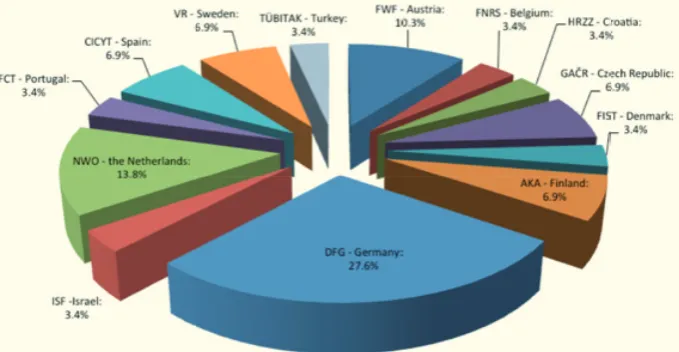
In addition to the research budget, the support-ing national fundsupport-ing organisations also covered the costs for the cross-CRP activities. Th ese activi-ties – be it networking, training or dissemination activities – are intended to enhance the coopera-tion between the various LogICCC Collaborative Research Projects (CRPs) and to sustain the coher-ence of the programme. Th ey also aim to deepen the impact of the research and to strengthen the fi eld. More on these cross-CRP activities can be found in Section 5. For the cross-CRP activities, a budget of 287 k€ was available. Figure 2 analyses the pro-portion of networking budget allocated by the 13 supporting national funding organisations.
Figure 2:
Lo
gIC
CC
–
M
od
el
li
ng
In
te
ll
ig
en
t I
n
te
ra
ct
io
n
9
4.
Overview and Highlights of the
Collaborative Research Projects
l l l
The EUROCORES Programme LogICCC is constituted by eight CRPs: large, international Collaborative Research Projects with partners in at least three different European countries. This chapter presents an overview of the eight CRPs and highlights some of their most important contribu-tions to the LogICCC programme.
4.1
Computational Foundations
of Social Choice (CFSC)
CFSC addresses some of the key issues in compu-tational social choice, an interdisciplinary field of study at the interface of social choice theory and computer science. It aims at deepening our under-standing of algorithmic and complexity-theoretic issues in social choice, at developing logic-based lan-guages for modelling and reasoning about choice problems and preference structures, and at applying established techniques from AI, such as preference elicitation and learning, to problems of collective decision making.
Funding Organisations:
• Deutsche Forschungsgemeinschaft (DFG), Germany
• Israel Science Foundation (ISF), Israel • Nederlandse Organisatie voor
Wetenschappelijk Onderzoek (NWO), the Netherlands
• Türkiye Bilimsel ve Teknolojik Arastirma Kurumu (TÜBITAK), Turkey
Project Leader:
• Professor Felix Brandt, Technische Universität München, Germany
Principal Investigators:
• Professor Ulle Endriss, University of Amsterdam, the Netherlands
• Professor Jeffrey Rosenschein, The Hebrew University of Jerusalem, Israel
• Professor Jörg Rothe, Heinrich-Heine-Universität Düsseldorf, Germany
• Professor Remzi Sanver, Bilgi University, Istanbul, Turkey
Associated Partners:
• Professor Vincent Conitzer, Duke University, Durham, United States
• Professor Edith Elkind, Nanyang Technological University, Singapore • Professor Edith Hemaspaandra, Rochester
Institute of Technology, United States • Professor Lane Hemaspaandra,
University of Rochester, United States
Professor Brandt presents the CFSC CRP at the Launch Conference
Lo
gIC
CC
–
M
od
el
li
ng
In
te
ll
ig
en
t I
n
te
ra
ct
io
n
10
• Professor Jérôme Lang, Université Paris 9 Dauphine, Paris, France
• Professor Jean Francois Laslier, École Polytechnique, CNRS, Paris, France
• Professor Nicolas Maudet, Université Paris 9 Dauphine, Paris, France
Project Members funded under CRP budget:
• Mr Markus Brill, PhD student, funded as part of Professor Brandt’s team
• Dr Haris Aziz, postdoctoral researcher, funded as part of Professor Brandt’s team
• Ms Pelin Pasin, PhD student, funded as part of Professor Sanver’s team
• Mr Bora Evci, Master’s Degree student, funded as part of Professor Sanver’s team
• Mr Murat Ozturk, Master’s Degree student, funded as part of Professor Sanver’s team • Ms Dorothea Baumeister, PhD student,
funded as part of Professor Rothe’s team • Ms Claudia Lindner, PhD student, funded as
part of Professor Rothe’s team
• Dr Gabor Erdelyi, postdoctoral researcher, funded as part of Professor Rothe’s team • Ms Lena Piras, PhD student, funded as part of
Professor Rothe’s team
• Mr Aviv Zohar, PhD student, funded as part of Professor Rosencheim’s team
• Mr Reshef Meir, PhD student, funded as part of Professor Rosencheim’s team
• Mr Michael Zuckerman, PhD student, funded as part of Professor Rosencheim’s team • Dr Daniele Porello, postdoctoral researcher,
funded as part of Professor Endriss’s team
Project Members with funding from outside CRP budget:
• Mr Felix Fischer, PhD student, a member of Professor Brandt’s team
• Dr Paul Harrenstein, postdoctoral researcher, a member of Professor Brandt’s team
• Mr Hans Georg Seedig, PhD student, a member of Professor Brandt’s team
• Mr Mingyu Guo, PhD student, a member of Professor Conitzer’s team
• Mr Lirong Xia, PhD student, a member of Professor Conitzer’s team
• Professor Ipek Ozkal-Sanver, collaborative partner of Professor Sanver’s team
• Professor Goksel Asan, collaborative partner of Professor Sanver’s team
• Mr Magnus Roos, PhD student, a member of Professor Rothe’s team
• Mr Thanh Nguyen Trung, PhD student, a member of Professor Rothe’s team
• Dr Frank Gurski, postdoctoral researcher, a member of Professor Rothe’s team
• Ms Anja Rey, Master’s Degree student, a member of Professor Rothe’s team
Scientific Highlights:
This collaborative research project addressed key issues in computational social choice, an interdisci-plinary field of study at the interface of social choice theory and computer science. Computational social choice is concerned with the application of compu-tational techniques to the study of social choice mechanisms, such as voting rules and fair division protocols, and with the integration of social choice paradigms into computing. The project combined the expertise of some of the most active researchers in the field, who have worked on different aspects of computational social choice in the past, and who have come to this area from very different back-grounds: theoretical computer science, artificial intelligence, logic, economics and political science. The Amsterdam group studied applications of logic in a number of areas in social choice theory. One strand of work concerns the first computational study of the framework of judgment aggregation, which deals with the aggregation of propositions expressed in a logical language. We have established the computational complexity of problems such as computing the collective judgment, of manipulating a judgment aggregation procedure, and of checking whether consistency of the outcome can be guar-anteed for a given set of propositions. A second
Some members of the CFSC team at the Dagstuhl seminar on ‘Computational Foundations of Social Choice’ (March 2010) From left to right: Professor Ulle Endriss, Professor Nicholas Maudet, Professor Edith Hemaspaandra, Professor Edith Elkind, Professor Lane Hemaspaandra, Professor Felix Brandt, Professor Remzi Sanver, Professor Jörg Rothe, Professor Jean-Francois Laslier (bottom right). Missing from the photo: Professor Vincent Conitzer, Professor Jerome Lang and Professor Jeff Rosenschein.
Lo
gIC
CC
–
M
od
el
li
ng
In
te
ll
ig
en
t I
n
te
ra
ct
io
n
11
line of work concerns the modelling of preferences using logic-based languages. In cooperation with the group at LAMSADE, we have investigated the properties of the framework of weighted goals for preference representation in great detail. We have also extended this framework using the tools of lin-ear logic to allow for a better modelling of domains exhibiting multiplicity of items. This has applica-tions in fair division and combinatorial aucapplica-tions.
The group in Jerusalem investigated the problem of coalitional manipulation in elections; we put for-ward efficient algorithms for the problem in Borda, maximin and plurality with runoff voting, and ana-lysed their windows of error. Specifically, given an instance in which an algorithm fails, we bounded the additional power the manipulators need in order to succeed. In other work, we investigated the pos-sibility of stabilising a coalitional game by using external payments (the minimal necessary such payments is called ‘the cost of stability’). We proved general bounds on the cost of stability in several classes of games and provided a detailed algorith-mic study of the cost of stability in weighted voting games. We also extended our model and results to games with coalition structures.
The Düssseldorf group studied the computa-tional complexity of control, manipulation and bribery in a variety of models. Among the main achievements are the identification of natural vot-ing rules (namely, Bucklin, fallback votvot-ing and sincere-strategy preference-based approval voting) whose winners can be identified in polynomial time, but that have the broadest computational control resistance currently known to hold. In addition, the complexity issues regarding control, bribery and microbribery have been completely settled for the entire family of Llull/Copeland voting rules. For single-peaked electorates in a variety of voting rules, we showed that complexity shields for manipulation and control may evaporate, stay in place or can even be erected, depending on the given scenario. Other topics studied in Düsseldorf include cake-cutting algorithms, probabilistic lobbying and the complex-ity of some variants of the possible winner problem.
The group in Munich investigated the axiomat-ics and computational aspects of concepts and voting rules that are based on pairwise majority comparisons. We proposed a systematic methodol-ogy for defining such concepts using the notions of qualified subsets, von Neumann-Morgenstern stable sets and Schwartz retentive sets, and studied their relationship to rationalisability and strategy-proofness. On the computational side, we obtained preprocessing techniques via modular
decomposi-tion, intractability results, efficient algorithms and heuristics in this context. Particularly noteworthy is an NP-hardness proof of computing the tournament equilibrium sets as well as some progress towards solving an important conjecture associated with this concept.
During the course of this project, Professors Jean-Francois Laslier and Remzi Sanver finalised the edition of the Handbook on Approval Voting
(published by Springer) with several chapters writ-ten by one or more project members. A special workshop, attended by researchers inside and out-side the project, was organised in Palaiseau (France) on the occasion of the book’s release.
Members of the project consortium also organ-ised a Dagstuhl seminar on ‘Computational Foundations of Social Choice’ (March 2010), two international workshops on Computational Social Choice (September 2008 and September 2010) and an IJCAI workshop on Social Choice and Artificial Intelligence (July 2011), and edited three special issues of international journals on computational social choice.
Personal Reflection:
Mr Markus Brill
“I started my PhD in computer science in October 2008, at the same time the LogICCC programme was launched. This I had the privilege
to work in a stimulating international environment right from the beginning. The programme enabled me to attend several
Lo
gIC
CC
–
M
od
el
li
ng
In
te
ll
ig
en
t I
n
te
ra
ct
io
n
12
4.2
Dialogical Foundations
of Semantics (DiFoS)
Incorporating interaction and dialogue into logical semantics promises to overcome certain shortcom-ings of more traditional static approaches. The DiFoS project aims to assess the foundational value of dialogue semantics and examine its poten-tial to lay the foundations for logical reasoning in mathematics, computer science and linguistics. It compares dialogical and game-theoretical semantics with inferentialist approaches, and also investigates the historical roots of dialogues in logic, especially within medieval theories of obligationes.
Funding Organisations:
• Deutsche Forschungsgemeinschaft (DFG), Germany
• Fundação para a Ciência e a Tecnologia (FCT), Portugal
• Nederlandse Organisatie voor
Wetenschappelijk Onderzoek (NWO), the Netherlands
Project Leader:
• Professor Peter Schroeder-Heister, University of Tübingen, Germany
Principal Investigators:
• Professor Reinhard Kahle, Universidade Nova de Lisboa, Caparica, Portugal
• Professor Benedikt Löwe, University of Amsterdam, the Netherlands
Project Members funded under CRP budget:
• Dr Sara L. Uckelman, postdoctoral researcher, funded as part of Professor Löwe’s team • Dr Luca Tranchini, postdoctoral researcher,
funded as part of Professor Schroeder-Heister’s team
• Dr Bartosz Wieckowski, postdoctoral researcher, funded as part of Professor Schroeder-Heister’s team
• Dr Jesse Alama, postdoctoral researcher, funded as part of Professor Kahle’s team • Mr René Gazzari, Diploma student, funded as
part of Professor Kahle’s team
Project Members with funding from outside CRP budget:
• Dr Catarina Dutilh Novaes, research collaboration with Professor Löwe’s team • Mr Thomas Piecha, PhD student, a member of
Professor Schroeder-Heister’s team
• Dr Gregory Wheeler, postdoctoral researcher, a member of Professor Kahle’s team
Selected List of CRP Publications:
1) Baumeister, D., Brandt, F., Fischer, F.,
Hoffmann, J. and Rothe, J. (2010) The complexity of computing minimal unidirectional covering sets. In: Proceedings of the Seventh International Conference on Algorithms and Complexity (CIAC), Lecture Notes in Computer Science (LNCS) 6078,
299-310. Springer-Verlag.
2) Faliszewski, P., Hemaspaandra, E.,
Hemaspaandra, L. and Rothe, J. (2011) The Shield that Never Was: Societies with Single-Peaked Preferences are More Open to Manipulation and Control. Information and Computation 209(2), 89–107. (Preliminary version presented at TARK 2009.)
3) Laslier, J.-F. and Sanver, M.R. (Eds) (2010)
Handbook on Approval Voting. Springer-Verlag, Heidelberg, 481 pp. (Contains a chapter on ‘Computational Aspects of Approval Voting’ by
D. Baumeister, G. Erdelyi, E. Hemaspaandra, L. Hemaspaandra and J. Rothe and a chapter on ‘Approval as an Intrinsic Part of Preference’ by
M.R. Sanver.)
4) Uckelman, J., Chevaleyre, Y., Endriss, U. and Lang, J. (2009) Representing Utility Functions via Weighted Goals. Mathematical Logic Quarterly
55(4), 341-361.
5) Xia, L., Zuckerman, M., Procaccia, A.D., Conitzer, V. and Rosenschein, J.S. (2009) Complexity of Unweighted Coalitional
Manipulation Under Some Common Voting Rules. In: Proceedings of the Twenty-First International Joint Conference on Artificial Intelligence (IJCAI 2009), pp 348-353.
Further information:
Lo
gIC
CC
–
M
od
el
li
ng
In
te
ll
ig
en
t I
n
te
ra
ct
io
n
13
Scientific Highlights:
One of the distinguishing features of the DiFoS pro-ject is the combination of technical, philosophical and historical work. The work focused on two main research lines that have been interactively developed in parallel: on the one hand, the relation of tradi-tional – especially medieval – dialectical practices and modern dialogical conceptions of semantics; on the other, the comparison of the modern dialogical approach with other related ones, particularly on the proof-theoretic side.
A main subject of the Amsterdam node was the relationship between the medieval tradition of obligationes and modern dialogical logic. Here Dr Uckelman provided a framework for the com-parison of these traditions in order to answer the question: obligationes and modern dialogical logic are distinct and unrelated formal approaches to logic, despite the game-theoretic flavour that they both share.
The comparison between the Western histori-cal tradition of dialogue-based logihistori-cal analysis and modern dialogical logic naturally led to a question that was not originally foreseen in the project pro-posal, but turned out to be extremely fruitful: how many of the techniques used for the comparison of obligationes and modern dialogical logic can be used to analyse historical dialogical traditions of other cultures. The project ‘Dynamic and Dialogical Approaches to Historical Logic (DDAHL)’ was developed in the Amsterdam node of the CRP and provided a red thread in the research activ-ity, applying the techniques in particular to the Indian dialogical tradition. The cross-CRP event ‘Dialogues and Games’ in Lille (February 2010) was one of the first events in a series of meetings dealing with these issues. The formal reconstruction tech-niques used in DiFoS can also be used in fields other than historical traditions of logic. Professor Löwe has successfully applied them in the formalisation of narratives.
On the proof-theoretic side, which was essen-tially the topic of the Lisbon and Tübingen nodes, the main objective of the CRP was the relationship between proof-theoretic and dialogical/game-the-oretic approaches to semantics.
a) The structural relations between dialogues and sequent calculus have been studied in terms of a format which presents dialogues and win-ning strategies in sequent-style. This format helps to adapt methods from proof theory and also to import ideas from dialogues into proof theory. The proof-theoretic treatment of definitional reflection,
which is a universal approach to deal with inferen-tial definitions of logical and non-logical constants, has been carried over to the dialogical framework. A completeness result for the intuitionistic sequent
calculus with complex initial sequents in relation to the corresponding dialogical system for intuition-istic logic has been established, and the dialogical system has been extended by a certain argumen-tation form for definitional reasoning. The special case of semantical paradoxes, which feature promi-nently in philosophical theory, was analysed as a test case for the dialogical approach in comparison with the proof-theoretic treatment. The dialogical approach to semantics is grounded on the idea of a basic symmetry represented by the opposite roles played by the two agents engaged in a dialogue. The possibility of displaying such a duality also in
the proof-theoretic approach has been thoroughly investigated. Although it is possible to ‘dualise’ the basic proof-theoretic notions by introducing refuta-tions alongside with proofs, it is doubtful that a full analogy with the dialogical setting can be achieved. b) In relation to this point, the conception of implications as rules, which lies at the heart of computational approaches to implication, was investigated in the dialogical setting. An alterna-tive framework was developed, which diverges from the standard symmetric treatment of implication. A precise comparison of proof-theoretic and dialogical semantics of implications as rules showed that the asymmetry in deductive reasoning, which is the dis-tinguishing feature of the proof-theoretic approach, cannot be given up completely when switching to the dialogue-theoretic approach, which is inherently more symmetric.
c) The comparison of different semantic frame-works has been extended to comprise also the more traditional truth-theoretic approach. The idea of two layers in the structure of a semantic theory (tentatively referred to as ‘categorical’ and ‘hypo-thetical’ or ‘functional’) naturally applies to the dialogical setting. Here, an analogous distinction takes place between the level of play (i.e., of a single dialogue) and of strategy (i.e., of all possible dia-logues with respect to a certain proposition). The choice of which of the two layers is to be assigned priority seems to be critical for the architecture of a semantic theory. The work carried out provides a general pattern of analysis that could be fruitfully applied to other frameworks as well.
Lo
gIC
CC
–
M
od
el
li
ng
In
te
ll
ig
en
t I
n
te
ra
ct
io
n
14
the relation between dialogical and proof-theoretic semantics. Compared to what was envisaged in the original application, the results of the Tübingen and Lisbon groups exhibit a more fine-grained and sophisticated picture of the two approaches. Although certain conceptual distinctions are indeed
available in both frameworks, the dialogical frame-work can more successfully cope with phenomena involving some kind of symmetry, such as negation, whereas the proof-theoretic approach reveals all its power in describing asymmetric features of reason-ing, such as implication-like operators.
Personal Reflection:
Dr Sara L. Uckelman
“Working in the DiFoS project provided me with an excellent opportunity to combine my philosophical and historical interests in medieval logic with my technical and mathematical research in dialogue logic and formal dialogue systems. In addition to being able to share my work with a wide audience, I have also benefited from collaborations working in a variety of traditions, including multiple visits to Lisbon to work with a colleague at the Center for Artificial Intelligence, as well as a cross-CRP trip to Vienna to work with more computer scientists. DiFoS has also been a spring-board for projects I would otherwise probably not have gotten involved in, including the development of the research network Dynamic and Dialogical Approaches to Historical Logic (DDAHL), whose members have, since fall 2009, been involved in a number of workshops related to medieval Indian logic and philosophy.”
Selected List of CRP Publications:
1) Alama, J., Knoks, A. and Uckelman, S.L. Dialogue games for classical logic (short paper), to appear in the proceedings of TABLEAUX 2011. 2) Alama, J. and Uckelman, S.L. What is
dialogical about dialogical logic?, submitted. 3) Piecha, T. and Schroeder-Heister, P.
Implications as rules in dialogical semantics, to appear in The Logica Yearbook 2011.
4) Schroeder-Heister, P. (2011) Proof-theoretic semantics. The Stanford Encyclopedia of Philosophy.
5) Uckelman, S.L. (2011) Obligationes as formal dialogue systems. In: T. Ågotnes (Ed.)
STAIRS 2010: Proceedings of the Fifth Starting AI Researchers’ Symposium, IOS Press, pp 341-353.
Further information:
http://www-ls.informatik.uni-tuebingen.de/difos/
4.3
Games for Analysis and
Synthesis of Interactive
Computational Systems (GASICS)
This project studies game theoretic formalisations of interactive complex computational systems and algorithms for their analysis and synthesis. Our goal is to overcome the limitations of the existing notions of games played on graphs introduced by computer scientists, most of them being of the kind ‘two players-zero sum’. We aim to extend them to ‘multiple players-non zero sum’ games, and show the applicability of the new theory to the analysis and synthesis of interactive computational systems.
Funding Organisations:
• Deutsche Forschungsgemeinschaft (DFG), Germany
• Forsknings – og Innovationsstyrelsen (FIST), Denmark
• Fonds de la Recherche Scientifique (FNRS), Belgium
Project Leader:
• Professor Jean-François Raskin, Université Libre de Bruxelles, Belgium
Principal Investigators:
• Professor Wolfgang Thomas, RWTH Aachen University, Germany
• Professor Kim Larsen, Aalborg University, Denmark
Associated Partners:
• Professor Marcin Jurdzinski, University of Warwick, United Kingdom
• Professor Jean Eric Pin / Professor Olivier Serre, Université Paris Diderot-Paris 7, France • Dr Nicolas Markey, LSV, École Normale
Supérieure, Cachan, France
Project Members funded under CRP budget:
• Dr Emmanuel Filiot, postdoctoral researcher, funded as part of Professor Raskin’s team • Dr Olivier Gauin, postdoctoral researcher,
Lo
gIC
CC
–
M
od
el
li
ng
In
te
ll
ig
en
t I
n
te
ra
ct
io
n
15
• Mr Martin Zimmermann, PhD student, funded as part of Professor Thomas’s team • Mr Jörg Olschewski, PhD student, funded as
part of Professor Thomas’s team
• Mr Roman Rabinovich, PhD student, funded as part of Professor Thomas’s team
• Ms Line Juhl, PhD student, funded as part of Professor Larsen’s team
• Mr Mikkel Pedersen, PhD student, funded as part of Professor Larsen’s team
• Professor Alexandre David, funded as part of Professor Larsen’s team
Project Members with funding from outside CRP budget:
• Professor Ranko Lazic, collaborative partner of Professor Jurdzinski’s team
• Mr Michal Rutkowski, PhD student, a member of Professor Jurdzinski’s team
• Mr John Fearnley, PhD student, a member of Professor Jurdzinski’s team
• Professor Véronique Bruyère, collaborative partner of Professor Raskin’s team
• Professor Thomas Brihaye, collaborative partner of Professor Raskin’s team
• Ms Julie De Pril, PhD student, a member of Professor Raskin’s team
• Mr Marc Ducobu, PhD student, a member of Professor Raskin’s team
• Dr Laurent Doyen, postdoctoral researcher, a member of Professor Raskin’s team
• Mr Frédéric Servais, PhD student, a member of Professor Raskin’s team
• Mr Nicolas Maquet, PhD student, a member of Professor Raskin’s team
• Dr Christof Löding, collaborative partner of Professor Thomas’s team
• Mr Wladimir Fridman, PhD student, a member of Professor Thomas’s team
• Mr Frank Radmacher, PhD student, a member of Professor Thomas’s team
• Michael Holtmann, PhD student, a member of Professor Thomas’s team
Scientific Highlights:
To illustrate the scientific contributions obtained in the GASICS project, we give several examples of concrete progress in the four main topics structur-ing the project:
Multi-player non-zero sum games:
The notion of Nash equilibrium has been studied for multi-player non-zero sum games played on graphs, both for Boolean objectives and for quan-titative objectives. The existence of Nash equilibria has been proven in the two cases and computational complexity questions have been settled. Variants like secure equilibria or subgame perfect equilibria have also been studied.
Quantitative games:
Quantitative games played on weighted graphs are important mathematical models for synthesis of optimal or Pareto optimal controllers. In the project, progress has been made on this important topic. For example, we have improved existing algo-rithms for solving mean-payoff games. We have also extended mean-payoff and energy games from the one-dimensional case to the multi-dimensional case.
Games with imperfect information:
When modelling reactive systems made of several components, we need to explicitly take into account that each component has a partial view of the sys-tem in which it operates. This partial view leads to imperfect information, e.g., in a multi-process sys-tem a process does not have access to the private variables of other processes. Games of imperfect information are usually more expensive from a computational complexity point of view. We have developed a new symbolic data-structure to effi-ciently handle state spaces underlying the analysis of games with imperfect information. This new data-structure, based on the notion of ‘antichain’, has several other applications in the field of automata theory.
Implementation and heuristics:
Lo
gIC
CC
–
M
od
el
li
ng
In
te
ll
ig
en
t I
n
te
ra
ct
io
n
16
Personal Reflection:
Dr Emmanuel Filiot
“After a PhD centred on formal models for XML documents and databases (Lille, 2008), I joined the GASICS project as a postdoctoral researcher in 2009 (Université Libre de Bruxelles). Although there were some connections between my PhD topics and the GASICS project (tree automata for example), I was not familiar with all the concepts of computational game theory. The GASICS project and its bi-annual project
meetings were a wonderful opportunity for me to learn fast and to integrate into a new community. Being part of GASICS was a great opportunity to get feedback on my recent work, before going to formal publications, by some of the best international experts in the domain.”
Selected List of CRP Publications:
1) Bouyer, P., Fahrenberg, U., Larsen, K.G., Markey, N. and Srba, J. (2008) Infinite Runs in Weighted Timed Automata with Energy Constraints. In: Cassez, F. and Jard, C. (Eds) 6th International Conference on Formal Modelling and Analysis of Timed Systems (FORMATS 2008), Saint-Malo, France, LNCS 5215, 33-47. Springer-Verlag.
2) Bouyer, P., Markey, N., Olschewski, J. and Ummels, M. (2011) Measuring Permissiveness in Parity Games: Mean-Payoff Parity Games Revisited. LSV Research Report.
3) Brihaye, T., Da Costa, A., Laroussinie, F. and Markey, N. (2009) ATL with Strategy Contexts and Bounded Memory. LFCS’09.LNCS 5407, 92-106.
4) Doyen, L., Geeraerts, G., Raskin, J.-F. and Reichert, J. (2009) Realizability of Real-Time Logics. In: Proceedings of FORMATS: Formal Modelling and Analysis of Timed Systems.LNCS
5813, 133-148.
5) Doyen, L. and Raskin, J.-F. (2011) Games with Imperfect Information: Theory and Algorithms.
Lectures in Game Theory for Computer Scientists. Cambridge University Press, pp 185-212.
Further information:
http://www.ulb.ac.be/di/gasics
4.4
The Logic of Causal and
Probabilistic Reasoning in
Uncertain Environments (LcpR)
This project combines expertise from probability logic and nonmonotonic reasoning, probability and coherence, causality, conditional independence, models, human reasoning and empirical research on mental probability logic, counterfactuals and cogni-tive development. It focuses on:
(i) foundational topics like rationality and evolu-tion;
(ii) algorithms and implementation of local knowl-edge representation in non-graphical models (alternatives to Bayesian networks);
(iii) actual human reasoning in children and adults.
Funding Organisations:
• Deutsche Forschungsgemeinschaft (DFG), Germany
• Fonds zur Förderung der wissenschaftlichen Forschung (FWF), Austria
• Grantová agentura České republiky (GAČR), Czech Republic
Project Leader:
• Professor Gernot Kleiter, University of Salzburg, Austria
Principal Investigators:
• Professor Radim Jiroušek, Academy of
Sciences of the Czech Republic, Prague, Czech Republic
• Professor Josef Perner, University of Salzburg, Austria
• Professor Gerhard Schurz, University of Düsseldorf, Germany
Associated Partners:
• Dr Sarah Beck, University of Birmingham, United Kingdom
• Professor Angelo Gilio, University of Rome ‘La Sapienza’, Italy
• Professor Maximilian Kistler, Institut Jean Nicod, Paris, France
Project Members funded under CRP budget:
• Dr Jirka Vomlel, senior researcher, funded as part of Professor Jiroušek’s team
• Mr Václav Kratochvíl, PhD student, funded as part of Professor Jiroušek’s team
• Mr Václav Lín, PhD student, funded as part of Professor Jiroušek’s team
Lo
gIC
CC
–
M
od
el
li
ng
In
te
ll
ig
en
t I
n
te
ra
ct
io
n
17
• Mr Christian Wallmann, PhD student, funded as part of Professor Kleiter’s team
• Dr Eva Rafetseder, postdoctoral researcher, funded as part of Professor Perner’s team • Ms Louisa Hacking, project member, funded
as part of Professor Perner’s team
• Ms Christine Hofer, project member, funded as part of Professor Perner’s team
• Mr Matthias Unterhuber, PhD student, funded as part of Professor Schurz’s team
• Dr Paul Thorn, postdoctoral researcher, funded as part of Professor Schurz’s team
Project Members with funding from outside CRP budget:
• Dr Patrick Burns, postdoctoral researcher, a member of Dr Beck’s team
• Dr Giuseppe Sanfilippo, collaborative partner of Professor Gilio’s team
• Dr Niki Pfeifer, collaborative partner of Professor Kleiter’s team
Scientific Highlights:
The team of Professor Gerhard Schurz developed a computer simulation comparing different logico-probabilistic reasoning systems. Four prominent systems were investigated, the systems O, P, Z and QC (quasi classical). These systems differ in the number of inferences they license (O ⊂ P ⊂
z
⊂QC). Systems that license more inferences enjoy the possible reward of deriving more true informative conclusions, but with this possible reward comes the risk of drawing more false conclusions. Each of the four systems was extended by appeal to theorems that allow one to compute almost-tight lower-probability bounds for the conclusion of an inference, given lower-probability-bounds for its premises. The results suggest that system Z offers the best balance.
Professor Max Kistler investigated causality and causal reasoning within a causation as transmission
approach. Professor Kistler argued against the intervention account of causality and against mod-elling causal structures by Bayesian networks. In physics we find many examples of simultaneous law-ful dependence. These laws involve quantities that are related to one another in equations. Equations, however, may be solved for any of the variables they contain. Consider, for example, a magnetic stirrer rotating in a magnetic field with a certain angular momentum and a certain magnetic momentum (keeping other variables fixed).The causal law
relat-ing the variables is expressed in an equation which may be solved for the angular momentum or the magnetic momentum with equal rights.
By adopting a coherence-based approach to probabilistic default reasoning, Professor Angelo Gilio studied the quasi conjunction (a basic notion for defining consistent conditional knowledge bases) and the Goodman and Nguyen inclusion relation for conditional events. Given any family of conditional events F, they proved that:
(i) F p-entails the quasi conjunction C(S) for every subset S of F;
(ii) p-entailment from F is equivalent to p-entail-ment from C(S), for some nonempty subset S of F.
Professor Gilio characterised p-entailment by some alternative theorems. Finally, given any pair (F, E|H), they deepened the connections between
p-entailment and inclusion relation by introducing the class K of subsets S of F such that C(S) implies
E|H. We show that K is additive and that its greatest element can be determined by a suitable algorithm. As an alternative to the well-known Bayesian networks, Professor Radim Jiroušek has shown that conditional independence models can also be represented with the help of a composition operator
defined for marginal distributions. He generalised this composition operator to Shafer-Dempster belief functions and to possibility functions. A number of new properties of conditional independence within these approaches emerged during this work.
Dealing with causality it is important to have the possibility to study causal associations and causal chains. The models have to be able to cope with the concepts like counterfactual reasoning. Until recently, mathematical models were usually founded on the basis of probabilistic graphical models, mainly Bayesian networks and influence diagrams. The new approach does not employ graphs to describe structural properties of the distributions. Instead, the process of how the dis-tributions can be assembled (composed) from its parts (marginals) is described. Studying algebraic properties of the operator of composition, it was found that this approach is also advantageous for describing causal relationships. These models can easily describe how causality is processed within the model.
In the group of Professor Gernot Kleiter princi-ples of probability logic were used to model human inference. The human understanding of conditionals
condi-Lo
gIC
CC
–
M
od
el
li
ng
In
te
ll
ig
en
t I
n
te
ra
ct
io
n
18
tional events and one-third as conjunctions. When a sequence of 50 or 70 conditionals was presented, many participants shifted from conjunction to a conditional event interpretation. A test for working memory capacity was included in one experiment. Only a low correlation (.30) between the interpreta-tion (conjuncinterpreta-tion vs condiinterpreta-tional event) and one of the memory test variables was found.
If one wants to get an understanding of the nature of a cognitive capability it is a good strategy to study its origin and development. The groups of Professor Josef Perner and Dr Sarah Beck investi-gated the origins of counterfactual reasoning in children. Both groups developed prototypical sce-narios in which children first could play out a ‘story’ and afterward be asked “What if… would not have been the case?”. The distinction between a hypo-thetical version and a genuinely counterfactual version of problem is critical.
In Professor Perner’s project various age groups were investigated, children between three years and fourteen years old, adolescents and adults. Only 42% in the 5.0 to 6.5 years group give the correct answers to the genuinely counterfactual version, but 92% to the hypothetical version. The results support the conclusion that children are capable of hypothetical reasoning before six, but to counterfactual reason-ing only after ten. There are remarkable parallel developmental lines of counterfactual reasoning and the development of children’s theory of mind.
One aim of Dr Beck and her group was to find out when children are capable of counterfactual reasoning. She explored how counterfactual rea-soning can be distinguished from other types of reasoning. When a counterfactual scenario is being elaborated cognitively any open assumptions must be filled by facts from the real world scenario as far as logically possible. Counterfactual reasoning has to follow the nearest possible world constraint (Lewis). Prior studies yielding individual differences data suggested that counterfactual thinking may
be related to overcoming prepotent responses. In two experiments she manipulated how three- to five-year-olds responded to counterfactual condi-tional and syllogism tasks. Children’s performance improved on both conditional and syllogism tasks when they responded with an arrow, rather than pointing with their fingers. Three- to four-year-olds benefited from both an arrow manipulation and, separately, the introduction of a delay before responding. We suggest that both manipulations help children to overcome an impulsive prepotent response to counterfactual questions, arising from a default assumption that information about the past is true.
Personal Reflection:
Dr Jirka Vomlel
“I came to Salzburg for the first time as a PhD student visiting Professor Gernot Kleiter. Since then I have come to love this city not only because of the historical buildings at the foot of green hills that look beautiful, the Marzen beer in the Augustiner monastery that tastes great, but mainly because the people I met at the University of Salzburg are very friendly and open-minded – I have had many interesting conversations with them. When our Prague group was invited to take part in the LcpR project we were happy to join. The project meetings in Salzburg were in the spirit I remember – interesting talks and discussions not only at the
university, but also during the evenings with a glass of beer in hand, at a lift or even in a hut in a skiing resort, as was witnessed during the workshop ‘ProbNet 10’ in February 2010.”
Selected List of CRP Publications:
1) Beck, S.R., Riggs, K.J. and Burns, P.L. (2011) Multiple developments in counterfactual
thinking. In: Hoerl, McCormack and Beck (Eds)
Understanding Counterfactuals/Understanding Causality. OUP, Oxford, UK.
2) Fugard, A.J.B., Pfeifer, N., Mayerhofer, B. and Kleiter, G. D. (2011) How people interpret conditionals: Shifts towards the conditional event.
J. Experimental Psychology: Learning, Memory, and Cognition 37(3), 635-648.
A three-dimensional die with upper and lower probability bounds
Lo
gIC
CC
–
M
od
el
li
ng
In
te
ll
ig
en
t I
n
te
ra
ct
io
n
19
3) Gilio, A. and Sanfilippo, G. (2011) Quasi Conjunction and Inclusion Relation in
Probabilistic Default Reasoning. In: W. Liu (Ed.):
ECSQARU 2011,LNAI 6717, 497-508. Springer-Verlag, Berlin Heidelberg.
4) Kistler, M. (2009) Mechanisms and Downward Causation. Philosophical Psychology 22, (5), 595-609.
5) Jiroušek, R. Foundations of Compositional Model Theory. To appear in Int. J. General Systems. 6) Rafetseder, E., Christi-Vargas, R. and Perner, J. (2010) Counterfactual Reasoning: Developing a sense of “nearest possible world”. Child Development 81(1), 362—375.
7) Schurz, G. and Thorn, P. Logico-probabilistic reasoning systems: Logical investigation and simulation based analysis. Submitted to review of Symbolic Logic, pre-published in: TPP PREPRINTS, University of Düsseldorf, Annual 2011 No.1.
Further information: www.sbg.ac.at/lcpr
4.5
Logic for Interaction (LINT)
LINT is a collaborative research project aimed at developing mathematical foundations for inter-action. Intelligent interaction involves agents in complex scenarios like conversation, teamwork or games. Contours of a broad mathematical descrip-tion are starting to emerge today, based on several individual research developments that now need to be brought together. LINT gathers logicians, com-puter scientists and philosophers from six European countries in an effort to lay the grounds for a uni-fied account of the logic of interaction.
Funding Organisations:
• Suomen Akatemia / Finlands Akademi (AKA), Finland
• Deutsche Forschungsgemeinschaft (DFG), Germany
• Nederlandse Organisatie voor
Wetenschappelijk Onderzoek (NWO), the Netherlands
• Vetenskapsrådet (VR), Sweden
Project Leader:
• Professor Dag Westerståhl, University of Gothenburg, Sweden
Principal Investigators:
• Professor Jouko Väänänen, University of Amsterdam, the Netherlands
• Professor Erich Grädel, RWTH Aachen University, Germany
• Professor Lauri Hella, University of Tampere, Finland
Associated Partners:
• Professor Samson Abramsky, Oxford University, United Kingdom
• Professor Gabriel Sandu, Université Paris I, CNRS / ENS, Paris, France
Project Members funded under CRP budget:
• Mr Bernd Puchala, PhD student, funded as part of Professor Grädel’s team
• Mr Roman Rabinovich, PhD student, funded as part of Professor Grädel’s team
• Dr Juha Kontinen, postdoctoral researcher, funded as part of Professor Hella’s team • Dr Allen Mann, postdoctoral researcher,
funded as part of Professor Hella’s team • Mr Pietro Galliani, PhD student, funded as
part of Professor Väänänen’s team
• Dr Denis Bonnay, postdoctoral researcher, funded as part of Professor Westerståhl’s team • Dr Fredrik Engström, postdoctoral researcher, funded as part of Professor Westerståhl’s team
Project Members with funding from outside CRP budget:
• Dr Nikos Tzevelekos, postdoctoral researcher, a member of Professor Abramsky’s team • Mr Roman Priebe, PhD student, a member of
Professor Abramsky’s team
• Dr Dietmar Berwanger, collaborative research associate in Professor Grädel’s team
• Dr Lukasz Kaiser, postdoctoral researcher, a member of Professor Grädel’s team
• Mr Antti Kuusisto, PhD student, a member of Professor Hella’s team
• Mr Jonni Virtema, PhD student, a member of Professor Hella’s team
• Dr Allen Mann, postdoctoral researcher, a member of Professor Sandu’s team
• Professor Johan van Benthem, collaborative research partner in Professor Väänänen’s team • Ms Fan Yang, PhD student, a member of
Lo
gIC
CC
–
M
od
el
li
ng
In
te
ll
ig
en
t I
n
te
ra
ct
io
n
20
Scientific Highlights:
The LINT CRP has achieved a qualitative improve-ment in the understanding of the logic of the concept of dependence, such as the dependence of a move of a player on previous moves, and of inde-pendence, such as the independence of a move of a player on a move he or she has not seen. At the beginning of the project these concepts were under-stood in terms of so-called dependence logic and so-called independence friendly logic. During the project a wealth of related concepts emerged, some of them interestingly probabilistic. It is remark-able that, as it turned out, many of these concepts have previously also arisen in database theory with slightly different emphasis, but the connection had eluded observation.
It now seems that there is a general theory of dependence and independence, based on ideas within logic, computer science and mathematics, that underlies many seemingly unrelated topics in a multitude of areas of science, including physical, behavioural, social and biological sciences. This development, based on analyses and results within the LINT CRP, seems very promising and will be further pursued in future research projects.
An important observation of the LINT CRP at the beginning of the project was the realisation that there is an undiscovered connection between dependence logic and intuitionistic logic. It turned out that a proper use of intuitionistic logic leads to a deeper understanding of dependence logic and reveals an unexpected connection to second-order logic. Reverberations of this observation were felt throughout the project and the full impact of it has probably not yet been perceived.
Game Theoretic Semantics is one of the under-lying themes in LINT. It is based on the concept of the existence of a winning strategy. Therefore it was self-evident that there is a connection to exis-tential second-order logic. During the LINT CRP this connection was put under a microscope and completely analysed. As a result a fairly complete picture emerged and one can now pinpoint exactly what the second-order equivalent of most logics that have arisen around the concept of dependence is. This is important for conceptual reasons but it has also led to hierarchy theorems that delineate the complexity of dependence and independence logics. In another direction new resources known as Nominal Game Semantics were developed, lead-ing to concise mathematical models, which capture realistic fragments of dynamic programming lan-guages such as ML.
In their full power the logical systems considered in the LINT CRP have high complexity. This led the project to consider more manageable fragments such as modal logics and 2-variable logics. In both cases a rather complete picture emerged. The results on decidability and complexity delineated nicely the difference between dependence and independence: the satisfaction problem for 2-variable dependence logic turned out to be EXPTIME complete but the same for 2-variable independence friendly logic turned out to be undecidable.
Compositionality has been a recurring theme in the area of the LINT CRP. During the project major steps forward were taken by demonstrating that translations between certain of the relevant logics were non-compositional. On the other hand, it was established that even the probabilistic game-theo-retic semantics permits a compositional rendering.
The LINT CRP also proposed a new approach to the problem of logical constants. According to this approach the logical constants are the output of a new operation of ‘constant extraction’, dual to logical consequence as a function from sets of symbols to consequence relations. By its generality, the method is relevant to a variety of logical frame-works studied within the LogICCC programme. In a nutshell, the idea is to combine Bolzano’s insight that any choice of constants determines a semantic consequence relation with a method for going in the converse direction: to extract, from any given con-sequence relation, its constants. The method might thus be called consequence mining.