Original Research Article
Awareness and practice of road safety measures among undergraduate
medical students of Al Baha University, KSA
Yasir B. Elshambaty
1,3*, Ibrahim A. El Jack
2,3, Saud A. Al Zahrani
3,
Mohammad O. Al Ghamdi
3, Abdulrazag O. Shaker
3,
Khalid G. Al Ghamdi
3, Mohammad A. Alelyani
3INTRODUCTION
According to WHO reports, 1.24 million were killed and up to 50 million people were injured worldwide as a result of road traffic accidents in 2010.1,2 The number of deaths was 1.26 in 2000.3 Unfortunately the number of deaths increased again in 2013 to reach to 1.25 million. The mortality rate of RTAs is 40 people/hour for people under the age of 25 years old worldwide.
According to the WHO, road traffic injuries are the first cause of death for persons aged 15 to 29 years in 2012. Road traffic injuries are currently estimated to be the ninth leading cause of death across all age groups globally, and are predicted to become the seventh leading cause of death by 2030.1 This huge number of deaths and injuries made the united nation to launch a declaration about road safety. The decade 2011-2020 according to the UN is the decade of road safety.
ABSTRACT
Background: The aim of this study was to assess the level of awareness and practice of road safety measures by medical students of Al Baha University, Saudi Arabia.
Methods: The study was descriptive, cross-sectional, students-based conducted among the students of faculty of medicine, ALBaha University, between 1st to 15th May 2017.
Results: A total of (n=125) students were enrolled and the vast majority (98.4%) of them aged 18-25 years. All of
them are male. Around (97.6%) and (96%) of the participants have car and driving license, respectively. The majority (93.6%) of the participants were aware of road traffic regulations. The major (60%) did not receive driving training. Majority of students involved in RTA regardless the Mobile phone use during driving and driving speed. Approximately (70%) of the participants violated the traffic regulations in more than two occasions in the last year, whilst less than one third of the students use the seat belt and small percent do not use the mobile while they are driving. Around (76%) were previously involved in RTA.
Conclusions: The RTAs rate was high among our students regardless their high level of awareness of traffic
regulations. Studying medicine had little effect on car driving behaviour. Medical students of Al Baha University had more cars compared to their medical counterparts in the nearby regions, thus the accidents rate was found high. RTAs was multifactorial in our population. Restriction to give the driving license by the authorities is highly recommended.
Keywords: Awareness, RTA, Medical students, Road safety
1
Department of Surgery, 2Department of Community Medicine, 3Faculty of Medicine, Albaha University, KSA
Received: 19 June 2018
Revised: 28 July 2018
Accepted: 30 July 2018
*Correspondence:
Dr. Yasir B. Elshambaty,
E-mail: [email protected]
Copyright: © the author(s), publisher and licensee Medip Academy. This is an open-access article distributed under
the terms of the Creative Commons Attribution Non-Commercial License, which permits unrestricted non-commercial use, distribution, and reproduction in any medium, provided the original work is properly cited.
Saudi Arabia is considered one of the countries where RTAs is one of the major causes of death and disability.4 The RTA-related deaths in Saudi Arabia were 27.5 per 100,000 inhabitants in 2013 according to WHO. This rate is higher than the global rate, which is 17.4 per 100.000 and also more than that of low- income countries which is 24.1/100.000, though Saudi Arabia is not categorized as low- income country. The major cause of RTA in Saudi Arabia is the high speed.5-8
Saud Arabia is also regarded as one of the countries with high rate of RTAs with mortality and morbidity of 1 and 4 persons per hour respectively. These statistics reflect the magnitude of this problem which needs to be addressed seriously. Reports from the ministry of health in Saudi Arabia stated that 20% of Ministry of Health (MOH) beds are occupied by RTAs victims and 81% of hospital deaths are among RTAs patients.5
The aim of this study was to assess the level of awareness and practice of road safety measures by medical students of AL Baha University, Saudi Arabia.
METHODS
Ethical consideration
The study was approved by the ethics committee at the faculty of medicine, Albaha University with ethical permission number (REC/SUR/BU-FM/018/014), also a verbal informed consent was taken from each participant before starting to answer the questions.
Study design
The study was descriptive, cross-sectional, conducted among the undergraduate students of Faculty of medicine, Al Baha University, Saudi Arabia.
Study population
A total of (n=125) students were categorized into six different groups based on their academic level; group one represents students at semester 1 and 2 of the first year, group two represents level 3 and 4 of the second year,
group three represents level 5 and 6 of the third year, group four represents level 7 and 8 of the fourth year, group five represents level 9 and 10 of the fifth year and group six represents level 11 and 12 of the sixth year.
Sample size
All students fit the inclusion criteria and agreed to participate voluntarily in the study were enrolled.
Inclusion and exclusion criteria
All male medical students who able to drive a car regardless having license and available at the study period were included, in contrast, female students were excluded.
Data collection process
The data were collected from the students by a well-structured questionnaire that was answered by direct interviews. The questionnaire contained 18 questions. The questions were divided into three sections, demographic characteristics, knowledge and practice and the last section was about the attitude of the participants towards the car driving. The data were collected within two weeks from 1st to15th of May 2017. Data were analyzed and manipulated in suitable manner.
Data analysis
The data were analyzed by SPSS version 23 and presented as frequency and percentage and compared by the mean of chi-square test, results were considered significant at p≤0.05.
RESULTS
Population characteristics
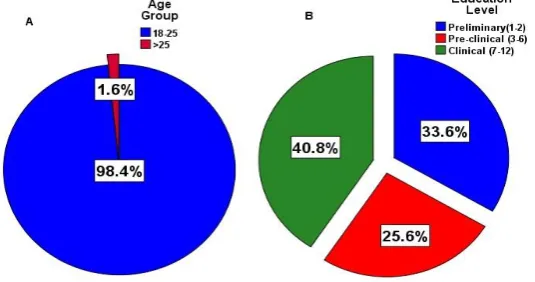
The majority (98.4%) of the students were between 18- 25 years old (Figure 1A), whilst their educational level distributed, as preliminary (33.6%), preclinical (25.6%) and clinical (40.8%), as shown in (Figure 1B).
Table 1: The participants' behavioural status regarding car driving (n=125).
Variable Frequency
(%) P value
Do you have a car?
Yes 122 (97.6)
No 5 (2.4)
Have you a driving license?
Yes 120 (96)
No 5 (4)
When did you start driving?
˂12 33 (26.4)
0.027
12-18 85 (68.0)
˃18 7 (5.6)
Have you received a driving training?
Yes 50 (40)
0.2
No 75 (60)
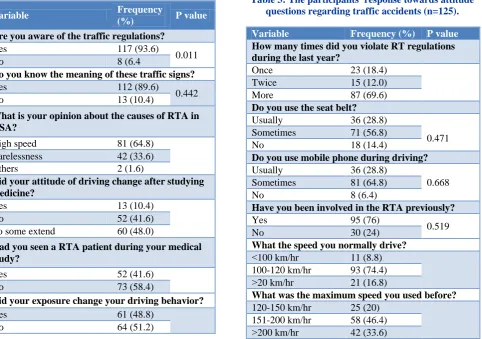
Most of study participants had their own cars (97.6%) and (96%) of them had driving license, besides, majority of them started driving early at age of (12-18) years old and (60%) did not receive driving training, see (Table 1).
Table 2: The participants' response towards awareness questions regarding traffic accidents
(n=125).
Variable Frequency
(%) P value
Are you aware of the traffic regulations?
Yes 117 (93.6)
0.011
No 8 (6.4
Do you know the meaning of these traffic signs?
Yes 112 (89.6)
0.442
No 13 (10.4)
What is your opinion about the causes of RTA in KSA?
High speed 81 (64.8)
Carelessness 42 (33.6)
Others 2 (1.6)
Did your attitude of driving change after studying medicine?
Yes 13 (10.4)
No 52 (41.6)
To some extend 60 (48.0)
Had you seen a RTA patient during your medical study?
Yes 52 (41.6)
No 73 (58.4)
Did your exposure change your driving behavior?
Yes 61 (48.8)
No 64 (51.2)
Figure 2: (A): The relationship between the participants' involvement in the previous RTA and mobile use during driving and (B): their driving speed
limit.
Table 3: The participants' response towards attitude questions regarding traffic accidents (n=125).
Variable Frequency (%) P value
How many times did you violate RT regulations during the last year?
Once 23 (18.4)
Twice 15 (12.0)
More 87 (69.6)
Do you use the seat belt?
Usually 36 (28.8)
0.471
Sometimes 71 (56.8)
No 18 (14.4)
Do you use mobile phone during driving?
Usually 36 (28.8)
0.668
Sometimes 81 (64.8)
No 8 (6.4)
Have you been involved in the RTA previously?
Yes 95 (76)
0.519
No 30 (24)
What the speed you normally drive?
˂100 km/hr 11 (8.8)
100-120 km/hr 93 (74.4)
˃20 km/hr 21 (16.8)
What was the maximum speed you used before?
120-150 km/hr 25 (20)
151-200 km/hr 58 (46.4)
Evaluation of students' attitude
Majority of students involved in RTA regardless the Mobile phone use during driving (Figure 2A) and driving speed (Figure 2B). Most of the students use a driving speed between 100-120 km/hour, regardless their educational level (Figure 3) Only 10.4% of the students reported that their attitude of the driving changed after became medical students and half of the students who came across RTA patients, their behaviour have changed (Table 2). The students who violated the traffic regulations more than twice in the last year were (69.6%) and three quarters of them had been involved in a previous RTA (Table 3). One third (33.6%) of the participants had driven the car at least once with speed exceeded 200 km/hr (Table 3).
Figure 3: The relationship between the participants' education level and the speed limit during driving.
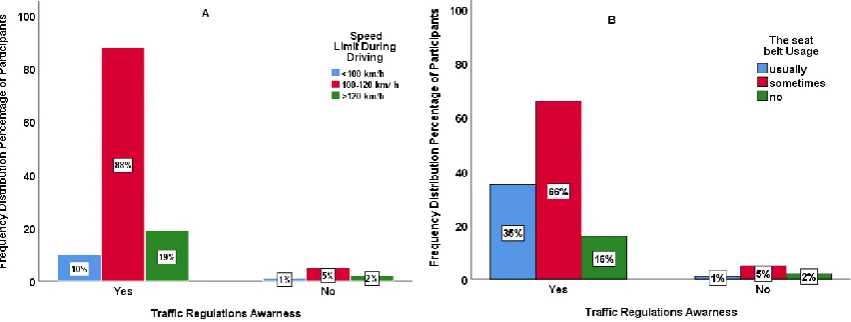
Figure 4: (A): The relationship between the participants' awareness of traffic regulations and speed limit during driving and (B): use of the seat belt.
Evaluation of students' knowledge
The vast majority of the participants are aware of traffic regulations, drive with speed 100-120 km/hr (Figure 4A) and use the seat belt sometimes (Figure 4B). The traffic signs were recognized by approximately 89.6% of the study participants. Around 64.8% of them attributed the RTAs in Saudi Arabia to the high speed.
DISCUSSION
The RTAs are reported high in Saudi Arabia with potential mortality and morbidity rate and reports from Ministry of health stated that (20%) of hospital beds and (81%) of hospital deaths are due to RTAs. These statistics reflect the magnitude of this problem which needs to be addressed.
Most of study participants had their own cars and driving license, but the majority did not receive any formal driving training, this can be taken as an evidence that, there no difficulty of having a car and driving license without formal training except the one they did when they were children. These findings agree with ALKhaldi-
from Aseer area in Saudi Arabia who reported from similar study 70% and 72% had cars and driving license respectively, and another study conducted by Al Zahrani from Al-Taif region who reported 60% of students had cars and 100% had driving licenses.6,9 Manjula et al reported only 10%, 42.2% of their participants have cars and driving license respectively.10 About 79% have driving license as mentioned by Phanindra.11 It is observed that our participants have the highest rate of owning cars.
Majority of students involved in RTA regardless the mobile phone use during driving (p=0.668) and driving speed (p=0.519).
This means that the driving speed and the use of mobile phone during driving are not the only factors that resulted in RTAs among our participants, this is in contrary to both Al-Khaldi and Al Zahranistudies, which reported high speed was the main cause of RTAs.6,9
difference (p=0.677) among the different academic levels.
The vast majority of our students said they are aware of traffic regulations (p=0.011) and the majority knew the traffic signs shown to them. This means that the participants have good knowledge concerning traffic regulations. Al-Khaldi mentioned more than 50% are aware of traffic regulations.6 Al Zahranimentioned that 12.6% have high, 75% have moderate knowledge of the traffic regulations.9 Manjula et al also reported 82.2% of his participants have good knowledge.10 Phanindra mentioned that the interpretation of the traffic signs was poor among his study population.11
Around two thirds of our participants were involved in RTA regardless the severity of injury they sustained. Al Zahrani and Al-Khaldi reported 50% and 54% involved in RTA respectively.6,9 Emmily said 55% of their participants had been involved in road traffic accident.12 Also this means that our students had more involvement in RTA than their counterparts.
More than one half of this study population use the seat belt sometimes. Taranga, et al mentioned that 62% of male and 38% of female, Al-Khaldi (2006) said 38%, Al Zahrani mentioned 33.3% use the seat belt.3,6,9 Also it is noted that our students are more committed with the usage of seat belt when compared to their counterparts.
CONCLUSION
Finally we can concluded, the RTAs rate is high among our students. The medical students of Al Baha University had more cars compared to their medical counterparts in the nearby regions, thus the accidents rate was found high. On other hand, studying Medicine has little effect on the driving behaviour of medical students, besides, no relationship between driving speed limit, mobile use during driving and the traffic accidents was observed among the study participants.
The authorities should be highly restricted to give the driving license except after comprehensive training and enforce the traffic regulations and laws stringently.
Funding: No funding sources Conflict of interest: None declared
Ethical approval: The study was approved by the Institutional Ethics Committeeat the faculty of medicine, Albaha University
REFERENCES
1. Peden M, Scurfield R, Sleet D, Mohan Hyder AA, Jarawan A. World Report on Traffic Injury
Prevention. Geneva (CH): World Health
Organization; 2004. Available at: http://whqlibdoc.
who.int/publications/2004/9241562609.pdf. Accessed on 3 June 2018.
2. World Health Organization. The Injury Chart book:
A graphical overview of the global burden of injuries. Geneva (CH): World Health Organization;
2002. Available at: http://whqlibdoc.who.int/
publications/924156220X.pdf. Accessed on 3 June 2018.
3. Reang T, Tripura A. Road Safety: Knowledge,
practice and determinants among undergraduate medical students of Agartala Government Medical College & Govinda Ballabh Pant hospital. Int J Med Sci Public Health. 2014;3:911-5.
4. Al-Tukhi MH. Road Traffic Accidents: Statistics and Data Comparing Gulf Countries and Riyadh Area. Saudi Med J. 1990;11:1-3.
5. Ansari S, Akhdar F, Mandoorah M, Moutaery K.
Causes and effects of road traffic accidents in Saudi Arabia. Public Health. 2000;114:37–9.
6. Al-Khaldi YM. Attitude and practice towards road traffic regulation among students of health sciences college of Aseer Region. J Family Community Med. 2006;13:108-13.
7. Badawi IA, Alakija W, Aziz MA. Road Traffic
accidents In Asir Region, Saudi Arabia: Pattern and Prevention. Saudi Med J. 1995;16:257–60.
8. Nofal FH, Saeed AA, Anokute CC. Aetiological
factors contributing to road traffic accidents in Riyadh city, Saudi Arabia. J R Soci Health. 1996;116:304–11.
9. Al-Zahrani HA. Knowledge and attitude towards
road traffic regulations among students of health sciences college in Taif KSA. Int J Med Sci Public Health. 2015;4:241-4.
10. Manjula R, Vijaylaxmi BH, Dorle AS. A study on knowledge and practice of road safety among medical students of S.N. Medical College, Karnataka. Int J Community Med Public Health. 2017;4(6):1993-5.
11. Phanindra D, Chaitanya G. Awareness and practice
of road safety measures among college going students in Guntur City. public health Review. Int J Public Health Res. 2016;3:54-8.
12. Emmily MK, Angolkar M, Swati BM. Assessment
of Knowledge and Practice Measures Regarding Prevention of Road Traffic Accidents among Undergraduate Medical Students. Int Res J
Interdisciplinary Multidisciplinary Studies
(IRJIMS). 2016;2:93-101.
Cite this article as: Elshambaty YB, El Jack IA, Al