Quality of Life in a Municipal Nursery in Brazil
Carolina Lutz VerçosaFederal Rural University of Rio de Janeiro (UFRRJ)
Paulo Lourenço Domingues Junior
Doctor in Sociology from University of São Paulo (USP) Professor at the Federal Rural University of Rio de Janeiro (UFRRJ)
Luisa Vieira
Federal Rural University of Rio de Janeiro (UFRRJ)
Abstract
This article aims to conceptualize Quality of Working Life (QWL), addressing its origins and evolution over time and its main models. The implementation of QWL in organizations brings actions that help to promote a healthier and more satisfactory work environment for employees. In this context, the article had as its research source a Municipal Nursery, the "Children's School Unit", public, non-profit, in the city of Paraíba do Sul – Rio de Janeiro, aimed at care and education to children between zero and four years . Through an internal analysis in the Unit made from individual interviews with some questions, it was possible to analyze the perception and knowledge of each interviewee on the subject and what are the main factors that interfere in Quality of Life at Work. It was also used, the bibliographic research, allowing a greater knowledge about the subject addressed.
Keywords: Quality Of Life at Work, Satisfaction Of Employees, Healthy Environment.
INTRODUCTION
Nowadays society has been experiencing countless social, economic, political, technological changes and especially with regard to Quality of Life and Quality of Life at Work. Concern for well being is becoming increasingly important and paramount in both personal and professional life. The concept of Quality of Life at work involves both the physical and environmental aspects and the psychological aspects of the workplace.
The growing interest in improving the quality of life at work highlights the evolution of society in general, as well as the level of education of people, since democratization has influenced workers' acceptance of the authoritarianism of their superiors (ROBBINS ; JUDGE; SOBRAL; 2010).
Chiavenato (2008) reports that quality of life implies creating, maintaining and improving the work environment in its physical, psychological and social conditions. This results in a pleasant, friendly work environment and substantially improves the quality of life of people in the organization.
In this way, organizations are increasingly concerned with strategies in order to develop and offer a good working environment, not only for the economic health of the company, but also for the health of the people who work there and are part of that daily context.
According to Chiavenato (2004: 448) "Total quality management in organizations depends fundamentally on the optimization of human potential".
Due to the importance of this theme in the organizational context, an interview with simple and objective questions was elaborated, where it was developed in a Municipal Nursery in the city of Paraíba do Sul (Rio de Janeiro), in order to obtain information about the degree of knowledge of the interviewees, in which refers to Quality of Life at Work and what aspects contribute to this.
For a better analogy and help of this research, this article will have in the next sections the theoretical reference that will bring the origin and evolution of QWL; the concept of QWL; and the main models in the perspective of three scholars; in the third section will be presented the research methods, then the analysis and discussion of the results and, finally, the conclusions of this research.
THEORETICAL FOUNDATIONS
Origin and evolution of Quality of Life at Work
The first research and studies on Quality of Work Life began in the 1950s in London where Eric Trist and his colleagues researched and developed a model to study the relationship between individual-work-organization. This model had the following perspective that said "it understands the organizations as constituted by two independent subsystems: the technological one and the social one" (ZANELLI, BORGES ANDRADE, BASTOS, 2004, p.354).
These studies culminated in the search for an enrichment and restructuring of the tasks to make the life of the workers less painful, giving rise to the name QWL (FERNANDES, 1996).
In the early 1970s, there was a decrease in QWL interests due to the energy crisis. It was not until the end of the decade, in 1979, that there was a resurgence of the QWL movement, due to the concern with international competitiveness and the great success of managerial styles and techniques of the employee-centered Japanese productivity programs.
Given this scenario, companies seek new ways to involve employees in organizational processes, starting with new management strategies, began the search for new technologies, as well as new ways of organizing work.
Already in the 80s, the search for a greater participation of the workers in the decision-making processes of the companies had considerable growth. This led workers to claim and question their labor rights, causing organizations to rethink the way they manage and interact with their employees (Nadler et al, 1983).
The 1990s brought the information age. From that moment on, companies that are looking for market success, have a greater concern for their employees and the work environment.
Since then, the Quality of Life at Work have been the object of academic study and experiences in all parts of the world.
Quality of life at work
Currently, the topic of Quality of Life at Work (QWL) has been much discussed and concern for the well being of people in both personal and professional life, it is already of extreme importance.
Thus, there are several factors that are relevant to Quality of Life at Work, such as the choice of profession, culture, values, family infrastructure, interpersonal relationships. The QWL concept involves both the physical and environmental aspects and the psychological aspects of the workplace.
Chiavenato (2008) reports that quality of life implies creating, maintaining and improving the work environment in its physical, psychological and social conditions. This results in a pleasant, friendly work environment and substantially improves the quality of life of the people in the organization.
For Gil (2009) the concept of QWL is related to deep respect for people. Managers know that to achieve high levels of quality and productivity, organizations need motivated people who actively participate in the jobs they do and are adequately rewarded for their contributions.
Classical authors such as Maslow and Herzberg (BÚRIGO, 1997, p.39), investigated the Quality of Life at Work movement as motivational factors linked to performance, and from that point on, based on the authors' conceptions, it is considered "quality of life at work when individuals can meet their important personal needs through the organization in which they operate".
According to Chiavenato (1999), QWL involves a relation of factors, such as: satisfaction with the work performed; the possibilities of future in the organization; recognition of the results achieved; the perceived salary; benefits accrued; the human relationship within the group and the organization; the psychological and physical work environment; the freedom and responsibility to make decisions; opportunities to participate. QWL affects personal and behavioral attitudes relevant to individual and group productivity, such as: motivation for work, adaptability to changes in the work environment, creativity and willingness to innovate or accept changes (GIL, 2009).
Main models of Quality of Life at Work
According to Bergamini (2008) the main goal of the quality of life program is to improve worker satisfaction by giving due value to its employee, encouraging him in his work.
However, the quality of high work leads to a climate of trust and mutual respect, in which people tend to increase their contributions and increase their chances of success (OGATA AND SIMURRO, 2009).
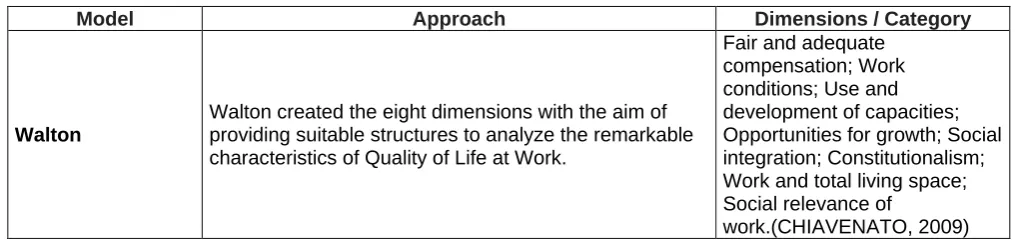
Given the range of theories and studies on QWL, we chose to list the main models of this movement, established by authors who are considered classics in this area, among them: Nadler and Lawler; Hackman and Oldham; and Walton, as shown in Table 1.
TABLE 1: Adapted by the authors (2018).
Model Approach Dimensions / Category
Walton
Walton created the eight dimensions with the aim of providing suitable structures to analyze the remarkable characteristics of Quality of Life at Work.
Fair and adequate compensation; Work conditions; Use and development of capacities; Opportunities for growth; Social integration; Constitutionalism; Work and total living space; Social relevance of
Model Approach Dimensions / Category
Nadler e Lawler The model is based on four aspects
Perception of need; Focus on the problem and highlight it in the organization; Structuring problem identification and solution, participant training project theory / model; Compensations designed for both processes and outcomes; Broad involvement of the organization in the realization of the project (BERGAMINI, 2008)
Hackman e Oldham
They propose a model of the characteristics of the task, based on the idea that the dimensions involved can create critical psychological states that can, in turn, generate positive results for both the worker and the organization. The evaluation of the QWL, in this proposal, is given in terms of: task dimensions; psychological states of the worker, and personal and work results. For these authors, with this model it is possible to systematize the dimensions or
characteristics of the post determining the QWL, through the motivational potential of a task.
Variety of skills; Identity of the task; Meaning of the task; Autonomy; Retroaction of one's own work; Extrinsic feedback, Interrelationships. (BÚRIGO, 1997)
METHODOLOGY
For the elaboration of the present article, we worked with the methodology of qualitative research, using the technique of interviews. Qualitative research is described by Minayo (2001) as "the methodology that cares in the social sciences, with a level of reality that can not be quantified. That is, it works with the universe of meanings, motives, aspirations, beliefs, values and attitudes, which corresponds to a deeper space of relationships, processes and phenomena that can not be reduced to the operationalization of variables."
The purpose of qualitative research is to collect data in order to elaborate the "base theory", that is, the set of concepts, principles and meanings. In this way, the interview was chosen as the basic instrument for data collection. It is a face-to-face conversation, between the interviewer and the interviewee, in order to obtain important information and understand the perspectives and experiences of the interviewees.
According to Marconi and Lakatos (2004) "the qualitative interviews are little structured. The principal interest of the researcher is to know the meaning that the interviewee gives to the phenomena and events of his daily life, using his own terms. "
And to complete, we use the bibliographical research that has the purpose of according to Marconi and Lakatos (2004) "to put the researcher in direct contact with everything that has been written or said on a certain subject, including conferences followed by debates that have been transcribed by ". The main advantage of this methodology, according to Gil (2008) is that" the bibliographic research resides in the fact that it allows the researcher the coverage of a range of phenomena much more extensive than the one that could search directly. "
However, simple and direct questions on "Quality of Life at Work" were developed in order to obtain information about each interviewee and their perceptions about this topic. Fifteen employees of the "Infant Education Unit" (UEI), a municipal nursery, located in a peripheral district in the city of Paraíba do Sul (Rio de Janeiro), were interviewed.
ENVIRONMENT OF THE STUDY
The "Infant Education Unit" (UEI) is a day care center and is located in a peripheral district of the city of Paraíba do Sul (Rio de Janeiro), serving children from the nursery to the age of four. Its staff consists of four teachers, seven monitors, three lunchrooms, two general service aides, a secretary and the manager. Periodically, a pedagogical counselor go to the UEI to verify what is being done in the day care center and pass guidelines from the Municipal Education Department (SEDUC).
ANALYSIS AND DISCUSSION OF RESULTS
aides. However, simple and clear questions were elaborated in order to know the perception and opinion of the collaborators, on Quality of Life at Work and what influence to the improvement of such activity. Firstly, questions were asked to analyze the profile of employees, such as age, sex, marital status, children, schooling, hours worked and length of service. From there, we obtained the following results:
• 90% of the employees are women, aged between 18 and 47 and only two are married. • Approximately 32% have up to two children.
• Among the 16 employees, 11 employees work 6 hours a day and 5 employees work 8 hours a day. • 68% of employees have worked for more than two years in the day care center.
• Only 26% have up to elementary / middle school and the remaining 74% have an academic background or are in school.
In view of the analysis of these results, it was observed that because it is a work focused on child care, the predominance is female due to the ease and vocation in activities that require care and attention. However, it can be seen that age is not a relevant factor in the Unit interviewed to perform such activities, being able youngsters between 18 and 25 years to achieve the same performance of more experienced women, due to this, there is a variability in the age group of employees. In this way, it becomes a positive point within the organization, as there is an exchange of information and learning among employees. From the points mentioned it is noted that there is the possibility of contracting beyond the tender offered by the Municipality. Given this, one can see a negative point, since contracted employees may feel unequal in relation to the public employees because they have stability in the position.
The public tender for the Infant Education Unit does not require higher education for some areas such as monitors, lunchrooms, auxiliaries. The position of professor is necessary the superior education or teaching.
We asked them to describe their position, but the descriptions of the collaborators were very brief and the ideas presented were in common. As an example, one monitor cites "My position asks for an accompaniment regarding the students, regarding the hygienic care and aid to the pedagogical practices of the teachers, inside the classroom". Another example, now of a teacher, where she explains "…I develop pedagogical works and socialization with the students".
However, the positions and duties of the collaborators are very specific, the teachers have the function of developing pedagogical and socialization works, supervising the monitors in order to carry out their tasks with responsibility and commitment. The monitors have the task of accompanying the students in hygiene, food and pedagogical practices inside the classroom supervised by the teachers. The Lunch Boxes have as obligations, the preparation of food, organization of the kitchen and the validity and quality of the products to be used. General services aides are responsible for keeping the environment clean and organized.
Then we ask how they see the organization they work in. Among those interviewed we highlight an answer that called us attention, where he describes his organization as "a unit that offers quality teaching, where it always aims at the development, learning and growth of each student. With professionals who carry out each function with great responsibility, dedication, commitment and support to each other. "
However, it is noticeable that the day-care center has a harmonious and well-disciplined environment, with employees dedicated and involved in promoting education always with a lot of responsibility and respect among co-workers. After that, we asked about "what would be Quality of Life at Work for them". However, they defined QWL as a "quiet and pleasant environment", "having satisfaction in the activity and position we hold", "having good interpersonal relationships respecting everyone", "good living together", "having resources to develop their obligations ".
Another question was "which aspects favor the Quality of Life at Work". And in most of the answers, we see that the QWL favorable aspects in the respondents' conception are: "harmony in the workplace", "respect", "appropriate working conditions for each position and function", "adequate remuneration", "good relationships with colleagues", "appropriate physical structure", "cooperation", "recognition" and "security in the organization".
It can be observed that many people did not know to answer to the right, or only quoted points, referring to the last two questions mentioned above. In this way, we see an opportunity for the organization and / or municipality to invest in training and lectures on the subject, so that employees recognize the importance of QWL applied within an organization, even if it is a public organization.
For a company that adopts programs of Quality of Life at Work has some benefits such as the reduction of turnover (turnover of personnel), the retention of talent, improvement of employees' health, reducing the level of stress, improving the organizational climate, and motivating employees to work more quickly and efficiently. As a consequence, due to these benefits generated by QWL, we can affirm that there is a significant improvement of the productivity of the employees, because they will be satisfied and enthusiastic at work.
part, the interviewees cite that the service "without recourse" and "without adequate physical structure" are the main factors that generate discomfort and stress among them, since it is necessary an adaptation and certain improvisations of their parts so that they can attend all the children, as well as special children.
One of the interviewees quotes, "... something that discourages us, is that we have more children in the day care than we can, even though we can manage all the activities, you have to make adaptations so that all of them can accomplish activities." Another complains, "Having a few professionals to give attention to all the students generates a lot of stress." A lunch box states that "We do not have a specific training course on child nutrition and much less nutritionist to guide people in the day to day, we have to think what to prepare for children with what is provided." One of the monitors emphasizes "The day care does not have recourse to attend to children with disabilities generating difficulty in carrying out the activities". Another quote "Structure is not suitable for day care ..." and "we are not recognized ...".
However, it is notorious that there are flaws and deficiencies, and they need to be solved in the Infant Education Unit. However, because it is a public unit, where the funds, resources and management come from the Municipality, everything becomes more difficult and slow. We also observe that in this type of public sector organization, the interest for the health and well-being of the employees is not a factor with a high degree of importance, but only the service provided in question, where they aim to reach and benefit the community as a whole.
1.
CONCLUSIONSToday, companies are increasingly caring for their employees and their needs, but they are not all looking for programs that help in the achievement of Quality of Life at Work. These programs aim the satisfaction of employees and the improvement of the work environment and the basic conditions to carry out their activities, and they have the consequence of increasing the profitability of the company, employee productivity and organizational health.
In the Infant Education Unit (municipal nursery) in Paraíba do Sul city, we observed a unit with dedicated and united employees in order to carry out their activities with competence and responsibility. Employees appreciate the development and learning of children and perform their tasks in the best possible way. However, it is an organization with few resources and a physical structure that is not suitable for the operation of a Day Care Center, and it is necessary to have improvisations and adaptations by the teachers and the monitors to the care of the children and also the preparation of meals.
We conclude that not all organizations, whether public or private, can see and measure the importance of quality of life at work and the benefits that can be generated for employees and the organization itself. We have as an example the municipal nursery in question, which due to the lack of resources offered and the other problems exposed during the interviews, shows the disregard of the Quality of Working Life of its collaborators.
REFERENCES
BERGAMINI, C. W. Motivação nas Organizações. 5a Edição. São Paulo: Editora Atlas, 2008.
BÚRIGO, C. C. D. Qualidade de Vida no Trabalho: Dilemas e Perspectivas. Florianópolis: Insular, 1997.
CHIAVENATO; I. Gestão de pessoas: o novo papel dos recursos humanos nas organizações. 14ª edição. Rio de Janeiro: Campus 1999.
CHIAVENATO; I. Gestão de pessoas – 2a Edição. Rio de Janeiro: Campus, 2004.
CHIAVENATO; I. Recursos humanos: o capital humano das organizações. 8a edição. São Paulo: Atlas, 2008.
FERNANDES, E. C. Qualidade de vida no trabalho: como medir para melhorar. 3a edição. Salvador: Casa da Qualidade, 1996.
GIL, A. C. Gestão de pessoas. Enfoque nos papéis profissionais. São Paulo: Atlas, 2009. GIL, A. C. Métodos e Técnicas de Pesquisa Social- 6a edição. São Paulo: Atlas, 2008. LAKATOS, E. M.; MARCONI, M. A. Metodologia Científica- 6a edição- São Paulo: Atlas, 2004.
MARQUES, A. L.; MORAES L. F. R.; COSTA, R. P.; FERREIRA J. R. Qualidade de vida e estresse no trabalho em uma grande corporação de polícia militar. São Paulo, 1989.
MINAYO, M. C. S. (org.). Pesquisa Social. Teoria, método e criatividade. 18a edição. Petrópolis: Vozes, 2001. NADLER, D. A; HACKMAN, J. R.; LAWLER, E. E. Comportamento Organizacional. Rio de Janeiro: Campus, 1983.
OGATA, A., SIMURRO, S. Guia Prático de qualidade de vida: como planejar e gerenciar o melhor programa para a sua empresa. Rio de Janeiro: Elsevier, 2009.