The Evaluation of College Physical Education
Teachers’ Professional Accomplishments:
A College-Based Study in Taiwan
Ming-Ly Hsu * , Kuei-Pin Kuo**
* Lecturer, Office of Physical Education, LEE-MING Institute of Technology.
** Assistant Professor, Office of Physical Education, National Pingtung University of Science and Technology. Corresponding author: Kuei-Pin Kuo
Email: [email protected]
Mailing address: 1, Shuefu Road, Neipu, Pingtung 912, TAIWAN
Tel: +886-921-160110; Fax:+886-774-0471
Abstract
Given the internationalization of global universities and the tendency of families to have fewer children, competition among Taiwanese colleges and universities is becoming increasingly strong as the schools compete for a smaller pool of students. Among the occupations affected by this phenomenon are physical education (PE) teachers, who play comprehensive and multidimensional roles in these schools and face increasing challenges. This study examines professional accomplishment frameworks, indicators, and specific areas for improvement based on college and university requirements for PE teachers, comparing school supervisors' understanding regarding PE professional work with the actual state of PE teachers' professional accomplishments. Employing the analytic hierarchy process (AHP), this study asked teachers, scholars, experts, and administrators with substantive experience to define three main objectives (teaching, research, and service) and 16 criteria related to PE. Based on responses from 13 unit directors and scholars and 10 PE teachers, researchers determined relative weights for the indicators and examined differences between the perceptions of the respondents and the school supervisors to construct a detailed plan for further improvements in the professionalism of PE teachers. The results showed that the PE teachers' perception of assigned weights for the professional objectives, ordered from high to low, was as follows: teaching 0.696, service 0.229, and research 0.075. The unit directors and experts weighted the PE teachers' professional objectives as follows: teaching 0.687, research 0.187, and service 0.126. Because the data indicated that both the PE teachers and the directors ranked teaching as the most important objective, teaching should be a goal in future improvements. This result provides PE teachers with a plan to boost their professional accomplishments and simultaneously establishes an important reference for future performance evaluation.
Keywords: analytic hierarchy process (AHP); physical education; teacher profession
1.INTRODUCTION
ranking systems also correlate closely to the internationalized status of the various institutions of higher education. Hence, annual rankings attract significant global attention and have become the reference guide with which nations evaluate the international accomplishments of their domestic institutions of higher education. The rankings therefore influence the educational policies and funding allocations of educational institutions around the world.
Similar to the situation in other countries, the modernization process in Taiwan has been accompanied by a sharp drop in the national birth rate, presently the lowest among the developed countries. Based on Ministry of Interior data (Ministry of the Interior, 2009), the Taiwanese birth rate has decreased each year since 1981, falling from 2.30% in 1981 to 0.91% in 2008. The number of newborns in 2008 was 208,755 less than in 1981. As a result, kindergartens, elementary schools, and middle schools are universally experiencing insufficient enrollment. By 2016, colleges and universities are expected to face a similar problem because in addition to the decrease in the number of students, new schools have been established since 1991. The number of colleges and universities has increased to 162 in 2009 from 123 in 1991, and the number of technical colleges and universities has increased to 95 in 2009 from three in 1991. The combination of these two factors will result in substantial competitive pressure among schools, particularly technical colleges and universities. This competitive pressure is attributed to the fact that some weaker schools with insufficient enrollments might be forced to close. To boost the quality of teaching and research and to further their mission of service to society, Taiwanese colleges and universities are striving to formulate “teacher evaluation methods”. The Ministry of Education, aiming to respect the differences in the fields, functions, and traits of the different universities, has clearly declared that teacher performance evaluation methods and standards should be set by individual universities themselves. Professors’ teaching, research, and service standards are closely linked with university performance, which in the near term might influence the quality of education and the students’ rights to be educated; in the long term, this factor might influence the standards and competitiveness of the nation’s talent. Thus, determining how to design evaluation systems for university teachers’ performance that can satisfy student educational needs, national industrial development goals, and contributions to social service is a topic worthy of in-depth study.
In addition to PE instruction, college and university PE teaching incorporates advanced academic studies and social service activities. Instructors not only teach sports culture but also actively contribute to the significance of physical education with regard to individuals, society, and the nation. Through the practice of PE teaching, research, and service work, the nation's PE and sports policy can be further realized, thus promoting participation in sports and improving the physical health of the general public. Therefore, in general, college PE teaching and service is highly regarded by students and administrators. Surprisingly, however, college PE teachers have faced significant pressure and indifference during the educational reform process, creating major conflicts regarding the PE curriculum, personnel, and administrative systems of colleges and universities. Therefore, the topics correlating to the college PE curriculum have become key points of concern for all parties. Topics such as students' rights to education, teachers' work rights, required courses and electives, and the physical conditioning of college students are among the topics being discussed.
PE/sports-related fields in which AHP is applied are experiencing vigorous development. Examples include the following: the evaluation of Major League Baseball players (Bodin, & Epstein, 2000), topics in quality management for soccer players (Partovi, & Corredoira, 2002), and the evaluation and selection of members for the national baseball team (Lin, Tung, Chen, & Chen, 2011). In addition, research topics focusing on PE courses or the sports curriculum demonstrate the rapid development in related studies, including a comprehensive evaluation of college PE courses (Liu, & Xu, 2013), an exploration of preventive measures concerning sports injuries in PE activity (Zhou, 2013), and an efficiency analysis of rural Iranian PE development (Soleimani-Damaneh, Soleimani-Damaneh, & Hamidi, 2012). In view of these developments, this study references an evaluation by Chen and Lin (2008) focusing on the professional accomplishments of PE teachers in Taiwan-area science and technology (S&T) universities, adjusting Chen and Lin’s evaluation method to even better conform to an evaluation framework for present college PE teachers. In addition to teaching, research, and service objectives, this study includes the following 16 criteria: a teaching evaluation; an outline of instruction given; a compilation of lecture notes; any selection as a superior teacher; any participation in teaching symposia or practical experience and certification; the attendance situation for the instruction given by teachers; the teachers’ academic publications listed in the Science Citations Index (SCI), the Social Sciences Citation Index (SSCI), the Arts & Humanities Citation Index (A&HCI), the Taiwan Social Sciences Citation Index (TSSCI), and the Engineering Index (EI); the publication of papers in general periodicals; any National Science Foundation (NSF) programs; other government projects or industry-academia cooperation proposals; the delivery of papers at and participation in symposia; teachers concurrently holding administrative posts within their schools; the assumption of administrative work in the gymnasium; practicum training or civic organization guidance; assistance in popularizing education; the assumption of class advisor duties; and other after-class assistance/guidance (see Figure 1).
Overall, the various pressures faced by college PE teachers are similar to the pressures faced by teachers in other systems. Teachers must exert mental and physical efforts in teaching, research, and service and must conform to various requirements in this important and difficult job. Hence, this study focuses on the theoretical and practical requirements for college PE teachers given collegiate competition and the tide of internationalization in Taiwan. The study seeks to establish an evaluation framework for PE teachers' professional accomplishments and to examine the relative weights of the primary aspects and their relationships. By comparing the views of supervisors and PE teachers, the study provides a detailed scientific basis for improving the professional accomplishments of PE teachers, enabling the teachers to fulfill the missions entrusted to them by society and academia, and further enhancing professional performance.
2.METHOD 2.1 Participants
assistance/guidance) and indicators developed from the main aspects, the study constructed an “analytic hierarchy questionnaire of indicators for Taiwan college PE teachers' professional accomplishments” to collect the interviewees' responses. From a practical point of view, the study evaluated the PE teacher profession within colleges and universities and obtained questionnaire responses from 10 PE teachers within the university (one professor, three associate professors, one assistant professor, and five lecturers, each with at least 10 years of teaching experience). Overall, 23 people served as the subjects for the study's questionnaire.
2.2 Analytic Hierarchy Process (AHP)
AHP, a set of decision-making methods developed by Saaty in 1971, is primarily applied to decision-making problems with uncertain circumstances and multiple evaluation criteria. AHP is one method of multiple-attribute decision making (MADM), which is primarily applied to evaluation and selection (Tzeng, 2003). AHP can combine complex problems to establish a hierarchical structure having mutually influencing relationships, and under this structure AHP compares and evaluates the importance of the influencing factors (Satty, 1980). When processing the hierarchical procedures, the overall steps (Satty, 1990) are as follows: (1) Delimitation of the problem: i.e., identifying the problem.
(2) Establishment of the hierarchy: the partitioning of the hierarchy must have a structure for understanding the problem.
(3) Questionnaire design and survey: after the partitioning of the hierarchy, the weights of the various factors must be determined to solve for the weights of the hierarchical factors. Jensen (1984) suggested that the mode of pair-wise comparison should be adopted to solve for the factor weights, meaning that any two factors within a certain level—with the next higher level’s factors as the evaluation mark—are each used to evaluate the relative contribution or importance of these two factors to the next-higher-level factors. Saaty recommended using a 1-9 numerical evaluation scale to represent the importance, where 1 means equally important, 3 means slightly more important, 5 means considerably important, 7 means extremely important, and 9 means absolutely important, with 2, 4, 6, and 8 representing intermediate values in the adjacent scale.
(4) Computing the weights of the hierarchical factors: after a comparison of the scores of each level's factors relative to the higher level's factors, matrix operations are conducted to process the data, and at each level the matrix is composed of its lower-level factor scores. The eigenvectors thus computed are the weights for the relative importance of these factors to the higher-level factors (Satty, 1980).
Based on the recommendations of Saaty and Jensen, this study’s “Analytic hierarchy questionnaire of indicators for the profession accomplishments of PE teachers in Taiwan colleges and universities” employed an evaluation table with a 9-point scale design to serve as the research tool.
3.RESULTS
assistance/guidance, after confirming the views of 13 university administrators and the experts and scholars outside the university. The questionnaire included three primary objectives—teaching, research, and service—and 16 evaluation indicators (“criteria”) to serve as the framework for evaluating the PE teachers’ professional accomplishments. All of the objectives and criteria are detailed in Figure 1. The four functions of management science include the following: planning (the process of determining in advance which tasks should be completed and how to complete the tasks), organization (the process of combining manpower with material resources and determining the formal relationships among manpower, tasks, and material), leadership (the process of applying decision-making capability to act and influence organization), and control (the correction process in the comparison of reality to standards). Therefore, in the administrative effort to increase teachers’ professional accomplishments, the role played by PE teachers in schools would be increasingly important. Using the evaluation framework for the PE teachers’ professional accomplishments, the two key management points of planning and organization can be satisfied and can be used to improve PE teachers’ professional accomplishments while simultaneously realizing the study’s goal of assisting in efficient management.
3.1 Analysis of indicator weights for college PE teachers’ professional accomplishments
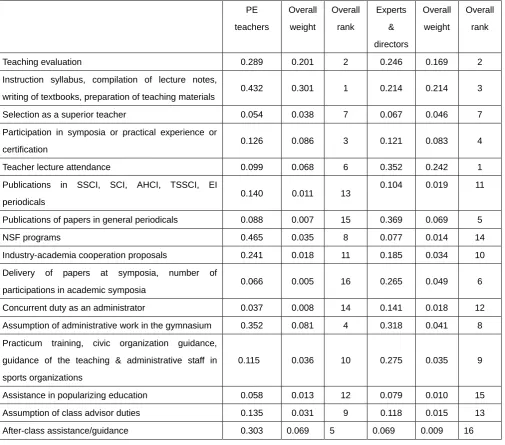
The study’s self-compiled 9-point-scale for the “Analytic hierarchy questionnaire of indicators for the profession accomplishments of PE teachers in Taiwan colleges and universities” was employed to obtain responses from the 13 unit directors and experts and scholars and from the college’s 10 PE teachers. AHP Maker Version 1.0 beta software performed the indicator weight analysis of the responses, solving for the weights and importance ranks of all indicators for the college PE teachers. The consistency ratio (CR) value to CR value is always < 0.1, and therefore, the consistency in each matrix meets the requirement (as detailed in Table 1). The relative weights of all indicators and their importance ranks are detailed in Table 2.
From the viewpoint of PE teachers, the weight analysis for the objectives ordered from high to low was as follows: teaching 0.696, service 0.229, and research 0.074 (Table 1). This result clearly shows that teaching is the most important aspect and the most needed resource, indicating that PE teachers are primarily focused on teaching. From the standpoint of the supervisors, the most important objective also was teaching (0.696), with research (0.187) second, and service (0.126) third.
The PE teachers’ views on the importance of the criteria (Table 2) were ordered as follows: (1) instruction syllabus, the compilation of lecture notes, the writing of textbooks, and the preparation of teaching materials (0.301); (2) teaching evaluation (0.201); (3) participation in teaching symposia, practical experience, or certification (0.086); (4) the assumption of administrative work in the gymnasium (0.081); (5) after-class assistance/guidance (0.069); (6) teacher lecture attendance (0.068); (7) selection as a superior teacher (0.038); (8) National Science Foundation (NSF) projects (0.035); (9) the assumption of class advisor duties (0.031); (10) practicum training, civic organization guidance, and the guidance of teaching and administrative staff in sports organizations (0.036); (11) industry-academia research proposals (0.018); (12) assistance in popularizing education (0.013); (13) publication in SSCI, SCI, A&HCI, TSSCI, and EI periodicals (0.011); (14) concurrent duty as an administrator (0.008); (15) the publication of papers in general periodicals (0.007); and (16) the numbers of papers published at symposia and the amount of participation in academic symposia (0.005).
textbooks, the preparation of teaching materials (0.214); (4) participation in academic symposia, practical experience, or certification (0.083); (5) the publication of general papers in periodicals (0.069); (6) the number of papers published at symposia and the amount of participation in academic symposia (0.049); (7) selection as a superior teacher (0.046); (8) the assumption of administrative work in the gymnasium (0.041); (9) practicum training, civic organization guidance, the guidance of teaching and administrative staff in sports organizations (0.035); (10) industry-academia cooperation proposals (0.034); (11) publication in SSCI, SCI, A&HCI, TSSCI, and EI periodicals (0.019); (12) concurrent duty as an administrator (0.018); (13) the assumption of class advisor duties (0.015); (14) NSF projects (0.014); (15) assistance in popularizing education (0.010), and (16) after-class assistance/guidance (0.009).
3.2 The differences between teachers’ and directors’ perception regarding PE teachers’ professional
accomplishments
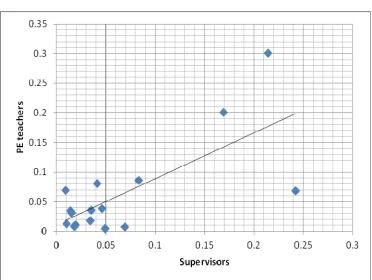
To avoid the confusion of “those concerned being too close to the matter” and to obtain a comprehensive evaluation of the professional accomplishments of PE teachers, the study examined the accomplishments that PE teachers ideally should achieve by assessing the different standpoints of the 13 unit directors, experts, and scholars. In addition, the study analyzed the differences between PE teachers and administrators regarding their perceptions of PE teachers’ professional accomplishments (Figure 2) to collect broad views and obtain beneficial effects.
The results demonstrate that both sides viewed the following criteria as having similar importance: (1) teacher lecture attendance (0.068, 0.242); (2) teaching evaluation (0.201, 0.169); and (3) instruction syllabus, the compilation of lecture notes, the writing of textbooks, and the preparation of teaching materials (0.301, 0.214). Conversely, the criteria that PE teachers and administrators viewed as having different importance were as follows: (1) assistance in popularizing education (0.013, 0.010); (2) concurrent duty as an administrator (0.008, 0.018); and (3) publication in SSCI, SCI, A&HCI, TSSCI, or EI periodicals (0.011, 0.019).
4.DISCUSSION
considering teachers’ professional advancement, i.e., studying for academic degrees, taking short-term advanced studies or refresher courses, and participating in academic discussions.
The overall weights of the indicators suggest that from both PE teachers’ and supervisors’ standpoints, the following indicators—teaching evaluation; instruction syllabus, the compilation of lecture notes, the writing of textbooks, and the preparations of teaching materials; selection as a superior teacher; participation in teaching symposia, practical experience, or certification; and teacher lecture attendance—are located within the top seven rankings for both groups. This result underscores the objectives layer, which suggests that teaching is the most important task. Among the research criteria, both the teachers and the supervisors indicate that the publication of papers in SSCI, SCI, A&HCI, TSSCI, or EI periodicals (ranked 13th by the teachers and 11th by the directors) is fairly challenging for PE teachers and thus should not be a major task for PE teachers. However, the administrators indicate that the publication of papers in other general periodicals is important (ranked 5th by the directors versus 15th by the teachers), suggesting an area of inadequacy and potential improvement on the part of the PE teachers in the perception of the school supervisors. Among the service criteria, the assumption of administrative work in the gymnasium (ranked 4th by the teachers and 8th by the directors) was ranked as an importance task by both sides. PE teachers, like all school teachers, emphasize teaching, research, and service, and the promotion of teaching administration is considered an important element of the teachers’ presence in schools.
Physical education is an important sub-division of education. Given today’s rapid changes in knowledge and ideas, PE teachers who can simultaneously succeed in the different aspects of teaching, research, and service represent full-dimensional, professional college PE teachers. This study used an efficiency management approach to explore the various challenges faced by college and university PE teachers and to firmly uphold the efforts that are appropriate to the PE teacher profession. In practice, the establishment of all evaluation criteria for PE teachers in domestic colleges and universities should consider the actual school reality to clearly define the indicators and list typical examples, thus enabling the indicators to become even more relevant in use. Therefore, future studies should explore evaluation methods for the professional accomplishments of PE teachers in all types of colleges and universities nationwide and should perform a cross-sectional study with expanded panel data to provide important suggestions for elevating the professional accomplishments of college and university PE teachers.
REFERENCES
Bodin, L., & Epstein, E. (2000). Who’s on first-with probability 0.4. Computers & Operations Research, 27, 205-215.
Chen, M. J., & Lin, W. B. (2008). A study of performance evaluations for physical education teachers’ professions in Takming university of science and technology. Tamsui Oxford Journal of Sports Knowledge, 5, 112-122.(Chinese)
Jensen, R. E. (1984). An alternatives scaling method for priorities in hierarchical structures. Journal of Mathematical Psychology, 28, 317-332.
Lin, W. B., Tung, I. W., Chen, M. J., & Chen, M. Y. (2011). An analysis of an optimal selection process for characteristics and technical performance of baseball pitchers. Perceptual and Motor Skills, 113(1), 300-310. doi:10.2466/05.25.PMS.113.4.300-310
Liu, H, & Xu, W. (2013). Based on the college physical education of comprehensive evaluation of mathematical models. Journal of Theoretical and Applied Information Technology, 49(2), 728-733.
Ministry of the Interior (2009). Ministry of the interior statistics: Annual report. Retrieved from Ministry of the Interior Global Information Net Web site: http://sowf.moi.gov.tw/stat/year/list.htm.
Partovi, F. Y., & Corredoira, R. A. (2002). Quality function deployment for the good of soccer. European Journal of Operational Research, 137(3), 642-656.
Satty, T. L. (1980). The analytic hierarchy process. NewYork, NY: Mcgraw-Hill.
Satty, T. L. (1990). How to make a decision: the analytic hierarchy process. European Journal of Operational Research, 48, 9-26.
Soleimani-Damaneh, J., Soleimani-Damaneh, M., & Hamidi, M. (2012). Efficiency analysis of provincial departments of physical education in IRAN. International Journal of Information Technology & Decision Making, 11(5), 983-1008. doi: 10.1142/S0219622012500290
Tzeng, G. H. (2003). Multiple-objective decision-making in the past, present and future. In T. Tanino, T. Tanaka, & M. Inuiguchi (Eds.), Multiple-objective Programming and Goal Programming: Theory and Application, (pp. 105-128). New York: Springer.
Table 1
Composite table of weights for PE teachers’ and experts’ objectives
PE teachers Rank Experts & directors Rank
Teaching 0.696 1 0.687 1
Research 0.075 3 0.187 2
Service 0.229 2 0.126 3
Table 2
Composite table of weights for PE teachers’ and experts’ criteria
PE
teachers
Overall weight
Overall rank
Experts & directors
Overall weight
Overall rank
Teaching evaluation 0.289 0.201 2 0.246 0.169 2
Instruction syllabus, compilation of lecture notes, writing of textbooks, preparation of teaching materials
0.432 0.301 1 0.214 0.214 3
Selection as a superior teacher 0.054 0.038 7 0.067 0.046 7
Participation in symposia or practical experience or certification
0.126 0.086 3 0.121 0.083 4
Teacher lecture attendance 0.099 0.068 6 0.352 0.242 1
Publications in SSCI, SCI, AHCI, TSSCI, EI periodicals
0.140 0.011 13
0.104 0.019 11
Publications of papers in general periodicals 0.088 0.007 15 0.369 0.069 5
NSF programs 0.465 0.035 8 0.077 0.014 14
Industry-academia cooperation proposals 0.241 0.018 11 0.185 0.034 10
Delivery of papers at symposia, number of participations in academic symposia
0.066 0.005 16 0.265 0.049 6
Concurrent duty as an administrator 0.037 0.008 14 0.141 0.018 12
Assumption of administrative work in the gymnasium 0.352 0.081 4 0.318 0.041 8
Practicum training, civic organization guidance, guidance of the teaching & administrative staff in sports organizations
0.115 0.036 10 0.275 0.035 9
Assistance in popularizing education 0.058 0.013 12 0.079 0.010 15
Assumption of class advisor duties 0.135 0.031 9 0.118 0.015 13
After-class assistance/guidance 0.303 0.069 5 0.069 0.009 16
Figure 1. Schematic of analytic hierarchy for college PE teachers profession.
GOAL
Teaching
Research
Service
Teaching evaluation
Teacher lecture attendance
Participation in symposia or practical experience or certification
Selection as a superior teacher
Instruction syllabus, compilation of lecture notes, writing textbooks, teaching materials preparation
Publications in SSCI, SCI, AHCI, TSSCI, EI periodicals
Delivery of papers at symposia, number of participations in academic symposia Industry-academia cooperation proposals NSF programs
Publications of papers in general periodicals
Concurrent duty as an administrator
Assumption of class advisor duties Assistance in popularizing education
Practicum training, civic organization guidance, teaching guidance, sport organization administration Assumption of administrative work in the gymnasium
After-class assistance/guidance