Original Research Article
Impact of middle level eye care personnel on the delivery of eye care
services in South-western Nigeria
Tayo J. Bogunjoko
1*, Adekunle O. Hassan
1, Ogugua Okonkwo
1, Toyin Akanbi
1,
Mildred Ulaikere
1, Ayodele Akinye
1, Halima Bogunjoko
1, Monsurat Y. Lawal-Sebioniga
2INTRODUCTION
The result of the Nigeria national blindness and visual impairment survey showed that an estimated 4.25 million adults aged ≥40 years have moderate, severe visual impairment or blindness. Out of this, >1 million adults with blindness are seriously in urgent need of attention.1
One of the key element of vision 2020, the right to sight is human resources development. It has suggested human resources target that will be needed to significantly reduce avoidable visual impairment in 2020.2,3 The human resources for eye health (HReH) are ophthalmologist-led. Other key members are optometrists, ophthalmic nurses, midlevel ophthalmic
ABSTRACT
Background: The objectives of the study were to review the training and assess the impact of middle level eye care
personnel (community ophthalmic technician) with skills to complement the services of the ophthalmologist for efficient eye care system and fulfilling vision 2020 goals.
Methods: The collaboration between 2010 and 2015 was reviewed with an institutional questionnaire for both Eye
Foundation Centre and College of Health Technology in Ijebu, Nigeria: structure of 2 year training Programme and one year internship, community ophthalmic technicians (COT) as assistants to ophthalmologists, hierarchy/career options and challenges and ensuring clinical quality and their strength in the Eye Foundation Eye Health System were appraised.
Results: From 2010 to 2015, a total of 72 COTs have graduated, 41(57%) of them employed by the Eye Foundation
Hospital Group. Apart from this, 28 did their internship in 2015, 19 (68%) out of this at Eye Foundation establishments in southwestern and north central Nigeria. Others are employed by other government or nongovernmental agencies. From 2010 to 2015, outpatients‟ visits have increased from 42,962 to 104,239 at its peak, surgical volume from 3,999 to 18,350 at the Eye Foundation Hospital Group. The COT programme has been accredited by International Joint Commission on Allied health personnel in Ophthalmology (IJCAHPO).
Conclusions: COTs with skills are required in large numbers to complement the services of ophthalmologists for
efficient eye health system. Their contribution is very important to meet the vision 2020 human resources objectives for Sub-Saharan Africa.
Keywords: Community ophthalmic technicians, Ophthalmologists, Eye foundation
1
Eye Foundation Centre for the Prevention of Blindness Ilese-Ijebu-Imushin, Ogun state, Nigeria
2Ogun State College of Health Technology, Ilese, Ogun State, Nigeria
Received: 08 November 2017
Revised: 21 January 2018
Accepted: 23 January 2018
*Correspondence:
Dr. Tayo J. Bogunjoko,
E-mail: [email protected]
Copyright: © the author(s), publisher and licensee Medip Academy. This is an open-access article distributed under
the terms of the Creative Commons Attribution Non-Commercial License, which permits unrestricted non-commercial use, distribution, and reproduction in any medium, provided the original work is properly cited.
personnel, (ophthalmic assistants/technicians/medical technologists), refractionists etc.4
Recent data suggest that there is shortage of ophthalmologists in developing countries.4,5 The capital cities are in most cases over supplied to the detriment of majority in the rural areas. Furthermore, training of ophthalmologists takes a long time and it is expensive. Cataract surgical rate and cataract surgical coverage are very low.4-7
In Nigeria, the traditional setting in HReH is: ophthalmologist, optometrist and ophthalmic nurses. MLOPs have not been adequately utilized in the Nigerian ophthalmic establishment. There are no cataract surgeons in Nigeria.7 Ophthalmic nurses are concentrated in the urban centres and expensive to employ in rural areas and private/mission establishments.7
Also in Nigeria where the number of ophthalmologists almost equal the required number estimated for a million population (4 per million population), there is maldistribution of ophthalmologists and other eye care workers.6-8
One way to increase the efficiency of ophthalmologist and other key eye care workers and lessen the impact of shortages is to increase the efficiency and effectiveness of each ophthalmologist by the training and use of mid-level ophthalmic personnel (MLOP). It is also a cost effective option.9-10
MLOP are dedicated ophthalmic paramedics and nurses in ophthalmic department. In 1980, a World Health Organization (WHO) task force on training such auxiliaries identified 3 levels of workers and varying levels of training. MLOP might be hospital-based or community-based personnel.11-12 Optometrists are nonmedical and they maintain an independent role.12 Observations from world health organization (WHO) meeting and report in 2001 included availability, production, distribution and utilization of MLOP in the South East Asia Region (SEAR). Therefore, MLOP is a cadre of mid-level eye health worker formally recognized by WHO.11-13 MLOP is also part of “Allied Ophthalmic Personnel” (AOP).14
The WHO global action plan 2014-19 states that AOP comprise opticians, ophthalmic and optometric technicians, ophthalmic nurses, ophthalmic photographer/ imagers, ocularists, orthoptists, vision therapists and ophthalmic administrators.14
In 2015, International agency for the prevention of blindness (IAPB) with partners International Joint Commission on Allied Health Personnel in Ophthalmology (IJCAHPO)/ Joint Commission on Allied Health Personnel in Ophthalmology (JCAHPO) and ICO signed the Cambridge Declaration. The declaration acknowledges the critical role of AOP in the delivery of
high quality comprehensive eye services - and their role in achieving Universal Eye Health.14
By delegating time-consuming patient tasks like medical record activities and patient evaluation (visual acuity, intraocular pressure etc.) to MLOPs, the ophthalmologists can efficiently deal with patient diagnosis and treatment thus increasing quality and quantity in patient care. The community ophthalmic technician (COT) programme was mooted in January 2006 when Deseret Community Vision Institute, an Eye Foundation Centre for the prevention of blindness started operations in Ogun state of Nigeria. Its officials and that of Sheikh Zayed Regional Eye Care Centre, The Gambia had a discussion that there is need to train middle level ophthalmic man power if the Eye Foundation Centre is to be a high volume ophthalmic centre. After this the idea was sold to the college of health technology for partnership. (Personal communications).15
The Eye Foundation Centre for the Prevention of Blindness consists of:
1. The Eye Foundation Hospital group which consist of 5 hospitals with state of the art equipments. This is the private arm of the establishment. They are located in: Ikeja (Headquarters), Victoria Island, Ikorodu and Lekki in Lagos state, Abuja (Federal capital territory) and Ijebu-Imushin (Ogun state). 2. The public/community hospitals- Deseret
Community Vision Institute (DCVI) Ijebu-Imushin (Ogun state) and Deseret Eye Centre, Lagos.
3. The community outreach programme.
In this paper, the authors review the training and assess the impact of middle level eye care personnel (Community Ophthalmic Technician) with skills to complement the services of the ophthalmologist for efficient eye care system and fulfilling vision 2020 goals in southwestern Nigeria.
Figure 2: Map of south-western Nigeria. Source: Nigerian official website.
METHODS
This is a descriptive cross-sectional study
The collaboration between 2010 and 2015 was reviewed with an institutional questionnaire for both Eye Foundation Centre and College of Health Technology in Ijebu, Nigeria: structure of 2 year training Programme and one year internship
Structure of the 2 year training programme
COT development in Nigeria started in 2010. Initiative from The Eye foundation hospital group in collaboration with the Ogun state school of health technology under the Department of Public health Nursing
The programme starts with a 2 years diploma as community ophthalmic technician. This is the Basic level which is a pathway to the advanced level.
Recruitment/strategy
Examination of need and capability to train average of 30 students yearly: information is provided in newspapers and on the website of the college. 1. Application packet, 2. Admission policies and procedures. 3. Institutional tuitions, fees, expenses, prerequisite course work requirements, student selection in to the Programme, sponsors institutional and pragmatic accreditation status, student tuition accurately stated.
Information for enrolling students
The following are explained to them when they are finally enrolled: they undergo examination and interview before they are enrolled: student handbook, minimum grade average, programme policies and procedures,
communicable disease policies, procedure for undergoing student evaluation, student grievance procedure and faulty grievance procedure.
General admission requirements:
1. The admission requirements for National Diploma (ND) programmes are a minimum of five (5) „O‟ Level credits passes in English Language, Mathematics, Chemistry, Physics and Biology from WAEC or NECO in not more than 2 sittings.
2. The admission requirements for Higher National Diploma (HND) programmes is National Diploma (ND) not lower than lower credit in relevant programme in addition to five (5) „O‟ level credits passes in English Language, Mathematics, Chemistry, Physics and biology from WAEC/NECO is not more than two (2) sittings.
Course duration and venues
Duration 2 years plus 12 months internship
Main venues:
1. Ogun state college of Health Technology, Ilese. 2. Deseret Community Vision Institute (DCVI),
Ilese/Ijebu-Imushin.
Centres for practical/clinicals:
1. DCVI/Eye foundation hospital, Ilese/Ijebu-Imushin. 2. Deseret Eye Centre (DEC)/Eye foundation hospital,
Ikeja, Lagos.
3. Eye foundation Hospital, Abuja. 4. Primary Health Centres in Ogun State.
Hierarchy of each subset/career options
Community Ophthalmic Technician (COT) - as student
Ophthalmic Practitioner (OPs) - interns -1 year
Nursing care ophthalmic Practitioner (NCOP) step1- 1 year post internship
NCOP step2- 2 years post internship
NCOP step3-3years (attempt IJHCAPO certification examination in third year)
Senior NCOP-after IJHCAPO certification
Principal NCOP (3 years after senior NCOP)
Chief NCOP– (after 3 years of Principal NCOP).
Statistical analysis
Figure 3: Program organizational chart.
RESULTS
Community ophthalmic technician (COT) programme
The programme started in October 2010 (Table 1).
The first set of 22 COT interns graduated in October 2013.
The second set of 23 graduated in October 2014.
The third set of 27 graduated in October 2015.
The fourth set of 28 started their one year internship in October 2015.
Nursing care ophthalmic practitioner (NCOP) in the Eye Foundation Hospital (EFH) group
A total of 72 COTs have graduated from inception and 41 (57%) of them were employed by EFH group.
28 are currently undergoing internship training and 19 (68%) of the interns are observing their internship with EFH group, others are in different local government cottage hospitals and primary health care centres.
27 COT students in 200 levels are still in school and will be resuming their clinical in February 2016.
100 level COT student started session in October 2016.
Distribution of NCOPs in EFH Group
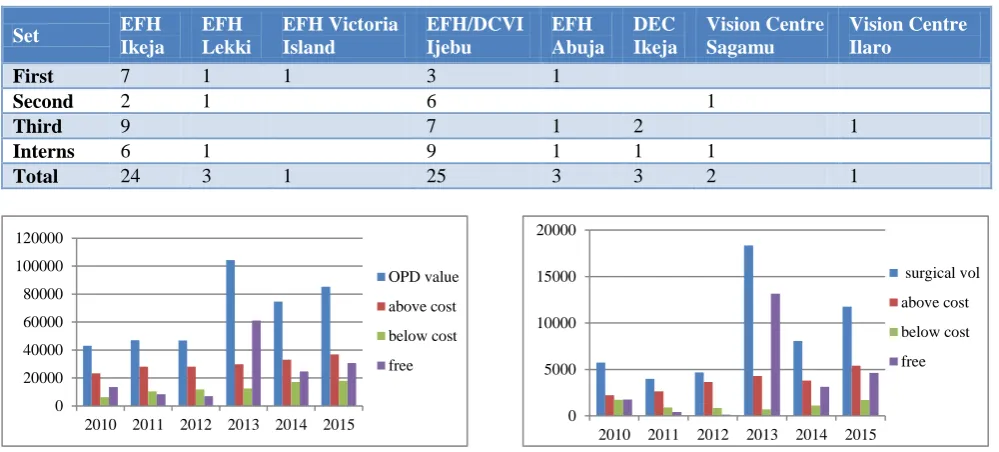
The NCOPs have been trained to function in different departments and the ones employed were posted to different hospitals and working in different departments namely (Table 1 and 4).
First set of COTs- 22 graduated, 13 employed
Distribution –Ikeja-7, Lekki -1, VI-1, Ijebu-3, Abuja-1.
Second set of COTs- 23 graduated and 10 employed.
Distribution- Ikeja - 2, Ijebu- 6, Lekki- 1, VC Sagamu - 1.
Third set of cot -27 graduated in Oct 2015 and 20 have been interviewed and considered for employment.
Distribution: Ikeja- 9, Abuja-1, Ijebu-7, VC Ilaro- 1, DEC-2,
Internship
28 Ophthalmic practitioners (OPs) started their internship on the 7th October 2015 with 19 of them undergoing their internship with EFH group while 9 are with different local governments PHCs (Table 4 and 5).
Distribution: Ikeja- 6, Ijebu-9, Vision centre (VC) Shagamu-1, Abuja-1, Lekki -1 and Dec-1.
Table 1: Distribution of NCOPs in EFH Group 2013-2015.
Set EFH
Ikeja DEC Lagos
EFH
Lekki EFH V.I.
EFH/DCVI Ijebu
EFH Abuja
Vision centre Sagamu
Vision centre Ilaro
First (13 employed) 7 1 1 3 1
Second (10 employed) 2 1 6 1
Third (20 employed) 9 2 7 1
Internship 6 1 9 1 1
Total 24 3 2 1 25 3 1 1
OSCOTECH administrative council
Provost
Clinical instructors
Clinical affiliates. Eye Foundation Centre Ijebu, Eye Foundation
Hospital, Lagos, Eye Foundation Hospital Abuja, Government Health Centres in
Ogun state
EFC administrative council
Program Director
Medical Director
Figure 4: No of NCOPs and centres in the EFH group.
Total NCOP/intern– 60
Outpatient value and surgical volume 2010 to 2015
From 2010 to 2015, outpatients‟ visits have increased from 42,962 to 104,239, surgical volume from 3,999 to 18,350 at the Eye Foundation Hospital Group. There was a strong, positive correlation between volume of surgery above cost and number of COT (r=0.880, p = 0.021, two-tailed). Correlation between volume of OPD consultations and number of COT was also statistically significant. There was also a strong, positive correlation between volume of OPD consultations above cost and number of COT (r=0.941, p=0.005, two-tailed). A similar relationship was found between number of COT and volume of OPD consultation below cost (Table 2 and 3). Also see Figures 5 and 6. The COT programme has been accredited by International Joint Commission on Allied health personnel in Ophthalmology (IJCAHPO) and some of the candidates in the first set will be doing their certification exams with JCAHPO in August 2017.
Table 2: Outpatient value 2010 to 2015.
2010 2011 2012 2013 2014 2015
OPD value 42962 46950 46882 104239 74657 85338
Above cost 23224 28130 28025 29878 32998 36786
Below cost 6235 10394 11805 12427 17051 17893
Free 13470 8426 7052 61001 24608 30659
Table 3: Surgical volume.
2010 2011 2012 2013 2014 2015
Surgery volume 5739 3999 4676 18350 8068 11769
Above cost 2228 2655 3654 4308 3806 5409
Below cost 1748 925 874 716 1128 1723
Free 1763 419 148 13168 3134 4632
Table 4: Distributions of NCOPs in EFH Group (2013–2015).
Set EFH
Ikeja
EFH Lekki
EFH Victoria Island
EFH/DCVI Ijebu
EFH Abuja
DEC Ikeja
Vision Centre Sagamu
Vision Centre Ilaro
First 7 1 1 3 1
Second 2 1 6 1
Third 9 7 1 2 1
Interns 6 1 9 1 1 1
Total 24 3 1 25 3 3 2 1
Figure 5: Bar chart for OPD value. Figure 6: Bar chart for surgical volume.
0 5 10 15 20 25 30
Ijebu Ikeja Abuja DEC Lekki Victoria Island
VC Ilaro
VC Sagamu
No of NCOPs and centres in the EFH Group
No
0 20000 40000 60000 80000 100000 120000
2010 2011 2012 2013 2014 2015
OPD value
above cost
below cost
free
0 5000 10000 15000 20000
2010 2011 2012 2013 2014 2015
surgical vol
above cost
below cost
T a ble 5 : T a ble o n depa rt m e nta l dis tributio n o f NCO P s in E F H ( 2 0 1 0 – 2 0 1 5 ).
EFH Ikej
a
EFH Le
k
k
i
EFH V.I.
EFH/DC
V
I
Ije
bu
EFH Abu
Table 6: Comparison of staff and patient strength from 2010-2015.
COTs Nurses Optometrists Ophthalmologists OPD value Surgical volume
2010 18 4 10 42962 5739
2011 18 4 10 46950 3999
2012 20 5 10 46882 4676
2013 18 20 4 10 104239 18350
2014 33 22 5 12 74657 8068
2015 60 20 5 12 85338 11769
Table 7: Role of MLOP and impact on ophthalmologist.
Role of MLOP Impact on ophthalmologist Impact on Hospital
Patient evaluation
Monitoring
Diagnostic tests
Surgical assistance
Counselling
More surgery
Improve quality
Training
Skilled support staff
Not independent decision makers
Main workforce in the hospital setting
Cost effectiveness
Figure 7: Trend in volume of surgical consultations against number of COTs 2010-2015.
Figure 8: Personnel in the EFH Group from 2010-2015.
0 10 20 30 40 50 60 70
0 2000 4000 6000 8000 10000 12000 14000 16000 18000 20000
2010 2011 2012 2013 2014 2015
Trend in volume of surgical consulations against number of COTs employees, 2010-2015
SURGERY ABOVE COST SURGERY BELOW COST FREE SURGERY COT
2010 2011 2012 2013 2014 2015
COTs 0 0 0 18 33 60
NURSES 18 18 20 20 22 20
optometrists 4 4 5 4 5 5
ophthamologists 10 10 10 10 12 12
0 10 20 30 40 50 60 70
Personnel, EFH, 2010-2015
Relationship between number of overall OPD consultation and surgery; and number of COT was strongly positive but not statistically significant (r=0.759, p=0.08) (Table 6).
DISCUSSION
This study reviewed the training and assessed the impact of middle level eye care personnel (Community Ophthalmic Technician) with skills to complement the services of the ophthalmologist for efficient eye care system and fulfilling vision 2020 goals. We are not aware of studies on this subject in Nigeria or sub-Saharan Africa.
Structure of training programme
This programme is collaboration between ophthalmology and college of health technology. It is a 2 years course with one year internship which leads to the award of national diploma. This is comparable to the MLOP programme at Aravind hospital in India, though it is a 2 year course.16,17 The ophthalmic technician course in Canada is of 10 months duration.10,18 and the one at Timor-Leste is a 12 month diploma for midlevel eye care workers.19 So there is variation depending on the level of need from country to country. Entry point is essentially the same for all countries: secondary school graduates. In a few cases qualified nurses are co-opted in to the programme.
Role of MLOP
It is to assist ophthalmologist to be able to function more effectively in his or her core duties. They are involved in registration, taking of measurements, doing investigations, servicing and repairing instruments, nursing care on admission and camp activities etc. this is what obtains in all the countries where mid-level eye care personnel are needed. They are trained skilled support staff, not independent decision makers and they form the backbone of hospital workforce.9,10,16,17 From 2013 to 2015, 72 COTs have graduated with 28 on internship. Aravind started 38 years ago and have graduated thousands.9,16,17 Timor-Leste that started 3 years before Eye Foundation had graduated four.19 The disparity in the numbers of MLOPs graduated is due to need and size. India has a population of 1.2 billion therefore their need will be greater than Nigeria with a population of 170million or Timor-Leste with a population of 1.2 million.
Impact on ophthalmologist and hospital activities
There was a strong, positive correlation between volume of surgery above cost and number of COTs (r=0.880, p=0.021, two-tailed). This suggests that an increase in number of COT was associated with an increase in volume of surgery above cost. There was also a strong, positive correlation between volume of OPD
consultations above cost and number of COT (r=0.941, p=0.005, two-tailed). This suggests that an increase in number of COT was associated with an increase in volume of OPD consultations above cost. A similar relationship was found between number of COT and volume of OPD consultation below cost.
Because of the OPs and the NCOPs since 2013, Eye Foundation Hospital Group has been able to handle high volume eye projects all over Nigeria. Prominent among them is the MTN foundation EyeRIS project. Eye Foundation Centre (EFC) partnered with MTN communications limited (foundation) in 2013 to significantly reduce avoidable blindness among the underserved in the Nigerian societies, this resulted in the biggest cataract surgeries ever carried out in a year in Nigeria. 61,000 patients were screened, 15,415 cataract surgeries were done at the base hospital and across the six geopolitical zones.20 Only few of the nurses were involved in these projects. They were left to supervise activities in the base hospitals. Prior to this the EFC was doing an average of 2000 cataract surgeries per year all over Nigeria.20 The NCOPs have made the work of the ophthalmologist easier. They help in setting up the microscopes; they scrub for surgeries, check the visual acuities etc. They are trained to be polyvalent. This type of effect has also been seen in the outpatient visits and surgical volumes of the Eye Foundation Hospital Group. This is comparable to that of Aravind Eye Care System in India, eye health systems in Nepal and Canada.16,17,18,21
Limitations of this study
1. There are issues of confounding factors like increase population over the years, number of doctors, increase in number of equipment etc.
2. This study did not review the quality of services especially the quality of cataract surgery and other ophthalmic surgeries and patient satisfaction. But the services have witnessed more patient turnout and more surgeries being done since the inception of the programme. The number of ophthalmologists in 2010 is about the same as in 2015. But they are able to handle more patients unlike before.
This buttresses the fact that the importance of MLOPs cannot be over-emphasised.
CONCLUSION
Funding: No funding sources Conflict of interest: None declared Ethical approval: Not required
REFERENCES
1. Kyari F, Murthy VSG, Selvaraj S, Clare EG, Mohammed MA, Entekume G, et al. Prevalence of Blindness and Visual Impairment in Nigeria: The National Blindness and Visual Impairment Survey. Invest Ophthalmol Vis Sci. 2009;50:2033–9. 2. World Health Organisation: Global Initiative for the
Elimination of Avoidable Blindness. World Health Organization; 1997.
3. Vision 2020: Global Initiative for the Elimination of Avoidable Blindness: Action Plan 2006 to 2011. WHO; 2007. Available at: http://www.who.int/ blindness/Vision2020_report.pdf. Accessed on 3 October 2017.
4. Golnick K, Anderson L. Training, certification and accreditation for eye teams. Community Eye Health. 2014;2786:28.
5. Resnikoff S, Felch W, Gauthier T, Spivey B. The number of ophthalmologists in practice and training worldwide: a growing gap despite more than 200 000 practitioners. Br J Ophthalmol. 2012.
6. Palmer JJ, Chinanayi F, Gilbert A, Pillay D, Fox S, Jaggernath J, et al. Mapping human resources for eye health in 21 countries of sub-Saharan Africa: current progress towards VISION 2020. Human Resources for Health. 2014;12:44.
7. Bogunjoko TJ, Hassan AO, Akanbi TB, Ashaye AS, Akinye AA. Analysis of Human Resources for Eye Health in Ogun State of Nigeria: Progress towards Vision 2020. Br J Med Med Res. 2017;1910:1-9:BJMMR.31702
8. Trevelyan J. Vision Atlas Global Action Plan Indicators
9. Kim U. Role of Mid-Level Ophthalmic Paramedical staff MLOPS in Developing countries. Aravind Eye Care System. WOC 2006.
10. Astle W, Simms C, Anderson L. A workforce in crisis: a case study to expand allied ophthalmic personnel. Can Jophthalmol. 2016;51:4.
11. Prasad N, Thoughts on establishing mid-level ophthalmic personnel for VISION 2020 in India. Community Eye Health. 2005;1855:112.
12. du Toit R, Brian G, Mid-level cadre providing eye care in the context of Vision 2020. N Z Med J. 2009;1221291:77-88.
13. World Health Organization. Mid-Level Ophthalmic Personnel in South-East Asia. World Health Organization, South East Asia Region. New Delhi, 2002.
14. Qureshi B. Developing Competent Allied
Ophthalmic Personnel.
https://www.iapb.org/blog/resources-develop-competent-allied-ophthalmic-personnel, 2017. 15. Hassan A.O. Personal communications.
16. http://www.aravind.org/default/clinicscontent/hospit als
17. Aravind eye care system in 2009. One mission, multiple roads. Available at: https://www. slideshare.net/ilaagrawal/aravind-eye-care-system-in-2009-team-1. Accessed on 3 October 2017. 18. William F, Sheriff G, Robert L, Marc D, Anderson
L, Dukes M, et al. Survey on allied health personnel in Canadian ophthalmology: the scalpel for change. Can J Ophthalmol. 2011;46:28–34.
19. Palagyi A1, Brian G, Ramke J. Training and using mid-level eye care workers: early lessons from Timor-Leste. Clin Exp Ophthalmol. 2010;388:805-11.
20. Bogunjoko T, Hassan A. Significantly increasing cataract surgical rate in Nigeria. Available at: http://www.iapb.org/sites/iapb.org/files/Increasing% 20Cataract%20Surgical%20Rate%20in%20Nigeria_ Eye%20Foundation%20Centre_0.pdf. Accessed on 3 October 2017.
21. http://nnjs.org.np/index/page/opthalmic-assistant-train. Accessed on 3 October 2017.
Cite this article as: Bogunjoko TJ, Hassan AO,