© 2018 IJSRSET | Volume 4 | Issue 8 | Print ISSN: 2395-1990 | Online ISSN : 2394-4099 Themed Section : Engineering and Technology
Smart Car Parking by using RFID Code Tracking
Sonika J. Giri1, Nalini A. Mhetre2
1Department of Computer Engineering, Smt. Kashibai Navle College of Engineering, Pune, Savitribai Phule,
Pune University, Pune, Maharashtra, India.
2Department of Computer Engineering, Smt. Kashibai Navle College of Engineering, Pune, Savitribai Phule,
Pune University, Pune, Maharashtra, India
ABSTRACT
Now-a-days, there has been important research focus on smart cities and how to use resources efficiently. Allocating parking space, in particular, is scarce in most metropolitan areas and intelligent systems are required to coordinate parking. In this paper, introduced the technique for smart parking, in which RFID tag is used on each car. Each car has RFID tag on their car, each parking has RFID reader, at the time of parking RFID card is scan by the reader and parking space is allotted to the car, and RFID server android update the details about the car parking in the database. This paper also introduced the concept of pattern rule generation, by using apriori algorithm frequent rule is generated for the car which is frequently park the car, and system automatically allocate the space in the parking for the car. By using apriori it saves the time of the user for searching the space for the parking.
Keywords : RFID, Smart Parking, Rule Generation, Frequent Rule Generation.
I.
INTRODUCTIONBuilding an advanced parking framework is important in a developing nation like India where population and vehicles are expanding quickly. Utilization of the vehicles is expanding quickly, in any case, the effective parking space are not accessible to stop a vehicle, which constrain the driver to park a vehicle on the streets, which is the purpose behind heavy congestion on the streets and moderate development of traffic. In spite of the fact that, lot of time is waste in scanning for parking space and keeping in mind that searching unexpectedly it impacts condition by the emission of harmful and dreadful gases from cars. This emission debases the air by CO2 and different gases by burning of fuel. Additionally, while searching parking spaces, movement of traffic become slow. To overcome all the issues described above, there is need to proposed an efficient parking
framework which would help to reduce traffic congestion and enhance air quality at critical areas where traffic rush is more.
Now we discussed the different parking solutions available in our country.
Parking Solutions
There are various solution for the parking issues which significant urban areas experience. Proposed arrangements incorporate automatic parking and advanced sensor systems.
1) Automatic Parking
At the point when retrieving the vehicle, the driver punches his/her username and secret word into the framework, and the PC utilizes this technique to recover the vehicle. To extend out such a framework to a smart parking framework some type of insight and booking frameworks should be implemented.
2) Advanced Sensor Networks
Many plans have been recommended for the association of parking offices utilizing advanced sensor systems [5]. Example incorporate utilizing optical sensor heads to detect passing vehicles have the disadvantage that the information can be corrupted when a person on foot or protest is standing out. This can be avoided by setting sensors in areas where no one but vehicles can trigger the framework, or enlarging the detecting framework to expand the detecting sensing reliability.
In this paper proposed the system smart parking system. The main contribution of our system is as follows:
1. Allot the space for the car automatically which frequently come for the car parking, by using the apriori algorithm.
2. Cars have the RFID code and parking have the RFID reader for parking the car and for allocating the space.
3. Thissmart system automates the process of locating an availableparking spot and paying for said parking spot.
4. Driver have the mobile application of the car parking, after reading the RFID code the details about the car is automatically updated.
Rest of the paper is follows as: in second section literature review is discussed, in third section proposed system is discussed after that we discussed the results of the system. Finally we conclude the system.
II.
LITERATURE REVIEWIn [1] paper describes the framework and outline of Arduino based car parking framework. Approval of driver or user is the fundamental rule used to park a vehicle in a parking place. Approval card will be given to each user, which conveys the vehicle number or other detail. If the user is approved and space is accessible in the parking, at that point the parking entryway will open and the user is permitted to park the vehicle in parking place the vehicle isn't permitted even the user is approved individual. If car is permitted to park, at that point mobile notification will be send to user about parking. It solves the parking issue in urban regions, moreover security to a vehicle and an unapproved user isn't permitted to go into a parking place. It parks vehicle in multifloored parking likewise as it will show which floor has free space.
In [2] proposed a design which comprises of software and hardware to serve as a parking guidance framework. The hardware contains a variety of IOT sensors, for example, proximity sensors, magnetic field sensors, LED displays and remote correspondence gadgets. In the product design, author develop algorithms also, techniques to control the on and off of all sensor gadgets.
In [3] the background on parking issues is presented and applicable algorithm, frameworks, also, methods behind the smart parking are looked into and discussed. This paper gives a great knowledge into the direction, checking and reservations parts of the smart car parking and direction to the future improvement.
spot nearest to the current area is found by genetic protocol.
In [5] proposed the framework comprises of sensor nodes which can recognize the occupancy of parking spot; hand-off nodes to communicate between sensor nodes and the server; server application to get information from the relay nodes and send information to mobile application; and a mobile application to show the parking areas and the occupancy of the parking area on a guide. The vehicle detection sensor node was produced with low cost furthermore, low power sensors and segments. The vehicle identification sensor node was composed with magnetic sensor and a distance sensor. The magnetic sensor identifies the presence of the vehicle furthermore, the distance sensor clarifies it. The mobile application was created utilizing Android and the server application is hosted in AWS (Amazon Web Services).
In [6] proposed a proficient technique to check the accessibility of the parking slot and to hold a space. Existing work concentrates on accessibility of the parking space only. However drivers in this quick paced world can't pass judgment on whether a parking space is accessible on-request. To beat this limitation, smart parking with reservation alternative utilizing cloud based environment is proposed. This make the drivers simpler to park the vehicles and furthermore overcome the movement blockage. Drivers can start ask for utilizing reservation application in the android mobile to decide the accessibility of the parking slot. In the event that the opening is accessible a driver can save a space through online payment framework. The propose framework additionally empowers drivers to wipe out the saved parking space.
In [7] proposed an IoT based cloud integrated smart parking framework. The proposed Smart Parking framework comprises of an on location deployment of an IoT module that is utilized to monitor and signalize the condition of accessibility of each single
parking space. A mobile application is additionally given that permits an end user to check the accessibility of parking spot and book a parking slot likewise. The paper likewise depicts a high level perspective of the framework design. Towards the end, the paper examines the working of the framework in form of a use case that demonstrates the accuracy of the proposed show.
In [8] presents a wireless framework for location parking spots remotely via a cell phone, and a remote sensor node which decides whether parking spaces are empty or not. It is discovered that the framework is highly proficient and has high precision, even at long ranges.
In [9] portrays solution for smart parking framework utilizing internet of Things (IoT) to override stopping parking and clarifies how can it limits emitting greenhouse gases. IoT enables smart parking system using the system of interconnected Raspberry Pi, Distance Sensor, Pi Camera devices together. This hardware reacts to one another collects data an transmits to cloud storage.
III.
PROPOSED APPROACH
Proposed System Overview
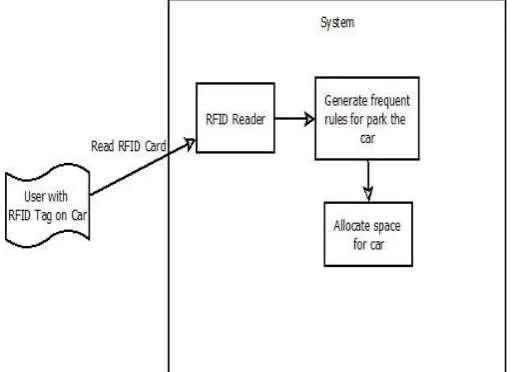
As illustrated in Fig. 1, the processing pipeline of the approaches for smart parking system:
park the car, then system automatically allocate the space for the car.
Figure 1.Proposed System Architecture
Algorithm
Algorithm 1: Proposed Algorithm
Association rule learning is a popular and well researched method for discovering interesting relations between variables in large databases. It is intended to identify strong rules discovered in databases using different measures of interestingness.Steps of the algorithm is as follows:
The Apriori algorithm 1. Find all large 1-itemsets
2. For (k = 2 ; while Lk−1 is non-empty; k++)
3. k = apriori-gen(Lk−1)
4. For each c in Ck, initialisec.count to zero
5. For all records r in the DB
6. r = subset(Ck, r); For each c in Cr , c.count++
7. Set Lk := all c in Ck whose count >= minsup
8. } /∗ end – return all of the Lk sets
Mathematical Model
Mathematical model for apriori algorithm
Let I = {i1,i2,....,in} be a set of n binary attributes called items.
Let D = {t1, t2, ....,tm} be a set of transactions called the database.
Each transaction in D has a unique transaction ID and contains a subset of the items in
I.
TRA-1 = {P1} TRA-2= {P1, P2} TRA-3= {P1, P2} TRA-4 = {P3, P1} TRA-5 = {P2, P4} TRA-6 = {P2, P1} TRA-7 = {P2}
Where, I = {P1, P2, P3, P4}
Database containing the items (1 codes presence and 0 absence of an item in a transaction)
The support supp(X) of an itemset X is defined as the proportion of transactions in the data set which contain the itemset.
For ex, the itemset {P1, P2} has a support of 1/7= 0.1 The confidence of a rule is defined conf(X=> Y) = supp(X U Y) / supp(X).
Set theory
Let S, be a system such that,
S = {I, e, In, Ou, T, fme, DD, NDD, ffriend, MEMshared, CPUCoreCnt, Φ}
Where,
S- Proposed System
I- Initial state at T<init> i.e. Providing the RFID code. e- End state of allocate space for parking.
X- Input of System i.e. RFID code Y- Output of System i.e. rules generation
fme- Main algorithm resulting into outcome Y, mainly focus on success defined for the solution. In a given system Apriori algorithm is used.
DD- Deterministic Data, it helps identifying the load-store function or assignment function.
e.g. i= {return }. Such function contributes in space complexity. In a given system deterministic data will be transactional Database.
NDD- Non Deterministic Data of the system to be solved. These being computing function or CPU time or ALU time function contribute in time complexity. In a given system we need to provide security to database.
ffriend- Set of association rules.
MEMshared- Memory required to process all these operations, memory will allocated to every running process.
CPUCoreCnt- More the number of count double the speed and performance.
Φ- Null value if any.
IV.
RESULTS AND DISCUSSIONA. DataBase
Here, in this project i am using a live dataset of car and it
is in store in Mysql.
B. Experimental Setup
Hardware Requirement :
1. Raspberry Pi Model B+ V1.2 2. RFID-RC22
Software Requirements:
i. The system is built using Java framework on Windows
platform.
ii. The Net beans IDE is used as a development tool. iii. For Database using Mysql.
C. Expected Result:
In this section discussed the experimental result of the proposed system.
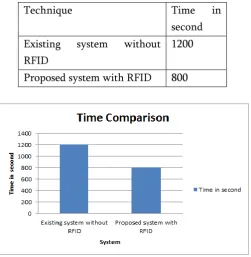
Table 1 and figure 2 represent the comparative analysis of time required for smart parking in existing and proposed system. From figure it is clear that the proposed system is faster than existing system to park the car.
Table 1: Time Comparison
Technique Time in
second Existing system without
RFID
1200
Proposed system with RFID 800
Fig 2. Time Comparison Graph
V.
CONCLUSION AND FUTURE SCOPEVI.
REFERENCES
1. HemantChaudhary, Prateek Bansal, Dr. B.Valarmathi, "Advanced CAR Parking System using Arduino",2017 International Conference on Advanced Computing and Communication Systems (ICACCS -2017), Jan. 06 - 07, 2017, Coimbatore, INDIA
2. Chihhsiong Shih, Zhaolong Liang, "The development and simulation of a smart parking guidance system," Proceedings of the 2017 IEEE International Conference on Applied System Innovation IEEE-ICASI 2017 - Meen, Prior & Lam (Eds).
3. Amir O. Kotb, Yao-chunShen, and Yi Huang, "Smart Parking Guidance, Monitoring and Reservations: A Review," IEEE Intelligent transportation systems magazine 6Sumer 2017. 4. IlhanAydin, Mehmet Karakose, EbruKarakose,
"A Navigation and Reservation Based Smart Parking Platform Using Genetic Optimization for Smart Cities," in IEEE 2017.
5. HM.A.P.K. Bandara J.D.C. Jayalath, A.R.S.P. Rodrigo, A.U. Bandaranayake, Z. Maraikar, and R.G. Ragel, "Smart Campus Phase One: Smart Parking Sensor Network",Proceedings of the 1st Manufacturing & Industrial Engineering Symposium 22 October 2016, Colombo, Sri Lanka.
6. Karthi.M andPreethi Harris, "Smart Parking With Reservation In Cloud Based Environment," in 2016 IEEE International Conference on Cloud Computing in Emerging Markets.
7. AbhirupKhanna,Rishi Anand, "IoT based Smart Parking System," in 2016 International Conference on Internet of Things and Applications (IOTA) Maharashtra Institute of Technology, Pune, India 22 Jan - 24 Jan, 2016. 8. O Orrie, B. Silva and G.P. Hancke., "A Wireless
Smart Parking System", IECON2015-Yokohama November 9-12, 2015.
9. PrabhuRamaswamy,"IoT Smart Parking System for Reducing Green House Gas Emission", 2016 Fifth International Conference On Recent Trends In Information Technology.