* To whom all correspondence should be addressed.
Algorithm of Iterative Solution of Linear Algebraic Equations
Systems Based on the Second Order Delta-Transformation
for Specialized Computers of Real-Time Systems
Pavel Pavlovich Kravchenko, Liubov Vladimirovna Pirskaya and Nail’ Shavkyatovish Khusainov
Southern Federal University, Russia, 344006, Rostov-on-Don, Bolshaya Sadovaya Str., 105/42. doi: http://dx.doi.org/10.13005/bbra/2201
(Received: 01 July 2015; accepted: 18 August 2015)
The study discusses iteration method for solution of algebraic equation systems with constant and variable free terms based on the second order delta-transformation with variable quantum. Use of that methodology allows to significantly decrease number of iterations, as compared with constant quantum, and realize computing process in a specialized computer without devices for multiplication of multi-bit codes. The study for the first time presents theoretical points justifying approximate solution of problem of minimization of number of iterations in a case of implementation of variable quantum. Theoretical justification forms evaluations, which characterize optimized operation of idealized iteration cycles with constant quantum of a certain value. For implementation of real processes integer evaluations of parameters are developed, which define a method for specification of sequence of values of variable quantum in cycles and which are based on four or eight idealized iterations per cycle. The study proposes conditions for effective ending of iteration processes in cycles. The study presents results of computer simulation of iteration solution of various algebraic equation systems, which differ in convergence rate. The results of computer simulation of linear algebraic equation systems (linear systems) with harmonic free terms are presented, which demonstrate an advantage in a value of realized step of solution in steady-state process in, approximately, 80 times in a case of implementation of the second order delta-transformation as compared with implementation of the first order delta-transformation.
Key words: Iterative methods, Solution of linear algebraic equation systems, The second order delta-transformation, The first order delta-transformation,
Specialized computers, PLD.
At all stages of development of computers problems of design of specialized computers, which are operating in real time and which allow to provide necessary characteristics of performance, while minimizing expenses of hardware resources and energy, were always topical
Iteration methods for solution of linear systems are known, which include multiplication operation and which are based on the first and second order delta-transformations (Malinovski, et al., 1977; Boyun, et al., 1977; Tretyakov, 1978; Kravchenko, 1983; Baikov, & Sergeev, 1986; Kravchenko, 1989; Gomozov, 2009; Gomozov, & Ladigenski, 2010; Kravchenko, 2010; Kravchenko, & Pirskaya, 2014; Pirskaya, 2014). Use of the first order delta-transformation with variable quantum allows to significantly decrease number of iterations, as compared with use of constant quantum, and achieve number of iterations, which is close to those of the simple iteration method (Kravchenko, & Pirskaya, 2014; Pirskaya, 2014).
Known methods of the second order delta-transformation as compared to the first order delta-transformation have higher dynamic and accuracy characteristics (Kravchenko, 1989; Kravchenko, 2010). In connection with the aforementioned, it would be reasonable to take into consideration as a prospective direction in studies of solutions of linear systems a method of the second order delta-transformation.
In the presented study problems of organization of iterations process of solution of linear systems with constant and variable right part on a basis of delta-transformation of second order are discussed. For the first time new type of transformation of variable quantum are discussed, which are based on minimization of duration of iteration processes.
Problem statement
Let’s presume that initial linear system contains matrix of constant coefficients, in general case, variables are free terms, which meet conditions of convergence in a case of realization of the method of successive iteration, and it has the following form:
...(1) Let’s transform the systems and transfer to writing with residual z(t) and use of iteration method:
...(2)
In the presented systems ,
– matrixes of coefficient of dimensionality n×n; G(t), D(t)- column vectors of free terms of a system (in the particular case for the
system with constant free terms ,
); – column vector of a
system’s unknown; , – vector columns of residuals and approximate values of unknown; t – independent variable; .
Let’s present the algorithm of iteration solution of the system (1) with implementation of the second order delta-transformation and variable quantum in the following difference form for i step
with initial conditions , ,
, , and use of the
materials presented in the previous studies (Kravchenko, 1989; Kravchenko, 2010):
- demodulation:
...(3.1)
...(3.2)
...(3.3)
, , ;
- formation of the second difference of a transformed variable:
...(3.4)
- formation of residuals’ values:
...(3.5)
...(3.6)
...(3.7) - formation of switching functions and signs of quantum of the second differences:
...(3.8)
; , .
linear systems with variable free terms the following
relationships are used: ; . In a
case of solution of linear systems with constant free terms with transfer from cycle to cycle
, ; ; .
Study of problems of minimization of solution of linear systems with constant free terms on a basis of the second order delta-transformation by number of iterations
Let’s discuss conditions of formation of the solution optimized by number of cycles and values of quantum in cycles, which is aimed at minimization of number of iterations.
Basic provisions in solution of the problem of optimization
The solution of the problem is based on idealization of iteration process, which is essentially consists in assumption on value of . Validity of introduction of that assumption is justified by the face that solution of the problem is carried out approximately, and real value of for linear systems can lead to both increase and decrease of number of iterations.
In the previous study (Kravchenko, 2010) it was demonstrated that in a case of absence of external perturbations (in relation with the discussed case ) and the worst case of behavior of demodulated values of error (in the presented study error and residual is the same variable), for carrying out of the second order delta-transformation maximum of all possible minimum values of error near coordinate axis for
steady-state process do not exceed . For
simplification of the formulated in the following part of the paper relationships let’s assume that , and that value for solution of the optimization problem is accepted as finite in a cycle. Considering the aforementioned, number of steps (iterations) Rl for l cycle, let’s present in the following form (it is presumed that , Rl are not integer yet) (Kravchenko, 2010):
...(4)
To summarize the above, for carrying out theoretical justification of conditions of organization of iteration computational process with variable quantum of the second order
delta-transformation, let’s assume:
• The ratio (4) as a basic for evaluation of number of iterations in an idealized cycle; • In l cycle as transformation quantum –
, as an initial value of error in a cycle – value of
, .
Development of evaluations for minimum duration of idealized iteration processes with variable
quantum for .
Number of iterations (duration of transition process) Ì of idealized solution of linear systems let’s formulate as follows:
, ...(5)
or taking into account (4)
...(6)
For transition from cycle to cycle let’s accept
, ,
and transform the expression (6):
.
...(7) For all cycles accepting in the form of the same value:
, ...(8)
Initial values of residual and weight
of minimum quantum , which is related with required accuracy of calculation, are specified as initial conditions. Taking into account (7) and (8) obtaining:
...(9)
Taking into account the last equation (9), evaluation of duration of transition process (5) takes the following form:
...(10)
...(11)
As the result, the evaluation (10) of number of iterations (duration of an idealized transition process) M, taking into account (11), takes the following form:
...(12) Using definition of natural logarithm, for the equation (11) let’s specify:
...(13)
At the same time the equation (9) can be formulated as follows:
...(14)
From the equality of right parts of (13) and (14), taking into account equality of left parts: , from which for optimum value of R obtaining:
.
Thus, for minimum number of iterations of an idealized process in a cycle, where transformation quantum is constant, basically depends on initial value of residual and
weight of minimum quantum , it is constant, which is equal to doubled Euler number.
The obtained relationship (12), which is describing duration M of an idealized transition process for the second order delta-transformation with constant free terms of linear systems and variable quantum, is identical to ratio of evaluation of number of iterations for use of the first order delta-transformation (Kravchenko and Pirskaya, 2014; Pirskaya, 2014).
Formation of conditions and parameters for realization of iteration process taking into account
.
In real computing process in a case of convergence conditions by norm and use of the second order delta-transformation, process of decrease of residual remains, because during carrying out of transition process there are constantly perturbation actions
, restricted by modulus,
where for the second order delta-transformation characterizes maximum level of acting acceptable perturbation actions (Kravchenko, 2010). At that, for corresponding restricted norm linear systems can be formulated as follows (Kravchenko, 2010):
;
...(15)
, ; .
Depending on sing of the value yril
2 ∇ real speed of decrease of residual is increasing or decreasing. At that, number of iterations can decrease and increase relatively to approximated evaluation (4).
In the framework of the solution of that problem, which is related with organization of solution of linear systems with , it is necessary to defined integer number of cycles and related parameters specifying relationship of values of transformation quantum for adjacent cycles. In addition, it is necessary to formulate conditions for completion of iterations in cycles. Development of integer parameters of iteration processes with variable quantum for .
Realization of iteration process for solution of linear systems without operation of multiplication of multi-bit codes consists in that values of constant values (quantum) *
l
c ,
must be presented in the form 2-s, s ∈ N, and P and
R- in the form of integer values Pint and Rint correspondingly. At that in the algorithm (3) for each iteration operation of multi-bit multiplication of a matrix coefficient on transformation quantum may be presented in a form of operation of single-step shift of that coefficient for S of binary digits with specification of the corresponding sign.
Ratio of quantum of adjacent cycles can be written as follows:
, .
In order that all , can be
presented in the form of , , obviously, it is
, ...(16) As integer values Rint it is reasonable to accept number, which are the closes to optimum evaluation R=2e, i.e. Rint,1=4 and Rint,2=8
Then, defining . Finding the logarithm of the equation (14):
.
Using properties of the logarithm
obtaining the equation for integer values Pint,(1,2):
....(17)
The equation (17) is an integer part of a number truncated to a bigger number. Now, the evaluation of total number of iterations is as follows:
...(18) In order to simplify and make the algorithm more universal (3) it seems reasonable to create universal templates, specifying number of cycles and iterations in cycles. If necessary, during realization of the last cycle it is possible to slightly vary value of c*p, which also, in general, can’t cause significant influence on total value of iterations.
On the basis of (16), (17) it is possible to formulate the following ratios for quantum of adjacent cycles (s– degree of minimum quantum, s∈N):
- for ,
and
- for , .
Optimized parameters Rint,(1,2) and
are obtained on the condition . In real computational process, as it, in particular, demonstrated below during description of experiment results, number of iteration in cycles can be bigger or smaller relatively to the value
( – constant parameter).
Formation of conditions of completion of iteration processes in cycles
In the previous study (Kravchenko, 2010) for the second order delta-transformation it is
demonstrated that for limited perturbations and the worst case of behavior of error, maximum of all possible minimum values of counting of errors
, located in the vicinity of coordinate axis during a steady-state process, do not exceed a certain value. Relatively to the discussed problem, the level of the worst case perturbations is defined
by the value , i.e. norm of rth equation of
linear system.
As an indication of completion of iteration process in a cycle by rth variable of linear system it
is accepted that for
, where – maximum
error of a steady-state process, – accepted restriction by norm. For practical parallel realization it is more convenient to carry out as follows:
)) / ( ) / ( / ( ) /
(zril cl* sign zril cl* sign zril cl* zril* cl*
sign =− − ⋅ ,
...(19)
, ; .
Generally, that condition characterizes theoretically predicted crossing of coordinate axis and moment of formation of indication of completion of iteration process in l cycle for rth
variable.
An indication of completion of iteration process in a given cycle and transition to a next cycle for a whole linear systems is completion (not necessarily simultaneously) of the condition (19) for all equations. Computational processes in cycle must continue until the aforementioned condition is not met for all equations.
Taking into account presented in the previous studies (Kravchenko, 2010) recommendations for optimization of processes on a basis of the second order delta-transformation, it is reasonable to use:
and
Fadeev, & Fadeeva, 2009; Vuik, 2012). In order to expand the mentioned capabilities additional conditions of completion of an iteration process in a cycle are introduced and experimentally proved:
...(21)
The essence of that heuristic condition (30) consists in identification of the moment of crossing of residual and coordinate axis, and it is presumed to be used simultaneously with the condition (19). At that, there are possibilities for identification of crossing of coordinate axis in a case, when crossing takes place, but with increased norm doesn’t meet the requirement (19).
Results of computer-based experiments for solution of leaner Systems with constant free terms
Operability of the obtained recommendations for organization of iteration process was verified on conditions of various linear systems with constant free terms. Below, there are results of independent experiments based on use of the presented below linear systems (norm of a matrix coefficients of examples (22) and (23) is less than 1, (24) and (25) is more than 1):
...(22)
...(23)
...(24)
...(25)
In a course of the study we carried out comparative analysis of methods for solution of linear systems on the condition of the same accuracy ( ~2-14) on a basis of the first and second
order delta transformations with constant quantum c*
p=2
-14, on a basis of the first order delta
transformation with variable quantum for Rint,1=2,
Rint,2=4, the optimized process and
14
2−
=
P
c (Kravchenko, & Pirskaya, 2014; Pirskaya,
2014), the method of successive iteration, as well as method based on the second order delta transformation with variable quantum for
and , discussed in the presented
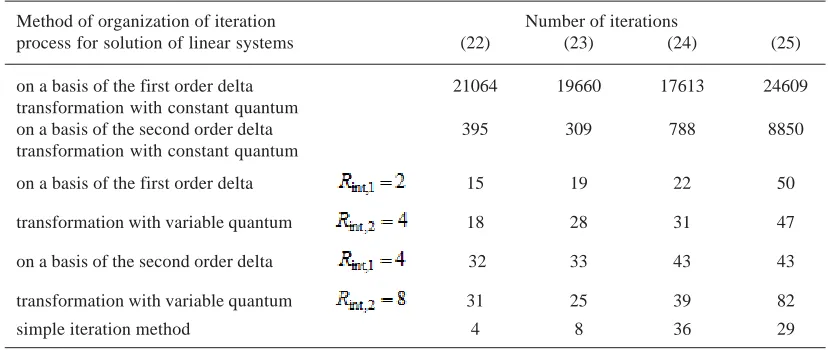
study. Obtained data is presented in Table 1. Analysis of the obtained data demonstrated that iteration processes of solution of linear systems with implementation of the second
Table 1. Results of computer-based experiments for solution of linear systems with constant free terms
Method of organization of iteration Number of iterations
process for solution of linear systems (22) (23) (24) (25)
on a basis of the first order delta 21064 19660 17613 24609
transformation with constant quantum
on a basis of the second order delta 395 309 788 8850
transformation with constant quantum
on a basis of the first order delta 15 19 22 50
transformation with variable quantum 18 28 31 47
on a basis of the second order delta 32 33 43 43
transformation with variable quantum 31 25 39 82
order delta transformation and variable quantum differ in decrease of number of iterations in hundreds of times as compared with the method of solution of linear systems on a basis of the first order delta transformation with constant quantum, in tens of times – as compared to the method for solution of linear systems on a basis of the second order delta transformation and constant quantum, as well as certain distance by number of iterations to the simple iteration method.
Also, from the Table 1 it can be seen that the total length of iteration process is close to values in a case of variable quantum for the first and second order delta transformations. The presented data is the experimental prove of the obtained in section 2.2 conclusion about identity of evaluations, which characterize minimum value of iterations of idealized process for the first and second order delta transformations.
Also, experimental studies with specified above conditions were carried out for linear systems of higher order. The results supported
theoretical evaluations, recommended parameters were similar with the presented above results for linear systems of third order.
Study of solution of linear systems with variable free terms on a basis of the second order delta transformation and variable quantum
Effective solution of linear systems with variable free terms is of interest for problems, which are realized in real time, for example, for on-board control system in navigation and aircraft with continuous change of variable free terms (Barabanov, & Barabanova, 2007; Skripnik, 2014). At that, efficiency is considered as possibility to create a specialized computer with minimum hardware expenditures, for example, on a basis of PLD with minimum time of realization of iteration for solution of linear systems. From the point of view of organization, preparation of linear systems for solution (evaluation of convergence, reduction to form with specification of diagonal elements, evaluation of number of cycles, trial testing) can be carried out at ground stage of preparation of a
Table 2. Results of computer-based experiments for solution of linear systems with variable free terms
leaner leaner system normMethod of solution,
systems ( ) delta-transformation
(35) 0.15 of the first order 0.0079 84
of the second order 0.66
(36) 0.25 of the first order 0.0076 88
of the second order 0.66
(37) 1.2 of the first order 0.000044 80
of the second order 0.0035
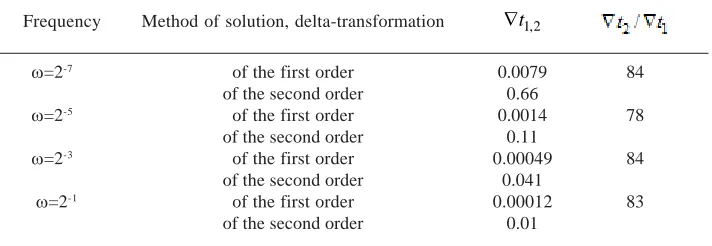
Table 3 . Relationship of sampling increment and oscillation frequency.
Frequency Method of solution, delta-transformation ∇t1,2
ω=2-7 of the first order 0.0079 84
of the second order 0.66
ω=2-5 of the first order 0.0014 78
of the second order 0.11
ω=2-3 of the first order 0.00049 84
of the second order 0.041
ω=2-1 of the first order 0.00012 83
task.
Solution of linear systems can be discussed in a form of iteration process, which has two stages: iteration (transition) stage and after its completion – steady-state process, in which solution with a required accuracy is provided in one iteration. Taking into account that variables continuously changing free terms are function of time, then it can be presumed that bigger time period (step of solution) can correspond to bigger intensity of change of free terms, and, therefore, bigger perturbation action influencing error of iteration process at each stage (influence on value
of norm in a form of the component ,
, ; ).
From the point of view of efficient use of resources (of on-board hardware), organization of computing process, when information processing on level of one iteration is carried out with significant accuracy, high performance and maximum time step is of interest. In that conditions it is possible to set the lowest requirements for frequency of formation of data, which characterize changing right part of linear systems (e.g., frequency of formation of distances from aircraft to beacons of local navigation system (Barabanov, & Barabanova, 2007; Skripnik, 2014), as well as for performance of computing hardware, taking into account possibilities of simultaneous realization of algorithms and software). Topicality of effective solution of linear systems for lower orders in the discussed conditions rapidly increases, when it is necessary to simultaneously solve large number of linear systems.
The discussed below material is aimed for justification of possibility of efficient solution of linear systems with variable free terms on a basis of implementation of the second order delta transformation in steady-state iteration process.
Let’s presume that linear system (1) has variable free terms, i.e. in the algorithm (3)
.
Essentially, process of solution of linear system (1) with variable free terms on a basis of an algorithm, which is based on the second order delta transformation and variable quantum, consists in setting initial conditions and organizing iteration (transition) process of solution before transferring
to steady-state process, when ,
, , where – significantly small values allowing to provide specified solution accuracy. On a basis of algorithm (3) transfer to steady-state process is carried out after completion of iterations in the last cycle . In further, formation is carries out of variables with constant by modulus weight of minimum transformation quantum , . Formed in discreet time
periods values Dri, , in the
algorithm (3) are presumed to be numerically defined at each stage. For each new vector of
discreet values of , , in steady-state process results of linear system solution must be formed in one iteration.
Form the point of view of generalized conclusion, let’s presume that free terms are harmonic oscillations (Frish and Timoreva, 1962):
, ...(26)
where A- oscillation amplitude, ω – cyclic oscillation frequency, ϕ0 – initial oscillation phase for t=0.
The first and second derivatives for the variable (26):
...(27)
...(28) Maximum values for the expressions (27) and (28) considering differential representations:
...(29)
...(30) Thus, taking into account values of the first and second difference of variable
) (t D
considering the expressions (29), (30):
...(31)
(20). In fact, the ratio (20) for a certain cl* allows to evaluate restricted intensity of perturbations.
It should be noted that in real processes of delta-transformations the worst internal and external influence is unlikely. In this connection successful operation is possible in a case of provision of convergence by value of norm, at
least, in limits of value ( (Kravchenko, 2010).
Presuming for commonality of comparative analysis of use of the first and second order delta transformations for variable of harmonic free term the same values of introduced components of perturbations in transformation:
,
where – specifies values of perturbation actions , in relation
to value *
c .
Then, ratios for definition of sampling increment it is possible to evaluate using the evaluation:
- for use of the first order delta transformation
...(33) - for the second order delta transformation
...(34)
(33) and (34) allow to obtain coefficient, which characterizes ratio for realized steps of solutions (finally, for realized maximum frequencies of change of free terms) for use of the first and second order delta transformations with a steady-state iteration process:
.
For example, for A=1, b=0.4, * 14 2− =
P c
and use of the second order delta transformation it can be assumed that in a steady-state iteration process (solution of linear systems for one
iteration) there is an advantage in times.
Results of computer-based experiments for solution of linear systems with variable free terms The study of operability of the algorithm (3) for solution of linear systems with variable free terms was carried out for linear systems, which is convergent in a case of carrying out of the simple
iteration and which has various norms of a matrix coefficients (norm for example (35) – 0.15, for (36) – 0.25, for (37) – 1.2):
...(35)
...(36)
...(37)
where
; ; ;
.
In a course of study a comparative analysis between methods of solution of the given linear systems was carried out on a condition of the same accuracy at level ~ 14
2− for use of the second order delta transformation with variable
quantum for , , and
the first order delta transformation with variable
quantum for , , .
During the study it was accepted
. Table 2 presents the results, which
characterize steps and , which provide the specified maximum similar accuracy of solution for steady-state process for one iteration for the first and second.
Analysis of the data in Table 2 shows that use of the second order delta transformation relatively to use of the first order delta transformation for harmonic free terms and provision of the same accuracy has an advantage by value of the realized step of solution in a steady-state process in ~80 times.
presented in Table 3. Advantages for realized frequencies remain the same as in the Table 2.
In the experiments use of the second order delta transformation by duration of transition process was used less than the first order delta transformation. However, if we take into account that the final result is formed in a steady-state process, the found advantages of the second order delta transformation can be considered significant. Use of the simple iteration method in a steady-state process allows, at least, to achieve evaluated in the comparisons accuracy for discussed steps and frequencies. However, in that conditions of realization of the method of successive iteration with use of specialized computer is related with need of realization of multi-bit multiplication devices, and, as it can be easily used, significantly bigger (measured in number of steps), as compared with realization of the second order delta transformation, duration of iteration (Pirskaya, 2015). In a case of necessity of creation of effective specialized computer for continuous iteration solution of linear systems with step, which exceeds acceptable for the second order delta transformation, it is reasonable to take into account use of other methods and technical means of solution of linear systems.
CONCLUSION
The paper presents study of solution of linear systems of use of the second order delta transformation with constant and variable quantum. Theoretical justification of number of cycles and values of variable quantum is proposed, which is aimed for minimization of number of iterations for solution of linear systems. The paper presented study of efficiency of use of the second order delta transformation for solution of linear systems with variable free terms, which proves possibility for obtainment of result for one iteration for a steady-state process, as well as correctness of theoretical justifications. At that, use of the second order delta transformation allows to carry out processing of information with significant accuracy and in tens of times bigger time step as compared with the first order delta transformation, as well as allows to organize computation process in specialized computer without use of devices for multiplication of multi-bit codes.
One of the prospective directions of studies is use of the second order delta transformation and variable quantum for solution of problem of positioning of aircraft using several distributed in space beacons. At that the specialized computer on board of an aircraft is forming linear systems by obtaining distances between an aircraft and beacons and coordinates of beacons, and the solution of linear systems allows to find position of an aircraft in space. Use of the second order delta transformation for solution of that problem allows to organize computing process in a way, in which processing of information for a steady-state iteration process on a level of one iteration is carried out with significant accuracy, high performance and maximum time step.
ACKNOWLEDGMENTS
The presented study was carried out in a framework of a basic part of state contract in the field of research and development (project No. 3442 “Information and algorithmic support of digital control systems, autonomous high-speed navigation and machine vision for prospective aerial vehicles: development of theoretical foundations of design, algorithms, methods of effective and reliable software implementation, use of high performance computational infrastructure for experimental simulation”).
REFERENCES
1. Greenbaum, A. Iterative Methods for Solving Linear Systems. 1997; Philadelphia, PA: SIAM. 2. Kravchenko, P.P., & Pirskaya, L.V. The method of organizing the iterative process of the system of the linear algebraic equations solution excluding the multidigit multiplication operation.
Biosciences Biotechnology Research Asia, 2014; 3(11), 1831-1839.
3. Kravchenko, P.P. Solving systems of algebraic and differential equations by second-order difference modulation. Cybernetics, 1989; 2(25), 218-229.
5. Vuik, Ñ. Iterative solution methods. The Netherlands, Delft: Delft Institute of Applied Mathematics 2012.
6. Amosov, A.A., Dubinski, Yu.A., & Kopchenov, N.V. Computational methods for engineers.
Moscow: MPEI publishing house 2003. 7. Baikov, V.D., & Sergeev, M.B.
Structurally-oriented algorithm for solving of systems of linear algebraic equations. Control system and machines, 1986; 2, 81-84.
8. Barabanov, O.O., & Barabanov, L.P.
Mathematical problems distance-measuring navigation, 2007; Moscow: FIZMATLIT. 9. Boyun, V.P., Kozlov, L.G., Malinovski, B.N., &
Tret’yakov, S.I. Device for solution of systems of linear algebraic equations. Certificate of authorship No. 543943 – BI, No. 3 ; 1977. 10. Gomozov, O.V., & Ladigenski, Yu.V. Incremental
algorithms for solution of systems of linear algebraic equations and architecture multiprocessors on programmable logic.
Scientific works of DonNTU. Series “Informatics, cybernetics and computer science”, 2010; 12(165), 34-40.
11. Gomozov, O.V. (2009, October 7-9). Structure of incremental algorithms for solution of systems of linear algebraic equations. Materials of the 3rd international scientific and technical
conference “Modeling and computer graphics –
2009”, Donetsk, 255-259.
12. Kravchenko, P.P. Incremental methods for solution of systems of linear algebraic equations.
Multiprocessor computing structures, 1983; 5(XIV), 30-32.
13. Kravchenko, P.P. Optimized delta-conversion of second order. Theory and applications: Monograph, 2010; Moscow: Radio engineering. 14. Malinovski, B.N., Boyun, V.P., & Kozlov, L.G. Algorithms for solution of systems of linear algebraic equations, oriented for structural implementation. Control system and machines,
1977; 5: 79-84.
15. Pirskaya, L.V. (2015). On application of delta-transformations of first order for creation of specialized computers. Bulletin of SFU. Engineering, 1977; 2(163), 83-92.
16. Samarski, A.A., & Gulin, A.V. Numerical methods, 1989; Moscow: Science.
17. Skripnik, O.N. Radio navigation systems of aircraft: Textbook, 2014; Moscow: INFRA-M. 18. Tretyakov, S.I. Algorithms of operation of specialized processors for solutions of systems of equations. Cybernetics, 1978;5: 34-36. 19. Fadeev, D.K., & Fadeeva, V.N. Computational
methods of linear algebra, 4th ed., reprint. Saint-Petersburg: Lan’ 2009.