Vol. 05, Issue 11 (November. 2015), ||V1|| PP 05-11
Hydrodynamic Sonochemistry in Food Processing
Prof. T. Shlenskaya
1, Prof. S. Shestakov
1, Prof. E. Smeshek
2,
Assoc. T. Baulina
1, Assoc. I. Scherbakova
1, Assoc. Y. Zubtsova
11Moscow State University of Technology and Management, Russia, Moscow 2Polessky State University, Belarus, Pinsk
Abstract: - The paper presents a detailed analysis of the physico-chemical effects of acoustic cavitation used in food processing. The mechanism of interaction between acoustic cavitation and food media is discussed. An overview of recent studies carried out on dairy processing using acoustic cavitation is provided along with a full analysis of these studies. The acoustic cavitation reactors available in the market are not suitable for large-scale food processing despite positive results obtained with laboratory and pilot scale experiments. Considering a new approach to the theory of cavitation in rotary machines, it has been suggested that hydrodynamic cavitation can be an alternative to acoustic cavitation in food processing applications involving large volumes. A model that has been developed is suitable for the construction of new generation cavitational rotary disintegrators.
Keywords: - Food sonochemistry, hydrodynamic cavitation, cavitational rotary disintegrator.
I.
INTRODUCTION
Ultrasonic sonochemistry, despite its young age in science, has firmly taken the place of a separate section in high energy chemistry [1]. Now it has separate research areas such as ultrasonic food processing that are actively developing [2-5]. It promises to solve many problems faced by the food industry, such as the efficient replenishment of moisture lost during the storage and primary processing of edible raw materials. The mankind has been forced to keep the ever-increasing supplies of raw food materials in the dried and frozen form. Therefore, the effective binding of water with food biopolymers – hydration process – is one of the major problems in the modern food industry. The advantages derived from the addition of water during food processing were established by Henry IV Bolingbroke.
A global scientific community for the first time focused its attention to the importance of water in food in 1974 at the International Symposium «Water relations of food» in Glasgow. Then the Proceedings of the Science Forum, edited by Professor RB Duckworth of the University of Strathclyde [6], was released which is now more popular among professionals. Biochemists at the symposium reported that chemically pure protein can theoretically bind up to 40% water by weight as a result of hydration. Hydration shells of protein increase their affinity for water during the precipitation of colloidal systems that can further enhance the hydration of ground biomass.
The hydration process and any reversible chemical reactions move to energetically favorable conditions in accordance with the principle of Le-Chatelier-Brown. As hydration is an exothermic process, it is better when the hydration shell of the protein is built from individual water molecules at the initial stages of the reaction, which can be achieved by pre ultrasonic treatment. Its action is based on the distribution of water in the periodic pressure pulses that are under the influence of elastic ultrasonic waves emitted by microscopic gas inclusions (cavitation bubbles). Ultrasonic treatment can lead to hydration without heating and does not affect the properties of water, such as its solvation power, structure, etc. Similar mechanisms of action of cavitational restructuring hydration shells of ions in real solution may be responsible for the denaturation of biopolymers in their colloidal solutions and even dispersed phase of sols, and emulsions, that is, in any process in which the object is formed by the impact ion-dipole and dipole-dipole interactions structural connections. Many useful reactions are induced by ultrasound in liquid media: food processing is based on similar such reactions [3, 4]. It is established that the formation of dense and strong hydration shells raise the dissolved thermoresistance valuable nutrients and vitamins, preventing them from thermal denaturation at the subsequent heat treatment [5].
II.
RESULTS OF PRELIMINARY STUDIE
For food processing applications, where processing is subject to small amounts of food to several tons a day, ultrasonic equipment is available in various scales. For example, Hielscher Systems GmbH [9] has built ultrasonic equipment for small to large scale processing. One of the Hielscher products, a flow type reactor, meets the engineering prediction of one of the founders of the cavitation. Professor Knаpp from University of California, who once wrote that the industrial use of cavitation will be possible only when reactors are built that can handle continuous flow of fluid [10]. At University of Melbourne has used a 4 kW flow through ultrasonic unit for the processing of dairy fluids (Fig 1) [11].
It was found that, in spite of the desired frequency ultrasound (20 kHz), with reduced production of free radicals and desired reduction in the viscosity and increased heat stability of protein concentrates, such units have limitations in terms of processing volume (6 L/min). So, where volumes are handled tens of tons per day or more, the use of ultrasonics becomes a problem. For processes with small production quantities, such as moistening the grain before grinding or «wet» salted minced meat [12, 13] in studies conducted in Moscow [4] the ultrasonic cavitation reactor РКУ-0,63 was used. It is intended for brine meat and food products from minced meat, where process volume of 80 tons per day of 1-2 tons per day could be achieved.
Fig 1. Pilot-scale experimental setup used in dairy processing using Hielscher Systems GmbH UIP-400 (Figure Adapted from [11])
In this regard, it has to be recognised that hydrodynamic cavitation was introduced more than half a century ago in the processes of homogenization, dispersion and emulsification [2, 14]. Cavitation is generated due to constrained fluid flow. Technology in this field has made a great progress in recent years. One of the first explorers of the hydrodynamic cavitation, Dr. J. Hint in Estonia, continued to engage in traditional rotary hydrodynamic disintegrantors. J. Hint, was the first, who noticed in the process of mechanical disintegration that not only dispersion, but some other important physico-chemical properties of processed materials are changed: this has introduced the concept of «disintegrationalactivation». Later he began to also write about the activation of liquid media in mechanical disintegrators [15]. The phenomenon of activation of the rotary-pulse devices will soon become uniquely associated with the action of cavitation [16]. But only in this century, the disintegration of fluids as a result of erosive effects of hydro [17] or acoustic cavitation has been highlighted and an independent term «cavitational disintegration» [18] has been established.
of amino acids involved active polar centers represented the carboxyl -COOH, hydroxyl -OH and amino -NH2 groups. The binding of water to protein molecules results in hydration structures (Fig 2).
Fig 2. Hydration and structuring of proteins
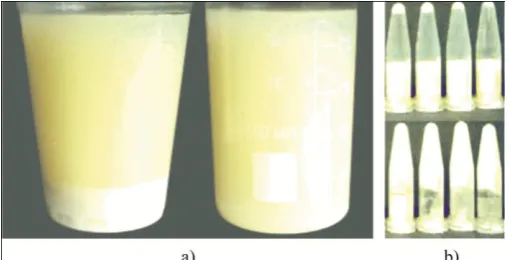
Studies have shown that ultrasonically treated water results in better hydration of proteins, stabilized against separation and precipitation, resulting in complete dissolution of proteins (Fig. 3a). However, the structuring of the protein leads to an increase in the viscosity of protein solutions and changing the conditions of occurrence of syneresis in them, which is not always a positive feature. Some investigations on the effects of ultrasound on whey proteins were aimed at expanding the parameters used in subsequent stages of heat treatment technology and to facilitate the further process of ultrafiltration. This involves the need to reduce the viscosity and prevent the formation of protein aggregates [3, 20].
The desired effects cannot always be achieved by a separate water treatment, as previously recommended. The ultrasonic treatment of aqueous solutions of dry whey protein WPC 80 (Figure 3b) resulted in an increase in viscosity under specific experimental conditions. It can be clearly seen that the sonication effect in terms of increasing the solubility of proteins differ from the effect of heat stability.
Fig 3. a) Reconstituted whey, left without sonication, right with the sonication at 22 kHz, 90 W/L, 1 min. b) solution of whey protein from WPC 80 in the top row without treatment, the bottom with treatment at 20 kHz,
31 W, 60 min. Post heating to +80 ° C for 10, 12, 14 and 16 minutes (left to right)
III.
THEORY
AND
COMPUTER
EXPERIMENT
channels have openings with little more than a tenth of a millimeter. When gas bubbles move from a high to a low pressure zone, they do not survive [10]. The sudden drop in pressure leads to the growth and the eventual collapse of these gas bubbles, referred to as hydrodynamic cavitation. In roto disintegrators, the effects are not just due to the liquid flow alone – additional forces are generated due to hydrodynamic cavitation. Here, we should use a slightly different approach to assessing efficiency than commonly used. The pulsations of cavitation bubbles and the shock waves that emanate from them can be major forces causing cavitation erosion [21,22], which in the theory of vibrations and waves can be estimated by finding the value of the deformation of rarefaction and compression, that is, determining the magnitude of the potential component of the scattered energy in a fluid [10]. Cavitation power depends proportional to the square of periodic changes in pressure in the fluid. It depends not so much on the changes in pressure caused by the discontinuity of fluid flow through channels in the radial direction, but it is generated by movement relative to the profile of transversal section of the rotating rotor, which was due to the presence of periodically repeating holes.
The latter can be confirmed by looking at the homogenizers manufactured by Aquametro AG, in which the fluid does not flow in the radial direction but axially in the gap between deaf equipped with grooves facing each other on the walls of the rotor while the stator cross-sectional area of which the diameter remains constant (Fig 4a).
Fig 4. a). Schematic design of rotor and stator homogenizer (Swiss company Aquametro AG). b). The device with the rotor and stator in the form of cylindrical shells with the rectangular holes. Red arrows indicate the direction of fluid motion, blue - the rotation of the rotor. b). Is shown the cross section - the lines show stress-strain fluid having a rheological equation of state of the limit nature, as in an absolute elastic body, and the current without friction, obtained by conformal mapping d). Is shown of the invariant for section c). Arabic and
Roman numerals indicate the corresponding angles.
But among the rotary disintegrators widely used, for example, where the rotor and stator are used with one or more cylindrical shells of finite length at the bottom, fluids flow through the hole of rectangular shape. The rotor and stator create a working volume between the top and the bottom of one another, fluid flow through the axis to the periphery of the construction in the radial directions by opening and closing of the rotating liquid flow channels (Fig 4b). Mathematical model of cavitation in a disintegrator may be based on differential equations of Hickling-Plesset or Rayleigh-Plesset [21.23] for vapor cavity wall motion under the influence of strain and stress, as described in some problems of solid mechanics theory of functions of complex variables. Description of this occurs when a mechanical stress in the fluid or the force of the surface area, that is, the pressure at any point in the volume of fluid can be made on the basis of conformal mapping. In order to apply them to a flat region, z profile of the treated liquid in a rotary disintegrator, with shaping the profile elements to display its conformal invariance, which has a uniform distribution of stresses, strains, such as an infinite strip of constant width (Fig 4c, Fig 4d) the Schwarz-Christoffel integrals can be used.
liquid, they are quite acceptable, especially if the cavitation bubble on the wall behaves as a Newtonian fluid according to Hickling-Plesset equation. Mechanical stress at any point can be expressed in terms of the pressure in the working volume, р0, derivative of the mapping function to map this point onto the invariant :
d dz z where , z2 0 p (1)
It is clear that the exponent at z is 2 only if all the profiles of fluid flow plane-parallel to each other. The nature of the elastic strain and stress, as well as their behavior in a batch of microscopic inclusions of steam in the liquid can be determined by numerical simulations. They allow for numerical comparisons. The behavior of the cavitation bubble was performed by numerical integration of Hickling-Plesset Runge-Kutt method. The periodic variation of pressure in the liquid was substituted appropriately (1) with a derivative of the function display strip to the diametrical cross section of one of the holes in the rotor, one of the holes in the stator and the gap between them: 2 2 2 2 2 2 2 ch 2 sh arctg 2 ch 2 sh Arth z a a a a , (2)
where: а – width of the opening (the size of the diameter the gap between the stator and rotor;
coordinate on the invariant expressed by the complex number Its derivative is equal to
) 2 ( 1 z 2 2 e e a (3)
Reciprocal of the square of z is proportional to the tensile deformation of the fluid at any point of the section, causing a pressure change:
2 2 2 ) 2 ( ) 2 ( ~ a e e e e p
(4)
To calculate the change in pressure points on the real axis for a total period of the invariant, the coordinate must
vary in the range The time during which a corresponding change in pressure occurs will be
R T
,
where R – outer radius of the rotor, and is the minimum allowable period of pressure on the elastic deformation of the liquid. is a root of the transcendental equation:
2 2 2 ) 2 ( ) 2 ( 1 a e e e e
, (5)
where = 0,05 – margin of error in relative units.
The quantification of the effectiveness of cavitation can be estimated from the increment of the erosion of power that characterizes its action [22]. A comparative assessment of its value can be estimated using conditional parameters, – erosion of unit capacity, that is, the extra power released in the pressures on the wall during the collapse, pmax > р0, the maximum for the pulse of its volume Vmax conventionally located in each channel in the middle of the stator and rotor clearance a cavitation:
2 0 max
max ( )
2 p p Nn V Р
where: adiabatic compressibility of the fluid; rotor speed; N – number of channels in the rotor, n – in the stator. The model was implemented in a computer program. Water was chosen as the liquid with the values of the equation of its state.
A computer experimental analysis was made on the behavior of bubbles with a diameter of 10 m using the model in accordance with (1) - (6) and on the basis of information contained in [17]. It was also verified by the measurement of power of the sound near the stator of the experimental cavitational disintegrator (Fig 5), on the frequency in which the cavitation noise was expected, calculated as:
z 2
R
f , at
Fig 5. Photos of the prototype rotary cavitation disintegrator with a cover sealing the lid of the working volume 1 and withdrawn from stator 2 the rotor 3 and left.
The results of calculations and experiments 142 m are shown in Fig 6.
Fig 6. а). Pressure on the surface of a cavitation bubble as a function of time 1 at the antinode of acoustic waves of frequency 20 kHz with an amplitude of sound pressure 1,2 bar; 2 in the gap between the stator and rotor of
the disintegrator, b). calculated P (blue), measured with low gain Pcav (green).
IV.
CONCLUSIONS
REFERENCES
[1]. Margulis M.A. Sonochemistry – a new promising field of high-energy chemistry // Chemistry of High Energies, T.38, 3, 2004
[2]. Mawson R., Knoerzer K. A brief history of the application of ultrasonics in food processing // 19-thICA Congress, Madrid, 2007
[3]. Ashokkumar M. at al. The ultrasonic processing of dairy products // Dairy Science and Technology, V.90, 2010, pp. 147-168
[4]. Ashokkumar M. at al. Modification of food ingredients by ultrasound to improve functionality: A preliminary study on a model system // Innovative Food Science and Emerging Technologies, Vol. 9, 2008, pp. 155–160
[5]. Shestakov S. Food sonochemistry: the concept, the theoretical aspects and practical applications.- Saarbruecken: Lambert Academic Publishing, 2012
[6]. Water relations of foods / Edited by R.B. Duckworth.-London: Academic Press, 1975
[7]. Ashokkumar M. at al. Modification of food ingredients by ultrasound to improve functionality: A preliminary study on a model system // Innovative Food Science and Emerging Technologies, 9, 2008, pp. 155-160
[8]. Patent RU 2422198, C02F 1/36, B01J 19/10. Method of sonochemical treatment of water solution for biopolymer hydration, 2011
[9]. http://www.hielscher.com
[10]. Knapp R., Daily J. and Hammitt F. Cavitation.–NY: McGraw Book Company, 1970
[11]. Zisu B. at al. Ultrasonic processing of dairy systems in large scale reactors // Ultrasonics Sonochemistry, Vol. 17, 2010, pp. 1075-108
[12]. WO 2007111524, Biopolymer hydrating method, 2006
[13]. Patent ЕР 1 609 368 B1, A23B 4/02, A23L 1/025, A23L 1/31, A23L 1/317, A23L 3/30, A23B 4/26, A23B 4/01. Verfahren zur herstellung von fleischnahrungsmittel
[14]. Bergmann L. Der Ultraschall und seine Anwendung in Wissenschaft und Technic.-Zürich, 1954 [15]. Hint J.A. UDА-technology: challenges and perspectives.-Tallinn: Valgus, 1981 (in Russian)
[16]. Balabyshko A.M., Zimin A.I. and Różycki V.P. Hydromechanical dispersion .- Moscow: Nauka, 1998 (in Russian)
[17]. Promtov M.A. Pulsation apparatus of rotary type: theory and practice.- M.: Mechanical Engineering; 2001 (in Russian)
[18]. Shestakov S. The basic technology of cavitation disintegration.-M: EVA-Press, 2001 (in Russian
[19]. Akbarzade K. et al Asphaltenes: problems and prospects // Oil and Gas Review. Summer 2007, pp. 28-53 [20]. Ashokkumar M. at al. Hot topic: Sonication increases the heat stability of whey proteins // J. Dairy Sci.,
Vol. 92, 11, 2009, pp. 5353-5356
[21]. Shestakov S. Mathematical Model of Multibubble Cavitation into Sonochemical Reactor // American Journal of Modeling and Optimization, Vol. 2, No. 2, 2014, pp. 60-68
[22]. Shestakov, S. A mathematical model of hydrodynamic cavitation / Sixteenth session, of the Ross. Acoust. Society, Vol.2 .- M.: GEOS, 2005, p.p. 71-73 (in Russian)
![Fig 1. Pilot-scale experimental setup used in dairy processing using Hielscher Systems GmbH UIP-400 (Figure Adapted from [11])](https://thumb-us.123doks.com/thumbv2/123dok_us/7824814.1665776/2.595.153.442.254.460/pilot-scale-experimental-processing-hielscher-systems-figure-adapted.webp)