Prediction for Diabetes and Heart Disease using
Data Mining Techniques
Sukanya Wavhal Anirudh Saha
BE Student BE Student
Department of Computer Engineering Department of Computer Engineering
Terna Engineering College, Nerul, Navi Mumbai, INDIA Terna Engineering College, Nerul, Navi Mumbai, INDIA
Jayashree Patil Snehal Raut
BE Student BE Student
Department of Computer Engineering Department of Computer Engineering
Terna Engineering College, Nerul, Navi Mumbai, INDIA Terna Engineering College, Nerul, Navi Mumbai, INDIA
Surekha Janrao
Assistant Professor
Department of Computer Engineering
Terna Engineering College, Nerul, Navi Mumbai, INDIA
Abstract
The major challenge facing the healthcare industry is the provision for quality services at affordable costs. A quality service implies diagnosing patients correctly and treating them effectively. Poor clinical decisions can lead to disastrous results which is unacceptable. Even the most technologically advanced hospitals in India have no such software that predicts a disease through data mining techniques. There is a huge amount of untapped data that can be turned into useful information. Medical diagnosis is known to be subjective; it depends on the physician making the diagnosis. Secondly and most importantly, the amount of data that should be analyzed to make a good prediction is usually huge and at times unmanageable. In this context, machine learning can be used to automatically infer diagnostic rules from descriptions of past, successfully treated patients and help specialists make the diagnostic process more objective and more reliable.
Keywords: Data Mining Techniques, IJCSI, In pseudo code the algorithm
________________________________________________________________________________________________________
I.
INTRODUCTION
Data mining has been used intensively and extensively by many organizations. In healthcare, data mining is becoming increasingly popular, if not increasingly essential. Data mining applications can greatly benefit all parties involved in the healthcare industry. For example, data mining can help healthcare insurers detect fraud and abuse, healthcare organizations make customer relationship management decisions, physicians identify effective treatments and best practices, and patients receive better and more affordable healthcare services. The huge amounts of Data generated by healthcare transactions are too complex and voluminous to be processed and analyzed by traditional methods. Data mining provides the methodology and technology to transform these mounds of data into useful information for decision making [1].
Data mining is the process of finding previously unknown patterns and trends in databases and using that information to build predictive models. The large amount of data is a key resource to be processed and analyzed for knowledge extraction that enables support for cost-savings and decision making. Data mining provides a set of tools and techniques that can be applied to this processed data to discover hidden patterns and also provides healthcare professionals an additional source of knowledge for making decisions.
In this fast moving world people want to live a very luxurious life so they work like a machine in order to earn lot of money and live a comfortable life therefore in this race they forget to take care of themselves, because of this their food habits change their entire lifestyle change, in this type of lifestyle they are more tensed they have
blood pressure, sugar at a very young age and they don’t give enough rest for themselves and eat what they get and they even don’t bother about the quality of the food if sick the go for their own medication as a result of all this small negligence it leads to a major threat that is the heart disease. It is a world known fact that heart is the most essential organ in human body if that organ gets affected then it also affects the other vital parts of the body.
be deployed in these automated systems. This automation will also reduce the number of tests to be taken by a patient Medical Informatics is the applied science at the junction of the disciplines of medicine and information technology, which provides measurable improvements in both qualities of care and effectiveness. Information technologies are playing a crucial role in advancing the science of quality measurement but more can be done to apply it to quality improvement [2].
Table - 1
Results Obtained from IHDPS Techniques Accuracy Navie Bayes 86.53% Decision Tree 89%
ANN 85.53% The Health care provides various services which are used to:
1) Improve quality and efficiency.
2) Engage patients and families; improve care coordination, and population and public health.
Maintain privacy and security of patient health information. The most predominant health issue is heart failure which occurs especially in old patients because of diet, non-steroidal anti-inflammatory drugs and will leads even towards death. One of the commonly occurred heart diseases is Cardio vascular disease. Thus it is highly essential to predict such diseases through suitable symptoms. There are various types of algorithms which are present for the prediction of heart diseases which are Decision Trees, Naïve Bayes etc. Regrettably all doctors do not possess expertise in every sub specialty and moreover there is a shortage of resource persons at certain places. Therefore, an automatic medical diagnosis system would probably be exceedingly beneficial for bringing the efficient and accurate result. Appropriate computer-based information and decision support systems can aid in achieving clinical tests at a reduced cost. In this work a performance comparison of heart disease diagnosis is executed with the help of Decision tree and Naïve Bayes.
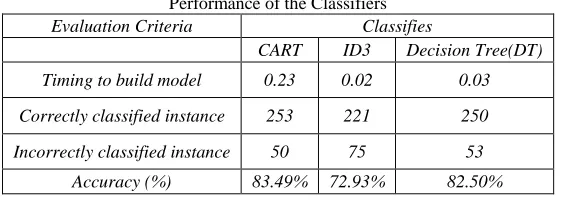
Table - 2
Performance of the Classifiers Evaluation Criteria Classifies
CART ID3 Decision Tree(DT)
Timing to build model 0.23 0.02 0.03
Correctly classified instance 253 221 250
Incorrectly classified instance 50 75 53
Accuracy (%) 83.49% 72.93% 82.50%
II.
LITERATURE SURVEY
A. Heart Disease Prediction Using Classification with Different Decision Tree Techniques IJCSI International Journal of Computer Science Issues, International Journal of Engineering Research and General Science Volume 2, Issue 6, October-November, 2014, ISSN 2091-2730 [2]
Analysis:
ID3 and C4.5 are algorithms introduced for inducing Classification Models, also called Decision Trees. We are given a set of records. Each record has the same structure, consisting of a number of attribute/value pairs. One of these attributes represents the category of the record. The problem is to determine a decision tree that on the basis of answers to questions about the non-category attributes predicts correctly the value of the category attribute. Usually the category attribute takes only the values {true, false}, or {success, failure}, or something equivalent. In any case, one of its values will mean failure
ID3:
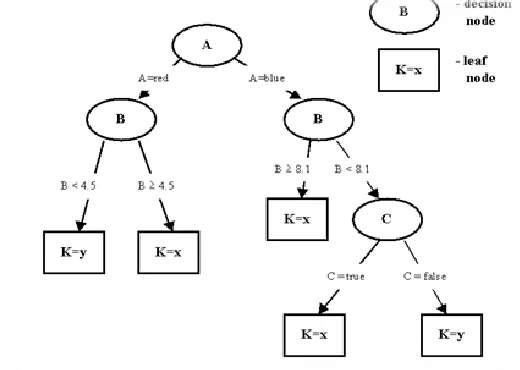
Fig. 1: Decision Tree
A decision tree classifies data using its attributes. It is upside down. The tree has decision nodes and leaf nodes. In Fig, “link from Academies” attribute is a decision node and the “author” attribute is the leaf node. The leaf node has homogenous data which means further classification is not necessary. ID3 algorithm builds similar decision trees until all the leaf nodes are homogenous.
ID3 Algorithm:
Create a root node for the tree
- If all examples are positive, Return the single-node tree Root, with label = +. - If all examples are negative, Return the single-node tree Root, with label = -.
- If number of predicting attributes is empty, then Return the single node tree Root, with label = most common value of the target attribute in the examples.
Fig. 2: ID3 Algorithm
C4.5:
C4.5 is an algorithm used to generate a decision tree developed by Ross Quinlan.C4.5 is an extension of Quinlan's earlier ID3 algorithm. At each node of the tree, C4.5 chooses one attribute of the data that most effectively splits its set of samples into subsets enriched in one class or the other. Its criterion is the normalized information gain (difference in entropy) that results from choosing an attribute for splitting the data. The attribute with the highest normalized information gain is chosen to make the decision. C4.5 made a number of improvements to ID3.
Handling both continuous and discrete attributes creates a threshold and then splits the list into those whose attribute value is above the threshold and those that are less than or equal to it.
Handling training data with missing attribute Values Handling attributes with differing costs.
C4.5 Algorithm:
C4.5 builds decision trees from a set of training data in the same way as ID3, using the concept of information entropy. The training data is a set S= s1, s2... of already classified samples. Each sample si = x1, x2... is a vector where x1, x2... represent attributes or
features of the sample. The training data is augmented with a vector C = c1, c2... where c1, c2...represent the class to which each
sample belongs. At each node of the tree, C4.5 chooses one attribute of the data that most effectively splits its set of samples into subsets enriched in one class or the other. Its criterion is the normalized information gain (difference in entropy) that results from choosing an attribute for splitting the data. The attribute with the highest normalized information gain is chosen to make the decision. The C4.5 algorithms then recourses on the smaller sub lists.
This Algorithm Has a Few Base Cases
- All the samples in the list belong to the same class. When this happens, it simply creates a leaf node for the decision tree saying to choose that class.
- None of the features provide any information gain. In this case, C4.5 creates a decision node higher up the tree using the expected value of the class.
- Instance of previously-unseen class encountered. Again, C4.5 creates a decision node higher up the tree using the expected value.
In Pseudo Code the Algorithm
Check for base cases
- For each attribute find the normalized information gain from splitting on a - Let a best be the attribute with the highest normalized information gain. - Create a decision node that splits on a_best.
- Recurs on the sub lists obtained by splitting on a_best, and add those nodes as children of node. - J48 is an open source java implementation of the C4.5 algorithms in the weka data mining tool.
B. Prediction of Heart Disease using Classification Algorithms, Proceedings of the World Congress on Engineering and Computer Science 2014 Vol II WCECS 2014, 22-24 October, 2014 [4]
Analysis
The J48 algorithm grows an initial tree using the divide and conquers technique. the visualization of the tree from modeling the dataset using the J48 algorithm. The tree is pruned to evade over fitting. The research undertook an experiment on application of various data mining algorithms to predict the heart attacks and to compare the best method of prediction. The research results do not present a dramatic difference in the prediction when using different classification algorithms in data mining. The experiment can serve as an important tool for physicians to predict risky cases in the practice and advise accordingly. The model from the classification will be able to answer more complex queries in the prediction of heart attack diseases. The predictive accuracy determined by J48 and SIMPLE CART algorithms suggests that parameters used are reliable indicators to predict the presence of heart diseases.
Cart
Classification and regression trees (CART) areanon-parametric decision tree learningtechnique that produces either classification or regression trees, depending on whether the dependent variable is categorical or numeric, respectively.
Decision Trees Are Formed By a Collection Of Rules Based On Variables In The Modeling Data Set
- Rules based on variables' values are selected to get the best split to differentiate observations based on the dependent variable. - Once a rule is selected and splits a node into two, the same process is applied to each "child" node (i.e. it is a recursive
procedure).
- Splitting stops when CART detects no further gain can be made, or some pre-set stopping rules are met. (Alternatively, the data are split as much as possible and then the tree is laterpruned).
- Each branch of the tree ends in a terminal node. Each observation falls into one and exactly one terminal node, and each terminal node is uniquely defined by a set of rules.
C. Predictive Data Mining for Medical Diagnosis: An Overview of Heart Disease Prediction International Journal of Computer Applications (0975 – 8887) Volume 17– No.8, March 2011 [5]
Analysis
data mining technique other approaches e.g. ANN, Time Series, Clustering and Association Rules, soft computing approaches etc. can also be incorporated. The outcome of predictive data mining technique on the same dataset reveals that Decision Tree outperforms and sometime Bayesian classification is having similar accuracy as of decision tree but other predictive methods like KNN, Neural Networks, Classification based on clustering are not performing well. The second conclusion is that the accuracy of the Decision Tree and Bayesian Classification further improves after applying genetic algorithm to reduce the actual data size to get the optimal subset of attribute sufficient for heart disease prediction. The proposed work can be further enhanced and expanded for the automation of Heart disease prediction. Real data from Health care organizations and agencies needs to be collected and all the available techniques will be compared for the optimum accuracy
D. Survey of Classification Techniques in Data Mining, International Journal of Computer Science and Mobile Applications, Vol.2 Issue. 2, February- 2014 [6]
Analysis
This paper deals with various classification techniques used in data mining and a study on each of them. Data mining is a wide area that integrates techniques from various fields including machine learning, artificial intelligence, statistics and pattern recognition, for the analysis of large volumes of data. Classification methods are typically strong in modelling interactions Each of these methods can be used in various situations as needed where one tends to be useful while the other may not and vice-versa. These classification algorithms can be implemented on different types of data sets like data of patients, financial data according to performances. Hence these classification techniques show how a data can be determined and grouped when a new set of data is available. Each technique has got its own pros and cons as given in the paper. Based on the needed Conditions each one as needed can be selected On the basis of the performance of these algorithms, these algorithms can also be used to detect the natural disasters like cloud bursting, earth quake, etc.
Limitations of Naïve Bayes
1) The naive Bayes classifier requires a very large number of records to obtain good results. 2) It is instance-based or lazy in that they store all of the training samples.
Limitation of Support Vector Machine Algorithm
1) SVM is a binary classifier. To do a multi-class classification, pair-wise classifications can be used (one class against all others, for all classes).
2) Computationally expensive, thus runs slow.
Limitation of Neural Network Algorithm
1) It is sensitive to the local structure of the data. 2) Memory limitation.
3) Being a supervised learning lazy Algorithm i.e., runs slowly.
Limitation of Decision Tree
1) Empty branches. 2) Insignificant branches. 3) Over fitting.
III.
EXISTING SYSTEM
WebMD
WebMD is an American corporation which provides health information services. It was founded in 1996 by Jim Clark and Pavan Nigam as Healthscape, later Healtheon, and then acquired WebMD in 1999 from Robert Draughon to form Healtheon/WebMD.
WebMD is primarily known for its public website, which has information regarding health and health care, including a symptom checklist, pharmacy information, drugs information and blogs of physicians with specific topics.
Key Features
WebMD Symptom Checker
Select the part of the body that is troubling you, choose your symptoms, & learn about potential conditions or issues.
Conditions
Find medically reviewed information about Conditions relevant to you & learn more about causes, treatments, & related symptoms.
Drugs & Treatments
Pill Identification Tool
Identify your prescription drugs and over the counter medicines by pill shape, color & imprint.
First Aid Essentials
Your handy guide for medical emergencies. From insect stings to broken bones, helpful treatment tips are always available, even without an Internet connection.
Local Health Listings
Find the closest physician, hospital & pharmacy based on your current location or search by city, state or zip.
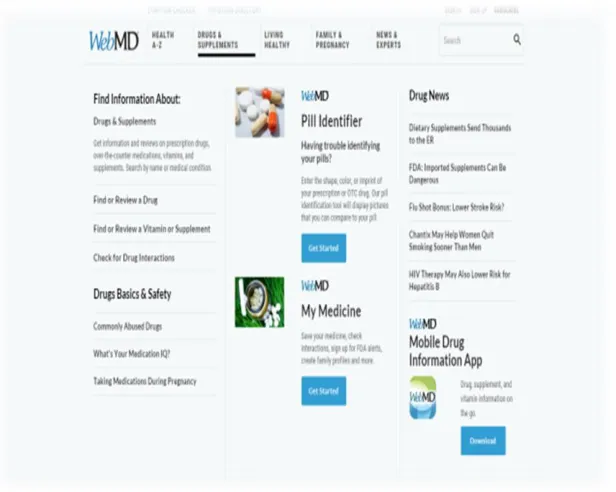
Fig. 3: Some Screenshots of WebMD
Fig. 5: Drugs & Supplements Page on WebMD
Criticism/Disadvantage
Allegations have been made that WebMD biases readers towards using drugs sold by their pharmaceutical sponsors in cases in which the drug is unnecessary.
IV.
PROBLEM DEFINITION
Problem Definition for Existing System
The patient’s healthcare record has evolved into the most reliable source of data available to fulfill multiple purposes and functions. As many as 150 end users seek access to a standard medical record. With ever increasing numbers of individuals needing the information in a medical record, the physical condition and location of the record becomes extremely important. Here are some disadvantages of using a manual (non-computerized) paper medical record.
Costs Of Manual Medical Records
There are several types of costs associated with manual patient records. One type, duplication of the record, requires paper and copying supplies, as well as the staff to create and distribute the copies. Staff hired to assemble, file, retrieve, or distribute the hard copy chart is a costly expense. Storage of the paper record necessitates the use of valuable space that could be better utilized. The records also need to be protected from water, fire, or mishandling of the paper to preserve their physical integrity. One of the most expensive disadvantages of the paper record is duplicate patient testing required to replace lost or missing test results. Repeating procedures may jeopardize the patient’s health, creating a potential opportunity for an adverse medical event. Duplicate testing wastes scarce medical resources (time, staff, supplies, and equipment) that could be used for other patients. It is a contributing source to the rising costs of health care by generating additional charges to be billed to the patient, insurance company, or other third- party payor. A related issue pertains to ordering procedures or tests that are either unnecessary or contraindicated. These types of decisions, when based on inadequate information or delayed results, create a potentially harmful situation for the patient and a needless expense for all concerned. Claims submitted for medical errors that could have been prevented with accurate and accessible patient information are issues that are seen with the use of a paper record.
Lost Productivity From Manual Medical Records
Accessibility Of Medical Records
Of great concern is the lack of access to the record. Only one person at a time may use the chart and the chart has to be in a single location. Staff needing access to the record must wait until it is available for their use. This also contributes to the difficulty of updating the paper record, especially for an active patient’s chart since that chart travels with the patient to each location of care. Delivering documentation by hand to the patient’s temporary location lends itself to the potential for losing or misplacing the records. Delayed access to the chart negatively affects coding, billing, and reimbursement processes.
Quality Of Manual Medical Records
The issue of quality encompasses the physical record, the documentation, and patient care. There are limitations to the physical quality of the paper record. Paper is fragile and does not last permanently. Normal use of the record may result in torn or stained documents. Also, over the years, ink used to complete documentation can fade. Actual damage resulting from water or fire is another threat to the physical integrity of the paper record. Quality of the actual documentation varies based on the healthcare provider’s documentation skills and knowledge level. While standardization of the data documentation has improved over the years, not all providers use the same abbreviations, terminology, format, or chart organization. This can result in incomplete or inaccurate healthcare data collection. Handwritten information may be illegible, creating the potential for errors in patient treatment or medication orders.
Fragmentation Caused By Manual Medical Records
Fragmentation of the patient’s record occurs as the result of multiple encounters with different healthcare providers. Due to disparate patient documentation and billing systems, there is often minimal or no exchange of information that contributes to compiling a longitudinal medical history for the patient. Each provider or facility has a limited portion of the patient’s overall health information. Some minor communication may be provided between referring and consulting physicians, but only for a specific encounter. The level of fragmentation varies based on several factors. These factors include:
- The patient’s ability to communicate pertinent health information to the provider; - The ability of the provider to collect information that is accessible to other providers;
- The provider’s ability to directly elicit health information from the patient and any written documentation to create an appropriate treatment plan;
- The limitations of the patient record system(s) that are being utilized to collect and disseminate information.
A well planned and implemented electronic medical record system should address and/or alleviate many of the general disadvantages of the paper record. This is an immense undertaking that requires an in-depth review of current processes, a detailed strategy for determining the organization’s future needs and goals, an organization’s willingness and ability to make significant changes, and the financial investment to achieve the desired results. It is also a very time-intensive project that demands the utmost dedication and commitment by the entire health system. Patients, providers, and other interested parties could all expect to derive benefits from a properly planned and installed automated system.
V.
PROPOSED SYSTEM
Today, many hospitals manage healthcare data using healthcare information system; as the system contains huge amount of data, used to extract hidden information for making intelligent medical diagnosis.
The main objective of this research is to build Intelligent Heart Disease Prediction System that gives diagnosis of heart disease using historical heart database. To develop this system, medical terms such as sex, blood pressure, and cholesterol like 10 input attributes are used. To get more appropriate results, two more attributes i.e. obesity and smoking are used, as these attributes are considered as important attributes for heart disease. The data mining classification techniques viz. Decision Trees, Naive Bayes etc are used.
In the proposed method we use the concepts of fitness number. In the proposed approach we convert the given data set into binary format as per the given condition for heart attack. We divide the large data set into number of parts. We perform simple intersection calculation for every part of data set and finally we consider only those item set which satisfy the given minimum support fitness value Consider a simple example
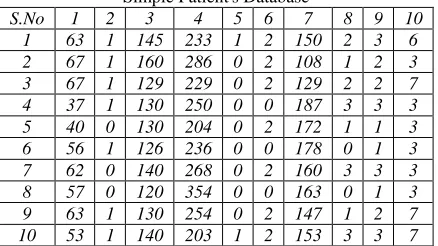
Table - 3 Simple Patient's Database
Table - 4
Description of Attribute for Patient's database S.No Attribute
1 Age
2 Sex
3 Blood Pressure
4 Cholesterol
5 Fasting Blood Sugar
6 Resting ECG
7 Thalach Value
8 Old Peak
9 Slope
10 Thal
We have taken 10 attribute which are responsible for the heart attack problem. We convert the given test data set into binary format with a possible condition for heart attack. Possible conditions for heart attack Age>45, BP>120, Cholesterol range>240, FBS>120, Resting ECG>1, Thalach value>100 Beats/Minute, Old peak>0, Slope>=2, Thal Value>3, as per the given conditions we convert the test data set into binary format. 1 represent for condition true and 0 for condition false.
Fig. 6: Working Process of Proposed Method
Table - 5
Binary Conversion as Per the Give Condition S.No 1 2 3 4 5 6 7 8 9 10
1 1 1 1 0 0 1 1 1 1 1 2 1 1 1 1 0 1 1 1 1 1
3 1 1 1 0 0 1 1 1 1 1 4 0 1 1 1 0 0 1 1 1 1 5 0 0 1 0 0 1 1 1 0 1
6 1 1 1 0 0 0 1 1 0 1 7 1 0 1 1 0 1 1 1 1 1 8 1 0 0 1 0 0 1 0 0 1 9 1 1 1 1 0 1 1 1 1 1 10 1 1 1 0 0 1 1 1 1 1
Table - 6 First Part of the Database
1 1 1 1 0 0 1 1 1 1 1 2 1 1 1 0 0 1 1 1 1 1 3 0 0 1 0 0 1 1 1 0 1 4 1 0 1 1 0 1 1 1 1 1 5 1 1 1 1 0 1 1 1 1 1
FV (1) =4, FV (2) =3, FV (3) =5, FV (4) =2, FV (5) =0 FV (6) =5, FV (7) =5, FV (8) =5, FV (9) =4, FV (10) =5 One attribute satisfies the given condition,
FV (1) =4, FV (2) =3, FV (3) =5, FV (6) =5, FV (7) =5, FV (8) =5, FV (9) =4, FV (10) =5 Two candidate attribute set which satisfy the given condition,
FV (1,2) =3, FV (1,3) =4, FV (1,6) =4, FV (1,7) =4, FV (1,8) =4, FV (1,9) =4, FV (1,10) =4, FV (2,3) =3, FV (2,6) =3, FV (2,7) =3, FV (2,8) =3, FV (2,9) =3, FV (2,10) =4 FV (3,6) =5, FV (3,7) =5, FV (3,8) =5, FV (3,9) =4, FV (3,10) =4 FV (6,7) =5, FV (6,8) =5, FV (6,9) =4, FV (6,10) =5 FV (7,8) =5, FV (7,9) =4, FV (7,10) =5 FV (8,9) =4, FV (8,10) =5, FV (9,10) =4
We repeat this process for three, four … attribute and finally we got, (1,3,6,7,8), (1,3,7,8,10), (1,3,6,7,9), (1,3, 7, 8, 9)
We repeat this procedure for seconds’ part and we got, (1,2,3,7,8), (1,2,3,7,10) (1,2,3,8,10), (1,3,7,8,10)
From the result of both parts we find (1, 3, 7, 8, 10) are common attribute satisfying the condition Age>45, Blood pressure > 120, Thalach Value>100, Old Peak>0, Thal Value>3 mean heart Attack possibilities.
VI.
ANALYSIS AND DESIGN
This disease makes a life threatening complexities such as heart attack and death. The importance of Data Mining in the Medical Domain is realized and steps are taken to apply relevant techniques in the Disease Prediction. The various research works with some effective techniques done by different people were studied. The observations from the previous work have led to the deployment of the proposed system architecture for this work. Though, various classification techniques are widely used for Disease Prediction, Decision Tree classifier is selected for its simplicity and accuracy.
VII.
CONCLUSIONS
Data mining offers promising ways to uncover hidden patterns within large amounts of data. These hidden patterns can potentially be used to predict future behaviour. Good data is the first requirement for good data exploration. Assuming good data is available, the next step is to choose the most appropriate technique to mine the data. However, there are tradeoffs to consider when choosing the appropriate data mining technique to be used in a certain application. Therefore, it clear that proposed method is more accurately classify the recodes as compared to previous method. Proposed method considers all attribute given to heart attack condition. Proposed method is also simple to understand and calculation is also easy. We have taken only ten attribute which are mainly responsible for heart attack, in future we have consider more than ten attribute which are also responsible for heart attack.
ACKNOWLEDGMENT
We would like to express our sincere gratitude towards my guide Assistant Prof.Surekha Janrao and Project Coordinator Prof. V. B Gaikwad for the help, guidance and encouragement provided during the Progress seminar. This work would have not been possible without their valuable time, patience and motivation. We thank them for making my stint thoroughly pleasant and enriching. It was great learning and a being their student. We are deeply thankful to Dr. Lata Ragha (H.O.D Computer Department) and entire team in the Computer Department. They supported us withs scientific guidance, advice and encouragement, they were always helpful and enthusiastic and this inspired us in our work. We take the privilege to express our sincere thanks to Dr. L. K. Ragha vice Principal for providing the encouragement and much support throughout our work.
REFERENCES
[1] Ordonez, C,”Association Rule Discovery With The Train and Test Approach for Heart Disease Prediction”,IEEE Transactions on information technology in biomedicine, Vol.10,No.2,April 2006
[2] K. Thenmozhi, P. Deepika,” Heart Disease Prediction Using Classification with Different Decision Tree Techniques “, IJCSI International Journal of Computer Science Issues, International Journal of Engineering Research and General Science Volume 2, Issue 6, October-November, 2014, ISSN 2091-2730 [3] NA Sunder, PP Latha, MR Chandra, “Performance analysis of classification data mining techniques over heart disease data base”, International journal of
engineering science and advanced technology volume-2, issues-3
[4] Hlaudi Daniel Masethe, Mosina Anna Masethe,” Prediction of Heart Disease using Classification Algorithms Proceedings”, World Congress on Engineering and Computer Science Vol WCECS 2014, 22-24 October, 2014
[5] J Soni, U Ansari, D Sharma, S Soni,” Predictive Data Mining for Medical Diagnosis: An Overview of Heart Disease Prediction”,International Journal of Computer Applications (0975 – 8887)Volume 17– No.8, March 2011