Efficient Lifting based Wavelet Transform in
Image Processing for Watermarking Application
and Realization on FPGA
Gifty K Baby Prof. G. K. Sadanandan
PG Student Associate Professor
Department of Electronics and Communication Engineering Department of Electronics and Communication Engineering Toc H Institute of Science and Technology, Arakkunnam
Kochi
Toc H Institute of Science and Technology, Arakkunnam Kochi
Abstract
Digital Watermarking has emerged as a new area of research in an attempt to prevent illegal copying and duplication. The discrete wavelet transform (DWT) is being increasingly used for image coding. The DWT can be used in Watermarking application. Digital watermarking technology as an important branch of information hiding technology research field. In the development of Internet today, research on digital watermarking technology for copyright protection has great practical significance. The project gives of efficient lifting based wavelet transform in image processing. The Discrete Wavelet Transform (DWT) is the transform of choice at the heart of recent image compression algorithms. This is due to the fact that DWT supports features like progressive image transformation and ease of compressed image manipulation. This project aims at implementation of efficient lifting based 2D DWT in image processing for watermarking application. A 2-D separable discrete wavelet transform is equivalent to two consecutive 1-D transforms. DWT has traditionally been implemented by convolution. Such an implementation demands both a large number of computations and a large storage features that are not desirable for either high-speed or low-power applications. Lifting-based scheme that often requires far fewer computations has been proposed for the DWT. This is suitable for VLSI implementation. Lifting scheme based DWT method leads a speed-up and a fewer computation compared to the classical convolution-based method.
Keywords: Lifting Schme, Discrete Wavelet Transform, Watermarking
________________________________________________________________________________________________________
I.
INTRODUCTION
Fig. 1: Block Diagram of digital watermarking
Applications of Digital Watermarking:
1) Owner Identification: It establishes ownership of the content.
2) Copy Protection: It prevent people from making illegal copies of copyright content.
3) Authentication of Content: To detect modifications of the content as a sign of invalid authentication. 4) Fingerprinting: Trace back illegal duplication and duplication of the content.
5) Broadcast Monitoring: Specially for advertisements and in entertainment industries, to monitor content that is broadcast as contracted and by the authorized source.
6) Medical Applications: Used to provide both authentication and confidentiality without affecting the medical image in any way
III.
DISCREATE WAVELET TRANSFORM
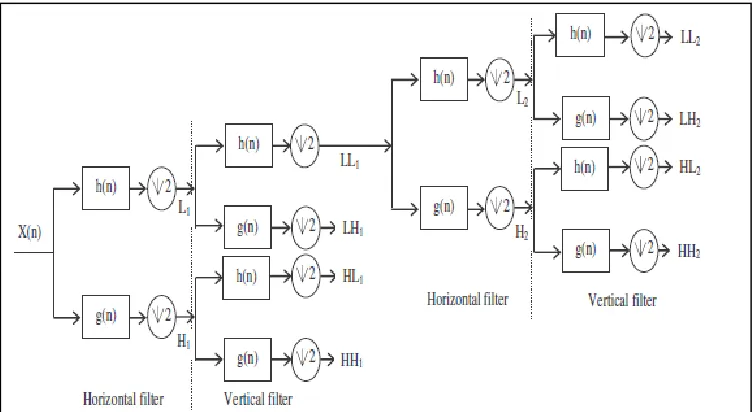
Discrete wavelet transforms (DWT) has become a cutting edge technology in image data compression. The DWT has been introduced as highly efficient and flexible method for sub band decomposition of signals. In JPEG2000, Discrete Wavelet Transform is used as a core technology to compress still images. DWT is an efficient tool for multi-resolution sub band decomposition of signals useful in many signal and image processing applications.
In DWT, the most prominent information in the signal appears in low frequencies and the high prominent information appears in very low frequencies. Data compression can be achieved by discarding these high frequencies. The wavelet transforms enables high compression ratios with good quality of reconstruction. At present, the application of wavelets for image compression is one the hottest areas of research. Recently, the Wavelet Transforms have been chosen for the JPEG 2000 compression standard. The inherent time-scale locality characteristics of the discrete wavelet transforms have established them as powerful tools for numerous applications such as signal analysis, signal compression and numerical analysis.
Fig. 2: Sub band decomposition for two-level 2D-DWT
IV.
LIFTING SCHEME
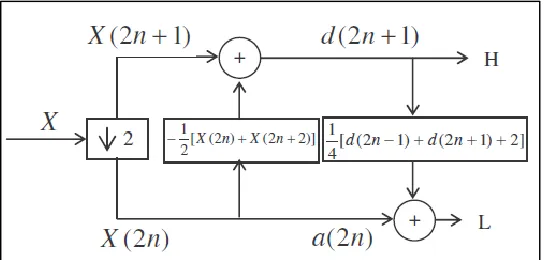
The basic idea behind the lifting scheme is first split the data into two sets (split phase) i.e., odd samples and even samples as shown. Because of the assumed smoothness of the data, odd samples have a value that is closely related to their neighbouring even samples. Use N even samples to predict the value of a neighbouring odd value (predict phase). With a good prediction method, the chance is high that the original odd sample is in the same range as its prediction. Calculate the difference between the odd sample and its prediction and replaces the odd sample with this difference. As long as the signal is highly correlated, the newly calculated odd samples will be on the average smaller than the original one and can be represented with fewer bits. The odd half of the signal is now transformed. To transform the other half, apply the predict step on the even half as well. Because the even half is merely a sub-sampled version of the original signal, it has lost some properties that we might want to preserve.
In case of images keep the intensity (mean of the samples) constant throughout different levels. The third step (update phase) updates the even samples using the newly calculated odd samples such that the desired property is preserved. Now the circle is round and can move to the next level. Apply these three steps repeatedly on the even samples and transform each time half of the even samples, until all samples are transformed.
Fig. 3: Lifting scheme
Lifting Schme:
It does not require complex mathematical calculations that are required in traditional methods. Lifting scheme is simplest and efficient algorithm to calculate wavelet transforms. Digital signals are usually a sequence of integer numbers, while wavelet transforms result in floating point numbers. For an efficient reversible implementation, it is of great importance to have a transform algorithm that converts integers to integers. Fortunately, a lifting step can be modified to operate on integers, while preserving the reversibility. Thus, the lifting scheme became a method to implement reversible integer wavelet transforms. Constructing wavelets using lifting scheme consists of three steps: The first step is split phase that split data into odd and even sets. The second step is predict step, in which odd set is predicted from even set. Predict phase ensures polynomial cancellation in high pass. The third step is update phase that will update even set using wavelet coefficient to calculate scaling function. Update stage ensures preservation of moments in low pass.
V.
RESULTS AND CONCLUSION
Matlab have been used for simulation and finding out the results. The image is given as the input. Two dimensional discrete wavelet transform has been performed in the input image. After a one-level of 2D discrete wavelet transform, the volume of image is decomposed into HH, HL, LL and LHsignals. Among this LL is selected and the watermark image is embeddedto the LL image .The data which is embedded in the image is done in two ways. First watermarking is done using a generated key as watermark and second by using an image as watermark. Then the inverse discrete wavelet transform is performed to get the watermarked image.
Lifting based DWT:
Watermark Image Watermarked Image Fig. 6:Lifting based DWT
The effectiveness of the image is estimated by the method of mean square error(MSE) and peak signal to noise ratio(PSNR) PSNR between watermarked(5.8) and DWT image (5.9)
MSE: 0.02 PSNR: 65.32dB
An efficient system for digital watermarking is proposed here by the literature survey done on various papers and simulation. Digital watermarking technology is an important branch of information hiding technology. The DWT can be used in Watermarking application. Discrete wavelet transform based image coding has better performance than traditional DCT based image coding, especially for low bit rate application. A new approach called the lifting scheme based wavelet transform or simply lifting has been proposed. It allows a faster implementation of the wavelet transform. It requires half number of computations as compare to traditional convolution based discrete wavelet transform.Matlab have been used for simulation and finding out the results. The two dimensional discrete wavelet transform is performed using the lifting based scheme .
REFERENCES
[1] Wang S.H, LinY.P, “Wavelet Tree quantization for copyright protection for watermarking”, IEEE Transactions, Image Processing,pp. 154-165, 2002. [2] Wang Y., Doherty J.F., Dyck V.R.E., “A wavelet-based watermarking algorithm for ownership verification of digital images”, IEEE Transactions, Image
Processing, 2002.
[3] Tao P., Eskicioglu A.M., “A robust multiple watermarking scheme in the discrete wavelet transform domain”, Proceedings of the SPIE,Vol. 5601, 2004. [4] Luo Y., et al. “Study on digital elevation mode data watermark via integer wavelets”, Journal of software, 16(6), 2005.
[5] Yuan Y., Huang D., Liu D., “An Integer Wavelet Based MultipleLogo- watermarking Scheme”, In IEEE, Vol-2, 2006.
[6] S.S. Bedi, G.S. Tomar, ShekharVerma “ Robust Watermarking of image in the transform domain using edge detection” UKSim 2009; 11th international conference on computer modeling and simulation .
[7] J. Mei, S. Li and X. Tan, “A Digital Watermarking Algorithm Based on DCT and DWT”, IOSN 978-952-5726-00-8, Proceedings of the 2009 International Symposium on Web Information Systems And Applications (WISA’09)Nanchang , P.R. China , May 22-24,2009
[8] DhahaDia, MedienZeghid, TaoufikSaidani, Mohamed Atri, BelgacemBouallegue,MohsenMachhout and RachedTourki,“Multi-level Discrete Wavelet TransformArchitecture Design” Proceedings of the World Congress on Engineering 2009 Vol IWCE 2009, July 1 - 3, 2009, London, U.K.
[9] Lin Q., Lin Z., Feng G., “DWT based on watermarking algorithmand its implementing with DSP”, IEEE Xplore, 2009
[10] Navjeet Sidhu, RS Uppal, “Analysis of Wavelet Le Gall 5/3 transform in Image Watermarking”,International Journal of Recent Trends in Engineering, Vol 2, No. 4, November 2009
[11] Chen, S.T., Huang, H.N., Chen, C.J., Wu, G.D., ‘Energy-proportionbased scheme for audio watermarking’, IET Signal Process,2010
[12] Preda, R.O., Vizireanu, D.N., ‘A robust digital watermarkingscheme for video copyright protection in the wavelet domain’,Measurement, 2010
[13] C.-C. Lai and C.-C.Tsai, “Digital Image Watermarking Using Discrete Wavelet Transform and Singular Value Decomposition”, IEEE Transactions on Instrumentation and Measurement, vol. 59, no. 11, November,2010.
[14] M. Narang and S. Vashisth, “Digital Watermarking using Discrete Wavelet Transform”, International Journal of Computer Applications(0975 – 8887) vol. 74, no. 20, July,2013.
[15] Deng, N., Jiang, C.S., ‘CDMA watermarking algorithm based onwaveletbasis’. Proc. 9th Int. Con. Fuzzy Systems and KnowledgeDiscovery, May 2012 [16] EmyRamola,“An area efficient implementation of Discrete wavelettransform for multi resolution analysis” IEEE Transaction 2011.