Research Article
CODEN: IJPNL6
DEVELOPMENT OF VALIDATED HPTLC METHOD FOR SIMULTANEOUS
QUANTIFICATION OF RUTIN AND QUERCETIN FROM BARK OF
ANOGEISSUS
LATIFOLIA
Pradeep Hulikare Ananth
1, Saleemulla Khan
2, Raghu Chandrasekhar
2and Mohammed Ibrahim
1*1
Department of Pharmacognosy and Biotechnology, Nizam Institute of Pharmacy, Deshmukhi,
Pochampally (Mandal), Near Ramoji Film City, Nalgonda 508284, Andhra Pradesh & Centre for
liver Research and Diagnosics, Deccan College of Medical Sciences & Allied Hospitals,
Kanchanbagh, Hyderabad 500058, Andhra Pradesh, India.
2
Manipal College of Pharmaceutical Sciences, Dept of Pharmacognosy and Biotechnology,
Manipal, Karnataka & JSS College of Pharmacy, Dept of Phytopharmacy & Phytomedicine,
TIFAC CORE, Ooty, Tamilnadu
*Corresponding author e-mail:
[email protected]
ABSTRACT
A simple and fast method was developed for simultaneous quantitative determination of two biologically active flavonoid compounds i.e. quercetin and rutin in bark of Anogeissus latifolia using High-Performance Thin-layer Chromatography. The separation was performed on TLC aluminium plates precoated with silica gel 60 F254. Good
separation was achieved in the mobile phase of Ethyl acetate: Formic acid: Glacial acetic acid: Water (100:11:11:26,
v/v) and densitometric determination of these compounds was carried out at 366 nm in reflection/absorbance mode. The rutin and quercetin content of hydroalcohol bark extract of Anogeissus latifolia were found to be 0.1617% w/w and 1.875%w/w respectively. The linear regression analysis data for the calibration plots showed a good linear relationship with r=0.9997 and r= 0.9942 for rutin and quercetin, respectively. The average recoveryof rutin and quercetin was 99.98 % and 100.11%, respectively indicating the excellent reproducibility. Statistical analysis of the data showed that the method is reproducible. The present method is being reported first time and may be used for routine quality control of the bark of Anogeissus latifolia. This HPTLC method was found to be simple and convenient for rapid screening of active compounds and quantification of the investigated flavonoids in Anogeissus latifolia.
Keywords: HPTLC, Anogeissus latifolia bark, Quercetin and Rutin
INTRODUCTION
Flavonoids comprise a vast array of biologically active compounds ubiquitous in plants, many of which have been used in traditional medicine for thousands of years1. Over 4000 structurally unique flavonoids have been identified in plant sources2. Flavonoids belong to a group of polyphenolic compounds, which are classified as flavonols, flavonones, flavones, flavanols, flavan-3-ols and isoflavones according to the positions of the substitutes present on the parent molecule.
Flavonoids of different classes have several pharmacological activities3. Flavonoids, Rutin (5,7,3’,4’,tetrahydroxy flavonol -3- rhamnoglucoside) and Quercetin (5,7,3’,4’, tetrahydroxy flavonol) have been known to posses biochemical effects, which inhibit a number of enzymes such as aldose reductase4, xanthine oxidase5, phosphodiesterase6, Ca+2-ATPase7, lipoxygenase8, cycloxygenase9, etc.
They also have a regulatory role on different hormones like estrogens, androgens10 and thyroid hormone11. In view of their wide pharmacological and biological actions12 they seem to be having a
International Journal of Pharmacy
great therapeutic potential. High performance thin layer chromatography HPTLC method is the most suitable method for estimation of chemical constituents present in plant materials. So, the quality control and quantitative analysis of flavonoid
compounds in traditional herbal medicines have become a necessary undertaking.
The genus Anogeissus (Combretaceae) is widely distributed in most tropical and subtropical countries of the world. Anogeissus is a genus of trees, shrubs or small trees. The genus has eight species, five native to South Asia, two indigenous to the southern Arabian Peninsula, and one native to Africa. Plants of this genus have been used in folk medicine for centuries to treat a broad spectrum of disorders. Chemical constituents isolated from genus
Anogeissus so far include amino acids, terpenoids (and their glycoside derivatives), steroids, flavonoids and their glycosides, tannins and other phenolic compounds and lignan13.
Anogeissus latifolia, (A.latifolia) (Combretaceae), locally known as Dhava, is a moderate sized tree characteristic of dry deciduous forests and available throughout India. In phytotherapy, the bark, leaves, heartwood and roots of the plant is traditionally used for the treatment of dysentery, snakebite, leprosy, wounds and ulcers, skin diseases including diabetes and jaundice14. The bark is reported to have potent antioxidant activity15 and possess several biological activities like antiulcer, antimicrobial16, wound healing17, chemoprotective18 and hepatoprotective activity19. A variety of chemical constituents which might contribute to various therapeutic activities have been identified in the plant. The bark of A. latifolia is reported to contain phenolic compounds like gallic acid, ellagic acid, chebulic acid and flavonoids like rutin and quercetin20,21 which are potential antioxidants22-25. The different biological activities of the bark are mainly attributed to antioxidant constituents like gallic acid, ellagic acid, chebulic acid, quercetin and rutin of the bark. In this contest,
A.latifolia an important medicinal and economic plant was selected to develop a better method for analysis of its flavonoid compounds by HPTLC. Densitometric HPTLC has been widely used for phytochemical evaluation of drugs and formulations. Hence, a densitometric HPTLC method has been developed in the present work for the quantification of rutin and quercetin in A.latifolia bark extract. The bark of the plant was standardized for the presence of Gallic acid and Ellagic acid (0.95% w/w and
0.25%w/w respectively) using HPTLC by
Govindrajan et al, 2006. However, no repot is available on the quantitative studies of rutin and
quercetin. Keeping this in view, the present study was carried out for simultaneous determination and quantification of rutin and quercetin (Fig 1) in hydroalcohol extract of bark of A.latifolia using HPTLC.
MATERIALS AND METHODS
Reagents, Standard Solutions, and Materials: All chemicals and solvents used were of analytical grade and obtained from E.Merck (Darmstadt, Germany). Flavonoid standards (rutin and quercetin) were purchased from Lobo Chemie, Mumbai, India (purity >97%). Stock solutions (1 mg/ml) of the standards were prepared daily in methanol immediately before use. TLC aluminum plates pre-coated with silica gel 60 F254 (10x 10 cm, 0.2 mm thick) used were
obtained from E. Merck Ltd (Mumbai, India).
Plant material: Bark of A.latifolia was collected from Chikmagalure District, Karnataka, India, during the month of May. It was authenticated from Botanical Survey of India, Coimbatore, Tamilnadu, India (No.BSI/SC/5/23/06-07/Tech.880).
Extraction of plant material for HPTLC analysis: The bark was shade dried and powdered coarsely. The coarse powder (250g) obtained was extracted with n-Hexane to remove the fatty substances; the marc was further extracted exhaustively with 70% ethanol in Soxhlet apparatus and filtered. The extract was concentrated under reduced temperature and pressure to get dry residue (26.8g) and stored in the dessicator was used for subsequent experiments. Preliminary phytochemical screening revealed the presence of Polyphenols, flavonoids and carbohydrates.
Preparation of Standard and Sample solutions: Standard stock solutions of rutin and quercetin were prepared by dissolving 10mg of rutin and quercetin in 10ml of methanol. From this 3μl each of these solutions was applied using Linomat applicator. 100mg of hydroalcoholic extract of A.latifolia was dissolved in 10ml of methanol and filtered. The filtrate (10mg/ml) was used for the HPTLC chemoprofiling.
Chromatographic conditions: Chromatography was performed on pre-activated (at 110oC) silica gel 60 F254 HPTLC plates. Sample(8μl) and standard (3μl
parameters were maintained for all analyses performed.
Detection and quantification of compounds: TLC was performed with Ethyl acetate: Formic acid: Glacial acetic acid: Water (100:11:11:26, v/v) as mobile phase. Chromatograms were developed at room temperature (24 ± 1°C) in glass twin-trough chambers (10 cm × 10 cm, with metal lids; Camag, Switzerland) previously saturated with mobile phase vapor for 30 min. The development distance was 80 mm. Ascending mode was used for development of thin layer chromatography.
Following the development, the TLC plate was dried
in a current of air with the help of an air dryer at 110oC for 10min, and immediately scanned at λ =
366 nm and the chromatograms were obtained with CAMAG TLC scanner equipped with CATS 4 software (Camag) in absorption reflection scan mode.
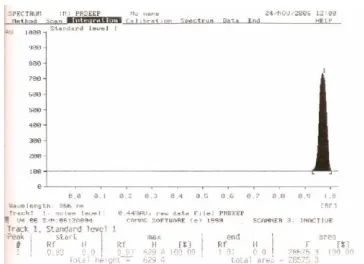
The presence (or absence) of the investigated compounds was determined according to their Rf values and fluorescence colors. Estimation of retention factor (Rf) and Area Under Curve (AUC) were done by Integration Software 4.05. Calculations for percentage were done considering standard and sample Rf, AUC and dilution factor. Integrated legends arepresented as fig 1-4. For validation of the method, calibration curve was obtained by plotting peak area Vs concentration of rutin and quercetin and checked for reproducibility, linearity and validating the proposed method. Spectra of samples and standard rutin and quercetin were matched26.
Validation of HPTLC method
Linearity: A calibration curve of standard rutin and quercetin were obtained by plotting peak area of rutin and quercetin against the different concentration. Stock solutions of rutin and quercetin were prepared in methanol and different amounts 1, 2, 4, 6, 8, and 10 µg/spot of these were loaded onto a TLC plate for preparing calibration curves. There was a good linear relationship between peak area and concentration in the range 1-10µg per zone (Table1). The experiment was performed in triplicate.
Accuracy (% Recovery): This was determined by addition of standard marker. To a fixed amount of preanalysed sample, certain amount of standards were added in the below and above level from normal level expected in sample. For this two concentrations in triplicate were used. The average recoveryof rutin and quercetin was 99.98% and 100.11%, respectively indicating the excellent reproducibility (Table 2).
RESULTS AND DISCUSSION
HPTLC is primarily used as an inexpensive method for separation, qualitative identification, or semi-quantitative visual analysis of samples27. Recent reviews show that the HPTLC techniques can be used to solve many qualitative and quantitative analytical problems in a wide range of fields, including medicine, pharmaceuticals, chemistry, biochemistry, food analysis, toxicology and environmental analysis28.
The use of HPTLC has expanded considerably due to the development of forced flow (FF) and gradient TLC methods, improved stationary and mobile phase selection, as well as new methods of quantitation methods29. To estimate rutin and quercetin in hydroalchoholic extract of A. latifolia bark the composition of the mobile phase was optimized by testing different solvent compositions of varying polarities. The best results were obtained using Ethyl acetate: Formic acid: Glacial acetic acid: Water (100:11:11:26, v/v)as mobile phase.
The selected mobile phase showed good resolution. Standard rutin and quercetin showed single peak in HPTLC chromatogram (Fig.1 and 2). After development the plate was scanned at 366 nm. The compound with Rf value 0.38 and 0.97 were identified as rutin and quercetin respectively. The rutin content of hydroalcoholic extract of A.latifolia
bark was 0.1617% w/w and quercetin content was found to be 1.875%w/w. The peak areas for different concentration of rutin and quercetin were found to be linearly dependent on the concentration in the range of 1-10 µg per spot. According to the area of peak, the regression equation and correlation coefficient were from calibration curves, Y= 6.1496 x + 85, r = 0.9997 for rutin and Y = 6.9601 x + 5.18, r = 0.9942 for quercetin. As the quercetin content is quit high it can serve as commercial source. Average recoveryof rutin and quercetin was 99.98 % and 100.11 %, respectively indicating the excellent reproducibility Drug shows good amount of flavonoids and phenolic compound, therefore it will prove better in antioxidant profile also.
CONCLUSION
HPTLC method mentioned here represented an excellent technique for simultaneous determination of rutin and quercetin in the bark extract of A.latifolia
in A.latifolia and will play a reference role on the determination of flavonoids in other medicinal plants or pharmaceutical herbal preparations.
ACKNOWLEDGEMENTS
The authors are thankful to Management, J. S. S. University, Mysore and Mr. Mohammed Jafer, Chairman, Nizam Institute of Pharmacy for providing necessary facilities for carry out this research work.
Fig 1: HPTLC chromatogram of quercetin Fig 2: HPTLC chromatogram of Rutin
Fig 3: HPTLC Chromatogram of A. latifolia bark extract Fig 4. Chromatogram of Std. and sample track
Table 1: Rf and linear regression equation of quercetin and rutin
Compound Rf Regression equation r*
Rutin 0.38 y = 6.1496 x + 85 0.9997
Quercetin 0.97 y = 6.9601 x + 5.18 0.9942
* Correlation coefficient
Table 2: Accuracy (%Recovery) for Rutin and Quercetin by HPTLC
Compound Amount of compound
in bark (mean,mg/100mg
Amount of Std added(mg)
Amount of Std found in mxture(mg)
Recovery (%)
Rutin 161 161 325.8 100.19±0.86
322 471.0 99.77±0.91
Quercetin 1875 1875 3752.19 100.11±1.12
REFERENCES
1. Elliott Middleton, JR.Chithan Kandaswami, and Theoharis. The Effects of Plant Flavonoids on Mammalian Cells: Implications for Inflammation, Heart Disease,and Cancer. The American Society for Pharmacology and Experimental Therapeutics, Pharmacol Rev., 2000; 52:673–751.
2. Harborne JB. Flavonoids in the environment: Structure-activity relationships, in Plant Flavonoids in Biology and Medicine II: BiochemicaL Cellular and Medicinal Properties (Cody V, Middleton E, Harborne JB and Beretz A eds) Alan R. Liss, Inc: New York. 1988b.
3. Harsteen B, Flavonoids.1983. A class of natural products of high pharmacological potency. Biochem. Pharmacol., 1983;32: 1141-1148.
4. Jager W, Zembsch B, Wolschann P, Pittenauer E, Senderavicz AM, et al. .Metabolism of the anticancer drug flavopiridol, a new inhibitor of cyclin dependent kinases in rat liver. Life Sci., 1998;62:1861-1873. 5. Koch HP, Jager W, Groh U, Plank G. In vitro inhibition of adenosine deaminase by flavonoids and related
compounds. New insight into the mechanism of action of plant phenolics. Methods Find Exp. Clin. Pharmacol., 1992;14:413-417.
6. Alcaraz MJ, Ferrandiz ML. Modification of arachidonic metabolism by flaronoids. J. Ethnopharmacol., 1987; 21:209-229.
7. Scerola D, Barbarini G, Grosso A, Bona S, Perissoud D. Flavonoids and hepatic cyclic monophosphates in liver injury. Boll 1st seiroter Milan., 1984., 1984;63:77-82.
8. Baumann J, Von Brucchau Sen F, Wurm G. Flavonoids and related compounds as inhibition of arachidonic acid peroxidation. Prostaglandins., 1980;20:627-639.
9. Varma SD, Kinoshita JH. Inhibitory effects of plant polyphenols on rat liver glutathione-S-transferase. Biochem Pharmacol., 1976;25:2505-2510.
10. Noro T, Oda Y, Miyasa, Ueno A, Fukushim S. Inhibition of adinosine deaminase activity of aortic endothelial cells by selected flavonoids. Chem Pharm Bul., 1983;l(31):3984-3991.
11. Petkov E, Nickdor N, Uzunov P. Inhibitory effects of flavonoids on xanthine oxidase. Planta Med., 1981; 43:183-187.
12. Raj Narayana K, Sripal Reddy K, Chaluvadi MR, Krishna DR. Bioflavonoids Classification, Pharmacological, Biochemical Effects and Therapeutic Potential. Indian Journal of Pharmacology., 2001; 33: 2-16
13. Mann A., Amupitan JO, Oyewale AO, Okogun JI., Ibrahim K. Chemistry of secondary metabolites and their antimicrobial activity in the drug development process: A review of the genus Anogeissus, Medicinal Plants - International Journal of Phytomedicines and Related Industries., 2009; 1 : 2.
14. Anonymous , Indian Medicinal Plants. Vol I, Orient Longman, India,1987.
15. Govindarajan R, Vijayakumar M, Rao CV, Shirwaikar A, Rawat AK, Mehrotra S, Pushpangadan P. Antioxidant potential of Anogeissus latifolia. Biol Pharm Bull., 2004; 27: 1266-1269.
16. Govindarajan R, Vijayakumar M, Singh M, Rao ChV, Shirwaikar A, Rawat AK, Pushpangadan P. Antiulcer and antimicrobial activity of Anogeissus latifolia. J Ethnopharmacol., 2006; 106: 57-61.
17. Govindarajan R, Vijayakumar M, Rao CV, Shirwaikar A, Mehrotra S, Pushpangadan P. Healing potential of Anogeissus latifolia for dermal wounds in rats. Acta Pharm., 2004;54: 331-338.
18. Khan S, Pradeep HA, Vijan R. et al,..Chemoprotective activity of Anogeissus latifolia bark extract on Paracetamol-induced hepatotoxicity. Pharmacologyonline., 2008; 2: 303-327.
19. Pradeep HA, Saleemullah Khan, Karamkonda Ravikumar, Meesala Srinivasa Rao, Mandava Kiranmai, Dachani Sudhershan Reddy, Mohammed Ibrahim. Hepatoprotective evaluation of Anogeissus latifolia : In vitro and in vivo studies, World J Gastroenterol., 2009; 15(38): 4816-4822.
20. Reddy KK, Rajadurai S, Nayudamma Y. Studies on Dhava (Anogeissus latifolia) Tannins: Part III- Polyphenols of bark, sapwood and heartwood of Dhava. Indian J Chem., 1965;308-310.
21. Deshpande VH, Patil AD, Ramarao AV, Venkataraman K. 3,3’-Di-O-methylellagic Acid-4’-β-D-xyloside and 3,4,3’-tri- O-methylflavellagic acid-4’-β-D-glucoside from Anogeissus latifolia bark. Indian J Chem., 1976;14B: 641-643.
22. Aruoma OI, Murcia A, Butler J, Halliwell B. Evaluation of the antioxidant and prooxidant actions of gallic acid and its derivatives. J Agric Food Chem., 1993;41: 1880-1885.
23. Festa F, Aglitti T, Duranti G, Ricordy R, Perticone P, Cozzi R. Strong antioxidant activity of ellagic acid in mammalian cells in vitro revealed by the comet assay. Anticancer Res., 2001; 21:3903-3908.
25. Boots AW, Haenen GR, Bast A. Health effects of quercetin: from antioxidant to nutraceutical. Eur J Pharmacol., 2008; 585: 325-337.
26. P.D. Sethi. HPTLC, CBS Publishers and distributors, 1st edition New Delhi,1996.
27. Rozylo JK, Janicka M. Different planar techniques for prediction of solute retention in column liquid chromatography. J Planar Chromatogr., 1996; 9(6): 418-424.
28. Weins C, Hauck HE. Advances and developments in thin layer chromatography. LC-GC Int., 1996; 4(6): 455-71.