298
International Journal of Pharmaceutical Sciences and Drug Research
2015; 7(3): 298-303
Research Article
CODEN (USA): IJPSPP
ISSN: 0975-248X
Production and Optimization of α-Amylase from
Aspergillus flavus
under
Solid State Fermentation
S. Manivannan
1*, P. Madhavi
1, S. Bhuvaneswari
21Post Graduate and Research Department of Biotechnology, Bharath College of Science and Management,
Thanjavur, Tamil Nadu, India
2Department of Pharmaceutics, Periyar College of Pharmaceutical Sciences, Tiruchirappalli-620 021, Tamil Nadu, India
ABSTRACT
Alpha amylase is one of the important and well known industrial enzymes that cause the breakdown of starch or glycogen. Use of microorganism for the production of amylase is economical as microbes are easy to manipulate to obtain enzymes of desired characteristics. However fungus is preferred over bacteria for enzymes production because of its filamentous nature. Agricultural wastes byproducts have great potential for the production of enzymes. Two indigenous carbon sources namely wheat bran and rice bran were used as substrate for amylase synthesis by Aspergillus flavus through solid state fermentation. Wheat bran gave the highest (670 ± 36μmol./min/mL)and Rice bran (428 ± 24μmol./min/mL) gave the lowest enzyme activity was obtained. Optimum inoculum size of 10% (660 ± 36μmol./min/mL), incubation period 120 hours (670 ± 28 μmol./min/mL), pH 6 (680 ± 42μmol./min/mL), temperature at 30°C (660 ± 46μmol./min/mL) gave highest yield of enzyme production. The highest yield of amylase production was obtained by the addition of MgSO4
0.2% and CaCl2 0.02% respectively. The results obtained in the present study suggest that the Aspergillus flavus
may act as a potent strain for industrial production of α-amylase.
Keywords: Aspergillus flavus, α-amylase, Solid state fermentation, Optimization of parameters.
INTRODUCTION
Amylases have potential applications in the food, fermentation, textile, paper and pharmaceutical industries. Amylase can be derived from several sources, such as plants, animals and microorganisms. Amylases are the hydrolytic enzymes, widely spread in nature having varied application in different industrial processes and constitute a class of industrial enzymes
*Corresponding author: Dr. S. Manivannan,
Post Graduate and Research Department of Biotechnology, Bharath College of Science and Management, Thanjavur - 613 005, Tamil Nadu, India;
Tel.: +91-9444488109; Fax: +91-4362-227185; E-mail: [email protected]
Received: 30 April, 2015; Accepted: 08 May, 2015
and representing approximately 25-33% of the world market. α-amylases (endo-1,4 alpha-D-glucan glucohydeolase, E.C3.2.1.1) are extracellular enzymes that randomly cleave the 1, 4 alpha-D flucosidic linkages between adjacent glucose units inside the linear amylose chain. [1- 3] The enzymes from microbial
sources generally meet industrial demands and made significant contribution to the production of foods and beverages. The microbial amylase has almost completely replaced chemical hydrolysis of starch in starch processing industry. [4] Selection of the right
Int. J. Pharm. Sci. Drug Res. May-June, 2015, Vol 7, Issue 3 (298-303)
manipulation, ease of process modification, optimization and also suitable for industrial application. [5]
Amylase of fungal origin was found to be more stable than the bacterial enzymes on a commercial level. Several attempts have been made to optimize culture conditions and suitable strains of fungi. [6-7] Fungal
α-amylases are produced by different fermentation techniques. Production of α- amylases has been investigated through submerged (SmF) and Solid-state fermentation (SSF). [8] The use of SSF for enzyme
production has numerous advantages over SmF, including simple technique, low capital investment, inexpensive substrate high volumetric productivity, relatively higher concentration of the products, less effluent generation, lower energy requirements and use of simpler downstream processing. [9-10] Recently, it has
gained importance in the production of microbial enzymes owing to several economic advantages over conventional submerged fermentation. The content of synthetic media is very expensive and uneconomical, so they need to be replaced with more economically available agricultural by-products to reduce the costs. Most agricultural wastes contain three major components; cellulose (30-50%), hemicellulose (20-35%) and 4-35% lignin. Starch based agro industrial residues are generally considered the best substrates for the SSF of α-amylases. [11-12]
The selection of suitable substrates for SSF has mainly been centered on agro industrial residues due to their potential advantages for filamentous fungi. Which are capable of penetrating into the hardest of these solid substrates, aided by the presence of turgor pressure at the tip of the mycelium. Optimization of various parameters and manipulation of media are one of the most important techniques used for the over production of enzymes in large quantities to meet industrial demands. [13] Production of α-amylase in
fungi is known to depend on both morphological and metabolic state of the culture. Growth of mycelium is crucial for extracellular enzymes like α-amylase. [14]
Various physical and chemical factors have been known to affect the production of α-amylase such as temperature, pH, period of incubation, carbon sources acting as inducers, surfactants, nitrogen sources, phosphate, different metal ions, moisture and agitation. Interactions of these parameters are reported to have a significant influence on the production of the enzyme. The present study is undertaken to enhance the production of α-amylase capacity by endophytic fungus Aspergillus flavus under SSF fermentation using agro industrial waste and optimization of the parameters, favoring the maximal production of α-amylase.
MATERIALS AND METHODS
Microorganism and culture maintenance
Fungal strain of Aspergillus flavus was obtained from Industrial Biotechnology Research Laboratory (IBRL)
culture collection, USM Penang. The culture was maintained on potato-dextrose-Agar (PDA) slants. The slants were grown at 27°C for 5 days and stored at 4°C. Starch hydrolyzing activities were detected as clear zones after exposure to Iodine. [15]
Inoculum preparation
A volume of 10 mL of sterilized distilled water was added to a sporulated (5-day-old) PDA slant culture. The spores were dislodged using the inoculation needle under aseptic conditions and then it was shaken thoroughly to prepare homogenized spore suspension. A volume of 1 mL suspension contained about 106
spores.
Substrate
Wheat bran and Rice bran were procured form local market of Thanjavur City. These substrates were dried and ground into coarse powder with an electronic blender, and was used as a substrate for amylase production in solid state fermentation.
Solid state fermentation
Agricultural wastes such as wheat bran, and rice bran were used as substrate for α-amylase production. The substrates were ground into coarse powder with a blender. SSF was carried out using wheat and rice bran states individually. Starch content of individual substrates was checked by Anthrone method. [16] 5 g of
substrates amended with 10mL of mineral salt solution containing (composed of (g/L); (NH4) 2SO4 4MgSO4
.7H2O, FeSO4. 7H2O 0.02, K2HPO4 1.4 and KH2 2PO4 0.6,
at pH 5.5), were taken into 250 mL Erlenmeyer flasks, mixed homogenously and sterilized at 121°C for 15 min in an autoclave. Thereafter, the flask material was cooled a room temperature and inoculated with 1 mL of inoculum. The flasks were then incubated at 27°C for 48 hour.
Optimization of cultural and nutritional parameters
Various process parameters affecting enzyme production during SSF were optimized. The strategy was to optimize each parameter independently of the others and subsequently optimal conditions were employed in all experiments. Opimization experiment was carried out at different incubation period (2, 4, 6, 8 and 10 days), inoculum level (1, 3, 5, 10 and 15%) incubation temperature (30, 40, 50, 60, 70°C), pH (2, 4, 6, 8 and 10; adjusted with 0.1 N HCl and 0.1N NaOH) and moisture content (10, 20, 40, 60, 80, and 100%). Different metal salts MgSO4 (0.2, 0.4, 0.6, 0.8 and 1%) and CaCl2
(0.02, 0.06, 0.06, 0.08 and 0.1%) concentration were supplemented with the production media to determine their effect on amylase production under the optimized fermentation conditions.
Protein assay
Protein content was determined by the method of Lowry et al. (1951) [17] with crystalline Bovine Serum
(BSA) as the standard.
Determination of dry mass of substrates
Dry mass of substrates was determined by drying them in an oven at 80°C for 24 hour.
Int. J. Pharm. Sci. Drug Res. May-June, 2015, Vol 7, Issue 3 (298-303)
After the incubation period from submerged fermentation the fermented broth was centrifuged at 8 000 rpm for 15 min. Supernatant was filtered through Whatman No. 1 filter paper and filter was used the enzyme source. From the solid state fermentation, 50 mL of distilled water was added in each flask containing fermented mash and placed on a rotary shaker at 200 rpm for 60 min. The mixture was filtered through two fold cheese cloth and then filtering through Whatman No.1 filter paper. The filtrate was used as source of amylase. [18]
Enzyme assay
The amylase activity was assayed by measuring the reducing sugar liberated in the reaction mixture. The reaction mixture (3 mL) consisted of 0.5 mL of 1% (w/v) soluble starch and 0.5 mL appropriately diluted enzyme source in 2 mL of 0.1 M phosphate buffer (pH 6.5). After incubation at room temperature for 20 min the reaction was stopped by addition of dinitrosalicylic method (DNS). Then boiling tubes in a water bath for 15 min and thus the reducing sugars released by enzymatic hydrolysis of starch ware determined. [19]
One unit of amylase activity was defined as the amount of enzyme the releases one micromole of reducing sugar as glucose per minute under assay conditions and enzyme activity is expressed as the specific activity, which is represented as U/mL of protein. The experiments were carried out in triplicates.
Statistical analysis
The results were expressed as mean ± standard deviation.
RESULTS AND DISCUSSION
Two indigenous carbon sources namely wheat bran and rice bran were used as substrate for α-amylase synthesis by A. flavus through SSF. α-amylase production by using different conditions, such as inoculum level, incubation period, pH, temperature, different carbon source, nitrogen sources, moisture content, MgSO4, and CaCl2 concentration were
analyzed by SSF method.
Effect of substrate
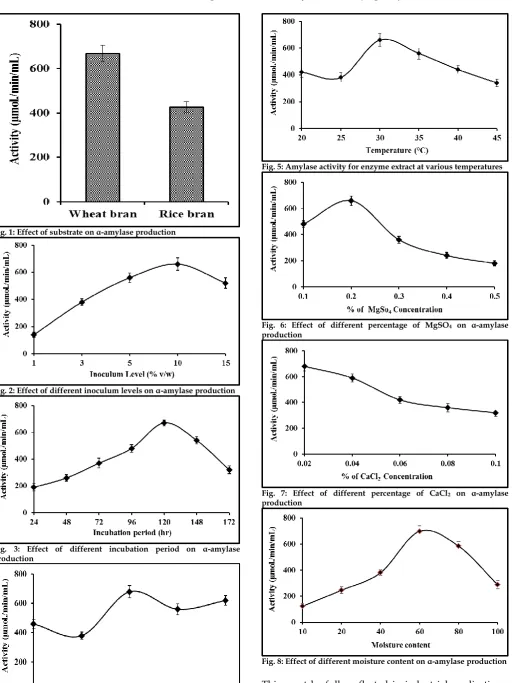
Different substrates i.e. wheat bran and rice bran were used in the fermentation for the production of α-amylase at 30°C using A. flavus for 5 days. Wheat bran gave the highest (670 ± 36μmol./min/mL) and Rice bran (428 ± 24μmol./min/mL) gave the lowest enzyme activity as shown in Fig. 1. Highest activity in Wheat bran may be due to its high carbohydrate contents and suitable texture.
Effect of inoculum level
Inoculum level is an important factor for the production of enzymes. Effect of inoculum size was checked by varying the concentration of A. flavus in SSF of wheat bran. Various inoculum levels (1, 3, 5, 10 and 15% (v/w)) were tried to study their effect on amylase production. Optimum inoculum size of 10% (660 ± 36μmol./min/mL) of A. flavus gave highest yield of enzyme production as shown in (Fig. 2). Increasing the
size of inoculum resulted in decreased emzyme production. Increased inoculum size resulted in increases moisture level, which ultimately decreased the fungal growth and enzyme production. [20] The free
excess liquid present in an unabsorbed form creates an additional diffusion barrier together with that imposed by the solid nature of the substrate and lead to a decrease in growth and enzyme production. On the other hand, low inoculum level introduces a lower number of cells in the production medium. This requires a longer time to grow to an optimum number to utilize the substrate and form the desired product. Highest yield of amylase production from A. flavus
using inoculum size of 0.0637 × 10⁶/mL-1. [21] Zambare
(2010) obtained highest enzyme production (1672-1693 U/gdfs) at inoculum level of 5-8% v/w) in SSF using A.
oryzae. [22] The reason behind such a result may be that a
small quantity of inoculum might have postponed mycelia growth and reduced enzyme productivity while any higher inoculum volume resulted in inadequate heat transfer, although water-holding capacity of media might have been better.
Effect of incubation time
The incubation period varies with enzyme production. Short incubation period offers potential for inexpensive production of enzymes. [23] In the present study,
amylase production was 190 ± 28μmol./min/mL in 24 hr and gradually increased up to 670 ± 22μmol./min/mL in 120 hour of incubation. After 120 hr there was gradual decrease in enzyme production (Fig. 3). Kathiresan et al. (2006), reported, that maximum activity was detected in 96 hour by
Penicillium fellutanum under sub merged fermentation
and as against a short duration of 24 h in the case of bacteria. [24]
Effect of pH
The enzyme an activity of the wheat bran containing media crude enzyme extract was assayed at various pH was studied. Among physical parameters, pH of the growth medium plays an important role by inducing morphological changes in microbes and in enzyme secretion (Fig. 4). The pH change observed during the growth of microbes also affects product stability in the medium. Most of the earlier studies revealed the optimum pH range between 6 and 7 for the growth of bacterial strains and enzyme production. [25-27] The
maximum enzyme activity was obtained at pH 6 (680 ± 42μmol./min/mL) and the minimum was obtained at pH 4 (380±24 μmol./min/mL).
Effect of temperature
SSF is usually carried out in the temperature range of 25 to 40°C. Amylase production was optimum at 30°C (660 ± 46μmol./min/mL) (Fig. 6). Temperature optimum for amylase was found to be in a range between 25 and 37°C for the mesophilic fungi. [27]
Int. J. Pharm. Sci. Drug Res. May-June, 2015, Vol 7, Issue 3 (298-303)
Fig. 1: Effect of substrate on α-amylase production
Fig. 2: Effect of different inoculum levels on α-amylase production
Fig. 3: Effect of different incubation period on α-amylase production
Fig. 4: Effect of different pH level on α-amylase production
Fig. 5: Amylase activity for enzyme extract at various temperatures
Fig. 6: Effect of different percentage of MgSO4 on α-amylase
production
Fig. 7: Effect of different percentage of CaCl2 on α-amylase
production
Fig. 8: Effect of different moisture content on α-amylase production
Int. J. Pharm. Sci. Drug Res. May-June, 2015, Vol 7, Issue 3 (298-303)
Effect of metal ions
These ions play an important role for the production of α-amylase. The underlying reason for this is that most α-amylases are metalloenzymes. Ca2+ and CaCl2 ions
are significantly important for the production of these enzymes. [28-29] In the present study effect of different
concentrations of CaCl2 on α-amylase production was
evaluated. 0.02% was found to be optimum (680 ± 36μmol./min/mL) for the production of α-amylase. With the increase in calcium ions there was a slight reduction in enzyme production. The addition of MgSO4.7H2O into the wheat bran medium enhanced
amylase production by A. flavus and 0.2% MgSO4
resulted in maximum α-amylase activity (660 ± 36μmol./min/mL) (Fig. 6 & 7).
Effect of moisture content
The results presented in Fig. 8 indicate that moisture content of 60% was optimum for maximum enzyme yield. Optimum yield was observed as (698 ± 42μmol./min/mL) at 62% moisture content. Highest content moisture in solid state systems could increase the processes of diffusion. [30] Increase in moisture
content resulted in clumping of the solid particles and consequent reduction in enzyme yield and microbiological activity on a substrate will progressively decrease at lower water contents. [31]
Fungal enzyme α - amylase was produced using a specific culture A.flavus. Various parameters viz. temperature, pH, incubation time and inoculum level, various mineral salts were studied to optimize the conditions to carryout SSF of wheat bran by A. flavus. Hence form the present study we conclude that SSF of the wheat bran for the optimal production of enzyme is technically feasible. Further utilization of wheat bran for the production of enzyme in SSF would reduce the cost considerably. The results will be useful for industrial production of this important enzyme with low input cost.
ACKNOWLEDGEMENT
The authors express their gratitude to Bharath College of science and management, for providing laboratory facility to carry out this study.
REFERENCES
1. Castro AM, Carvalho DF, Freire DMG, Castilho LR. Economic analysis of the production of amylases and other hydrolases by Aspergillus awamori in solid-state fermentation of babassu cake. SAGE- Hindawi Access to Research Enzyme Research 2010; 1:9.
2. Anto H, Ujjval T, Kamlesh P. Alpha amylase production by
Bacillus cereus MTCC 1305 Using solid state fermentation. Food Technol Biotechnol. 2006; 44:241-245.
3. Pandey A, webb C , Soccol CR, Larroche C. Rice bran as a substrate for proteolytic enzyme production. Enzyme technology. New delhi, Asiatech publishers, 2005.
4. Monga M, Goyal M, Kalra KL, Soni G. Production and stabilization of amylases from Aspergillus niger. Mycosphere. 2011; 2:129-34.
5. Burhan A, Nisa U, Gokhan C, Omer C, Ashabil A, Osman G. Enzymatic properties of a novel thermostable, thermophilic, alkaline and chelator resistant amylase from an alkaliphilic
Bacillus sp. isolate ANT-6, Process. Biochem. 2003; 38:1397-1403.
6. Abu EA, Ado SA, James DB. Raw starch degrading amylase production by mixed culture of Aspergillus niger and
Saccharomyces cerevisae grown on Sorghum pomace. Afr J Biotechnol. 2005; 4:785-790.
7. Suganthi R, Benazir JF, Santhi R, Ramesh kumar V, Anjana H, Nitya M, Nidhiya KA, Kavitha G, Lakshmi R. Amylase production by aspergillus niger under solid state fermentation using agro industrial wastes. Int J Eng Sci Tech. 2011; 3:1756-1763.
8. Ramachandran S, Patel AK, Nampoothiri KM, Chandran S, Szakacs G, Soccol CR, Pandey A. Alpha amylase from a fungal culture grown on oil cakes and its properties. Brazilian Archives of Biology and Technology. 2004; 47:309-317. 9. Lonsane BK, Ghildyal NP, Budiatman S, Ramakrishna SV.
Engineering aspects of solid state fermentation. Enzyme Microb Technol. 1985; 7:258-265.
10. Baysal, Z, Uyar F, Aytekin C. Solid-state fermentation for production of α-amylase by a thermotolerant Bacillus subtilis
from hot-spring water. Process Biochem. 2003; 38:1665-1668. 11. Arasaratnam V, Mylvaganam K, Balasubramaniam K.
Glucoamylase production by Aspergillus niger in solid state fermentation with paddy husk as support. J Food Sci Technol. 2001; 38:334-338.
12. Kocher GS, Kaur P, Grewal HS. Production of α-amylase by
Aspergillus niger using wheat bran in submerged and solid state fermentations. Indian J Microbiol. 2003; 43:143–145. 13. Tanyildizi MS, Ozer D, Elibol M. Optimization of a-amylase
production by Bacillus sp. using response surface methodology. Process Biochem. 2005; 40:2291-2296.
14. Carlsen M, Nielsen J, Villadsen J. Growth and a-amylase production by Aspergillus oryzae during continuous cultivations. J. Biotechnol. 1996; 45:81-93.
15. Asgher M, Asad MJ, Rahman SU, Legge RL. A thermostable - amylase from a moderately thermophilic Bacillus subtilis
strain for starch processing. J Food Eng. 2007; 79:950-955. 16. Sadasivam S, Manickam A. Estimation of starch by antrone
reagent. Biochemical Methods: New Age International Publishers, 1996.
17. Lowry OH, Rosebrough NJ, Farr AL, Randall RJ. Protein measurement with the Folin-Phenol reagents. Journal of Biological Chemistry. 1951; 48:17-25.
18. Alva S, Anupama J, Salva J, Chiu YY, Vyshali P, Shruthi M, Yogeetha BS, Bhavya D, Purvi J, Ruchi K, Kumudini BS, Varalakshmi KN. Production and characterization of fungal amylase enzyme isolated from Aspergillus sp. JGI 12 in solid state culture. African journal of Biotechnology. 2007; 6:576-581.
19. Miller GL. Use of dinitro-salicyclic acid for the determination of reducing sugars. Analytical chemistry. 1959; 31:426. 20. Sharma DK, Tiwari M, Behere BK. Solid state fermentation of
new substrates for production of cellulase and other biopolymer hydrolyzing enzymes. Appl Biochem Biotechnol. 1996;15:495-500.
21. Ammar MS and El-Safey EM. Production of α-amylase enzyme produced by Aspergillus flavus var. columnaris, S-9KP from maize meal and rice husk under solid-state fermentation (SSF) conditions in open air. International Conference of Enzymes in the Environment, Activity, Ecology and Applications, Praha, Czech Republic, 2003, pp.33.
22. Zambare V. Solid state fermentation of Aspergillus oryzae for Glucoamylase Production on Agro residues. Int J Life Sci. 2010;4:16-25.
23. Silva S, Elmore BB, Houston KH. Cellular activity of
Trichoderma ressei (RUT-C30) on municipal solid waste. Applied Biochemistry and Biotechnology1995; 15:145-153. 24. Kathiresan K, Manivannan S. α--amylase production by
Penicillium fellutanum isolated from mangrove rhizosphere soil. African Journal of Biotechnology2006; 5:829-832. 25. Kundu AK, Das S, Gupta TK. Influence of culture and
Int. J. Pharm. Sci. Drug Res. May-June, 2015, Vol 7, Issue 3 (298-303)
submerged culture of Aspergillus oryzae. Journal of Fermentation Technology 1973; 51:142-150.
26. Castro PML, Hayter PM, Ison AP, Bull AT. Application of statistical design to the optimization of culture medium for recombinant interferon-gamma Process Biochemistry production by Chinese hamster ovary cells. Applied Microbiology and Biotechnology 1992; 38:84-90.
27. Gupta R, Gigras P, Mohapatra H, Goswami V K, Chauhan B. Microbial amylases: a biotechnological perspective. Process Biochemistry 2003; 38:1599-1616.
28. Francis FA, Sabu KM, Nampoothiri S, Ramachandran S, Ghosh S, Szakacs G, Pandey A. Use of response surface methodology for optimizing process parameters for the production of a amylase by Aspergillus oryzae. Biochem Eng J. 2003; 15:107-115.
29. Gupta RP, Gigras H, Mohapatra VK, Goswami B, Chauhan B. Microbial α -amylases: a biotechnological perspective. Process Biochem. 2003; 38:1599-1616.
30. Souza DFD, Peralta RM. Production of amylases by
Aspergillus tamarii in solid state fermentation at high initial glucose concentrations. Acta Scientiarum Maringa. 2001; 23:599-602.
31. Sindhu R, Suprabha GN, Shashidhar S. Optimization of process parameters for the production of a- amylase from
Penicillium janthinellum (NCIM 4960) under solid state fermentation. African Journal of Microbiology Research 2009; 3:498-503.