Energy Schemes For Multiple Mobile Base
Stations In Wireless Sensor Network
Manpreet Kaur, Shallu Bajaj
Computer Science and Engineering, Kurukshetra Institute of Technology and Management,Kurukshetra, India;Computer Science and Engineering, Kurukshetra Institute of Technology and Management,Kurukshetra
Email: [email protected]
ABSTRACT:The main design issues for a sensor network are conservation of the energy available at each sensor node. We propose to deploy multiple, mobile base stations to prolong the lifetime of the sensor network.In this paper, we look at communication protocols, which can have significant impact on the overall energy dissipation of these networks. We propose LEACH (Low-Energy Adaptive Clustering Hierarchy), a clustering-based protocol and integer linear programming, flow based routing protocol. Integer linear program is determine the new locations for the base stations and a flow-based routing protocol to ensure energy efficient routing during each round and LEACH protocol that utilizes randomized rotation of local cluster base stations (cluster-heads) to evenly distribute the energy load among the sensors in the network. We compare the three schema result by using three methods.
Keywords :WSNs,Energy efficiency,LEACH,interger linear programming,flow based routing,base station,multiple mobile base station
1 I
NTRODUCTIONThe main design issues for a sensor network are conservation of the energy available at each sensor node. We propose to deploy multiple, mobile base stations to prolong the lifetime of the sensor network. In this paper, we look at communication protocols, which can have significant impact on the overall energy dissipation of these networks. We propose LEACH (Low-Energy Adaptive Clustering Hierarchy), a clustering-based protocol and integer linear programming, flow clustering-based routing protocol. Integer linear program is determine the new locations for the base stations and a flow-based routing proto-col to ensure energy efficient routing during each round and LEACH protocol that utilizes randomized rotation of local clus-ter base stations (clusclus-ter-heads) to evenly distribute the ener-gy load among the sensors in the network. We compare the three schema result by using three methods.We show that employing multiple, mobile base stations in accordance with the solution given by our schemes would significantly increase the lifetime of the sensor network.
2 First Order Radio Model
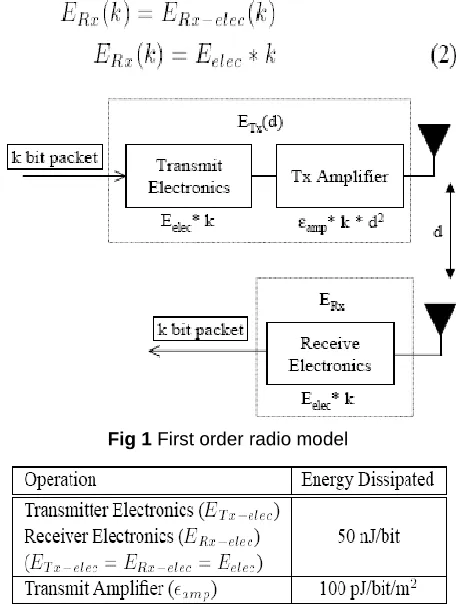
Currently, there is a great deal of research in the area of low-energy radios. Different assumptions about the radio amplifier to achieve an acceptable Eb /No (see Figure 1 and Table 1). These parameters are slightly better than the current state-of-the-art in radio design.We also assume an r2 energy loss due to channel transmission. Thus, to transmit k-bit message a distance d using our radio model, the radio expends: characte-ristics, including energy dissipation in the transmit and receive nodes, will change the advantages of different protocols. In our work, we assume a simple model where the radio dissipates Eelec=50NJ/bit to run the transmitter or receiver circuitry and
Eamp=100 pJ/bit/m 2
for the transmit and to receive this mes-sage, the radio expends:
Fig 1 First order radio model
Table 1 Radio charactersics
3 Advantageof Employing Multiple Base
Sta-tions
num-ber of hops the message has to travel, employing multiple base stations effectively reduces the energy consumption per message delivered.
Fig 2 Circular Field of Interest
4 Three Stages for problem formation
For problem formulation we used three solution for solving energy scheme in sensor network.These are as:
4.1 ILP
4.2 Flow based routing protocol 4.3 LEACH protocol
4.1 ILP: Integer Linear Program
An integer linear program formulation let yi be a 0-1 integer
variable for each i vf such that yi = 1 if a base station is
lo-cated at feasible site l;0 otherwise.
Assuming no data aggregation, the balance of flow of mes-sages at each node is represented by (1), where Xij represents number of messages node i transmits to node j in a particular round. Let Er be the energy spent by a sensor node in receiving a message. and Et be the energy spent by a sensor node in transmitting. Er and Et can be calculated from antenna characteristics. Then the total energy spent by all the nodes during a particular round is bound by (2). The number of feasible sites selected to locate the base stations is limited to at most Kmax in equation (3).
4.2 Flow based routing protocol
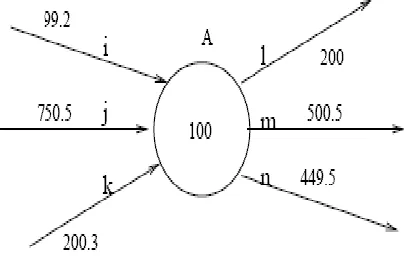
Sensor nodes can use the flow information obtained by solving the integer linear program to route messages in an energy efficient manner. Consider sensor node A with it incoming and outgoing number of messages as shown in the.fig Once a
sensor node has this information it would perform its routing as described below.
For every outgoing link a counter is maintained. The value of the counter is set to the floor of the flow going out on that particular link.
Whenever a node needs to transmit its packets, it would select one of the outgoing links in a round robin fashion.
If the counter value of the selected link is greater than the number of packets that have to be transmitted, then all the packets are transmitted on that link and counter value is de-cremented by the number of pakcetstransmitted; otherwise the number of packets equal to the counter value of the link are transmitted along the link and its counter values is set to 0. To transmit the remaining messages outgoing links are selected in a round robin fashion.(v) If the counter value of all the out-going links is zero then a link is selected arbitrarily and all the packets are transmitted on this link
FIG 3 FLOW BASED ROUTING
(v) If the counter value of all the outgoing links is zero then a link is selected arbitrarily and all the packets are transmitted on this link Example: Suppose the node A in Figure 2 had 250 packets to transmit. If link l was selected then 200 packets would be transmitted on this link and its new counter value would be set to 0. The remaining 50 packets would be trans-mitted on m and its counter values would be updated to 450. The main idea behind this heuristic is that when the number of packets to be transmitted is large, the routes taken by the packets closely follow the flow information on the outgoing links
.
4.3 LEACH: Low-Energy Adaptive Clustering Hierarchy
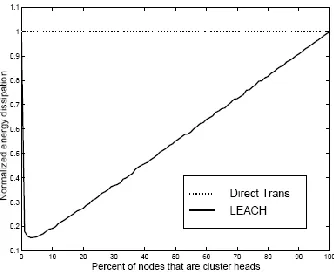
cluster-heads at any given time with a certain probability. These cluster head nodes broadcast their status to the other sensors in the network. Each sensor node determines to which cluster it wants to belong by choosing the cluster-head that requires the minimum communication energy. Once all the nodes are organized into clusters, each cluster-head creates a schedule for the nodes in its cluster. This allows the radio components of each non-cluster-head node to be turned off at all times except during its transmit time, thus minimizing the energy dissipated in the individual sensors. Once the head has all the data from the nodes in its cluster, the cluster-head node aggregates the data and then transmits the com-pressed data to the base station. Since the base station is far away in the scenario we are examining, this is a high energy transmission. However, since there are only a few cluster-heads, this only affects a small number of nodes .As dis-cussed previously, being a cluster-head drains the battery of that node. In order to spread this energy usage over multiple nodes, the cluster-head nodes are not fixed; rather, this posi-tion is self-elected at different time intervals.
Figure 4. Normalized total system energy dissipated v/s the percent of nodes that are cluster-heads. Note that direct transmissionis equivalent to 0 nodes being cluster-headsor all the nodes being cluster-heads.
5 Simulation result
To compare the proposed solutions, we simulated a sensor network of 30 nodes randomly distributed in a 30 X 30 meter square sensor field. 20 feasible sites were located randomly on the periphery of the sensor field. A maximum of 3 base sta-tions were made available. Each sensor node was provided with an initial energy of 0.5 J. The transmission range of each sensor node was set to 10 meters. The energy spent in trans-mitting a bit over a 1 meter distance is taken as 0.1 nJ/bit2 and the energy spent in receiving a bit is set to 50 nJ/bit . The packet length is fixed at 200 bits. Each round lasts 1000 time-frames. On this simulated sensor network we implemented following schemes for a comparative study.
(a) Scheme 1. A single, static base station. (b) Scheme 2. Three static base stations.
(c) Scheme 3. Three mobile base stations with random posi-tioning among the 30 feasible sites.
Scheme 1. A single, static base station
In scheme1 has single static base station is used .when we deploy 30 nodes randomly . Apply two protocols(leach and flow based routing ) then we obtained output as fig51 of net-work graph. Fig 6 has energy graph is shown in this graph has
energy is inversely proportional to the round when the number of round are increase then the energy will also decrease. In fig 7 has show the dead nodes graph .this graph has show the nodes are dead which round.
fig 5 of network graph
Fig 6 of energy graph Fig 7 dead node
Scheme 2. Three static base stations.
In scheme2 has three static base station is used .when we deploy 30 nodes randomly . Apply two protocols(leach and flow based routing ) then we obtained output as fig 4 of net-work graph.Fig 9 has energy graph is shown in this graph has energy is inversely proportional to the round .when the num-ber of round are increase then the energy will also decrease. In fig 10 has show the dead nodes graph.
Fig 9 of Energy Graph Fig 10 of Dead Node
Scheme 3. Four mobile base stations with random posi-tioning among the 30 feasible sites.
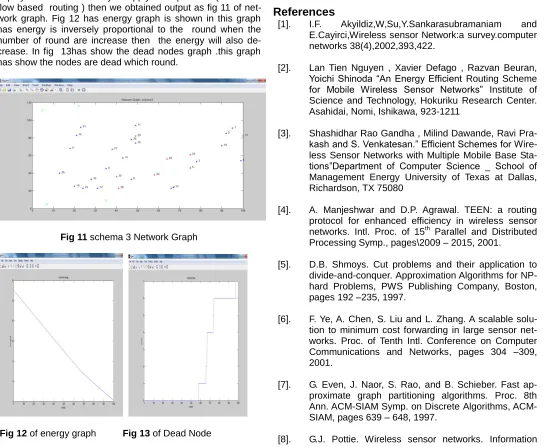
In scheme3 has Four mobile base station is used .when we deploy 30 nodes randomly . Apply two protocols(leach and flow based routing ) then we obtained output as fig 11 of net-work graph. Fig 12 has energy graph is shown in this graph has energy is inversely proportional to the round when the number of round are increase then the energy will also de-crease. In fig 13has show the dead nodes graph .this graph has show the nodes are dead which round.
Fig 11 schema 3 Network Graph
Fig 12 of energy graph Fig 13 of Dead Node
6 Conclusions and Future Scope
In this paper we have proposed an energy efficient usage of multiple, mobile base stations to increase the lifetime of wire-less sensor networks. Our approach uses an integer linear program to determine the locations of the base stations and a flow-based routing protocol and LEACH protocol that utilizes randomized rotation of local cluster base stations (cluster-heads) to evenly distribute the energy load among the sensors in the network. We conclude that using a rigorous approach to optimize energy utilization leads to a significant increase in network lifetime.A challenging and promising direction for fu-ture work is to explore the use of graph partitioning algorithms, particularly those for finding balanced partitions within such a framework.
7 End Sections
7.1 Acknowledgments
I wish to thank my dearest Parent/Guardians and work was supported my Guide Er.Shallu Bajaj(Assistant Professor, De-partment of Computer Science and Engineering), Kurukshetra Institute of Technology and Management , Kurukshetra.
References
[1]. I.F. Akyildiz,W,Su,Y.Sankarasubramaniam and E.Cayirci,Wireless sensor Network:a survey.computer networks 38(4),2002,393,422.
[2]. Lan Tien Nguyen , Xavier Defago , Razvan Beuran, Yoichi Shinoda “An Energy Efficient Routing Scheme for Mobile Wireless Sensor Networks” Institute of Science and Technology, Hokuriku Research Center. Asahidai, Nomi, Ishikawa, 923-1211
[3]. Shashidhar Rao Gandha , Milind Dawande, Ravi Pra-kash and S. Venkatesan.” Efficient Schemes for Wire-less Sensor Networks with Multiple Mobile Base Sta-tions”Department of Computer Science _ School of Management Energy University of Texas at Dallas, Richardson, TX 75080
[4]. A. Manjeshwar and D.P. Agrawal. TEEN: a routing protocol for enhanced efficiency in wireless sensor networks. Intl. Proc. of 15th Parallel and Distributed Processing Symp., pages\2009 – 2015, 2001.
[5]. D.B. Shmoys. Cut problems and their application to divide-and-conquer. Approximation Algorithms for NP-hard Problems, PWS Publishing Company, Boston, pages 192 –235, 1997.
[6]. F. Ye, A. Chen, S. Liu and L. Zhang. A scalable solu-tion to minimum cost forwarding in large sensor net-works. Proc. of Tenth Intl. Conference on Computer Communications and Networks, pages 304 –309, 2001.
[7]. G. Even, J. Naor, S. Rao, and B. Schieber. Fast ap-proximate graph partitioning algorithms. Proc. 8th Ann. SIAM Symp. on Discrete Algorithms, ACM-SIAM, pages 639 – 648, 1997.
Theory Workshop, pages 139 – 140, 1998.
[9]. G.L. Nemhauser and L.A. Wolsey. Integer Program-ming and Combinatorial Optimization. Wiley, 1988. [10]. J. Agre and L. Clare. An integrated architecture for
cooperative sensing networks. Computer, 33(5):106 – 108, 2000.
[11]. J. Chlebikova. Approximability of the Maximally ba-lanced connected partition problem in graphs. Inform. Process. Lett., 60:225 – 230, 1996.
[12]. J. Elson and D. Estrin. Time synchronization for wire-less sensor networks. Proceedings 15th International Parallel and Distributed Processing Symposium, pag-es 1965 – 1970, 2001.
[13]. K. Sohrabi, J. Gao, V. Ailawadhi and G.J. Pottie. Pro-tocols for selforganization of a wireless sensor net-work. IEEE Personal Communications,.
[14]. M.A. Youssef, M.F. Younis and K.A. Arisha. A Con-strained Shortest- Path Energy-Aware Routing Algo-rithm for Wireless Sensor Networks. Wireless Com-mun. and Networking Conference, 2002, 2:794 –799, 2002.
[15]. R. Min, M. Bhardwaj, Seong-Hwan Cho, E. Shih, A. Sinha, A. Wang and A. Chandrakasan. Low-power wireless sensor networks. Fourteenth International Conference on VLSI Design, pages 205 – 210, 2001. [16]. R.K. Ahuja, T.L. Magnanti, and J.B. Orlin. Network
Flows. Prentice Hall, New Jersey,1993.
[17]. S. Lindsey and C. Raghavendra. PEGASIS: Power-Efficient Gathering in Sensor Information Systems. Intl. Conf. on Communications, 2001.
[18]. W.R. Heinzelman, A. Chandrakasan and H. Bala-krishnan. Energy efficient communication protocol for wireless micro sensor networks. Proceedings of the 33rd Annual HawaiInternational Conference on Sys-tem Sciences, pages 3005 – 301, 2000.