A Practical Dynamic Frequency Scaling Solution
to DPM
in Embedded Linux Systems
Zhang YuHua
School of Computer Science and Technology,Soochow University, Suzhou, China Email:[email protected]
Qian LongHua,Lv Qiang, Qian Peide,Guo Shengchao
School of Computer Science and Technology,Soochow University, Suzhou, China Email: {Qianlonghua,qiang}@suda.edu.cn
Abstract—Traditional power management enables CPU to switch among different power consumption modes such as running, idle and standby to save energy to a certain degree. In battery-powered embedded Linux systems, power management plays an even more important role than in desktops. This paper proposes a practical solution to dynamic power management (DPM) based on dynamic frequency scaling (DFS). According to the system workload, it switches the working frequency among several predefined settings. This paper presents a design and implementation of the solution in an embedded Linux system. Experimental results on an Intel PXA250-based system have demonstrated that the system running a DPM-enabled Linux can save up to 44% of execution time with less than 8% extra power consumption in an email application.
Index Terms—Dynamic Frequency Scaling, Dynamic Voltage Scaling, Embedded Linux
I. INTRODUCTION
With recent popularity of mobile computing, power management scheme becomes an important concern in embedded applications. In portable, battery-powered devices such as personal digital assistants and mobile phones, effective and efficient power management scheme can reduce power consumption of the embedded applications, and extend their working hours as long as possible to satisfy users’ need of portability and durability. On the other hand, as an embedded system usually comprises of high density of millions of transistor gates, if the device often runs at a high temperature caused by excessive power consumption without appropriate cooling components, it will surely do harm to the reliability and lifetime of the embedded system.
Traditional power management module can switch CPU among different power consumption modes, e.g. running, idle and standby etc., to save energy as much as possible. When CPU has no job to run, it will be put into the idle mode. At that time its core clock stops working, but the components that monitor various interrupt requests are still in active state so as to keep the system states of both software and hardware. As soon as one of the interrupt requests arrives, the CPU is pulled back to the running mode. Such switching between running and idle modes is easy to implement, but the energy savings it brings about are limited. Further, if the idle time is
greater than a threshold, the system will be set to the standby mode until it is waked by user’s keystroke or other events. In this mode, the power of most components is off except the one that detects the signal of waking the standby mode, thus the switching between running and standby modes is relatively complex, but the consequence of this functionality greatly reduces the power consumption.
As a matter of fact, during the running mode the system workload varies from time to time. If the power consumption is reduced when the workload is low, then the overall energy consumption of the embedded system can be further decreased. Dynamic power management (DPM) [1,2,3] can adjust the hardware working status according to the system workload. Dynamic voltage scaling (DVS) is a known effective mechanism of DPM for reducing CPU energy consumption without degrading system performance significantly. When the system workload is lower, the CPU voltage will be decreased to reduce the power consumption. When the system workload becomes higher, the CPU voltage will be increased to shorten the user response time. However, the implementation of DVS in an embedded system is really an intractable task for its workload measurement and voltage switching [3,8,10,11].
This paper proposes a practical solution to DPM based on dynamic frequency scaling (DFS). According to the system workload, it switches the working frequency among several predefined settings. We carefully designed and implemented this solution in an embedded Linux system. Experimental results on an Intel PXA250-based system have demonstrated that the system running a DPM-enabled Linux can save execution time with little extra power consumption in an email application.
DFS solution are also discussed in this section. Finally SectionⅤprovides our conclusions and future discussions.
II. DYNAMIC FREQUENCY SCALING
A. Background and Related Work
DVS was elaborated from a theoretical perspective in [9]. The main source of power dissipation in a digital CMOS circuit of the embedded system is the dynamic power dissipation:
(1)
2 DD M
1 k
dynamic CLk Switk V
P =
∑
• •=
where M is the number of the gates in the circuits, CLk is the load capacitance of the gate gk, Switk is the switching speed of the gate gk, and VDD is the supply voltage.
However, reducing power supply causes increase of circuit delay. The circuit delay is estimated by the following formula:
2 T G DD/(V -V ) V
∝
τ (2)
where τ is the propagation delay of the CMOS transistor, VT is the threshold voltage, and VG is the voltage of the
input gate.
(1) and (2) indicate that there is a fundamental trade-off between the switching speed and the supply voltage. When the supply voltage decreases to reduce the power consumption, the switching speed also must be decreased to tolerate the increased propagation delay. We recast the equation as the following one, assuming that the dynamic power is the most dominant one:
2 DD V f C
P= • • (3)
This equation shows that the power consumption is linearly proportional to clock frequency and square of supply voltage. Accordingly, one can reduce power consumption by reducing these two variables. Furthermore, by reducing the supply voltage, one also increases a circuit’s delay linearly. The switching speed will be lower accordingly, that reduces the power consumption intensively. This is called dynamically voltage scaling (DVS). The motivation behind DVS is that actively scheduling tasks running speed, higher or lower, can save energy. However, system performance will degrade if clock frequency is lowered, and the time to complete a task will increase. So there is a trade-off between the power consumption and the system response time to the user.
Scaling the supply voltage means scaling the working frequency accordingly. From another perspective, to every working frequency, there should be a corresponding lowest supply voltage to support this working frequency properly while minimizing the power consumption. Dynamic frequency scaling (DFS) is used to adjust the working frequency according to the system workload in order to save the power consumption without degrading the system performance significantly beyond the user tolerance. In fact DFS is a variant of DVS, but here the focus is the working frequency, which is closely
related to the response time in the whole system-level. Only when the decrease of the working frequency doesn’t affect the response time significantly, can we lower the working frequency and the corresponding supply voltage to get energy savings.
Early related work on DPM includes theoretical studies [9] and simulations on the potential of DVS techniques [7, 8, 10]. Since then, practical implementation of DVS schemes have already been proved feasible with some commercial processors [1, 18] and academic design efforts [11, 12, 16]. Various DPM models are also proposed to scale voltage with underlying software support [13,14,15,17,19,20]. These works focus on model-based complex DVS algorithms, relatively few are on the practical solutions to implement them in a real embedded system. Another aspect is that most of these related works concentrate on frequency scheduling or energy savings of individual components, e.g. CPU, memory ,disk [21,22,23] etc. Seldom are on system-level energy savings.
One of the motivations that distinguish our work from previous research is that we design and implement a practical solution to DPM in a real embedded Linux system based on Intel PXA250 microprocessor. The ready statistics data source provided by the kernel is utilized to compute the workload trend. PXA250 also provides easily customized one-step operation to frequency scheduling based on mode switching. Another objective is that frequency scheduling is not limited to individual component (usually CPU); we can also optimize the memory frequency in accordance with one designated CPU frequency. Finally we evaluate our solutions through the overall system-level energy saving brought about by DFS in a real system running an email application recursively.
B. Design of DFS in PXA250
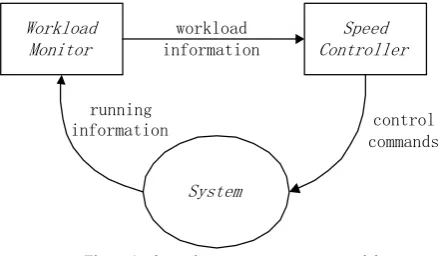
Figure.1 describes the dynamic power management model with DFS. It consists of a monitor and a controller of the system. The monitor checks the current system running status to get the information about the system workload, and reports the workload information to the controller. The controller switches the working frequency according to the dynamical trend of the system workload. If the system workload rises, then working frequency is increased to shorten the response time. Vice verse, if the system workload drops, the working frequency is decreased to save the power consumption. Through careful design of workload monitoring and speed controlling, we can reach an optimal balance between lowest power consumption and tolerable response time.
customized switching functionality to solve the second problem.
Workload Monitor
Speed Controller
System workload information
control commands running
information
Figure 1. dynamic power management model
The hardware platform of our target embedded system is an Intel PXA250-based system with X-Scale architecture [6] and PXA250 microprocessor. The PXA250 microprocessor provides effective and efficient DFS support to DPM. In this microprocessor the working frequency is mainly controlled by core clock configuration register (CCCR). By setting the different value of CCCR, the working frequency of RAM and CPU can be dynamically adjusted accordingly. However, Intel Corporation doesn’t suggest this solution for the sake of operation complexity and system safety. During the period of system running, modifying frequency multiplier coefficients dynamically covers a sequence of very complex operations that inevitably incur relatively great time delay. Further more, most of the system components and peripherals will be affected during that time. In order for developers to adjust the working frequency safely and quickly, Intel supplements an additional Turbo running mode for PXA250 besides the normal Running mode. It is suggested that proper frequency multiplier coefficients of CCCR be set when the system is initialized. Therefore DFS can be achieved by switching CPU running modes between normal and turbo modes very quickly when the system is running [4].
The working frequency of both PXA250 and memory are derived from a crystal oscillator with 3.6864MHz frequency. CCCR defines frequency multiplier coefficients L, M and N between CPU and the crystal oscillator.
Memory Frequency = Crystal Frequency * L Run Mode Frequency = Memory Frequency * M Turbo Mode Frequency = Run Mode Frequency * N Where L is Crystal Frequency to Memory Frequency Multiplier, M is Memory Frequency to Run Mode Frequency Multiplier and N is Run Mode Frequency to Turbo Mode Frequency Multiplier.
The microprocessors with Intel X-Scale architecture may support CPU working frequency with very wide range, but the stable frequency range for PXA250 is limited from 100MHz to 400MHz. According to the suggestion from Intel Corporation, the CPU mode is switched between the Running mode and the Turbo mode so as to adjust the CPU working frequency dynamically. When CPU is initialized through Boot Loader module in embedded Linux, the frequency multiplier coefficients are set to L (27), M (2) and N (2). As the result of this
setting the frequency of memory, the Running mode and the Turbo mode is 100MHz (99.53≈100), 200MHz and 400MHz respectively. When the system is running, the system workload is computed and compared periodically. If the workload is increasing, switch the CPU from the Running mode to the Turbo mode in order to make it run with 400MHz. On the contrary, if the system workload is decreasing, then switch it from the Turbo mode to the Running mode in order to make it run with 200MHz.
III. IMPLEMENTATION ISSUES
In order to implement DFS in embedded Linux based on Intel PXA250, first we should detect the system workload trend as precise as possible. This step starts with the determination of an approximately fixed interval (100ms), then computes the idle time proportion in this interval periodically, and finally compares the three consecutive results to judge the workload trend. The last implementation issue is the switching functionality of the working frequency. Switching the working frequency is absolutely not an easy work while the system is running. However, in Intel PXA250 because the system has set all the values in CCCR related to DFS when it starts up, what we want to do is to only reverse the Turbo bit in the coprocessor register CCLKCFG to switch the working frequency.
A. Workload Measurement Scheme
The first problem of DFS solution is how to compute the system workload trend. That’s a critical problem, for the computation cost of complex detection algorithms will probably dwarf the advantage of energy saving by DFS. Weiser, et al. [8] proposed three scheduling algorithms to predict the future workload, namely OPT, FUTURE and PAST. The goal of these algorithms is to decrease time wasted in the idle loop while retaining tolerable interactive response. OPT spreads computation over the whole trace period to eliminate all idle time, and FUTURE uses a limited future look ahead to determine the minimum clock. Both of OPT and FUTURE algorithms need future knowledge to compute the system workload trend. This is impractical in most running system, because it’s hard to know the future workload exactly, so these two algorithms are only suitable for the simulation system [8,9,10] or a baseline system for comparison, while the PAST algorithm looks a fixed window back into the past workload, and assumes the next window will be like the previous one. Although it is not always true that the next window will be like the previous one, we can get the previous workload information relatively easily, so this algorithm is really a simple and practical one. Thereafter, Govil et al. [7] used a more sophisticated predication method in order to improve performance substantially. As for the simplicity of implementation and availability of workload information, we adopted the simplified elementary PAST algorithm described as the following.
B. Sampling Interval Determination located in the system directory /proc/loadavg which
computes the number of processes in TASK_RUNNING state over the past 1, 5, and 15 minutes to reflect system busyness. The other is the cpu data item in the directory /proc/stat which provides the ticks that the CPU is in user mode, kernel mode and idle mode respectively since the system is started up. Because the time interval for the first method to compute the workload is too long, while the second one can reflect the system workload trend as precise as possible, we think the second one is more appropriate.
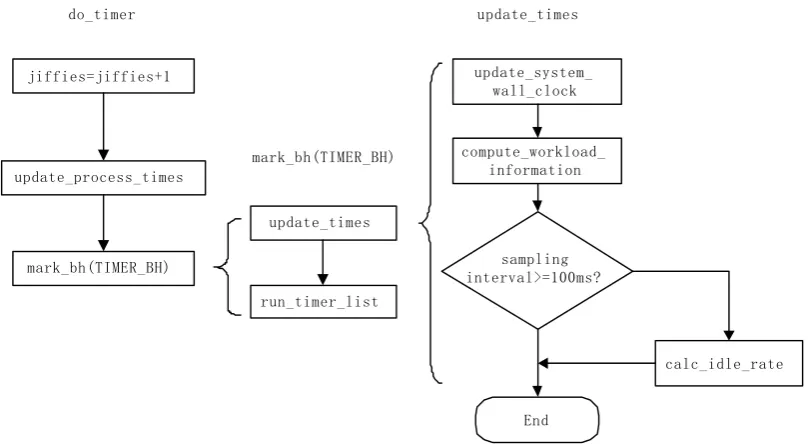
The first of workload computation is determination of the sampling interval. The clock framework in Linux kernel provides appropriate solution to determine the sampling interval. Just like in X86 platform, the timing device in PXA250 will trigger the clock interrupt in every 10 milliseconds, then the interrupt routine do_timer() in kernel/timer.c will be called. Fig. 2 depicts the flow chart of sampling interval determination that we use.
The routine do_timer() first increases the global variable jiffies by one, where jiffies records clock ticks (1 tick=10ms) since startup of the system. Then it refreshes the kernel global variable kstat that records many pieces of kernel statistics information through update_process_times(). Linux kernel executes the routine do_timer() 100 times in every 1 second, so this routine cannot do too many things, the other important works should be done in bottom-half process.
If in a fixed interval the proportion of the idle time to total time becomes higher, it is supposed that the system is idler than before. On the contrary, the system will be busier than ever. Based on this consideration and the workload computation method used in DPM in Windows CE [5], we propose the following algorithm. The proportion of the idle time is first computed periodically. Then three consecutive results are compared. The computation procedure can be expressed as the following formulas:
In the final stage the routine do_timer() activates bottom-half routine timer_bh(), and the kernel will run timer_bh() in the appropriate time. The bottom-half processing can be finished in 1 tick when the workload is light. However, when the workload is heavy, the bottom-half routine will probably run one time in several ticks. As a result, the sampling interval may be a little bit greater than T_per. The timer_bh() calls the routines update_times() and run_timer_list() respectively. The first one is used to refresh system wall clock and the second one is used to run tasks in the kernel timer queue. Here we only concern update_times().
ms per
T_ ≈100 (4) ∑
=
= M
k
idlek T idle T
1
_
_ (5)
per T idle T rate
T_ = _ / _ (6)
where T_per is the sampling interval (empirically approximate 100ms [5]), T_idle is the accumulated idle time in T_per, T_rate is the proportion of the idle time T_idle to T_per, and one of the sampling results we want. Judging by comparing three consecutive results, if T_rate1 < T_rate2 < T_rate3, we think the system workload is decreasing, lower the speed then; if T_rate1 > T_rate2 > T_rate3, the system workload is increasing, raise the speed.
In the routine update_times(), the sampling interval is initialized to zero and accumulated by ticks. When the sampling time reaches 100 milliseconds, the routine calc_idle_rate() will be called to compute the system workload trend, and the CPU working frequency will be adjusted if needed.
do_timer
mark_bh(TIMER_BH) jiffies=jiffies+1
update_process_times
update_times
update_times
run_timer_list mark_bh(TIMER_BH)
calc_idle_rate compute_workload_
information update_system_
wall_clock
sampling interval>=100ms?
End
C. Workload Measurement Implementation
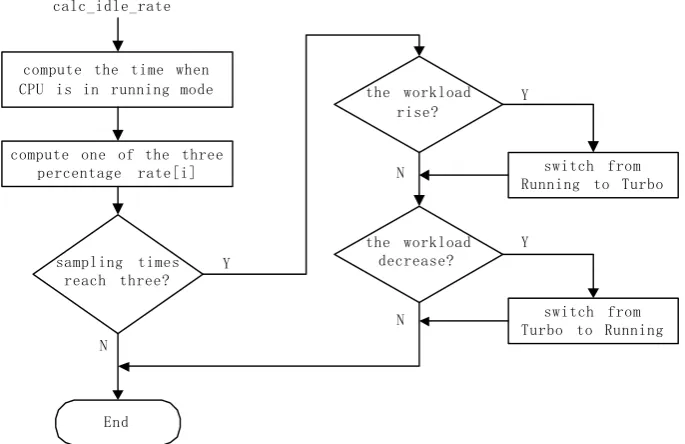
The main task of routine calc_idle_rate() as illustrated in Fig. 3 is to compute the proportion how much the idle time is in the fixed time T_per. One direct method is to sum the intervals every time when CPU is in idle mode. Because of its computation cost, this is not a practical method. What we use is an indirect method. The kernel global variable kstat records the time when it is in user mode and system mode in kstat.per_cpu_user[cpu],
kstat.per_cpu_nice[cpu] and kstat.per_cpu_system[cpu] (cpu is always zero when there is only one processor) respectively, and the sum of these items is just the time when CPU is running. We subtract this sum from the interval T_per to get the accumulated idle time. This method utilizes the ready kernel statistics information to compute the idle time, and avoids computing the sum every time when CPU enters the idle mode, so it needs lower computation cost than the first one.
calc_idle_rate
compute one of the three percentage rate[i] compute the time when CPU is in running mode
sampling times reach three?
End
the workload rise?
the workload decrease?
switch from Running to Turbo
switch from Turbo to Running Y
Y
N N
Y
N
Figure 3. workload measurement and speed controlling
After the three consecutive results have been sampled, we compare these results. If rate1>rate2>rate3, then switch the CPU from the Running mode to the Turbo mode. Vice verse, if rate1<rate2<rate3, then switch the CPU from the Turbo mode back to the Running mode. Otherwise, nothing is done.
D. Frequency Switching Implementation
The second problem of DFS solution is how to switch the working frequency. Because Intel PXA250 provides the CCCR register to control the speed, switching the frequency means reversing the Turbo bit in CCLKCFG indicating whether it is in the Turbo mode or not. After the Linux kernel is initialized, the value of CCCR register has been set properly. The system switches the working frequency according to the workload trend through the routine run_turbo_swither() we built in the kernel. Actually this routine first reads the CCLKCFG value to a variable, then judges whether the Turbo bit in CCLKCFG be reversed or not according to the switching requirement, finally it writes the variable back to CCLKCFG if needed. The read and write operation should be programmed with inline assembly codes in C programs for their direct system register access operations. Because of its concise instructions, the switching operation is very efficient and safely.
IV. EXPERIMENTAL RESULTS
A. System Boot
First we load the Linux system with DPM into an Intel PXA250-based system, which is delivered Embedded GUI applications based on QT/embedded. After booting Linux kernel, the DFS module is ready to run. This module can adjust the working frequency according to the three consecutive proportions of the idle time. The successful Linux kernel will then activate Qtopia (a Qt/Embedded desktop). So everything is ready now for the user of the device. We monitor the switching activities of CPU speed through two processes klogd and syslogd in this startup process. The running results are the following:
Jan 1 00:08:16 lubbock syslog.info syslogd started: BusyBox v0.60.1
Jan 1 00:08:27 lubbock auth.info login[19]: root login on 'tty1'
Jan 1 00:08:52 lubbock daemon.warn klogd: 199.07MHz to 398.15MHz
Jan 1 00:08:54 lubbock daemon.warn klogd: 398.15MHz to 199.07MHz
Jan 1 00:08:58 lubbock daemon.warn klogd: 398.15MHz to 199.07MHz
Jan 1 00:08:59 lubbock daemon.warn klogd: 199.07MHz to 398.15MHz
Jan 1 00:09:00 lubbock daemon.warn klogd: 398.15MHz to 199.07MHz
Qtopia is a GUI desktop system based on Qt/Embedded, whose startup is a relatively slow process. Before the DFS is applied, this process takes about 20 seconds to complete. As illustrated above, after the DFS is applied, the CPU speed switches between 200MHz and 400MHz about 6 times in the Qtopia startup process. In most cases the CPU is working at 400MHz, so the startup time is less than 10 seconds. That means we have shorten the startup process at least to 50%.
B. Email Application
In order to measure the effectiveness of our DFS solution to power consumption and system performance, we built an email application, EMAILER, in an embedded Linux system that is powered by four AA 1.5(UM-3) alkaline batteries. EMAILER is an email client program that can edit, send and receive simple emails. As for simplicity of implementation it only supports one image file as the attachment. If there were other types of attachments in the receiving mail, EMAILER would discard those attachments that it can’t recognize.
We composed an example email message that contained a text message attached by a JPG-typed image file. The message’s destination is set to the sender itself. The message size is about 8KB. After EMAILER startups, it automatically connects to the ISP with the attached dialing modem. After the Internet connection is ready, EMAILER first sends the example email to the mail server. Then it waits for checking that incoming mail, receives this mail and deletes it from the mail server. This procedure continues with a loop, resending and receiving the example mail, until all the power supply is run out off. The reason why we conduct the experiment of sending and receiving mail is that such loop is totally unpredictable because of the Internet communication delay via modem connection. The system workload with this email application will vary unpredictably from time to time. When EMAILER sends or receives the mail, the workload is high. When EMAILER waits for the response, the workload is low.
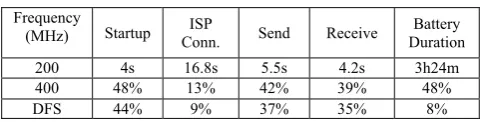
The evaluation is based on three cases where the CPU frequency is fixed at 200MHz, 400MHz and dynamically adjusted using our DFS solution. The program startup time is computed using klogd and syslogd methods. The time to connect to the ISP, send and receive the example mail message is calculated by subtraction of the end time and the start time of the corresponding operations. The time is expressed in ticks that are fetched by EMAILER through the system call the routine get_sys_ticks() we embedded in Linux kernel. Then this value is converted to seconds we want. We conducted 20 groups of experiments. One of the results is showed in TableⅠ. The time to send and receive the example mail message is an average value through the running period.
TABLE I.
TIME COST OF SEVERAL OPERATIONS IN EMAILER Frequency
(MHz) Startup Conn. ISP Send Receive DurationBattery
200 4s 16.8s 5.5s 4.2s 3h24m
400 48% 13% 42% 39% 48%
DFS 44% 9% 37% 35% 8%
The first case with 200MHz frequency is regarded as the baseline. The values in this line are the actual time costs to finish the corresponding operations. The two lines below indicate the shorten percentage of time cost to finish these same operations in the system with 400MHz frequency and DFS solution respectively, compared with the baseline.
These results show that, although the system with the highest frequency has greatest time reduction to finish these operations, the system has much more shorter battery duration than the other two cases (only about half of lifetime). The time costs to finish ISP connection, Sending and Receiving are also subject to network communication delay, so the differences are not as obvious as the startup time of EMAILER, especially for ISP connection time that is mainly related to ISP. However, as for the system with DFS, the response time reduction is a little bit less than that with 400MHz (about 4~5% decrease), but the battery duration is much more longer than it. That’s to say, we get great reductions in the response times (average about 41%) with DFS, while the reduction of battery duration is not obvious (about 8%). The other 19 groups of experimental results show the similar trend, so we don’t list them here. From this perspective we think the system can achieve a good trade-off between the response time and the power supply duration.
V. CONCLUSION AND FUTURE WORK
This paper proposed and implemented a practical DFS solution to DPM in embedded Linux systems. According to the system workload, the working frequency can be correspondingly adjusted higher or lower to meet the balance between energy saving and system performance. We designed and implemented a simple and practical workload measurement and speed-controlling scheme in an embedded Linux system based on Intel PXA250 microprocessor. The working frequency scheduling is not limited to affect individual component (usually CPU); the memory frequency can also be adjusted too. This solution is on system-level and therefore completely transparent to developers and users of applications. We also evaluated our practical solutions through an email application for energy savings in a system as whole. Experimental results have demonstrated that the system running a DPM-enabled Linux can save up to 44% of execution time with less than 8% extra power consumption.
needs to be done to quantitatively analyze the balance between the computation cost and energy saving as well as response time extension brought about by DFS solution.
REFERENCES
[1] L. Benini, A. Bogliolo, and G. D. Micheli. A Survey of Design Techniques for System-Level Dynamic Power Management. In IEEE Transactions on VLSI Systems. 8(3): 299~316, 2000.
[2] G. A. Paleologo, L. Benini, A. Bogliolo, and G. D. Micheli. Policy Optimization for Dynamic Power Management. In Proceedings of Design Automation Conference, pages 173~178, 1998.
[3] T. Simunic, L. Benini, P. Glynn, and G. D. Micheli.
Dynamic power management for portable systems. In Proceedings of the 6th annual international conference on Mobile computing and networking, pages 11~19, 2000. [4] Intel Corporation. Intel PXA250 and PXA210 Application
Processors Developer's Manual, Feb. 2002.
[5] Intel Corporation. Intel PCA Power Management Software Design Guide, Sep. 2002.
[6] Intel Corporation. Intel XScale microarchitecture, 2005. http://developer.intel.com/design/intelxscale.
[7] K. Govil, E. Chan, and H. Wasserman. Comparing
algorithms for dynamic speed-setting on a low-power CPU. In Proceedings of the First Annual Int’l Conf. on Mobile Computing and Networking, pages 13–25, Nov. 1995. [8] M. Weiser, B. Welch, A. Demers, and S. Shenker.
Scheduling for reduced CPU energy. In Proceedings of the First Symposium on Operating Systems Design and Implementation (OSDI), pages 13–23, Nov. 1994.
[9] T. Ishihara and H. Yasuura. Voltage scheduling problem for dynamically variable voltage processors. In ISLPED, pages 197–202, Aug. 1998.
[10]T. Pering, T. Burd, and R. Brodersen. The simulation and evaluation of dynamic voltage scaling algorithms. In ISLPED, pages 76–81, Aug. 1998.
[11]S. Lee and T. Sakurai. Run-time voltage hopping for low-power real-time systems. In 37th Design Automation Conference, pages 806–809, 2000.
[12]J. Pouwelse, K. Langendoen, and H. Sips. Voltage scaling on a low power microprocessor. In Int’l Symposium on Mobile Multimedia Systems and Applications (MMSA), Nov. 2000.
[13]A. Azevedo, I. Issenin, R. C. R. Gupta, N. Dutt, A.
Veidenbaum, and A. Nicolau. Profile-based Dynamic Voltage Scheduling using Program Checkpoints in the COPPER Framework. In Design Automation and Test in Europe, Mar. 2002.
[14]V. Tiwari, S. Malik, and A. Wolf. Power analysis of
embedded software: A first step towards software power minimization. In IEEE Transactions on VLSI Systems, Dec. 1994.
[15]L. Benini, A. Bogliolo, and G. Micheli. Dynamic power management of electronic systems. In International Conference on Computer-Aided Design, pages 696–702, 1998.
[16]T. Pering, T. Burd, and R. Brodersen. Voltage scheduling in the lpARM microprocessor system. In ISLPED, pages 96–101, Jul. 2000.
[17]S. Lee, A. Ermedahl, and S. Min. An accurate instruction-level energy consumption model for embedded risc processors. In ACM SIGPLAN Conference on Languages, Compilers, and Tools for Embedded Systems(LCTES’01), Jun. 2001.
[18]M. Fleischmann. Crusoe power management: Reducing the operating power with LongRun. 2000.
[19]C. H. Hsu, U. Kremer, and M. Hsiao. Compiler-Directed Dynamic Frequency and Voltage Scheduling. In Workshop on Power-Aware Computer Systems (PACS’00), 2000.
[20]A. Manzak and C. Chakrabarti. Variable voltage task
scheduling for minimizing energy or minimizing power. In Int’l Conf. on Acoustics, Speech and Signal Processing, Jun. 2000.
[21]K. Li, R. Kumpf, O. Horton and T. Anderson, A
Qantitative Analysis of Disk Drive Power Management in Portable Computers, in Proceedings of the 1994 Winter USENIX Conference, pages 279-291, Jan. 1994.
[22]F. Douglis, P. Krishnan, and B. Bershad. Adaptive Disk Spin-down Policies for Mobile Computers. In Computing Systems, volume 8, pages 381–413, 1995.
[23]S. Udani and J. Smith. Power Management in Mobile