
An Efficient Information Hiding Scheme with
High Compression Rate
Sarita S. Kamble A. S. Deshpande
ME Student Assistant Professor
Department of Electronics & Telecommunication Engineering Department of Electronics & Telecommunication Engineering Imperial College of Engineering & Research, Wagholi, Pune,
Maharashtra SPPU University
Imperial College of Engineering & Research, Wagholi, Pune, Maharashtra SPPU University
Abstract
Paper presents an effective image compression and data hiding scheme with high embedding capacity for digital images utilized using side match vector quantization (SMVQ) and digital image inpainting. The two modules of image compression and data hiding can work independently. Vector quantization is utilized for upmost and leftmost blocks. Except leftmost and upmost blocks, remaining blocks are compressed by SMVQ and digital image inpainting. Covert data is embedded after compression by using stegano-coder adaptively. Covert data is extracted by stegano-decoder. Decompressed image is reconstructed by applying reverse side match vector quantization and digital image inpainting effectively. Performance of proposed method is compared with other presented methods as well as different sizes of image. Results check the compression ratio (CR), peak signal to noise ratio (PSNR) and con-structural similarity (SSIM). Con-structural similarity measures decompression quality between input image and decompressed image. The performance parameters show that proposed scheme has the satisfactory performances for CR, PSNR, SSIM and data hiding capacity.
Keywords: SMVQ, Image Inpainting, Vector Quantization, Stegano-Coder, Stegano-Decoder
________________________________________________________________________________________________________
I. INTRODUCTION
In the digital world, image compression as well as information hiding is essential topics for research. Information hitting is used to secure covert information. The scheme is capable to avoid the transmitted content from arousing the attraction of malicious attackers. Overall, the privacy of the covert information is maintained. Information hitting has two main roots i.e. irreversible information hiding and invertible information hiding [2]. The irreversible information hiding scheme is capable to transmit large amount of covert information. However, illustration quality of image is permanently indistinct and cannot recover after extracting the covert information. While invertible information hiding has good illustration quality. The invertible information hiding is lossless information hiding technique, hides covert information in a digital cover image in invertible way.
Now a day, Search order coding (SOC) [9] and SMVQ [11] are popular image compression schemes. In 1992, Gray described [16] a vector quantization technique. In 1997 Barton [4] described an invertible information hiding scheme. As SMVQ technique gives better performance as compared to other existing techniques.
Chaur Heh Hsieh and Jyi Chang Tsai proposed a SOC [9] algorithm. The technique is capable for compress of the VQ index table. A new lossless algorithm that exploits the inter block relationship within the index field.
Image inpainting [7] is ancient technique to modify damaged images. For photography inpainting [7-8] is used to insert or eradicate objects. Picture inpainting is a element of digital inpainting. Main intend of inpainting [15] is to restore damaged paintings in addition to images/videos to the subtraction or alternate of chosen objects. A choice of methods are available such as diffusion based inpainting, texture synthesis, PDE inpainting, Exemplar inpainting etc.
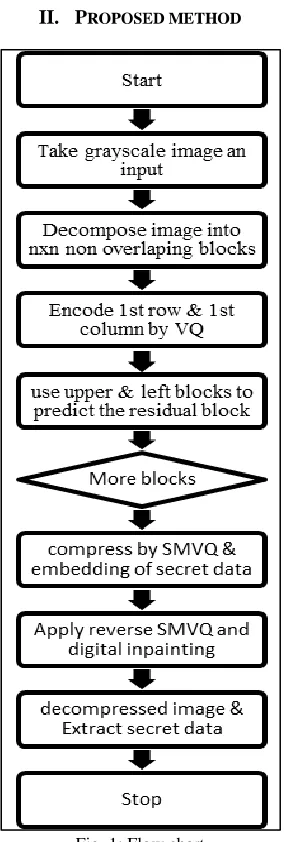
II. PROPOSED METHOD
Fig. 1: Flow chart
Formation of Codebook
Codebook is generated for VQ technique. Leftmost column and topmost row is used to form codebook. It refers to leftmost column and topmost row and leftmost column blocks. Sub Codebook refers to blocks excluding the topmost row and leftmost column. For effective compression use the grayscale images. The indices of the sub codebooks are store and the correlation of neighboring block is considered. It can be achieved by using the better decompression quality by using the standard algorithm that is of SMVQ, and it gets suitable form of embed covert bits.
As in this technique we will be having a codebook that is at sender and receiver will have same codebook. As the original image ‘I’ is divided into non-overlapping blocks. For simplicity assume that there is no remainder and then we got divided blocks.
Image Compression
Main goal of image compression is to remove the redundant pixels of image. VQ and SMVQ are the ways to reduce or remove empty space of image at pixels level. So that the residual blocks are encoded progressively in raster scanning order, and their encoded methods are related to the covert bits for embedding and the correlation between their neighboring blocks. After that MSE (Mean square error) is being calculated between predicted pixels and corresponding pixels. The images are JPEG, GIF, PNG and any other format. Choose any one gray scale image as input image of size M x N where M=N.
Vector Quantization
and no secret bits are embedded. As the block in the leftmost and the topmost of image is encode with the process of VQ and to embed covert bits it is not being used. This is a method of mapping multidimensional space into smaller set of messages. It has highest compression ratio but loss of information is more.
Side Match Vector Quantization and Image Inpainting
In the scheme, sender and recipient both have the equivalent codebook with W codewords and each codeword of length is n2. As an image of size M×N is alienated into n×n blocks. After encoding of first row and first column, SMVQ is applied on 2nd block of second row i.e. current block or residual block. Left block and top block of current block are used to predict current block. Similarly, numbers of iterations do cover up the whole image and image gets compressed. Both image compression as well as information thrashing is the two independent modules. Covert information can be rooted just after image compression. Image inpainting technique is at ease with make untraceable change in the image. It is manually applied to image.
Information Embedding
The covert message is encrypted before the actual embedding process starts. The hidden message is encrypted using a simple encryption algorithm using covert key and hence it will be almost unfeasible for the impostor to unhide the actual covert dispatch from the embedded cover file without knowing furtive key. Embedding is the process of combining the data into the compressed image. Then the embedded image is sent. Only receiver and sender know the covert key. Stegano encoder is used as embedding and data hiding.
Image Decompression
After receiving the compressed code, then at receiver it conducts the process of decompression that obtains the image of decode and which is much similar to the original uncompressed image. According to indicator bits, the compression codes are segmented into series of sections that conducts the decompression. The blocks in the leftmost and top most must use for the decompression process for each residual block; they must be decompressed by the VQ indices of compress image code. By using the raster scanning order for each residual block are processed. It shows the decompression is performed using reverse side match vector quantization algorithm and decompression for each block can be achieved successfully. Additionally, in decompression process, the receiver can obtain the hidden information/image bits at any time.
Information Extraction
Extraction is the process of separating the secret data from compressed image and decompresses the compressed image.
After the segment section compress code complete the above described procedure, the covert bit embed that can be extracted correctly. Because of use of side match vector decoder, decompressed image doesn’t contain the covert bits. If the current indicator bit of compress code is zero. This means that session corresponds to VQ compress block which doesn’t have Covert bit embed. Stegano decoder is used for extraction method. However, information hiding is always conducted after image compression, which means the image compression process and the information hiding process are two independent modules on the server or sender side. The covert bits can be extracted before or during the decompression method.
III. RESULT OF PROPOSED METHOD
Performance of Proposed Method
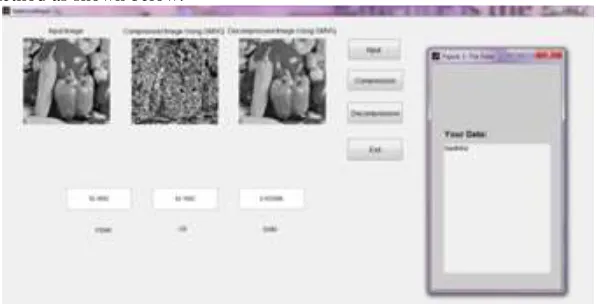
The first stage, input image is to be compressed by SMVQ and covert information is defeated inside the input image.
For Peppers
Performance of proposed method as shown below:
For Lena
Performance of proposed method as shown below:
Fig. 3: Performance of proposed method for Lena Fig. 4: image output after data hiding and Compression
Fig. 5: Reconstructed image after decompression and data extraction
Last stage, extraction of information as well as decompressed input compressed image is to be achieved by measuring various parameters successfully.
Compression Ratio (CR)
Compression ratio can be calculated as:
CR= 8×M×N
Lc (1) Where,
M and N are the height and the width of the images Lc is length of compressed code
Table - 1
Comparison of CR performance with different images [1] Scheme/ images Lena Lake Peppers Airplane
VQ[1] 18.29 18.29 18.29 18.29
SMVQ [1] 20.66 21.74 21.23 21.37
Chuan Qin, et al [1] 20.66 21.74 21.23 21.37 P. Tsai[1] 20.66 21.74 21.23 21.37 Proposed Scheme 23.42 36.88 24.10 23.82
Hiding Capacity
The hiding capacity of the proposed scheme is equal to the sum of the numbers of SMVQ and inpainting blocks. Table - 2
Comparison of hiding capacity with different methods [1]
Images/schemes Tsai et al.’s scheme Qian et al.’s Scheme Ni et al.’s scheme Chang et al Proposedscheme
Lena 5237 248 4604 10292 13980
Lake 4983 457 7320 7247 16094
Peppers 5332 372 5624 11295 15075
It can be concluded that hiding capacity of proposed scheme has high capacity to store data. Since, data is stored in gray scale (8 bit) image instead of black and white image.
Peak Signal to Noise Ratio (PSNR)
PSNR[1] can be calculated as:
𝑃𝑆𝑁𝑅 = 10 × log (2552
𝑀𝑆𝐸) (2)
Here,
MSE is mean square error
MSE [1] is calculated for (2n-1) pixels of residual blocks X.
𝑀𝑆𝐸 = 1
𝑀×𝑁∑ (𝑆𝑖 − 𝐶𝑖)
2 𝑀×𝑁
𝑖=1 (3)
Where,
Si and Ci represent pixels values of input image and decompressed image respectively. Table - 3
Comparison of PSNR performance with different images [1] Scheme/ Images Lena Lake Peppers Airplane
VQ[1] 29.70 26.63 30.15 29.16
SMVQ [1] 29.70 26.63 30.15 29.16
Chuan Qin, et al.[1] 29.85 26.67 30.35 29.31 P. Tsai[1] 28.86 26.04 27.84 28.20 Proposed Scheme 35.32 31.86 35.51 33.37
Con-Structural Similarity (SSIM)
The con-structural similarity (SSIM) [10] is used to assess the illustration quality of the decompressed image. Table - 4
Comparison of SSIM performance with different images [1] Schemes /Images Lena Lake Peppers Airplane
VQ [1] 0.8871 0.9073 0.8821 0.9188 SMVQ [1] 0.8871 0.9073 0.8821 0.9188 Chuan Qin, et. al [1] 0.9086 0.9164 0.8999 0.9273 P. Tsai [1] 0.8853 0.9008 0.8766 0.9001 Proposed scheme 0.9410 0.9191 0.9331 0.9290
IV. CONCLUSION
Proposed method developed data hiding and image compression scheme using SMVQ and digital image inpainting manually. At the sender side, Leftmost and topmost blocks are compressed by VQ and no secret data embedded in it. VQ is also utilized for some intricate blocks to control the illustration distortion and error diffusion. Image blocks can be embedded with covert information and compressed simultaneously by SMVQ or digital image inpainting. On the receiver side, after segmenting the compressed codes into a series of sections by the indicator bits, the embedded covert bits can be easily extracted according to the index values in the segmented sections, and the decompression for all blocks can also be achieved successfully by VQ, SMVQ, and digital image inpainting.
The proposed scheme works better in terms of performance parameters of compression ratio (CR), peak signal to noise ratio (PSNR) and Structural similarity (SSIM). Experimental result shows that, high compression rate achieved without degrading quality of image. Also high compression rate reduces the size of digital image. Instead of embedding data into the black & white image, gray scale image can hide more data. Hiding capacity is more than existing methods.
Furthermore, scheme can be developed for video compression to reduce the size of video also capable to transmit more data with secure transmission.
REFERENCES
[1] Chuan Qin, Chin-Chen Chang, Fellow, IEEE, and Yi-Ping Chiu,” A Novel Joint Data-Hiding and Compression Scheme Based on SMVQ and Image Inpainting,” IEEE transactions on image processing, VOL. 23, NO. 3, MARCH 2014
[2] Thai-Son Nguyen , Chin-Chen Chang, and Meng Chieh Lin,”Adaptive Lossless Data Hiding Scheme for SMVQ-Compressed Images using SOC Coding” , Smart Computing Review, vol. 4, no. 3, June 2014
[3] P. Tsai, “Histogram-based reversible data hiding for vector quantization compressed images,” IET Image Process., vol. 3, no. 2, pp. 100–114,2009. [4] J. M. Barton, “Method and apparatus for embedding authentication information within digital data,” U.S. Patent 5 646 997, Jul. 8, 1997.
[5] C. C. Chang, W. L. Tai, and C. C. Lin, “A reversible data hiding scheme based on side match vector quantization,” IEEE Trans. Circuits Syst.Video Technol., vol. 16, no. 10, pp. 1301–1308, Oct. 2006.
[6] P. Tsai, “Histogram-based reversible data hiding for vector quantization compressed images,” IET Image Process., vol. 3, no. 2, pp. 100–114,2009. [7] M. Bertalmio, G. Sapiro, V. Caselles, and C. Ballester, “Image inpainting,” in Proc. 27th Int. Conf. Comput. Graph. Interact. Tech., New Orleans, LA,
[8] A. Criminisi, P. Perez, and K. Toyama, “Region filling and object removal by exemplar-based image inpainting,” IEEE Trans. Image Process., vol. 13, no. 9, pp. 1200–1212, Sep. 2004.
[9] C. H. Hsieh and J. C. Tsai, “Lossless compression of VQ index with search-order coding,” IEEE Trans. Image Process., vol. 5, no. 11, pp. 1579–1582, Nov. 1996.
[10] Z. Wang, A. C. Bovik, H. R. Sheikh, and E. P. Simoncelli, “Imagequality assessment: From error visibility to structural similarity,” IEEE Trans. Image Process., vol. 13, no. 4, pp. 600–612, Apr. 2004
[11] T. Kim, “Side match and overlap match vector quantizers for images,” IEEE Trans. Image Process., vol. 1, no. 4, pp. 170–185, Apr. 1992. [12] H. W. Tseng and C. C. Chang, “High capacity data hiding in JPEG compressed mages,” Informatica, vol. 15, no. 1, pp. 127–142, 2004
[13] B. Yang, Z.-M. Lu, and S.-H. Sun, “Reversible watermarking in the VQ-compressed domain,” in Proc. 5th VIIP, Benidorm, Spain, Sep. 2005, pp. 298–303. [14] M. Oliviera, B. Bowen, R. Mckenna, and Y.-S. Chang. Fast Digital Image Inpainting. In Proc. Of Intl. Conf. On Visualization, Imaging And Image
Processing (VIIP), Page 261266, 2001.
[15] A.C. Kokaram, R.D. Morris, W.J. Fitzgerald, P.J.W. Rayner. Detection of missing data in image sequences. IEEE Transactions on Image Processing 11(4), 1496-1508, 1995.
![Table - 1 Comparison of CR performance with different images [1]](https://thumb-us.123doks.com/thumbv2/123dok_us/7810975.1662821/4.612.53.557.55.402/table-comparison-cr-performance-different-images.webp)
