ANALYSIS OF LEARNER PROFILE
GENERATION ALGORITHMS
ROHINI NAIR
Computer Engineering Department, Mumbai University, K J Somaiya College of Engineering-Vidyavihar, Mumbai,Maharashtra-400077,India
[email protected] http://www.somaiya.edu/kjsce
KAVITA KELKAR
Computer Engineering Department, Mumbai University, K J Somaiya College of Engineering-Vidyavihar, Mumbai,Maharashtra-400077,India
[email protected] http://www.somaiya.edu/kjsce Abstract :
With the rapid growth of computer and Internet technologies, e-learning has become a major trend in the computer assisted teaching and learning fields. By observing how learners behave during their online self-study, educators are then capable of comparing, evaluating, and profiling individual learners’ learning processes and thus making suggestions to learners with similar characteristics in the same context.
Learner profile generation can be achieved by various methods like sequential data mining algorithms where computer logs are analyzed to profile learners in terms of their learning tactic use and motivation in a web-based learning environment. Basic steps involved are preprocessing, pattern discovery and pattern analysis- evaluation.
Another approach is that of Fuzzy Cognitive Map (FCM) tool which is a soft computing tool and the reason, which leads to FCM approach, is mainly the observation of uncertainty in learner’s profile description. Therefore, classes in any classification of learner’s profile are considered as fuzzy sets and are represented as vertices of a Fuzzy Cognitive Map. It is based on Kolb’s learning model which is widely accepted technique. A third approach is that of using genetic algorithm based on adaptive learning for fulfilling multiple constraints to determine the learning scheme which best suits a learner. Adaptability can be provided at different levels according to the context of the learners. For constraint satisfaction problems in which multiple alternative paths have to be explored, genetic algorithm based approach is best suited.
Literature survey done on the above approaches shows that a lot of work is being carried out in the area of learner profile generation and understanding of the various approaches. In this report exhaustive study on various methods like genetic based algorithms, adaptive learning based on Kolb’s learning cycle using FCM tool and sequential pattern analysis is presented.
Keywords: Learner profile, adaptive learning, Kolb’s cycle, genetic algorithm, sequential mining, fuzzy sets. 1. Introduction
constraint satisfaction problems in which multiple alternative paths have to be explored, genetic algorithm[5] based approach is best suited. Hence, the learning scheme is generated using the genetic algorithm based approach. The next method of learner’s profile and style recognition is based on Fuzzy Cognitive Maps [3]which is a soft computing methodology that has been successfully used to model complex systems and to support making decisions. A system designed to diagnose in the best possible way the learner’s profile as it has been classified by the experts in the field, can be considered a complex system FCM methodology.
2. Related Work
Data mining techniques can discover useful information that can be used in formative evaluation to assist educators establish a pedagogical basis for decisions when designing or modifying an environment or teaching approach. The application of data mining in educational systems [2] is an iterative cycle of hypothesis formation, testing, and refinement. Mined knowledge should enter the loop of the system and guide, facilitate and enhance learning as a whole. The discovered knowledge can be used not only by providers (educators) but also by own users (students).So, the application of data mining in educational systems can be oriented to different actors with each particular point of view. The approach based on sequential pattern mining approach where the algorithms are employed to discover patterns which characterize learners either across session or groups based on their study tactic choice and goal orientation. With data mining techniques, instructors can first receive a detailed record of a learner’s behavior. Further, if they find similar groups of students, they can classify them into one group which shows the main characteristics of the group, and it allows new students to be classified. Finally, the instructors can discover if there is any relationship between these characteristics and learners’ other psychological attributes. To profile learners based on their learning behavior, the studying actions comprised of the events logged by the system are needed for the learning pattern extraction. The steps[1] are: Preprocessing- The raw learning logs involve a complex series of low-level events spaced along a time dimension. Through a log parsing mechanism, it matches events in a learning log to study actions predefined by the researcher and generates a sequence of temporally ordered learner actions. The data pre-processing phase includes the data cleaning, user identification, session identification and data transformation respectively.Next is the pattern discovery phase involves the discovery of frequent sequences.The pattern analysis phase involves the analysis of the frequent patterns generated by the pattern discovery phase.
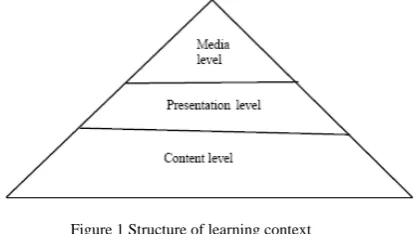
Figure 1 Structure of learning context
Content layer deals with learning path generation. The individual learning path generation is important because different learners may have different characteristics, prior knowledge or motivation or needs. The second level, Presentation level mainly concentrates on the learner’s preferences and intentions. For example, a learner may prefer to learn a content material by Concept, Detailed Concept,etc
2.1. GSP Algorithm[9]-(Generalized Sequential Pattern)
The algorithm used for sequence mining and for solving sequence mining problems are mostly based on the a priori (level-wise) algorithm. One way to use the level-wise paradigm is to first discover all the frequent items in a level-wise fashion. It means counting the occurrences of all singleton elements in the database. Then, the transactions are filtered by removing the non-frequent items. At the end of this step, each transaction consists of only the frequent elements it originally contained. This modified database becomes an input to the GSP algorithm. This process requires one pass over the whole database.GSP Algorithm makes multiple database passes. Given a set of frequent n-1 patterns, the candidate set for next generation are generated from input set according to the thresholds. Only frequent patterns in the current set are considered for generating the next candidate sequence. A pruning phase eliminates subsets of infrequent patterns. For all patterns P in the candidate set with length k, all sessions are processed once and the count is incremented for each detected pattern in the candidate set. There are two main steps in the algorithm. Candidate Generation-Given the set of frequent (k-1)-frequent sequences F(k-1), the candidates for the next pass are generated by joining F(k-1) with itself. A pruning phase eliminates any sequence, at least one of whose subsequences is not frequent. Support Counting-Normally, a hash tree–based search is employed for efficient support counting. Finally non-maximal frequent sequences are removed.GSP makes multiple passes over the session set.
2.1.1 GSP Algorithm
F1 = the set of frequent 1-sequence k=2, do while F(k-1)!= Null; Generate candidate sets Ck (set of candidate k-sequences); For all input sequences s in the database D
do
Increment count of all a in Ck if s supports a
Fk = {a Є Ck such that its frequency exceeds the threshold} k= k+1;
Result = Set of all frequent sequences is the union of all Fks End do
End do
The GSP algorithm discovers frequent sequences, allowing for time constraints such as maximum gap and minimum gap among the sequence elements
2.1.2. The GSP Algorithm Analysis
The GSP algorithm[8] includes two key steps:
1. Candidate Generation. Given the set of frequent (k-1)-frequent sequences F(k-1), the candidates for the next pass are generated by joining F(k-1) with itself. A pruning phase eliminates any sequence, at least one of whose subsequences is not frequent.
2. Support Counting- Normally, a hash tree–based search is employed for efficient support counting. Finally non-maximal frequent sequences are removed.
2.2. Fuzzy Cognitive Map tool[3]
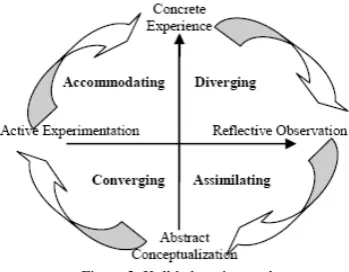
Fuzzy Cognitive Map is based on Kolb’s learning cycle. According to Kolb’s model[4], the four learning styles and the corresponding per learning dimension choices are presented at the following table. Below are the basic factors that correspond to learner’s behavior. The proposed fuzzy sets and their corresponding membership functions are:
Mw(weak cause) the fuzzy set for causality around 17.5 % with membership function µwc. Mo(ordinary cause) the fuzzy set for causality around 42.5 % with membership function µoc. Ms(strong cause) the fuzzy set for causality around 57.5 % with membership function µstrc. Mvs(very strong cause) the fuzzy set for causality around 82.5 % with membership function µesc.
Table 1 Basic factors that correspond to learner’s behaviors
Figure 2 Kolb’s learning cycle
2.2.1. Algorithm
Let N be the number of concepts in the FCM 1. Set the number k of learners
2. Set initial values n=0, V0(Ci) for i = 1, 2, , N from the learner’s profile database. Data have been stored as the
learner responded to certain tests. Data have been stored as linguistic values Ai , and have been turn to fuzzy
degrees V0(Ci) for all concepts except those in LP.Concepts in LP are set equal to 0 for n = 0.
3. Set the initial values for wj,k according to given information.
4. For n=n+1, apply the relation (1) and set values Vn+1(Ci). Update learner’s profile database. Following the
defuzzification the weights at the edges of the graph are presented as elements of the adjacent matrix Wn.
5. Set Vn+1=WnVn , where
a. If a Ci does not be influenced by any Cj , j≠i then wj,i=1 at present n
b. If a Vn(Ci)= m [Vn(Cj)] -1, for a given measure of competence 0<m<1, then set wi,j= -m
6. Use the unipolar sigmoid function to transform the coordinates of V n+1 into the interval [0,1].
a. If max 0 < i < k|V n+1(Ci)- Vn(Ci)| < ε, (ε >0) then stop and store as result the learner’s profile which
has the highest value V n+1(Ci)
Using the above membership functions we defuzzify the fuzzy degrees[8] of LAF causalities towards Learning styles.
2.3. Genetic Algorithm[5]
Genetic algorithm is based on context aware adaptive learning[5].For generating a learning scheme, three levels of contexts of learner are to be considered. There are many learner’s parameters considered for context aware e-learning system. These parameters are used for generating e-learning path. Learning path defines the sequence of learning activities that is carried out by the learner going through learning units in e-learning system.
2.3.1. Algorithm
Step 1: Definition of Chromosome String.
The content level genes are composed of IDs of learning objects which constitute the learning path of a learner. The presentation level genes represent the order of presentation of learning objects to the learner based on his learning preference and intention. Each learning object can be presented in six ways such as concept, example, case study, simulation, demonstration and detailed concepts. The media level genes represent the media of learning object such as audio, video or text.
Step 2: Initial Population- It is obtained by taking permutation of each set of genes
The above is the Gene Representation Step 3: Selecting the fitness function: f= f(s) + f(p) + f(m) ,
where f(s)={effort taken for studying one learning object with respect to other LO }*{difficulty of LO going to study}
f(p)= ∑{ Position of abstraction based on psychology of Learner}*{ Position of each type of LO in the randomly generated presentation}
f(m) Media level fitness Step 4: Reproduction Operation.
In the reproduction operation, the chromosome with the larger fitness function value will have a higher probability to reproduce the next generation. The aim of this operation is to choose good chromosome to achieve the goal of gene evaluation.
Step 5: Stop Criterion.
The genetic algorithm repeatedly runs the reproduction, cross over and mutation operations until it converge at maximum fitness value.
1. [Start]Generate random population of chromosomes.
2. [Fitness]Evaluate the fitness f(x) of each chromosome f(x)=f(s)+f(p)+f(m) where f(s) is content level fitness ,f(p) is presentation level fitness, and f(m) is media level fitness.
3. [New population] Create new population by repeating following steps until the new population complete.
a. [Selection]Select two parent chromosome from a population according to their fitness, the better fitness, the bigger chance to be selected.
b. [Cross over] Two point cross over the parents to form new children. 3. Results
In the above subtopics various algorithms for analysis of learner profile generation have been studied in detail and this section shows the comparison and results of the three algorithms.
GSP algorithm
Input …….Frequent Set k-1 (F[k-1]) Output……Candidate Set C[k] Steps-
1. Join F[k-1] with F[k-1]
2. Get rid of infrequent sequences (prune) 3. Order of items matter
F[3] = <{1, 2} {4}>, <{1, 2} {5}>,< {1} {4, 5}>, < {1, 4} {6}>, < {2} {4, 5}>, < {2} {4} {6}> After Join: <{1, 2} {4, 5}>, <{1, 2} { 4} {6}>
After Prune: <{1, 2} {4, 5}> C[4]= <{1, 2} {4, 5}>
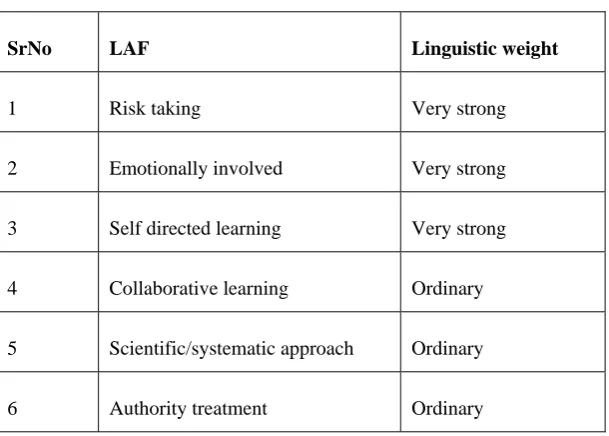
Table 2 Learning Activity Factors with weights assigned
Fuzzy cognitive map tool
Below are the fuzzy sets based on the LAF above Fuzzy Sets
Mw(weak cause)-17.5% ;Mo(ordinary cause)-42.5 %,Ms(strong cause)-57.5%; Mvs(very strong cause)-82.5 %,Below is a matrix of the LAF versus the weights.
0.175 0.575 0.825 0.175 0.825 0.175 0.425 0.575
0.175 0.575 0.425 0.825 0 0 0.175 0.825 0 0 .825 0.575 0.175 0.175 0.425 0.825 0.575 Fig 3 Matrix of LAF v/s weights
<Risk taking, emotionally involved, Collaborative learning,Scientific approach.>,Weights-.<Very Strong, Very strong, Ordinary, Ordinary>
Genetic algorithm
Chromosome-010101, Fitness Function-8+10+1=19
LAF 1 2 3 4 5 6
Chromosome 0 1 0 0 1 1
Weight 7 8 4 10 4 6
Chromosome -110110, Fitness Function -7+8+10+4=29
LAF 1 2 3 4 5 6
Chromosome 1 1 0 1 1 0
Weight 7 8 4 10 4 6
Chromosome -010011, FitnessFunction-4+8+6=18
LAF 1 2 3 4 5 6
Chromosome 0 1 0 0 1 1
Weight 7 8 4 10 4 6
Fitness values-.<1,2,4,5>
SrNo LAF Linguistic weight
1 Risk taking Very strong
2 Emotionally involved Very strong
3 Self directed learning Very strong
4 Collaborative learning Ordinary
5 Scientific/systematic approach Ordinary
4. Conclusion
After analyzing the three approaches for learner profile generation the conclusion that can be inferred is that genetic algorithm is the best amongst them because it has advantages like, a new three level structure for learner’s context comprising of the content level, presentation level and media level is defined.[5] The learning scheme generation algorithm is designed to be genetic where various learner’s context parameter values are viewed as constraints to be fulfilled in the learning scheme generation. Genetic algorithms are best suitable for handling multiple constraint satisfaction problems which have many alternative solutions. Fuzzy logic and neural network based algorithm known as FCM (Fuzzy Cognitive Map)[3] tool is also not very advantageous as there are deficiencies caused by the dependence on human experts and learner’s response.GSP[6] (Generalized Sequential Pattern) has given the worst result because a huge set of candidates could be generated ,multiple scans of database in mining. The real challenge is mining long sequential patterns.
References
[1] Chih-Ming Chen , Ying-Ling Hsieh, Shih-Hsun Hsu, (2007):Mining learner profile utilizing association rule for web-based learning diagnosis,Expert Systems with Applications 33,6–22.
[2] C. Romero, S. Ventura, ,(2007) : Educational data mining: A survey from 1995 to 2005,Department of Computer Sciences, University of Cordoba, Cordoba, Spain, , Expert Systems with Applications 33, 135–146Berry M. W., Dumais S. T., O’Brien G. W. (1995): Using linear algebra for intelligent information retrieval, SIAM Review, 37, pp. 573-595.
[3] Demetrius A.Georgiou, Despina Makry,,(2004):A Learner’s Style and Profile Recognition via Fuzzy Cognitive Map, Proceedings of the IEEE International Conference on Advanced Learning Technologies (ICALT’04)0-7695-2181-9/04 $20.00 ©IEEE.
[4] Dimitrios A. Georgiou and Sotirios D. Botsios,( 2008): Learning Style Recognition: A Three Layers Fuzzy Cognitive Map Schema, Fuzzy Systems, 2008. FUZZ-IEEE 2008. (IEEE World Congress on Computational Intelligence). IEEE International Conference, pages 2202 – 2207,2007 Date of Conference: 1-6 June
[5] Manju Bhaskar, Minu M Das, Dr.Chitralekha, Dr.S.Sivasatya,(2010):Genetic algorithm based adaptive learning scheme generation for context aware e-learning ,(IJSCE),International Journal on Computer Science and Engineering ,Vol 02,No.4,1271-1279.
[6] Mingming Zhou,(2010):Data Mining and Student e-Learning Profiles, International Conference on E-Business and E-Government. [7] Murat Ali Bayır, Ismail H. Toroslu, Ahmet Coşar,(2006):A Performance Comparison of Pattern Discovery Methods on Web Log Data
Page445 ,Print ISBN: 1-4244-0211-5Digital Object Identifier 10.1109/AICCSA.2006.205129.
[8] Philip H. Winne1, John C. Nesbit1, Vivek Kumar,Allyson F. Hadwin, Susanne P. Lajoie,Roger Azevedo,Nancy E. Perry,(2006): Supporting Self-Regulated Learning with gStudy Software: The Learning Kit Project, Tech., Inst., Cognition and Learning, Vol. 3, pp. 105-113, ©Old City Publishing, Inc.