University of Pennsylvania
ScholarlyCommons
Publicly Accessible Penn Dissertations
1-1-2015
Silent or Salient? Perks and Perils of Performance
Posting
Cexun(Jeff) Cai
University of Pennsylvania, [email protected]
Follow this and additional works at:http://repository.upenn.edu/edissertations
Part of theAdvertising and Promotion Management Commons, and theMarketing Commons
This paper is posted at ScholarlyCommons.http://repository.upenn.edu/edissertations/1021
For more information, please [email protected].
Recommended Citation
Cai, Cexun( Jeff), "Silent or Salient? Perks and Perils of Performance Posting" (2015).Publicly Accessible Penn Dissertations. 1021.
Silent or Salient? Perks and Perils of Performance Posting
Abstract
Many firms in the U.S. spend more on their sales force than they do on other marketing activities. Thus, improving sales force performance is of paramount importance. A controversial way is to post performance (i.e., display everyone's performance), now done with ease on social platforms due to advances in information technology. On one hand, posting performance encourages social comparison and competition. On the other hand, it may discourage low-end performers. Also, not posting performance may encourage greater effort from sales agents to push ahead or avoid falling behind, if they are unaware of how others are doing. The result of these opposing factors is, prima facie, unclear. I study the effectiveness of performance posting using theory and experiments. In a game-theoretic model of incomplete information about agents' abilities, I allow a firm to control the precision of social comparison by choosing whether to post performance. Firstly, I find that a firm should not post performance when agents' abilities are sufficiently homogenous, as this prevents a low-ability (high-ability) agent from being overly discouraged (overly complacent). In contrast, a firm should post performance when agents' abilities are sufficiently heterogeneous, as a low-ability agent puts in more effort to avoid lagging by too much. Secondly, some social comparison or competitiveness helps performance posting but too much hurts, i.e., there is a non-monotonic relationship in its effectiveness of performance posting, due to tradeoffs between how much a high-ability and low-ability agent changes effort. Thirdly, I find that the firm's profit from posting increases (decreases) when the financial compensation is unattractive (attractive). Said differently, firms that pay less are more likely to benefit from posting, and therefore, more likely to post. Next, I demonstrate the empirical validity of these propositions using a series of lab experiments and a field study. Together, my theoretical and empirical results provide guiding principles on when a firm can benefit from performance posting.
Degree Type Dissertation
Degree Name
Doctor of Philosophy (PhD)
Graduate Group Marketing
First Advisor Robert J. Meyer
Second Advisor Jagmohan S. Raju
Subject Categories
SILENT OR SALIENT? PERKS AND PERILS OF PERFORMANCE POSTING
Cexun(Jeff) Cai
A DISSERTATION
in
Marketing
For the Graduate Group in Managerial Science and Applied Economics
Presented to the Faculties of the University of Pennsylvania
in
Partial Fulfillment of the Requirements for the
Degree of Doctor of Philosophy
2015
Supervisor of Dissertation Co-Supervisor of Dissertation
_____________________ _____________________
Robert J. Meyer, Professor of Marketing Jagmohan S. Raju, Professor of Marketing
Graduate Group Chairperson
_____________________
Eric T. Bradlow, Professor of Marketing, Statistics and Education
Dissertation Committee
Barbara A. Mellers, Professor of Marketing and Psychology
Christophe Van den Bulte, Professor of Marketing
SILENT OR SALIENT? PERKS AND PERILS OF PERFORMANCE POSTING
COPYRIGHT
2015
Cexun Cai
This work is licensed under the Creative Commons Attribution- NonCommercial-ShareAlike 4.0 License
To view a copy of this license, visit
Acknowledgements
My greatest gratitude goes out to my advisers, Robert J. Meyer and Jagmohan S. Raju.
I have been extremely fortunate to receive their timeless wisdom and priceless
encourage-ment over the years. Both of them inspire in their individual ways, yet share a common
principle of mentorship best represented by Goethe’s quote: “If we treat people as they are,
we make them worse. If we treat people as they ought to be, we help them become what
they are capable of becoming.” My sincerest appreciation to both of them for helping me
become better each day.
In similar capacity, my committee members Barbara A. Mellers, Christophe Van den
Bulte and T. Pinar Yildirim have been self-sacrificial, dedicating only the best of their
resources to guide me through this dissertation. I have benefited tremendously from their
immense intellect, and am greatly indebted to them as academic mentors.
In writing up this dissertation, I have gained much reflecting on the thoughtful
feed-back from faculty and doctoral students at the University of Pennsylvania (The Wharton
School), Emory University (Goizueta Business School), Erasmus University (Rotterdam
School of Management), Georgia State University (Robinson College of Business), Hong
Kong University of Science and Technology (HKUST Business School), INSEAD,
University (The Stern School), Texas A&M University (Mays Business School),
Univer-sity of Notre Dame (Mendoza College of Business), UniverUniver-sity of South Carolina (Moore
School of Business), University of Texas at Dallas (Naveen Jindal School of Management)
and University of Virginia (Darden School of Business).
Many others ought to be mentioned – the list of which, I think, is lengthier than this
dissertation. As such, I will have to confine myself to these important groups of people.
My close friends and colleagues from the Wharton Marketing department, the Wharton
Doctoral Programs, the Wharton Behavioral Lab, and the Wharton Risk Management and
Decision Processes Center – all of you have been instrumental in providing the best possible
research environment any one could possibly imagine.
Naturally, I leave the closing acknowledgement for my dear wife and lifelong partner,
Kayla Chen, who is and has always been my strong pillar of support. Thank you for giving
up a big portion of your life and its familiarities to make this journey possible, and for
ABSTRACT
SILENT OR SALIENT? PERKS AND PERILS OF PERFORMANCE POSTING
Cexun(Jeff) Cai
Robert J. Meyer
Jagmohan S. Raju
Many firms in the U.S. spend more on their sales force than they do on other
market-ing activities. Thus, improvmarket-ing sales force performance is of paramount importance. A
controversial way is to post performance (i.e., display everyone’s performance), now done
with ease on social platforms due to advances in information technology. On one hand,
posting performance encourages social comparison and competition. On the other hand, it
may discourage low-end performers. Also, not posting performance may encourage greater
effort from sales agents to push ahead or avoid falling behind, if they are unaware of how
others are doing. The result of these opposing factors is,prima facie, unclear. I study the
effectiveness of performance posting using theory and experiments. In a game-theoretic
model of incomplete information about agents’ abilities, I allow a firm to control the
pre-cision of social comparison by choosing whether to post performance. Firstly, I find that
a firm should not post performance when agents’ abilities are sufficiently homogenous, as
com-placent). In contrast, a firm should post performance when agents’ abilities are sufficiently
heterogeneous, as a low-ability agent puts in more effort to avoid lagging by too much.
Secondly, some social comparison or competitiveness helps performance posting but too
much hurts, i.e., there is a non-monotonic relationship in its effectiveness of performance
posting, due to tradeoffs between how much a high-ability and low-ability agent changes
effort. Thirdly, I find that the firm’s profit from posting increases (decreases) when the
financial compensation is unattractive (attractive). Said differently, firms that pay less are
more likely to benefit from posting, and therefore, more likely to post. Next, I demonstrate
the empirical validity of these propositions using a series of lab experiments and a field
study. Together, my theoretical and empirical results provide guiding principles on when a
Table of Contents
Acknowledgements iii
Abstract v
List of Tables x
List of Figures xii
1 Introduction 1
2 Motivation 3
3 Literature Review 8
3.1 Social Comparison Affects Behavior and Utility . . . 8
3.2 Managing Social Comparison by the Strategic Firm . . . 10
3.2.1 Performance Feedback in Other Literatures . . . 11
3.2.2 Social Effects of Performance Posting . . . 13
3.3 Contribution to the Literature . . . 15
4 Model 17 4.1 Game Set-Up . . . 18
4.1.2 Performance of Agents . . . 18
4.1.3 Firm’s Objective . . . 19
4.1.4 Agents’ Utility Function . . . 20
4.1.5 Sequence of Events . . . 23
4.2 Theoretical Results . . . 26
4.2.1 Equilibrium Effort of an Agent . . . 26
4.2.2 If Performance is Not Posted . . . 31
4.2.3 If Performance is Posted . . . 31
4.2.4 Comparing Effort Levels of Agents for No Posting versus Posting . 33 4.2.5 Performance for Both Types of Agents . . . 40
4.2.6 Firm’s Decision . . . 41
5 Empirics: Lab Experiment and Field Study 47 5.1 Description of Lab Experiment . . . 48
5.2 Treatments and Results for Lab Experiment . . . 49
5.2.1 Testing the Effects of Heterogeneity . . . 50
5.2.2 Testing the Effects of Social Comparison Levels (k) . . . 54
5.2.3 Testing the Effect of Incentives (w) . . . 59
5.3 Field Study . . . 62
6 Discussion and Managerial Implications 65 6.1 Discussion . . . 65
6.2 Managerial Implications . . . 67
6.2.1 Prescriptive . . . 67
6.2.2 Descriptive . . . 68
7 Exploring Other Issues 70
7.1 Other Firm Actions . . . 70
7.2 Social Comparison versus Competition . . . 71
7.3 Risk Aversion of Agents . . . 72
7.4 From Two toNAgents . . . 74
7.5 Team Sales . . . 76
7.6 Structural Estimation of Parameters from Experiment . . . 77
7.7 Effect of Biased Inferences . . . 78
8 An Extension: Partial Performance Posting 80 8.1 Motivation for this Extension . . . 80
8.2 Providing an Overall Performance Measure (“Partial” Posting) . . . 81
9 Conclusion 85
Appendix 87
List of Tables
4.1 Parameters and Decision Variables . . . 17
5.1 Mean Improvement in Absolute Scores from Practice to Actual Round for
No Posting versus Posting . . . 59
5.2 Mean Improvement in Absolute Scores from Practice to Actual Round for
Bottom and Top Half in No Posting . . . 59
5.3 Mean Improvement in Absolute Scores from Practice to Actual Round for
Bottom and Top Half in Posting . . . 59
5.4 Mean Improvement in Absolute Scores from Practice to Actual Round for
No Posting versus Posting ($0.25 bonus versus $1 bonus) . . . 60
5.5 Mean Improvement in Absolute Scores from Practice to Actual Round for
List of Figures
2.1 Firms Can Choose Whether to Provide Updates of Everybody’s Sales
Per-formance (Source: RepTivity) . . . 5
4.1 How Events Unfold in a Sequential Game of Incomplete Information . . . 25
4.2 Effort Levels of Agents When There is a Limited Difference in Ability Levels (No Posting is Shown in Dotted Line, while Posting is Shown in Solid Line) . . . 34
4.3 Effort Levels of Agents When There is Sufficient Difference in Ability Lev-els (No Posting is Shown in Dotted Line, while Posting is Shown in Solid Line) . . . 34
4.4 Effort Levels of Agents for Varying Levels of k (No Posting is Shown in Dotted Line. Posting is Shown in Solid Line) . . . 36
4.5 Effort Levels of Agents for Varying Levels ofw (No Posting is Shown in Dotted Line, while Posting is Shown in Solid Line) . . . 37
4.6 How Performance Levels of Agent i Compare Across No Posting versus Posting . . . 41
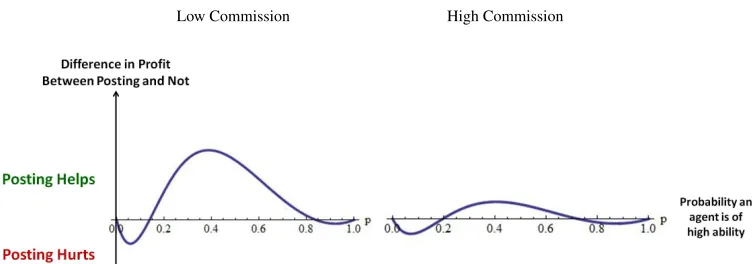
4.7 Heterogeneity in Abilities Leads to Effectiveness of Posting . . . 43
4.8 Social Comparison Helps Posting, But Only Up to a Certain Point . . . 44
5.1 Clock Counting Down as Participants are Given Limited Time to Solve a
Series of Multiplication Questions . . . 50
5.2 Easy Multiplication Task (left) had Greater Degree of Heterogeneity in
Practice Round Performance Compared to Difficult Task (right) . . . 52
5.3 Posting Does BetterOnlyfor Heterogeneous Distribution . . . 53
Chapter 1
Introduction
What do people experience when they observe their own performance posted vis-à-vis
similar others’ performance on the same task? Do people respond differently on a task
when they know that their performance will be posted? Knowing how people respond, can
a social planner strategically decide to post or not performance? These questions lie at the
heart of my dissertation as I explore the topic of performance posting.
Performance posting is relevant to many disciplines. In marketing, the use of
per-formance posting has posed a perennial puzzle within sales force management. Firms
and sales managers today continue to wrestle with whether it is optimal to use
perfor-mance posting. Furthermore, the growing ubiquity of social platforms for sales
manage-ment amongst groups of sales employees has intensified the need for an answer. In health
care, policy makers debate vigorously about whether performance posting of doctors and
hospitals would hurt or help the quality of medical services1. Likewise, public health
offi-cials explore the use of restaurant hygiene grade card posting to reduce the prevalence of
foodborne illnesses2. In education, a prolonged debate ensues on whether teacher ratings
should be posted, and whether doing so would increase the quality of teaching – judges had
1http://www.intrahealth.org/page/motivating-providers-by-posting-performance-data
to deliberate hard on this decision3.
Why is the desirability of performance posting difficult to assess? The benefits of
per-formance posting appears to be, in the spirit of competition, seemingly obvious. And yet,
it raises apprehension in the minds of social planners who, in addition to privacy concerns,
recognize that performance posting as a practice may lead to a drop in morale and thus
have negative effects on performance. The tension between these forces is not immediately
clear, and their resolution is, at best, opaque. Perhaps this is why confusion and
frustra-tion underlie the ongoing debates about the effectiveness of performance posting. In my
dissertation, I shed light on the outcomes of performance posting, and provide prescriptive
guidance on when a social planner can use it.
Despite its breadth of applications, I take a modest first step by studying performance
posting in the context of a sales force. There are two reasons for this. First, the sales
force is a substantive area in marketing, and sales force expenditure is several times that
of other marketing spends. Thus, the potential impact of performance posting on sales
force productivity can be sizable in absolute terms. Second, the sales force within the
firm is an ideal starting point for the study of performance posting, since there is little
ambiguity to what performance means for the firm, and consequently, how performance
posting translates to changes in the firm’s profit.
I begin the next chapter of my dissertation with the motivation and roadmap for the
study of performance posting in the sales force. In the closing chapter, I will return to the
prevalence and relevance of performance posting across different domains, and how I can
Chapter 2
Motivation
Each year, firms in the U.S. spend $800 billion on sales force compensation and hire at least
20 million people to carry out their sales function (Zoltners et al. 2008). Given that many
businesses spend more on their sales force than they do on any other marketing activity,
improving the performance of the sales force is of paramount importance. Yet, managing
the sales force is an often overlooked area in marketing research.
A firm has several levers to increase sales performance. The lever studied most in the
marketing literature is sales force compensation. This broadly includes desigining of
opti-mal compensation plans (e.g., Basu et al. 1985), accounting for heterogeneity in the sales
force (e.g., Raju and Srinivasan 1996, Rao 1990, Misra, Nair and Daljord 2013), estimating
the effectiveness of compensation plans (e.g., Chung, Steenburgh and Sudhir 2013, Misra
and Nair 2011), and using sales contests in the form of rank order tournaments to
moti-vate efforts (Kalra and Shi 2001). Another lever is territory allocation (e.g., Lodish 1975,
Zoltners and Sinha 2005), i.e., how to allocate sales force across different geographies and
industries. The interaction between sales compensation and territory allocation has also
attracted attention (e.g. Caldieraro and Coughlan 2009).
More recently, progressive firms are leveraging social incentives to increase sales force
performance. Specific levers include social pressure (Steenburgh and Ahearne 2012) and
managers, relatively inexpensive to implement as far as out-of-pocket costs are concerned,
potentially controversial, but not well-studied – posting performance in a social setting
within a group. When is it profitable for firms to post performance of sales people versus
not post performance? On one hand, posting performance might encourage social
compar-ison and competition in the workplace. On the other hand, it might have the unintended
effect of discouraging low-end performers. Also, not posting performance might yield
bet-ter aggregate performance if being unaware of how others are doing translate to employees
putting in more effort to push ahead or avoid falling behind.
Even though the question of displaying everyone’s performance (or not) is
straightfor-ward, the result of these opposing factors is unclear. There is also lack of guidance to
this question. Existing literature has examined how relative performance affects
compen-sation decisions (e.g., Kalra and Shi 2001, Lazear and Rosen 1981, Lim et al. 2009), but
not when it is actually profitable for firms tomake available information on relative
per-formance when there exist information asymmetries with regards to the perper-formance of
others.
This question is not only important, but also increasingly relevant given recent advances
in information technology. Enabled by the proliferation of social platforms, relatively
low-cost software such as RepTivity, Hoopla and LevelEleven now integrate with customer
relationship management databases provided by companies like salesforce.com. This
al-lows for interfaces designed to share accurate information about the performance of sales
agents in a group, as seen in Figure 2.1.
The increasing ease of posting performance has not, however, translated into an
across-the-board adoption. Anecdotally, performance posting has received mixed reviews among
sales agents and managers. Some find performance posting useful, citing it as “a public
Figure 2.1: Firms Can Choose Whether to Provide Updates of Everybody’s Sales Perfor-mance (Source: RepTivity)
visibility into where they are in relation to the team and to their peers”1. Others decry
performance posting as “childish” and “useless”. Given that performance posting affects
the morale, effort and consequently, performance, we need more than anecdotal evidence
of its value or lack thereof. More rigorous research can help firms assess the value of
per-formance posting, and decide when to let sales agents know or not know their perper-formance
in a social setting, i.e., when to make it salient and when to remain silent about it.
How then should a firm decide when to post or not post performance? A firm whose
objective is to maximize aggregate performance needs to consider how interdependencies
among sales agents, specifically, how knowing one another’s performance, influences the
collective outcome. To address this, I set up a stylized model of a single firm and two sales
agents in a sequential game of incomplete information. I allow for agents’ abilities to be
private information that is drawn from a distribution which is common knowledge. In my
model, the firm moves first and commits to performance posting (or not), and agents then
simultaneously decide how much effort to exert in order to generate sales. I solve for a
Perfect Bayesian equilibrium which arises from the strategic interdependency between a
firm’s decision to post performance and the amount of effort agents put in.
Using the model, I develop several theoretical propositions on how performance
post-ing affects a firm’s profit. First, I find that if agents’ abilities are sufficiently homogenous,
a firm obtains higher profit bynot posting performance. But if there is sufficient
hetero-geneity in agents’ abilities, a firm obtains higher profit by posting performance. Second, the
extent of social comparison between the agents moderates the effectiveness of performance
posting in a non-monotonic way. Specifically, social comparison has an inverted U-shaped
effect on the effectiveness of performance posting. Some social comparison is good but
too much is bad. By this, I refer to the degree of social comparison between agents that
moderates the aggregate amount of utility both agents get from the simultaneous
compar-ison of performances with each other, as will be made clear in the model chapter of this
dissertation. Lastly, I find that the attractiveness of the financial compensation also affects
the effectiveness of performance posting. In particular, I find that an attractive financial
incentive reduces the differential profit between posting performance versus not. To test
whether the propositions from my model hold up, I examine their empirical validity using
a series of experiments, and find that there is good evidence. Taken together, my
theoret-ical and empirtheoret-ical results suggest that firms need to carefully consider the interaction of
multiple factors before making their decision on whether to carry out performance posting.
The remainder of this dissertation is as follows. Chapter 3 covers the various literatures
related to the question I have posed. Chapter 4 presents a game-theoretic formulation of
the problem and solves for a firm’s profit under the presence and absence of performance
posting. Comparing the difference in profit across both cases, I outline the scenarios under
which it is optimal for a firm to post performance, and explain why this is so. Chapter
5 presents a series of lab experiments designed to test the internal validity of my model,
ecological validity of my theoretical propositions. Chapter 6 concludes with a discussion of
the findings and managerial implications. For purposes of the dissertation, I have included
two additional exploratory chapters. Chapter 7 provides a perspective on issues which is
not only of personal interest, but serves as an outlet for the dimensions on which I can
advance future work on performance posting. I provide in Chapter 8 preliminary insights
Chapter 3
Literature Review
Performance posting relates to the social effects of information disclosure. Performance
posting is, after all, a practice that informs one about the performance of others – itself an
under-studied but important area in the sales force literature (Amaldoss et al. 2008) – and
also informs others about one’s performance. In this chapter, I draw from several literatures
(marketing, economics, psychology, neuroscience and education) and organize the findings
into two main themes. In Section 3.1, I examine how social comparison matters and how it
can affect behavior. In Section 3.2, I examine the literature on how a firm can provide social
information to influence behavior, which, like performance posting, is a form of mechanism
design. In Section 3.3, I explain the gap in our understanding of when performance posting
is effective, and how my paper intends to bridge this.
3.1
Social Comparison Affects Behavior and Utility
pa-with other people, i.e., we look to others for information that will help us evaluate ourselves
on dimensions relating to abilities or skills. The broader stream of literature relating to
so-cial motivation, however, goes back even further to the idea of soso-cial facilitation in Triplett
(1898) who finds that bicycle racers had faster times when they raced with others than when
they raced alone, children reeled in fishing lines faster when performing alongside another
child as compared to when they were reeling on their own, and that the “bodily presence
of another contest participating simultaneously” can “liberate latent energy not ordinarily
available”, i.e., increase competitive motivation. These examples in Triplett (1898) are
what Zajonc (1965) later categorizes as coaction effects (how behavior changes when other
individuals are performing the same activity), versus another paradigm within social
facil-itation – audience effects (how behavior changes in the presence of passive spectators). In
particular, Zajonc (1965) argues that a consequence of being in the presence of others is
that is serves as arousal for organisms, and this heightened arousal can improve (hurt) an
organism’s performance on familiar (unfamiliar) tasks.
Broadly, the informative aspect of social comparison (Festinger 1954) is analogous to
what Deutsch and Gerard (1955) call informational social influence, which is that we
“ac-cept information obtained from another as evidence of reality”. Deutsch and Gerard (1955)
also contrast this to normative social influence, which is that we want to “conform with the
positive expectations” of “oneself, of a group, or of another person”. Both informational
and normative social influence stand in contrast to the competitive aspect of social
facilita-tion (Triplett 1898, Zajonc 1965), which recent literature in social comparison relates more
to, and goes one step further by exploring how social comparison serves direct purposes
such as self-enhancement (Wood 1989). This development is further complemented by
re-cent papers in neuroscience, where evidence from functional magnetic resonance imaging
(fMRI) show how social comparison triggers motivation-related processes in the brain
for the commonly-observed psychological phenomena of people wanting to do well
rela-tive to others (Bunnk and Gibbons 2007). This brings us closer to this idea that emotions
arising from social comparison may also be a primary source of utility: Dvash et al. (2010),
also using fMRI, finds that participants who lost money expressed joy and gloating if the
other player had lost more money, and participants who won money expressed envy if the
other player had made more money. Said differently, even when a person loses money,
merely adding information about another person’s greater loss may increase certain brain
activations to a point similar to those of an actual gain. Taken together, this growing body of
evidence provides motivation for economic models that allow for both absolute and relative
measures to enter into a person’s primary utility function – an approach which economists
are now using to resolve certain paradoxes in the economics of happiness (Clark et al.
2008).
3.2
Managing Social Comparison by the Strategic Firm
Given that social comparison affects behavior and utility, a firm can act in a manner that
is optimal to its own objective if it knows how people engage in social comparison. This
applies across a variety of settings in marketing. When a firm interfaces with multiple
consumers, it can use social norms to influence consumers’ actions. For example,
Gold-stein, Cialdini and Griskevicius (2008) find that providing social norms in terms of towel
reuse (e.g., a majority of other guests reuse towels as part of environmental conservation)
increased guests’ towel reuse rates relative to traditional appeals focused solely on
envi-ronmental conservation. Moreover, these were most effective when they “most closely
matched individuals’ immediate situational circumstances” – evidence that perceived
behavior. In another marketing context, knowledge about how individuals relate to others
in shared goal-pursuit programs (e.g., alleviating uncertainty through similar others when
participating in a Weight Watchers program) builds on understanding how and when social
comparisons are made, and can help marketers “enhance consumer involvement” (Huang
et al. 2015).
In managing these social comparisons, strategic behavior by the firm becomes most
evident in the marketing literature when a firm is managing its sales force, and has to
interface with multiple sales employees. In particular, Lim (2010) finds that when sales
employees exhibit disutility of losing to others, a firm can obtain greater effort from its
sales force by changing the proportion of winners to losers when designing its sales contest.
3.2.1
Performance Feedback in Other Literatures
Given that social comparison affects behavior and utility, and that a firm can manage social
comparison in a strategic way, my research focus will be on a firm’s use of performance
feedback as a way to influence social comparisons in a sales force. Currently, there is
limited work in the marketing literature that relates to this question. Hence, I will draw
from the performance feedback literature from other disciplines and then relate it to my
research question.
Azmat and Iriberri (2010) study the effect of a high school providing performance
feed-back privately to students, and find that even though students are rewarded only for
abso-lute performance, providing performance feedback about how they fared relative to the
class average increases students’ grades by 5%. The authors attribute this improvement to
the stimulating of competitive preferences. In another setting, Kuhnen and Tymula (2012)
may learn about their ranking, suggesting that feedback about relative performance
modi-fies one’s self-esteem. The findings from both of these studies are directionally consistent
with Blanes i Vidal and Nossol (2011) who find that grocery packers at a warehouse who
received private information about how they fared relative to others displayed a long-term
increase in productivity. Here, the authors find that this is best explained by relative
con-cerns stemming from social comparison.
Given that the above literature demonstrate the benefits of relative performance
feed-back, why then do we not observe every firm using it to boost performance? Can there
be potential downsides to performance feedback? Barankay (2012) finds this to be the
case, and offers contrasting evidence that there can be negative effects of relative
perfor-mance feedback. In a randomized workplace experiment, he finds that removing private
rank incentives actually increases sales performance – mostly that of male employees – by
11%, even though rankings do not convey any direct and additional financial benefit. Taken
together, these studies show that relative performance feedback does affect performance,
though it is not immediately clear whether this has a positive or negative effect.
Since relative performance feedback has an impact on performance even when feedback
has no direct effect on financial incentives which are either fixed (i.e., payment is
indepen-dent of production) or piece-rate (i.e., payment for each unit of individual production), it
is no surprise then that relative performance feedback has an effect when itdoesaffect
fi-nancial incentives, as is the case with contests or tournament incentives. Hannan, Krishnan
and Newman (2008) explore the effect of relative performance feedback on both piece-rate
(i.e., payment for each unit of individual production) and tournament incentives (i.e.,
em-ployees are ranked ordinally and compensated according to rank). They find that relative
performance feedback improves the average performance of participants in a piece-rate
incentive, regardless of the precision or content of the feedback. However, relative
if the feedback is sufficiently precise, but not if the feedback is coarse. The authors find
that this drop in performance happens for participants whose performances are lagging, but
not for those whose performances are excelling, and that there are more of the former than
latter and therefore a net decrease in overall performance.
Freeman and Gelber (2010) examine the performance of participants solving
paper-and-pencil mazes under different tournament prize structures and the effect of information
about others’ performances. The authors find a main effect in tournament prize structure:
performance is lowest when incentives are independent of performance (everyone received
$5 regardless of performance), moderate when there is a single large prize (only the top
scorer receives $30), and highest when there are multiple, differentiated prizes (first prize
winner receives $15, second prize winner receives $7, so on and so forth). As for the
interaction of information and prize structure, the authors find that participants who knew
how their competitors did in a preliminary round perform even better under the multiple,
differentiated prizes treatment, compared to those who do not know. However, this is not
the case for a single, large prize as participants in the bottom half know that they stand little
chance of winning a single prize. This suggests that aggregate performance depends on the
interaction between the information and prize structure. Said differently, depending on the
prize structure, it may help a firm to provide or withhold such information if it elicits greater
effort from agents – a finding that resonates with work on interim performance evaluation
in dynamic tournaments (e.g., Ederer 2010).
3.2.2
Social Effects of Performance Posting
Performance posting, unlike relative performance feedback given in private, tends to be
oth-ers’ performance, it also informs others about one’s performance. To the extent that a
sales person may care what others think about his or her performance when it is posted,
performance posting may create social incentives (e.g., pride) or disincentives (e.g.,
so-cial pressure, embarrassment) if people know that their performance is being observed or
monitored by others. This is related to what Deutsch and Gerard (1955) previously
de-scribe as conforming to positive expectations, and in this case, more likely that of others’
expectations. Such social incentives may be especially relevant and useful in a group task
when accountability to others is important given the lack of transparency: Lount and Wilk
(2014) find that when individual performance was (not) publicly posted in the workplace,
employees working in a group did better (worse) than when working alone. When it comes
to individual tasks, however, the mechanism and effect of performance posting becomes
less clear.
The social or public nature of performance posting is also related to the literature on
peer effects and its influence on productivity. Falk and Ichino (2006) find that subjects who
worked on the same task at the same time in the same room not only had smaller standard
deviations in output (compared to those who worked alone) but also higher output. This
was the case even though the financial incentive for a subject was the same and
indepen-dent of output in both cases. Bandiera et al. (2005) find that workers produce higher output
in piece-rate (i.e., payment for each unit of individual production) versus relative
incen-tives (i.e., payment depends on the ratio of individual productivity to average productivity
among all co-workers). This is because in the case of relative incentives, they internalize
the negative externality of their actions (i.e., my working harder raises both my
individ-ual and also average productivity, which means much more pay for me and slightly less
pay for you), especially when working amongst friends. Furthermore, the internalization
of this externality happens when they can monitor others’ performances and when their
ef-fectiveness of relative incentives. In another study, Mas and Moretti (2009) examine how
the productivity of a focal worker in a supermarket chain goes up when highly productive
coworkers are introduced, with the focal worker’s effort being positively related only to the
productivity of other workers who see the focal worker, but not those who do not see the
focal worker. Putting these findings together, peer effects exist and a firm may thus take
this into consideration when designing its incentives. This is what Roels and Su (2014)
does – social planners need to consider how ahead-seeking (or behind-averse) behavior of
agents leads to output polarization (or clustering), and that one can mitigate these effects
either by providing the full reference distribution of outputs or by assigning players into
uniform rather than diverse reference groups.
3.3
Contribution to the Literature
Having gone through several literature streams that relate to my research question, I will
now briefly describe my research contribution. Previous papers have skipped over the
dis-tinction between the effects of social comparison in the presence versus absence of
know-ing how others perform. Also, the literature that recognizes this distinction has assumed
that social comparison does not take place in the absence of information about how others
perform (e.g., Kuhnen and Tymula 2012) – this is somewhat peculiar given the
volumi-nous research on social comparison as a prevalent phenomena, whether in the presence or
absence of such information.
Using a game-theoretic model, I will make a distinction between the types and effects
of social comparison depending on the availability of information, thereby disentangling
these two constructs. Said differently, I model the effects of social comparison – both in
the presence and absence of performance information. To be clear, I assume that if the firm
outcome of the other agent’s performance; if not an agent’s comparison is to an “average”
agent’s performance. This will become clearer when I specify the model in the next chapter.
Through my model, I can study when it is optimal for a firm to use performance posting to
elicit the greatest amount of collective effort from a sales force who works individually on
a sales task but functions broadly as part of a sales team.
In my model, I build on the findings from the above literature in the following ways.
First, people care not only about absolute incentives but also about relative incentives in
a primary and direct way. I thus enrich the psychology of the agents to include social
interdependencies via my utility specification. This extends previous work (Bandiera et al.
2005) which examined the separate effects of absolute and relative incentives on behavior.
Second, firms – knowing that people do care about both absolute and relative incentives –
can take certain actions to fulfill its objective of profit maximization. I explore the context
of performance posting as a relevant firm action and how it affects the effort levels which
agents exert. Third, it is not clear whether information about how others do relative to
themselves helps or hurts both the firm and the agents; different studies provide mixed
evidence and also contingencies. I attempt to reconcile the mixed evidence using my model
by showing when posting does work versus when it does not work.
In the next chapter, I lay out a game-theoretic model that incorporates factors related to
performance posting. Specifically, I consider the potential heterogeneity in the abilities of
agents, the extent of social comparison or competitiveness among agents, and the structure
Chapter 4
Model
The road map for this chapter is as follows. I first set up my theoretical model in Section 4.1
and then present the results for when performance posting yields higher profit for the firm in
Section 4.2. Within Section 4.1, I lay out the players, how performance is determined, the
objectives of the players, and the sequence of the game. I then solve for the equilibrium that
arises in this game, and lay out in Section 4.2 the comparative statics for the equilibrium,
followed by the outcomes when the firm chooses not to post performance versus when
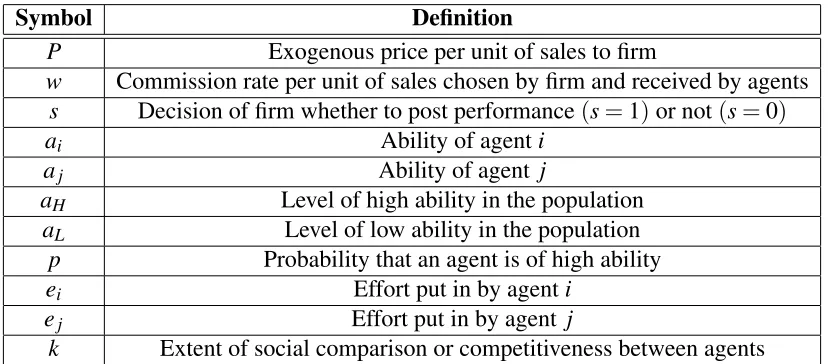
it chooses to post performance. Table 4.1 lists all parameters and decision variables that
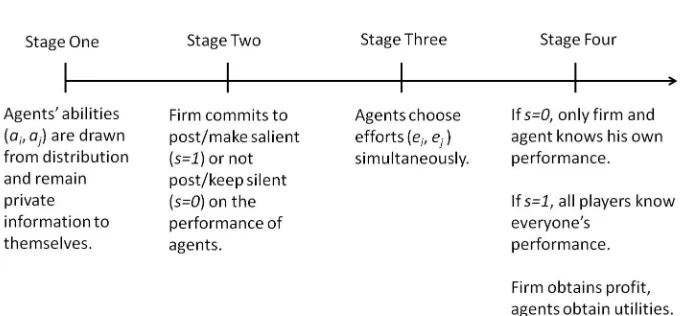
appear in my model. Figure 4.1 in Section 4.1.5 shows how the dynamic game unfolds.
Symbol Definition
P Exogenous price per unit of sales to firm
w Commission rate per unit of sales chosen by firm and received by agents s Decision of firm whether to post performance(s=1)or not(s=0)
ai Ability of agenti
aj Ability of agent j
aH Level of high ability in the population aL Level of low ability in the population
p Probability that an agent is of high ability
ei Effort put in by agenti
ej Effort put in by agent j
k Extent of social comparison or competitiveness between agents
4.1
Game Set-Up
4.1.1
Players
In business-to-business settings, it is common practice for a firm to hire agents to obtain
sales for the firm. I begin with a simple model comprising of three players: a single firm
and two sales agents,iand j. Assume thatiand jwork on a similar and comparable task
for the firm. Going forward, I will useias the focal agent and a similar case always applies
to j.
I assume that each agent has an inherent ability parameter (ai >0, aj >0) which is
private information, i.e., known only to himself or herself, and not known to either the other
agent or to the firm. That said, the distribution of agents’ abilities is common knowledge:
an agent is of high ability (aH) with probability p and low ability (aL) with probability
(1−p). This gives rise to four possible scenarios:{ai=aH,aj=aH},{ai=aH,aj=aL},
{ai=aL,aj =aH} and {ai=aL,aj =aL} with respective probabilities of p2, p(1−p), (1−p)pand(1−p)2.
4.1.2
Performance of Agents
Agent i’s performance is a function of his or her ability parameterai and effort decision
ei>0. In addition to ability being unobservable to the other agent and the firm, the same
applies for an agent’s effort decision, i.e., effort is not observable to the other agent and the
firm. The firm observes, however, the performances of both agents that transpire from each
agent’s combination of ability and effort. I allow for substitutability between ability and
effort in which performance is the sum ofi’s ability and effort,ai+ei. This is a specification
commonly used in the literature (e.g., Ederer 2010, Kuhnen and Tymula 2012).
high-ability agents who also put in high levels of effort. However, neither high-ability nor effort is
observable by the firm. That said, the firm does observe performance that transpires from
the additive combination of ability and effort, in terms of the sales numbers that get realized
by each agent. That firms do not observe ability is a realistic assumption if the agents are
newly hired employees, or if there is a high turnover of employees (oftentimes the case in
a sales setting) such that there is limited learning of agents’ abilities by the firm. That firms
do not observe effort is a common assumption in many principal-agent settings, in which
the principal only observes the “outcome”, which is an imperfect signal of the action taken,
primarily because supervisory measures are extremely costly (Salanié 2005). This is an
especially relevant assumption in the sales force setting, given that agents spend most of
their time in the field getting deals done, and very little of such effort is observed by the
firm.
Furthermore, on the abilities of agents, I assume that these are independent draws from
a known distribution that reflect the inherently random nature of abilities, despite best
ef-forts by a firm to screen for ability. A firm, in order to maximize profit, seeks to maximize
agents’ aggregate performance and specifically chooses the action (whether to post
perfor-mance or not) in order to maximize agents’ aggregate effort. I will now specify the firm’s
objective.
4.1.3
Firm’s Objective
The firm’s objective is to maximize the following profit function:
π= (P−w)·[(ai+ei) + (aj+ej)] (4.1)
In equation 4.1,Pis an exogenous price net of variable costs which the firm obtains per
sales performance achieved. (P−w)is thus the margin per unit of sales for the firm, where
P>w.
I assume that the performances ofiand jsum to give the aggregate performance of the
firm,(ai+ei) + (aj+ej). In other words, there is no direct substitutability or
complemen-tarity between the performances of both agents. The firm’s objective is to maximize profit
by choosing whether to post performance (s=1) or not (s=0). To maximize profit given
exogenous margins(P−w), a firm’s objective is then to maximize aggregate performance
(ai+ei) + (aj+ej). Ideally, a firm would like to have agents with high abilities putting
in high levels of effort. That said, the ability of an agent is determined by a random draw
from the distribution of abilities, and is therefore not within control of the firm. In essence,
then, the firm’s objective is to maximize, conditional on expected abilities, the aggregate
effort ei+ej, and seeks to do so by deciding whether to post or not post performance. I
will elaborate on this decision of the firm,s, shortly.
4.1.4
Agents’ Utility Function
I now turn to the agents’ utility functions. I enrich the psychology of agents to include
social interdependencies, i.e., I assume that agents are motivated not only by financial
in-centives, but also obtain utility from social comparison. This builds not only on decades of
research on social comparison in social psychology (e.g., Bunnk and Gibbons 2007,
Fes-tinger 1954, Wood 1989) but also a growing body of literature in neuroscience (e.g., Dvash
et al. 2010, Fliessbach et al. 2007) which show the direct effects of social comparison on
reward processing in the brain. Assuming that the individual rationality constraints for the
agents are satisfied and that the agents remain in the firm, i.e., there is no attrition (or hiring
Ui(ei) =w·(ai+ei) +k·
ai+ei
(ai+ei) + (aj+ej)− e2i
2 (4.2)
Equation 4.2 shows i’s utility being made up of three additively separable terms. The
first two represent utility arising from income (“financial utility”) and social comparison
(“social utility”) respectively, and the third represents disutility arising from cost of effort.
Based on i’s performance, an agent receives a financial compensation of w·(ai+ei)
from the firm. As seen in the mathematical expression, financial compensation is the
prod-uct of the commission rate per unit of performance and performance. Social comparison
is specified ask· ai+ei
(ai+ei)+(aj+ej) and comprises of two components. The latter component
ai+ei
(ai+ei)+(aj+ej) represents the performance share ofi. It can also represent the remuneration share ofi because commission ratewis constant per unit of performance, and will factor
out in the numerator and denominator. I specifically chose this specification for two
rea-sons. First, because of its concavity, it has the desirable property that marginal gains are
smaller in magnitude than marginal losses of the same magnitude – in line with
behav-ioral literature across many domains, that gains are good, but losses of the same magnitude
oftentimes feel worse. Second, this specification is continuous and thus gives me greater
tractability1. Furthermore, the added benefit of this specification is that it bears similarity to
a sales contest setting, in which the proportion of an agent’s effort determines the expected
probability of winning the sales contest prize, or simply the expected “financial utility”;
here, the proportion of performances determines the expected “social utility” from social
comparison. In using this specification, therefore, I am able to link the intuitions of my
propositions below with the findings of the literature on sales contests.
I allow performance share to be moderated by a former term, the parameter k> 0,
which represents the extent of social comparison or a “culture of competitiveness” (Garcia,
Tor and Schiff 2013) between the two agents. In my setup, a higherkrepresents a higher
level of social comparison or competition between both agents. Notice here that I do not
have an agent-specific subscript fork: my intent is to letkcapture a common level of social
comparison or competition within a firm. For example, there are certain firms or countries
(e.g., those with a low level of collectivism) which may have a predominant culture of
comparison and competition (i.e., higher k), more so than others, where this is a need –
either because of self-selection of agents into a firm, or inculcated through experience –
to compare oneself to peers (and in turn, be compared to). That said, while I modelk as
a parameter common to both agents in my model, the magnitude of this parameter can be
influenced by the firm2. This will be clearer once I examine the comparative statics in my
propositions.
Finally, I operationalize the assumption of convex costs using a quadratic cost function,
e2i
2, which is a common assumption in this nature of work and captures the notion that effort
is increasingly costly.
Firm Does Not Post Performance. Since this is a game of incomplete information, a
firm not posting performance (s=0) implies that the focal agent will not know about the
performance of the other agent. In this case, I am going to assume that the focal agent
compares himself or herself to an agent of average ability, and how an agent of average
ability will perform. Specifically, the expected utility of idepends on social comparison
with the performance of an agent of average ability, Ei[aj], putting in an average-ability
type level of effort,ej|Ei[aj], as seen in the following:
EUi(ei|s=0) =w·(ai+ei) +k· ai+ei
(ai+ei) + (Ei[aj] +ej|Ei[aj])− e2i
2 (4.3)
Firm Posts Performance. On the other hand, if the firm posts performance (s=1), this 2
means that with probability p,i’s utility will be:
Ui(ei|s=1) =w·(ai+ei) +k·
ai+ei
(ai+ei) + (aj=H+ej=H)
−e
2
i
2 (4.4)
And with probability 1−p,i’s utility will be:
Ui(ei|s=1) =w·(ai+ei) +k· ai+ei
(ai+ei) + (aj=L+ej=L)
−e
2
i
2 (4.5)
Thus, the expected utility ofiwill be:
EUi(ei|s=1) =w·(ai+ei) +p·k
h
ai+ei
(ai+ei)+(aj=H+ej=H) i
+
(1−p)·kh ai+ei
(ai+ei)+(aj=L+ej=L) i
−e2i
2
(4.6)
4.1.5
Sequence of Events
I now describe the sequence of events in my multi-stage game of incomplete information
shown in Figure 4.1. Throughout the game, I assume that the following are common
knowl-edge: (i) the distribution of agents’ abilities; (ii) commission ratew; and (iii) the extent of
social comparison or competitiveness between the agents as represented byk. All of these
are exogenous parameters in my model.
In stage one, agents receive private information from nature about their own ability
types (eitheraH oraL), which are independent draws from the ability distribution. In stage
two, the firm maximizes profit, with the margin per unit of sales remaining constant at
(1−w), i.e., the firm maximizes profits by maximizing aggregate sales(ai+ei) + (aj+ej)
and does so by committing to post or not post performance. In stage three, agents choose
efforts to maximize utilities based on their private information about their own abilities and
the agent chooses effort, regardless of whether it carries out performance posting. But if
the firm had committed in stage two to post performance (s=1), each agent also learns precisely about the other agent’s sales performance; if the firm commits in stage two to not
post performance, then each agent makes the best possible inference that the other agent
is of average ability with a corresponding effort and performance level. In other words, i
thinks that j’s performance is what an average agent would achieve and j thinks likewise
of i’s performance in the absence of performance posting. I then solve for the unique
equilibrium in this game of incomplete information.
It is worth highlighting that in my model, regardless whether the firm posts
perfor-mance or not, each agent is inclined to compare his or her perforperfor-mance to the other agent’s
performance as moderated by k, the competitiveness between the agents. In other words,
I disentangle social comparison – a key aspect of human nature – from the availability of
information about others’ performance3. This allows us to understand the effects of social
comparison on effort when a firm can control the availability or precision of information
about others’ performance.
I model this as a non-repeated “one-shot” game to understand the steady-state
equi-libriumwhich arises from the firm’s decision on whether to post or not post performance.
More specifically, my setup allows me to examine the difference in firm’s profit between
two scenarios: one in which the firm decides to post performance versus the other in which
the firm decides not to post performance. For example, a firm may decide on the first day
of work whether to post or not post performance for a new batch of agents. My model
predicts the subsequent steady-state difference in profits some time down the road based
on these two decisions. To be clear, I do not model the potentiallearningthat can happen
3Here is where I depart from Kuhnen and Tymula (2012) who assume that the absence of information
about the other agent means that social comparison does not happen. In my model, I disentangle the existence of social comparison from the availability of information: the only difference between both cases is the
Figure 4.1: How Events Unfold in a Sequential Game of Incomplete Information
if this one-shot game is repeated. It is possible that if the game is repeated, information
revealed in stage four of the first game then narrows the asymmetry of information because
the firm receives more information about agents’ abilities and each agent knows the other
agent’s ability a bit better.
To complicate matters in a repeated game, agents might strategically withhold effort
in the first game to influence the learning that will happen in between the games, so as to
strategically influence the outcome of the next game. This is analogous to the ratcheting
effect in dynamic principal-agent settings: agents strategically cut back on effort in the
first game given rational anticipation that the firm will raise the performance bar for the
next game based on the performance in the first game, though Charness, Kuhn and Villeval
(2010) finds that the presence of competition eliminates ratcheting effects. Such an
exten-sion is of interest for future work. For now, I employ a one-shot game to cleanly understand
4.2
Theoretical Results
From the firm’s perspective, there are four possible scenarios that can arise regarding the
ability distribution of both agents. The first scenario is that both agents are of high ability:
{ai=aH,aj =aH}. The second and third scenarios are that one agent is of high ability while the other agent is of low ability:{ai=aH,aj=aL}, {ai=aL,aj=aH}. The fourth and last scenario is that both agents are of low ability: {ai=aL,aj = aL}. Given that the ability draws from the distribution are independent, each of these scenarios then have
respective probabilities ofp2, p(1−p),(1−p)pand(1−p)2.
Agents of different ability types respond differently when the firm posts or not posts
performance. To understand how this is so, I first examine in Section 4.2.1 the unique
non-negative Nash equilibrium effort of an agent in a general setting. Next, I examine the effort
levels of agents when the firm does not post performance (Section 4.2.2) versus when the
firm posts performance (Section 4.2.3), and compare how the effort levels are different in
both cases (Section 4.2.4). After providing some intuition about performance for both types
of agents in Section 4.2.5, I obtain aggregate performance from the firm’s perspective, and
compare expected profit under both cases in Section 4.2.6 to derive the cases under which
a firm does better by posting performance.
4.2.1
Equilibrium Effort of an Agent
The amount of effort that idecides to put in against j depends on his or her belief about
aj. Giveni’s belief aboutaj, there exists a unique Nash equilibrium in non-negative efforts
given by:
e∗(a,a ,k,w) =(a
2
i +aiaj+2k+3aiw+ajw+2w2)
√
λi+ (w−ai)λi
whereλi=a2i +a2j+4ajw+2ai(aj+2w) +4(k+w2).
Whenidecides how much effort to put in, it is a function of i’s abilityai, i’s beliefs about
the other agent’s abilityaj, the degree of competitiveness or social comparisonk, and the
commission ratew. There is, however, uncertainty ini’s belief aboutaj. Depending on the
firm’s decision to post or not post performance, this uncertainty aboutaj, and consequently
j’s performance, affectsi’s utility differently in both cases. I will elaborate on this further
in Sections 4.2.2 and 4.2.3.
As for the firm, it seeks to maximize profit. In my model setup, a firm maximizes profit
by maximizing agents’ aggregate performance. Since ability and effort combine additively
to generate performance – and ability draws for the agents are assumed to be exogenous and
not within a firm’s control – the firm essentially decides whether to post or not performance
with the objective of maximizing agents’ aggregate effort, conditional on the ability draws
for the agents. I lay out this decision in Section 4.2.6.
To understand how a firm makes this decision, I first study how each agent’s optimal
effort varies with the parameters in my model. The lemmas below are based on comparative
statics of the optimal effort in equation 4.7. Details are provided in Appendix A.
Lemma 1A: When agents are symmetric in abilities, an agent’s effort eiis weakly
decreasing in ability.
Based on the draws of ability distribution, agents can both be of high abilityaHor of low
abilityaL. These are two out of four scenarios in which agents are symmetric in abilities –
for these, I take the first derivative ofe∗i with respect toa=ai=aj. I find that ∂e
∗
i
∂a 60 for
k>0, and ∂e∗i
∂a <0 fork>0, i.e.,i’s optimal effort is weakly (strictly) decreasing in ability if
kis weakly (strictly) positive. When agents are symmetric in abilities, and correspondingly,
symmetric in performance since there is a one-to-one mapping between ability and optimal
effort are substitutes in the production of sales performance. In addition, ∂2e∗i
∂a2 >0 for
k>0 and ∂2e∗i
∂a2 >0 for k>0. This means that for every unit increase in i’s ability, the
corresponding decrease ini’s effort is proportionately smaller.
Lemma 1B: When agents are asymmetric in abilities, an agent with higher
abil-ity will put in effort that is weakly increasing in the other agent’s abilabil-ity. An agent
with lower ability will put in effort that is weakly decreasing in the other agent’s
abil-ity. Furthermore, an agent’s effort ei is convex in aj only if the following conditions
are jointly satisfied: 0<ai< aj
2, 0<k< 1
2(−2a2i −aiaj+aj2−5aiw+ajw−2w2) and
0<w<aj−2ai.
For agents with asymmetric abilities, ∂e∗i
∂aj >0 ifai>aj, or
∂e∗i
∂aj >0 ifai>ajandk>0. However, ∂e∗i
∂aj <0 if 0<ai<aj andk>0. Thus, if an agent has higher (lower) ability, then his or her effort is weakly increasingly (decreasing) in the other agent’s ability. Said
differently, ifiis the agent with higher (lower) ability, his or her optimal action is to scale
up (down) effort as j’s ability increases. This result is similar to a common finding in
contest theory amongst heterogeneous players, in which a weaker player (in this case, the
agent with lower ability) experiences “discouragement” and will cut back on costly effort
as it becomes relatively unprofitable to beat the stronger player (in this case, the agent with
higher ability), while the stronger player will be more passive or “complacent” unless s/he
faces another player of similar strength (Dechenaux et al. 2012).
Furthermore, ∂
2e∗
i
∂a2j >0 if certain conditions are jointly satisfied. First,i’s ability needs
to be less than half of the other agent’s ability. This can happen ifiis the weaker agent and
there is sufficient difference in ability levels, or ifiis the stronger agent and there is limited
difference in ability levels. The latter is ruled out by the condition on the commission
rate, which needs to be positive, which meansineeds to be the weaker agent. In addition,
If so, then for every unit increase in j’s ability, the corresponding decrease in i’s effort
is proportionately smaller for a weaker agent. As we will examine later, the convexity in
the other agent’s ability corresponds to the case in which iis “discouraged” by his or her
lower ability, butiis not “overly discouraged” if the above conditions are jointly satisfied.
The intuition here is that when the level of competitiveness and commission rate are both
sufficiently low, the effort levels of agents will be low, and the difference in effort levels
between the stronger and weaker agent will not be large.
Lemma 2: An agent’s effortei is always increasing in social comparison or
com-petitiveness k, and is convex in k only if the following conditions are jointly satisfied:
ai>2aj, 06k< 12(a2i −aiaj−2aj2+aiw−5ajw−2w2), and 0<w<ai−2aj.
Next, ∂e∗i
∂k >0 for the entire range of the parameter space and is convex, i.e.,
∂2e∗i
∂k2 >
0, only if the following conditions are jointly satisfied: i has higher ability and there is
sufficient difference in ability levels between both agents, if competitiveness is lower than a
threshold level, and if the commission rate is sufficiently small. Otherwise, effort is concave
inkand there will be decreasing returns to effort askincreases. From the firm’s perspective,
a higher k seems to be better because it yields higher effort from agents. Furthermore, a
higher k does not increase the firm’s cost. But as we will examine later, there may exist
tradeoffs between regions of concavity and convexity in effort such that depending on the
circumstances, a firm can do better by posting or not posting performance.
Also, notice the similarity in the convexity conditions for effort in Lemma 2 compared
to that of Lemma 1B. The only difference between both conditions is that the perspective
ofiin Lemma 2 is one in whichiis the stronger agent, while the perspective ofiin Lemma
1B is one in whichiis the weaker agent. The similarity in the convexity conditions comes
social utility component respectively. The implication is that if there is sufficient difference
in ability levels between both agents, there cannot be convexity in both the stronger and
weaker agent’s effort in regions where both the stronger agent’s ability and the level of
competitiveness are increasing at the same time.
Lemma 3: An agent’s effort ei is always increasing in commission rate w, and
is convex in w under any one of these three conditions: (i) 0<ai<2aj and k>0;
or (ii) ai>2aj, k> 12(a2i −aiaj−2a2j+aiw−5ajw−2w2), and 0<w<ai−2aj; or (iii)
ai>2aj, k>0 and w>ai−2aj.
As for the commission rate, I observe that ∂e∗i
∂w >0 for the entire parameter space. This
means that the firm can increase the efforts of both agents as long as it increases the
com-mission rate. This is intuitive, as agents put in more effort when they are rewarded with a
greater financial incentive to do so. Also, I observe that ∂
2e∗
i
∂w2 >0, i.e., there is convexity in
effort with respect to the commission rate under any one of these three conditions: (i) given
any presence of competitivenessk, eitheriis the weaker agent, or ifiis the stronger agent
and there is limited difference in both agents’ abilities; or (ii) i has substantially higher
abilityai such that there is sufficient difference in ability levels between agents,
competi-tivenesskis higher than some threshold level, and the commission ratewis small; or (iii)
ihas substantially higher abilityai such that there is sufficient difference in ability levels
between agents, there is some presence of competitivenessk, and the commission ratewis
sufficiently large. Otherwise, effort is increasing and concave in the commission ratew.
Notice that the convexity conditions under which ∂
2e∗
i
∂k2 >0 (from Lemma 2) and ∂2e∗i
∂w2 >0
(from Lemma 3) are mutually exclusive. This means that the stronger agent’s effort can
4.2.2
If Performance is Not Posted
If performance is not posted, both agents will not know the realized performance of the
other agent at stage four of the game. In this case, the only inference for social comparison
that agentican make is that s/he is facing an agent of average ability,Ei[aj] =paH+ (1−
p)aL, who puts in average-type level of efforts as denoted by ej|Ei[aj]. In this case, i’s
optimal effort is given by:
e∗i(ai,Ei[aj],k,w|s=0) =
(w−ai)λi+ (a2i +aiA+2k+3aiw+Aw+2w2)
√
λi
2λi
(4.8)
whereA=paH+ (1−p)aL,λi=a2i +A2+4Aw+2ai(A+2w) +4(k+w2).
4.2.3
If Performance is Posted
Given that the expected utility ofiis linearly separable in the scenarios of the other agent
being either of high or low ability, and weighted by pand(1−p)respectively, I first solve
for the case in which iis of high ability, and anticipates j to be of high ability as well. If
so,i’s optimal effort is:
e∗i(ai=aH,aj=aH,k,w|s=1) =F+4G
3/2
8G (4.9)
whereF =−4a3H−4aHk−4a2Hw+4kw+4aHw2+4w3,
G=a2H+k+2aHw+w2.
Ifiis of high ability, and anticipates jto be of low ability, theni’s optimal effort is:
e∗i(ai=aH,aj=aL,k,w|s=1) = H+J
√
M