University of Pennsylvania
ScholarlyCommons
Publicly Accessible Penn Dissertations
2016
Before And After The Great Contentions:
Explaining The Diffusion Of Crises With Machine
Learning And Archives
Doga Kerestecioglu
University of Pennsylvania, [email protected]
Follow this and additional works at:https://repository.upenn.edu/edissertations
Part of theBusiness Administration, Management, and Operations Commons,Management Sciences and Quantitative Methods Commons,Political Science Commons, and theSociology Commons
This paper is posted at ScholarlyCommons.https://repository.upenn.edu/edissertations/2384 For more information, please [email protected].
Recommended Citation
Kerestecioglu, Doga, "Before And After The Great Contentions: Explaining The Diffusion Of Crises With Machine Learning And Archives" (2016).Publicly Accessible Penn Dissertations. 2384.
Before And After The Great Contentions: Explaining The Diffusion Of
Crises With Machine Learning And Archives
Abstract
This dissertation presents three articles that study crises from a sociological perspective. The first two articles studies the effects of global trade networks on financial and political crises with the implantation of big data and supervised machine learning methods on a dataset for a sample of 70 countries for the years between 1962 and 2009. Using the institutional and network theories, the first article finds support that normative pressures lead countries to commit sovereign defaults. Countries are more likely to commit sovereign default if other structurally equivalent or role equivalent countries did so in the previous year. The second article finds that role equivalent and structurally equivalent countries occupying a similar position in the global trade networks are affected similarly by revolutionary waves and experience revolutionary situations
simultaneously. The third article argues that state secularization is a process involving mobilization, political tactics, and resources as opposing forces struggle over three major institutional dimensions. Examining the history of state secularization in Turkey, Mexico, and France in the aftermath of revolutions, this article demonstrates that the degree of secularization is determined by political contention. (1) The revolutionary state attempts to seize church property, which opens the way for further struggles. (2) If the church administers law through its own courts, or has an autonomous code of law, revolutionary states struggle to substitute secular courts and state-enacted law. (3) Churches often control education; a revolutionary state eventually attempts to take control of education when it mobilizes sufficient resources for the required state capacity. Taking all these dimensions together, the struggle over secularization has many partial outcomes and stopping places, and thus mixed patterns are much more typical than an ideal type transition to pure secularist modernity.
Degree Type Dissertation
Degree Name
Doctor of Philosophy (PhD)
Graduate Group Sociology
First Advisor Mauro F. Guillen
Second Advisor Randall Collins
Keywords
Crises, Globalization, Religion, Revolutions, Secularism, Trade Networks
Subject Categories
Business Administration, Management, and Operations | Management Sciences and Quantitative Methods | Political Science | Sociology
BEFORE AND AFTER THE GREAT CONTENTIONS: EXPLAINING THE DIFFUSION OF CRISES WITH MACHINE LEARNING AND ARCHIVES
Doğa Kerestecioğlu
A DISSERTATION
in
Sociology
Presented to the Faculties of the University of Pennsylvania
in
Partial Fulfillment of the Requirements for the
Degree of Doctor of Philosophy
2016
Supervisor of Dissertation Co-Supervisor of Dissertation
______________________ _________________________
Mauro F. Guillén Randall Collins
Dr. Felix Zandman Professor Dorothy Swaine Thomas
of International Management Professor of Sociology
Graduate Group Chairperson
______________________
David Grazian, Associate Professor of Sociology
Dissertation Committee
Mauro F. Guillen Dr. Felix Zandman Professor of International Management
Randall Collins Dorothy Swaine Thomas Professor of Sociology
BEFORE AND AFTER THE GREAT CONTENTIONS: EXPLAINING THE DIFFUSION OF CRISES WITH MACHINE LEARNING AND ARCHIVES
COPYRIGHT
2016
Doğa Kerestecioğlu
This work is licensed under the
Creative Commons Attribution-
NonCommercial-ShareAlike 3.0
License
To view a copy of this license, visit
iii
DEDICATION
To Sabiha, Dürdane, Zeki, and Adem Vasfi,
Whose memories and stories started this research years before I was aware;
and to Esen,
who’s been there from the beginning to the end (even though partners of
iv
ACKNOWLEDGMENTS
First and foremost I would like to thank Randall Collins and Mauro F.
Guillén for advising me and guiding me throughout my graduate school years.
When I decided to join Penn Sociology, the primary factor driving my decision
was the opportunity to learn from these two great scholars and I am grateful that
they accepted me as a student and mentored me through my intellectual and
professional development. Mauro and Randy have been a great team of advisors
for the last seven years for me.
Over the years, Randy constantly challenged me about my theories and
gave me serious questions regarding the big picture. Most of the times, his
elegantly-stated and simple-looking questions took me months to come up with
satisfactory answers. I hope that they are convincing for him as well. He also gave
me highly detailed comments not only on my ideas, but also on my writing style
and even grammar. I was also lucky enough to learn about his working routine
and how he produces his research. I tried to adopt it as best as I could.
Mauro helped me stay on the ball. Over the years, I feel like I ran many
sprints with him. As any PhD candidate would know, the road to PhD is a very
long journey and most times progress is hard to measure and this his leads to
motivational problems from time to time. At those times when I wasn’t sure what
v
to put me back on track. Few people I know in life responds to their emails as fast
as Mauro and I can’t stress enoughhow much I appreciated that—especially as an
international student, who needed some rapid bureaucratic action more than
once over the years— but I’m sure most others who have been through a PhD
program can understand. He also pushed me into the direction, where I started
learning what it means to program for real, which turned out to be one of the
greatest skills I attained in graduate school.
I came to Penn with some econometrics background, but any real
expertise I have in Statistics, I owe to Paul Allison. I made sure to at least audit
every class he taught at Penn and was lucky enough to work as a TA for him,
which was just as important as a learning exercise. He gave me valuable advice
for the earlier drafts of the first article, but it would not be stretching the truth to
say that the quantitative analyses in this dissertation would not be possible
without what I learned from Paul.
Guobin Yang was happy to join my second comprehensive exam
committee on a relatively short notice soon after he joined Penn Sociology. He’s
been very encouraging in furthering my research ever since. I especially
appreciate his candid comments and advice for me after my first adventure1 into
academic publishing.
Maya Charrad provided valuable advice for the research that resulted in
vi
me for both improving ways to market my articles to academic journals and
navigating my way around the academic job market.
Our managers, coordinators and administrators at Penn Sociology, Aline
Rowens, Audra Rodgers, Marcus T. Wright, and Kathleen Paone have been
extremely helpful throughout the years. Penn Sociology could not exist without
them and by corollary, neither could this dissertation. Especially Aline and Audra
have helped me in countless ways. They helped me secure funding so I could
conduct the research, get the necessary bureaucratic documents so I could
continue to stay as a legal non-resident alien in this country as an international
student, and helped me stay focused on being a graduate fellow.
Emily Hannum has been an amazing Director of Graduate Students at
Penn Sociology, but even after she moved to other positions, she always provided
the moral support and professional guidance, which proved to be extremely
valuable once I became ABD.
Simone Polillo shared his code with me and when he did I had no idea that
it was the beginning of a dive through a rabbit hole that was deeper than I could
ever imagine. His dozens of lines of unfinished STATA code is where I started
teaching myself loops and small do files that finally led to complicated machine
learning algorithms in Python years later. In a parallel universe without his code,
vii
at Penn that relied on Excel and even imagining that gives me nightmares so I’m
really happy that Simone gave me that code in this particular universe.
Witold Henisz, Joe Cohen, Sadia Saeed, Charlie Kurzman, Damon Mayrl,
Neil Gross, Ann Orloff, Paul Almeida, and Michael McQuarrie have either made
valuable comments to various early drafts of the articles in this dissertation or
supported me by discussing my ideas and suggesting improvements.
Without my friends at Penn Sociology it would be impossible to get here.
As social networks appear in the wild, some ties are stronger than others and the
stronger ties are reflected in my work in one way or another. In my specific social
network at Penn, Alex, Valerio, and Sarah have been the strongest ties
throughout the years. Although it is hard to pinpoint how they exactly should be
acknowledged in regards to this dissertation, I know they all gave me lots of ideas
and helped me improve my research for many years.
Over and over, Alexander Jerneck told me to write a “function” for years.
He didn’t really explain what a function was and I wasn’t sure what he meant, but
he kept telling me. I also constantly heard of these weird sounding phrases and
words like machine learning, topic modeling, and Python -- also, this new thing
called Data Science. I finally gave up and spared some time to really look into
those things. I owe Alex so much! I am so happy that I got the chance to share the
same department with him; I learned a great deal from him. His help, of course,
viii
helped me navigate the graduate school. He happened to be my trail blazer and
all I had to do was follow the path. He also kept me company through many
ASAs, helped me make beer, and drink beer; all required things for a good
dissertation.
Valerio Baćak showed me how graduate school should be done, how a PhD
Candidate becomes a stellar scholar, and through his example I could see what I
should do. He gave me ideas and good advice (that I didn’t always follow, but
should have), commented on my work and always stayed humble even though he
did not need to.
Sarah Spell has provided constant moral support, read drafts, and gave me
comments I did not always want, but definitely needed. But more importantly,
from her I learned what true conviction is. Her stubborn pursuit to follow what
she believes in even though it might not be popular is an exemplary trait of a true
PhD. She provided a great lesson for me especially because we did not always see
eye to eye. I didn’t always think or realize at the time, but she was right in her
pursuits. Seeing her confidence in herself helped me be more confident in myself,
as we don’t always need to follow popular ideas or paths.
The program directors and fellows at 2016B Insight Data Science program
taught me principles of Agile, most importantly how to pivot and the concept of
ix
that final required 1% once you have done 99% of the work. I used what I learned
there to finish the last 1% of my PhD education.
Robin Gauthier and Nicole Denier have been strong partners in
[committing] crime (that is ‘committing sociology’) since my years in McGill. I
think they helped me keep sane through the craziest turns of grad school through
being outsider insiders. I am grateful to Robin for always keeping me grounded
and thankful to Nicole for visiting me in Philadelphia for a day and especially
screaming at me at Sam’s Morning Glory Diner.
On the subject of settings, I would like to thank the countless metal bands
that came to Philadelphia (especially In Flames and Katatonia) for concerts and
released albums (especially Heaven Shall Burn and Cult of Luna) during the last
seven years. Their music and live shows gave me the much needed emotional
energy to get through the years. I would like to thank all the coffee shops of
Fishtown and their baristas (especially those in Steap and Grind and La Colombe
Fishtown). They have provided amazing places for me to work. Most of these
articles were written in these places, where I made friends and found out that
what I did was interesting to people outside of a closed academic circle. This gave
me the much required emotional energy to continue writing.
I also cannot thank Audrey and Arnaud Libois enough for always showing
x
friends in the ‘real world.’ They were rare in actually caring and wanting to
discuss what I do and I always appreciated it.
Similarly Erdem Çapar was always happy to give me his insights at short
notice via various forms of written communication whenever I felt like bouncing
off ideas with him. Some of his work experiences in Turkey has been highly
insightful for me in the early stages of theory building regarding the formation of
institutional processes.
I am grateful to Dilber and Ismail Sunnetçioğlu for opening their home
and letting me stay with them during part of my archival research in Istanbul.
They have also been very supportive through the years of my PhD across the
ocean, which is much appreciated.
I am thankful to Buket and Murat Pençe for hosting me for the other part
of my archival research in Istanbul and for accepting me into their family, giving
me amazing moral support and trusting me with their daughter, without whom
this dissertation would prove to be much more difficult than it already is, but I’ll
get to her later.
My grandparents Vasfi and Sabiha Kerestecioglu and the memories they
shared with me have inspired the research for the third article. They were the
children of the Republic and among the first teachers that came out of it.
xi
dissertation was completed and my grandmother Sabiha passed away days after
the PhD defense so neither got to see the final product that was dedicated to them
and they can’t be acknowledged enough for their enormous influence in making
me who I am and this dissertation what it is.
My immediate family has been very supportive throughout the years. My
sister, Damla Kerestecioğlu, has always been very understanding. She cheered me
up when I needed even though she had to do it on Skype most of the times. I
don’t think I’ll ever appreciate enough what it meant for my parents, Ayşe and
Merih Kerestecioğlu, to send me across the ocean and support me in what I’ve
been doing ever since. They also always believed in me and gave me mental
support when I needed it. Especially my mother, who always told me it was going
to be better even when there was not really any good signs for it. She was right;
things ended well. Even though I rarely had to rely on it, they also always
provided me with the financial security I needed. The fact that I had a safety net
that I could rely on helped me avoid it entirely and it is an amazing luxury for a
PhD student in social sciences.
Finally, Esen Pençe deserves the most credit for all that is good in this
research. She read countless drafts, ran the required errands when I was
indisposed to do so, double checked everything for me, suffered through the
graduate school with me even though she wasn’t getting a degree out of it. She
xii
completely open and very intelligent person to discuss any ideas I had in mind.
She shared most of the burden with me even though I didn’t acknowledge it in
every moment. She couldn’t be acknowledged enough here even if I wrote about it
for the entire length of this dissertation.
As it is traditional to say, all the help I received from all of these amazing
people are the good things about this research. Any faults or mistakes are solely
mine.
Doğa Kerestecioğlu – Fishtown, Philadelphia, PA, October 2016
xiii
ABSTRACT
BEFORE AND AFTER THE GREAT CONTENTIONS: EXPLAINING THE
DIFFUSION OF CRISES WITH MACHINE LEARNING AND ARCHIVES
Doğa Kerestecioğlu
Mauro F. Guillén
This dissertation presents three articles that study crises from a
sociological perspective. The first two articles studies the effects of global trade
networks on financial and political crises with the implantation of big data and
supervised machine learning methods on a dataset for a sample of 70 countries
for the years between 1962 and 2009. Using the institutional and network
theories, the first article finds support that normative pressures lead countries to
commit sovereign defaults. Countries are more likely to commit sovereign default
ifother structurally equivalent or role equivalent countries did so in the previous
year. The second article finds that role equivalent and structurally equivalent
countries occupying a similar position in the global trade networks are affected
similarly by revolutionary waves and experience revolutionary situations
simultaneously. The third article argues that state secularization is a process
involving mobilization, political tactics, and resources as opposing forces struggle
xiv
secularization in Turkey, Mexico, and France in the aftermath of revolutions, this
article demonstrates that the degree of secularization is determined by political
contention. (1) The revolutionary state attempts to seize church property, which
opens the way for further struggles. (2) If the church administers law through its
own courts, or has an autonomous code of law, revolutionary states struggle to
substitute secular courts and state-enacted law. (3) Churches often control
education; a revolutionary state eventually attempts to take control of education
when it mobilizes sufficient resources for the required state capacity. Taking all
these dimensions together, the struggle over secularization has many partial
outcomes and stopping places, and thus mixed patterns are much more typical
xv
TABLE OF CONTENTS
DEDICATION _____________________________________________________________________________ iii
ACKNOWLEDGMENTS __________________________________________________________________ iv
ABSTRACT _______________________________________________________________________________ xiii
LIST OF TABLES _______________________________________________________________________ xviii
LIST OF FIGURES _______________________________________________________________________ xix
PREFACE __________________________________________________________________________________ xx
1. Crisis and Sociology _______________________________________________________________ xx
2. Global Diffusion of Crises _______________________________________________________ xxii
3. Why Big Data? ___________________________________________________________________ xxvi
4. The Aftermath of Revolutions ________________________________________________ xxix
5. Dissertation Plan ________________________________________________________________ xxx
6. References ______________________________________________________________________ xxxii
ARTICLE 1: EXPLANING FINANCIAL CRISES THROUGH GLOBAL TRADE
NETWORKS: THE INTERNATIONAL STRUCTURE OF SOVEREIGN DEBT
DEFAULTS AND SOVEREIGN STATES’ WILLINGNESS TO PAY ______________________ 1
1. Abstract ______________________________________________________________________________ 1
2. Introduction _________________________________________________________________________ 2
xvi
4. Data _________________________________________________________________________________ 16
5. Dependent Variable ______________________________________________________________ 16
6. Explanatory Variables ___________________________________________________________ 17
7. Control Variables _________________________________________________________________ 21
8. Method _____________________________________________________________________________ 21
9. Results ______________________________________________________________________________ 24
10. Conclusion ________________________________________________________________________ 30
11. References _______________________________________________________________________ 33
ARTICLE 2: REVOLUTIONARY WAVES AND INTERNATIONAL STRAINS: THE
EFFECTS OF GLOBAL TRADE NETWORKS ON REVOLUTIONARY SITUATIONS _ 38
1. Abstract ____________________________________________________________________________ 38
2. Introduction _______________________________________________________________________ 39
3. Interstate Relationships and Revolutions ____________________________________ 43
4. Data _________________________________________________________________________________ 51
5. Dependent Variable ______________________________________________________________ 53
6. Explanatory Variable _____________________________________________________________ 56
7. Other Variables ___________________________________________________________________ 62
8. Method _____________________________________________________________________________ 63
9. Results ______________________________________________________________________________ 65
10. Discussion and Conclusion ____________________________________________________ 71
xvii
ARTICLE 3: a theory of state secularization through post-revolutionary
political contention _____________________________________________________________________ 78
1. Abstract ____________________________________________________________________________ 78
2. Introduction _______________________________________________________________________ 79
3. The Ambiguity of Religious Secularization ___________________________________ 81
4. “Unsettled lives” and Political Opportunities following Revolutions ____ 86
5. Secularizing Revolutions in Turkey, Mexico, and France __________________ 90
6. Political Struggle over Church Property ______________________________________ 94
7. Political Struggle over Religious Law and Civic Rights _____________________ 99
8. Political Struggle over Religious Education _________________________________ 106
9. Conclusion: The Sequence of Secularizing Institutional Changes ________ 110
10. REFERENCES ____________________________________________________________________ 115
xviii
LIST OF TABLES
Table I - Sample Descriptive Statistics ______________________________________________________________________ 21
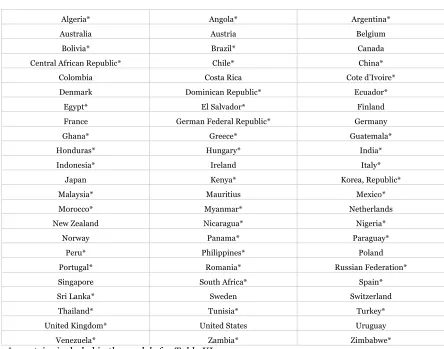
Table II - List of Countries in the Sample ____________________________________________________________________ 23
Table III - Correlation Matrix of the Variables ______________________________________________________________ 25
Table IV - Coefficients as Odds Ratios from Random-Effects Logistic Regression Models for Sovereign
External Defaults as the Dependent Variable _______________________________________________________________ 26
Table V - Coefficients as Odds Ratios from Random Effects Logistic Regression Models for Sovereign
External Defatuls and "Near" Defaults as the Dependent Variable ________________________________________ 27
Table VI - Coefficients as Odds Ratios from Fixed-Effects Logistic Regression Models for Sovereign
External Defaults as the Dependent Variable _______________________________________________________________ 27
Table VII - Coefficients as Odds Ratios from Fixed Effects Logistic Regression Models for Sovereign
External Defaults and "Near" Defaults ______________________________________________________________________ 28
Table VIII - Descriptive Statistics ____________________________________________________________________________ 63
Table IX - Countries in the Sample __________________________________________________________________________ 66
Table X - Pairwise Correlations ______________________________________________________________________________ 66
Table XI - Panel Random Effects Logistic Regression Models for Revolutionary Situations ______________ 68
Table XII - Panel Fixed Effects Logistic Regression Models for Revolutionary Situations ________________ 68
xix
LIST OF FIGURES
Figure I - External Defaults Since 1800 _______________________________________________________________________ 6
xx
PREFACE
1.Crisis and Sociology
This dissertation presents three articles that focus on understudied issues
regarding crises in the sociological literature. Crises by definition are rare, but
they are key and frequent events that punctuate processes of state building,
episodes of international conflict, and other macro trends. Sociologists have been
studying crises in one form or another ever since the inception of the field. In its
earliest days a specific form of crises, revolution, has received close attention.
This was mostly due to the fact that when sociology was coined as a social
science, it happened in a period of history that was heavily affected by the French
Revolution and its aftermath. The dominant paradigm of the Enlightenment at
the time had a path-dependent effect on how revolutions and crises in sociology
came to be studied over the last century or so.
Affected by this positivist paradigm of their period, theories presented by
Marx and Engels assumed that the existence of natural laws applied to not only
hard science such as physics, chemistry, and biology, but also for the social
sciences. This supposition lead them to argue that revolutions play a significant
role in the societies as marking the point in time when the societies move from
xxi
Despite the changing paradigms and dominant theories in sociology over
the centuries, this special status conferred upon revolutions has persisted mostly
unchanged. Revolution has been one of the most common topics in the field of
historical and comparative sociology, which consistently built upon a coherent
literature on revolutions. The evolution of theories in the field over decades has
been well documented (Goldstone 1980, Goodwin 1994).
An interesting and striking fact about these theories is that until recently
revolutions were perceived as special and significant, unique events. While recent
generations of revolution theories allow for discussion over types of revolutions
and whether certain events qualify as a revolution or not, the general assumption
in the field is that revolutions are a specific type of social phenomenon that has
its own unique causes and dynamics. This is mainly due to the path-dependent
evolution of the theories starting from the Marxian notion that revolutions are
supposed to have a transformational effect, progressing societies from a certain
stage to the next one.
As such, historically, most attention has been paid to causes and the
periods leading to the revolutions, rather than its aftermath. This also led to
successful revolutions being used as a unit of analysis, instead of crises, which
covers a greater spectrum of events under the definition of the term1. This trend
was recently identified by both in the subfield of revolutions and in other related
xxii
calls for focusing research on the aftermaths of revolutions (Goldstone 2001).
There have also been calls for studying revolutions along with other dynamics of
contention such as conflict, social movements, etc. with the notion that all these
varying types of contention might be affected by the same dynamics (McAdam,
Tarrow, and Tilly 2001).
This dissertation recognizes the dearth in research pointed out by these
calls and presents three articles that informs on these issues by focusing on the
conditions leading to crises, and the patterns that happen in their aftermath. By
using quantitative methods such as machine learning and statistical modeling,
the first two articles focus on two different forms of crises and study how they
diffuse globally. These methods allow for the study of a larger number of cases
and observations from big data to scrutinize crises as the dependent variable.
Studying crises, in place of revolutions, allow for learning from not only a limited
number of successful cases matched to similar failed ones, but from a
comprehensive systematic comparison of all potential cases. The third article
presents a study on the aftermath of revolutions, the severest form of crises, to
identify patterns that lead to stability.
2.Global Diffusion of Crises
The commonly preferred methodology in theories of revolution is
comparative historical methods that favor in-depth case studies and qualitative
xxiii
models. These approaches allow the researchers to gather highly detailed
information regarding the processes that underlie revolutions and compare them
to other potential cases that had different outcomes. While these approaches are
extremely useful for explaining the causal mechanisms that lead to revolutions,
the number of cases they can study are limited. In practice, researchers are
required to study thousands of historical documents in multiple languages and
analyze them in depth before they can implement a systematic comparison to
discover these patterns. These methods are highly fitting for the original
questions of the literature that are interested in studying specific great
revolutions in the history. Skocpol (1979)’s classic work studying the social
revolutions in France, Russia, and China is a typical example of this, as the
author’s main interest is explaining social revolutions and the author finds the
three cases to be the most fitting examples of these phenomena in history.
When the goal is to only explain a handful of cases in history, historical
and comparative methods are the most fitting ones; however, when the subject is
approached from a dynamics of contention perspective, where the goal is to
discover common dynamics that underlie various types of conflict, the limited
number of cases allowed by the qualitative methods become less satisfactory. The
number of contentions that take place decreases as the severity of the contention
increases. Contentious cases with lower severity, such as demonstrations or riots,
xxiv
rebellions. As there are thousands of these low severity cases compared to the
high severity ones, studying them using historical and comparative methods is
problematic during the process of case selection. While selecting ideal type cases
for revolutions might be possible due to their rarity, it is harder to select an ideal
type case that is exemplary of all demonstrations or riots. It is even more difficult
to select failed cases to which to compare.
For example, a common finding in theories of revolution is that
international strains play a significant role in leading to state breakdowns.
Traditionally these strains are studied from a bilateral perspective and
researchers mostly pay attention to the greatest of these strains such as
international warfare. Yet, international strains are not only limited international
warfare, nor do these strains solely result from relationships in which the focal
country engages.
To remedy this problem, this article opts for using big data and supervised
and unsupervised machine learning techniques to account for the great number
of variables potentially having effects. If the dynamics of contention are similar in
cases of varying severity, one should observe similar conditions affecting the
outcomes. In other words, different types of contention should be affected by
similar variables. Two of the articles presented in this dissertation focuses on two
different but highly severe types of crises: external sovereign defaults and
xxv
External sovereign defaults, as frequently evidenced in literature, is closely
related to the willingness of the states to pay their debt and happens when they
are no longer willing to honor their previous agreements. This key concept of
willingness to pay, which determines whether states commit an external
sovereign default or not, qualifies sovereign defaults as a case of contention. The
parties involved in the crises, debtor country and lenders, engage in political
contention over the terms of a potential default or restructuring of the debt.
Meanwhile, the debtor country risking bankruptcy also faces political contention
locally with its subjects, who will be affected greatly by the outcome. As such,
economic crises are neither solely economic nor financial events. Instead, they
should be studied as contentious events that are affected by similar dynamics as
other types of contentious events.
Revolutionary situations, similar to successful revolutions, are contentious
events with the highest severity. There will be special conditions for when these
revolutionary situations will end up as successful cases, which are studied in
depth by the existing literature, but there are fewer studies that try to discover
common strains that lead to all potential revolutionary situations. If the school of
thought introduced by dynamics of contention is valid, then one should expect
similar dynamics to affect both successful and failed cases of revolutions,
xxvi
A systematic comparison of dynamics that has a significant effect on both
sovereign defaults and revolutionary situations is not immediately apparent or
intuitive. This is, where recent technological developments in data collection and
analysis come to aid. This dissertation favors the use of graph theory, methods
developed by social networks theory, and big data to develop a comprehensive
study that discovers the common variables that serve as significant dynamics of
contention.
An in-depth review of the existing literature focusing on these two
different types of contention reveals that there is ample evidence that patterns of
trade have a significant role. Both articles presented in this dissertation use big
data, methods suggested by graph theory, and social networks analysis to build
measures that can test the effects of trade ties on these crises. The results in both
articles demonstrate that similar dynamics of trade play a significant role in
leading to the two different types of crises and leads credence to the approach
suggested by dynamics of contention.
3.Why Big Data?
Advances in technology and innovations in data collection and storage
have lead to an immense amount of data accumulation that did not exist in prior
stages of human history. In our present day, more data is available to researchers
than there ever was. As of the writing date of this dissertation, there is an
xxvii
by the articles in this dissertation with a solid theoretical foundation, big data can
be a powerful tool in sociological research.
As sociologists, for decades we have focused on the motivations and
actions of individuals. Big data—whether it is provided through technological
companies such as Twitter or Facebook, or international organizations such as
United Nations—and advanced computers allow researchers to study millions of
observations at once and control for all the variables that might be affecting a
phenomenon. One big advantage of the existing big data that is presently
available to researchers is the fact that it reports on the actions that individuals
have taken, instead of motivations that they claim. Data coming from a tweet, an
individual posts on the internet, or trade data reported by United Nations is not
an opinion claimed or a memory recalled, but actual action that was carried out
by the subject in study. This presents itself as a great strength over survey results,
where the researchers have to deal with various problems of recall and cognition
that lead to reliability and validity errors.
The biggest problem that arrives with big data is the sheer size of the data
that the researcher has to deal with. Social sciences and their quantitative
methods have developed over the years to deal with the scarcity of data and
dealing with small datasets. Once the researchers no longer deal with small
samples of larger populations, the p-values that they tend to rely on and accept
xxviii
p-values decrease. The researchers need to be aware of this fact and not simply
rely on small values derived from millions of observations; however, this should
not mean that they should simply ignore the new resources available to them.
The articles in this dissertation use ensemble methods to deal with this
problem. Motivated by the literature, I collected highly granular data on the trade
behavior for a sample of 70 countries. Based on data that was reported by United
Nations on types of products countries have imported and exported, I have
gathered data on approximately 30 million3 observations over 47 years. I also
gathered data on bilateral trade between countries as reported by the Correlates
of War Project.
While it is not possible to implement a systematic comparison of so many
observations using historical and comparative methods nor is it reliable to
conduct causal inference using statistical methods over such a large amount of
observations, I have used methods derived from graph theory and social
networks methods to implement dimensionality reduction. To put things into
perspective in relation to the problem of limited number of cases a researcher can
systematically study when using qualitative methods, the number of bilateral
trade relationships between the countries reported for my sample between the
years 1962 and 2009 is 108,590. It is not humanly possible to keep track of so
xxix
The methods derived from graph theory and social networks analysis
allowed me to make systematic analyses of all of these relationships along with
accounting for other variables. I came up with measures that consider how the
position of one country has changed in comparison to others in the world society
across years when these millions of relationships across the world were held into
account. It is significant that both articles in this dissertation find that the
measures that were derived using the same big data and machine learning
methods had similar effects on two different types of contention that were
previously assumed to be of different causes. In fact, these two types of crises are
traditionally studied by two different disciplines of social sciences. On one hand,
categorized as a type of financial crises, sovereign defaults are commonly seen as
a subject covered by research in the field of economics. On the other hand,
revolutionary situations are categorized as either political or sociological
phenomena and are commonly studied by sociologists and political scientists. As
these dissertation reveals, even crises that are solely seen to be derived by
economic factors should be studied from a sociological perspective and
sociological variables should be taken into account in their explanations.
4.The Aftermath of Revolutions
The final article in this dissertation pays attention to the aftermath of
crises, which was recognized as an understudied issue in a recent call in the
xxx
around countries with similar types of culture, it studies three cases that had a
similar type of outcome following revolutions.
Because of the exploratory nature of the question posed by the literature, I
have opted for an in-depth study of three historical cases using comparative and
historical methods. This study reveals that there is a pattern to
post-revolutionary state formation when the challenger groups find themselves facing
against an incumbent political group that are mainly legitimated through a
religious authority. Studying the cases of France, Mexico, and Turkey in the
aftermath of revolutions, I observe that the methods of post-revolutionaries
implemented by the French in their earlier experiences diffuse into the later cases
of Mexico and Turkey.
The article identifies the major dimensions of political struggles that have
a determining effect on the degree of secularism a state will have in the aftermath
of a revolution. As the political crises resulting from struggles between modern
states and religious authorities are still an ongoing problem in our present day,
the findings regarding the underlying patterns for what results in a ‘settled time’
following a revolution is valuable for understanding current cases as well.
5.Dissertation Plan
The first article in the dissertation studies the effects of global trade
xxxi
structurally equivalent in the global trade networks are more likely to commit
sovereign defaults during the same waves of financial crises in historical time
periods.
The following article studies the effects of global trade network structure
on revolutionary situations. Similar to the first article, it finds that structurally
equivalent and role equivalent countries are likely to be affected during the same
revolutionary waves. While these two articles are motivated by relevant
literatures studying their specific phenomenon, they use similar statistical and
machine learning methods that rely on big data and quantitative analyses. This is
a significant point, which not only reveals that different subfields of sociology
have valuable contributions for each other, but also strengthens the point made
by dynamics of contention literature: different types of contention are likely to be
affected by similar strains.
The third article is an in-depth study of aftermath of crises and presents a
theory of secularizing revolutions by analyzing the cases of France, Mexico, and
Turkey. It reveals a pattern that secularization happens through struggles across
religious property, civic rights, law, and education. The final chapter concludes
the dissertation with a summary of conclusions and potential avenues for future
xxxii
6.References
Goldstone, J. A. 1980. “Theories of Revolution: the Third Generation.” World Politics
32(3):425–53.
Goldstone, J. A. 2001. “Toward a Fourth Generation of Revolutionary Theory.”
Annual Review of Political Science 4:139–87.
J. Goodwin. 1994. “Toward a New Sociology of Revolutions.” Theory and Society
23(6):731–66.
McAdam, Doug, Sidney Tarrow, and Charles Tilly. 2001. Dynamics of Contention. Cambridge, UK: Cambridge University Press. Kindle Edition.
Skocpol, T. 1979. States and Social Revolutions: a Comparative Analysis of France, Russia and China. Cambridge University Press.
1 Another possible reason for the dearth of studies on the aftermath of revolutions also has to do
with the positivistic roots of these theories. Because revolutions are perceived to be
transformational events that progresses societies from one stage to another, there is a rarely voiced implicit assumption that revolutions bring positive outcomes. When the periods following the revolutions are studied; however, it is soon realized that there is a great diversion between the intentions of revolutionaries and the acts of post-revolutionaries. This can be problematic for theories when the social revolutions that are carried out by the support of masses and peasant classes end up as new forms of state that do not necessarily favor the masses.
2 The latest issue of Perspectives, the official newsletter of the American Sociological Association’s
Theory Section was devoted to the topic of “Big Data,” which surveyed leading scholars from various subfields of sociology to provide their opinions on the topic. The editor of the issue summarizes these scholars’ views as “from celebratory and optimistic to wary and cautioning.” This summary is barely a euphemism for most of the scholars’ apprehension towards big data. One of the scholars describe big data as “the new fad in social sciences…” Most scholars do not give much credence to this “fad” of big data. The general consensus is that big data is unlikely to be of any use without concrete theories. Interestingly enough, the scholars, who approach big data most positively are those working on comparative historical and social movements fields.
3 The size of the raw data I gathered from Feenstra et al’s dataset had 27,573,764 observations.
1
ARTICLE 1: EXPLANING FINANCIAL CRISES THROUGH GLOBAL
TRADE NETWORKS: THE INTERNATIONAL STRUCTURE OF
SOVEREIGN DEBT DEFAULTS AND SOVEREIGN STATES’
WILLINGNESS TO PAY
11.Abstract
In sovereign bankruptcies, willingness to pay plays a more significant role than in the case of individual or corporate bankruptcies. This results in sociological processes taking place at a global level affecting the decisions of individual countries when they face financial hardships. How countries identify themselves among others, and how they are identified by the world society, affects their default behavior. Trade is one of the most important relationships that countries constantly and frequently engaged in, and as such they can be used for
determining countries positions in the global space. Using the institutional and network theories, this article uses unsupervised machine learning to process big data reporting on volumes of products traded to implement dimensionality reduction to analyze millions of observations on traded products. Based on a dataset of 70 countries reporting on social, political, and economic features for the years between 1962 to 2009, I find support that normative pressures lead countries to commit sovereign defaults. Countries are more likely to commit sovereign default other structurally equivalent or role equivalent countries did so in the previous year.
2
2.Introduction
In the market economy, crises are as old as the existence of the capitalist
system itself (Arrighi [1994] 2010). The sociological literature sees economic
crises as a necessary condition for social and political change, especially social
revolutions (Skocpol 1979; Goldstone 1993). They also play an important role in
determining the hegemonic structure of the world-system (Wallerstein [1974]
2011; Arrighi 2010).
In recent decades, most crises—especially financial ones—occurred in
emerging economies. The global financial crisis of 2008; however, represents a
stark reminder that no economy is immune from the market system running
amok. Even after the U.S. economy has (partially) recovered from the crisis, as
late as 2013, there was a non-zero-probability risk of default due to the stalemate
in Congress, resulting in a downgrading of U.S. government debt by the credit
rating agencies, although a U.S. default would be purely “technical1.”
This idiosyncratic event in the U.S. financial history is just a particularly
striking example of a more general finding. Financial crises are driven not just by
economic fundamentals but also by social and political processes at the state and
global levels (Carruthers and Kim 2011). One specific type of financial debacle
that tends to play an especially important role in state building and in
international conflicts is the sovereign debt crisis and default. The extraction
3
determining the state’s capacity to engage in policymaking (Centeno 1997; Tilly
[1990] 1992).
This article focuses on social-structural processes at the global level that
affect the financial capacity of states. We develop arguments about how the
interconnections between pairs of countries affect the propensity of a country
declaring itself in default. In economic and financial analyses of default, state
actors are assumed to be rational decision makers with the ability to assess
macroeconomic fundamentals and act accordingly. The macroeconomic variables
entertained in these analyses include fiscal deficit, inflation, GDP growth, and
exchange rate overvaluation, among flow variables, and debt-to GDP ratio and
short-term debt among stock variables. Economic and financial perspectives
provide a baseline argument for sovereign defaults arguing that they happen
when states lose the ability to service their debts. This has motivated
research-developing measures of solvency, liquidity, deficits, and volatility to predict their
effects on sovereign defaults (Detragiache and Spilimbergo 2001; Hemming, Kell,
and Shimmelpfenning 2005; Catão and Sutton 2002). While there is a wide
agreement that economic indicators are significant, there is debate on whether
political variables are significant or not. Existing research has shown that
political uncertainty leads to economic uncertainty (Manasse, Roubini, and
Schimmelpfenning 2003), and democracy plays a significant role in external
4
variables do not add any additional information once economic factors have been
accounted for” (Haque 1998, 12).
These perspectives, however, either downplay or ignore the social
processes that take place at a more global-structural level. The socially
constructed nature of global finance is frequently neglected in market approaches
(Carruthers 2011; Biggart 1991). In order to account for these shortcomings more
recent research identified willingness-to-pay to have a central role in declaring
sovereign defaults (Reinhart and Rogoff 2009). Even if there might not be
well-defined procedures against a sovereign default from the creditors, the indirect
costs are still significant enough to deter states from reverting to defaults as the
first best option. In fact it is the existence of these indirect costs that allow for the
existence of sovereign debt. Had such indirect costs not existed, the states would
simply default in every given opportunity. Willingness-to-pay is explained
through countries making decisions based on their perceived costs of defaulting,
including loss of autonomy, tarnishing of national prestige, and international
ostracism. Assuming an anarchic space with no overseeing authority, Tomz
(2007) argues that reputational costs allow sovereign lending and stresses that
context matters in decision to default. He argues that the defaults of the Russia,
Mexico, and Ecuador happened “when external conditions did not justify a lapse”
(228), and thus they were not allowed to borrow for the rest of the decade.
5
also play a significant role in decision-making process before committing
defaults. These include “international trade exclusion costs, costs to the domestic
economy through the financial system, and political costs to the authorities”
(Borensztein and Panizza 2009, 5).
Despite the acknowledgment of the importance of willingness-to-pay by
this line of research, assumptions of an anarchic global space and atomized
decision making are not satisfactory from a sociological perspective. The
willingness to pay is usually associated with the internal traits of countries, such
as credit culture and stability of the political system (Tomz and Wright 2013).
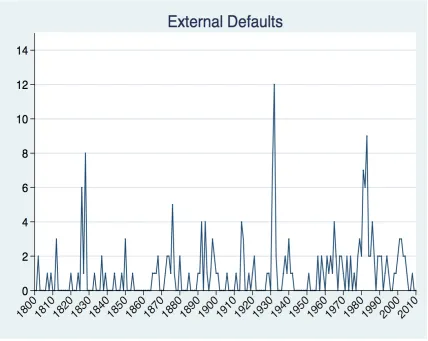
Yet, defaults do not take place in isolation, as one empirically observes a
clustering of defaults over time (see Figure I). The peak years in terms of defaults
are 1828, 1876, 1932, and 1983. In other words, sovereign defaults occur in
waves, with several states getting into trouble simultaneously. It seems that once
a country defaults, others tend to follow suit, as in the Latin American debt crisis
of 1982, and the East Asian flu crisis of 1996. Economists explain this clustering
by reference to business cycles, where credit booms typically result in sovereign
6
Figure I - External Defaults Since 1800
Sociological research shows that institutional and cognitive processes
(Carruthers 2011; Swedberg 2011), organizational structures and regulation
(Guillén and Suarez 2011; Palmer and Maher 2011), and historical processes
(Fligstein and Goldstein 2011; Dobbin 1994; Mizruchi 2011) play significant roles
in economic crises. Changes in organizational structure, regulation, and political
context may lead actors to readjust their considerations for short-term effects,
which might lead to crisis-prone situations in the long run (Krippner 2011). The
7
the actors, whether they are individuals, organizations, or political entities,
within a social network, where they are affected by their ties. However, many
studies mostly focus on the US due to its role as a financial leader. Both this
common finding and the trajectory of the global crisis, which first began as a
mortgage crisis in the US but then diffused to other countries, and mutated to
become a sovereign debt crisis in Europe reveals that finance, or more
specifically, sovereign debt is not an issue specific to single countries but it is a
matter embedded in the global finance system. Existing research within countries
can be improved by transnational research that considers not only one country
but also the connectedness of the global economy.
In this article, we improve upon the existing literature by testing measures
of interconnectedness and reveal the significant effects that relationships
between countries have on sovereign defaults. We develop two hypotheses based
on two dominant global-level theories, world polity and world-system. We argue
that learning and similarity in behavior happens among states that trade more
with each other instead of having a diffused pattern of trade spread evenly across
all countries. We also find that states occupying a similar position in the global
trade structure will experience crises at similar points in time.
3.The Ambiguities of Sovereign Defaults in A Global Economy
Bankruptcy is one of the foundational elements of the market economy
8
countries. Sovereign defaults are a foundational and important element of the
global economic system. They have been a part of the global economy since the
existence of modern nation-states. The first modern nation-states also happened
to be the first serial defaulters. England, the Italian city-states, France, and
Portugal were all defaulted repeatedly before the 1800s, i.e. until they could
establish stable national economies and strong institutions (Reinhart and Rogoff
2009). Defaults became more common after industrialization. This happened
due to two reasons. First, more modern nation-states became established in the
global political arena. It is only after a modern nation-state establishes a national
economy that it can have the capacity to carry out substantive amounts of
borrowing. Without a large borrowing capacity, states cannot incur sufficient
sovereign debts to default. Second, the creation of markets for public debt
increased both the size and depth of financial markets. Markets for public debt
increased potential capacity for sovereign debt incurred by states, which
increased the potential for borrowing beyond capacity, leading to sovereign
defaults.
Public debt continues to be a core element in the present global economy.
However, public debt is different from private debt. For private agents, lending
and borrowing are routine activities. When investments do not pay off as
planned, bankruptcy is a regular outcome for underperforming firms; when firms
9
as a mediator. Creditors can make claims on the assets of the bankrupt debtor
and retrieve some (if not all) of their loss. However, the process changes when the
bankrupt agent is a sovereign state. While it may have been tried in the past,
gunboat diplomacy is too costly for states to coerce other states into paying their
debts. Moreover, at the present time declaring war over another state due to
economic failures is no longer legitimate. There is no single international
overseer legal agency to facilitate the default of a sovereign. Most states’ assets
cannot be appropriated when states default on their debt because such assets are
usually immune and off limits. The claims of creditors are not well defined and it
is unlikely for judges to rule against their own state (Yeyati 2005; Borensztein
and Panizza 2009). Bankrupt states do not go out of business, either. States
continue to exist in their sovereign capacity. They might default on some of their
debt instead of going completely bankrupt. In other cases, when facing the
default of a debtor, lenders might choose to pre-emptively bail them out to
prevent greater overall costs. While defaults have been common in the global
economy throughout the history, the legitimate ways to resolve them has varied
across different time periods.
This creates an ambiguous situation in terms of power between lenders
and borrowers. While lender states and other parties are powerful due to their
economic capacity, debtor states can also become powerful as lender states
10
issue becomes even more complicated given Borensztein and Panizza’s (2009)
conclusion that the economic effects of sovereign defaults tend to be short-lived,
and usually do not extend beyond two years. The dependency increases with the
amount of debt. Focusing solely on the countries that participate in lending and
borrowing from each other is not sufficient to understand the entire mechanism
underlying sovereign lending. In order to get a complete picture of the sovereign
lending system, one should also account for the global-level mechanisms that
play an underlying role in the bilateral relationships. Sociologists have long
demonstrated that cultural construction of nation states play a role in
determining legitimate behavior, which effects decision making (Meyer 2010),
and global trade patterns play a significant role in how power is distributed
among countries that occupy different spaces in the world system (Wallerstein
[1974] 2011; Arrighi [1994] 2010).
Institutional processes can play a significant role in determining the
behavior of states as they participate in a common world polity and strive for
legitimacy independent of their efficiency (Meyer and Rowan 1977). This results
in mimetic processes among states, where they replicate each other’s behavior.
The behavior of other states that is deemed legitimate is replicated. As states have
become globally more connected, they have structurally expanded around the
globe. This process has legitimated the world models helping in the consolidation
11
increased compared to earlier eras (Meyer, Boli, and Thomas 1997; Meyer 2010).
While they have been required as necessary actors to make and enforce rules,
they have also been expected to remain legitimate within the world polity and
society. While the expansion of world society has resulted in increasing
convergence, the result is not increasing flattening of the world polity. Instead,
the world polity becomes more fragmented and regionalized (Beckfield 2010). In
other words, the perception of legitimacy across the world society is not flat but
instead may vary across different states based on their varied connections with
each other.
In a global system in which countries interact with one another, they start
to influence each other’s actions, resulting in the formation of a collective culture.
Let us build the argument about cohesion from the group level to the
organizational field, and then to the world-polity and world-system level. High
social density translates into social cohesion, which in turn tends to produce
behavioral similarity (Durkheim [1915] 1995; Durkheim [1933] 1997; Collins
1994). Actors in social networks who share strong connections to one another
tend to develop strong group identity, solidarity and conformity. Cohesive
networks establish “sacred objects”, i.e. symbols of focused attention that
demarcate the boundaries of the group. Similarity in behavior is driven by the
actors’ desire to appear appropriate and legitimate within their shared social
12
At the level of the organizational field, Harrison White was the first to
conceptualize the argument in his sociology of markets. He defines markets as
social structures arising among cliques of firms watching one another as they
position themselves in distinct market niches (White 1981, 2002). The
organizations in the field or market observe and benchmark against other
organizations or actors they consider to be their peers (Strang and Tuma 1993).
As the number of organizations in the same field that adopt a given innovation,
structure or practice grows; the behavior becomes legitimized (Abrahamson and
Rosenkopf 1993).
The argument about social cohesion and behavioral similarity can be
extended to states in the world-polity and world-system (Guler et al. 2002; Polillo
and Guillen 2005). When two states have intense relationships with one another,
they are more likely to adopt common patterns of behavior. In particular, the
intensity of trade transactions indicates the density of the social network in which
a given country is embedded. To use Durkheim’s terminology, defaulting on
sovereign debt is conferred with the “sacredness” of group membership. Our
argument is that countries that exhibit cohesive trade relationships with each
other are likely to adopt similar patterns of behavior, including the decision to
default. Sovereign debt crises involve high level of uncertainty; precisely the
situation in which neo-institutional theory predicts that isomorphic behavior
13
commits sovereign default, it sets a precedent for others who consider it as a peer
and have an intense relationship with it. In particular, seeing one country go into
default in a socially cohesive environment prompts others in the same context to
ask for similar terms of treatment.
Examples of this pattern abound. In times of high violent conflict,
countries might stop servicing their debt, as it happened in the cases of
Austria-Hungary, Bulgaria, and Turkey before World War I, and Italy, Japan, and Turkey
before World War II. Cohesiveness also takes place among lenders, which
typically result in formation of associations or institutions that can facilitate
harmonized behavior among them. In late 19th and early 20th centuries creditors
lending countries formed their own local associations to take united action
among debtors. In England, the British Corporation of Foreign Bondholders
(CFB) was the major creditor association that acted on behalf of lenders to
resolve issues of default. Similar institutions were also set up in, France, Belgium,
Switzerland, Germany, and the United States. In late 20th Century “Bank
Advisory Committee” (BAC) assumed a similar role. Such institutions result in
cohesive action from creditors and result in similar treatments deemed to be
legitimate by the world polity to countries perceived to be in similar situations in
a given time period. For example in the late 19th Century and early 20th Centuries,
creditors could form administrative units that would assume the public financial
14
other time periods, countries might be bailed out before they an actual default,
such as the IMF bailouts of Thailand and South Korea in 1997. Given these
arguments and historical evidence, we expect that
Hypothesis 1: Controlling for macroeconomic and
political-economic variables, the more a state trades with another state that
declares sovereign default, the more it is likely to declare sovereign
default.
Intense relationships between pairs of countries are one mechanism
underpinning behavioral similarity. The other key effect identified in the
literature is structural equivalence. Burt (1987) proposed that individuals and
organizations occupying the same position in social structure are likely to behave
similarly. He considered two actors to be in the same position if they are
structurally equivalent, i.e. they each have the same set of relationships with third
actors.
Applying the concept of structural equivalence at the global level runs
parallel to the tenets of world-system and world-polity theories. Countries in the
world-system occupy different structural positions, namely, some are
industrialized core countries and others are peripheral providers of natural
resources and cheap labor (Wallerstein [1974] 2011). The development of
industry in the periphery led to the concept of “semi-periphery,” that is,
15
and markets (Guillén 2001). In the world-polity, some countries are more
frequently sources of cultural models than others, which tend to be recipients
(Meyer et al. 1997).
We argue that countries embedded in the same structural position in trade
networks are more likely to exhibit similar behavior because they face similar
opportunities and threats. Common relationships puts countries in a situation in
which they share the same sources of supply and destination markets, even if
they do not trade with one another, i.e. if their dyadic cohesion is low. Financial
markets, and especially sovereign debt markets, tend to see structurally
equivalent countries as similar. In particular, research has shown that crises
often occur in waves affecting different parts of the world, in a pattern that
reveals an underlying structure of positional equivalence (Reinhart and Rogoff
2009). For instance, the Asian flu crisis of 1997 spread from Thailand like
wildfire to other East and South East Asian economies, all of which used local
labor to make manufactured goods for export to the U.S. and European markets.
The economies in that part of the world were structurally equivalent, and many
were driven to situations of near default. We therefore predict that:
Hypothesis 2: Controlling for macroeconomic and
political-economic variables, the more a pair of countries trades with the same
third countries, the more likely a default in one of them will be