R E S E A R C H A R T I C L E
Open Access
Decision-making at the limit of viability:
differing perceptions and opinions
between neonatal physicians and nurses
Hans Ulrich Bucher
1*, Sabine D. Klein
1, Manya J. Hendriks
1,2, Ruth Baumann-Hölzle
3, Thomas M. Berger
4,
Jürg C. Streuli
2, Jean-Claude Fauchère
1and on behalf of the Swiss Neonatal End-of-Life Study Group
Abstract
Background:In the last 20 years, the chances for intact survival for extremely preterm infants have increased in high income countries. Decisions about withholding or withdrawing intensive care remain a major challenge in infants born at the limits of viability. Shared decision-making regarding these fragile infants between health care professionals and parents has become the preferred model today. However, there is an ongoing ethical debate on how decisions regarding life-sustaining treatment should be reached and who should have the final word when health care professionals and parents do not agree. We designed a survey among neonatologists and neonatal nurses to analyze practices, difficulties and parental involvement in end-of-life decisions for extremely preterm infants.
Methods:All 552 physicians and nurses with at least 12 months work experience in level III neonatal intensive care units (NICU) in Switzerland were invited to participate in an online survey with 50 questions. Differences between neonatologists and NICU nurses and between language regions were explored.
Results:Ninety six of 121 (79%) physicians and 302 of 431(70%) nurses completed the online questionnaire. The following difficulties with end-of-life decision-making were reported more frequently by nurses than physicians: insufficient time for decision-making, legal constraints and lack of consistent unit policies. Nurses also mentioned a lack of solidarity in our society and shortage of services for disabled more often than physicians. In the context of limiting intensive care in selected circumstances, nurses considered withholding tube feedings and respiratory support less acceptable than physicians. Nurses were more reluctant to give parents full authority to decide on the course of action for their infant. In contrast to professional category (nurse or physician), language region,
professional experience and religion had little influence if any on the answers given.
Conclusions:Physicians and nurses differ in many aspects of how and by whom end-of-life decisions should be
made in extremely preterm infants. The divergencies between nurses and physicians may be due to differences in ethics education, varying focus in patient care and direct exposure to the patients. Acknowledging these
differences is important to avoid potential conflicts within the neonatal team but also with parents in the process of end-of-life decision-making in preterm infants born at the limits of viability.
Keywords:Extremely preterm infants, Neonatal intensive care, End-of-life decisions, Shared decision-making, Health care professionals, Previable period
© The Author(s). 2018, corrected publication 2020.Open AccessThis article is distributed under the terms of the Creative Commons Attribution 4.0 International License (http://creativecommons.org/licenses/by/4.0/), which permits unrestricted use, distribution, and reproduction in any medium, provided you give appropriate credit to the original author(s) and the source, provide a link to the Creative Commons license, and indicate if changes were made. The Creative Commons Public Domain Dedication waiver (http://creativecommons.org/publicdomain/zero/1.0/) applies to the data made available in this article, unless otherwise stated.
* Correspondence:[email protected]
1Department of Neonatology, University Hospital Zurich, Frauenklinikstrasse
10, 8091 Zürich, Switzerland
Background
Over the past decades, survival of extremely preterm in-fants has improved with new technological, medical and neonatal care developments [1]. However, deciding to initiate, withhold or withdraw intensive care for infants born at the limit of viability remains a difficult decision in modern neonatal medicine [2]. According to a recent retrospective cohort study of infants born between 22 and 27 completed weeks of gestation in Switzerland, a decision to withhold active treatment before or immedi-ately after birth is taken only for a minority of these in-fants [3]. Instead, most inin-fants born ≥24 weeks are offered provisional intensive care. Most extremely pre-term infants who die in neonatal intensive care units (NICUs) do so after a decision to redirect treatment from intensive care to comfort care (i.e., withdrawal of life-sustaining therapies) [4,5].
Today, it is generally accepted that end-of-life deci-sions in extremely preterm infants should be made in a process involving physicians, nurses and parents [6, 7]. This makes it especially important to discuss and reflect upon the–possibly–diverse moral attitudes and values of stakeholders, and specifically in this study, health care professionals.
It has been shown that mortality rates adjusted for gestational age, sex and other risk factors vary widely be-tween hospitals and bebe-tween countries [8,9]. Moreover, end-of-life decisions are not only based on outcome sta-tistics but are greatly influenced by the attitudes, values and perceptions of the reported outcomes by the differ-ent parties involved in this decisional process [10].
We were interested to explore the kind of problems that neonatologists and NICU nurses identify in end-of-life decision-making and how they perceive the role of parents in this process. For this reason, an online survey was performed among all nine level III NICUs in Switzerland. We also aimed at investigating whether the answers were associated with professional status, years of professional experience, importance of religion or lan-guage region.
Methods
A questionnaire was prepared integrating selected items from a previously used questionnaire [11] and also ques-tions used in a telephone survey of a representative sam-ple of the Swiss population [12]. The initial English questionnaire was translated into German and French. The translation accuracy was checked and reviewed by a panel of translators to ensure identical semantic content in each language.
The questionnaire consisted of 32 statements about end-of-life decision-making in infants born before 28 weeks’ gestation, nine statements about prenatal decision-making (for physicians only), five questions regarding dissent
between parents and health care professionals (HCPs) and about the role of a Hospital’s Ethics Committee, each with several options, from which only one could be chosen. Four questions were about professional education and ex-perience and importance of religion of the participants (full questionnaire see Additional file1).
The goals of this study were presented to the staff of all nine Level III NICUS in Switzerland. All physicians and nurses who had been working for more than 12 months in a NICU setting (n= 552) were invited per e-mail to participate in an online survey. Participation was voluntary, interviewees were asked for consent preceding the actual online survey. Non-respondents received two reminders. Data were anonymised before analysis. No formal approval of this survey was required by the Ethics Committee of the Canton Zurich.
Statistical analysis was performed using IBM SPSS Statistics 22 (Armonk, NY, USA). The following groups were compared using chi-squared, Kruskal-Wallis or Mann-Whitney U tests: physicians vs. nurses, German vs. French speaking areas, duration of professional experience (≤5, 6–15, > 15 years), importance of religion (important vs. not important). Results are presented as proportions and 95% confidence intervals (Wilson score intervals). Significance was defined asp< 0.05.
Results
Ninety six of 121 (79%) physicians and 302 of 431 (70%) nurses completed the online questionnaire. The charac-teristics of the participants are given in Table 1. Com-pared to nurses, participating physicians were more frequently in a leading position and more often had chil-dren of their own.
Difficulties encountered in end-of-life decision-making
Acceptable approaches to limiting intensive care
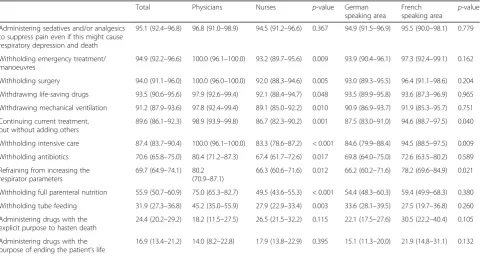
Administering sedatives and/or analgesics to suppress pain even if this might cause respiratory depression and death was acceptable to 95% of all respondents (Table3). 24% accepted administering drugs with the explicit pur-pose to hasten death. Compared to physicians, nurses significantly less often indicated that withholding inten-sive care (83% vs. 100%), refraining from increasing re-spiratory support (66% vs. 80%) and withholding full parenteral nutrition (50% vs. 75%), tube feeding (28% vs. 45%) or antibiotics (67% vs. 80%) would be acceptable options when it comes to limiting intensive care.
Parental involvement in decision-making
More than half of the respondents (60%) thought that parents should have the opportunity to take part in the decision-making process; this opinion was shared more often in the German speaking than in the French speak-ing area (64% vs. 49%). Moreover, 15% thought that par-ents should always have the opportunity to decide the course of action for their infant. Nurses (25%), as com-pared to physicians (12%), were more in favour of not directly involving parents in decision-making; they indi-cated that parental wishes and attitudes should be ex-plored indirectly and considered by the decision-making health care team (25% vs. 12%). Only 0.5% of all HCPs thought that parents should not be involved at all, but merely be informed about the decision (see Additional file2).
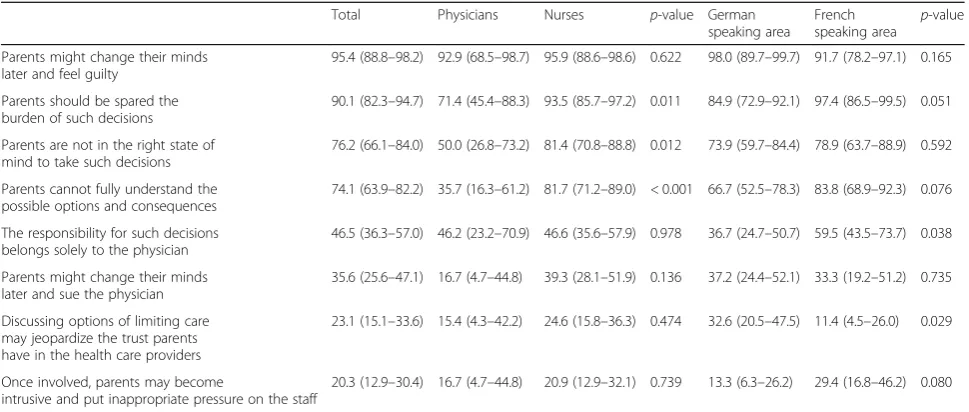
HCPs gave several reasons for not directly involving parents in decisions on treatment limitations (Table4). Firstly, 95% considered that parents should not be in-volved because they might change their minds later and experience feelings of guilt. Secondly, they felt that parents should be spared the burden of such de-cisions (90%), with significantly more nurses taking that standpoint than neonatologists (94% vs. 71%). Thirdly, parents might not be in the right state of mind to take such decisions (76%), again with more nurses agreeing with that view (81% vs. 50%). Finally, nurses more often than physicians (82% vs. 36%) stated that parents canot fully understand the possible options and consequences (74%). Interestingly, 47% of HCPs took up the view that the responsibility for such decisions belongs solely to the physicians (nurses 47% vs. 46% physicians, ns); this position was signifi-cantly more often cited in the French speaking than in the German speaking area (60% vs. 37%).
Disagreement between HCPs and parents
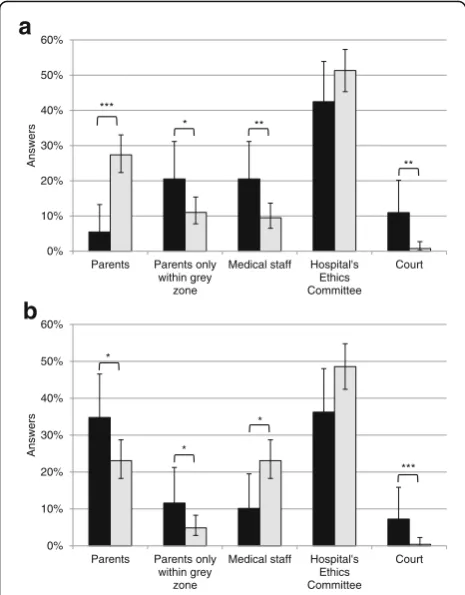
In the event that parents would request limitation of intensive care, while HCPs recommend continuation of treatment, 43% of respondents considered hospital ethics committees to be the ultimate decision-makers and 31% felt that this would be the right of the par-ents. Another 10% indicated the medical staff and only very few (3%) chose the court as ultimate decision-makers (Fig 1a). In the opposite situation, namely if the parents request continuation of inten-sive care, while HCPs think that life-sustaining ther-apies should be withdrawn, 36% of all respondents considered the ethics committee to be the ultimate decision-maker, 20% named the parents, 16% the medical staff and only 1.5% the court (Fig. 1b). Nurses differed significantly from physicians in both scenarios.
Table 1Characteristics of the survey participants
Physicians Nurses Total
N % N % N %
Language region
German 74 77.1 210 69.5 284 71.4
French 22 22.9 92 30.5 114 28.6
Gender
Men 47 50.0 19 6.3 66 16.7
Women 47 50.0 283 93.7 330 83.3
Age, yrs
< 30 4 4.3 53 17.5 57 14.4
30–39 38 40.4 126 41.7 164 41.4
40–49 30 31.9 78 25.8 108 27.3
≥50 22 23.4 45 14.9 67 16.9
Experience in NICU, yrs
≤3 26 27.1 49 16.2 75 18.8
4–6 18 18.8 66 21.9 84 21.1
7–10 14 14.6 58 19.2 72 18.1
11–20 29 30.2 84 27.8 113 28.4
> 20 9 9.4 45 14.9 54 13.6
Leading position
Yes 87 90.6 47 15.6 134 33.7
No 9 9.4 255 84.4 264 66.3
Religious background
None 23 24.5 85 28.1 108 27.3
Catholic 40 42.6 126 41.7 166 41.9
Protestant 26 27.7 70 23.2 96 24.2
Other 5 5.3 21 7.0 26 6.6
Importance of religion
Important 30 31.9 96 31.8 126 31.8
Not important 64 68.1 206 68.2 270 68.2
Own children
Yes 58 61.7 154 51.0 212 53.5
Table 2Important problems when making decisions about limiting intensive care
Question Total Physicians Nurses p-value German speaking area French speaking area p-value
Difficulty in foreseeing patient’s future quality of life
93.8 (91.0–95.8) 94.7 (88.3–97.7) 93.5 (90.1–95.8) 0.673 92.8 (89.1–95.3) 96.4 (91.1–98.6) 0.184
Difficulty of making an accurate long term prognosis
89.5 (86.1–92.2) 92.6 (85.6–96.4) 88.6 (84.4–91.7) 0.259 89.2 (85.1–92.4) 90.3 (83.4–94.5) 0.766
Difficulty of interpreting parents’ attitudes precisely
89.3 (85.8–92.0) 81.7 (72.7–88.3) 91.7 (88.0–94.4) 0.007 88.3 (84.0–91.6) 91.7 (85.0–95.6) 0.329
Insufficient time for decision-making 74.2 (69.6–78.4) 54.3 (44.2–64.0) 80.9 (75.9–85.0) < 0.001 74.7 (69.3–79.5) 72.8 (63.5–80.5) 0.706
Legal constraints 73.3 (68.6–77.6) 54.3 (44.2–64.1) 79.5 (74.4–83.8) < 0.001 74.0 (68.4–78.9) 71.8 (62.8–79.4) 0.669
Impossibility of obtaining the patient’s own views
66.2 (61.2–70.9) 64.9 (54.8–73.8) 66.7 (60.9–72.0) 0.754 69.3 (63.5–74.6) 58.3 (48.6–67.3) 0.044
Lack of a consistent Unit policy to guide you
64.4 (59.3–69.2) 36.1 (26.6–46.9) 73.0 (67.4–77.9) < 0.001 58.1 (52.0–64.0) 80.8 (72.0–87.4) < 0.001
Conflict between your own principles and Unit policy
55.5 (50.4–60.5) 40.0 (30.5–50.3) 60.4 (54.6–65.9) 0.001 53.5 (47.6–59.4) 60.6 (51.0–69.4) 0.220
Difficulty of foreseeing future developments in medicine which may help babies who now appear hopeless cases
43.2 (38.2–48.3) 29.8 (21.5–39.7) 47.8 (41.9–53.7) 0.002 43.9 (38.1–49.8) 41.2 (32.0–51.2) 0.654
Society’s lack of solidarity for the disabled 40.4 (35.6–45.4) 22.1 (14.9–31.4) 46.4 (40.7–52.1) < 0.001 39.7 (34.1–45.6) 42.2 (33.4–51.6) 0.654
Shortage of services for the disabled
37.5 (32.7–42.6) 12.4 (7.0–20.8) 45.5 (39.8–51.4) < 0.001 33.7 (28.3–39.7) 46.7 (37.6–56.1) 0.019
Answers to the question:“How important do you consider each of the following problems when making decisions about whether or not to limit intensive care for an extremely preterm baby?”Percentages of respondents who answered“very important”or“important”with 95% confidence intervals are shown. Answers are listed in decreasing importance. Totaln= 397
Table 3Acceptable approaches of limiting intensive care
Total Physicians Nurses p-value German
speaking area
French speaking area
p-value
Administering sedatives and/or analgesics to suppress pain even if this might cause respiratory depression and death
95.1 (92.4–96.8) 96.8 (91.0–98.9) 94.5 (91.2–96.6) 0.367 94.9 (91.5–96.9) 95.5 (90.0–98.1) 0.779
Withholding emergency treatment/ manoeuvres
94.9 (92.2–96.6) 100.0 (96.1–100.0) 93.2 (89.7–95.6) 0.009 93.9 (90.4–96.1) 97.3 (92.4–99.1) 0.162
Withholding surgery 94.0 (91.1–96.0) 100.0 (96.0–100.0) 92.0 (88.3–94.6) 0.005 93.0 (89.3–95.5) 96.4 (91.1–98.6) 0.204
Withdrawing life-saving drugs 93.5 (90.6–95.6) 97.9 (92.6–99.4) 92.1 (88.4–94.7) 0.048 93.5 (89.9–95.8) 93.6 (87.3–96.9) 0.965
Withdrawing mechanical ventilation 91.2 (87.9–93.6) 97.8 (92.4–99.4) 89.1 (85.0–92.2) 0.010 90.9 (86.9–93.7) 91.9 (85.3–95.7) 0.751
Continuing current treatment, but without adding others
89.6 (86.1–92.3) 98.9 (93.9–99.8) 86.7 (82.3–90.2) 0.001 87.5 (83.0–91.0) 94.6 (88.7–97.5) 0.040
Withholding intensive care 87.4 (83.7–90.4) 100.0 (96.1–100.0) 83.3 (78.6–87.2) < 0.001 84.6 (79.9–88.4) 94.5 (88.5–97.5) 0.009
Withholding antibiotics 70.6 (65.8–75.0) 80.4 (71.2–87.3) 67.4 (61.7–72.6) 0.017 69.8 (64.0–75.0) 72.6 (63.5–80.2) 0.589
Refraining from increasing the respirator parameters
69.7 (64.9–74.1) 80.2 (70.9–87.1)
66.3 (60.6–71.6) 0.012 66.2 (60.2–71.6) 78.2 (69.6–84.9) 0.021
Withholding full parenteral nutrition 55.9 (50.7–60.9) 75.0 (65.3–82.7) 49.5 (43.6–55.3) < 0.001 54.4 (48.3–60.3) 59.4 (49.9–68.3) 0.380
Withholding tube feeding 31.9 (27.3–36.8) 45.2 (35.0–55.9) 27.9 (22.9–33.4) 0.003 33.6 (28.1–39.5) 27.5 (19.7–36.8) 0.260
Administering drugs with the explicit purpose to hasten death
24.4 (20.2–29.2) 18.2 (11.5–27.5) 26.5 (21.5–32.2) 0.115 22.1 (17.5–27.6) 30.5 (22.2–40.4) 0.105
Administering drugs with the purpose of ending the patient’s life
16.9 (13.4–21.2) 14.0 (8.2–22.8) 17.9 (13.8–22.9) 0.395 15.1 (11.3–20.0) 21.9 (14.8–31.1) 0.132
Hospital’s ethics committee
The role of hospital’s ethics committee was seen as fol-lows: 80% of respondents indicated to give advice in in-dividual cases, 12% being responsible for ultimate decision-making in individual cases - the latter was favoured more often by nurses (14%) than by physicians (6%) - and 5% only to set general guidelines; this view was taken more often in the German speaking area (6% vs. 0.9% in the French speaking area) (see Additional file3).
Prenatal decision-making
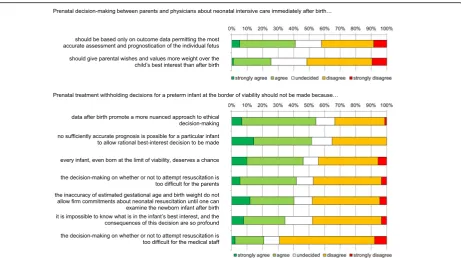
A majority of neonatologists argued that decisions to withhold life-sustaining therapies from infants born at the limit of viability should not be made prenatally be-cause prognosis is not sufficiently accurate (52%) and in-dividual assessment after birth allows a more nuanced approach (54%) (Fig2). There was no consensus among physicians whether parental wishes and the child’s best interest should be viewed differently before than after birth: 25% of physicians agreed that, prenatally, parental wishes and values should be given more weight than the child’s best interest, whereas this no longer is true after birth; 51% disagreed with this statement.
Discussion
For the interpretation of these results, it is important to note that Switzerland is a diverse country with four official languages and regions, in which cultural differences are often reported [12]. In contrast to what we expected, our study found only few differences between the German-and French-speaking regions of SwitzerlGerman-and. One reason may be the fact that more than 50 % of the HCP working
in Swiss NICUs come from other countries [13]. There-fore, the differences between language regions are blurred. Professional experience and religion also had little influ-ence on the answers given.
Social cohesion and solidarity are important values in Switzerland [14]. Interestingly, nurses in our study con-sidered society’s lack of solidarity and shortage of ser-vices for disabled as problematic within the decision-making process. This stands in contrast to a Swiss popu-lation survey about extreme prematurity, where a large majority of the population expressed substantial solidar-ity towards disabled people and did not perceive a de-crease of solidarity over the last years [15]. More importantly, extremely premature infants born in Switzerland are provided with high quality care in which long-term economic considerations should not interfere with ethical decision-making for an individual case [16].
Traditionally, Swiss health care professionals had a more restrictive attitude towards providing proactive care for infants born at the limit of viability [3]. At present, the ideal decision-making model is considered a collaborative approach where parents and the health care team together make decisions regarding the treat-ment of an extreme premature infant [17]. In Switzerland, this is currently in development. For in-stance, one national study showed that decisions regard-ing resuscitation were less often shared in the neonatal unit [18]. Another study on decision-making in Switzerland showed how one perinatal centre was in the midst of changing from an informed consent approach to a shared approach [19]. Hence, overall, the develop-ment of a shared approach in Switzerland is still under-way and practices vary enormously [20].
Table 4Reasons why parents should not directly be involved in decision-making
Total Physicians Nurses p-value German speaking area
French
speaking area p -value
Parents might change their minds later and feel guilty
95.4 (88.8–98.2) 92.9 (68.5–98.7) 95.9 (88.6–98.6) 0.622 98.0 (89.7–99.7) 91.7 (78.2–97.1) 0.165
Parents should be spared the burden of such decisions
90.1 (82.3–94.7) 71.4 (45.4–88.3) 93.5 (85.7–97.2) 0.011 84.9 (72.9–92.1) 97.4 (86.5–99.5) 0.051
Parents are not in the right state of mind to take such decisions
76.2 (66.1–84.0) 50.0 (26.8–73.2) 81.4 (70.8–88.8) 0.012 73.9 (59.7–84.4) 78.9 (63.7–88.9) 0.592
Parents cannot fully understand the possible options and consequences
74.1 (63.9–82.2) 35.7 (16.3–61.2) 81.7 (71.2–89.0) < 0.001 66.7 (52.5–78.3) 83.8 (68.9–92.3) 0.076
The responsibility for such decisions belongs solely to the physician
46.5 (36.3–57.0) 46.2 (23.2–70.9) 46.6 (35.6–57.9) 0.978 36.7 (24.7–50.7) 59.5 (43.5–73.7) 0.038
Parents might change their minds later and sue the physician
35.6 (25.6–47.1) 16.7 (4.7–44.8) 39.3 (28.1–51.9) 0.136 37.2 (24.4–52.1) 33.3 (19.2–51.2) 0.735
Discussing options of limiting care may jeopardize the trust parents have in the health care providers
23.1 (15.1–33.6) 15.4 (4.3–42.2) 24.6 (15.8–36.3) 0.474 32.6 (20.5–47.5) 11.4 (4.5–26.0) 0.029
Once involved, parents may become
intrusive and put inappropriate pressure on the staff
20.3 (12.9–30.4) 16.7 (4.7–44.8) 20.9 (12.9–32.1) 0.739 13.3 (6.3–26.2) 29.4 (16.8–46.2) 0.080
Discrepancies between nurses and physicians
This survey reveals important differences between nurses and physicians regarding end-of-life decision-making in extremely preterm infants. These differences concern the perceived importance of specific challenges in the decision-making process, of acceptable ap-proaches to limiting intensive care and of the degree of parental involvement in the decision-making process. For instance, nurses considered insufficient time for decision-making, legal constraints and lack of a consist-ent unit policy significantly more often problematic than physicians did. Moreover and although the large major-ity of neonatologists and neonatal nurses agree that withholding intensive care is acceptable in futile situa-tions, nurses were more reluctant to withdraw respira-tory support and tube feeding. Several speculations can be put forward when trying to explain these discrepan-cies between neonatal nurses and physicians.
First, differences may exist concerning education in medical ethics and ethical arguing. In Switzerland, physi-cians traditionally had a longer and perhaps more inten-sive training and exposure to ethical dilemmas, starting at medical school and continuing into professional life. Over the last years, medical ethics have also been incor-porated into the curriculum of neonatal nurses and most units provide a continued training including ethical topics such as futility, over- and undertreatment, with-holding and withdrawing lifesaving interventions.
Second, the differing views may be due to the different roles physicians and nurses play within the end-of-life decision process of extremely preterm infants [21]. Phy-sicians are expected to have an understanding of the prognostic and outcome data of infants born extremely premature. Often considered less emotionally attached to the patient as nurses, they provide‘an expert’point of view to the team and parents. This medical judgement however is encumbered with significant medical prog-nostic uncertainty. It is therefore no surprise that physi-cians rather than nurses indicate prognostic issues as challenging. The active involvement of neonatal nurses in end-of-life decisions in NICUs was implemented only in recent years [22,23]. Prior to that, the opinion of the nursing staff was not, or not explicitly, taken into ac-count [24].
Third, the discomfort reported by nurses regarding some forms of therapy limitations (e.g. withdraw tube feeding, refraining from increasing respiratory parame-ters) may stem from the fact that the nurses will be more directly exposed to the patients and the parents. In some Swiss NICUs, a framework for decision-making has been introduced and has shown to reduce stress for both, physicians and nurses [25].
Parental involvement in decision-making
The results of our survey indicate that today the Swiss HCPs are more willing to involve parents in the decision-making process than 10 years ago; however, they still do not give them full authority [26]. The trend towards in-creasing parental involvement in end-of-life decisions has also been reported in other countries [27–29].
The Swiss Civil Code for the protection of adults and children, enacted in 2013, emphasises parental authority when a child is incapable of making his or her own deci-sions. Shared decision-making between HCPs and parents is proposed by many national guidelines [7, 16]. It is a process aiming at a collaborative decision. This process may not be easy and disagreement, rarely reported in the past, has become more frequent in recent times [30]. Alandagady et al. observed that parents quite often do not agree with HCPs on limitations of life-sustaining therapies [31]. In this context, it is noteworthy, that in our study, HCPs give more weight to parental opinions in cases of 0%
10% 20% 30% 40% 50% 60%
Parents Parents only within grey
zone
Medical staff Hospital's Ethics Committee
Court
Answers
* **
**
0% 10% 20% 30% 40% 50% 60%
Parents Parents only within grey
zone
Medical staff Hospital's Ethics Committee
Court
Answers
b
*
*
*
*** ***
a
disagreement when parents request limitation of in-tensive care compared to situations where they ask for continuation of intensive care. Although the dif-ference between withholding and withdrawing inten-sive care measures are morally equivalent, these differences might be considered relevant in practice [32]. In both cases, a large percentage of respondents think that a hospital’s ethics committee should be the ultimate decision-maker. This stands in contrast to a Swiss population survey, where a large majority of lay-people expressed that parents should be the final decision-makers [12].
There are differences between nurses and physicians in how and to which extent parents should be involved in the decision-making process. Nurses were more in favour of integrating the views of the parents indirectly rather than to directly confront them with the choice between several options and to embark in a shared decision-making. In Switzerland, neonatal nurses are fully and dir-ectly involved in the decision-making process, together with the physicians and parents. However, it could be that they are more prone to embrace the ‘expert opinion’ of physicians regarding the prognosis and outcome for a given infant than to incorporate parental values, which often include aspects of family autonomy, parental obliga-tions towards other children and own legitimate self-interests. As stated by Leuthner, the concept of best interest and medical expertise on the course of neonatal diseases
and outcome data is a too restrictive concept of decision-making [32]. Only the addition of parental values gives meaning to the prognosis. Moreover, within the triad physi-cians, nurses and parents, it is often the case that over the first days and weeks when it may come to a decision-making process, the nurses have the most close and intim-ate contact with the premature infant. This fact may add to the greater difficulty for neonatal nurses to acknowledge and integrate parental values and attitudes within the decision-making process.
HCPs who believed parents should not be (directly) in-volved in the decision-making on whether or not to limit intensive care, gave several reasons for doing so. These reasons, however, are empirically unfounded or proven false. For example, Caymeax et al. showed that greater in-volvement of parents in end-of-life decisions was associ-ated with lower levels of grief [33].
Prenatal decision-making
Prenatal decisions differ in several aspects from deci-sions made after birth not only because the legal status of an unborn child differs from that of a liveborn infant, but also because the prognosis is much more uncertain [34,35]. Therefore, a prenatal decision not to resuscitate an infant born at the limit of viability should be based on strict criteria and take into account the wishes and preferences of the parents [6,36].
Fig. 2Difficulties in prenatal decision-making about neonatal intensive care immediately after birth. Answers are listed in decreasing agreement.
Strength of this study
The high response rate of motivated HCPs is likely to result in a representative nationwide assessment of opin-ions of HCPs regarding end-of-life decision-making. The large sample size allows subgroup analyses. Since several identical questions as in previous surveys were used, time and societal trends and differences to other coun-tries can be assessed.
Limitations of this study
The answers given online are self-reported qualitative judgments that are difficult to quantify. The number of questions had to be limited to avoid impeding participa-tion and, therefore, several aspects could not be explored in more depth.
Conclusions
Physicians and nurses differ in many aspects of how and by whom end-of-life decisions should be made in ex-tremely preterm infants. Acknowledging these differ-ences is important to avoid potential conflicts within the neonatal team but also with parents in the process of end-of-life decision-making in preterm infants born at the limits of viability.
Additional files
Additional file 1:Full questionnaire. (PDF 121 kb)
Additional file 2:Involvement of parents. (DOCX 13 kb)
Additional file 3:Role of the Hospital’s Ethics Committee. (DOCX 15 kb)
Abbreviations
HCPs:Health Care Professionals; NICU: Neonatal intensive care unit
Acknowledgements
The Swiss Neonatal End-of-Life Study Group includes the following local co-ordinators (listed in alphabetical order of study site): Aarau: Neonatal Unit, Dept. of Paediatrics, Kantonsspital Aarau (Meyer Philipp, MD)–Basel: Neo-natal Unit, University Children’s Hospital Basel UKBB (Neumann Roland, MD; Itin Renate)–Bern: Neonatal Unit, University Children’s Hospital, Inselspital (Nelle Mathias, MD; Stoffel Liliane)–Chur: Neonatal Unit, Dept. of Paediatrics, Kantonsspital Chur (Scharrer Brigitte, MD; Roloff Kai)–Geneva: Neonatology and Pediatric Intensive Care, Dept. of Paediatrics, University Hospital HCUG (Pfister Riccardo, MD)–Lausanne: Division of Neonatology, Dept. of Paediat-rics, University Hospital CHUV (Roth Matthias, MD; Contino Magali)–Lucerne: Neonatal Unit, Children’s Hospital, Kantonsspital Luzern (Berger Thomas, MD; Schlegel Ulrike)–St. Gallen: Neonatal Unit, Children’s Hospital, Kantonsspital St. Gallen (Jaeger Gudrun, MD; Dutler Ruth)–Zurich: Department of Neonat-ology, University Hospital Zurich (Fauchère Jean-Claude, MD; Dinten Barbara).
Funding
This work was supported by a grant No. 406740_13950/1 of the Swiss National Research Foundation (SNRF NRP 67 Project“End-of-Life Decisions”).
Availability of data and materials
The dataset generated and analysed during the current study is not publicly available, since confidentiality was guaranteed towards the respondents. However, all data are presented in aggregated forms in the Tables, Figures and Additional files.
Authors’contributions
HB designed the study and the questionnaire, drafted the initial manuscript and wrote the final manuscript with contributions from all other authors; SK helped design the questionnaire, analysed the data, reviewed and revised the initial manuscript; TB and RB helped design the study, reviewed and revised the initial manuscript; MH and JS reviewed and revised the initial manuscript; JCF designed the study and the questionnaire, coordinated the data collection, reviewed and revised the initial manuscript. All authors approved the final manuscript as submitted.
Ethics approval and consent to participate
The Ethics Committee of the Canton Zurich confirmed on request that no formal approval of this survey is required. (see manuscript methods) Informed consent was electronically obtained from each respondent before filling out the online questionnaire.
Consent for publication Not applicable
Competing interests
The authors declare that they have no competing interests.
Publisher’s Note
Springer Nature remains neutral with regard to jurisdictional claims in published maps and institutional affiliations.
Author details
1Department of Neonatology, University Hospital Zurich, Frauenklinikstrasse
10, 8091 Zürich, Switzerland.2Institute of Biomedical Ethics and History of Medicine, University of Zurich, Zurich, Switzerland.3Dialogue Ethics Foundation, Interdisciplinary Institute for Ethics in Health Care, Zurich, Switzerland.4Neonatal and Paediatric Intensive Care Unit, Children’s Hospital of Lucerne, Lucerne, Switzerland.
Received: 18 May 2017 Accepted: 30 January 2018
References
1. Marlow N. Keeping up with outcomes for infants born at extremely low gestational ages. JAMA Pediatr. 2015;169(3):3–4.
2. Fanaroff JM, Hascoet JM, Hansen TWR, Levene M, Norman M, Papageorgiou A, Shinwell E, van de Bor M, Stevenson DK. Ipc: the ethics and practice of neonatal resuscitation at the limits of viability: an international perspective. Acta Paediatr. 2014;103(7):701–8.
3. Berger TM, Steurer MA, Bucher HU, Fauchere JC, Adams M, Pfister RE, Baumann-Hoelzle R. Bassler D, on behalf of the Swiss neonatal end-of-life study group, Euronic study group: retrospective cohort study of all deaths among infants born between 22-27 completed weeks of gestation in Switzerland over a three-year period. BMJ Open. 2017;7:e015179.https://doi. org/10.1136/bmjopen-2016-015179.
4. Hellmann J, Knighton R, Lee SK, Shah PS. Neonatal deaths: prospective exploration of the causes and process of end-of-life decisions. Arch Dis Child Fetal Neonatal Ed. 2016;101(2):F102–7.
5. Verhagen AA, Dorscheidt JH, Engels B, Hubben JH, Sauer PJ. End-of-life decisions in Dutch neonatal intensive care units. Archives of pediatrics & adolescent medicine. 2009;163(10):895–901.
6. Lemyre B, Daboval T, Dunn S, Kekewich M, Jones G, Wang D, Mason-Ward M, Moore GP. Shared decision making for infants born at the threshold of viability: a prognosis-based guideline. J Perinatol. 2016;36(7):503–9. doi: https://doi.org/10.1038/jp.2016.81.
7. Pham-Nguyen AT, Ho LY. Review on neonatal end-of-life decision-making : medical authority or parental autonomy? Proceedings of Singapore Healthcare. 2013;22:140–5.
8. De Leeuw R, Cuttini M, Nadai M, Berbik I, Hansen G, Kucinskas A, Lenoir S, Levin A, Persson J, Rebagliato M, et al. Treatment choices for extremely preterm infants: an international perspective. J Pediatr. 2000;137(5):608–16. 9. Geurtzen R, Draaisma J, Hermens R, Scheepers H, Woiski M, van Heijst A,
10. Verhagen E, Janvier A. How babies die and why this is important to clinicians, researchers and parents. In: Verhagen E, Janvier A, editors. Ethical Dilemma’s for Critically Ill Babies. Volume 65. Dordrecht: Springer; 2016. 11. Cuttini M, Nadai M, Kaminski M, Hansen G, de Leeuw R, Lenoir S, Persson J,
Rebagliato M, Reid M, de Vonderweid U, et al. End-of-life decisions in neonatal intensive care: physicians’self-reported practices in seven European countries. Lancet. 2000;355(9221):2112–8.
12. Hendriks MJ, Klein SD, Bucher HU, Baumann-Holzle R, Streuli JC, Fauchere JC. Attitudes towards decisions about extremely premature infants differed between Swiss linguistic regions in population-based study. Acta Paediatr. 2017;106(3):423–9.
13. Kopetsch T. The migration of doctors to and from Germany. Journal of Public Health. 2009;17(1):33–9.
14. Biller-Andorno N, Zeltner T. Individual responsibility and community solidarity: the Swiss health care system. N Engl J Med. 2015;373(23):2193–7. 15. Hendriks MJ, Bucher HU, Klein SD, Streuli JC, Baumann-Holzle R, Fauchere
JC. Exploring societal solidarity in the context of extreme prematurity. Swiss Med Wkly. 2017;147:w14418.
16. Berger TM, Bernet V, El Alama S, Fauchere JC, Hosli I, Irion O, Kind C, Latal B, Nelle M, Pfister RE, et al. Perinatal care at the limit of viability between 22 and 26 completed weeks of gestation in Switzerland. 2011 revision of the Swiss recommendations. Swiss Med Wkly. 2011;141:1–13.
17. Légaré F, Witteman HO. Shared decision making: examining key elements and barriers to adoption into routine clinical practice. Health affairs (Project Hope). 2013;32(2):276–84.
18. Zimmermann K, Bergstraesser E, Engberg S, Ramelet A-S, Marfurt-Russenberger K, Von der Weid N, Grandjean C, Fahrni-Nater P, Cignacco E. When parents face the death of their child: a nationwide cross-sectional survey of parental perspectives on their child’s end-of life care. BMC Palliative Care. 2016;15(1):30.
19. Hendriks MJ, Abraham A. End-of-life decision making for parents of extremely preterm infants. J Obstet Gynecol Neonatal Nurs. 2017;46(5):727–36.https://doi. org/10.1016/j.jogn.2017.06.006.
20. Cornuz J, Kuenzi B, Krones T. Shared decision making development in Switzerland: room for improvement!Zeitschrift für Evidenz. Fortbildung und Qualität im Gesundheitswesen. 2011;105(4):296–9.
21. Ferrand E, Lemaire F, Regnier B, Kuteifan K, Badet M, Asfar P, Jaber S, Chagnon JL, Renault A, Robert R, et al. Discrepancies between perceptions by physicians and nursing staff of intensive care unit end-of-life decisions. Am J Respir Crit Care Med. 2003;167(10):1310–5.
22. Gallagher K, Marlow N, Edgley A, Porock D. The attitudes of neonatal nurses towards extremely preterm infants. J Adv Nurs. 2012;68:1768–79. 23. Inghelbrecht E, Bilsen J, Mortier F, Deliens L. Nurses’attitudes towards
end-of-life decisions in medical practice: a nationwide study in Flanders, Belgium. Palliat Med. 2009;23:649–58.
24. Malloy DC, Hadjistavropoulos T, McCarthy EF, Evans RJ, Zakus DH, Park I, Lee Y, Williams J. Culture and organizational climate: nurses’insights into their relationship with physicians. Nurs Ethics. 2009;16(6):719–33.
25. Baumann-Holzle R, Maffezzoni M, Bucher HU. A framework for ethical decision making in neonatal intensive care. Acta Paediatr. 2005;94(12):1777–83. 26. Arlettaz R, Mieth D, Bucher H-U, Duc G, Fauchère J-C. End-of-life decisions in
delivery room and neonatal intensive care unit. Acta Paediatr (Oslo, Norway: 1992. 2005;94:1626–31.
27. Boland RA, Davis PG, Dawson JA, Doyle LW. What are we telling the parents of extremely preterm babies? Aust N Z J Obstet Gynaecol. 2016;56(3):274–81. 28. Bry K, Bry M, Hentz E, Karlsson HL, Kyllönen H, Lundkvist M, Wigert H.
Communication skills training enhances nurses’ability to respond with empathy to parents’emotions in a neonatal intensive care unit. Acta Paediatr. 2016;105(4):397–406. doi:https://doi.org/10.1111/apa.13295. 29. Haapa Hybinette H. Comparing experiences of neonatal information
provision between parents of extremeley premature babies and neonatal nurses. Stockholm: Stockholm University; 2015.
30. de Vos MA, van der Heide A, Maurice-Stam H, Brouwer OF, Plötz FB, AYN S-v M, Willems DL, HSA H, Bos AP. The process of end-of-life decision-making in pediatrics: a national survey in the Netherlands. Pediatrics. 2011;127: e1004–12.
31. Aladangady N, Shaw C, Gallagher K, Stokoe E, Marlow N. Short-term outcome of treatment limitation discussions for newborn infants, a multicentre prospective observational cohort study. Arch Dis Child Fetal Neonatal Ed. 2017;102(2):F104–f109.
32. Leuthner SR. Borderline viability: controversies in caring for the extremely premature infant. Clin Perinatol. 2014;41(4):799–814.
33. Caeymaex L, Jousselme C, Vasilescu C, Danan C, Falissard B, Bourrat MM, Garel M, Speranza M. Perceived role in end-of-life decision making in the NICU affects long-term parental grief response. Arch Dis Child Fetal Neonatal Ed. 2013;98(1):F26–31.
34. Pinter AB. End-of-life decision before and after birth: changing ethical considerations. J Pediatr Surg. 2008;43(3):430–6.
35. Laventhal N, Spelke MB, Andrews B, Larkin LK, Meadow W, Janvier A. Ethics of resuscitation at different stages of life: a survey of perinatal physicians. Pediatrics. 2011;127(5):e1221–9.
36. Wilkinson D. How much weight should we give to parental interests in decisions about life support for newborn infants? Monash bioethics review. 2010;29(2):13. 11-13.25
• We accept pre-submission inquiries
• Our selector tool helps you to find the most relevant journal
• We provide round the clock customer support
• Convenient online submission
• Thorough peer review
• Inclusion in PubMed and all major indexing services
• Maximum visibility for your research
Submit your manuscript at www.biomedcentral.com/submit