A Pilot Study of the Effectiveness of a School-Based Influenza
Vaccination Program
James C. King, Jr, MD*; Ginny E. Cummings, CPNP*; Jeffrey Stoddard, MD‡; Bernard X. Readmond, RN*; Laurence S. Magder, PhD§; Mary Stong, EdD㛳; Margaret Hoffmaster, RN㛳; Judith Rubin, MD§;
Theodore Tsai, MD¶; and Elizabeth Ruff, MD#, for the SchoolMist Study Group
ABSTRACT. Objective. The objective of this study was to evaluate the feasibility of a school-based influ-enza immunization program.
Methods. Pupils and their families from 3 demo-graphically similar elementary schools participated in this pilot, unblinded, controlled intervention study. Live attenuated influenza vaccine (FluMist) was made avail-able to all eligible pupils in 1 target school during regu-lar school hours. Two schools where vaccine was not offered served as control schools. All families from the 3 study schools were sent an anonymous questionnaire requesting 7-day recall data on fever or respiratory ill-ness (FRI)-related medical visits, medications purchased, and days of school or paid work lost during the peak influenza week. Changes in weekly pupil absenteeism were also examined.
Results. One hundred eighty-five (40%) of the target school pupils received vaccine, of whom >50% were vaccinated <3 weeks before the influenza outbreak pe-riod. Questionnaires were returned by 43% to 51% of households. Significant (45–70%) relative reductions in FRI-related outcomes, including doctor visits by adults or children, prescription or other medicines purchased, and family schooldays or workdays missed, were observed for target school households, compared with control school households. The increases in absenteeism rates during the influenza outbreak period, compared with baseline rates earlier in the fall, were not significantly different between target and control schools. Within the target school, however, the increase in absenteeism rates was significantly smaller for the FluMist-vaccinated pu-pils, compared with the non–FluMist-vaccinated pupils. Conclusions. This school-based influenza immuniza-tion program was associated with significant reduc-tions in FRI-related outcomes in households of pupils attending an intervention school. These results might have underestimated the potential impact of FluMist, because the majority of children received intraepidemic vaccination. Pediatrics 2005;116:e868–e873. URL: www.
pediatrics.org/cgi/doi/10.1542/peds.2005-1301; influenza, vaccination, live attenuated, school-based.
ABBREVIATIONS. FRI, fever or respiratory illness; TIV, trivalent inactivated vaccine.
A
pproximately 5% to 20% of US residents con-tract influenza each year. Of these,⬃200 000 are hospitalized because of influenza-related complications, and 36 000 die as a result of compli-cations of influenza. Rates of serious illness and death are highest among persons ⱖ65 years of age and persons of any age who have medical conditions that place them at increased risk for complications of influenza.1,2 Influenza-related costs are estimated tobe between 11 and 18 billion dollars annually, in-cluding medical care utilization, medications, school-days lost, and workschool-days lost.3,4
Children experience higher rates of influenza in-fection5and they shed greater quantities of influenza
viruses for longer periods of time, compared with adults.6–8School-aged children are important vectors
for the spread of influenza within their households.9
Influenza-related illnesses and school absenteeism have been observed to peak among schoolchildren before the occurrence of influenza-related illnesses and industrial absenteeism among adults in the same community.10
Vaccinating school-aged children might be an ef-fective method of interrupting the chain of transmis-sion and thereby reducing influenza-related morbid-ity in households and the entire communmorbid-ity. In Japan, the cessation of a policy regarding influenza vaccination of schoolchildren was associated with increases in influenza-related and overall mortality rates among the elderly.11 Vaccinating school-aged
children with inactivated influenza vaccine in Mich-igan was associated with a reduction of influenza-like illness in the community.12
Influenza vaccination in physician practices in-volves a substantial amount of waiting room, medi-cal staff, and examination room time.13
Administra-tion of vaccines in school settings is a more efficient method of vaccinating large numbers of children, compared with individually appointed office visits.14
School-based immunization programs have been used in the past to administer influenza vaccines in Japan and Russia.15,16 Also, school-based settings
have been used to administer live attenuated vac-From the Departments of *Pediatrics and §Epidemiology, University of
Maryland School of Medicine, Baltimore, Maryland; ‡MedImmune, Inc, Gaithersburg, Maryland;㛳Carroll County Public School System, Westmin-ster, Maryland; ¶Wyeth Vaccines, Philadelphia, Pennsylvania; and #Carroll County Health Department, Westminster, Maryland.
Accepted for publication Aug 10, 2005. doi:10.1542/peds.2005-1301
Conflict of interest: Dr Stoddard is an employee of MedImmune, Inc, manufacturer of FluMist. Dr Tsai is an employee of Wyeth Vaccines. Wyeth Vaccines had a co-marketing agreement with Aviron, now part of Med-Immune.
cines, including poliomyelitis, varicella, measles, and rubella, and inactivated vaccines, such as hepatitis B, diphtheria, tetanus, and pertussis.17–20
This small pilot study was designed to assess the feasibility of a school-based influenza immunization program and to examine its impact on influenza-related morbidity in the households of target school pupils. FluMist (influenza virus vaccine, live, intra-nasal; MedImmune, Gaithersburg, MD) was offered, at no cost, to healthy pupils in 1 elementary school (the target school). Influenza-related outcomes were compared between target school households and households of pupils in 2 control schools where Flu-Mist was not offered. Outcomes measured included fever or respiratory illness (FRI)-related medical care utilization by household members, medication/hu-midifier purchases for household members, days of school lost by children, and days of paid work lost by adults. Overall pupil absenteeism was compared be-tween the target and control schools during an influ-enza outbreak in the community and during the peak influenza week. Pupil absenteeism also was com-pared within the target school between FluMist and non-FluMist recipients during the influenza out-break and during the peak influenza week.
METHODS Study Design
This was an open-label, unblinded, controlled, community in-tervention study in which FluMist was offered to all healthy children ⱖ5 years of age in 1 target public elementary school during the fall of 2003. The selection of the target school was based on an established close working relationship with the school’s staff in a previous influenza-related study.21Two Carroll County
elementary schools were selected as control schools on the basis of comparability to the target school with respect to geographic proximity, ethnic and socioeconomic distributions, and total num-bers of enrolled pupils.
Recruitment
Parents were informed about the study through videotapes, informational flyers, posters, and various school-based functions. Interested parents contacted the school-based study nurses, who answered questions, confirmed the medical eligibility of the child, and obtained written informed consent.
Vaccine Eligibility
Children were eligible to receive vaccine if they attended the target school and their personal health care provider confirmed eligibility in accordance with the prescribing information and provided authorization for immunization. All vaccinated children were ⱖ5 years of age. Exclusion criteria included a history of severe hypersensitivity to eggs, a history of Guillain-Barre´ syn-drome, concurrent aspirin therapy, chronic underlying medical conditions, immunosuppression, and a severely immunocompro-mised household member. The school nurse estimated that⬃20% of the students would not be medically eligible.
Study Procedures
After written informed consent was obtained from the parents/ guardians, study registered nurses administered the 2003–2004 formulation of FluMist (each dose formulated to contain 106.5–7.5
times the 50% tissue culture infective dose of live attenuated influenza virus reassortants of the strains recommended by the US Public Health Service for the 2003–2004 season, ie, A/New Cale-donia/20/99 [H1N1], A/Panama/2007/99 [H3N2] [A/Moscow/ 10/99-like], and B/Hong Kong/330/2001) to students during reg-ular schooldays between November 4, 2003, and January 12, 2004. Children⬍9 years of age were offered a second dose of FluMist 6 to 10 weeks after the first dose, in accordance with prescribing
information. Vaccine was transported to the target school on dry ice, where it was stored in a regular freezer in insulated storage containers provided by MedImmune, to maintain a constant tem-perature of⫺15°C or below. Vaccine was thawed just before use; if it was not used, it was discarded.
Influenza Surveillance
Community influenza surveillance was performed by using culture or antigen test results from the University of Maryland Medical Center Hospital Virology Laboratory, which is⬃40 miles from the study schools. This laboratory receives and tests⬃20 to 80 respiratory viral samples per week from 2 hospitals in the greater Baltimore metropolitan area. Two pediatric practices and 1 family medicine practice in Carroll County were given rapid influenza A and B antigen diagnostic test kits, at no charge, in return for providing weekly information on anonymous influenza test results to the study coordinators. These community practices were within 5 to 15 miles of the study schools.
According to the Center for Disease Control and Prevention, the 2003–2004 influenza season in the United States was charac-terized by the early onset of influenza activity; reports of severe illness, particularly among children; and predominant circulation of an influenza A (H3N2) virus strain that was antigenically distinct from the influenza A (H3N2) vaccine strain.22Nationally,
of the influenza A (H3N2) isolates that were characterized, 89% were similar to the drift variant A/Fujian/411/2002 (H3N2), whereas only 11% were antigenically similar to the vaccine strain A/Panama/2007/99 (H3N2).
Outcome Measures
On December 19, 2003, a self-administered, anonymous ques-tionnaire was distributed to households of all pupils in both the target and control schools. The investigators selected this date as an estimate of peak influenza activity in the community, based on the Centers for Disease Control and Prevention and local influ-enza surveillance data and the prediction that the 2-week holiday vacation period from December 20, 2003, to January 4, 2004, would dampen the influenza outbreak. The household survey form elic-ited no personal identifying information and included questions about household composition and the receipt of either FluMist or parenteral trivalent inactivated vaccine (TIV) by household mem-bers that season. Using a 7-day (December 13–19, 2003) recall period, the survey elicited information regarding the occurrence of FRI, which was defined as a temperature of⬎100.4°F or cough, wheezing, pharyngitis, runny nose, nasal congestion, sinus prob-lem, earache, ear infection, headache, or muscle aches. FRI-related medical visits (medical offices or emergency departments) by adults and children were recorded. The survey also included questions regarding the number of FRI-related purchases, such as over-the-counter medications, herbal or natural remedies, pre-scription medicines, and humidifiers. Finally, the numbers of FRI-related days of school lost by children and days of paid work lost by adults were recorded by the respondents for the 7-day period. Parents were asked to mail back the completed questionnaires within 3 weeks after distribution. Returned surveys could be distinguished between target and control schools but contained no personal identifiers.
The Carroll County Public School System provided aggregate data from the 3 study schools on weekly absenteeism, regardless of cause, throughout the entire school year. For the target school, study coordinators collected individual weekly absentee data for children who received FluMist with the consent of their parents/ guardians. Comparative weekly absenteeism rates among nonen-rolled children in the target school were then calculated by sub-tracting the absences for vaccinated children from the total numbers of absences in the target school.
Data Analysis
To analyze the household questionnaire data, family-specific rates were calculated for each outcome and treated as the data points in the comparisons between schools. The effect of the intervention was then estimated by comparing the target school with the control schools with respect to the mean value for each outcome.Pvalues were calculated with a mixed-effects regression model to account for correlation in the outcomes within schools. To assess the impact of the intervention on absenteeism rates, we compared the target school with the control schools with respect to changes in absenteeism rates between baseline and influenza outbreak weeks. P values for this comparison were calculated with a 2-samplettest. We also compared absenteeism among children in the target school who received FluMist with that among children in the target school who did not receive FluMist.Pvalues for this comparison were calculated by treating the difference in absenteeism between those who received FluMist and those who did not receive FluMist during each week as independent data points. A 2-samplettest was used to determine whether the mean difference in absenteeism rates between these groups during the baseline period differed significantly from the mean difference observed during the outbreak weeks.
RESULTS
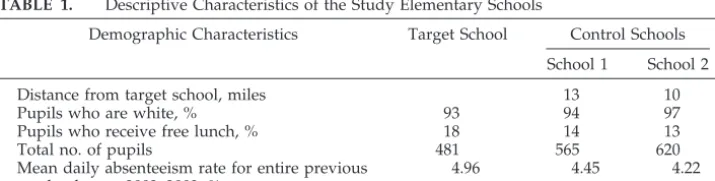
The 3 study schools were similar with respect to geographic location, ethnic distribution, number of students, and percentage eligible for free lunches (a proxy measure for family income) (Table 1). A total of 202 signed consent forms were obtained for chil-dren in the target school; 14 chilchil-dren were later deemed medically ineligible by their physicians, and 3 were withdrawn from participation by their par-ents. Therefore, a total of 185 (40%) of the 460 target school pupils received a first dose of FluMist intra-nasally in this school-based program between No-vember 4, 2003, and January 12, 2004. Ninety percent of the first doses were given by December 9, 2003. A second FluMist dose was given to 112 pupils be-tween December 12, 2003, and February 10, 2004.
Surveillance data revealed that influenza occurred in the community beginning in the second week of November (Fig 1). Figure 1 also demonstrates the cumulative FluMist immunization efforts in the tar-get school. It should be noted that much of the im-munization intervention was conducted concur-rently with the influenza outbreak period, which occurred early in the season, between December 1, 2003, and January 5, 2004. The peak influenza week was December 8 to 14, 2003.
The household questionnaire was distributed on December 19, 2003, temporally close to the peak in-fluenza week. Questionnaires were returned by 157 families (43%) from the target school, 222 (51%) from control school 1, and 230 (47%) from control school 2. In the families that returned the questionnaires, the mean number of adults per household was 1.8 for the target school and 1.8 and 1.9 for control schools 1 and 2, respectively. The mean number of children per
household was 2.2 for all 3 study schools. Data from the household questionnaire revealed that similar proportions of elementary school pupils had re-ceived TIV in each of the study schools (17% in the target school and 12% in the control schools) but 49% of the target school pupils and none of the control school pupils had received FluMist. Respondents to the questionnaire indicated that TIV was used by 21% of the target school and 20% of the control school adults and by 14% and 12% of all of the children in the target and control school households, respectively. Also, FluMist was used by 1% of the target school and 0.2% of the control school adult household members and by 2% of the target school and none of the control school household children who were not in elementary school.
Significantly fewer FRI-related ambulatory physi-cian visits during the 7-day recall period were re-ported for both adults and children in the target school households, compared with those in the con-trol school households (Table 2). There were signifi-cantly fewer purchases of over-the-counter and pre-scription medications for FRI by the target school households, compared with the control school households. There was a trend toward fewer herbal/ natural remedies purchased by target school holds for FRI, compared with control school house-holds. Finally, for the 7-day recall week, there were significant reductions in FRI-related days of work lost by adults and days of school lost by all children in the households of pupils attending target schools, compared with those attending control schools.
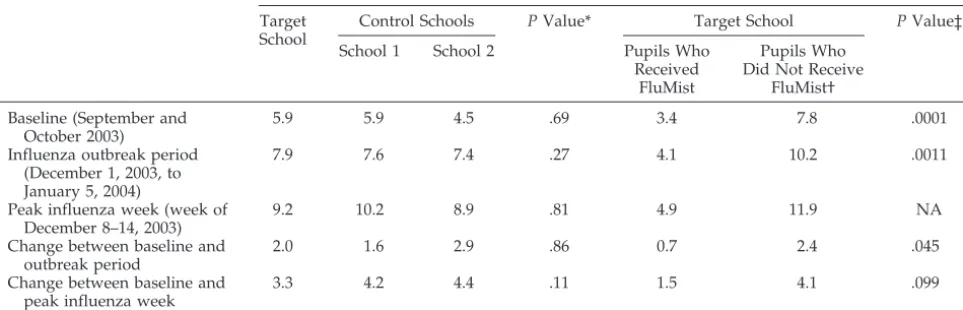
The increase in absenteeism rates during the influ-enza outbreak period or peak influinflu-enza week over baseline rates in September and October did not differ significantly between the target and control schools (Table 3). However, in the target school, dur-ing the influenza outbreak period, there was a sig-nificantly smaller increase in absenteeism rates, com-pared with baseline, for FluMist recipients versus non-FluMist recipients (P⬍.05) (Table 3). Similarly, there was a trend toward a smaller increase in ab-senteeism during the peak influenza week, com-pared with baseline, for FluMist recipients versus non-FluMist recipients (P⫽.10). However, unvacci-nated children had a higher absenteeism rate during the baseline period, which suggests that these pop-ulations might be different.
DISCUSSION
During the peak week of influenza activity, there were significant reductions in FRI-related outcomes in the households of pupils attending the target
TABLE 1. Descriptive Characteristics of the Study Elementary Schools
Demographic Characteristics Target School Control Schools
School 1 School 2
Distance from target school, miles 13 10
Pupils who are white, % 93 94 97
Pupils who receive free lunch, % 18 14 13
Total no. of pupils 481 565 620
Mean daily absenteeism rate for entire previous school year, 2002–2003, %
school with a school-based influenza vaccination program, compared with households of pupils who attended demographically similar control schools without this program. Target school household members had fewer medical visits, medications pur-chased, paid workdays lost by adults, and school-days lost by children, compared with households of control school pupils.
These findings emphasize the important role that young schoolchildren play in the transmission of wild-type influenza to their households and presum-ably the community. Neuzil et al9 found marked
excesses in secondary illnesses among household members (adults and siblings) after a child’s absence because of illness during an influenza outbreak,
com-pared with absences during the noninfluenza period. They also found significant increases in analgesic use and parental industrial absenteeism during the influ-enza outbreak period. The importance of children in the spread of influenza to the rest of the community is also illustrated by the observation that, during influenza outbreaks, school absenteeism, pediatric emergency department visits, and pediatric hospital-izations for treatment of pneumonia all predate in-dustrial absenteeism, adult emergency department visits, and adult pneumonia hospitalizations.10
Fi-nally, it has been observed that there is a reduction in respiratory disease morbidity rates in the entire com-munity when schools are closed during high levels of influenza activity.23
Fig 1. Community surveillance data for
influenza for 2003–2004 and cumulative percentage of the 185 pupils who received their first dose of FluMist, according to date.
TABLE 2. FRI-Related Outcomes for Target and Control Schools
Outcome Target School
(n⫽157)
Control Schools PValue*
School 1 (n⫽222)
School 2 (n⫽230)
Mean rate of adult medical visits, no. per 100 adults
3.3 8.9 8.9 .015
Mean rate of child medical visits, no. per 100 children
5.6 15.3 18.3 .0008
Mean rate of adult emergency department visits, no. per 100 adults
0.6 0.3 0.5 .66
Mean rate of child emergency department visits, no. per 100 children
0.0 1.7 1.0 .29
Over-the-counter medications purchased, no. per 100 households
25.9 51.2 44.5 .0016
Herbal/natural medications purchased, no. per 100 households
4.0 15.0 10.0 .072
Prescription medications purchased, no. per 100 households
10.6 27.8 26.8 .002
Humidifiers purchased, no. per 100 households 3.4 4.7 9.6 .41
Mean rate of paid workdays lost, d per 100 adults 1.3 7.0 5.7 .0004
Mean rate of schooldays lost, d per 100 children 4.1 7.2 8.2 .023
Evidence that immunization of young children can reduce the impact of influenza in households was reported previously. Vaccination of children attend-ing out-of-home care with inactivated influenza vac-cine was associated with significant reductions in febrile respiratory illnesses, missed schooldays, adult missed workdays, physician visits, antibiotics pre-scribed, and over-the-counter medications used in their households, compared with households of non-immunized children.24 Finally, immunization of
large numbers of children with inactivated vaccine has reduced the impact of influenza on the commu-nity as a whole.12
In the present study, changes in pupil absenteeism from baseline (September to October 2003) to the influenza outbreak period were similar in the target school and the control schools. Within the target school, there was a smaller increase in absenteeism during the peak influenza week, compared with baseline, for FluMist-vaccinated children versus un-vaccinated pupils. However, the baseline rates of absenteeism in September and October were lower for FluMist recipients, compared with non-FluMist recipients, which suggests that comparing study out-comes for these 2 groups could be problematic.
Several factors might have contributed to the lack of observed differences in overall absenteeism be-tween the study schools. First, only 40% of the target school pupils received FluMist. Second, all absentee-ism, without respect to cause, was recorded. It is likely that there were many non–influenza-related causes for missing school. Third and perhaps most important, the influenza outbreak started very early in 2003, close to the time when FluMist was offered in the target school; therefore, the majority of chil-dren received intraepidemic vaccination. Fourth, many pupils in the intervention school received only a single vaccine dose before the arrival of the peak influenza activity week. Although a 1-dose schedule for children showed significant efficacy among chil-dren (89%), pooled data from several studies favored (73% vs 93%) a 2-dose regimen.25,26Last, there was a
mismatch between the vaccine strain (A/Panama/ 2007/99-like) and the most common circulating A/H3N2 strain (A/Fujian/411/2002-like) in the United States.27 Therefore, the pupils who received
FluMist might not have been able to develop maxi-mally protective immune responses. However, de-spite the lack of an observed effect on the vaccinated children themselves in terms of absenteeism, an ap-parent protective impact on their households was seen. These observations parallel those of Hurwitz et al,24who found similar indirect effects on household
members of vaccinated day care attendees, although no efficacy against influenza was demonstrated among the inactivated vaccine recipients themselves. There are several limitations of the present study. First, the selection of the target school was not ran-dom but rather was based on prior experience with the school by the study staff. Second, the study was neither blinded nor placebo controlled. These factors could contribute to bias in the responses to the household questionnaire, the primary tool used to assess influenza-related outcomes between target and control schools. Also, the study was small, in terms of both numbers of children and numbers of schools. The relatively low uptake of FluMist among target school pupils (40%) might have been attribut-able to parental caution, because this was a new type of vaccine in its first year of licensure. Also, vaccina-tion was delayed until November 4 and the influenza outbreak started early (December 1), which likely reduced uptake because parents might have thought that it was too late for vaccination. Last, although the schools were clustered within a relatively small geo-graphic area, there was no certainty that influenza affected the households of the 3 schools equally.
Despite these limitations, the observed results sug-gest that clinically meaningful outcomes can be ob-tained with a school-based influenza prevention pro-gram. This study also demonstrates acceptance of a school-based influenza immunization program by a substantial number of parents, despite the novelty of the vaccine and the setting for vaccination. On the
TABLE 3. Absenteeism Rates in Target and Control Schools
Time Period Absenteeism Rate, %
Target School
Control Schools PValue* Target School PValue‡
School 1 School 2 Pupils Who
Received FluMist
Pupils Who Did Not Receive
FluMist†
Baseline (September and October 2003)
5.9 5.9 4.5 .69 3.4 7.8 .0001
Influenza outbreak period (December 1, 2003, to January 5, 2004)
7.9 7.6 7.4 .27 4.1 10.2 .0011
Peak influenza week (week of December 8–14, 2003)
9.2 10.2 8.9 .81 4.9 11.9 NA
Change between baseline and outbreak period
2.0 1.6 2.9 .86 0.7 2.4 .045
Change between baseline and peak influenza week
3.3 4.2 4.4 .11 1.5 4.1 .099
NA indicates not available (insufficient degrees of freedom to calculate). * Based on a 2-samplettest.
basis of this pilot project, a randomized study of select target and control schools in 4 areas through-out the country has been launched to address the problems of bias, unequal penetration of influenza infections, and small sample size. Live, attenuated, cold-adapted, influenza vaccine is ideal for use in a school-based immunization program. The needle-free intranasal delivery method may be perceived to be less noxious for children than parenteral vaccine. Furthermore, the convenience of a school-based vac-cination program should increase the proportion of children immunized, because parents can avoid missing work or other activities to take their child to a primary care office for influenza vaccination.
CONCLUSIONS
An elementary school-based influenza immuniza-tion program was associated with significant reduc-tions in FRI-related outcomes in the households of pupils attending an intervention school. These find-ings were especially impressive because the majority of children received intraepidemic vaccination. Ad-ditional studies are warranted to examine the feasi-bility, public health, and economic issues related to school-based influenza immunization efforts.
ACKNOWLEDGMENTS
This study was supported by a grant from MedImmune, Inc, Gaithersburg, MD.
The SchoolMist Study Group included Carroll County surveil-lance practitioners Paul Feinerman, MD; Edward Perl, MD; Kevin Seymour, MD; John Ignatowski, MD; Jason Tate, MD; and William Linthicum, MD; University of Maryland, Baltimore, coinvestiga-tors Judith Lovchik, PhD; Richard Lichenstein, MD; and Pamela Singer; principals of the 2 control schools, Judith Walker and Lisa Busher; and Director of Student Services, Carroll County Public Schools, Cynthia Little.
We express our gratitude to the parents/guardians and chil-dren who participated in this study. We appreciate the coopera-tion of Charles Ecker, the Superintendent of Carroll County Public Schools, and Timothy Culp for providing absentee data.
REFERENCES
1. Centers for Disease Control and Prevention. Key facts about the flu: how to prevent the flu and what to do if you get sick. Available at: www.cdc.gov/flu/keyfacts.htm. Accessed March 2, 2005
2. Thompson WW, Shay DK, Weintraub E, et al. Influenza-associated hospitalizations in the United States.JAMA.2004;292:1333–1340 3. Sullivan KM. Health impact of influenza in the United States.
Pharmaco-economics.1996;9(suppl 3):26 –33
4. Szucs TD. Influenza: the role of burden-of-illness research.
Pharmaco-economics.1999;16(suppl 1):27–32
5. Monto AS, Sullivan KM. Acute respiratory illness in the community: frequency of illness and the agents involved.Epidemiol Infect.1993;110: 145–160
6. Fox JP, Hall CE, Cooney MK, Foy HM. Influenza virus infections in Seattle families, 1975–1979, I: study design, methods and the occurrence of infections by time and age.Am J Epidemiol.1982;116:212–227
7. Foy HM, Cooney MK, Hall C, Malmgren J, Fox JP. Case-to-case intervals of rhinovirus and influenza virus infections in households.J Infect Dis. 1988;157:180 –182
8. Long CE, Hall CB, Cunningham CK, et al. Influenza surveillance in community-dwelling elderly compared with children.Arch Fam Med. 1997;6:459 – 465
9. Neuzil KM, Hohlbein C, Zhu Y. Illness among schoolchildren during influenza season: effect on school absenteeism, parental absenteeism from work, and secondary illness in families.Arch Pediatr Adolesc Med. 2002;156:986 –991
10. Glezen WP, Couch RB. Interpandemic influenza in the Houston area, 1974 –76.N Engl J Med.1978;298:587–592
11. Reichert TA, Sugaya N, Fedson DS, Glezen WP, Simonsen L, Tashiro M. The Japanese experience with vaccinating schoolchildren against influ-enza.N Engl J Med.2001;344:889 – 896
12. Monto AS, Davenport FM, Napier JA, Francis T Jr. Modification of an outbreak of influenza in Tecumseh, Michigan by vaccination of school-children.J Infect Dis.1970;122:16 –25
13. Szilagyi PG, Iwane MK, Humiston SE, et al. Time spent by primary care practices on pediatric influenza vaccination visits: implications for uni-versal influenza vaccination.Arch Pediatr Adolesc Med.2003;157:191–195 14. Luce BR, Zangwill KM, Palmer CS, et al. Cost-effectiveness analysis of an intranasal influenza vaccine for the prevention of influenza in healthy children.Pediatrics.2001;108(2). Available at: www.pediatrics. org/cgi/content/full/108/2/e24
15. Rudenko LG, Slepushkin AN, Monto AS, et al. Efficacy of live attenu-ated and inactivattenu-ated influenza vaccines in schoolchildren and their unvaccinated contacts in Novgorod, Russia.J Infect Dis. 1993;168: 881– 887
16. Oya A, Nerome K. Experiences with mass vaccination of young age groups with inactivated vaccines. In: Kendal A, Patriarca P, eds.Options
for the Control of Influenza.New York, NY: Alan R. Liss; 1986:183–192
17. Hall S, Galil K, Watson B, Seward J. The use of school-based vaccination clinics to control varicella outbreaks in two schools.Pediatrics.2000; 105(1). Available at: www.pediatrics.org/cgi/content/full/105/1/e17 18. Boyer-Chuanroong L, Woodruff BA, Unti LM, Sumida YU.
Immuniza-tions from ground zero: lessons learned in urban middle schools.J Sch
Health.1997;67:269 –272
19. Wilson T. A bi-state, metropolitan, school-based immunization cam-paign: lessons from the Kansas City experience.J Pediatr Health Care. 2001;15:173–178
20. Billstein S. School-based immunization clinics: a method for raising community immunization levels.West J Med.1977;126:73–78 21. King J, Rubin J, Readmond B, Cummings G, Lovchik J. Association of
influenza outbreaks with excess elementary school absenteeism over two years. Presented at the Pediatric Academic Societies Meeting; May 4, 2004; San Francisco, CA
22. Centers for Disease Control and Prevention. Assessment of the effec-tiveness of the 2003– 04 influenza vaccine among children and adults: Colorado, 2003.MMWR Morb Mortal Wkly Rep.2004;53:707–710 23. Heymann A, Chodick G, Reichman B, Kokia E, Laufer J. Influence of
school closure on the incidence of viral respiratory diseases among children and on health care utilization.Pediatr Infect Dis J. 2004;23: 675– 677
24. Hurwitz ES, Haber M, Chang A, et al. Effectiveness of influenza vacci-nation of day care children in reducing influenza-related morbidity among household contacts.JAMA.2000;284:1677–1682
25. Belshe RB, Mendelman PM, Treanor J, et al. The efficacy of live atten-uated, cold-adapted, trivalent, intranasal influenza virus vaccine in children.N Engl J Med.1998;338:1405–1412
26. Jefferson T, Smith S, Demicheli V, Harnden A, Rivetti A, Di Pietrantonj C. Assessment of the efficacy and effectiveness of influenza vaccines in healthy children: systematic review.Lancet.2005;365:773–780 27. Centers for Disease Control and Prevention. Update: influenza activity:
DOI: 10.1542/peds.2005-1301
2005;116;e868
Pediatrics
and Elizabeth Ruff
Laurence S. Magder, Mary Stong, Margaret Hoffmaster, Judith Rubin, Theodore Tsai
James C. King, Jr, Ginny E. Cummings, Jeffrey Stoddard, Bernard X. Readmond,
Program
A Pilot Study of the Effectiveness of a School-Based Influenza Vaccination
Services
Updated Information &
http://pediatrics.aappublications.org/content/116/6/e868
including high resolution figures, can be found at:
References
http://pediatrics.aappublications.org/content/116/6/e868#BIBL
This article cites 22 articles, 0 of which you can access for free at:
Subspecialty Collections
http://www.aappublications.org/cgi/collection/influenza_sub Influenza
b
http://www.aappublications.org/cgi/collection/infectious_diseases_su Infectious Disease
following collection(s):
This article, along with others on similar topics, appears in the
Permissions & Licensing
http://www.aappublications.org/site/misc/Permissions.xhtml
in its entirety can be found online at:
Information about reproducing this article in parts (figures, tables) or
Reprints
http://www.aappublications.org/site/misc/reprints.xhtml
DOI: 10.1542/peds.2005-1301
2005;116;e868
Pediatrics
and Elizabeth Ruff
Laurence S. Magder, Mary Stong, Margaret Hoffmaster, Judith Rubin, Theodore Tsai
James C. King, Jr, Ginny E. Cummings, Jeffrey Stoddard, Bernard X. Readmond,
Program
A Pilot Study of the Effectiveness of a School-Based Influenza Vaccination
http://pediatrics.aappublications.org/content/116/6/e868
located on the World Wide Web at:
The online version of this article, along with updated information and services, is
by the American Academy of Pediatrics. All rights reserved. Print ISSN: 1073-0397.