Early Experience Alters Brain Function and Structure
Heidelise Als, PhD*; Frank H. Duffy, MD‡; Gloria B. McAnulty, PhD*; Michael J. Rivkin, MD*‡§;
Sridhar Vajapeyam, PhD§; Robert V. Mulkern, PhD§; Simon K. Warfield, PhD§; Petra S. Huppi, MD‡
储
;
Samantha C. Butler, PhD*; Nikk Conneman, MD*; Christine Fischer, MD*; and Eric C. Eichenwald, MD¶#
ABSTRACT. Objective. To investigate the effects of early experience on brain function and structure.
Methods. A randomized clinical trial tested the neu-rodevelopmental effectiveness of the Newborn Individ-ualized Developmental Care and Assessment Program (NIDCAP). Thirty preterm infants, 28 to 33 weeks’ ges-tational age (GA) at birth and free of known develop-mental risk factors, participated in the trial. NIDCAP was initiated within 72 hours of intensive care unit admission and continued to the age of 2 weeks, corrected for pre-maturity. Control (14) and experimental (16) infants were assessed at 2 weeks’ and 9 months’ corrected age on health status, growth, and neurobehavior, and at 2 weeks’ corrected age additionally on electroencephalogram spec-tral coherence, magnetic resonance diffusion tensor im-aging, and measurements of transverse relaxation time.
Results. The groups were medically and demograph-ically comparable before as well as after the treatment. However, the experimental group showed significantly better neurobehavioral functioning, increased coherence between frontal and a broad spectrum of mainly occipital brain regions, and higher relative anisotropy in left in-ternal capsule, with a trend for right inin-ternal capsule and frontal white matter. Transverse relaxation time showed no difference. Behavioral function was improved also at 9 months’ corrected age. The relationship among the 3 neurodevelopmental domains was significant. The re-sults indicated consistently better function and more ma-ture fiber strucma-ture for experimental infants compared with their controls.
Conclusions. This is the first in vivo evidence of en-hanced brain function and structure due to the NIDCAP. The study demonstrates that quality of experience before term may influence brain development significantly. Pe-diatrics2004;113:846 – 857;preterm infants, NIDCAP, neu-robehavior, spectral coherence, diffusion tensor imaging, transverse relaxation time, Bayley Scales of Infant Devel-opment, APIB.
ABBREVIATIONS. NICU, newborn intensive care unit; NIDCAP, Newborn Individualized Developmental Care and Assessment Program; MRI, magnetic resonance imaging; EEG, electroenceph-alogram; APIB, Assessment of Preterm Infants’ Behavior; Prechtl,
Prechtl Neurologic Examination of the Fullterm Newborn Infant; Bayley II, Bayley Scales of Infant Development, Second Edition; MDI, mental developmental index; PDI, psychomotor develop-mental index; BRS, Behavior Rating Scale; T2*, transverse relax-ation time; DTI, diffusion tensor imaging; ROI, region(s) of inter-est; E1, principal eigenvalue; E3, tertiary eigenvalue; RA, relative anisotropy; MANOVA, multivariate analysis of variance.
T
he preterm infant provides an opportunity to
study the effects of early postnatal experience
on brain development. Increasing evidence
suggests that features of brain structure
1– 4and
func-tion
5– 8are different between medically healthy
pre-term infants and their pre-term counterparts when
as-sessed at a comparable age point. Although some
differences are explained by the cumulative effect of
minor medical complications associated with
prema-ture birth, the infant’s sensory experience in the
new-born intensive care unit (NICU) environment,
in-cluding exposure to bright lights, high sound levels,
and frequent noxious interventions, may exert
dele-terious effects on the immature brain and alter its
subsequent development.
9 –15The importance of the
match between the environment and the brain’s
ex-pectation during “critical” periods of brain
develop-ment has long been demonstrated in animal models
of development, beginning with the classical
exper-iments of Hubel and Wiesel.
16 –23In an effort to
de-crease the discrepancy between the immature human
brain’s expectation and the actual experience in a
typical NICU environment, a comprehensive
ap-proach named the Newborn Individualized
Devel-opmental Care and Assessment Program (NIDCAP)
has been developed and tested. Several randomized
trials have shown positive results in both behavioral
and electrophysiological functioning of very
pre-mature infants (
⬍
30 weeks’ gestational age) at
high risk for various serious organ injuries such
as chronic lung disease and intraventricular
hemor-rhage.
11–13,15,24Despite the consistent results, a
re-cent meta-analysis concluded that sufficient evidence
did not exist at this time to warrant a multicenter
clinical trial.
25Similar developmental results have
been documented also in low-risk 30- to 34-week
gestational preterms.
10The goal of the current study
was to explore the effect of the NIDCAP intervention
on a population of low-risk preterm infants.
Neu-robehavioral, electrophysiological, and quantitative
structural magnetic resonance imaging (MRI)
meth-ods were used for this study. It was hypothesized
that the NIDCAP intervention group, when
com-From the Departments of *Psychiatry, ‡Neurology, §Radiology, and¶New-born Medicine, Harvard Medical School and Children’s Hospital Boston, Boston, Massachusetts;储Department of Newborn Medicine, University of Geneva, Geneva, Switzerland; and #Newborn Intensive Care Nursery, Brigham and Women’s Hospital, Boston, Massachusetts.
Received for publication Jun 17, 2003; accepted Dec 29, 2003.
Address correspondence to Heidelise Als, PhD, Harvard Medical School and Children’s Hospital Boston, Enders Pediatric Research Laboratories, EN107, 320 Longwood Ave, Boston, MA 02115. E-mail: heidelise.als@ childrens.harvard.edu
pared with a standard care group, would perform
better on all 3 measures of neurodevelopment.
METHODS Design
A controlled trial design with 2-group randomization was used. Blocking by gender (male/female) and ethnicity (white/ other) was imposed a priori. Consent was obtained as soon after delivery as feasible within the first 3 postpartum days. Immedi-ately after consent was obtained, subjects were assigned randomly to either the experimental or control group. Group assignment was revealed by parental opening of the opaque, prenumbered, sealed envelope drawn from the respective randomization box, dependent on the infant’s gender and ethnicity. Outcome assess-ment staff was purposefully kept “blind” to the infants’ group assignments. The outcome assessments were performed at 2 weeks’ corrected age (all infants were discharged from the NICU before this point) and at 9 months’ corrected age.
Subjects
Thirty low-risk preterm infants and their parent(s) constituted the study sample. They were recruited from the NICU of the Brigham and Women’s Hospital (Boston, MA), a facility with
⬎6000 births per year and a 46-bed level III NICU with an exclu-sively inborn population. The institutional review boards for re-search with human subjects of both Brigham and Women’s Hos-pital and Children’s HosHos-pital Boston (Boston, MA), at which the outcome assessments took place, approved the study protocol. The 2 hospitals are interconnected physically, and both are Har-vard teaching hospitals.
Study family selection criteria included residence in the greater Boston area; mothersⱖ14 years; absence of major maternal med-ical or psychiatric illness, chronic maternal medication treatment (eg, insulin, steroids, thyroid replacement, antidepressants, and anticonvulsants), or history of maternal substance abuse at any time (including alcohol or tobacco abuse); family accessibility by telephone; and some English-language facility. Infant criteria in-cluded gestational age at birth of 28 weeks 4 days to 33 weeks 3 days after mother’s last menstrual period; 5-minute Apgar score
ⱖ7; weight and head circumference at birth appropriate for ges-tational age (ⱖ5th,ⱕ95th percentile26); normal initial cranial
ul-trasound(s), MRI, and/or electroencephalogram (EEG);ⱕ72 hours of mechanical ventilator support including continuous positive airway pressure; andⱕ72 hours of vasopressor medication. Ad-ditional exclusion criteria included congenital or chromosomal abnormality, congenital or acquired infection (eg, HIV, sepsis, toxoplasmosis, rubella, cytomegalovirus, and herpes simplex), ab-sence of prenatal care, known prenatal brain lesions (eg, cysts or infarctions), and neonatal seizures.
The study-recruitment period extended over 28 months, from
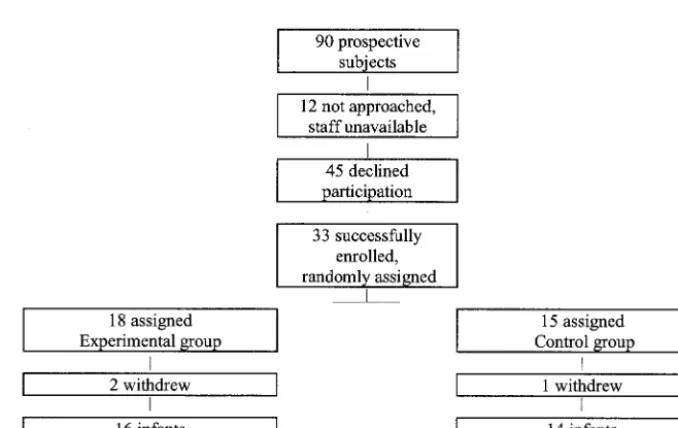
May 1, 2000 through August 30, 2002. Ninety infants met study criteria. Of these, 12 families were not approached because of staff unavailability, and 45 families declined participation. The main reason given was the extensive nature of the outcome assessments. After successful entry into the study, 3 families failed to return for outcome assessment. In terms of background criteria, the families that were eligible but did not participate for the various reasons described were comparable with the families that participated. Although the participants represent only 33% of the population eligible in the course of the intake period, they nevertheless seem broadly representative. Figure 1 presents a flowchart of both the eligible and the studied infants, with reasons for nonparticipation shown.
Control and Experimental Group Experience
Control group infants received the standard care practiced throughout the Brigham and Women’s Hospital NICU at the time of study, which included an effort at primary care nursing and staff-dependent inconsistent parent inclusion. The standard devel-opmental protocol of the NICU involved uniform shielding of incubators with white hospital blankets, early use of dressing in T-shirts, and side and foot rolls; liberal provision of pacifiers; and inconsistent nurse-dependent encouragement of skin-to-skin holding (kangaroo care) and breastfeeding. No formal effort was made to prevent spillover and contamination effects from exper-imental to control group care. Therefore, significant experexper-imental effects identified by definition were conservative, because they had to be in excess (ie, go beyond the inevitable spillover) of care contamination by the experimental treatment provided in the same NICU and cared for at the same time as control group infants.
The individualized intervention consisted of daily (7 days a week) observations and evaluations of the experimental group infants’ behavior, with suggestions for parents and staff in terms of ways to support each infant’s development. The framework of developmental care views preterm infants as fetuses who find themselves too early and unexpectedly in a technologic hospital environment instead of the evolutionarily promised mother’s womb. Developmental care emphasizes the behavioral individu-ality of each infant. Each infant is seen as an active participant in all care. Each family is valued as the infant’s most consistent nurturer and most important advocate. Developmentally support-ive care seeks to reduce the discrepancy between womb and NICU environment by taking into account the individual infant’s current thresholds of behavioral organization, diminishing stress, and supporting each infant’s strengths and competencies. This means assuring restfulness, calm breathing and well modulated color; a well-functioning, calm digestive tract; well-modulated face, ex-tremity, and trunk tone; comfortable restful positions; and slowed tempo of all caregiving procedures, individualized adjustment of all timing and implementation of procedures, and provision of
well-supported relaxation periods. The developmental specialist team, trained to reliability and experienced in the use of the NIDCAP approach,27included a developmental psychologist and
a developmentally trained neonatologist. They provided the in-tervention-group infants’ weekly observations and daily contact with the infants’ current caregivers, ensuring continuity and con-sistency of developmental care. In addition, they provided ongo-ing support for the care teams and parents in jointly plannongo-ing and implementing individually supportive care. Special problem solv-ing around staff consistency and parent support with input by the developmental specialists for the experimental group infants was facilitated by the NICU’s nurse managers and medical directors. A group of 25 nurses was “recruited” before the start of the study to volunteer for developmental care training and caregiving for the experimental infants. They were comparable in age and years of experience with the NICU nursing staff as a whole and included very young and recently hired as well as senior long-term staff members.
The developmental specialists provided daily contact and sup-port for the caregivers in understanding the experimental group infants’ stress and comfort signals, adjusted their care accordingly, and conceptualized the infants as active participants in the care delivered. The developmental specialists formally observed each infant’s behavior weekly throughout the hospitalization, starting with the phase of the infant’s initial stabilization and then every 7 days throughout hospital discharge and to 2 weeks’ corrected age. For each observation, the developmental specialist systematically recorded an infant’s behavior for⬃20 minutes before a planned medical or nursing caregiving interaction and continued to ob-serve throughout the duration of the interaction and for ⬃20 minutes beyond the caregiving interaction. Ninety-one behaviors, including autonomic (breathing, heart rate, color changes, and visceral signs), motor (postures, muscle tone fluctuations, and movements), and state organization behaviors (levels of arousal, patterns of transitions between states, and clarity and robustness of sleep and awake states) were monitored every 2 minutes. Behaviors were conceptualized as stress (eg, flaccidity, agitated or frantic movements, hyperextensions, duskiness, respiratory pauses, gagging, spitting up, finger splaying, arching, gaze aver-sion, etc) and regulatory (eg, hand to mouth, hand clasping, grasping, efforts to suck, tucking, etc) and interpreted as indices of the infants’ current vulnerabilities and strengths, respectively.
The developmental specialists used the observations to formu-late descriptive neurobehavioral reports and suggestions, to struc-ture caregiving procedures to the infant’s sleep/wake cycle, and to maintain the infant’s well-regulated behavioral balance in an effort to promote the infant’s strengths and simultaneously to reduce the infant’s self-regulatory vulnerability. For example, some infants became aroused and agitated easily and struggled during care, whereas others become limp and lethargic. In these situations, suggestions included gently helping the infant tuck into a more curled up position to promote maintenance of motor tone, energy, and restfulness; gently swaddling the infant with a soft blanket or bedding the infant tucked in a soft, comfortable, individually sized, well-fitting bunting; supportively holding into a tucked position and cradling in the caregiver’s hands a vulner-able infant whose breathing easily became labored and/or whose color fluctuated quickly or an infant who paled out, became easily dusky, or began to gag or hiccough during taxing manipulations; supporting restful return to sleep by gently bedding the infant curled up on his or her side; supporting the infant by soft, indi-vidually adjusted bedding; bathing the infant swaddled in a soft blanket in deep, warm water; weighing the infant gently swad-dled; including a second caregiver to support the infant during stressful procedures such as suctioning, chest radiographs, and cranial ultrasounds; increasing darkness and quiet for the infant; and, from early on, supporting the parents in caring for their infant, nursing, and holding their infant in skin-to-skin closeness and/or cradle their infant during stressful and difficult proce-dures. Staff members were encouraged to offer parents comfort-able recliner chairs (availcomfort-able as part of the study) in which to relax and hold and sleep with their infant in restful, skin-to-skin contact for prolonged periods of time. Several accessories specif-ically designed to support the experimental group infants when in the incubator or crib included natural sheepskins, terry cloth buntings, soft, special-sized, appropriate body and hugging pil-lows, and soft, special pacifiers. Furthermore, parents were en-couraged to personalize their infant’s bed area. To provide a
soothing atmosphere with muted indirect lighting and the impe-tus to approach calmly, parents and staff were encouraged to make use of custom-made, attractive “privacy screens” consisting of polished wood frames and soft-colored cloth panels as well as specially designed coordinated soft-colored cloth crib canopies with bows and ribbons.9These materials supported the
develop-ment of soothing bedside islands in the midst of an otherwise large, very active, and often hectic NICU.
Medical/Demographic Background and Medical Outcome
Medical information derived from the infants’ NICU and com-munity hospital charts was abstracted in double-blind fashion by the study’s pediatrician, who was completely unfamiliar with the identity of the infants and families. The information was coded into a priori-defined variables. Demographic and parent/infant medical history information not accessible from the medical records was obtained by parent interview, also in double-blind fashion, by the study’s senior psychologist, who was kept naive to family and infant identity. Because randomization was used, it was hypothesized that control and experimental groups would be comparable in terms of medical and demographic background. On the basis of the earlier study of developmental care for low-risk, appropriate-for-gestational-age preterm infants,10it was also
hy-pothesized that there would be no differences between the 2 groups in medical outcome. Although the current study’s infants were selected to be, on average, younger at birth than the infants in the earlier study, they nevertheless were selected to have only very early (⬍72 hours) transient medical issues and were all born to healthy mothers, had grown well in the womb, and were considered medically at low risk. Given their early gestational age (28 –33 weeks), some of the infants, as would be expected for this population, required several weeks of supplemental oxygen and supportive gavage feedings before being fully weaned to the breast (or, in some cases, a combination of breast and bottle).
Measurement of Developmental Care Experience Consistency of the developmental care experience for the ex-perimental group infants was measured by percent of weekly developmental care observations completed and by the number of nursing shifts staffed by developmentally skilled nurses. To arrive at this determination, all formal care observations resulting in written reports were tabulated by infant, compared with the in-fant’s number of weeks from birth to 2 weeks’ corrected age, and expressed as a percentage. Additionally, nursing staff was as-signed a score of 1 or 2, reflecting the degree to which their caregiving conformed to the criteria of the developmental care program guidelines.27Two independent raters familiar with the
developmental care guidelines and the nursing staff’s care prac-tices performed the ratings. Each child’s care was subsequently described in terms of percent time of total hospital duration cared for by a developmentally skilled nurse. At the time of recruitment of an experimental group infant into the study, a great effort was made to schedule a developmentally skilled nurse to that infant for each caregiving shift.
Neurobehavioral Outcome Measures at 2 Weeks’ and 9 Months’ Corrected Age
Two neurobehavioral assessments were used at 2 weeks’ cor-rected age: the Assessment of Preterm Infants’ Behavior (APIB)4,28
and the Prechtl Neurologic Examination of the Fullterm Newborn Infant (Prechtl).29For all assessments performed at 2 weeks’ and 9
months’ corrected age, the evaluator was blind to the study group of the infant.
1 to 9. The lowest 3 scores (1–3) denote degrees of well-modulated and well-organized behavioral regulation, reflective of high thresholds of transition from good modulation to disorganization and stress; the highest scores (7–9) denote easily disorganized, poorly modulated behavioral regulation, reflecting low and very low thresholds to disorganization and stress. Well-functioning infants between 10 and 30 days’ corrected age are expected to respond in the 1 to 3 range.6The 6 main system variables were
used for analysis (for details of specific variable construction see refs 7 and 8).
The Prechtl is a well-known neurologic evaluation of the new-born at term. It was reduced to 12 summary variables,10which
were used for analysis. The variables assess functions such as syndromes of reactivity and thresholds of functioning. Addition-ally, in a separate analysis, 8 APIB/Prechtl factor scores were examined as outcome measures. They were generated for the current independent population based on the rules established by principal components analysis with Varimax rotation in a large study of 312 preterm and term infants examined with the APIB and Prechtl at 2 weeks’ corrected age.5The current study’s
sub-jects were not included in the analysis of the 312 infants. The 8 APIB/Prechtl factors resulting from the large independent sample had explained 67.62% of the total variance in the large population and showed good electrophysiological group differentiation.6It
was hypothesized that the experimental group compared with the control group in the current small sample would perform signif-icantly better on the 6 APIB and 12 Prechtl scores and on the 8 factor scores.
At 9 months’ corrected age, the infants were assessed in terms of growth (weight, height, and head circumference) and with the Bayley Scales of Infant Development, Second Edition (Bayley II),31
which yield a mental developmental index (MDI) and psychomo-tor developmental index (PDI) (both with a mean of 100 and an SD of 15) age-equivalent scores, and 4 factor scores (percentile) de-rived from the Behavior Rating Scale (BRS; orientation/engage-ment, emotional regulation and motor quality, and BRS total score). Growth was expected to be comparable between the 2 groups. The Bayley II measures were hypothesized to be signifi-cantly better for the experimental group than for the control group.
Two independent examiners, who were naive as to the infants’ backgrounds and group status, assessed the infants. All assess-ments were performed at the Neurobehavioral Studies Laboratory at Children’s Hospital Boston in a quiet, private, light-controlled, and comfortable examination room. All assessments were video-taped for later reliability assessment. The examiners maintained periodically assessed interexaminer reliability of ⬎90% scoring agreement per evaluation. The APIB/Prechtl assessments were scheduled 1 hour before an infant’s anticipated next feeding; the Bayley II assessments were typically in the morning between 9:30 amand 11:00 am, at a time the infants’ parents judged to be optimal for their infants’ best alert and play time. The parent(s) were present throughout all examinations. The APIB and Prechtl as well as the Bayley II variables derived from the assessments were coded by 1 of 2 experienced coders. All coding was double checked for accuracy by an independent research coordinator familiar with the instruments.
Neurophysiologic Outcome Measures
All infants were additionally assessed neuroelectrophysiologi-cally (EEG) on the same day after the neurobehavioral assessment. Sleep EEG cortical spectral coherence data were evaluated for the study. Infants were evaluated during quiet sleep, verified by constant EEG monitoring. In EEG, quiet sleep is recognized as the most stable state and therefore was chosen as the best condition for obtaining an estimate of the brain’s resting functional archi-tecture. Spectral analysis, in this case coherence analysis, repre-sents the average of architecture of connectivity over a period of at least 15 minutes, which serves to average random variations sec-ond to secsec-ond and minute to minute. Thus, spectral coherence data accurately reflect the landscape of cortical-cortical connectiv-ity during quiet sleep. Cortical spectral coherence between 2 EEG electrodes is generally taken as a measure of cortical coupling between the brain areas underlying the electrodes. Coherence assesses the neural function responsible for complex cognitive and affective regulatory processes.33– 41
In the current study, the EEG spectral coherence data at 2
weeks’ corrected age of the 30 study infants were represented electrophysiologically by 40 coherence factors, derived from an independent large population.5All coherence data available per
subject of the large sample of 312 infants with varying medical backgrounds had been entered into a principal components anal-ysis, followed by Varimax rotation. By use of an algorithm based on singular value decomposition, 3040 coherence variables from trace´ alternant sleep formed 40 coherence factors, which ac-counted for 65% of the variance. These factors, which successfully predicted gestational age at birth, degree of medical compromise, and newborn behavioral factors,6were used in the current study.
A registered EEG technologist and infant-behavior specialist, both with extensive infant experience, gathered the EEG data at the Developmental Neurophysiology Research Laboratory at Children’s Hospital Boston. The EEG was monitored continuously during data collection. Data were obtained from 20 scalp elec-trodes with linked ear reference. After amplification (Neuroscan Synamps, El Paso, TX), data were digitized at 250 Hz and were band pass filtered from 1 to 100 Hz. Subsequent analyses were limited to artifact-free segments of quiet sleep, delineated by a senior electroencephalographer naive to subject identity. Limiting analysis to infant quiet sleep assured freedom from movement and eye-blink artifact. A minimum of 180 seconds of EEG was analyzed to compensate for the minimally residual trace´ alternant pattern, a potential instability still noted at 2 weeks’ corrected age. Creation of log-corrected coherence data, using the Laplacian reference,41and derivation of factor scores were performed as
detailed.5
Neurostructural Outcome Measures
MRI provides several quantitative methods to search for brain structural changes underlying functional differences. All MRI was performed at Children’s Hospital Boston on a 1.5-T General Elec-tric scanner operating at the LX 8.3 hardware/software configu-ration (GE Medical Systems, Milwaukee, WI). Scanning was per-formed during a single scanning session after behavioral and EEG data acquisition on the same day.
The 2 MRI methods used were transverse relaxation time (T2*) and diffusion tensor imaging (DTI). The T2* measurements were made by using a spoiled gradient echo sequence acquiring 5 axial 7-mm-thick slices through the middle of the cerebral hemispheres. The repetition time was fixed at 100 milliseconds, and data sets were acquired at echo-time values of 7, 24, 48, 64, and 91 millisec-onds. The total scan time for the T2* measurement was⬃5 min-utes. The T2* values were calculated at selected regions of interest (ROI) from monoexponential fits of the signal decay with echo time.
T2* has been demonstrated to decrease as the brain matures,42
making it a potentially useful index for comparison of brain development between the experimental and control groups. Four ROI were selected a priori for measurement: frontal white matter, considered the locus of attention regulation and executive func-tion; thalamus, an early maturing structure; and the medial and lateral occipital lobes, given the challenge of premature visual processing in early born infants and the subsequent spatial visu-alization and visual-motor difficulties, respectively, in preterm children at later ages.43,44 For the T2* analysis, all ROI were
circular, 5 mm in diameter, and placed manually in 4 locations according to anatomic landmarks as agreed on by the same 2 experienced neuroimaging investigators, who placed all regions. It was hypothesized that frontal white matter as well as the medial and lateral occipital lobes might show differences in favor of the experimental group.
The second methodology chosen was DTI, which was per-formed with a line scan diffusion imaging sequence45 using a
repetition time/echo time of 2500/70 milliseconds, a field of view of 24 cm, b factors46of 5 and 750 seconds/mm2, and 48 columns
per slice, with a 24⫻12-cm field of view and columns oriented posterior to anterior. The 6 gradient directions sampled were 1,1,0 (⫺1,1,0), 1,0,1 (⫺1,0,1), and 0,1,1 (0,⫺1,1). Five to eight 6-mm-thick axial slices were typically sampled with total DTI scan times between 6 and 8 minutes. Acquired images could be manipulated to obtain all the elements of the diffusion tensor and related quantities on a pixel-by-pixel basis.
prin-cipal eigenvector, and the secondary and tertiary eigenvalue (E3) represent diffusion transverse to the fiber tract axis. The rotation-ally invariant ratio of E1/E3 extracted from the diffusion tensor image is a shape descriptor of the diffusion tensor ellipsoid and can be thought of as an index associated with the myelin sheath development of the underlying white matter fibers. Another index commonly used is the relative anisotropy (RA), which is a more rotationally invariant measure of the diffusion anisotropy. RA is calculated as a percentage with the equation
RA⫽
冑
冑
32
D⫺1
3trace共D兲I
Trace共D兲
whereDis the trace of the diffusion tensor andIis the identity matrix. Both E1/E3 and RA were determined at 4 ROI chosen a priori: frontal white matter, the left and right internal capsules, and corpus callosum. The ROI for each location was hand drawn by using neuroanatomical markers as seen on the apparent diffu-sion coefficient maps and the diffudiffu-sion-weighted images. All ROI for DTI analysis were determined by the same 2 experienced neuroimaging investigators working together, who took great care to ensure that all ROI for a particular location were of comparable size and shape.
All infants were scanned unsedated, asleep, and positioned comfortably in a specially designed vacuum pillow used to stabi-lize head position. All infants wore effective ear protection to muffle the magnet’s sounds. Cardiac function and blood oximetry levels were monitored (MR Equipment Corp, Bay Shore, NJ) throughout the study. Resuscitation equipment and personnel were available at all times. No untoward events were encountered at any time in the course of the study. All infants were accompa-nied by 1 of their parents and a skilled behavioral professional. The project’s pediatric neuroradiologist reviewed each scan and provided the institution-required clinical report.
Data Analysis
All statistical analyses were performed by using BMDP soft-ware.47 Medical and demographic background and medical/
growth outcome continuous variables were submitted to re-spective multivariate analysis of variance (MANOVA), with subsequent univariate analysis of variance using Holm’s48method
of correction for multiple comparisons. To account for unequal variances, the Browne Forsythe test of variance (F*) was uniformly
used. Categorical variables were submitted to2test with Yates’
correction.47,49For all analyses, an a priori probability level ofPⱕ
.05 (2-tailed) was selected. The sample size chosen assures detec-tion at a .05 probability level, with medium to large effects ac-counting for between 23% and 69% of the variance.50
Because no significant group effects favoring the experimental group were identified in the medical and demographic back-ground or in the medical/growth outcome measures, the behav-ioral, electrophysiological, and neurostructural outcome measures were submitted to analysis as outlined. Given the sample size of 30 infants compared with the set of 40 EEG coherence factors,5
dis-criminant function analysis was restricted to use of the first 20 coherence factors for hypothesis testing. In a separate analysis, the second 20 coherence factors were explored. Wilks’51was
calcu-lated, and jack-knifed52,53 classification was performed to
ascer-tain 2-group classification success. Canonical correlation analysis was used to explore the relationship among the behavioral, elec-trophysiological, and neurostructural domains. Three canonical correlations54 were performed for each of 2 sets of variables,
namely the behavioral factors with the coherence factors, as well as each of these with the (E1/E3) DTI measures.
RESULTS
Age at assessment was comparable for both
groups at 2 weeks’ corrected age as well as at 9
months’ corrected age (2 weeks: control mean
⫽
21.00 days’ corrected age [SD: 8.80]; experimental
mean
⫽
17.19 days’ corrected age [5.99];
F
⫽
1.87;
degrees of freedom [df]
⫽
1,22;
P
⫽
.19; 9 months:
control mean
⫽
9.36 months’ corrected age [0.34];
experimental mean
⫽
9.27 months’ corrected age
[0.23];
F
⫽
0.67; df
⫽
1,21;
P
⫽
.42).
All 30 subjects had complete medical and
demo-graphic background review along with
neurobehav-ioral assessment at 2 weeks’ corrected age. The
groups were comparable on the medical and
demo-graphic background, including pregnancy and
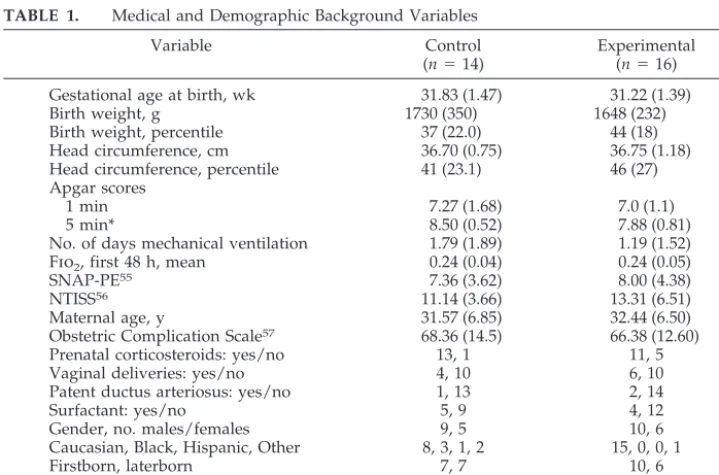
deliv-ery indices, as shown in Table 1.
Apgar score at 5 minutes favored the control
group (8.5 [0.5] vs 7.9 [0.8];
P
⫽
.02). Because the
TABLE 1. Medical and Demographic Background Variables
Variable Control
(n⫽14)
Experimental (n⫽16)
Gestational age at birth, wk 31.83 (1.47) 31.22 (1.39)
Birth weight, g 1730 (350) 1648 (232)
Birth weight, percentile 37 (22.0) 44 (18)
Head circumference, cm 36.70 (0.75) 36.75 (1.18)
Head circumference, percentile 41 (23.1) 46 (27)
Apgar scores
1 min 7.27 (1.68) 7.0 (1.1)
5 min* 8.50 (0.52) 7.88 (0.81)
No. of days mechanical ventilation 1.79 (1.89) 1.19 (1.52)
Fio2, first 48 h, mean 0.24 (0.04) 0.24 (0.05)
SNAP-PE55 7.36 (3.62) 8.00 (4.38)
NTISS56 11.14 (3.66) 13.31 (6.51)
Maternal age, y 31.57 (6.85) 32.44 (6.50)
Obstetric Complication Scale57 68.36 (14.5) 66.38 (12.60)
Prenatal corticosteroids: yes/no 13, 1 11, 5
Vaginal deliveries: yes/no 4, 10 6, 10
Patent ductus arteriosus: yes/no 1, 13 2, 14
Surfactant: yes/no 5, 9 4, 12
Gender, no. males/females 9, 5 10, 6
Caucasian, Black, Hispanic, Other 8, 3, 1, 2 15, 0, 0, 1
Firstborn, laterborn 7, 7 10, 6
Social class: I and II, III, IV and V58 9, 4, 1 12, 3, 1
Parents married/attached: yes/no 14, 0 16, 0
direction of the difference made the results more
conservative, covarying on later analyses was not
performed. All head ultrasounds and baseline MRI
and EEG studies, specially performed to assure
in-fant’s brain intactness before onset of experimental
intervention, were read as normal by the 2
indepen-dent radiologists and the senior
electroencephalog-rapher, respectively, who were all naive as to the
infants’ group status.
As was hypothesized, because both groups were of
relatively low medical risk, none of the medical or
growth outcome measures showed significant group
differences. The control and experimental group
in-fants were discharged from the hospital after 32 (17)
and 40 (19) days, respectively, at a mean age after
mother’s last menstrual period of 36.4 (1.6) and. 36.9
(1.8) weeks, respectively (ie, well before the expected
due date). At 2 weeks’ and 9 months’ corrected age,
there was no significant weight (g), height (cm), or
head circumference (cm) difference between the 2
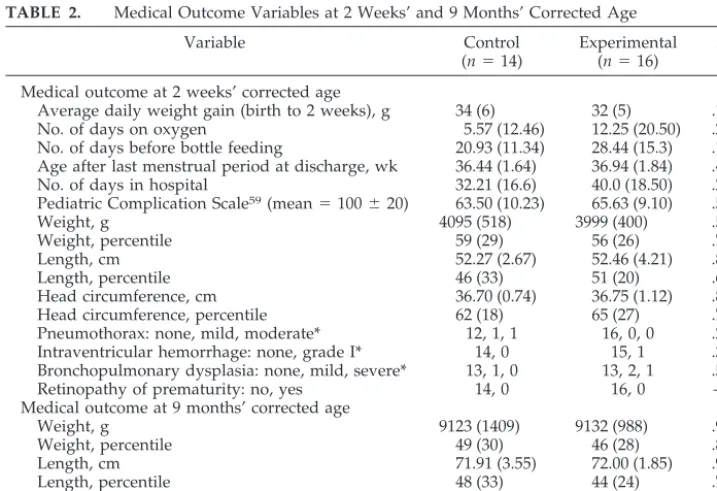
groups, nor was there any other difference, as Table
2 shows. Review after hospital discharge of all head
ultrasounds revealed a questionable grade 1
intra-ventricular hemorrhage for 1 of the experimental
group infants. However, both groups were
consid-ered clinically neurologically normal and healthy at
the 2 weeks’ and 9 months’ corrected age outcome
points.
Developmental Care Experience
The developmentalists’ weekly observations and
reports, as well as their feedback and support to the
parents and the caregiving staff, were conducted
with 100% consistency. Additionally, the
experimen-tal group infants were cared for by nurses rated as
developmentally skilled for more hours/shifts in the
course of their hospitalization than the control group
infants (control: mean
⫽
38% [9.9]; experimental:
mean
⫽
53% [12.8];
F
⫽
11.06; df
⫽
1,18;
P
⫽
.004).
Behavioral Outcome
Experimental group infants showed significant
im-provement in neurobehavioral outcome (APIB and
Prechtl)
4,29in terms of the 6 APIB system scores, as
well as the 12 Prechtl variables, as the 2 significant
MANOVA indicate. Two APIB variables (motor
sys-tem modulation and self-regulation) and 6 Prechtl
scores were individually significant between the 2
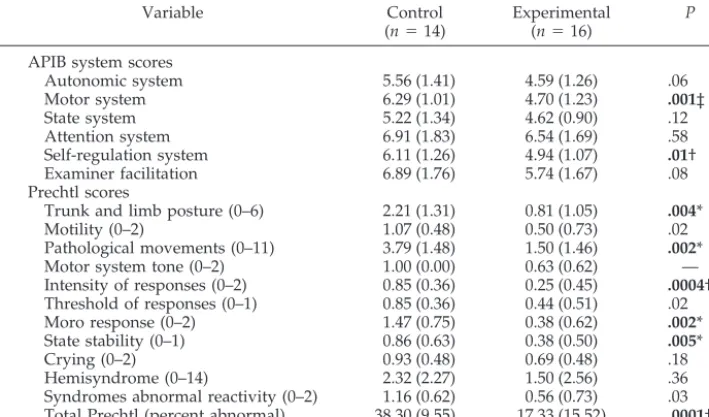
groups, as Table 3 shows.
The 8 APIB/Prechtl factor scores also showed
overall significant differences by MANOVA (F
⫽
4.88; df
⫽
8,21;
P
⫽
.0017). Factors 2 and 3 differed
significantly individually. Factor 2 represents a
broad motor organization factor and is almost
exclu-sively contributed to by APIB variables (P
⬍
.0004).
Factor 3, an intensity of reaction and hypersensitivity
factor, is exclusively contributed to by Prechtl
vari-ables (P
⬍
.00001).
At 9 months’ corrected age, 6 infants (1 control and
5 experimental) did not return for assessment
be-cause of family scheduling conflicts. The returning
experimental group children continued to show
sig-nificantly better performance than the control group
children. MDI and PDI as well as the BRS scores
(emotional regulation, motor quality, and total score)
differed significantly in favor of the experimental
group infants, as analyzed by MANOVA. (The
Bay-ley II scores, aside from the mean MDI and PDI
TABLE 2. Medical Outcome Variables at 2 Weeks’ and 9 Months’ Corrected Age
Variable Control
(n⫽14)
Experimental (n⫽16)
P
Medical outcome at 2 weeks’ corrected age
Average daily weight gain (birth to 2 weeks), g 34 (6) 32 (5) .17
No. of days on oxygen 5.57 (12.46) 12.25 (20.50) .29
No. of days before bottle feeding 20.93 (11.34) 28.44 (15.3) .14 Age after last menstrual period at discharge, wk 36.44 (1.64) 36.94 (1.84) .44
No. of days in hospital 32.21 (16.6) 40.0 (18.50) .24
Pediatric Complication Scale59(mean⫽100⫾20) 63.50 (10.23) 65.63 (9.10) .56
Weight, g 4095 (518) 3999 (400) .58
Weight, percentile 59 (29) 56 (26) .75
Length, cm 52.27 (2.67) 52.46 (4.21) .81
Length, percentile 46 (33) 51 (20) .63
Head circumference, cm 36.70 (0.74) 36.75 (1.12) .89
Head circumference, percentile 62 (18) 65 (27) .76
Pneumothorax: none, mild, moderate* 12, 1, 1 16, 0, 0 .29
Intraventricular hemorrhage: none, grade I* 14, 0 15, 1 .34
Bronchopulmonary dysplasia: none, mild, severe* 13, 1, 0 13, 2, 1 .55
Retinopathy of prematurity: no, yes 14, 0 16, 0 —
Medical outcome at 9 months’ corrected age
Weight, g 9123 (1409) 9132 (988) .99
Weight, percentile 49 (30) 46 (28) .81
Length, cm 71.91 (3.55) 72.00 (1.85) .94
Length, percentile 48 (33) 44 (24) .74
Head circumference, cm 45.62 (1.25) 46.09 (1.14) .34
Head circumference, percentile 50 (28) 60 (31) .40
Summary analysis at 2 week’s corrected age (MANOVA):F⫽0.45;df⫽13,10;P⫽.91 (using Holm’s correction); summary analysis at 9 months’ corrected age (MANOVA):F⫽0.46;df⫽3,20;P⫽.72 (using Holm’s correction). Data shown are means (SD).
scores, are also represented in terms of MDI and PDI
score frequency distribution above and below the
Bayley II mean score of 100, as well as in the form of
standardized percentile scores and age equivalents,
to aid in interpretation of the MDI and PDI group
differences. These additional score representations
did not enter the MANOVA [see Table 4].) The
re-sults indicated significant neurofunctional
improve-ment in terms of behavioral intactness and
modula-tion of funcmodula-tioning. This is in keeping with
previously identified results for medically low-risk
preterm infants
10and is documented here for infants
who were gestationally younger at birth.
Further-more, the findings are extended beyond the 2 weeks’
corrected age point to 9 months’ corrected age.
Neurophysiological Outcome
All 30 subjects had complete EEG spectral
coher-ence study data at 2 weeks’ corrected age.
Discrimi-nant function analysis using the first 20 coherence
factors identified 4 coherence factors as significantly
differentiating the control from the experimental
group infants (Wilks’
⫽
0.45;
F
⫽
7.69; df
⫽
4,25;
P
⫽
.0001). Jack-knifed classification success using
these 4 variables showed 83% correct subject
classi-fication.
52,53Misclassified were only 2 control and 3
experimental group subjects. The 4 successfully
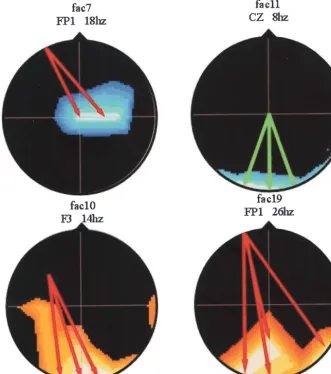
dis-criminating variables included coherence factors 7,
10, 11, and 19 (depicted in Fig 2).
The intervention group demonstrated increased
coherence in the fast
␣
and the

frequency bands
TABLE 3. APIB System4and Prechtl29Scores at 2 Weeks’ Corrected Age
Variable Control
(n⫽14)
Experimental (n⫽16)
P
APIB system scores
Autonomic system 5.56 (1.41) 4.59 (1.26) .06
Motor system 6.29 (1.01) 4.70 (1.23) .001‡
State system 5.22 (1.34) 4.62 (0.90) .12
Attention system 6.91 (1.83) 6.54 (1.69) .58
Self-regulation system 6.11 (1.26) 4.94 (1.07) .01†
Examiner facilitation 6.89 (1.76) 5.74 (1.67) .08
Prechtl scores
Trunk and limb posture (0–6) 2.21 (1.31) 0.81 (1.05) .004*
Motility (0–2) 1.07 (0.48) 0.50 (0.73) .02
Pathological movements (0–11) 3.79 (1.48) 1.50 (1.46) .002*
Motor system tone (0–2) 1.00 (0.00) 0.63 (0.62) —
Intensity of responses (0–2) 0.85 (0.36) 0.25 (0.45) .0004† Threshold of responses (0–1) 0.85 (0.36) 0.44 (0.51) .02
Moro response (0–2) 1.47 (0.75) 0.38 (0.62) .002*
State stability (0–1) 0.86 (0.63) 0.38 (0.50) .005*
Crying (0–2) 0.93 (0.48) 0.69 (0.48) .18
Hemisyndrome (0–14) 2.32 (2.27) 1.50 (2.56) .36
Syndromes abnormal reactivity (0–2) 1.16 (0.62) 0.56 (0.73) .03 Total Prechtl (percent abnormal) 38.30 (9.55) 17.33 (15.52) .0001†
Shown are APIB system scores at 2 weeks’ corrected age (range: 1–9; lower scores denote more appropriate responses) and Prechtl scores (ranges shown in parentheses; lower scores denote more appropriate responses). MANOVA for the APIB:F⫽3.19;df ⫽6,23;P ⫽.02; MANOVA for the Prechtl:F⫽3.35;df⫽12,17;P⫽.01. Data shown are means (SD). Probabilities in bold type indicate significant differences (Holm’s correction).
*P⬍.05; †P⬍.01; ‡P⬍.001.
TABLE 4. Bayley II31at 9 Months’ Corrected Age
Variable Control
(n⫽13)
Experimental (n⫽11)
P
Mental scale
MDI 94.85 (9.22) 109.55 (7.23) .0002‡
MDI⬍100/ⱖ100, percentile 69/31 9/91 .003†
Percentile 39 (20) 72 (15) .0002‡
Age equivalent, mo 8.39 (1.19) 10.27 (0.79) .0001‡
Motor scale
PDI 89.23 (14.88) 107.00 (9.28) .002†
PDI⬍100/ⱖ100, percentile 77/23 9/91 .003†
Percentile 31 (21) 67 (20) .0004†
Age equivalent, mo 8.00 (1.53) 9.91 (0.70) .0009†
BRS, percentile
Orient/engagement 57 (28) 71 (22) .19
Emotional regulation 39 (27) 67 (23) .01*
Motor quality 23 (22) 57 (32) .007*
Total score 39 (23) 73 (16) .0004†
MANOVA of MDI, PDI, and 4 BRS:F⫽3.59 (2-tailed);df⫽6,17;P⫽.017. Data shown are means (SD). Probabilities shown in bold type indicate significant differences (Holm’s correction). MDI and PDI: mean⫽100; SD⫽15.
between left frontal regions and occipital and
pari-etal regions (factors 7, 10, and 19), whereas midline
central to occipital coherence was reduced (factor 11)
in the experimental group. The NICU experimental
experience, as hypothesized, indicated changes in
functional connectivity between brain regions, with
preferentially broad enhancement of frontal to
ital coherence, and some pruning of central to
occip-ital coherence. The enhancement of coherence
be-tween left frontal to parietal regions was unexpected.
Neurostructural Outcome
T2* data were acquired and analyzed for the first
10 study infants only (first 5 control and first 5
ex-perimental) in preliminary exploration of the use of
this measure as a potentially effective index of
de-gree of brain organization. Heretofore T2* had only
been explored as an indicator of age-dependent brain
maturation. The MANOVA of the 4 variables
mea-sured (frontal white matter, median occipital lobe,
lateral occipital lobe, and thalamus) was not
signifi-cant (F
⫽
1.96; df
⫽
4,5;
P
⫽
.24). Although the
overall MANOVA was not significant, exploratory
comparison of the 4 individual variables, with
Holm’s correction for multiple comparisons,
re-vealed an overall trend in favor of the study’s
hy-pothesis. T2* values were reduced in frontal white
matter (P
⫽
.08), median occipital lobe (P
⫽
.05), and
lateral occipital lobe (P
⫽
.07) for the experimental
group infants. This trend, as had been predicted, was
not observed for the thalamus measurement (P
⫽
.80). The small subject number may account for the
failure of the MANOVA to reach significance.
For 23 subjects (8 control and 15 experimental),
artifact-free, complete DTI data sets were available.
Table 5 shows the group comparisons for RA and for
the ratio of E1/E3 for the respective delineated ROI.
Results by MANOVA indicate significant overall
improvement in RA, with specific trends in the
re-gions as predicted (frontal white matter, right
inter-nal capsule, and left interinter-nal capsule). Evidence was
stronger when testing E1/E3 than when testing RA.
MANOVA for E1/E3 was significant. The
individu-ally significant regional difference observed
per-tained to E1/E3 for the left internal capsule. These
MRI results obtained provide the first evidence of
significant difference in brain structure resulting
from developmental intervention, which means from
sensory experience of the very immature brain. As a
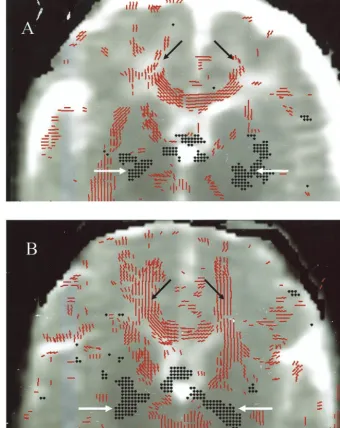
demonstration example, Fig 3 shows the comparison
of a control and an experimental group infant at 2
weeks’ corrected age.
Canonical correlations between the 8 behavioral
APIB/Prechtl factors and the 20 spectral coherence
factors were highly significant (
2⫽
238.76; df
⫽
160;
P
ⱕ
.0001), with 1 pair of canonical variates
ered significant. Examination of loadings on these
canonical variates suggested that greater behavioral
function symmetry, better motor organization, and
better expression of attention (behavioral factors 5, 2,
and 7, respectively) were associated with increased
frontal-occipital 12-Hz coherence, signifying
in-creased connectivity, and reduced midline
occipital-parietal 10-Hz coherence, signifying reduced
connec-tivity (coherence factors 17 and factor 9, respectively)
(Fig 2
5). The canonical correlation between the 8
behavior factors and 4 DTI measures also was
signif-icant (
2⫽
52.19; df
⫽
32;
P
ⱕ
.0135), with 1 pair of
canonical variates considered significant. The overall
pattern suggested that better, ie, less behavioral,
hy-persensitivity and lower intensity of reactivity
(be-havioral factor 3) were associated with a higher ratio
of E1/E3 (ie, they were associated with more mature
development in the left internal capsule and in
fron-tal white matter). The canonical correlation between
the 20 spectral coherence factors and the 4 MRI
mea-sures was very highly significant (
2⫽
726.81; df
⫽
80;
P
ⱕ
.00001), with 2 pairs of canonical variates
considered significant. The first pair of canonical
variates demonstrated that increased left frontal to
left posterior quadrant 18-Hz coherence (factor 14)
(Fig 2
5) correlated with a greater left internal capsule
and frontal white matter E1/E3 ratio, indicating
greater maturity in these regions. The second
associ-ation demonstrated that increased left posterior
tem-poral to right occipital 26-Hz coherence (factor 18)
(Fig 2
5) correlated with a higher right internal
cap-sule E1/E3 ratio, again indicating greater maturity.
These results demonstrated a strong relationship
among the 3 data domains for this sample of low-risk
preterm infants, which speaks to the sensitivity and
meaningfulness of the measures chosen.
DISCUSSION
The current study is the first investigation to test
the effect of developmental intervention in the NICU
on neurobehavior, electrophysiology, and brain
structure. The study’s results consistently favor the
experimental group infants who received
develop-mental care at an apparently sensitive period in brain
development. It may be concluded from these results
that experience before term may alter not only brain
function but also brain structure. The differences
observed in brain structure appear to be consistent
with the brain functional differences. The study
sup-ports the hypothesis that a developmentally based,
individualized approach to care in the NICU is
ef-fective in supporting neurodevelopmental outcome
of medically healthy, low-risk preterm infants by 2
weeks’ corrected age. It also supports the hypothesis
that such improvements have lasting effects to 9
months’ corrected age, as judged by behavioral
per-formance. Furthermore, the results validate previous
research on the benefits of developmental care
10,60and broaden the generalizability of the effectiveness
of developmental care in the NIDCAP model in
terms of expanding the gestational age range beyond
prior studies as well as the medical characteristics of
the population studied.
24The preterm infants who received developmental
care were better adjusted at 2 weeks’ corrected age.
The differences involved motor system functions and
self-regulation as well as a number of
neurobehav-ioral aspects involving state stability, intensity, and
threshold of responsiveness. EEG coherence
mea-sures indicated an orderly and conceptually
consis-tent pattern of neurophysiologic differences, in
keep-ing with the behavioral findkeep-ings. The differences
involved mainly the left frontal region and, to some
extent, the occipital and parietal regions. The
electro-physiological differences demonstrated significant
correlations with the behavioral indices of improved
motor system organization, symmetry, and
expres-sion of attention. The brain structural differences
discovered also involved the left frontal region and
the suggestion of occipital region involvement.
Cor-relation of the brain structural measures (MRI) with
the brain functional measures (behavior and spectral
coherence) showed that improved behavioral
regu-lation (less intensity and hypersensitivity) were
as-sociated with more mature frontal brain structural
development. This may not be surprising, given that
neuronal organization, especially in the frontal
re-gion, occurs late in the developmental sequence,
61– 64and previous studies of prematurity have indicated
the frontal lobes’ differential vulnerability.
6The
con-tinuity of improvement to 9 months’ corrected age in
terms of Bayley II scale mental, motor, and
behav-ioral performance may justify cautious optimism for
the continuity of enhanced long-term development
for similar preterm infants, who may receive
devel-opmental care in the future.
65The availability of MRI
makes feasible the examination of structural brain
changes underlying the functional improvements
ob-tained.
The results of the study are consistent with the
theoretical basis of the intervention tested and the
study’s hypotheses. The developmental care model
tested views the infant as an active participant who
seeks ongoing caregiver support for self-regulation
during the initial stabilization phase and in the
course of continuing developmental progression.
In-dividualized developmental care provided by the
preterm infants’ parents in collaboration with their
TABLE 5. Magnetic Resonance DTI at 2 Weeks’ Corrected Age
Variable Control
(n⫽8)
Experimental (n⫽15)
P
RA
Frontal white matter 12.03 (2.76) 14.66 (4.52) .10 Right internal capsule 35.20 (6.98) 41.54 (7.14) .06 Left internal capsule 35.18 (4.30) 40.19 (5.31) .03 Corpus callosum 40.43 (11.79) 40.23 (12.69) .97 Ratio of E1/E3
Frontal white matter 1.27 (0.08) 1.35 (0.13) .09 Right internal capsule 1.98 (0.25) 2.25 (0.34) .05 Left internal capsule 1.96 (0.13) 2.17 (0.21) .008* Corpus callosum 2.18 (0.55) 2.17 (0.52) .99
Higher scores represent more mature fiber tract development. MANOVA for RA: F ⫽ 2.85 (2-tailed); df ⫽ 4,18; P ⫽ .05; MANOVA for the ratio of E1/E3:F⫽2.88 (2-tailed);df⫽4,18;P⫽
.05. Data shown are means (SD). Probabilities in bold type indicate significant differences (Holm’s correction).
nursery care teams, and supported by a
developmen-tal specialist, may provide an extrauterine
environ-ment that supports cortical developenviron-ment by
provid-ing more stable autoregulation to the immature
autonomic system in a challenging sensory
environ-ment by focus and consistent assurance of calm
be-havioral function in the course of all medical and
daily care procedures.
66 – 68Chemical sedation to
achieve stabilization of immature autoregulation
69may be substituted successfully at least in part by
individualized modification and adaptation of care
delivery in recognition of the infants’ behaviorally
expressed stress thresholds.
The differential enhancement of frontal regions
identified in the current study seems to corroborate
further the earlier findings of greater frontal
vulner-ability to unexpected environmental experience and
stimulation. For preterm infants, even when
medi-cally at low risk, early birth nevertheless may trigger
the onset of sensitive brain developmental periods.
When the infants receive care that is structured
in-dividually based on their own thresholds to maintain
behavioral and therewith autonomic and motor
sys-tem equilibrium as tested in this study, they seem to
show improved outcome as compared with their
peers who experience more standard care. Although
the specific mechanisms are unclear at this point, it
has been postulated that processes may involve
re-setting of the
N-methyl-
d
-aspartate axis and
conse-quent inappropriate cell death (apoptosis) with
sub-sequent increased neurocitotoxic damage, lowered
sensory and pain thresholds, and increased
hyperre-activity and hypersensitivity.
14Other potential
mechanisms, inferred from results of differential
mothering and sensory experience experiments
70in
animal models, suggest that variations in maternal
care promote hippocampal synaptogenesis and
spa-tial learning and memory through systems known to
mediate experience-dependent neural development.
Well-mothered rat pups showed increased
expres-sion of
N-methyl-
d
-aspartate receptor subunit and
brain-derived neurotrophic factor messenger RNA
as well as increased cholinergic innervation of the
hippocampus and enhanced spatial learning and
memory. Similarly, a study in the primate model
maintained neocortical, experience-dependent
syn-aptogenesis in a number of cortical areas.
71Aside from the lack of definitive knowledge as to
the underlying mechanisms of the improvement in
outcomes of the experimental group, additional
lim-itations of the study include the relatively small total
number of subjects, resulting from the extensive
na-ture of the outcome assessments, and the substantial
time commitment requested from the parents who
participated in the study. The additional reduction of
subjects in terms of some of the methodologies, given
their technical complexity in acquisition of reliable
and complete data, presents an added limitation to
the study. Although medical, behavioral, and
neuro-physiological data sets were complete for all subjects,
the MRI assessments were available on fewer
sub-jects. For the T2* measures, the number of subjects
was purposefully limited to the first 10 subjects to
evaluate the merit of an untried methodology for the
purpose of the question asked. The sample size for
DTI data was reduced because of the insufficient
quality of the raw MRI data acquired, which
pre-cluded reliable data analysis. Nevertheless, even
with the smaller sample size, significant differences
were found between the control and experimental
groups. A larger sample of infants would be
ex-pected to yield even more significant results. An
additional limitation of the MRI data are the
inves-tigator-dependent, operator-driven delineation of
ROI chosen for analysis, which potentially might
enter a degree of subjectivity into the data analysis.
Automated, empirically validated, computer-driven
region delineation would be more desirable, yet such
technology is not available as yet for newborn
struc-tural brain image analysis.
An additional limitation of the study is the
short-term nature of the outcome points of 2 weeks’ and 9
months’ corrected age. It will be important to
inves-tigate whether the improvements found at these ages
(behavioral, brain structural, and
electrophysiologi-cal) will hold up over a more extended period of
time. The important questions to be asked would be:
How will these same children function at 2 years, 5
years, and when entering elementary school, at 18
years, and when entering college? What will their
brain structural development look like? And, in what
relationship, if any, will it stand to the early
child-hood data reported here. A replication study with a
larger sample size and with follow-up to later ages
indeed seems warranted to validate and extend the
generalizability of these first brain structural
find-ings resulting from change in earliest experience.
ACKNOWLEDGMENTS
This study was supported by National Institutes of Health grant RO1HD3826 and US Department of Education grants HO23C970032 and R305T990294 (to Dr Als); a grant from the Whitaker Foundation and National Institutes of Health grant P41 RR13218 (to Dr Warfield); and NIH grant P30HD18655 (to Dr Volpe). Investigators who additionally made significant contribu-tions to the study include the following co-authors: Sandra Kosta, BA (Department of Psychiatry, Harvard Medical School and Chil-dren’s Hospital Boston, Boston, MA); Jack Connolly, REEGT (De-partment of Neurology, Harvard Medical School and Children’s
Hospital Boston); Julianne Mazzawi, RN, and Marianne Metcalfe, RN, MSN (Newborn Intensive Care Nursery, Brigham and Wom-en’s Hospital, Boston, MA); Steven A. Ringer, MD, PhD (Depart-ment of Newborn Medicine, Harvard Medical School and Chil-dren’s Hospital Boston); Johan G. Blickman, MD (Department of Radiology, University of Nijmegen, Nijmegen, The Netherlands); and Richard L. Robertson, MD (Department of Radiology, Har-vard Medical School and Children’s Hospital Boston).
We thank R. Maltese and C. Schenck for expert support of data acquisition; Stephan E. Maier for continued support of the line scan diffusion imaging sequence; the study nurses for support to the NICU phase implementation; and foremost the study families and infants for their participation and commitment.
REFERENCES
1. Hu¨ppi PS, Schuknecht B, Boesch C, et al. Structural and neurobehav-ioral delay in postnatal brain development of preterm infants.Pediatr Res. 1996;39:895–901
2. Hu¨ppi PS, Warfield S, Kikinis R, et al. Quantitative magnetic resonance imaging of brain development in premature and mature newborns.Ann Neurol. 1998;43:224 –235
3. Hu¨ppi PS, Maier SE, Peled S, et al. Microstructural development of human newborn cerebral white matter assessed in vivo by diffusion tensor magnetic resonance imaging.Pediatr Res. 1998;44:584 –590 4. Als H, Lester BM, Tronick EZ, Brazelton TB. Manual for the Assessment
of Preterm Infants’ Behavior (APIB). In: Fitzgerald HE, Lester BM, Yogman MW, eds.Theory and Research in Behavioral Pediatrics. Vol 1. New York, NY: Plenum Press; 1982:65–132
5. Duffy FH, Als H, McAnulty GB. Infant EEG spectral coherence data during quiet sleep: unrestricted principal components analysis–relation of factors to gestational age, medical risk, and neurobehavioral status. Clin Electroencephalogr. 2003;34:54 – 69
6. Duffy FH, Als H, McAnulty GB. Behavioral and electrophysiological evidence for gestational age effects in healthy preterm and fullterm infants studied 2 weeks after expected due date.Child Dev. 1990;61: 271–286
7. Als H, Duffy FH, McAnulty GB. Behavioral differences between pre-term and fullpre-term newborns as measured with the APIB system scores: I.Infant Behav Dev. 1988;11:305–318
8. Als H, Duffy FH, McAnulty GB. The APIB: an assessment of functional competence in preterm and fullterm newborns regardless of gestational age at birth: II.Infant Behav Dev. 1988;11:319 –331
9. Als H. Reading the premature infant. In: Goldson E, ed.Developmental Interventions in the Neonatal Intensive Care Nursery. New York, NY: Oxford University Press; 1999:18 – 85
10. Buehler DM, Als H, Duffy FH, McAnulty GB, Liederman J. Effective-ness of individualized developmental care for low-risk preterm infants: behavioral and electrophysiological evidence. Pediatrics. 1995;96: 923–932
11. Fleisher BF, VandenBerg KA, Constantinou J, et al. Individualized developmental care for very-low-birth-weight premature infants.Clin Pediatr (Phila). 1995;34:523–529
12. Kleberg A, Westrup B, Stjernqvist K, Lagercrantz H. Indications of improved cognitive development at one year of age among infants born very prematurely who received care based on the Newborn Individu-alized Developmental Care and Assessment Program (NIDCAP).Early Hum Dev. 2002;68:83–91
13. Westrup B, Kleberg A, von Eichwald K, Stjernqvist K, Lagercrantz H. A randomized, controlled trial to evaluate the effects of the Newborn Individualized Developmental Care and Assessment Program in a Swedish setting.Pediatrics. 2000;105:66 –72
14. Anand KJS, Scalzo FM. Can adverse neonatal experiences alter brain development and subsequent behavior?Biol Neonat. 2000;77:69 – 82 15. Als H, Lawhon G, Duffy FH, McAnulty GB, Gibes-Grossman R,
Blick-man JG. Individualized developmental care for the very low birth-weight preterm infant. Medical and neurofunctional effects. JAMA. 1994;272:853– 858
16. Wiesel TN, Hubel DH. Receptive fields of cells in striate cortex of very young visually inexperienced kittens.J Neurophysiol. 1963;26:994 –1002 17. Wiesel TN, Hubel DH. Simple cell responses in striate cortex of kittens
deprived of vision in one eye.J Neurophysiol. 1963;26:1003–1017 18. Wiesel TN, Hubel DH. Comparison of the effects of unilateral and
bilateral eye closure on cortical unit responses in kittens.J Neurophsyiol. 1965;28:1029 –1040