COMPARATIVE STUDY OF PATH LOSS
MODELS DEPENDS ON VARIOUS
PARAMETERS
Purnima K Sharma
Research Scholar, UTU, Dehradun (INDIA) [email protected]
R. K. Singh
OSD (Professor), UTU, Dehradun (INDIA) [email protected]:
Wireless system designing is not only an expensive process but it also takes lots of time for establishment. So before going for the establishment of such type of expensive systems mathematical model analysis is necessary to estimate channel environment, frequency band and the desired radio coverage range. That type of modeling plays an important role in cell coverage prediction, received signal strength estimation and link budget analysis of mobile radio systems. To acquire more efficiency in the system design using the frequency reuse concept in current cellular systems one has to eliminate the interference at the cell boundaries. Determining the cell size correctly can be calculated by using an accurate path loss model. So the study of path loss models is important. In this paper we compare the different path loss propagation models depends on various parameters like frequency & height of antenna at the transmitter side. For comparative analysis we use the Stanford University Interim (SUI) Model, Hata model, COST231 Extension to Hata Model, Walfisch - Bertoni model and ECC-33 model in three different environments (urban, suburban, & rural environments).
1. Introduction
Understanding and predicting electromagnetic radio-propagation characteristics in different environments is important in the implementation of wireless system designing. As the volatile growth of cellular communication systems continues, it is very important to have the ability of determining minimum base-station locations, obtaining suitable data rates, and estimating their coverage, without conducting a series of propagation measurements, which are very expensive and time consuming [1]. It is therefore important to develop effective propagation models for mobile communications, in order to provide design guidelines for mobile systems. The path loss propagation models have been an active area of research in recent years because pathloss model analysis provides a good initial estimate of the signal characteristics. Path loss is an unwanted introduction arises when an electromagnetic wave propagates through space from transmitter to receiver. The strength of signal reduces due to various parameters like path distance, reflection, diffraction, scattering, free-space loss, type of environments (i.e. urban, suburban and rural), variation of transmitter antenna heights, variation of receiver antenna heights and absorption by the objects of environment.
2. PROPAGATION PATH LOSS MODELS
In wireless communication systems, transfer of information between the transmitting antenna and the receiving antenna is achieved by means of electromagnetic waves. The interaction between the electromagnetic waves and the environment reduces the signal strength send from transmitter to receiver that causes path loss. Different models are there to calculate the path loss. Some of them are described and compared in this paper [1].
2.1. Stanford University Interim (SUI) Model
The proposed standards for the frequency bands below 11 GHz contain the channel models developed by Stanford University, namely the SUI models. Note that these models are defined for the Multipoint Microwave Distribution System (MMDS) frequency band which is from 2.5 GHz to 2.7 GHz. Their applicability to the 3.5 GHz frequency band that is in use in the UK has so far not been clearly established [6]. The SUI models are divided into three types of terrains1, namely A, B and C. Type A is associated with maximum path loss and is appropriate for hilly terrain with moderate to heavy foliage densities. Type C is associated with minimum path loss and applies to flat terrain with light tree densities. Type B is characterized with either mostly flat terrains with moderate to heavy tree densities or hilly terrains with light tree densities. The basic path loss equation with correction factors is presented in
[4, 5].
10 0
10 log f h
d
PL A X X s
d
for
d
>d
0(1)
where, d is the distance between the Access Points (AP) and the Customer Premises Equipment (CPE) antennas in meters, d0 = 100 m and s is a log normally distributed factor that is used to account for the shadow fading owing to trees and other clutter and has a value between 8.2 dB and 10.6 dB [4]. The other parameters are defined as,
20 log
104
d
oA
(2) b bc
a bh
h
(3)where, the parameter hbis the base station height above ground in metres and should be between 10 m and 80 m.
The constants used for a, b and c are given in Table II. The parameter γ in (3) is equal to the path loss exponent. For a given terrain type the path loss exponent is determined by hb.
Table I: The parameters of SUI model in different types of environments
Model parmeter Terrain A Terrain B Terrain C a 1 ( )
b m
C(m) 4.6 0.0075 12.6 4.0 0.0065 17.1 3.6 0.005 20
The correction factors for the operating frequency and for the CPE antenna height for the model are [4,6].
10 6.0 log
2000
f
f
X
(4) 10.8 log10 2000
r h
h
X
for Terrain types A and B (5)
= 10 20.0 log 2000 r h
Where, f is the frequency in MHz and hr is the CPE antenna height above ground in meters. The SUI model is used to predict the path loss in all three environments, namely rural suburban and urban.
2.2. Hata Model
The Hata model [7] is an empirical formulation of the graphical path loss data provided by Okumura and is valid over roughly the same range of frequencies, 150-1500 MHz. This empirical model simplifies calculation of path loss since it is a closed-form formula and is not based on empirical curves for the different parameters. The standard formula for median path loss in urban areas under the Hata model is
50,urban 10 c 10 te
re te 10
L
(dB) = 69.55+26.16 log (f )-13.82 log (h )-a
(h )+(44.9-6.55 log10(h )) log (d).
(7)
The parameters in this model are the same as under the Okumura model, and a(hre) is a correction factor for the mobile antenna height based on the size of the coverage area. For small to medium sized cities, this factor is given by [3,7]:
r 10 c r 10 c
a(h ) = (1.1 log (f ) - 0.7)h - (1.56 log (f ) -0.8)dB (8)
& for larger cities at frequencies
f
c > 300 MHz by2
r 10 r
a(h ) = 3.2(log (11.75h ) - 4.97 dB. (9)
Corrections to the urban model are made for suburban and rural propagation, so that these models are,
respectively, 2
50,suburban 50,urban 10 c
L (dB) = L (dB) - 2[log (f /28)] - 5.4 (10)
2
50,rural 50,urban 10 c
10 c
L (dB) = L (dB) - 4.78[log (f )] +
18.33log (f ) - K (11)
Where K ranges from 35.94 (countryside) to 40.94 (desert). Hata’s model does not provide for any path specific correction factors, as is available in the Okumura model. The Hata model well-approximates the Okumura model for distances d > 1 Km. Thus, it is a good model for first generation cellular systems, but does not model propagation well in current cellular systems with smaller cell sizes and higher frequencies. Indoor environments are also not captured with the Hata model.
2.3. COST231 Extension to Hata Model
A model that is widely used for predicting path loss in mobile wireless system is the COST-231 Hata model [6,8]. The COST-231 Hata model is designed to be used in the frequency band from 500 MHz to 2000 MHz. It also contains corrections for urban, suburban and rural (flat) environments. Although its frequency range is outside that of the measurements, its simplicity and the availability of correction factors has seen it widely used for path loss prediction at this frequency band. The basic equation for path loss in dB is [3],
10 10
10 10
PL=46.3+33.9log ( ) 13.82log ( )
(44.9 6.55log ( ))log
b m
b m
f h ah
h d c
(12)
2
m 10
ah = 3.20(log (11.75hr)) -4.97, for f > 400 MHz (13)
for suburban or rural (flat) environments,
m 10 r 10
ah = (1.1 log f - 0.7)h - (1.56 log f - 0.8)
(14)where, hr is the CPE antenna height above ground level. Observation of (12) to (14) reveals that the path loss exponent of the predictions made by COST-231 Hata model is given by,
n
cost
(44.9 6.55 log ( )) 10
10h
b (15)To evaluate the applicability of the COST-231 model for the 3.5 GHz band, the model predictions are compared against measurements for three different environments namely, rural (flat), suburban and urban.
2.4. ECC-33 model
The ECC 33 path loss model, which is developed by Electronic Communication Committee (ECC), is extrapolated from original measurements by Okumura and modified its assumptions so that it more closely represents a fixed wireless access (FWA) system. The path loss model is defined as [6],
s m t r
PL(dB) = Af +Ab - G - G
(16)Where,
Af
s is free space attenuation,Ab
m is basic median path loss,G
tis BS height gain factor andG
ris received antenna height gain factor.They are individually defined as,2
2 92.4 20log( ) 20log
20.41 9.83log( ) 7.894log( ) 9.56[log( )]
log( )[13.98 5.8(log( )) ] 200
fs bm
b t
A d f
A d f f
h
G d
(17)
for medium city environments,
42.57 13.7log( ) log( ) 0.585
r m
G f h (18)
Where, f is frequency in GHz, The performance analysis is based on the calculation of received signal strength, path loss between the base station and mobile from the propagation model. The GSM based cellular d is distance between base station and mobile (km) hb is BS antenna height in meters and hm is mobile antenna height in meters.
2.5. The Walfisch - Bertoni model
This model is useful in case of dense urban areas in which the area has buildings with uniform height and separation distances. This is a semi-deterministic model which has formulation to calculate the path-loss and includes more parameters like building height and building separation distances these parameters are not considered in the case of hata and the remaining models. The model reduces the path loss to three components, free space loss, loss along the buildings and loss down at the street level. For calculating the loss along buildings the model starts by using the repeated Kirchhoff Integral for uniform parallel screens which is an application of scalar diffraction theory with some approximations [10]. The formula to calculate the path loss is
0.9 2
b m b b
LF=89.5-10log(( *(s) )/((H -h ) ))+21log(f)-18log(h -H )+38log(d);
LF=loss factor 2
2
= ( ) ;
2 b m
s
H h
(20)
ρ=path distance from the building edge to the mobile ,d=distance in km, hm=receiver height in meter, s=spacing between in meter, Hb=building height in meter, hb=antenna height in meter, f=freq in MHz.
3. Results & Conclusion
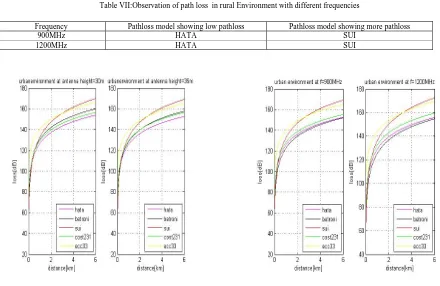
A detailed comparison of the proposed models was obtained for four cases where in each case four parameters are fixed and one particular parameter has two values. The distance range for each case was taken from 0 to 6 km. The building heights were chosen to be smaller than the transmitter heights since this is a must for the Walfisch-Bertoni model to be valid. The above mentioned models were plotted for two different carrier frequencies, and two different transmitter antenna heights. Figure 1 to figure 6 shows the results with the following fixed parameters:
Frequency 900MHz
Mobile antenna height 1.5 m Transmitter antenna height 35m Building heights 15 m
Building separation distances 40 m And variable parameters
Frequency 900MHz &1200MHz Transmitter antenna height 30m &35m
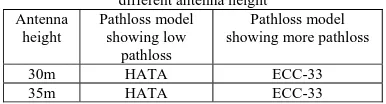
In this comparative analysis we find that no model is suited or recommended for all environments.
We can see in figures, the Hata model and Betorni model showed the lowest path loss at different heights and at different frequencies in most of cases as compared to other models.
Table II:Observation of path loss in Urban Environment with different antenna height
Antenna height
Pathloss model showing low
pathloss
Pathloss model showing more pathloss
30m HATA ECC-33
35m HATA ECC-33
Table III:Observation of path loss in Urban Environment with different frequencies
Frequency Pathloss model
showing low pathloss
Pathloss model showing more
pathloss
900MHz Betroni ECC-33
1200MHz Betroni ECC-33
Table IV:Observation of path loss in suburban Environment with different antenna height
Antenna height Pathloss model showing low pathloss Pathloss model showing more pathloss
30m HATA ECC-33
Table V:Observation of path loss in suburban Environment with different frequencies
Frequency Pathloss model showing low pathloss Pathloss model showing more pathloss
900MHz HATA ECC-33
1200MHz HATA ECC-33
Table VI:Observation of path loss in rural Environment with different antenna height
Antenna height Pathloss model showing low pathloss Pathloss model showing more pathloss
30m HATA SUI
35m HATA SUI
Table VII:Observation of path loss in rural Environment with different frequencies
Frequency Pathloss model showing low pathloss Pathloss model showing more pathloss
900MHz HATA SUI
1200MHz HATA SUI
Fig.3 Comarsion of path loss models in a sub urban environment Fig.4 Comarsion of path loss models in a sub urban environment at different heights at different frequencies
Fig.5 Comarsion of path loss models in rural environment Fig.6 Comarsion of path loss models in rural environment at different heights at different frequencies
Future work
In future, our simulated results can be tested and verified with practical field data. We may also derive a suitable path loss model for all terrain.
References
[1] Purnima K Sharma, R.K.Singh, “Comparative Analysis of Propagation Path Loss Models With Field Measured Data” IJEST, Vol.2(6)in 2010
[2] at 2008-2013.
[4] Communication System Design” was published in an International Journal of Recent Trends in Engineering and Technology, page no. 115-
[5] 118, vol.-3 no.-2 in May 2010.
[6] T.S Rappaport, Wireless communications –Principles and practice, 2nd Edition , Prentice Hall, 2001.
[7] [4] V.Erceg, K V S Hari, et al., “Channel models for fixed wireless applications,” tech. rep., IEEE 802.16 Broadband wireless access working
[8] group, jan-2001
[9] V. Erceg, L. J. Greenstein, et al., “An empirically based path loss model for wireless channels in suburban environments,” IEEE Journal on
[10] Selected Areas of Communications, vol. 17, pp. 1205–1211, July 1999.
[11] V.S. Abhayawardhana, I.J. Wassell, D. Crosby, M.P. Sellars, M.G.Brown”Comparison of empirical propagation path loss models for fixed
[12] wireless access systems”Vehicular Technology Conference, 2005. IEEE Date: 30 May-1 June 2005 Volume: 1, On page(s): 73- 77 Vol. 1 M. Hata, “Empirical formula for propagation loss in land mobile radio services,” IEEE Trans. Vehic. Technol., Vol VT-29, No. 3, pp. 317–
[13] 325, Aug. 1980.
[14] COST Action 231, “Digital mobile radio towards future generation systems, final report,” tech. rep., European Communities, EUR [15] 18957,1999.
[16] H. R. Anderson, Fixed Broadband Wireless System Design. John Wiley & Co., 2003.
[17] Bertoni H.L., Radio Propagation for Modern Wireless Systems, Prentice-Hall PTR, Upper Saddle River, NJ, 2000.
Biographies
Mrs K. Purnima Sharma was born on 2nd june1983 in Eluru, Andhra Pradesh (India). She received her M.Tech.degree in Communication and Signal Processing Engineering from NAGARJUNA UNIVERSITY (A.P.),India. She is a Associate Member of the IETE. She has published several Research papers in national and international journals/conferences. She is presently research scholar in UTTARAKHAND TECHANICAL UNIVERSITY, Dehradun (INDIA) . Her present research interest is in Image Processing and Wireless Communication.
Dr. R.K. Singh Professor, KEC, Dwarahat, Almora , Jointly submitting research and development project in
UCOST, Uttranchal. He is member of academic staff of Kumaon Engineering College, Dwarahat, Almora, where he